

©2026 ZenABM - All Rights Reserved.

In this article, I have compared Demandbase vs. RollWorks based on their features, pricing, and ideal uses to help marketing and sales teams decide which one fits their account-based marketing strategy.
I’ll also show you how ZenABM can be a lean, affordable alternative or a complementary layer to these enterprise ABM tools due to its unique features.
Read on…
Demandbase functions as a comprehensive ABM platform that handles everything from assembling target account lists to orchestrating multi-channel advertising and tailoring on-site experiences.
Its broader toolkit lets teams replace several point solutions with one system, simplifying processes and cutting the overhead of juggling separate tools.
Demandbase also consolidates account and contact records to strengthen sales intelligence, enrichment, and outreach so ABM programs perform better.
Key Demandbase capabilities explained:
Demandbase helps you create and tune target account lists by combining first-party and third-party data, plus AI recommendations that use firmographics, technographics, and intent signals.
This makes it easier for larger organizations to select the right accounts to pursue.


Demandbase includes its own programmatic engine so you can run display, retargeting, native, and Connected TV campaigns within a single environment. The native DSP supports precise account targeting across channels and applies intent data to reach high-value audiences.
It also hooks into leading social networks. You can manage LinkedIn, Facebook, Twitter, and YouTube from Demandbase, apply account-level frequency controls, and use AI to optimize spend.


Demandbase supports personalized site experiences for target accounts.
You can spin up account-specific pages or dynamic modules, such as greetings and offers that align with an industry or funnel stage.
Demandbase pulls in third-party intent covering more than 62,500 B2B topics and blends it with first-party engagement.
That lets Demandbase highlight target accounts that are “surging” on relevant themes across the web through providers like Bombora, in addition to how those accounts interact with your content.

You also get heatmaps and engagement scoring for a full picture of interest across channels. Beyond that, Demandbase applies predictive analytics and predictive marketing to surface in-market accounts and tailor outreach so sales and marketing can focus where impact is highest.


The platform builds buying committees by finding and targeting decision-makers at each account and lets you aim ads or sales plays at specific roles, such as CMO,s so the right personas see the message.
Demandbase delivers robust reporting to measure account engagement, campaign impact on pipeline, and revenue attribution, with visibility across the entire journey.


AI models estimate likely pipeline outcomes and spotlight where reps should concentrate to improve win rates.

Remember: Continuous upkeep of these dashboards is key to realizing full value.
Demandbase integrates with top CRMs such as Salesforce, marketing automation systems (MAPs), and sales tools so account insights flow directly into sales workflows, for example, via a Salesforce component that shows engagement. It also connects with popular sales engagement tools like Outreach and Salesloft to fit cleanly into most stacks and reduce friction.
This alignment keeps marketing and sales working from the same source of truth.
For the full catalog, see the Demandbase official docs.
Demandbase does not publish list prices and typically quotes custom enterprise packages after a conversation with sales.
Most deals include a platform fee plus per-seat pricing, and costs scale with team size. Usage patterns can also influence pricing, including engaged account volume, activity levels, and how many individuals interact with the platform.
According to industry references:


When reviewing quotes, outside benchmarks can help you validate fairness and prevent overspending.
Optional add-ins, such as extra intent data sources or sales intelligence databases, can raise the total.
Given its breadth, many small businesses find Demandbase more than they need.
They risk paying for modules that go underused.
In short, Demandbase fits teams with sizable ABM budgets and a mature program already in place.
RollWorks is the ABM arm of NextRoll, the company behind AdRoll, built to connect programmatic advertising with account-based marketing.
It is often positioned as an accessible enterprise ABM option for teams that want to scale.
RollWorks blends NextRoll’s ad tech with an ABM approach. It identifies target accounts, engages them through coordinated ads, and reports performance through the funnel.
A closer look at core capabilities:

You can upload or construct target account lists and score them for fit and intent.
RollWorks assigns an “ICP Fit” grade from A to D using firmographic, technographic, and CRM criteria.

It also tracks keyword-level research behavior. You choose topics, and RollWorks flags accounts that are actively reading about those subjects across the web.

Those signals, together with firmographic fit, feed Journey Stages that sort accounts into phases such as “Unknown,” “Aware,” “Engaged,” and “Open Opportunity” based on activity.
Pro Tip: Swap third-party keyword surges for high-quality first-party intent.
ZenABM derives qualitative intent by capturing which LinkedIn ads a company interacts with, so your team gets sharper signals to act on.
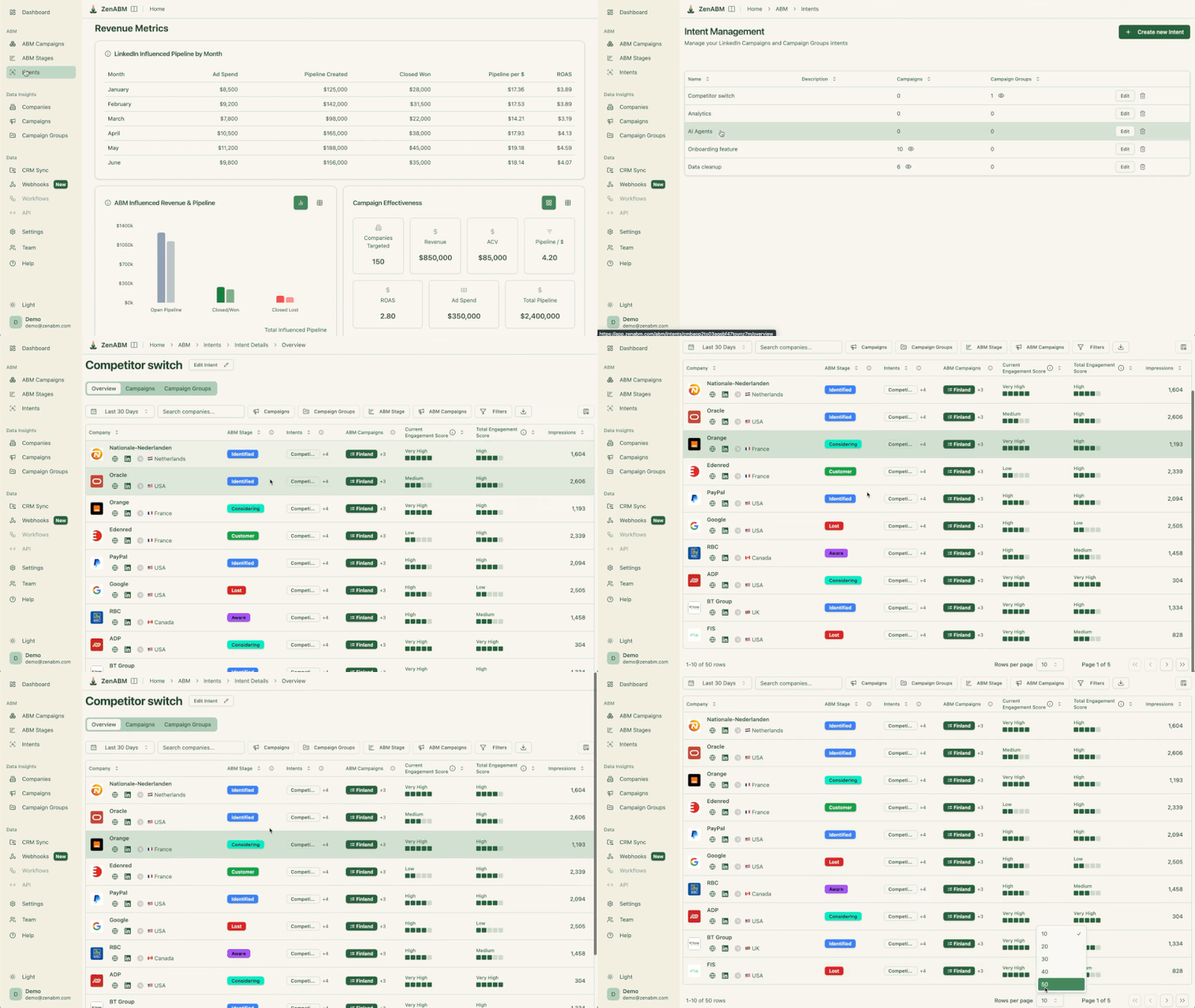
Some customers, like Userpilot, have oriented entire ABM programs around this, tagging campaigns by pain point and scaling BOFU ads that accounts actually engage with.
Their campaign structure:

RollWorks runs on NextRoll’s DSP to deliver display, retargeting, and selected social inventory.
For instance, you can execute programmatic display for your TAL and coordinate LinkedIn via RollWorks using the LinkedIn Marketing API for audience and campaign sync.

Persona targeting lets you tailor messages by role and seniority so outreach matches decision-maker context.
You also get dynamic creative options and an asset library to manage and iterate ads at scale.

To link advertising to pipeline, RollWorks offers a tracking pixel that attempts to de-anonymize visits by mapping IPs or cookies to companies.
When traffic from a target account hits your site, the system tries to attribute that visit to the company and can surface potential contacts.
RollWorks keeps an eye on engagement across channels such as ads and web activity, then sends Account Spike Alerts when activity jumps.

A G2 reviewer described these spike emails as transformational for sales because they provide timely visibility and help prioritize outreach.

RollWorks also embeds Sales Insights inside CRM, such as a Salesforce panel showing recent engagement with guidance on next steps, which aligns sales teams to ABM activity.

The platform automates workflows like shifting accounts between audiences, opening CRM tasks, or adjusting bids based on behavior.
For example, when an account reaches the Opportunity stage, RollWorks can reduce frequency or change the creative. If Bombora shows a surge on a topic, it can add that account to a campaign and raise bids.
Journey Stages also include playbook suggestions, such as boosting spend for high-fit accounts that have not engaged yet.

Analytics roll performance up to pipeline so you can view impressions, clicks, and attributed revenue or opportunities in one place.

Some users note that attribution depth can be limited and advanced reporting may require extra manual work.

RollWorks connects bi-directionally with Salesforce and HubSpot.
It also integrates with MAPs such as Marketo and Pardot, and with Outreach and Salesloft through APIs or native connectors.
For enrichment and intent, it works with Bombora, G2, and data providers like ZoomInfo.
For a fuller rundown, see our RollWorks for ABM guide.
RollWorks follows a tiered and usage-driven model rather than a simple self-serve subscription. As of 2025, it appears under the AdRoll ABM brand.
There is a limited free or self-serve option that supports retargeting and basic account targeting, where you only pay media costs.
More advanced ABM capabilities are part of paid packages that require a sales conversation.
Pricing is comparatively approachable for an ABM platform at this level.
For smaller to mid-sized teams, entry plans often start at a little under $1,000 per month.
Here are the key differences tabulated for you:
Category | Demandbase One | RollWorks |
|---|---|---|
Platform Focus & Feature Scope | Full-stack ABM suite combining account intelligence, web personalization, advertising (DSP), sales tools, and analytics. | Narrower scope, focusing on account identification, intent scoring, and ad/communication delivery. |
Data & Intent Signals | Uses first-party data (IPs, cookies, CRM) and integrates third-party intent feeds like Bombora’s Company Surge. | Partners with Bombora and mines CRM and web data for intent scoring; offers templated intent models for ease of use. |
Advertising & Campaigns | Provides a full DSP experience with multi-step campaign building and complex triggers; highly customizable but complex. | Runs account-based ads through AdRoll DSP, focusing on “Playbooks” for faster, simpler campaign launches. |
Integration & Workflow | Deep CRM and automation integrations; requires setup and data ops alignment. | Offers plug-and-play CRM sync (Salesforce, HubSpot) with bi-directional data flow and minimal setup time. |
Ease of Use | Powerful but complex; requires training or a dedicated ops person. G2 reviewers cite a “steep learning curve.” | Known for intuitive UI, guided playbooks, and faster onboarding. Easier to adopt for small teams. |
Pricing & Target Market | Enterprise-focused with custom pricing; typically high five to six figures annually. | Targets SMBs to mid-market and enterprise; entry plans in the low thousands per year, and even a free retargeting tier. |
There is no one-size-fits-all.
Demandbase One is better suited for large enterprises with complex, multi-channel ABM programs.
Its extensive data sets and feature breadth allow deep analytics, customized account journeys, and integration across a vast tech stack.
If you need full-funnel attribution and have the team to manage a comprehensive platform, Demandbase can deliver unmatched account-level insights.
RollWorks tends to win with mid-market companies or those just starting ABM.
Its turn-key campaigns and flexible packaging mean you can launch account-based advertising quickly and iteratively.
For example, small teams can spin up targeted LinkedIn or display campaigns the same day using RollWorks’ Playbooks and see results without months of ramp-up.
The lighter initial price point also makes budgeting simpler.
Both Demandbase and RollWorks are comprehensive ABM platforms designed to cover a wide range of account-based marketing needs.
ZenABM, on the other hand, takes a lean, purpose-built approach to ABM, focusing primarily on LinkedIn advertising-led strategies.
It’s positioned as a lighter and more cost-effective solution for teams that don’t need the full multi-channel complexity of enterprise platforms but still want deeper insights and automation for LinkedIn-focused ABM campaigns.
Its key features:


ZenABM connects directly with the official LinkedIn Ads API to pull account-level engagement data for every campaign.
This lets you see exactly which target accounts are engaging with your LinkedIn ads (impressions, clicks, etc.)—all attributed at the company level.
Because the data comes directly from LinkedIn’s login-based ecosystem, it’s first-party and highly reliable. In contrast, larger ABM platforms like Demandbase or RollWorks often depend on less accurate methods, such as cookie or IP matching, to infer company identity.
And by “less accurate,” we mean significantly off-base.
A Syft study found that IP-based deanonymization accuracy hovers around 42%.

ZenABM’s method provides qualitative intent signals based on real ad engagement. So, if multiple people from the same company are interacting with your ads, you can confidently treat that account as interested—without relying on third-party intent data.

ZenABM automatically assigns an engagement score to each account based on LinkedIn ad interactions and keeps it updated in real time.
You can track both current (e.g., weekly) and all-time engagement trends to identify which accounts are warming up or showing consistent interest.
These real-time insights help sales teams prioritize which accounts to engage first.
ZenABM lets you define and customize account journey stages (e.g., Identified → Aware → Engaged → Interested → Opportunity).
It uses engagement scores along with CRM data to automatically assign each account to the right stage.
You can also set thresholds for what qualifies as “Engaged” or “Interested,” and ZenABM continuously tracks movement between stages.


This gives funnel-level visibility comparable to major ABM suites, making it easy to spot stage bottlenecks and optimize campaigns.
ZenABM syncs bi-directionally with CRMs like HubSpot (and Salesforce on higher plans).
All LinkedIn engagement data flows into the CRM as company properties:

ZenABM can even auto-update an account’s status to “Interested” once it passes a certain engagement score, and assign a BDR to follow up.

ZenABM helps extract intent topics directly from your LinkedIn campaigns. You can tag each ad campaign with a theme or value proposition (like “Feature A” or “Feature B”).
ZenABM then shows which accounts engaged with each tagged theme, revealing the specific topics or features that interest them.

This is genuine first-party intent data—accounts telling you what they care about through their actions. No external vendor needed.
These insights can also be pushed into the CRM, enabling sales and marketing teams to time and personalize their outreach accordingly.

Result: reps can tailor their approach knowing exactly which message or feature resonates with each account.
ZenABM includes ready-to-use dashboards that tie LinkedIn ad engagement to account activity, funnel progression, and pipeline outcomes.


With ZenABM’s new custom webhooks, you can now integrate it seamlessly into virtually any workflow or tech stack.

Plans start at $59/month for Starter, $159/month for Growth, $399/month for Pro (AI), and $479/month for the Agency plan.
Even the top tier stays under $7,000 annually.
That’s far below what platforms like Demandbase or RollWorks charge.
All plans include essential LinkedIn ABM capabilities, with higher tiers expanding limits and adding Salesforce sync.
Both monthly and annual options are available, and every plan comes with a 37-day free trial to test the platform risk-free.
Both Demandbase and RollWorks are powerful ABM platforms built for serious marketing operations, but they sit at very different ends of the spectrum.
Demandbase is an all-in-one enterprise suite with unmatched depth, ideal for large organizations that can afford the time, budget, and team to fully leverage it.
RollWorks, on the other hand, shines for smaller or mid-market teams looking for faster wins and a smoother setup.
If you want to capture ABM-level insights without the overhead of these complex systems, ZenABM offers a refreshing middle path.
It focuses on first-party company-level LinkedIn ad engagement tracking, real-time scoring, and automated CRM syncs with a lean, accurate, and affordable infra.
For teams that want to do ABM instead of building infrastructure for it, ZenABM is the smart move.
