

©2026 ZenABM - All Rights Reserved.
Emilia Korczynska is Head of Marketing and co-founder at ZenABM. Before that she was VP of Marketing at Userpilot for nearly 7 years, where she ran a large ABM program primarily on LinkedIn ads.

In this article, I have compared 6sense vs. ZenABM based on their features, pricing, and ideal uses to help B2B marketing and sales teams decide which one fits their ABM strategy (or if they might need both).
Read on…
Deanonymize LinkedIn ad engagements, get intent, accounts scoring
37 Days Free Trial | Starting @ $59/month!

In case you’re short on time, here’s a quick snippet:
6sense is an AI-powered B2B ABM platform known for its revenue and sales intelligence capabilities.
It helps marketing and sales teams answer key questions like “Who’s showing intent to buy?” and “What accounts should we prioritize next?” by combining big data and machine learning.
The platform is feature-rich for sales and marketing teams and geared toward mid-to-large enterprises.
It even incorporates technologies like website visitor identification through a proprietary “Company Graph” that maps anonymous web traffic to target accounts.
Here are its key features:

6sense has its own B2B DSP and integrations to run ads across display, video, Connected TV, LinkedIn, Facebook, Google Ads, and more.
Marketers can create dynamic audience segments (using firmographics, technographics, intent keywords, CRM data, etc.) to laser-focus ad targeting.

The platform also automates orchestration so that ads, emails, and sales outreach can be coordinated based on account behaviors.

6sense’s hallmark is its use of AI-driven intent signals and predictive analytics.
It aggregates first-party data (e.g. your website visits), second-party data (from sites like G2 or TrustRadius), and third-party intent data (e.g. B2B search and content consumption) to score accounts on a 0–100 scale.
These scores indicate buying stages and the likelihood to convert.
For example, 6sense’s predictive analytics models can alert sales when an account surges on certain research topics or visits key pages, predicting who is “in-market.”

This gives sales teams a proactive way to target high-intent accounts.
Pro Tip: Ditch third-party keyword intent surges and embrace first-party sources.
ZenABM, for instance, captures first-party qualitative intent by tracking which LinkedIn ads a company actually interacts with, giving precise, actionable signals.
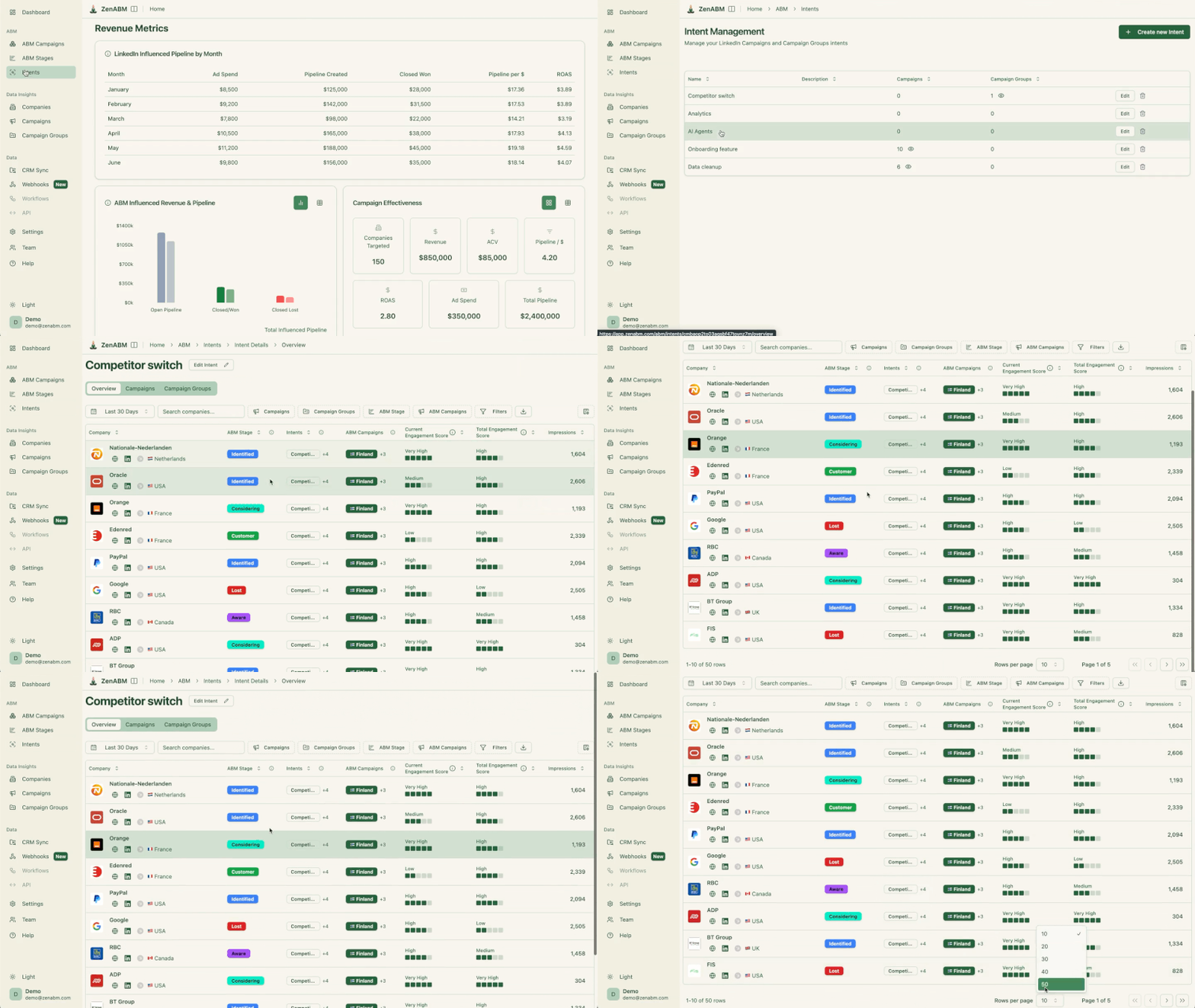
In fact, folks at Userpilot (our customer) had built entire ABM motions around this approach, tagging campaigns by pain point and then doubling down on specific BOFU ads based on what the account is engaging with.
Their campaign structure:

Deanonymize LinkedIn ad engagements, get intent, accounts scoring
37 Days Free Trial | Starting @ $59/month!

6sense builds a 360° profile of target accounts, including firmographics (industry, size), technographics (what tech they use), key contacts, and even psychographic or behavioral insights.
It often integrates data from third-party sources for contact enrichment. (Note: Some users report that contact data can be hit-or-miss internationally.)
Still, the platform’s sales intelligence features, like buying committee identification and recommended next-best actions give sales reps valuable context on each account.


6sense offers robust analytics dashboards to measure both marketing and sales impact.
It can do multi-touch attribution (crediting pipeline to marketing campaigns), show influenced vs. sourced revenue, and even provide AI-based forecasts of the pipeline.
Users can track how accounts move through buying stages and how marketing engagements correlate with won deals.
In addition, 6sense integrates with tools like Mutiny for web personalization and Drift for conversational marketing, extending the ABM experience to your website and chatbots
As an enterprise platform, 6sense connects with major CRM and marketing automation systems (Salesforce, HubSpot, Marketo, etc.), sales engagement tools (Salesloft, Outreach), data enrichment services, and more.
The idea is to serve as an intelligence layer across your go-to-market stack, helping to streamline workflows and improve team collaboration between sales and marketing.
For example, dynamic segments from 6sense can sync to LinkedIn Campaign Manager or trigger sales outreach sequences.
This ensures marketing and sales stay aligned on the same set of “in-market” accounts.
For more details, you can explore 6sense’s integrations page.
6sense is a premium product with no public pricing – interested companies must contact 6sense for a custom quote.
Generally, 6sense contracts involve an annual (or multi-year) license, often bundled with service packages or media spend, depending on usage.
How much does it cost?
While exact numbers vary by scope, buyers should expect mid-five-figure to six-figure annual costs for a full 6sense deployment.
Vendr, for instance, puts the median 6sense pricing at $54,250 per year.

In other words, a 6sense subscription can run anywhere from tens of thousands up to hundreds of thousands of dollars per year, which includes the platform and potentially add-ons.
This high investment, combined with the necessary time to implement and learn the system, means 6sense makes the most sense for organizations that plan to heavily leverage its advanced capabilities.
Smaller marketing and sales teams focused on a single channel might struggle to justify 6sense’s steep price and complexity.
ZenABM is a newer, lean ABM platform purpose-built for running ABM campaigns on LinkedIn.
Key features of ZenABM include:


ZenABM connects directly to the official LinkedIn Ads API to pull account-level data from every campaign.
This means you can see exactly which target companies are engaging with your LinkedIn ads (impressions, clicks, etc.) – all mapped at the account level.
Because this data comes straight from LinkedIn (based on logged-in users), it’s highly accurate. In contrast, many larger ABM platforms like 6sense rely on probabilistic methods such as IP lookups or cookie-based tracking to guess visitor identity.
That guesswork often backfires. A study by Syft found that IP-matching tools only identify companies correctly around 42% of the time.

ZenABM’s first-party approach delivers cleaner, intent-rich signals from ad engagement. So, if multiple people from the same company interact with your LinkedIn ads, you know that account’s showing genuine interest. No third-party data feed required.
Pro Tip: ZenABM can also help you deanonymize any number of website visitors for free. Just retarget the site visitors with LinkedIn text ads (which are diret-cheap btw) and ZenABM will reveal all the companies that were served impressions.

ZenABM continuously calculates engagement scores based on ad interactions. You can view recent (e.g., past week) or historical engagement trends to spot accounts that are warming up.
By leveraging engagement scores, marketing and sales teams can identify high-value accounts for targeted follow-up.
ZenABM lets you define your ABM funnel stages (for example: Identified → Aware → Engaged → Interested → Opportunity) and automatically categorizes each account using engagement and CRM data.
You can also set your own thresholds for what counts as “Engaged” or “Interested,” and ZenABM will track movement between stages automatically.


This gives you full-funnel visibility like enterprise ABM tools, spotting where target accounts stall and where progress accelerates.
ZenABM syncs bi-directionally with CRMs like HubSpot (and Salesforce on higher plans).
LinkedIn engagement data flows straight into your CRM as company-level properties (perfect to keep your sales team alert):

ZenABM can also auto-update account stages to “Interested” when engagement crosses a defined threshold and even assign those accounts to specific BDRs for follow-up.

ZenABM lets you tag each LinkedIn campaign by theme (for instance, “Feature A” vs. “Feature B”). It then shows which accounts engaged with which themes, revealing exactly what each company cares about.

That’s true first-party intent. Instead of paying 6sense or another vendor for inferred keyword interest, you get direct evidence, like Account Z clicking “Feature A” ads, showing real buying interest.
These insights sync to your CRM too, enabling hyper-targeted outreach and more relevant messaging.

In short, your reps always know what topic or pain point each account responds to most.
ZenABM comes with ready-made ABM dashboards connecting ad exposure, engagement, funnel stages, and pipeline performance.


ZenABM’s plans start at $59/month for Starter, $159/month for Growth, $399/month for the Pro (AI) tier, and $470/month for the agency tier.
Even the top plan costs under $7,000 per year (a fraction of what 6sense typically charges).
All plans include the essential LinkedIn ABM capabilities, with higher tiers mostly lifting limits or adding Salesforce integration.
Pricing is flexible (monthly or annual with two months free), and there’s a 37-day free trial so teams can test before committing.
Each platform offers unique ABM strategies to help identify and engage targeted accounts, ensuring personalized outreach and higher conversion rates.
Here are the key differences to consider:
6sense uses predictive intent modeling.
It aggregates intent signals from across the web (research behaviors on search engines, third-party data like Bombora topics, review sites, etc.) and applies AI to predict which accounts are in-market, capturing buyer research activity from search engines to uncover hidden buyer intent.
This gives a broad view of interest, even from anonymous research activity.
ZenABM uses first-party qualitative intent from ad engagement. It zeroes in on how target accounts actively engage with your LinkedIn ads as the intent signal.
In other words, 6sense might tell you an account is spiking on “CRM software” searches broadly, whereas ZenABM tells you this specific account clicked your product webinar ad twice. ZenABM’s intent data is very direct and campaign-specific, while 6sense’s is inferential and relies on large third-party data sets.
6sense is multi-channel.
It covers display advertising (via its DSP), social ads, search ads, email marketing, website personalization, sales outreach, and more.
By contrast, ZenABM is single-channel focused (LinkedIn).
There is some overlap in ABM fundamentals, but execution differs.
Sales alignment: Both aim to align marketing and sales, but 6sense does it by feeding insights into sales tools (e.g. telling an SDR which topics a prospect is researching). ZenABM does it by literally updating the CRM with engagement data and qualitative intent and assigning BDRs when engagement hits a point, ensuring a human follows up with context.
6sense offers advanced analytics and attribution across all your marketing efforts.
It can attribute pipeline to ads, emails, and events collectively and even forecast revenue impact with AI.
It’s great for a holistic view, but can be complex to configure and an overkill for most businesses.
ZenABM focuses on clear, deal-based attribution for LinkedIn campaigns.
It directly ties ad-engaged accounts to CRM opportunities, showing influenced pipeline and revenue per campaign in a very straightforward manner.

6sense has a steeper learning curve and typically requires more onboarding/enablement.
Users on review sites like G2, TrustRadius, and Capterra often note that while the platform is powerful, it takes time to configure segments, train the team, and tune the AI models to your business.
Larger companies often dedicate an ops person or a CSM to manage it.
ZenABM is designed to be much simpler, since it’s focused on one channel and provides plug-and-play dashboards.
Teams can get up and running quickly, often by just connecting LinkedIn and their CRM and defining a few thresholds.
The cost difference is dramatic.
6sense is an enterprise investment typically requiring a signed annual contract, custom pricing, and a budget on the order of $50K+ per year (scaling up with bigger deployments).
Additionally, there are costs for data enrichment or additional modules, and you’ll invest time/resources in management.
Plus, as I always say, pricing isn’t just about an absolute number but about how much you can utilize and justify.
In that regard, most Redditors say 6sense is an overkill for small- to mid-sized businesses with small teams.

ZenABM, on the other hand, is a subscription with plans ranging $59–479 per month and flexibility to cancel or upgrade as needed.
There’s no comparison in terms of TCO: ZenABM is the cost of a nice SaaS tool, whereas 6sense is a major line item in the marketing budget.
For organizations, this means 6sense will likely require a strong business case and executive buy-in, while ZenABM can be trialled (37-day free trial available) by a small team with minimal risk.
Deanonymize LinkedIn ad engagements, get intent, accounts scoring
37 Days Free Trial | Starting @ $59/month!
The answer largely depends on your organization’s needs, channels, and budget.
Both 6sense and ZenABM can power successful ABM, but they fit different scenarios:
Note: It’s also not just about the budget but also the approach. I, for instance, prefer to go as much first-party and LinkedIn-centric as possible, especially because:

So, I’d prefer ZenABM, which gives both qualitative and quantitative intent from LinkedIn ad engagement data pulled straight from LinkedIn’s official API.
Pro Tip: If you happen to have the budget and an established team, you could use both! For instance, using 6sense for intent discovery and broad analytics, but also using ZenABM for granular LinkedIn tracking.
6sense and ZenABM both deliver real value, but for entirely different worlds of ABM.
6sense is for the enterprise crowd chasing multi-channel precision, predictive intent, and massive datasets at a massive cost.
ZenABM is for leaner, pragmatic teams that want first-party accuracy and simplicity.
Try ZenABM now for free or book a demo!
Yes, but in different ways. 6sense uses third-party web signals and AI to predict buying intent, while ZenABM tracks real engagement signals from your LinkedIn ads( direct proof of interest).
ZenABM is far cheaper, starting at $59/month. 6sense typically costs tens of thousands per year, making ZenABM the better fit for startups or lean teams.
Not entirely. ZenABM is ideal for LinkedIn-based ABM, tracking engagement, syncing with CRM, and measuring ROI. 6sense covers more channels and data sources. Some teams use both: ZenABM for LinkedIn, 6sense for everything else.
Both do. 6sense embeds insights inside the CRM (like intent scores), while ZenABM pushes LinkedIn engagement data directly into CRM fields and automates follow-up workflows. ZenABM’s setup is simpler.
Choose based on scope and scale: 6sense suits broad, enterprise ABM with multi-channel intent data. ZenABM fits LinkedIn-first strategies and smaller budgets. Start with ZenABM if you want quick, clear ROI, and expand later if needed.
About the author

