

©2026 ZenABM - All Rights Reserved.

LinkedIn ads conversion campaigns for ABM get chosen by default because “conversions” are what everyone wants.
Then the campaign underdelivers, the cost per result stays stubbornly high, and nobody can say why.
The reason is usually arithmetic rather than creative.
A conversion campaign asks LinkedIn’s algorithm to learn who converts, and learning needs conversion volume.
An ABM audience is small on purpose, so it often cannot supply enough events for the algorithm to learn anything at all.
There is a second problem that is specific to account-based work, and it is worse.
Conversion optimization concentrates delivery on the handful of people most likely to convert.
ABM needs the opposite: broad coverage across a buying committee that averages 11 people.
So the honest answer to “when should I use conversion campaigns for ABM” is a calculation, not a preference.
This guide gives you that calculation, the objective to run at each stage instead, and how to measure conversion campaigns properly when you do use them.
A quick overview:
A website conversions objective tells LinkedIn to find people likely to complete your conversion event.

To do that, the system needs examples.
Not a few, quite a lot.
The working numbers are these.
Roughly 50 conversion events are needed to fully train delivery, and around 30 per month to keep it trained.
Few B2B campaigns reach that, so a more realistic working target is 15 to 25 conversions a month.
Now put a budget against it.
At a 3 percent landing page conversion rate and a $10 cost per click, 15 to 25 conversions a month need somewhere around $5,000 to $8,300 a month, which is $165 to $275 a day, on that one campaign.
Before you choose the objective, do this calculation on paper:
Monthly budget for this campaign, divided by your cost per landing page click, multiplied by your landing page conversion rate, equals expected monthly conversions.
If that number is under 15, a conversion campaign will not optimize. Pick a different objective.
Here is what it looks like across realistic ABM budgets, at $10 per click and a 3 percent page conversion rate:
Monthly campaign budget | Clicks | Expected conversions | Verdict |
|---|---|---|---|
$2,000 | 200 | 6 | Far too few. Do not use a conversion objective. |
$4,000 | 400 | 12 | Still short. It will stay in learning. |
$6,000 | 600 | 18 | Workable, at the low end. |
$10,000 | 1,000 | 30 | Comfortable. Optimization will hold. |
Two things follow from that table.
Most ABM campaigns sit in the top two rows, which is why so many conversion campaigns disappoint.
And splitting one budget across several conversion campaigns is worse than running one. Three campaigns at $2,000 each produce three campaigns that never learn, rather than one that does.
The learning phase is not a neutral waiting period. While a campaign is in it, cost per result typically runs 30 to 50 percent above where it eventually settles, and it lasts one to two weeks for most B2B campaigns.
A campaign that never gathers enough conversions never exists.
So you pay that premium indefinitely, on every result, forever.
That is the real cost of picking the wrong objective, and it does not show up as a line item anywhere.

Even when you can afford the volume, there is a structural conflict worth understanding.
Conversion optimization does exactly what you asked: it finds the people in your audience most likely to convert, and it sends your impressions to them.
For a demand gen campaign against a broad audience, that is great.
For ABM, it is a problem because the goal is not to find the easiest converter.
The goal is to reach a buying committee.
Gartner puts the average B2B buying committee at 11 people, and a deal moves when several of them have heard of you, not when one of them fills a form.
So conversion optimization concentrates spend on a narrow slice of your audience while the rest of the committee never sees an ad, which is the same frequency and distribution problem in a different form.
This compounds a problem LinkedIn already has for ABM.
Delivery goes to people, not companies, so a few large accounts absorb a disproportionate share of the budget by default.
Add conversion optimization on top, and the concentration gets tighter still.
The benchmark data points the same way.
In the ZenABM 2026 report covering 211 B2B companies, 161,256 ads and $5.5M in spend, clicks and CTR did not drive pipeline, while impressions did.
If impressions across the committee are what moves accounts, an objective that trades impressions for a narrow set of conversions is working against you above the bottom of the funnel.


ABM requires creative rotation.
Ads decay, and our rule is that an ad past 1,000 impressions with an eCTR under 0.4 percent comes off, with a two-week eCTR decline as the early warning.
But conversion campaigns punish change. Learning resets when you make a significant edit, including:
So the discipline that keeps ABM creative fresh is the same discipline that keeps resetting your conversion optimization.
There is no clever fix, only a sensible tradeoff.
Rotate creative aggressively in your cold and warm layers where the objective does not depend on learning, and rotate slowly in the one bottom-funnel conversion campaign where it does.
LinkedIn’s own guidance is to let a campaign run for at least 15 days before editing it.
Put the two tests together, and the rule becomes simple.
Situation | Use a conversion campaign? | Why |
|---|---|---|
Cold target accounts, no prior engagement | No | No conversion volume, and you need broad reach across the committee. |
Warm retargeting pool under 15 conversions a month | No | It will never leave the learning phase. Use engagement or website visits instead. |
Warm retargeting pool above 15 to 25 conversions a month | Yes | Enough events to optimize, and the audience already knows you. |
High-intent offer: demo, pricing, consultation | Yes | The landing page qualifies and persuades, and the visit is a strong account signal. |
Low-commitment offer: guide, checklist, webinar | No | Friction kills conversion on offers nobody was invested in. Use a Lead Gen Form. |
You need the website visit for retargeting | Yes | A Lead Gen Form gives you the lead and throws the visit away. |
Small audience near the 300-member floor | No | Too few people to produce events, whatever your budget. |
AJ Wilcox, founder of the LinkedIn Ads agency B2Linked, teaches this decision through his AMO framework: audience, message, offer have to match each other.
A bottom-funnel offer earns the friction of a landing page because you want commitment.
A top-funnel offer does not, because you are asking for a casual yes.
The objective should follow the offer, and the offer should follow the stage.
If a conversion campaign is wrong for most of your funnel, something has to carry those stages.
Stage | Objective | Format | What you are buying |
|---|---|---|---|
Cold | Brand awareness or engagement | Cheap, broad impressions across the committee | |
Aware | Engagement or video views | Video, document ads | Depth of attention and a retargeting pool |
Interested | Website visits | Single image, carousel | The visit and the page-level intent signal |
Considering | Website conversions | Single image, document | The demo or pricing action, if volume allows |
Thought Leader Ads deserve their place at the top of that table.
In the same benchmark, they posted a 2.68 percent median CTR at a $2.29 median CPC, against 0.42 percent for single image ads.
When you need impressions across a committee, that is the cheapest attention on the platform.

The warm layer is where your eventual conversion campaign audience gets built.
Retarget the people who watched 25 percent of a video, opened a lead form, or downloaded a document ad, and you accumulate a pool that is both warm and large enough to eventually feed conversion optimization.

Read related: LinkedIn consideration ads: how to warm target accounts before you ask for the meeting
Once the volume test passes, the real choice is between a conversion campaign and a native Lead Gen Form.
That argument is usually made on cost per lead, which is the wrong axis for ABM.
The right axis is the signal you walk away with.
Lead Gen Forms put the form inside the ad and pre-fill it from the member’s profile, so nobody leaves LinkedIn or types into a small mobile field.
They convert around 10 percent, past 15 percent for strong campaigns, and cut cost per lead by roughly 20 to 30 percent.
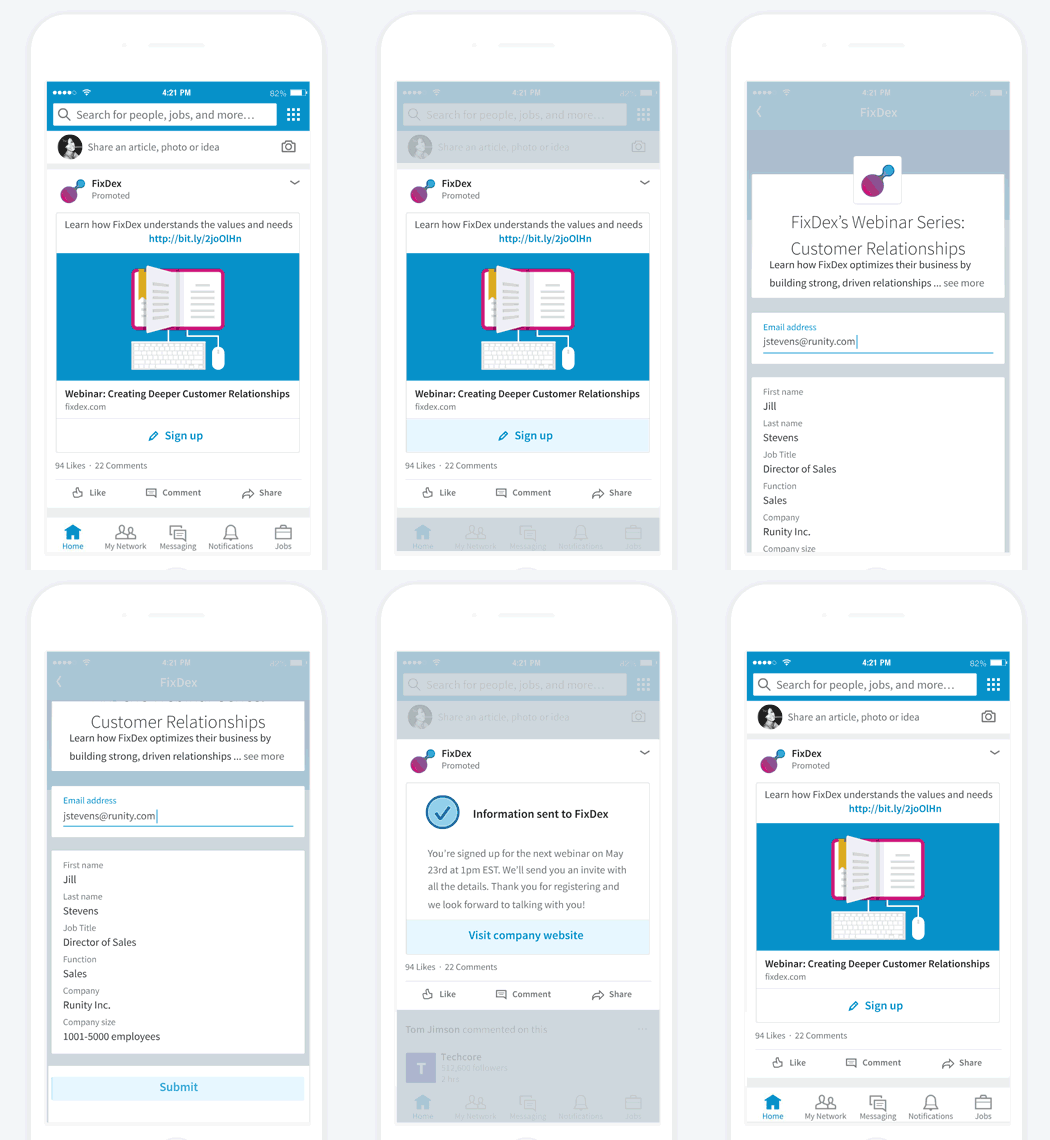
The catch is what the cost per lead number hides.
You gain the lead and lose the website visit, and with it the retargeting pool, the page-level intent, and the harder qualification a real page can do.
Dimension | Lead Gen Forms | Conversion campaigns |
|---|---|---|
Conversion rate | Higher, often around 10 percent or more | Lower, since the buyer has to leave LinkedIn |
Cost per lead | Lower, by roughly 20 to 30 percent | Higher per lead captured |
Website visit | None. The buyer never leaves the feed | Yes, with retargeting and page-level intent |
Qualification depth | Shallow, a pre-filled form | Deeper, with real copy and real questions |
Algorithm demands | Low. Works at a small volume | High. Needs 15 to 25 conversions a month |
Best stage | Top of funnel, content, and volume | Bottom of funnel, demos, and pricing |
The qualification difference protects sales time in a way the CPL comparison never shows.
In a Lead Gen Form, a curious junior employee and a real buying committee member look identical. On a page that asks real questions, they do not.
Veronika Vebere, a demand generation consultant who runs ABM pilots for lean teams, makes the practical version of this point in the ZenABM ABM Bootcamp 2026: watch ad performance and landing page performance together, because a high CTR does not guarantee conversions, and gating or ungating a page can change submission rates dramatically.

If your conversion campaign underperforms, test the page before you blame the objective.

If the volume test passes and the offer is bottom-funnel, here is the setup that gives it the best chance.
This is the single most important setting on the page. If you optimize for “demo booked” and get four a month, the algorithm learns nothing.
Optimize for the step above it instead, something like a pricing page view or a demo page view, which happens five to ten times more often. You get enough events to train delivery while still pointing at intent.
One campaign at $6,000 optimizes.
Three at $2,000 do not. Resist the urge to split by persona at this stage, and let the audience stay large enough to produce events.
Every LinkedIn audience needs 300 members to serve, but 300 is a serving minimum, not an optimization minimum. A conversion campaign wants a pool measured in thousands.
Audience Expansion and the LinkedIn Audience Network both push delivery beyond your target list. For an ABM conversion campaign, that means paying to convert people who were never on your list.


Give it at least 15 days before editing, and avoid budget swings above 30 percent.
Every significant edit sends you back to the start of learning, and back to paying the premium.
Here is the part that makes the whole tradeoff worthwhile, and it is where most teams leave value on the table.
A conversion campaign’s real ABM prize is not the form fill. It is the visit, because the visit tells you which company is looking.
ZenABM captures company-level engagement from the LinkedIn ad regardless of objective, pulled straight from the LinkedIn Ads API.
So the account that clicked your conversion ad becomes a named company you can score, stage and route, even if nobody filled the form.

High-intent page visitors are the most valuable retargeting pool you own.
ZenABM lets you retarget them at the account level and see the job titles behind the visits.


Set expectations on coverage, though.
Website visitor de-anonymization typically matches 20 to 40 percent of traffic (per the Syft study), so treat it as a partial view rather than a full one.

A conversion campaign should move accounts, not just collect emails.
Feed the visit into your engagement score and let it trigger a stage change.


Then push the stage into the CRM, so the visit reaches a human.

The last step is the honest one.
A conversion campaign can post a poor cost per lead and still be your best campaign if the leads it produced were real buyers.
ZenABM’s revenue attribution runs per ABM campaign, deduplicated, so you can compare pipeline per dollar rather than cost per form fill.

Grade it against the market too. Median-influenced pipeline in the 2026 benchmark report is $5.21 per dollar spent at 1.62x median ROAS, with top performers at $15.20.

The ABM KPIs guide covers the wider reporting that this sits within.


With the ZenABM MCP server connected (endpoint https://app.zenabm.com/api/mcp, Bearer token or OAuth, then /init), you can settle the objective question with a prompt:
For each of my campaigns in the last 90 days, show the objective, spend, landing page clicks, conversions, cost per conversion, and the number of distinct target accounts that engaged. Tell me which conversion campaigns produced fewer than 15 conversions a month, since those are unlikely to have exited the learning phase. For those, compare their cost per result against my engagement objective campaigns and tell me whether switching objective would likely have been cheaper.
What the result of the prompt would look like:
Two of the 15 skills the MCP server ships as slash commands help here.
/budget-wasters ranks leaks by monthly dollars at stake, which surfaces underfed conversion campaigns quickly. /scaling-planner tells you whether more budget on a campaign reaches new people or repeats to the same ones, which is the other half of the volume question.
If you would rather not set anything up, Zena answers the same questions inside the app.

Conversion campaigns are not better or worse than the alternatives for ABM. They are a tool with a volume requirement, and most ABM audiences do not meet it.
So run the calculation before you pick the objective. Budget divided by cost per click, multiplied by page conversion rate. Under 15 conversions a month, choose something else and stop paying a learning phase premium forever.
When you do use one, put it at the bottom of the funnel on a warm audience, optimize for a mid-funnel event, concentrate the budget in one campaign, switch off Audience Expansion and the Audience Network, and then leave it alone for two weeks.
And whichever objective you pick, capture the account.
The visit is worth more than the form fill in account-based work, because a form gives you one person, while the visit tells you a company is looking.
That company-level view is the part LinkedIn will not give you. If you want it on your own campaigns, ZenABM is free for 37 days with full functionality, and the engagement scores, stages, and pipeline attribution can be run before your next objective decision.
You can also book a demo with us to learn more.
Use them at the bottom of the funnel, on a warm retargeting audience, with a high-intent offer such as a demo or pricing, and only when the audience can produce at least 15 to 25 conversions a month. Below that volume LinkedIn’s optimization cannot train, the campaign stays in a learning phase where cost per result runs 30 to 50 percent high, and an engagement or website visits objective will be cheaper.
Roughly 50 conversion events fully train delivery, and around 30 a month keep it trained, though a realistic working target for B2B is 15 to 25 a month. At a 3 percent landing page conversion rate and a $10 cost per click, that requires roughly $5,000 to $8,300 a month on a single campaign. If your budget cannot produce that many events, choose a different objective rather than splitting spend further.
It depends which signal you need. Lead Gen Forms convert around 10 percent and cut cost per lead 20 to 30 percent, but the buyer never leaves LinkedIn, so you lose the website visit, the retargeting pool, and page-level intent. Conversion campaigns cost more per lead and keep all three. For ABM, use forms for top-funnel volume and conversion campaigns for bottom-funnel offers where qualification matters.
The most common cause is too few conversion events for the algorithm to learn from, which keeps the campaign in a permanent learning phase. Check three things: whether the campaign can produce 15 or more conversions a month, whether you are optimizing for a rare final action rather than a mid-funnel event, and whether recent edits reset learning. Budget changes above 30 percent, creative swaps, and audience edits all reset it.
Yes, above the bottom of the funnel. Conversion optimization concentrates delivery on the people most likely to convert, so a narrow slice of your audience absorbs the impressions while the rest of the buying committee sees nothing. With an average committee of 11 people, that works against how accounts actually progress. Use broader objectives for cold and warm layers and save conversion optimization for the final step.
Pick a mid-funnel event rather than the final one. Optimizing for “demo booked” when you get four a month gives the algorithm nothing to learn from, while a pricing page view or demo page view happens five to ten times more often and still signals intent. You can still report on the final action; the choice here is only about which event the algorithm trains on.
