



Every audit starts with the same scene.
The advertiser pulls up Campaign Manager, points at the LinkedIn ads cost per result column, and says “we are crushing it” or “we are burning money”, depending on the row the cursor lands on.
Then the question comes: which accounts did those results come from, and the room goes quiet.
That is the core problem with LinkedIn ads cost per result as a metric.
CPR tells you how much LinkedIn charges for an action.
It does not tell you whether that action came from a Tier 1 account, a competitor browsing the funnel, or a marketing intern who clicked because the meme was funny.
In ABM, the cheapest result is rarely the best result, and the most expensive click can be the one that signs a six-figure deal six months later.
This article will guide you on what CPR actually means for an ABM program, CPR benchmarks by objective and industry, how to optimize it, and, most importantly, what better metrics you should track and how.
Before diving into the benchmarks, here is the short version for anyone who wants to skim:

LinkedIn cost per result is the average cost of one unit of whatever a campaign is optimized for.
The formula is the same one used anywhere else:
Cost per result = total spend/number of results
The trap is that “result” is not one thing.

LinkedIn redefines it for every campaign objective, so the same column header can mean six different things across campaigns:
This is why CPR is a container metric.
It will tell you the cost of an apple in one row and a tractor in the next, with no warning, which means comparing CPR across different objectives is comparing apples and tractors.
In ABM, this gets messier because the “result” LinkedIn charges for has very little to do with the result a CFO cares about.
Maximilian Herczeg (ex-LinkedIn) ran a great audit thread on exactly this:
“I just audited a LinkedIn ads account, which seemed good at first sight: lead prices of 50-70 EUR, 4-5 EUR cost per click, CTRs of 0.5% and higher, etc. Would have been lovely, except a big chunk of the reached audience was rubbish. I don’t know why, but companies seem to totally underestimate how important targeting is. If LinkedIn ads was a house, targeting would be your foundation.” – Maximilian Herczeg in his LinkedIn post
Cheap CPR with bad targeting is the most dangerous combination in B2B paid media.
It looks like a green dashboard, but functions, in reality, as a slow drain.
Countless times, campaigns with stellar CPR get killed in the next quarterly review because they were the wrong campaigns for the job.
“Expensive” campaigns get cut that were the only thing meaningfully moving Tier 1 accounts toward a meeting.
These are the patterns where CPR misleads:
For ABM, the questions that actually matter are different.
None of those questions is answered by the cost per result column.
They are answered by tying ad delivery and engagement back to the company, the stage, and the deal, which is the gap ZenABM was built to close and the one covered in more depth in the running ABM on LinkedIn guide.
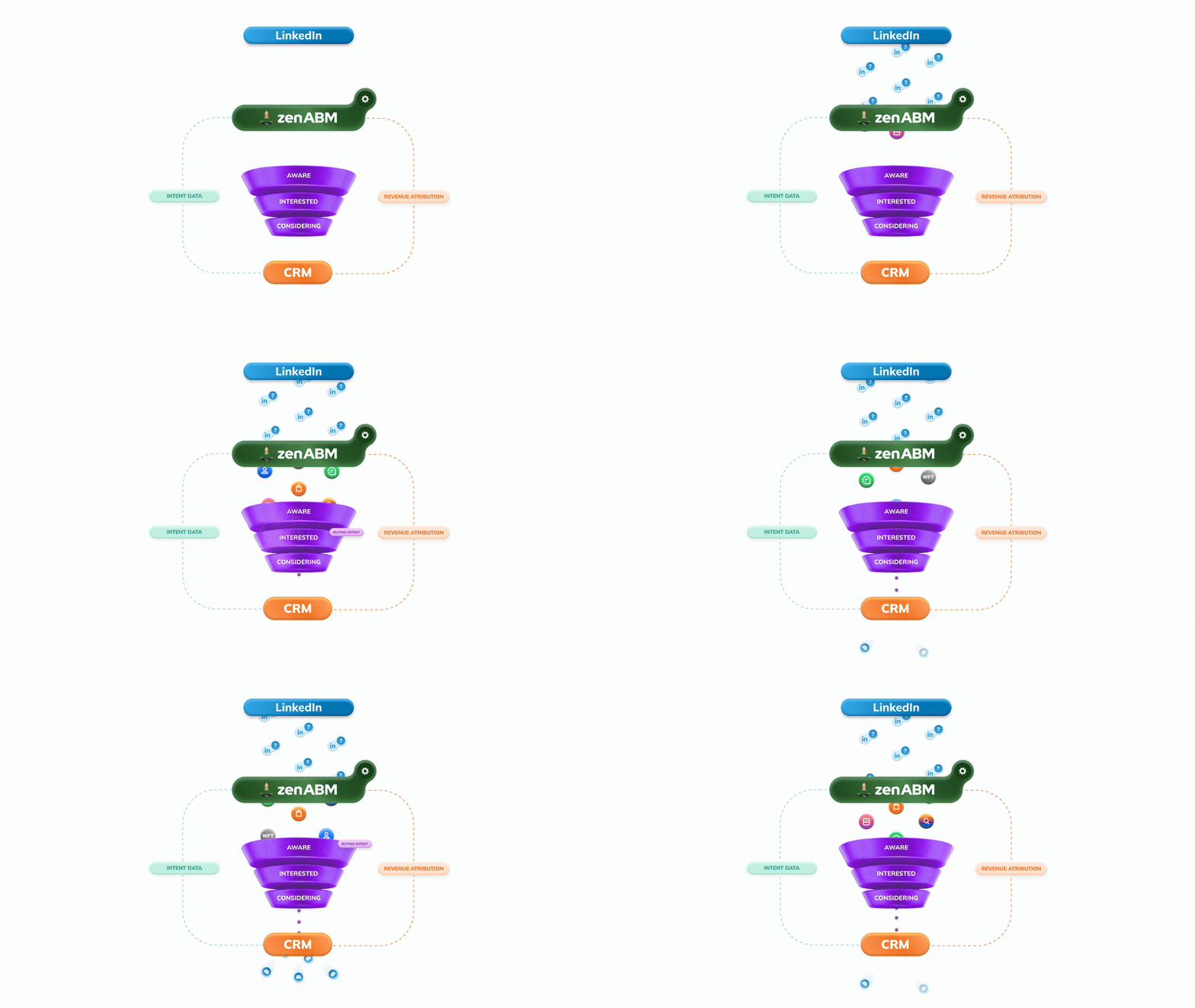
ZenABM pulls company-level ad engagement data from LinkedIn’s official ads API and then matches the ad-engaged companies to the deals in your CRM to finally give complete revenue and pipeline attrition data.


Also, it has gone multi-channel now.



The question of “the average LinkedIn cost per result” comes up almost every week, and the honest answer is that there is no single number that means anything.
There are dozens of useful numbers, and CPR alone is one of the weaker ones.
The dataset worth returning to is the 2026 ZenABM benchmarks report:
The headline benchmarks across that dataset:
| Metric | Median Company | Top Performer |
|---|---|---|
| CTR | 0.69% | 0.21% |
| CPC | $11.04 | $21.91 |
| CPM | $78.30 | |
| Pipeline per $1 spent | 5.21 | 15.20 |
| Influenced pipeline/month | $13,819 | $106,500 |
The most counter-intuitive line in that table is the CTR.
Top performers, by pipeline per $ spent, have a lower CTR and a higher CPC than the median company, because cheap clicks did not separate the winners: account fit, ACV, and the right format mix did.
Optimizing only for low CPR means optimizing away from the behavior that correlates with revenue. For the full methodology, see the 2026 LinkedIn ABM benchmarks report.
Format choice has more effect on LinkedIn ads cost per result than almost any other lever.
The same audience, the same offer, and the same creative concept can deliver wildly different costs depending on which format carries it, which is why format-level benchmarks matter before making any budget allocation decisions.
Here are the format-level numbers from the 2026 benchmarks dataset:
| Format | CTR | CPC | CPM | Best For |
|---|---|---|---|---|
| Thought Leader Ads | 2.68% | $3.06 | $82.14 | Best efficiency for engagement and traffic |
| Single Image Ads | 0.42% | $13.23 | $59.15 | Reach and scalable testing |
| Carousel Ads | 0.49% | $11.28 | $52.36 | Balanced storytelling |
| Document Ads | 0.52% | $13.04 | $62.06 | Dwell time and engagement |
| Video Ads | 0.24% | $15.61 | $38.94 | Use carefully, often over-budgeted |

Three things stand out.
Exact LinkedIn ads cost per result changes by objective, audience, geography, offer, and creative quality.
Public benchmarks from major 2026 reports cluster around $5 to $12 CPC for general B2B, $10 to $25 CPC for tech and finance, $33 CPM as a global average, and $60 to $150 CPL depending on vertical.
The right cost metric for each objective in ABM breaks down as follows:
Brand awareness:
Engagement:
Website visits:
Lead generation:
Video views:
Conversions:
The same CPR can be good or bad depending on the stage. $50 for a low-quality lead is expensive.
$500 to genuinely engage a Tier 1 account in a six-figure cycle is cheap.
The objective tells you which lens to use.

A good LinkedIn ads cost per result is the one that creates the right business outcome at a given ACV and buying cycle.
That is the boring, accurate answer, because there is no benchmark for “good CPR” that is meaningful without knowing average deal size, sales cycle length, and account fit rate.
Two examples ground that point:
The pattern from the 2026 benchmark data backs this up. Top performers by pipeline per $ spent had a 0.21% CTR and a $21.91 CPC, while the median company sat at 0.69% CTR and $11.04 CPC.
The winners were not running cheaper campaigns; they were running campaigns that hit the right accounts. A “good” cost per result is one that creates the right business outcome at a given ACV, not the lowest number in Campaign Manager.
If there is one number to keep on a wall, it should not be CPR. It should be pipeline per $ spent, with a small set of account-level cost metrics below it that actually map to the buying journey.
The metrics to track in every ABM account look like this:
None of those metrics lives inside Campaign Manager.
They live in a layer that joins LinkedIn ad delivery to a CRM and account list, which is what tools like ZenABM exist to solve.
And, as we discussed earlier in the article, ZenABM pulls company-level ad engagement data from LinkedIn’s official ads API and then matches the ad-engaged companies to the deals in your CRM to finally give complete revenue and pipeline attrition data.

Consider two campaigns running on the same target account list:
By cost per result, Campaign A wins.
By cost per Tier 1 account reached, Campaign B wins decisively, and by any metric that touches the pipeline, Campaign B wins by an even wider margin. CPR is blind to this kind of difference.
Account-level reporting is the only way to see it.
Maximilian Herczeg( ex-LinkedIn) has been making this point for years:
“You are running LinkedIn ads but you mess up the reporting. You target the wrong audience. You are not sure how well your campaigns are performing and your attribution is off, resulting in 95% of conversions ‘coming from channels other than LinkedIn ads’.” – Maximilian Herczeg in his LinkedIn post
The formulas to operationalize this in ABM are simple:
Campaign Manager cannot fully answer any of these because it does not organize performance around ABM stages.
If cost per account reached is the cleanest TOF and MOF metric, pipeline per $ spent is the cleanest BOF and exec-reporting metric.
The formula:
Pipeline per $ = influenced pipeline/ad spend
The reason it works is brutal simplicity: it ties LinkedIn ad spend to a number the CFO already cares about, and it accounts for high-value accounts in a way CPR never will.
A campaign that spent $5,000 and influenced two opportunities worth $80,000 each has a pipeline per $ of 32, making it a money printer even if its CPR was unremarkable.
The 2026 benchmark numbers:
One caveat: “influenced pipeline” can be wishful thinking if it is not defined carefully.
Gabriel Ehrlich at Remotion made this point directly:
“How big of a lie is ‘influenced pipeline’ on a scale of 1 to 10? If 1 is scientifically proven facts, and 10 is pure fiction, I’d give it a solid 8. It usually just means someone who saw, clicked, or engaged with an ad later showed up in the CRM attached to an opportunity. The ad wasn’t necessarily the cause. It just touched the contact at some point in their journey. It requires nuance and customization to get ‘influenced’ right.” – Gabriel Ehrlich in his LinkedIn post

He is right.
An influenced pipeline is only useful when defined with explicit rules: which engagement events count, which time windows count, and which accounts on the deal record actually saw the ad.
When those rules are in place, pipeline per $ becomes the most honest efficiency benchmark available. Without them, it becomes the loosest one.
CPR tells you how efficiently LinkedIn generated an action; pipeline per $ tells you whether the campaign actually helped create a revenue opportunity. Both are useful, but only one belongs on the wall.
This section is placed last on purpose because reducing CPR without thinking about quality is the fastest way to make an account look great while the pipeline disappears.
With that warning attached, here is the playbook:
From the qualitative analysis underpinning the benchmarks report, two specific patterns showed up in top single-image ads and TLAs:
None of those is CPR hacks.
They are quality patterns that lower CPR as a side effect.
Common CPR mistakes from audits, ranked by how much money they waste:

LinkedIn ads cost per result is a diagnostic, not a scoreboard.
Use it to spot broken creative, mismatched landing pages, or formats eating budget without moving accounts.
Do not use it to judge whether a campaign is working.
The metric that belongs on the wall is pipeline per $ spent. The 2026 benchmark data is clear: top performers ran at $21.91 CPC with a 0.21% CTR and reached 15.20 pipeline per $1 spent.
They were not running cheap campaigns.
They were running campaigns pointed at the right accounts.
ZenABM gives you that number automatically.
It pulls company-level engagement from LinkedIn’s ads API, matches it against your CRM, and calculates pipeline per $ spent, cost per engaged account, and revenue attribution without manual stitching.
Starting at $59/month with a 37-day free trial.
Start your free ZenABM trial now or book a demo to know more!
It depends entirely on objective, audience, and ACV. For high-ACV B2B, CPCs of $15 to $30 and CPLs of $200 to $400 can be excellent if the right accounts are moving toward pipeline. For low-ACV self-serve products, a $5 CPC and $40 CPL might still be unprofitable. The right benchmark is pipeline per $ spent, not the lowest CPR. In the 2026 dataset, top performers reached 15.20 pipeline per $1 with a $21.91 CPC.
Cost per result equals total spend divided by the number of results, where “result” is whatever the campaign is optimized for: clicks, leads, conversions, engagements, video views, or message sends. Because the result changes by objective, CPR is not directly comparable across campaigns with different objectives.
Common causes are over-segmented small audiences, weak creative hooks, mismatched landing pages, no exclusions for customers and competitors, and Audience Expansion turned on. The more important question is whether the high CPR is reaching the right accounts. A $30 CPC on Tier 1 accounts is often better than a $5 CPC on the wrong companies.
In the 2026 ABM benchmarks dataset of 161,256 ads, the median CPC was $11.04 and median CPM was $78.30. Public industry reports cluster around $5 to $12 CPC and $30 to $80 CPM depending on industry and audience. C-suite and tech audiences typically see CPCs of $15 and above. Use these as orientation, not targets.
No, not in ABM. Optimizing for the lowest CPR usually means cheap clicks from low-fit accounts, junior personas, or non-ICP companies. Optimize for cost per engaged target account, cost per opportunity, and pipeline per $ spent. Use CPR as a diagnostic to spot underperforming creative or formats, not as the success metric.
