

©2026 ZenABM - All Rights Reserved.

LinkedIn Thought Leader Ads (TLAs) put ad spend behind posts from real people instead of your company page, and they are the format I would start most B2B LinkedIn accounts on. This guide covers how to write them, where the posts come from, the best examples with their numbers, and what they really cost. The data comes from our 2026 LinkedIn ABM Benchmarks Report, which analysed 119 TLAs and over $300K in ad spend, plus more than two years of writing and running them myself.
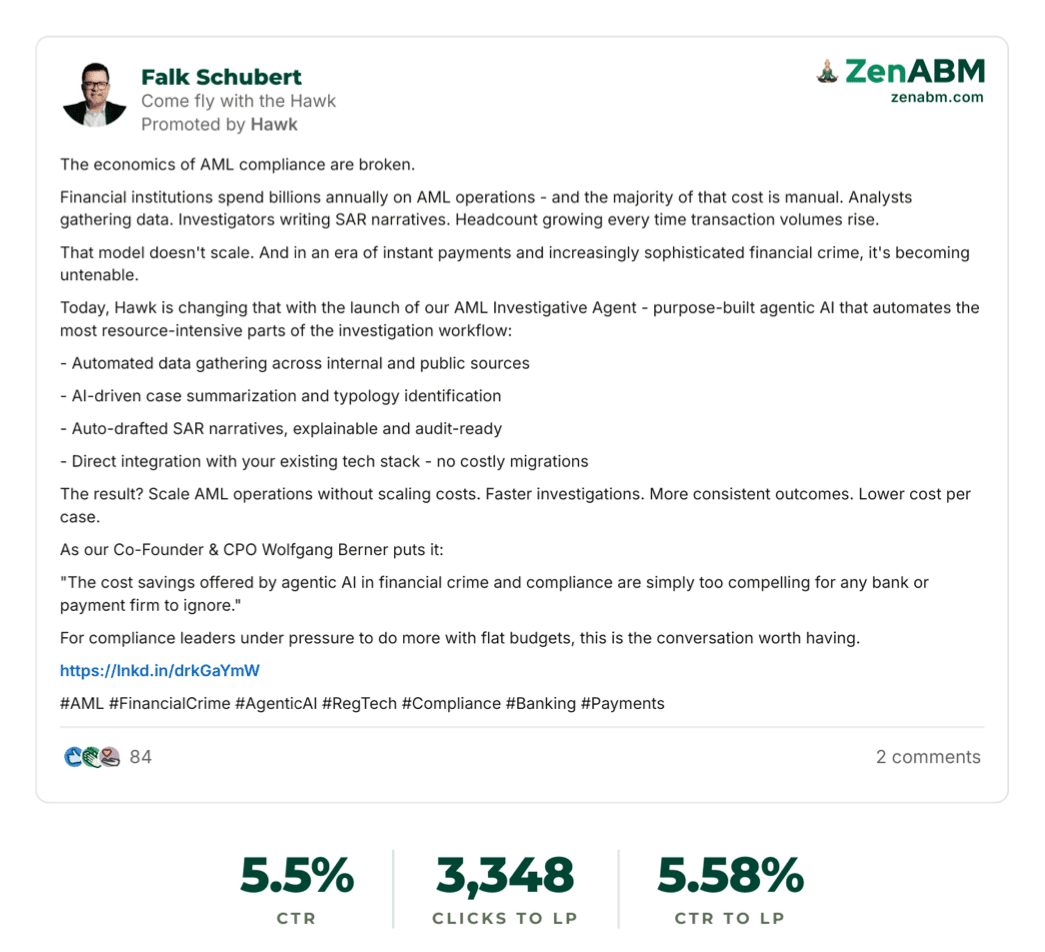
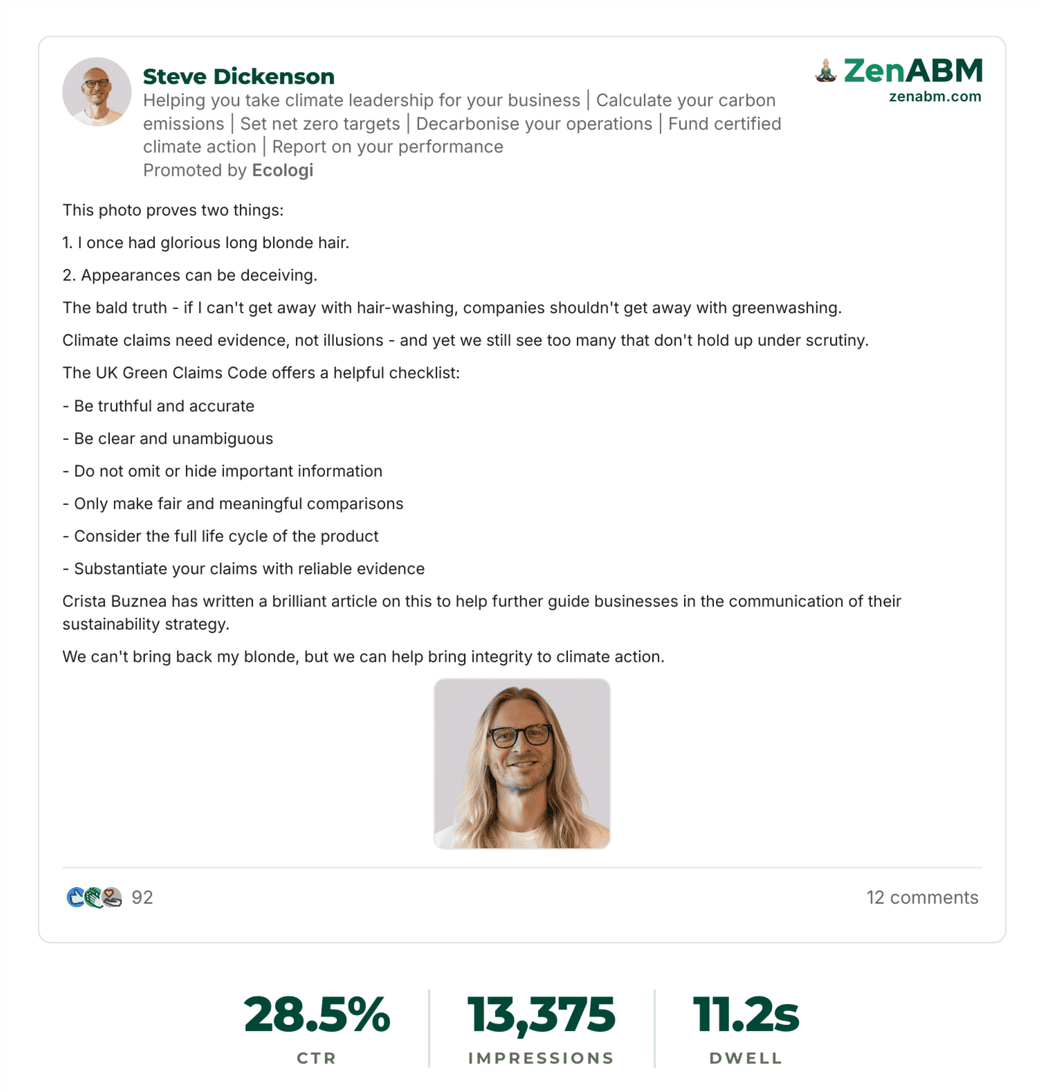
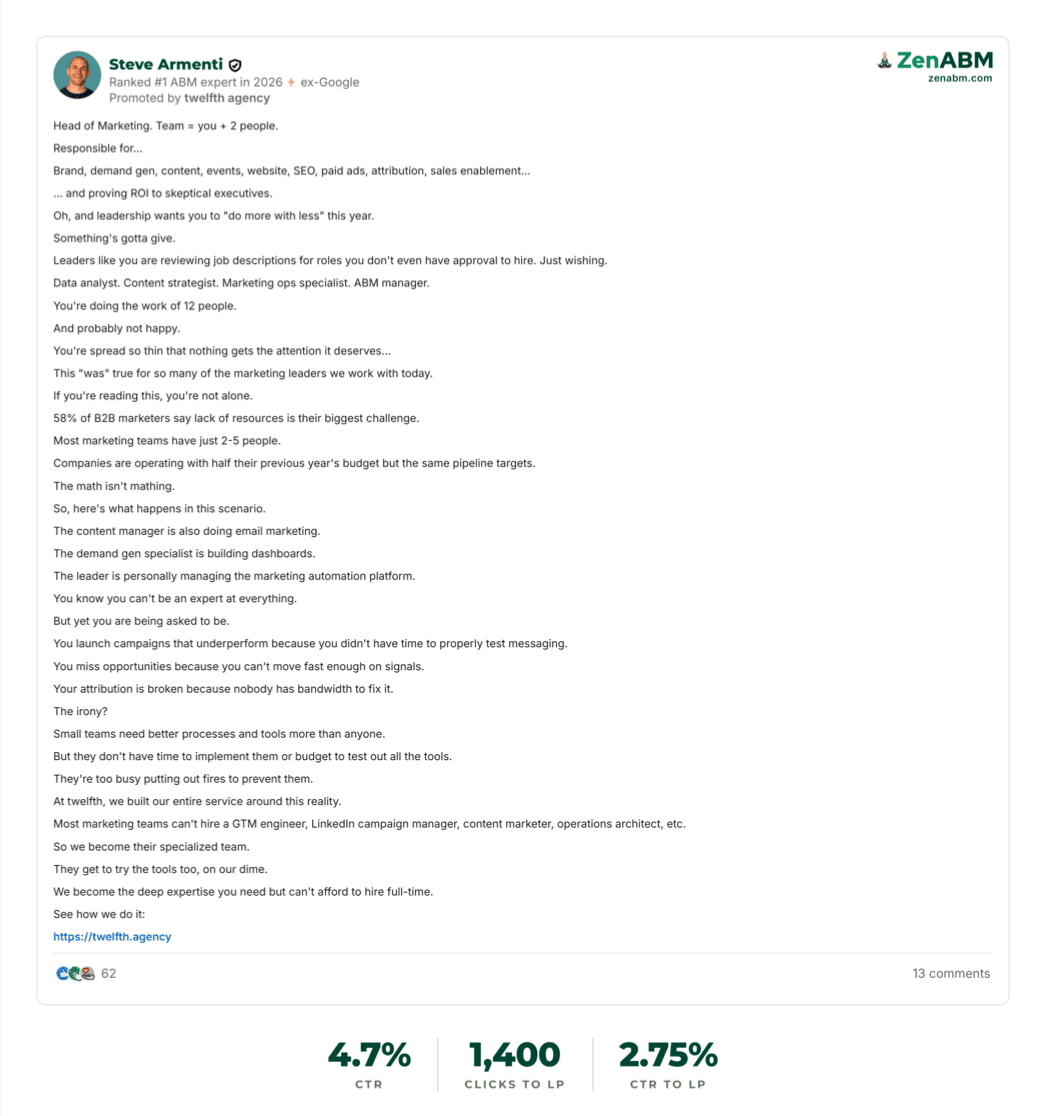
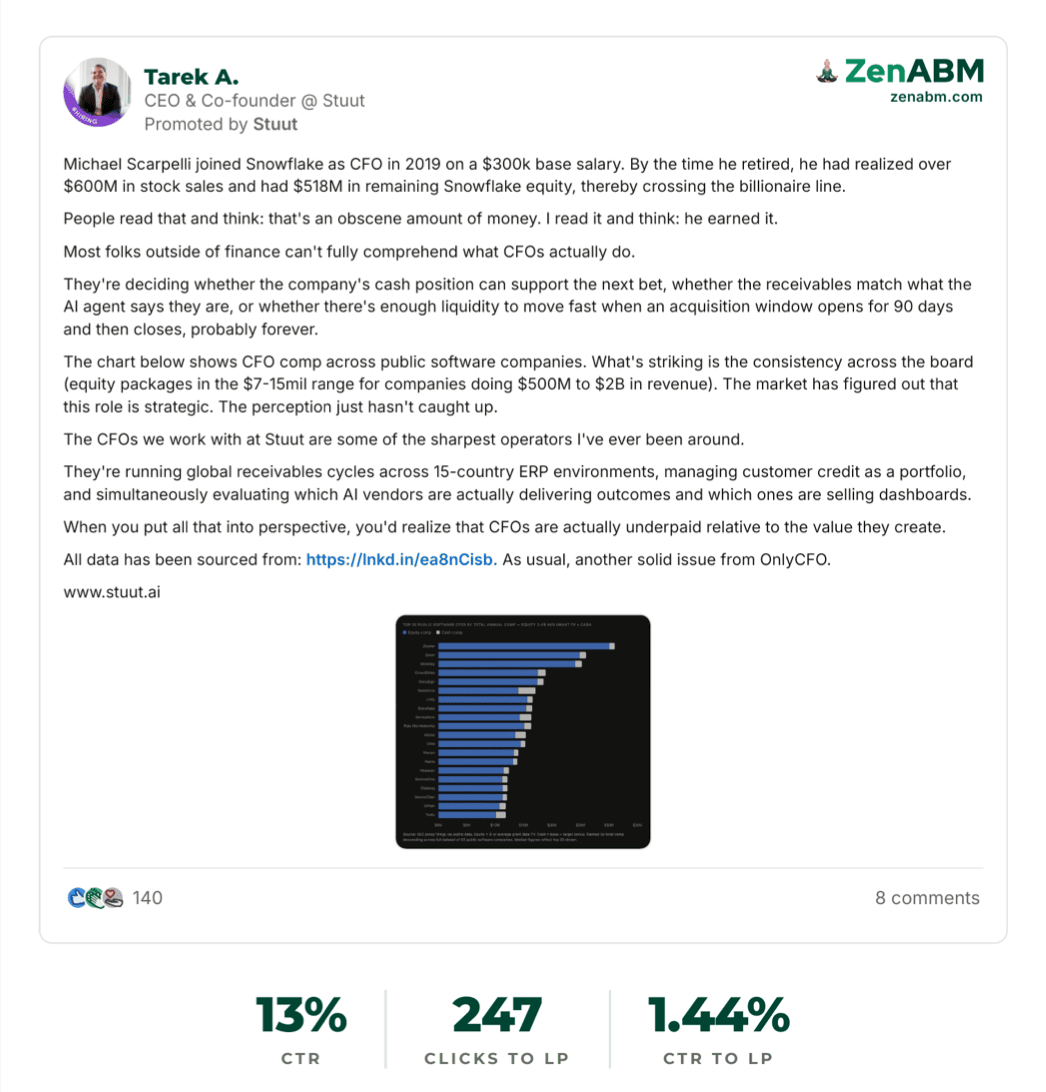
These six ads come from our TLA gallery, each from a different industry. Scroll sideways through the cards, then compare them in the table below. CTR counts every click on the post, including "see more" and reactions, so the column to compare is CTR to landing page:
Ad | Opening line | CTR | CTR to landing page |
|---|---|---|---|
Falk Schubert for Hawk (AML compliance) | "The economics of AML compliance are broken." | 5.5% | 5.58% |
Steve Dickenson for Ecologi (climate) | "This photo proves two things:" | 28.5% | Not on the card (11.2s dwell time) |
Steve Armenti for twelfth agency (ABM agency) | "Head of Marketing. Team = you + 2 people." | 4.7% | 2.75% |
Tarek A. for Stuut (finance software) | "Michael Scarpelli joined Snowflake as CFO in 2019 on a $300k base salary." | 13% | 1.44% |
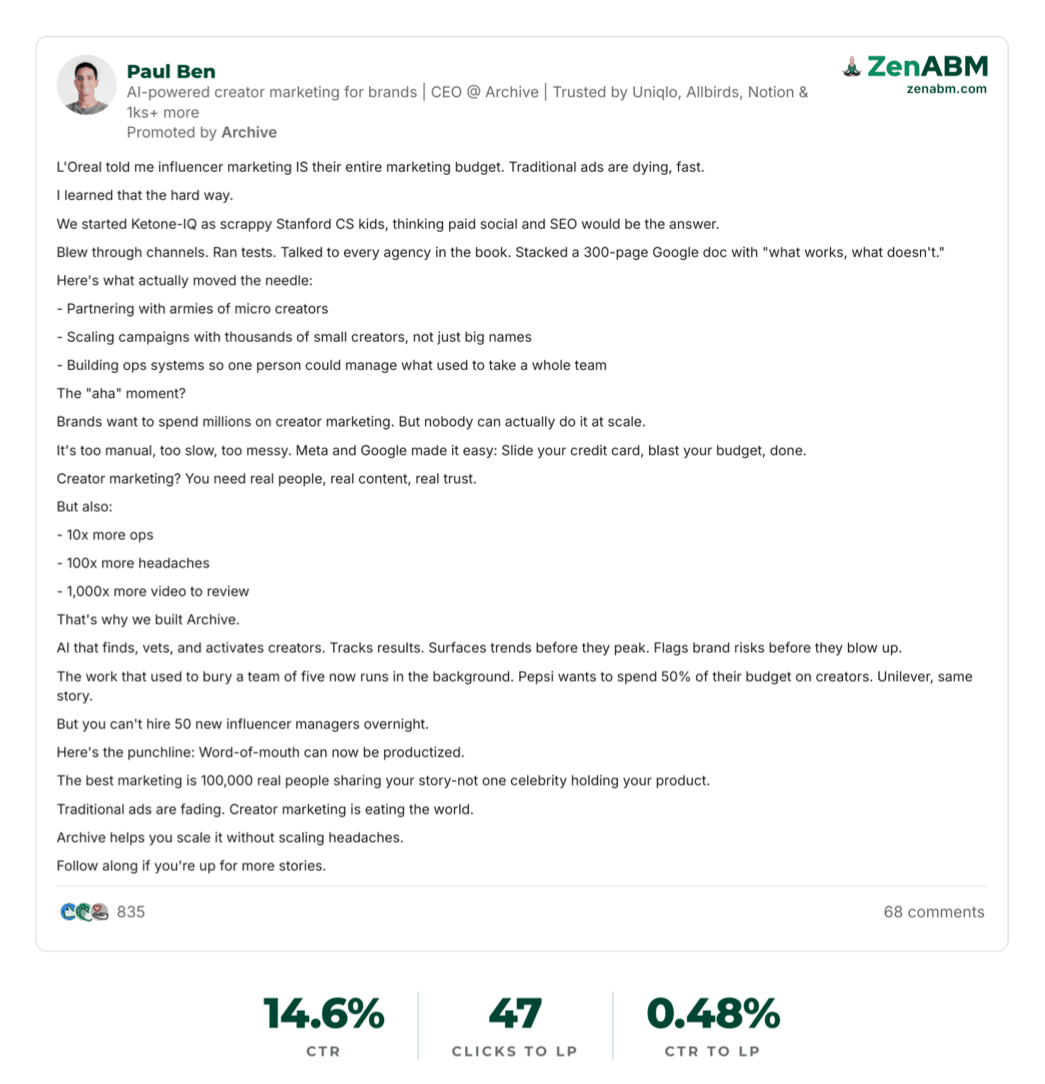
Paul Ben for Archive (creator marketing) | "L'Oreal told me influencer marketing IS their entire marketing budget." | 14.6% | 0.48% |
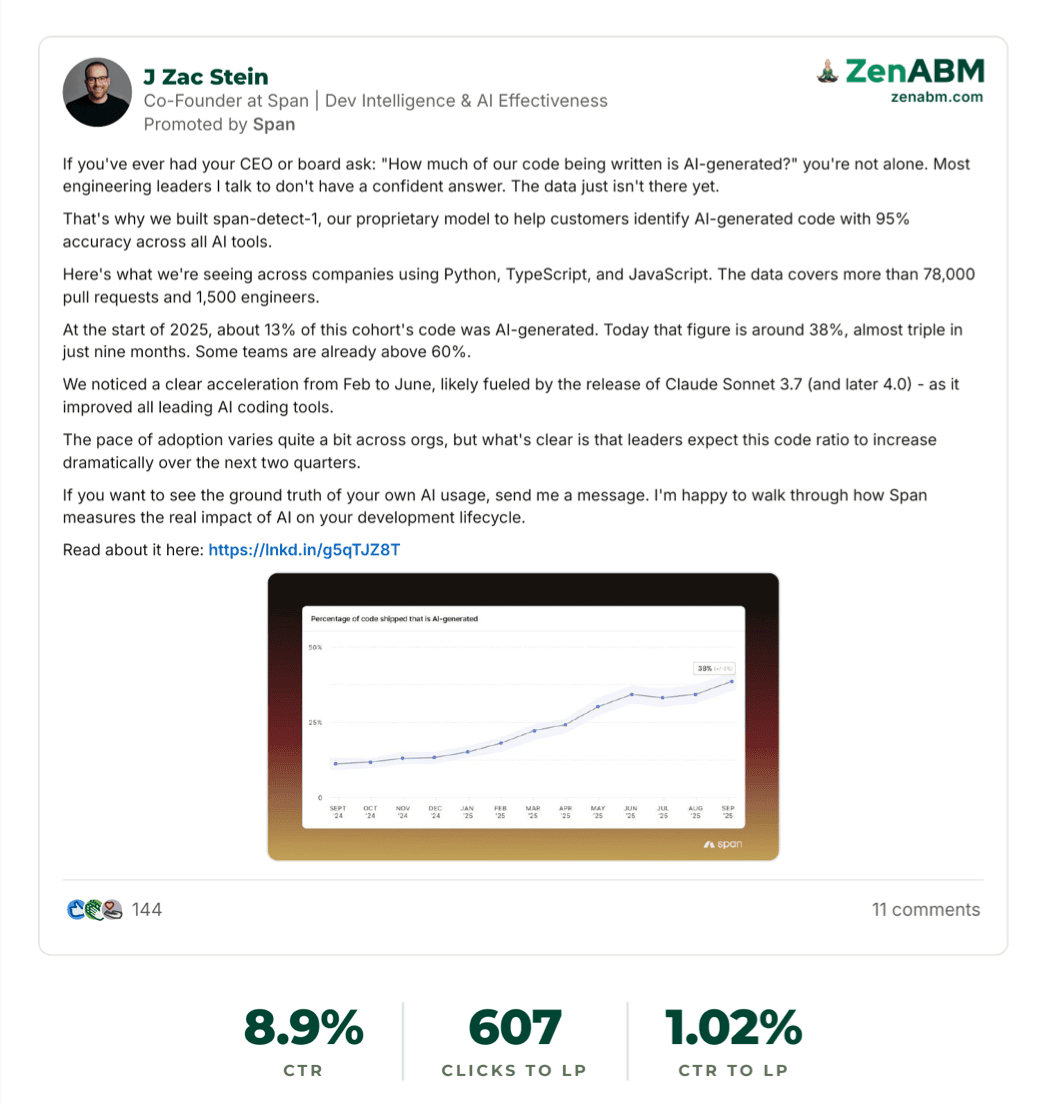
J Zac Stein for Span (developer tools) | "If you've ever had your CEO or board ask: "How much of our code being written is AI-generated?" you're not alone." | 8.9% | 1.02% |
Archive's ad shows why: a 14.6% CTR looks great, but only 0.48% of the people who saw it went to the landing page.
LinkedIn Thought Leader Ads are sponsored posts from individual profiles rather than company pages, and they are sometimes called thought leadership ads. They look like regular LinkedIn posts but reach your target audience through paid promotion, with only a small "Promoted by [Company]" note underneath.
This matters because B2B buyers trust people, not logos. As Ali Yildirim explains: "The advantage of thought leader ads is they appear as regular posts from individuals rather than company pages. No ad badges or corporate messaging that people instinctively scroll past."
LinkedIn introduced TLAs in 2023 for employee posts only. In March 2024 it expanded them to posts from any LinkedIn member who gives you permission.
You can promote text-only posts, single image posts, native video posts, articles and newsletters, and posts with third-party links.
You cannot promote documents, polls, multi-image posts, reshared content or "celebrate an occasion" posts.
The objective depends on the post type, according to LinkedIn's help page. Video Views only works when the promoted post is a video, and Website Visits is not available because a TLA post does not have to contain a URL.
You may hear that a lead generation objective is coming soon. LinkedIn's help page lists none for any TLA post type today, so I would not plan around it.
Here is the objective support by post type at a glance:

Check these before you pick a post:
Spec | What LinkedIn allows |
|---|---|
Ad format | Single image, video or event ad |
Content source | An existing organic post from a personal profile |
Author approval | Required for third-party posts, and the author can revoke it at any time, which switches the ad off |
CTA button | Not available for single image or video TLAs, but you can add URLs to the intro text |
Editing | You cannot edit the post from the ad, so edit the organic post itself |
Visibility | The post must be public and the member's profile must show their full name |
Recommended length | 1,000 to 1,500 characters (our recommendation, not a LinkedIn rule) |
A TLA does not need an image or a video. A text-only post works fine, because the format promotes whatever the person published.
TLAs work because the viewer sees a person first, not a logo, and reads the post like any other post in the feed. There are three structural reasons, and then there are the cases where they don't work.
According to the 2024 Edelman-LinkedIn B2B Thought Leadership Impact Study, 73% of B2B decision-makers say thought leadership is a more trustworthy basis for assessing a company's capabilities than marketing materials.
The same logic applies to who writes the post: the CEO talks best to CEOs, and a senior product manager talks best to product managers. Our TLA gallery has plenty of TLAs written by founders and CEOs. Here is one from Marc Woodland, CEO of Winbox, who opens with the pushback every agency hears, "Our CEO will never post on Linkedin.", and argues that they should. It reached a 10.4% CTR and a 0.98% CTR to landing page:

Most B2B ads fail because people recognise them as ads immediately: they are polished, corporate and emotionally detached. TLAs blend into the feed because they are real posts from real people.
Philip Ilic puts it simply: "Organic content + LinkedIn Thought Leader Ads + Warm Outbound = the best go-to-market strategy for sales-led SaaS right now."
Here is Philip's post promoting a Loom video, an example of the organic-plus-paid approach:

When a company engages with your TLA, you know a real person at that account reacted to your content, so you can follow up while the account is warm. Philip describes the workflow: "Run ~5 Thought Leader Ads to your ICP. Work from a list of about 1,000 companies. Watch the 'Companies' tab inside your ad account, see which companies are clicking, commenting, engaging. Export that list, upload to Clay, enrich with contacts, warm outbound."
ZenABM does this at company level. It tracks TLA engagement per company even when nobody likes or comments, and it can push engaged accounts to Clay over webhooks.
TLAs are not a replacement for conversion ads. They warm accounts, and a retargeted single image or video ad with a specific CTA does the asking.
They also fit badly in three situations:
TLA CTR counts every click on the ad (likes, comments, shares and "see more"), while single image ad CTR counts landing page clicks only. A 2.68% TLA CTR next to a 0.42% single image CTR is therefore not a fair comparison.
The fair comparison is eCTR (effective CTR, landing page clicks divided by impressions) and eCPC (effective CPC, spend divided by landing page clicks). Here are our median benchmarks on that basis, from 2,828 ads across 211 companies in our early 2026 benchmark:
Metric | Thought Leader Ads | Single image ads |
|---|---|---|
Median cost per landing page click (eCPC) | $3.06 | $13.23 |
Median CPM | $49.37 | $59.15 |
Median dwell time | 6.63 seconds | 3.64 seconds |
Efficiency score (out of 10) | 9.5 | 3.2 |
An eCPC of $3.06 is 77% cheaper than single image, and the longer dwell time means people actually read the post. TLA CTR and CPC measured on all clicks (a 2.68% median CTR and a $2.29 median CPC) are real, but you can only compare them with other TLAs.
Here is the benchmark table from the report:

Campaign Manager doesn't show eCTR or eCPC, so you have to calculate them yourself:
ZenABM calculates both out of the box, TLAs included. A TLA with no link in the post produces zero landing page clicks, so analyse TLAs with and without links separately.
The $3.06 above is a median from early 2026, and costs have moved since. Philip Ilic's newer analysis found TLAs at $25.21 per landing page click vs $11.80 for single image, which is 2.2x more expensive, and TLAs were cheaper in only 34 of 173 accounts. 😬
His research with Kiin also shows that the best 25% of accounts pay $10.82 or less per landing page click, so the spread between accounts is huge. Kiin's 2026 benchmark panel puts single image TLAs at $25.02 per landing page click and video TLAs at $73.56.
My own Userpilot data tells the same story of "it depends on your posts". TLAs with a link in the post body had a 0.90% eCTR and $12.73 eCPC vs 0.43% and $13.71 for image ads. But only six TLAs without links pushed the format average up to $16.30, as I shared on LinkedIn.
Cost also depends on the campaign objective, and there is no consensus. In Kiin's paired data, cost per landing page click was a tie ($17.24 for Brand Awareness vs $17.22 for Engagement, 36 pairs). Brand Awareness reached 77% more people per dollar, and Engagement got 88% more engagements.
In my recent Userpilot experiments, Brand Awareness gave better CTR and cheaper landing page clicks, while Philip's earlier $300K analysis (in Step 1 below) favoured Engagement.
Scaling fast makes costs worse too. Across 940 campaigns, Kiin found that doubling a campaign's spend makes each landing page click cost 26% more, and quadrupling it makes it 66% more. So raise budgets gradually and track eCPC weekly.
You need a steady supply of posts, and the three sources are your internal people, your customers and B2B influencers. At Userpilot, roughly 50% of our TLAs come from influencers, roughly 30% from internal stakeholders, and only 10 to 20% from customers, as I said in our webinar on building a deliberate TLA programme.
Internal stakeholders are our second best performing source, with one condition: the voice must match the persona. The CEO talks to CEOs, and the head of product talks to product managers, as I explained in our webinar on recruiting contributors. At Userpilot, a product manager's post about their own mistakes reached an 8.7% CTR.
Don't expect executives to write the posts themselves. Interview them regularly and give them a finished draft to tweak in their own style, because otherwise the TLAs will not happen. About $45,000 a month of our Userpilot ad spend goes to TLAs from internal stakeholders.
Customers with case studies tell strong, authentic stories about why they use you, and Tim Davidson says about 99% say yes when asked. Our own customer advocacy programme has not been very successful, so make it a deliberate programme with an incentive instead of an ad hoc ask.
An influencer your audience respects can vouch for you with receipts and data, and people trust that. In an experiment splitting TLA budget between internal stakeholders, influencers and customers, the influencer ads performed better than all other TLAs, as I showed in the TLA Bootcamp keynotes.
We promoted five influencers sourced through Passionfroot, spending about $6,000 on the posts and another $7,000 on ads. You pay for an influencer post once and you can promote it indefinitely, so the benefit keeps accruing. I covered the details in my LinkedIn post on why I'm bullish on TLAs.
Here is what you need to know about the two sourcing options:
LinkedIn also launched Creator Marketplace in Campaign Manager in June 2026, but it is in alpha, limited to the US and Canada, and only supports English-language content.
Before you spend on ads, look for posts that already perform well organically and ask the author to amplify them. If your people won't post, ask them to post first and then sponsor their posts from the backend.
A TLA is not created in Campaign Manager. The author publishes an organic post first, and you promote it by adding it to a campaign whose ad format matches the post.
Pick Brand awareness or Engagement (and Video views for video posts). As we discussed above, there's no professional consensus on which objective works better.
Philip analysed the numbers on one side of that debate. Philip Ilic tested both: "I analysed 300k worth of TLA data. When optimising for Engagement, the average CPC to the landing page was 4.80, compared to 7.90-12+ for Brand Awareness, up to 2x more efficient."
My recommendation is to start with Engagement, then test Brand Awareness against it with the same posts and compare eCPC.
Here is the objective selection in Campaign Manager:

Select "Single image ad", "Video ad" or "Event ad", depending on the post you plan to promote. A text-only or single image post uses the single image type.
Here is the member search in ZenABM's Content Library:

Authors can revoke permission at any time, which immediately turns off the ad. This is the Content Library with a post selected to sponsor:

Set your audience, daily budget and schedule as for any LinkedIn campaign, and keep each audience above LinkedIn's 300-member minimum. Budget $50 to $100/day per TLA campaign.
Turn off Audience Expansion and the LinkedIn Audience Network, and use manual bidding that starts 30% below the recommended range. ZenABM's Budget Savers keeps the first two off on every ad set, including ones you create later.
Launch the campaign and check the Engagement report for clicks to landing page. Here are TLA engagement metrics in Campaign Manager:

Our analysis of 119 TLAs separates top performers (2.00%+ CTR) from underperformers. Here is what they have in common:
Pattern | Top performers | Bottom performers |
|---|---|---|
Voice | First-person "I" (65%) | Corporate "we" (45%) |
Link placement | Bottom 25% of text (75%) | Mid-text placement |
Character length | 1,000 to 1,500 characters | Too short or too long |
Opening hook | Specific pain point (65%) | Generic statements |
Social proof | Concrete metrics (45%) | Vague claims |
CTA type | Specific resource or link | Webinar CTAs (0% in top 20) |
Here is a summary of the best practices and pitfalls we see:

The TLA Bootcamp was an event ZenABM ran in June 2026, where we analysed 50+ TLAs submitted by LinkedIn ad experts, showed them with their CTR, eCTR and dwell time in an art gallery, and ran talks on why TLAs perform so well. These are the points I make in them:

The winners are long-form (1,000 to 1,500 characters) and built as a "problem and solution" story. Our analysis of top performers gives this structure and character budget:
Here is a generated example that follows the pattern, with a story hook and a free implementation offer:

You can use this checklist directly in your Claude to generate your next winning TLA in your own style. The /abm-campaign-execution skill generates LinkedIn ad copy, creative briefs and mockups that are ready to launch. Our TLA generator does a quick version in the browser.
There's a very simple hack that can really boost your TLA performance: edit your organic post a few days after posting and add your landing page link to the body. Tim Davidson, one of the most recognisable LinkedIn Ads experts, has reported this too: "Demos from LinkedIn thought leader ads went from ZERO a month to 6+ a month. 8 turned into opps and 1 closed won. All from one small change: editing the post and adding a CTA link."
Here is Tim's post:

A link doesn't hurt paid reach the way it hurts organic reach, and it lets you track landing page clicks. Place it after the value has been delivered, like the 75% of top performers that put it in the bottom 25% of the text.
We keep a gallery of top performing TLAs with their metrics, built from the TLA Bootcamp submissions, and you can browse it or submit your own. 👀
Below are examples with the numbers we have on record. We don't have per-ad CPC and dwell time for all of them. For reference, our top TLAs hit 9 seconds of dwell time vs 6 seconds for top single image ads.
Valueships, a SaaS pricing agency, targeted senior SaaS executives in the US, UK and DACH. The post opened "Millennials: skinny jeans are still cool! (they're not). SaaS: seat-based pricing is still cool! (it's not)". It reached 20.92% CTR, 4.69% eCTR and 1,394 landing page clicks at $0.10 each.
Here is Valueships' TLAs in LinkedIn's Ad Library:

Why it worked:
A second post led with a real company and a concrete number: Amos Bar-Joseph at Swan AI paid Anthropic $51,217 in one month, then asked a provocative question about pricing. It reached 21.03% CTR, 3.02% eCTR and 141 landing page clicks at $0.02 each.
This is the invoice-proof TLA in the gallery:

Why it worked:
A TLA telling the personal story of reaching $650K in pipeline from ABM ads in about a quarter reached a 17.4% CTR and a 3.4% eCTR, which means very cheap clicking.
Here is the post:

Why it worked:
When we targeted product managers at Userpilot, a product manager from our team posted about product mistakes, drafted for them from their own experience. It reached an 8.7% overall CTR.
Why it worked:
One of my own posts hooks with a personal transformation story that shares a pain. Its gallery card shows a 4.4% CTR, 521 clicks to the landing page and a 0.95% CTR to landing page.

Why it worked:
Here is another of our top performing TLAs, from my Userpilot account:

Most of our top performers run 1,000 to 1,500 characters, but short can work when the one fact is strong enough. Ahmed Khairy, CEO of Gameball, opened with "If you've received a reward while buying groceries in Saudi Arabia, there's a 33% chance it was powered by Gameball." and added a one-line PS about what Gameball does. It reached a 12.1% CTR and a 2.21% CTR to landing page:

Why it worked:
Matej Trbara, co-founder of Farseer, opened with "Last week a pharma CFO told me they ran their entire H1 forecast on one scenario." and only brought Farseer in after explaining why finance teams end up there. It reached an 11.3% CTR and a 0.85% CTR to landing page:

Why it worked:
Bill Stathopoulos's post for SalesCaptain shared a Clay workflow and asked readers to comment to get the Clay table. It collected 505 comments, but reached a 3.1% CTR and a 0.37% CTR to landing page:

What to take from it:
In our live ABM Bootcamp teardown, two TLAs and single image ads ran to the same target accounts for 48 hours. TLAs delivered 74 landing page clicks for $131.58, an eCPC of $1.78, vs 28 clicks for $269, or $9.64, for single image ads (5.4x cheaper). The text-heavy posts did better than the shorter ones.
The most common TLA mistake is budget dilution. Plan for $50 to $100/day per campaign ($1,500 to $3,000/month), with 4 to 6 posts per campaign, though some people run 5 to 7. Aim for 3 to 5 impressions per account per week.
Philip explains the math: "Make sure your budget matches your audience size. If you're spending 2k/month and your audience is 300k people, no one's seeing your stuff."
Here are the budget and pacing formulas Ali Yildirim shares:

Philip recommends a three-tier structure:
"I set up accounts mostly with 3 campaign groups: Prospecting, Nurture, and Convert. 1. Prospecting: Cold campaigns designed to reach new, relevant audiences and feed your retargeting pools. 2. Nurture: Middle-of-funnel campaigns focused on education, brand, and credibility. Zero-click TLAs. 3. Convert: Retarget Thought Leader Ad engagement with conversation ads. This combo is fire."
Here is the full-funnel framework:

In a webinar on planning ABM with AI, the proposed structure was:
Rotate the TLAs instead of launching all your good organic posts together. The ABM Budget Calculator helps you plan your own split.
Here is a summary of the anti-patterns that kill TLA performance:

Maximilian Herczeg advises: "Don't run just 1 post as a campaign. Better: 4 to 6 variants with different content. This gives you comparison data and nurtures the audience with multiple perspectives."
Gabriel Ehrlich puts it like this: "Don't use hashtags in TLA. We pay to reach the right people: hashtags are unnecessary if your targeting is set up correctly."
Gabriel calls this out directly: "The whole post smells of AI (the em dashes, the vocabulary), it's all AI. We make ads sound like humans, not AI slop."
Philip found this pattern: "Most people are boosting the wrong content. Posts that do well organically aren't always the ones that convert in paid. You need posts that directly address your target audience's pain points." I would still not promote posts that did not resonate organically.
Without a link there are no landing page clicks to measure, so add one as described in the landing page hack above.
Zero of our top 20 TLAs used webinar CTAs, and 20% of the bottom 20 did. Everyone runs webinars and people won't give away their email for them, so offer a specific resource instead.
Rotate by frequency, not by calendar. Tim Davidson rotates when average frequency hits 3, and Gabriel Ehrlich treats frequency 2 as the point where a TLA starts to die. ZenABM's Bidding agent flags ads whose CTR has been sliding and pauses them once you approve.
Measure eCTR, eCPC and dwell time (calculated as described above), and then company-level engagement. Philip identifies the core challenge: "Most people fail with LinkedIn Ads because they can't track influenced pipeline. If you're spending budget on content + distribution with LinkedIn ads, and can't prove it's influencing pipeline or revenue… your boss (or client) will shift budget to Google Ads."
Campaign Manager's Companies tab shows aggregate engagement, and ZenABM goes further. Here is ZenABM's ad performance dashboard:

I asked Zena, ZenABM's AI agent, which ad formats the accounts I opened deals with had engaged with most. The overwhelming majority of engagements came from TLAs, which I used to defend the spend. In companies Userpilot opened qualified deals with over two months, TLAs drove 316 clicks vs 12 for image ads.
You can also retarget website visitors through the Insight Tag, or push engaged accounts to Clay for outbound.
Across top-performing TLAs, overall CTR (all clicks) ranges from 4.49% to 17.39% with an 8.32% average. For a TLA on the Engagement objective, 7% is already good and above 10% is very strong.
The real signal is downstream. Among top performers, eCTR sits between 0.81% and 3.42% (1.18% average, 0.35% median), while across all 119 TLAs the median is 0.29%. An eCTR above 1.2% to 2% is very solid, and below 0.30% is weak.
Dwell time predicts clicks: 6 to 7 seconds produces roughly 0.7% to 1.0% eCTR, while 3 to 4 seconds produces 0.16% to 0.26%.

Ali Yildirim shared this result: "We just closed a $120K ACV contract with a publicly traded company off $2,035.17 in spend on a Thought Leader ad." His point: "Most people think success with Thought Leader ads comes down to budget or optimization tricks. That's not where this gets won or lost. Write content people actually want to read."
In our Valueships case study, TLAs delivered 2,669 landing page clicks on $391 of the $6,204 total budget, at a $2.31 CPM and $0.15 per landing page click. Valueships booked 12 meetings in the first two weeks and closed an enterprise deal within 21 days.
Philip Ilic tested a concentrated TLA strategy: "This month we spent more and the budget was super concentrated on just one ad initiative: Thought leader ad to landing page (asking for email) to ridiculously strong follow-up. Our cost per call dropped by close to half."
Tim Davidson's link edit, covered above, turned zero monthly demos into 6+, with 8 becoming opportunities and 1 closing.
ZenABM is built for ABM on LinkedIn ads, and these capabilities handle the TLA-specific steps:
Here is ZenABM's campaign performance and ad format benchmarks:

Here is the ad sets timeline for one company's engagement journey (PayPal):

A thought leadership ad on LinkedIn is a sponsored post from an individual profile rather than a company page. It looks like a regular post and reaches your target audience through paid promotion, with only a small "Promoted by [Company]" note underneath. Because it keeps the author's identity and engagement, it feels more organic than a standard company ad.
Yes, for B2B companies where someone can write credible posts. In our early 2026 benchmark, TLAs cost $3.06 per landing page click vs $13.23 for single image. Philip Ilic's newer analysis found them more expensive, so track your own eCPC. They fit badly if nobody posts or if your budget is under $1,500/month.
Our median CPC is $2.29, but it counts all clicks, so use eCPC instead. That is a $3.06 median in our benchmark, though Philip Ilic's newer data shows $25.21. Costs vary widely by account and objective, and you should budget $50 to $100/day per campaign ($1,500 to $3,000/month) to get meaningful data.
TLAs run as single image, video or event ads from an existing public organic post, and you can promote text, image, video, article and newsletter posts. Documents, polls and multi-image posts are not supported. There is no CTA button on single image or video TLAs, but you can add URLs to the post text, and you cannot edit the post from the ad.
Start with Engagement, then test Brand Awareness. There is no professional consensus: Philip Ilic's $300K analysis favoured Engagement, with a $4.80 CPC to the landing page vs $7.90 to $12+, while other tests, including mine, found Brand Awareness cheaper per landing page click. Compare eCPC on the same posts.
LinkedIn's Companies tab in Campaign Manager shows aggregate engagement. For company-level tracking, use ZenABM's Company engagements view, which shows each engaging company with its score, ABM stage and CRM data, and syncs signals to HubSpot, Salesforce or Attio.
