Thought Leader Ads for ABM: Tim Davidson’s RPCD Framework for Turning LinkedIn Posts into Pipeline
Emilia Korczynska
Published ·Updated
Share this post
Thought Leader Ads are the most misunderstood format in LinkedIn advertising, and that misunderstanding costs teams real pipeline.
Most teams either avoid them entirely because the organic post “only got 5 likes, so it will not work as an ad,” or they run them without a strategy by promoting the CEO’s content regardless of its relevance to the buyer.
Both approaches leave significant pipeline on the table, which is a shame given that TLAs consistently deliver landing page clicks at $1.78 versus $9.64 for single image ads, a 5x cost difference on the exact same outcome.
This post covers Tim Davidson’s (founder at B2B Rizz) session at the ZenABM ABM Bootcamp 2026, where he shared his RPCD framework (Right Person, Right Content, Right Distribution) for running Thought Leader Ads for account-based marketing (ABM).
In case you’re short on time, here’s a quick overview:
Thought Leader Ads are one of the most misunderstood LinkedIn ad formats, but they can drive far cheaper landing page clicks than standard single-image ads when used correctly.
Organic post performance is a poor predictor of TLA performance. A post that gets very little organic engagement can still work extremely well as a paid ad when it is shown to the right audience.
Tim Davidson’s RPCD framework is the core strategy here: Right Person, Right Content, Right Distribution.
For the Right Person, founders tend to perform best, buyer-matching peers are strong second choices, and sales reps are usually the wrong fit unless you are selling to sales reps.
External TLA sources can work extremely well, too, especially customers, ex-customers, influencers, and brand fans who already have authentic credibility with your target audience.
For the Right Content, the best-performing TLA posts are personal, specific, and honest. Personal transformation stories, tactical playbooks, authentic customer stories, and sharp POV content consistently outperform corporate updates and polished feature announcements.
For the Right Distribution, start with the engagement objective, let the post run organically first, then add a CTA link after 2 to 3 days and promote it as a TLA. Frequency, not calendar time, should determine when to rotate the ad.
TLAs have technical restrictions that can quietly kill campaigns. Posts with multiple images or document attachments cannot be promoted as TLAs, and older posts may also become ineligible.
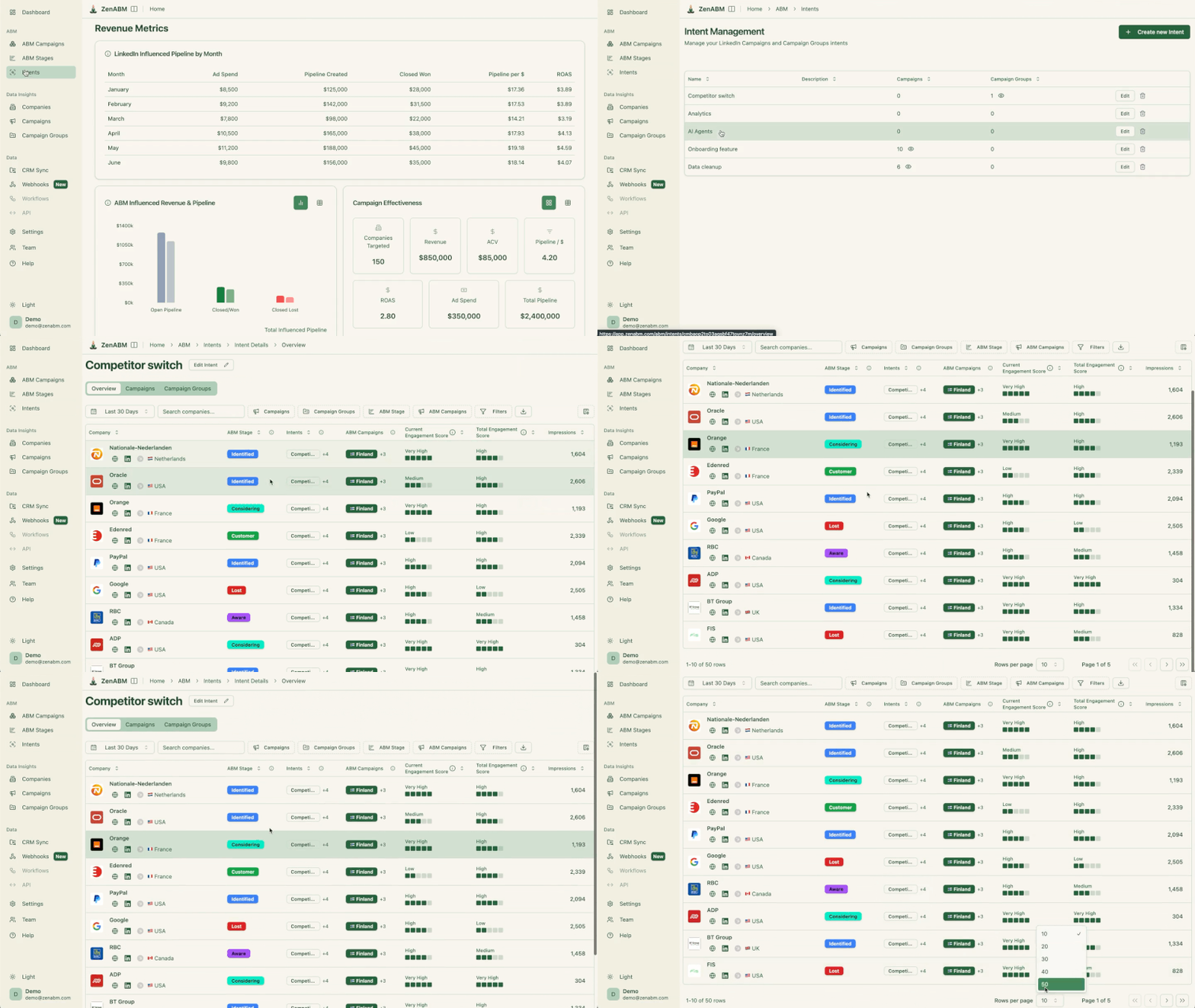
ZenABM makes TLAs more useful for ABM because it shows company-level LinkedIn ad engagement, qualitative intent by message resonance, CRM sync, and campaign-level account movement instead of leaving you with only aggregate campaign metrics.
The big lesson is that TLAs are not just a top-of-funnel vanity format. When the author, content, and distribution are aligned, they can become a highly efficient ABM lever for warming named accounts and creating more relevant follow-up opportunities.
Why Thought Leader Ads Work Better Than You Think
LinkedIn thought leader ads were found to be the top-performing ad format in 2026, as per ZenABM’s ABM Benchmarks report
The most common objection to TLAs is “but the post only got 3 likes, so it will not work as an ad,” and Tim’s response is that this objection confuses organic performance with paid performance, which are completely different contexts.
An organic LinkedIn post performs based on your existing follower base, the algorithm’s current distribution priorities, and whether your content triggers early engagement in the first few hours.
A TLA, by contrast, performs based on how relevant the content is to the specific audience you are targeting and how compelling the hook is for that persona.
A post can flop organically and perform exceptionally as a TLA because the people seeing it as an ad are exactly the people it was written for, not your general follower mix of colleagues, former coworkers, and random connections.
Tim’s strongest example: a post about making a specific B2B marketing mistake got 5 organic likes, but as a TLA targeting exactly the persona it referenced, it drove 3 demos in the first week.
The takeaway is simple: do not use organic performance as a proxy for TLA performance, because the distribution mechanics are fundamentally different.
The RPCD Framework: Right Person, Right Content, and Right Distribution
Tim Davidson’s RPCD framework for Thought Leader Ads for ABM
Let’s discuss Tim’s RPCD framework for LinkedIn thought leader for ABM in detail.
Right Person: Who Should Post Your TLA Content?
The author of the TLA matters more than most teams realize, because LinkedIn users see the post as coming from that individual (their photo, their name, their profile), which means the right author builds immediate credibility with your target audience while the wrong author creates friction even before the content is read.
Tim’s internal author priority order:
Founder/CEO: Founder-led content consistently outperforms other sources for TLAs because buyers trust founders and believe they have earned the right to strong opinions about the problems their company solves.
A buyer-matching peer: If you are selling to marketing leaders, a marketing leader on your team should post. If you are selling to engineers, get an engineer to post. The peer dynamic (“someone like me is saying this”) reduces skepticism in a way that no amount of polished corporate copy can replicate.
Any executive willing to post consistently: At this level, consistency matters more than title hierarchy. An eager VP who posts regularly is more valuable than a CMO who needs chasing for every post.
Anyone who will actually do it: The perfect author who never posts is less valuable than a genuine poster whose title is less prestigious, because a TLA that does not exist cannot drive pipeline regardless of how ideal its hypothetical author might be.
Who not to use: Sales reps, unless you are selling to sales reps. Sales reps’ LinkedIn content tends to read as salesy even when it is not, because the context of their role colors how readers receive the content before they have even finished the first sentence.
Right Person: External TLA Sources
TLAs do not have to come from your internal team, and in many cases, external authors can be more credible with specific audiences than anyone on your staff.
Customers and ex-customers: This is the most credible TLA source for late-stage buyers, and 99% of customers say yes when asked, according to Tim’s experience across dozens of clients.
Influencers in your space: Pay them to post (transparently, as a sponsored post) and then run their content as a TLA. This combines their audience reach with your precise targeting, so their followers see it organically while your ICP accounts see it as an ad.
Brand fans: These are people who have posted about your product organically without being asked. LinkedIn’s new Partnerships tab shows everyone who has tagged your brand, which gives you a direct source of TLA candidates whose content already carries authentic enthusiasm.
Right Content: What to Post for TLA Campaigns
Content that works as TLAs shares a common structure: it is personal, specific, and honest about failure or challenge.
Content that fails as TLAs tends to be corporate, vague, or focused on achievements rather than struggles.
The pattern is consistent enough that you can use it as a reliable filter before promoting anything.
Top-performing TLA content types:
Personal transformation stories: “I used to do X. I learned Y the hard way. Now I do Z.” These are first-person, built around specific outcomes, and honest about the mistake or the challenge. This is the format that generated Tim’s highest-performing TLA, where his founder told the story of how Userpilot got to $650K in pipeline in a quarter, including the mistakes along the way.
Playbooks and workflows: Specific, tactical, and immediately useful. Here is exactly how we run our ABM warm-up sequence in 5 steps.” The prospect gets value from reading it regardless of whether they click the CTA, which builds trust that compounds across multiple exposures.
Customer stories (not case studies): The difference matters. A case study is a polished summary; a customer story is a real narrative told from inside the experience. “Sarah at [Company] had this specific problem. Here is exactly what she tried first, why it did not work, and what she did differently.” Authentic, specific, and emotional in a way that PDF case studies never manage to be.
POV content: Strong opinions about the direction of the market, the mistakes everyone is making, or the conventional wisdom that is wrong. Polarizing content generates higher engagement from people who agree, and if you have structured your targeting correctly, those people are your ICP.
ZenABM makes this content choice more useful after launch because it lets you see whether a transformation story, playbook, or customer story attracted the right companies, the right personas, and the right downstream buying behavior.
Company-level LinkedIn ad engagement data for each campaign for a selected time period in ZenABMThe company buyer’s qualitative intent in ZenABM, which essentially tracks which particular messaging has resonated the most with each target account.
Deanonymize LinkedIn ad engagements, get intent, accounts scoring (starting @$59/month!)
Objective: Start with Engagement for TLAs because the Website Visits objective is not available for this format. Add your landing page link in the post copy, in the body of the text, rather than just as a call to action at the end. Tim’s data on this is striking: one client went from 1 demo per month to 6 by simply adding a link to their TLA posts, and the link was the only change they made.
CTA link timing: Post organically first and let it run for 2 to 3 days. Then edit the post to add a CTA link and switch it on as a TLA. LinkedIn allows post editing after publication, so use this to add the link contextually in the story where it fits naturally. Editing after the fact also lets you sharpen the hook for your paid audience: changing “marketers” to “VPs of Marketing at SaaS companies” in the text makes it more specific to the people who will see it as a targeted ad. Source
Longevity: TLAs run far longer than most teams expect. Tim had one TLA running for 8 months and still performing well. The key is to not pause a TLA based on the calendar but rather based on frequency: when the average frequency hits 3 (meaning the average viewer has seen it 3 times), rotate to something new.
Bidding: Manual CPC bidding, starting 30% below the recommended range. TLAs are efficient enough that overbidding is rarely necessary.
If you are running that distribution properly, ZenABM gives you the missing account-level feedback loop.
It shows company-level engagement by campaign, helps you compare how different TLAs perform across named accounts, and can push those engagement signals into your CRM so sales can act while the account is still warm.
LinkedIn ad data pushed to company lists in the HubSpot CRM using ZenABMPushing intent as property in ZenABM
TLA Technical Requirements That Kill Campaigns
These restrictions are not obvious in LinkedIn’s interface and catch many advertisers off guard, so it is worth knowing them before you commit to a content format:
Posts with 2 or more images cannot be promoted as TLAs. A post with a two-image carousel from an influencer cannot be used as a TLA even if the content is perfect, which means they would need to delete and repost with a single image.
Posts with document attachments cannot be promoted as TLAs. The document format is a separate LinkedIn format that cannot be combined with TLA promotion.
Posts older than approximately 6 months may be ineligible. LinkedIn restricts TLA promotion on older content, so if a post is stuck in review for days with no explanation, age may be the issue.
Single images: yes. Videos: yes. Multiple images: no. Documents: no.
LinkedIn Thought Leader Ads for ABM: The Takeaway
Thought Leader Ads work best when you stop treating them like boosted organic posts and start treating them like a precision ABM format.
The right author creates credibility, the right content creates relevance, and the right distribution setup makes sure that relevance reaches the right buyers at the right time. When those three pieces line up, TLAs can outperform more conventional LinkedIn formats by a wide margin.
The more important point, though, is measurement. It is not enough to know that a TLA got clicks or reactions. You need to know which companies engaged, what messaging resonated, and whether those accounts actually moved closer to the pipeline.
That is where ZenABM adds real value. Its company-level engagement tracking, qualitative intent signals, CRM sync, and account-level campaign visibility make TLAs much easier to evaluate as a serious ABM motion. If you are already investing in Thought Leader Ads, ZenABM is a strong layer to add so you can see what is actually working.
Some common questions asked about TLAs and their answers:
What types of LinkedIn posts work best as Thought Leader Ads?
Personal transformation stories (first-person, specific outcomes, honest about mistakes), tactical playbooks with specific steps, authentic customer stories told from inside the experience, and strong POV content with a clear opinion.
Corporate announcements, feature launches, and achievement posts consistently underperform as TLAs because they lack the personal authenticity that makes this format effective in the first place.
When should I add a CTA link to a Thought Leader Ad?
Add the link 2 to 3 days after posting organically, because letting organic reach run without a link first gives the algorithm a chance to distribute it without the external-link penalty.
Then edit the post to add a CTA link contextually in the body text where it fits naturally in the story, and promote it as a TLA. Tim Davidson’s data shows that going from 0 links to 1 link can triple demo conversion rates.
How long should I run a Thought Leader Ad?
Until average frequency hits 3, meaning the average person in your audience has seen it 3 times, at which point you should rotate to new content. TLAs can run for months if frequency is monitored properly, and one client ran the same TLA for 8 months with consistent performance.
Time-based pausing (every 30 days, every quarter) is the wrong trigger because it ignores how the audience is actually experiencing the ad; frequency-based pausing is the correct approach.
Can I use customer content as a Thought Leader Ad?
Yes, and this is often the most effective TLA source for late-stage buyers because it carries the credibility of a real user rather than a vendor.
Ask customers who have mentioned your product publicly to approve TLA promotion of their post, and send them the approval link directly via LinkedIn DM rather than relying only on the LinkedIn email notification.
According to Tim’s experience, 99% of people say yes when asked directly and personally.