Black Friday: up to 50% off ZenABM 💥Get up to 50% off ZenABM with our massive BlackFriday sale! 💥 - only 24-30 November!Get the deal12 Days of ABM Christmas · Report on your 2026 LinkedIn ABM & plan 2027 · Free webinars, 26 Nov – 9 DecSave your seat


Emilia Korczynska is Head of Marketing and co-founder at ZenABM. Before that she was VP of Marketing at Userpilot for nearly 7 years, where she ran a large ABM program primarily on LinkedIn ads.

Black Friday LinkedIn ads only work on WARM audiences: people who already know what you sell. NEVER on cold ones.
In this post I'll show you the best Black Friday LinkedIn ads I've seen this year (ours included), plus a few bad ones, and explain why they work or don't. Then I'll show you how to build the right audience for them, step by step, from your LinkedIn ad engagement, website visits and CRM data. Because even a great ad is wasted on people who have never heard of you.
(If you want the background on how the platform sells impressions first, our guide to how LinkedIn ads work covers it.)
ZenABM Black Friday: 50% off all plans
Ads from Claude, HOT company signals, dynamic audiences, CRM sync and revenue attribution at half price. New subscriptions only, until 30 November.

Here are the main points:
And here are the ads we'll go through, the good ones first and then the bad ones (scroll sideways):
Yes. On one condition: the offer has to reach people who already know what you sell.
Show it to strangers and you waste money, because a discount means nothing without context. 50% off what, exactly?
That's why I treat Black Friday ads as bottom-of-funnel conversion ads. They sit on top of the awareness you built earlier. They don't replace it.
AJ Wilcox structures LinkedIn funnels in three stages: stage 1 earns attention, stage 2 builds trust and stage 3 asks for the demo. Done properly, stage 3 often costs a fraction of what it would at stage 2. Black Friday is a stage 3 ad. So it only pays off if stages 1 and 2 have already happened.
Justin Rowe makes the same point from the account side: LinkedIn Ads accounts usually live and die by a strong and properly configured retargeting layer. This post applies that retargeting layer to one week of the year.
Now, most pages ranking for this topic treat Black Friday as a creative question (offers, copy, galleries). They rarely say WHO should see the ad. So I'm doing it the other way round: the audience first, then the ads, then the failures. ZenABM's own offer is the running example in the ad section.
One more thing: you can't build this sequence on the day. Plan it before the week starts. The four steps in order are:

The coupon and the end date need to exist in billing before the first ad goes live. Otherwise the deadline in your ad is a bluff.
So who exactly should see it?
Show Black Friday ads to warm, ICP-fit retargeting audiences. These are companies that already know what you do and match your ideal customer profile.
You build that pool from three sources, and you match website visits to your target account list. That way the audience is your market, and not whoever happened to click.
A cold audience has no context for your discount. The ad is noise, and you pay for the noise.
Broad targeting makes it worse. Broad targeting means LinkedIn's own company filters for industry, size and location, instead of an uploaded matched list. Your ad gets spread across thousands of companies that have never seen your product.
So never use broad audiences for Black Friday. Honestly, there's nothing worse than spending ad money pushing a discount on a tool to an audience that has never heard of you.
One source is rarely enough. So combine three:
You can set all of this up as rules in ZenABM Audiences. You pick your conditions from any LinkedIn ad engagement, plus contact-level and company-level events and properties from your CRM. Or you just describe the audience to Claude and build it through the ZenABM MCP.
ZenABM also scores the target accounts that look ready to buy, based on signals. The list below shows the kind of rules ZenABM uses: 5+ engagements, 3+ clicks, 1+ engagement, 50+ impressions with 3+ engagements, and engaged but never clicked. The button next to each signal creates an audience from it:

Whenever a company meets the conditions, the retargeting audience updates, so companies enter and leave it all the time. Here's one of ours: an "Interested from Signals" dynamic audience of 1,817 companies, built from the ABM stage condition and synced to LinkedIn:

The three sources feed one warm audience that you keep apart from cold:

Then exclude that warm audience from your cold campaign. The two layers don't overlap, and you can still read your results.
Plain website retargeting captures every company that lands on your site, including the ones you never wanted.
I learned this the hard way. When I audited our own website retargeting, the pool contained many bad-fit accounts, such as Microsoft and Meta. So I paused the spend (a four-figure budget) and moved it into a cold ABM campaign that produced $16 in pipeline per $1 spent.
Wait, cold? Didn't I just say never cold? Yes, for Black Friday. That campaign was cold ABM on a list we chose, with ads that build awareness. That's a different job from pushing a discount at strangers.
So if you use LinkedIn's native retargeting, always combine website visitors WITH a matched target account list audience. Layer the matched list over the website audience, and only visitors from companies on your list get served. That way you know the visit came from your TAM (your total addressable market). Not from competitors, students, customers, partners or bad-fit companies.
A static list is a snapshot. The day you export and upload a company list, it starts going out of date. And keeping it current means re-exporting and re-uploading by hand. Who has time for that in Black Friday week?
ZenABM keeps your LinkedIn retargeting and exclusion audiences updated every day from ad engagement and CRM rules, so you don't have to re-upload anything.
Then check the size. LinkedIn needs at least 300 matched members before it serves an audience, so check yours reaches that before you retarget.
Don't panic if your pool looks small, by the way. Philip Ilic looked at Conversation Ad data and found that median retargeting pools are about 3,300 people versus 45,000 for cold, and that the bigger the pool, the smaller its advantage over cold. Small pools are normal. That's exactly why the build matters.
Two timing traps to watch before the week:
Not sure your warm pool is big and clean enough? Talk to a LinkedIn Ads expert in our free expert chat before you spend.
Keep your warm audience updated every day
ZenABM builds LinkedIn retargeting audiences from your ad engagement and CRM data and refreshes them daily.
Ok, the audience is set. So what does the ad say?
The best Black Friday LinkedIn ads state the product's value first, list the savings clearly and give you a reason not to wait. Here are four real ones, and what to copy from each.
Good Black Friday ads don't just offer a discount. They reinforce the value of the product or service first, so the price is attached to something the buyer already wants.
Then they list the savings and the benefits clearly.
The strongest ads add FOMO (fear of missing out). They show the unpleasant consequences of doing nothing, and pair that with the offer to push you towards the "correct" action. A Black Friday ad can even sell an outcome with no discount at all, like protecting your margins, to a buyer who's already worried. That suits warm B2B audiences well.
Across the pages that rank for this topic, two patterns keep coming up. Good ads lead with the business outcome (not the words "Black Friday sale"), and they use one real deadline. For SaaS, the offers that work in practice are an annual-plan discount, a clear first-period price and a hard end date. A big headline percentage on its own doesn't do it.
The four steps of the good ad pattern, in order, give you a list to check your ad against:

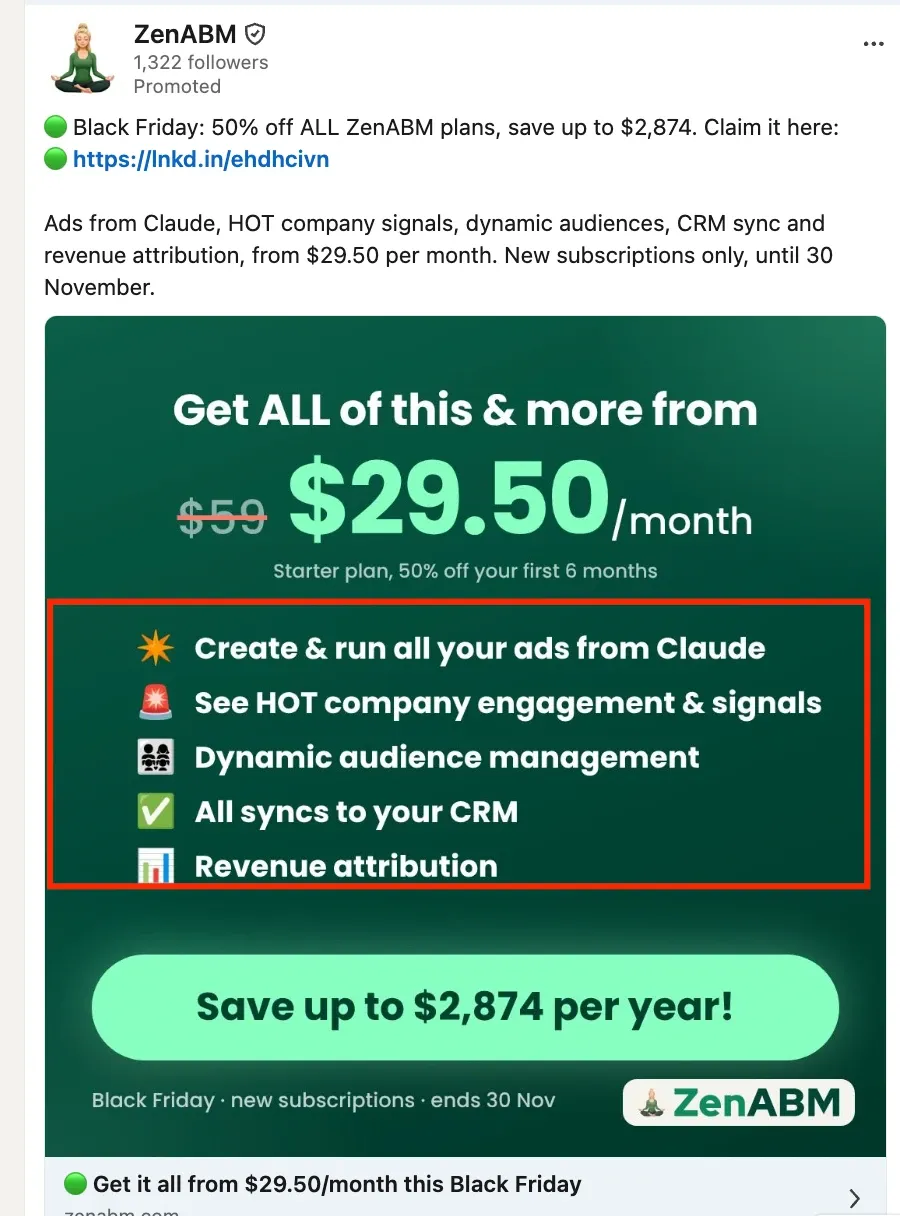
Let's start with our own ad. It leads with the number: "50% off ALL ZenABM plans, save up to $2,874".
The ad shows the $59 Starter price crossed out against $29.50 a month and says "50% off your first 6 months". It then spells out what you get: create and run all your ads from Claude, see HOT company engagement and signals, dynamic audience management, everything syncing to your CRM, and revenue attribution.
The ad closes with "Save up to $2,874 per year" and the fine print: new subscriptions only, ends 30 Nov. The live offer runs 24 to 30 November: 50% off the first year on annual plans, or 50% off the first 6 payments on monthly plans. Here is the ad, with the crossed-out price and the five benefits listed:

Why does the ZenABM ad work? The saving is a number. The old price sits right next to the new one. And the benefits tell a warm viewer what they're actually paying for. The end date does the FOMO job.
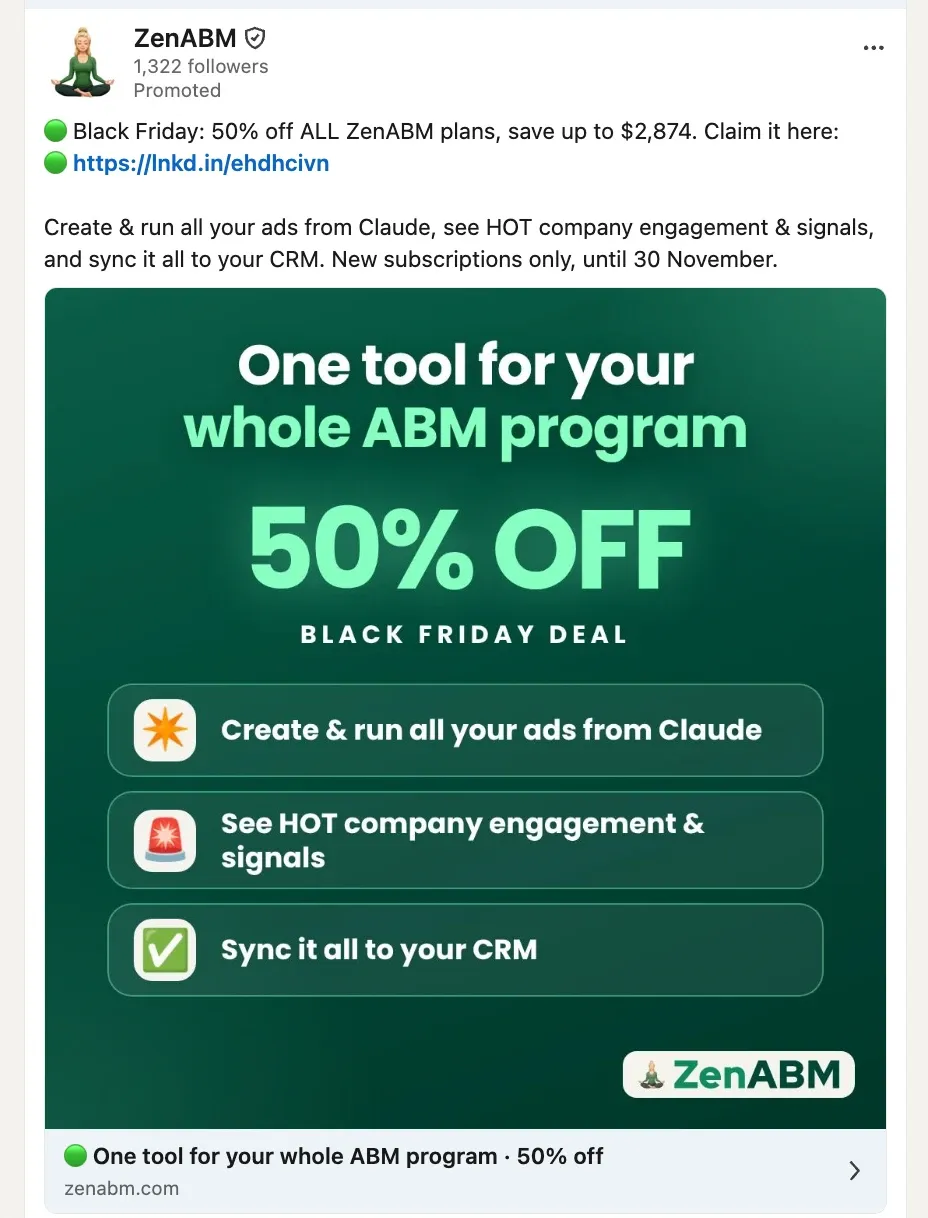
The second variant says "One tool for your whole ABM program, 50% OFF, Black Friday deal", with three benefit cards. It's shorter and gives the buyer one idea to hold.

What to copy: the crossed-out price, the first-period saving and the date.
Where it falls short (yes, ours too): "up to" and "new subscriptions only" mean a reader on a smaller plan sees a smaller saving. So the landing page has to make the real number obvious. A static ad like this is a single image ad, the format I'd use for any offer.
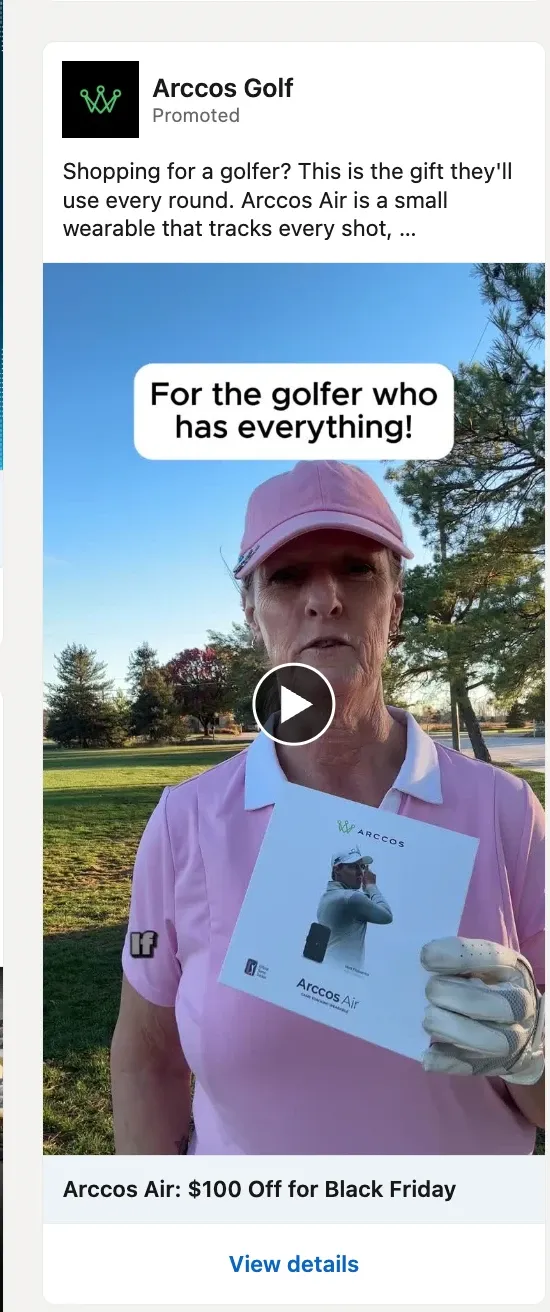
Arccos Golf runs a video ad with the line "For the golfer who has everything" and the offer "Arccos Air: $100 off for Black Friday". The video and the copy explain what the product does BEFORE the discount appears: it's a small wearable that tracks every shot. The ad looks like this:

The Arccos ad works because you learn the value first and meet the saving second. That's the order I'd copy. And the saving is named in plain money, not as some vague "deal".
Where it falls short for a B2B team: this is a consumer purchase with a flat price, so only the structure transfers. If you sell an annual software contract, show the first-period price as well as the discount, like our ad does.
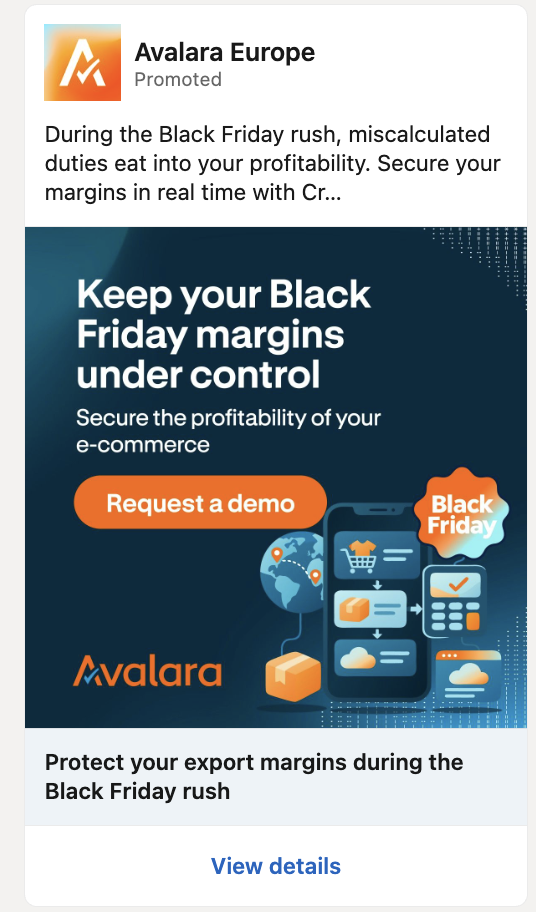
Avalara Europe isn't selling a discount at all. The ad says "Keep your Black Friday margins under control. Secure the profitability of your e-commerce. Request a demo", and the copy points out that miscalculated duties eat into profitability.

The Avalara ad works because it taps FOMO about the cost of doing nothing, and the demo is the action. It talks to a worried buyer at the exact moment the problem gets expensive. Perfect for a warm audience.
The catch? A demo request is a much bigger ask than a coupon. So this ad needs people who already know the duty problem. Copy the structure: name the cost, then the next step. A clean static ad like this is quick to build with the single image ad guide open next to you.
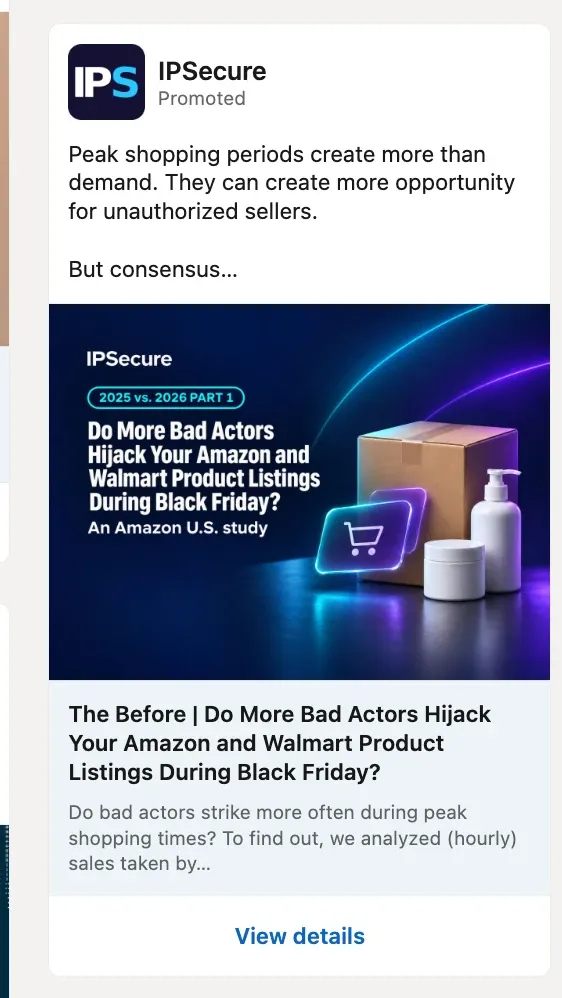
IPSecure leads with a question: "Do more bad actors hijack your Amazon and Walmart product listings during Black Friday? An Amazon U.S. study". The copy adds that peak shopping periods create more opportunity for unauthorized sellers. Here is the ad, which asks whether more bad actors hijack listings during Black Friday:

The IPSecure ad works because a study gives the hook credibility. And tying the risk to the season makes it specific and urgent. Again, no discount involved.
Where it falls short: a question headline plus a study invites a curiosity click. So the landing page has to continue the study, and not jump straight to a pitch. What to copy: attach a seasonal fact to a risk your buyer already worries about.
Need to build a clean static ad of your own? The free LinkedIn single image ad creator makes one without a designer.
Those four share a pattern. So do the failures.
The worst Black Friday LinkedIn ads fail in three ways: cold consumer promotions, cluttered AI-generated graphics and Thought Leader Ads pushing coupons. The rules above fix every one of them.
(Disclaimer: I'm criticising the ads and the formats here, not the people behind them.)
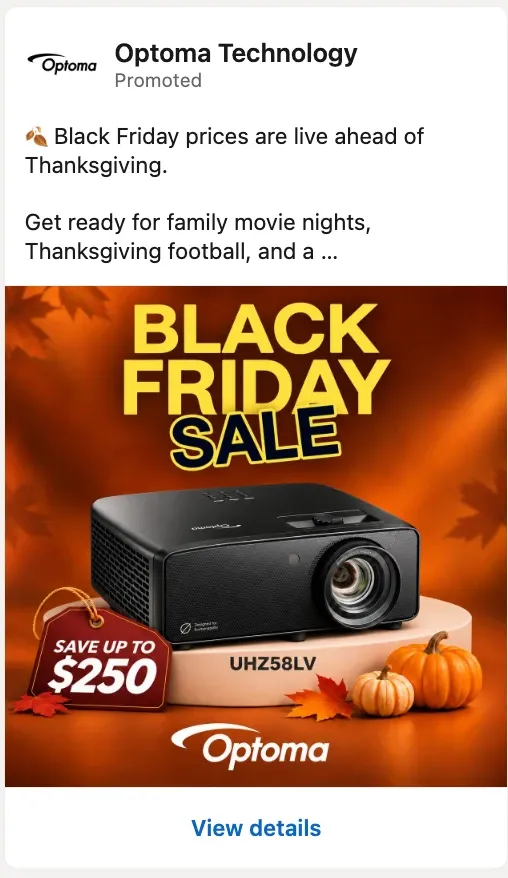
Optoma Technology's projector ad ("Black Friday sale, save up to $250", with pumpkins) sells a consumer discount to a professional feed. So does Grace First Collective's Grace Essentials Shop ad ("Black Friday starts now, everything 20% off, link in bio").
When was the last time you went to LinkedIn to shop for a projector? Or a hoodie?
Neither ad has any audience logic. And "link in bio" is a phrase from other platforms, so it gives a LinkedIn reader no clear next step. The Optoma ad is a consumer projector discount in a B2B feed:

Mixing audiences makes this worse. Charlie Mora-Smith audited a £50k LinkedIn Ads account where cold and warm audiences sat in the same campaign with the same creative and messaging. That usually gives messaging that resonates with neither group.
Cristina Maliţa found something similar: in her first month of stage tracking, a chunk of engaged accounts were warm only because retargeting and conversion ads had leaked into cold audiences.
A Black Friday campaign that blends cold and warm gets you the same problem. So keep them in separate campaigns.
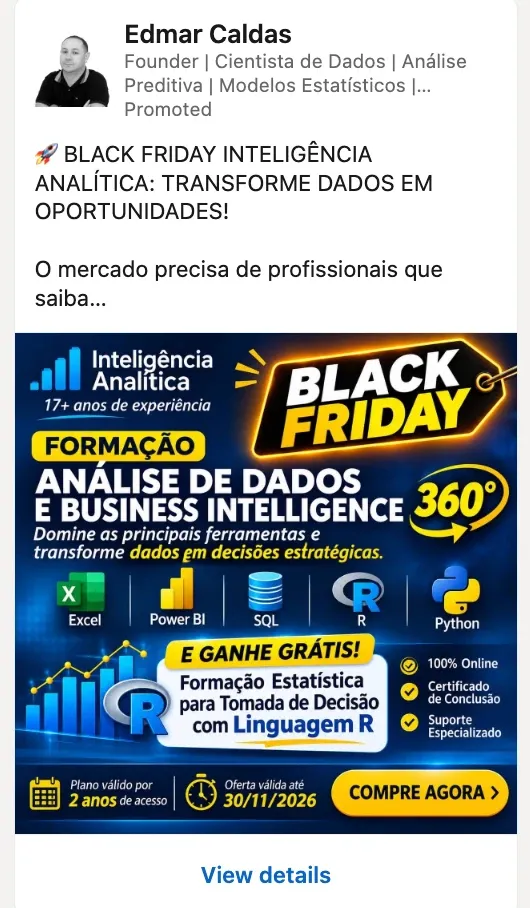
This Thought Leader Ad for a data analytics course is crowded with logos, badges and text:

Edmar Caldas's Portuguese data analytics course ad is crammed with logos, badges and text, so no single message survives. Someone scrolling the feed can't find the saving or the call to action. And poor-quality generated graphics hurt trust, too.
The fix? One clean message, with the savings and the call to action readable at a glance.
Edmar Caldas also ran his Black Friday course discount as a promoted personal post. That's a Thought Leader Ad (TLA), and it spends a trust-building format on a coupon.
Thought Leader Ads are for trust and point of view, not discount codes. LinkedIn also limits them to awareness and engagement objectives, so a discount TLA is a poor fit for a warm Black Friday sequence anyway. Use a single image or video ad to carry the offer, and keep your TLAs for the trust layer before the sale.
This table compares the three failures with the good pattern on audience, message and format:
Ad | Audience | Message | Format |
|---|---|---|---|
Cold B2C promotion | Random LinkedIn users | A consumer discount with no value story | Static ad aimed at the wrong feed |
Cluttered AI graphic | Whoever sees it | Logos, badges and text compete | Image with no single message |
Thought Leader Ad coupon | Cold or mixed | A discount code inside a personal post | A trust format used for a coupon |
The good pattern | Warm, ICP-fit | Value first, savings listed, one deadline | Single image or video ad |
The best ads pass six checks, and every failure above breaks at least one of them. Run your own ad against this list before you launch:
And the sequence matters as much as the single ad. Marc Woodland splits retargeting into two layers: mid-intent (educational content) and high-intent (book a demo, request an audit). That maps nicely to a pre-sale teaser and the Black Friday offer, as in our nurture campaign sequencing guide.
Justin Rowe's order of warmth, from his post on cold targeting, starts with your own pipeline and past clients. Next come the people in your ecosystem, such as website and company page visitors. Then lists built on fit and timing signals. Cold audiences come last.
It depends on what you already have: your CRM, your website traffic and the size of your warm pool. Find your situation in this table:
Your situation | Audience | Ad to run | Why |
|---|---|---|---|
CRM with trials, demos or closed-lost deals | CRM audience | Benefit ad with the savings listed, like ours | These people already know you, so a direct offer fits |
Website traffic only | Website visitors matched to a target account list | Offer ad with value first | The match keeps competitors and students out of the pool |
Small warm pool | A smaller, higher-fit audience | Hold the offer, or run one short burst | Too small a pool burns the same people |
No warm audience at all | None | Skip Black Friday and build the audience for Q1 | A discount to strangers wastes the budget |
A worried buyer (margins, risk, compliance) | Warm, ICP-fit accounts | FOMO ad without a discount, like Avalara or IPSecure | The cost of inaction is the offer |
How much can a warm pool actually produce? Gonçalo Prates gives a rough anchor: a 3,000-person remarketing audience generating around 20 meetings per month converts roughly 0.67% of the audience. Use it as a sanity check, not as a promise.
My own choice is simple: I'd run one clean ad to the dynamic warm audience and set a real end date. One clean ad to a warm audience beats a broad blast.
Read related: LinkedIn Retargeting Ads: How to Use Them for ABM
ZenABM covers each step above, from building the audience to checking what the sale produced:
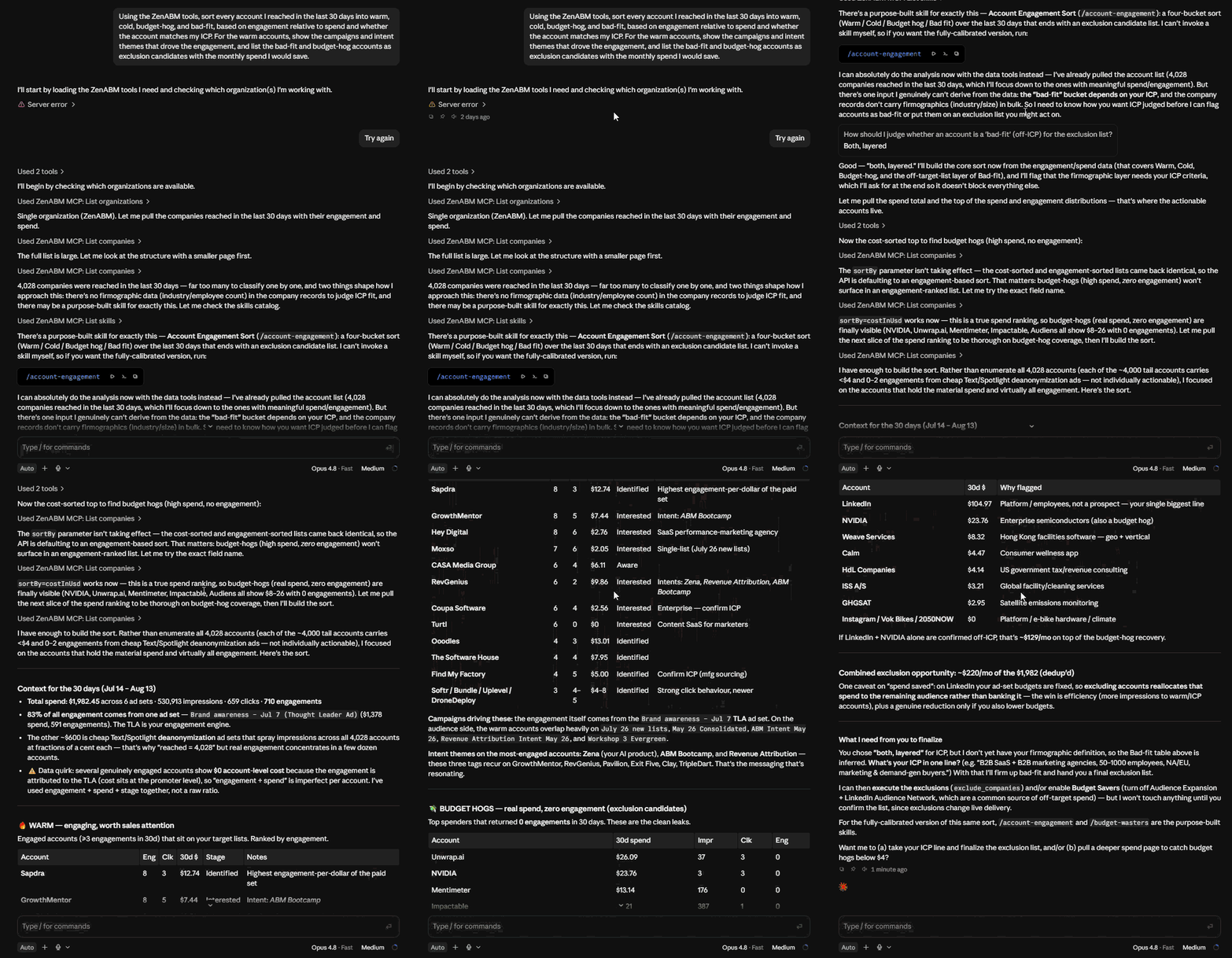
Here Claude, connected to the ZenABM MCP server, sorts accounts reached in the last 30 days by engagement into warm, cold, budget hog and bad fit:
Build your Black Friday warm audience in ZenABM
Connect LinkedIn Ads and start the 37-day free trial to build audiences that refresh daily.

So, to wrap up: a good Black Friday on LinkedIn starts before you write the ad. Get the warm, ICP-fit audience right, lead with the value, add one real deadline, and a simple ad does the job. Get it wrong, and the best graphic in the world is just money spent on strangers.
Yes, but only on warm audiences. A discount on a tool means nothing to people who have never heard of you. So run Black Friday ads only to retargeting audiences built from ad engagement, website visits matched to your target accounts and CRM events. Cold or broad audiences just waste ad money.
Companies that already know what you do and fit your ICP: engaged accounts, matched website visitors, trial signups and CRM contacts. Never use broad targeting or plain website retargeting, because it captures bad-fit companies. Combine website visitors with a matched target account list, so every visit comes from your market.
It reinforces the product's value first, lists the savings and benefits clearly, and adds FOMO about the cost of doing nothing, together with the offer. ZenABM and Arccos Golf list the savings and benefits. Avalara and IPSecure use FOMO about margins and listing risk. Then add one real deadline.
You can, but a Thought Leader Ad is a poor fit. Thought Leader Ads are for trust and point of view, not coupons, and LinkedIn limits them to awareness and engagement objectives. Use a single image or video ad to carry the discount, and keep Thought Leader Ads for the trust-building layer before the sale.
The warm audience should have at least 300 members. That's what LinkedIn needs to serve a matched audience, so check yours gets there before you retarget. And build the audience before the week starts.
Three common ones: cold B2C ads aimed at random LinkedIn users, cluttered AI-generated graphics crammed with logos and text, and Thought Leader Ads used to push discount codes. You fix them with a warm audience, one clear message with the value first, and the right ad format for an offer.
About the author

