



Most LinkedIn Ads accounts audited in the wild share the same structural problem: 50+ campaigns running simultaneously, no clear purpose for any of them, and a budget split that looks like someone threw darts at a board.
Cold lead-gen ads, retargeting, BOFU demos, and ABM list campaigns stack on top of each other in the same campaign group, fighting for the same audience and the same budget.
This guide walks through the LinkedIn ads campaign structure that actually works for ABM: a clean TOF/MOF/BOF LinkedIn ads funnel mapped to ABM account stages, with budget rules, retargeting logic, and a sales handoff that does not waste AEs’ time.
Each stage gets a breakdown covering how to think about it, how much budget to put behind it, which ad formats to run, and how to measure performance at the account level.

Short on time?
Here’s a quick overview:
The most common LinkedIn ads campaign structure seen in a typical account audit looks something like this:
None of those campaigns has a clearly defined funnel stage.
None are tied to an ABM account stage in the CRM. Budget splits roughly evenly across all of them, which means the BOFU ads (the ones that actually drive demos) are starved for spend while cold lead gen campaigns burn through cash on whitepaper downloads that sales will never call.
Tim Davidson (founder at B2B Rizz) put it well in a recent post about creating a new LinkedIn ads campaign:
“Creating a new LinkedIn ads campaign is like navigating a 53-year-old landmine field. You’re going for a little afternoon stroll and BOOOM. Budget wasted and sales is pissed at you for a bunch of intern leads. There is six and a half default settings (landmines) you need to navigate so you don’t waste all your money.” – Tim Davidson in his Linkedin post
The fix is not more campaigns.
It is fewer campaigns, each with a single, clear purpose.
That is the entire point of a TOF/MOF/BOF LinkedIn ads campaign structure.
Before opening Campaign Manager, every campaign about to launch needs to answer three questions:
If a campaign cannot pass that test, it does not get launched.
That single rule drives more account performance improvement than any creative test.
The cleanest LinkedIn ads campaign structure for ABM is three campaign groups, each pointed at a different job.
Philip Ilic at KiiN has been making this case consistently: most practitioners overcomplicate the structure and end up with no structure at all.
“Most ppl overcomplicate LinkedIn ads. Here’s how I keep it stupid simple. I set up just 3 campaign groups: TOF / MOF / BOF. Each has a clear objective. Most accounts I audit have 50+ campaigns with no clear purpose. Cold, warm, lead gen, retargeting, all mixed together. It’s chaos.” – Philip Ilic in his LinkedIn post
TOF is not a lead gen layer.
It is a retargeting audience builder, and its job is to put the brand in front of every account on the target account list often enough that engagement signals are usable downstream.
The objective is almost always “Engagement” or “Video Views”, not “Website Visits,” because the priority is low CPM, steady frequency, and filling the audience hub in Campaign Manager with companies and titles that can be pulled into MOF and BOF later.
Formats that work in TOF:


MOF is where the largest share of the creative budget belongs.
The audience is anyone who engaged with TOF: video viewers at 25% or above, website visitors, document ad readers, ad reactors, and engaged company lists.
Research by Professor John Dawes of the Ehrenberg-Bass Institute shows that 95% of B2B buyers are not in-market at any given time, which is precisely why demand creation at this layer matters far more than demand capture for the vast majority of the target account list.

Philip Ilic (LinkedIn ads expert) frames this layer well:
“Most people go straight for demand capture with LinkedIn Ads. That’s the bottom-of-funnel ‘book a demo’ stuff. The problem is that only 2-3% of your market is actually in-market at any given time. So what happens is you launch BOFU ads, you get a spike in demos, then it flatlines. This is why you need to build demand creation. This is normally the 180-day middle-of-funnel retargeting layer with the objective to deliver content. Zero-click style.” – Philip Ilic in his LinkedIn post
The 180-day window matters because B2B buying cycles are long, and Gartner research shows that the typical B2B purchasing decision now involves 6 to 10 stakeholders, most of whom will see ads many times before anyone on the buying committee raises a hand.
The metric for MOF is not clicks but engagement, dwell time, and the number of accounts that move from Aware to Engaged or Considering in the CRM.
What works in MOF:
BOF is the smallest layer by audience and budget but has the most direct revenue tie.
The audience is tight: high-engaged accounts from the Companies tab in Campaign Manager, anyone who hit the pricing or demo page in the last 30 days, and accounts that ZenABM has tagged as “Interested” based on cumulative ad engagement.
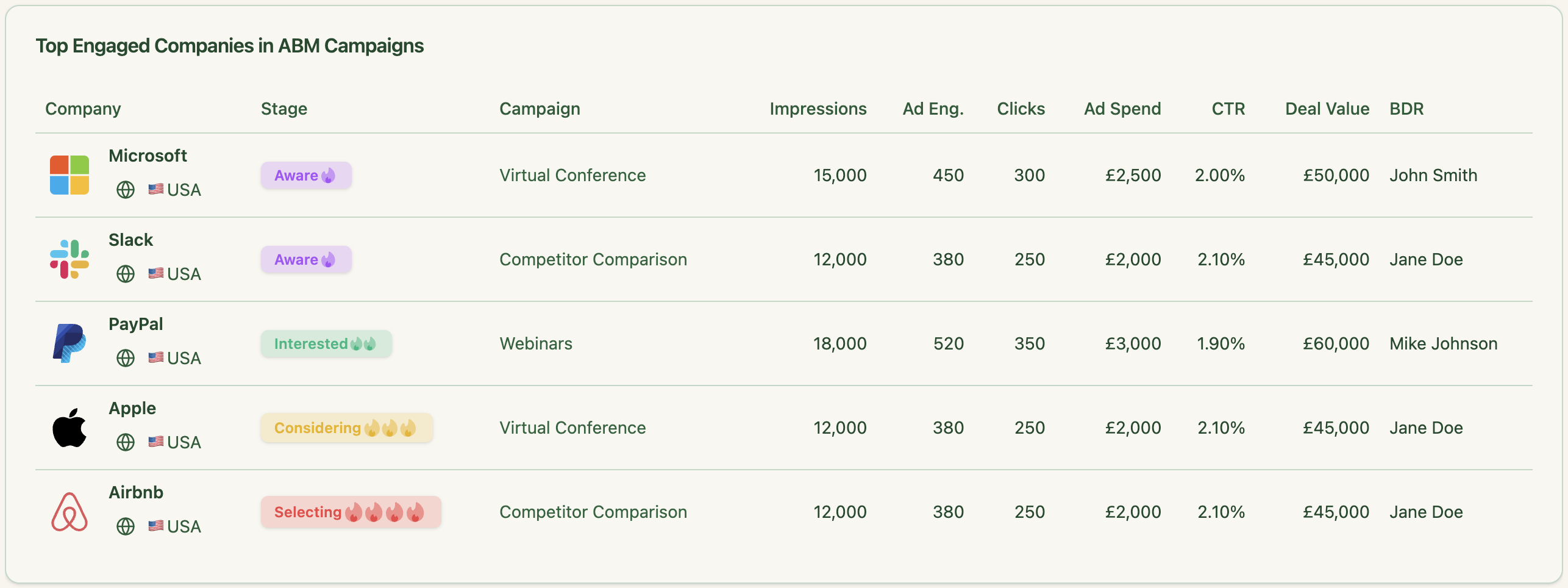


The objective is conversions or leads, with manual bidding, sized to the audience: small, intense, frequent.
For a deeper walkthrough on campaign architecture, the full guide on structuring LinkedIn ABM campaigns for pipeline growth covers the campaign-by-campaign setup.
Formats that work in BOF:

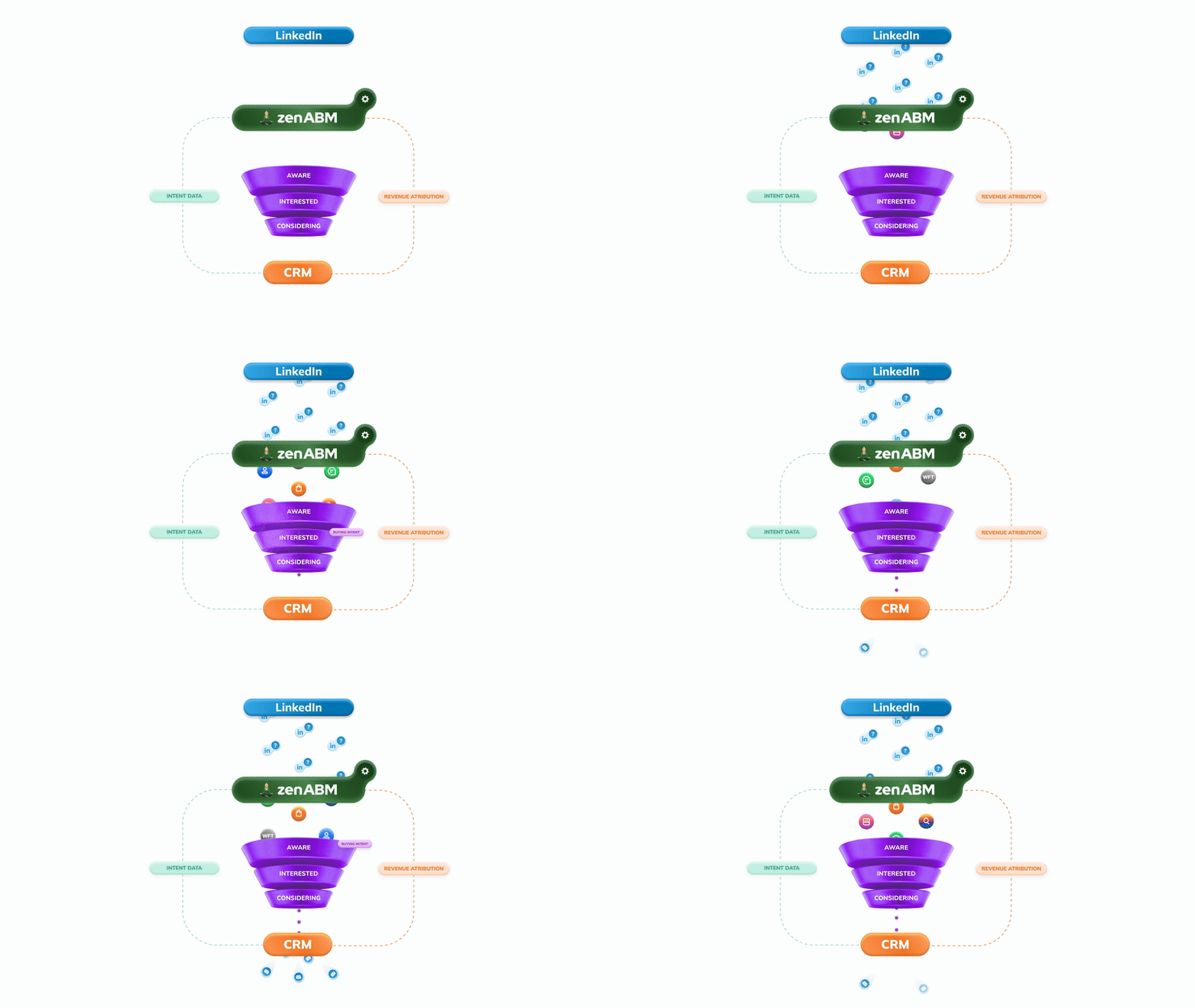
A TOF/MOF/BOF campaign structure on its own is just a media plan.
To make it work for ABM, every campaign has to push accounts through defined ABM stages, and the CRM has to reflect that movement.
The ABM stages are: Target, Aware, Engaged, Considering, Interested, In Pipeline, Closed Won.
Each stage has a definition, an entry trigger, and an exit trigger.

The mapping you can take inspiration from:
| ABM Stage | Funnel Layer | Campaign Job | Entry Trigger |
|---|---|---|---|
| Target | None yet | Account is on the TAL but has not seen an ad | Added to target account list |
| Aware | TOF | Account has seen 3+ impressions of brand content | 3+ paid impressions in 90 days |
| Engaged | TOF / MOF | Account is reacting, watching, or clicking | 1+ click, reaction, or 50% video view |
| Considering | MOF | Multiple buying committee members engaging | 2+ contacts engaged, or 5+ engagements |
| Interested | BOF | Account is showing in-market signals | Pricing page visit, demo CTA click, or ZenABM “Interested” stage |
| In Pipeline | BOF | Sales is in active conversation | Open opportunity in CRM |
The reason this mapping matters is that it kills a question every CMO eventually asks: “what is the LinkedIn budget actually doing?”
When every campaign is tied to a stage, the answer is concrete. TOF campaigns moved 412 accounts from Target to Aware last month. MOF campaigns moved 87 from Aware to Considering. BOF campaigns moved 14 from Considering to Interested, and 6 of those are now in the pipeline.
For a deeper walkthrough on how accounts actually progress, this guide on moving accounts from Aware to Considering covers the playbook stage by stage.
CTR and CPC are useful signals, but they do not indicate whether the program is actually moving accounts. Account stage progression does.
When the LinkedIn ads campaign structure feeds an account stage model, sales gets a concrete, actionable handoff: these 24 accounts moved from Considering to Interested this week, here is the engagement timeline for each.
That is a sales handoff.
CTR is not.
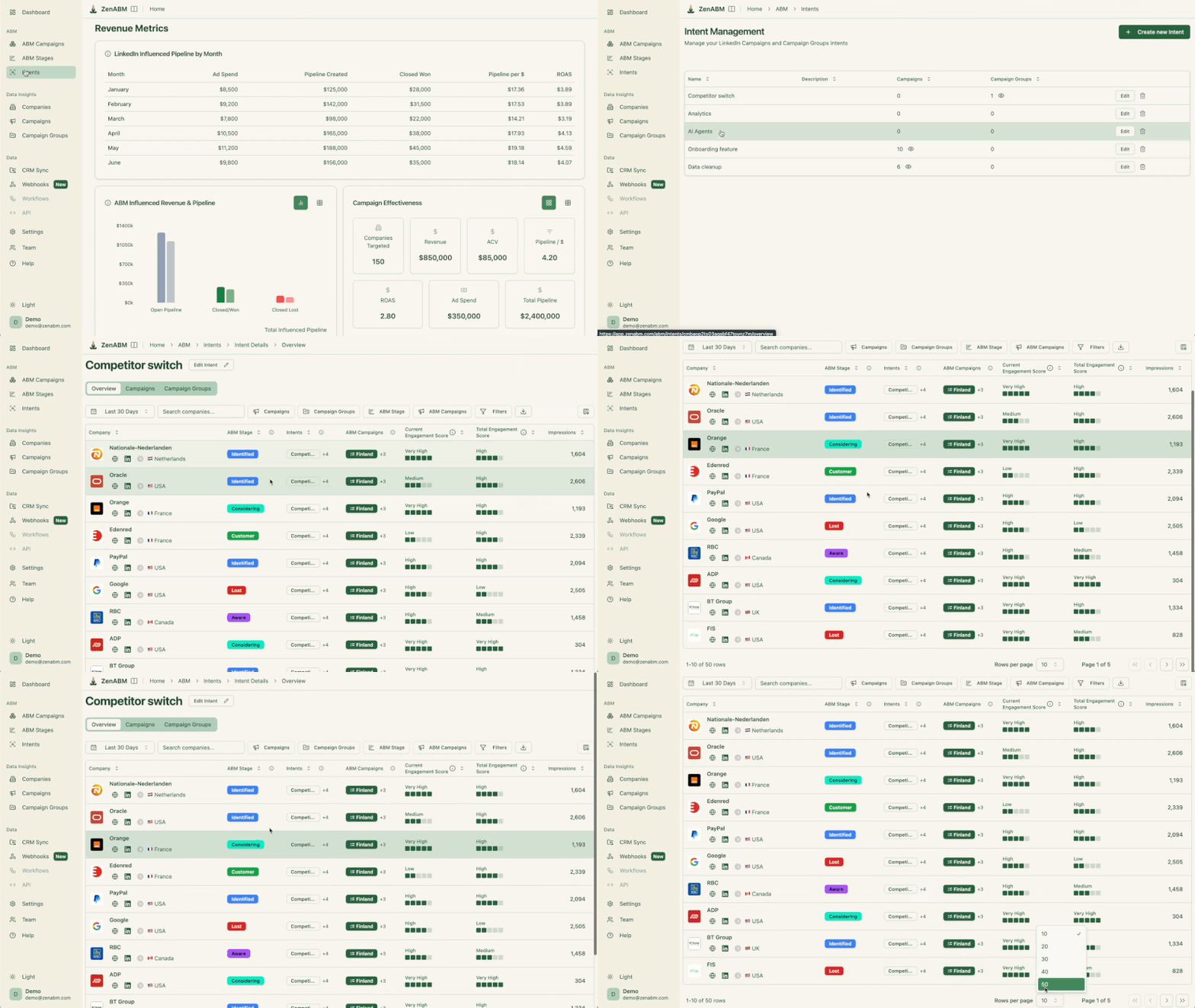
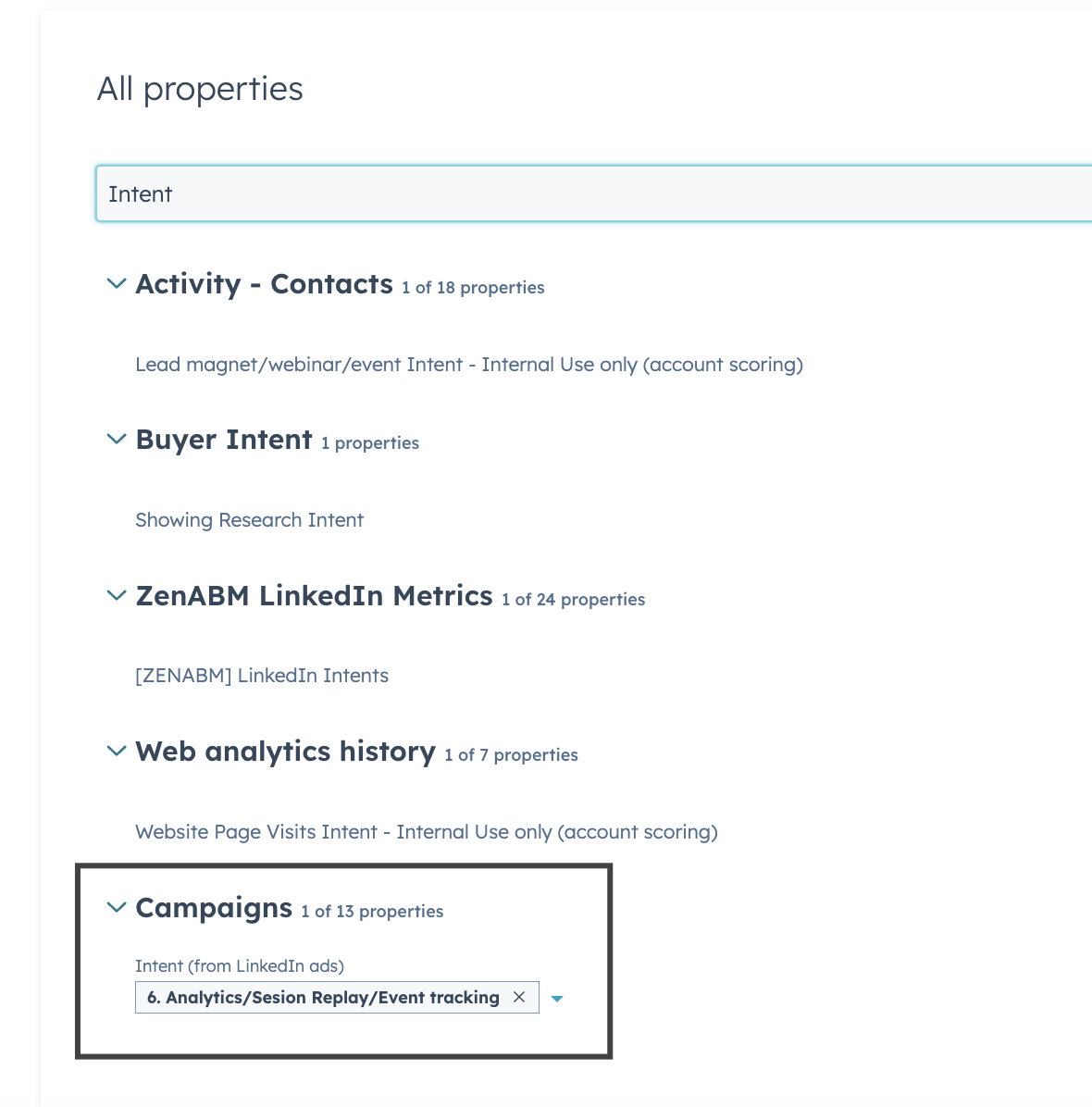
By the way, ZenABM operationalizes by assigning “interested” stage accounts to the BDRs in your CRM automatically:
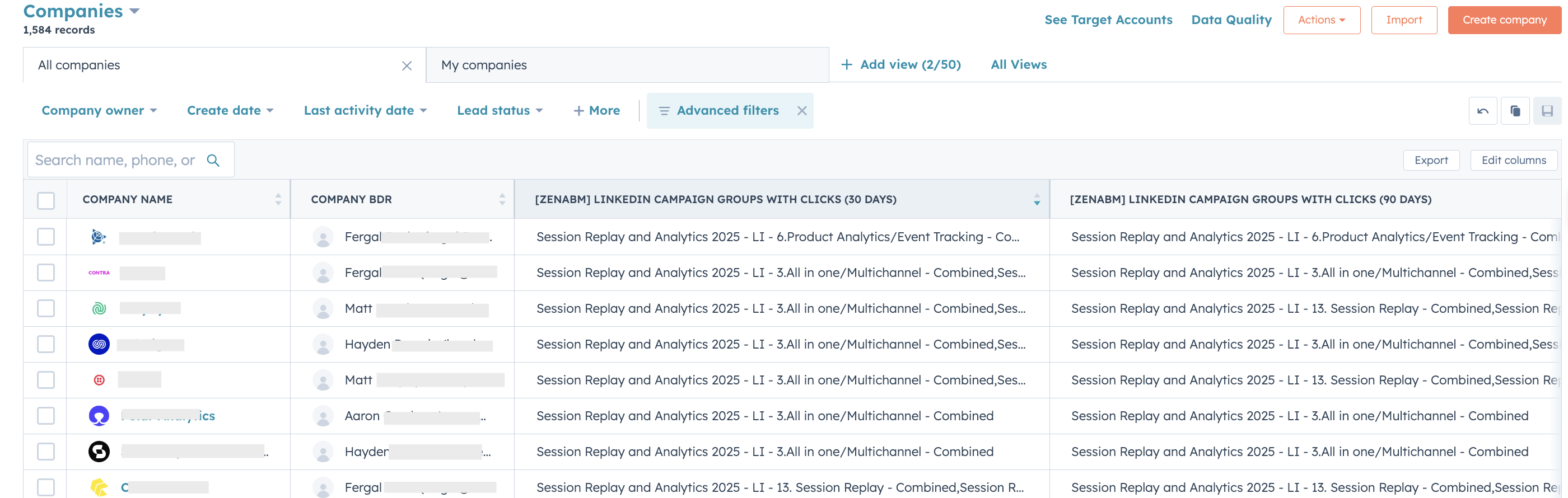
There is no universal split, but there is a sensible starting point for an ABM program where the goal is pipeline, not signups:
Budget shifts based on what the funnel actually needs.
If MOF is full but BOF is starving (lots of engaged accounts, no demos), more shifts into BOF retargeting.
If TOF coverage is thin (less than 30% of the TAL has hit 3+ impressions), budget shifts back into TOF.

Maximilian Herczeg, who ran accounts at LinkedIn before moving to independent consulting, has been one of the loudest voices on this:
“Manual Bid > Max Delivery: (Way) lower CPM and possibly higher engagement. The results for me so far were always clearly in favour of manual bidding.” – Maximilian Herczeg in his LinkedIn post
Manual bidding runs on almost every campaign.
The exception is conversion-objective campaigns where the audience is small, and LinkedIn needs to optimize for a rare conversion event.
Everything else stays on manual, with bids set close to the floor and incrementally pushed up if delivery stalls.
Frequency rules differ by stage. TOF can run hot on frequency because the goal is brand recall, so 8 to 12 impressions per person per month is acceptable.
MOF caps tighter to avoid fatigue on the same TLA: 4 to 6 impressions.
BOF is the highest frequency by ad but the smallest audience, which is exactly where volume makes sense.

Most LinkedIn ads campaign structures fail because the retargeting layer is an afterthought.
Dropping in a 30-day website retargeting campaign is not a retargeting strategy.
The 180-day MOF retargeting layer is the engine of a real LinkedIn ads funnel and the difference between a program that peaks once versus one that compounds over time.
The MOF audience is built from layered signals, stacked so the pool stays large enough to deliver efficiently over a long window:
For MOF, the metric that matters is audience penetration: what percent of the target account list has hit 3+ impressions in the last 30 days.

A LinkedIn ads campaign structure that does not connect to sales is a media plan, not an ABM program.
The BOF stage is where the structure has to deliver: not just demos, but qualified accounts handed to AEs with full context.
The handoff trigger is the “Interested” stage in the CRM.
An account hits Interested when two or more contacts at the account have engaged with paid ads in the last 30 days AND cumulative engagement crosses a threshold (clicks, reactions, comments, video views), OR a contact at the account hits the pricing or demo page.
Once an account hits Interested, it goes to the BDR queue with the full engagement timeline: which ads were seen, by which contacts, when, and what content they engaged with.
The BDR uses that context to write a warm outbound email rather than a cold one.


Lead gen forms are useful, but they over-index on people who fill out forms.
Most B2B buying committee members do not fill out forms.
They watch four videos, read two case studies, share a TLA with their boss, and then someone on the team books a demo.
That whole journey is invisible to a lead gen form but visible to a stage-based ABM model, which is why the BOF stage ties to engagement-based scoring rather than just form fills.
The full running ABM on LinkedIn guide covers the engagement-to-pipeline workflow in depth.
A few patterns show up consistently when auditing accounts.
Campaign Manager’s default “Group objective” forces every campaign in a group to share an objective.
The common workaround is cramming eight different objectives into one campaign group. The rule is one campaign group per funnel stage, period.
Whitepaper lead gen at the top of funnel is a budget killer.
Maximilian Herczeg (ex-LinkedIn) documented a client wasting 38% of their LinkedIn budget on whitepaper leads with a sub-3% MQL-to-SQL rate and zero closed deals, with sales ignoring the leads entirely.
TOF is a retargeting builder, not a lead-gen layer.
A 30-day website retargeting campaign set and forgotten is not retargeting.
Six months in, frequency hits 40 per person, creative is unchanged, and CPC has tripled. MOF creative needs a refresh every 4 to 6 weeks at minimum, with rotation within campaigns so individual ad fatigue does not kill the whole layer.
A campaign structure that does not feed stage progression in the CRM is just brand advertising with extra steps.
Every campaign needs a stage trigger so the data shows what is moving the funnel and what is not.
ABM list campaigns and broad ICP campaigns need different bid strategies, different creative, and different budgets.
ABM lists are smaller and warmer, which justifies higher spend per impression because the audience is pre-qualified.
Broad ICP is cheaper per impression but requires heavier downstream filtering.
A LinkedIn ads campaign structure that works for ABM is not complicated, it is disciplined.
Three campaign groups, one objective each, with TOF feeding the retargeting pool, MOF running demand creation across a 180-day window, and BOF capturing the small slice of accounts that are in-market right now.
The structure only earns its keep when every campaign maps to an ABM stage in the CRM, because that is what turns impressions and clicks into a sentence sales actually care about: these accounts moved from Considering to Interested this week, here is why.
The hard part is not the media plan; it is the visibility.
Knowing which accounts are progressing, which contacts engaged, and which campaigns drove the engagement that ended in the pipeline is the difference between a structure that looks good on a slide and one that compounds into revenue.
That account-level view is exactly the layer ZenABM adds on top of the structure described here, rolling LinkedIn engagement up to the company level and pushing the Interested stage straight into HubSpot or Salesforce so the funnel stays measurable end to end.
Also, to give a bigger picture, ZenABM also tracks Reddit Ads, Google Ads, etc., now.
Try ZenABM for 37-days for free or book a demo to know more!
Three campaign groups: TOF, MOF, and BOF, each mapped to an ABM account stage in the CRM. TOF runs cheap reach (TLAs, video, document ads) against the full target account list. MOF runs demand creation against engaged audiences over a 180-day window. BOF runs conversion-focused ads against in-market accounts. Budget split starts at 40/40/20.
40% TOF, 40% MOF, 20% BOF is a reasonable starting point for an ABM program focused on pipeline. Adjust based on funnel coverage: below 40% audience penetration means more into TOF; a full MOF with no demos means more into BOF retargeting.
TOF moves accounts from Target to Aware. MOF moves them from Aware to Engaged or Considering. BOF moves them from Considering to Interested. The CRM holds each stage as a company property, and the trigger to update it is engagement-based: impressions, reactions, video views, clicks, and page visits.
180 days. B2B buying cycles are long and a 30-day window misses the majority of the purchase consideration period where most B2B buying decisions actually happen.
TOF: audience penetration and CPM. MOF: dwell time, engagement rate, and stage progression from Aware to Considering. BOF: demos booked, accounts in pipeline, and Interested-to-pipeline conversion rate. CTR is useful but should not be the primary metric for any layer except BOF.
Manual tracking works with spreadsheets and the LinkedIn Companies tab but falls apart above a few hundred target accounts. ZenABM rolls up paid impressions, clicks, reactions, and video views to the company level, assigns ABM stages based on configurable rules, and pushes the stage into HubSpot or Salesforce as a CRM property, which is the data sales actually needs to act on warm accounts.
