

©2026 ZenABM - All Rights Reserved.
Emilia Korczynska is Head of Marketing and co-founder at ZenABM. Before that she was VP of Marketing at Userpilot for nearly 7 years, where she ran a large ABM program primarily on LinkedIn ads.

The best Madison Logic alternative depends on which part of Madison Logic you want to replace: the intent data, the media execution, or the whole stack. Madison Logic bundles buyer intent with content syndication, display, LinkedIn, CTV and audio on a custom quote, and teams usually leave over cost, a steep learning curve and leads that skew toward the top of the funnel. Below are 8 alternatives, ordered by which part of Madison Logic each one replaces and what it costs to run, starting with ZenABM for teams that run ABM on LinkedIn. If LinkedIn is where you advertise, first-party intent from your own LinkedIn ads is a much cheaper place to start.
Here is the whole post on one card, so you can see the groups and entry prices at a glance.

Tool | Category | Starting price | G2 rating | Core strength | Best for |
|---|---|---|---|---|---|
ZenABM | LinkedIn-first ABM | $59/mo billed annually ($69 monthly) | 5.0/5 (6 reviews) | Creates and manages LinkedIn campaigns with AI, company engagement, first-party intent signals, account stages, deal attribution, CRM sync | Teams that mainly advertise on LinkedIn and want engagement turned into sales action and pipeline proof |
Bombora | Third-party intent | Custom; from about $25K/yr per Vendr and Docket | 4.4/5 (161) | Company Surge intent topics | Teams that only want an intent feed |
Demandbase One | Enterprise ABM suite | Custom; Vendr median $68,591/yr | 4.4/5 (2,012) | Native ad platform, web personalization, sales intelligence and attribution in one suite | Enterprises that want display advertising at very large scale |
6sense | Enterprise ABM suite | Custom; Vendr median $62,440/yr | 4.3/5 (1,432) | Predictive scoring, third-party intent, multi-channel orchestration | Enterprises with budget and ops capacity for a full suite |
N.Rich | ABM advertising | From $34,830/yr | 4.7/5 (115) | Own DSP that turns intent into display and LinkedIn campaigns | Teams that can run programmatic ABM and have the ops muscle |
AdRoll ABM (formerly RollWorks) | ABM advertising | No platform fee for retargeting; other tiers custom | 4.3/5 (655) | Account targeting and retargeting across web and social with ICP fit grades | Smaller teams that want account-based ads without enterprise complexity |
Dreamdata | Revenue attribution | Free tier; paid plans custom (Vendr median $35,440/yr) | 4.7/5 (271) | Multi-touch journeys and pipeline attribution | Teams that must prove ABM impact on revenue |
Recotap | Mid-market ABM suite | $1,499/mo billed annually | 4.7/5 (57) | LinkedIn ad orchestration, 1:1 personalization, built-in Bombora intent | Mid-market teams that want a LinkedIn-first suite |
Madison Logic (reference) | Enterprise ABM platform | Custom quote | 4.3/5 (275) | Intent plus syndication, display, LinkedIn, CTV and audio | Large teams running multi-channel ABM at scale |
Not sure which row is yours? Pick by your situation.
Your situation | Best alternative | Why |
|---|---|---|
You mainly advertise on LinkedIn and want engagement turned into scores, stages and CRM updates. | ZenABM | Creates and manages LinkedIn campaigns, scores engaged accounts and syncs to your CRM, from $59/month. |
You like Madison Logic's intent-to-activation approach but want one suite that also runs ads and supports sales. | Demandbase One | One vendor for ads, engagement measurement and sales visibility, not just intent plus activation. |
You need to spot in-market accounts at scale beyond your own site and campaigns. | 6sense | Predictive scoring and third-party intent, with orchestration playbooks on top. |
You only want a third-party intent feed and plan to activate it in tools you already own. | Bombora | A dedicated company-intent layer that plugs into LinkedIn, email, sales engagement or your ABM platform. |
You must prove multi-channel ABM revenue to the CFO. | Dreamdata | Every touch across ads, website, email and CRM on one revenue timeline. |
You want a mid-market ABM suite with LinkedIn orchestration and built-in intent. | Recotap | Account segmentation, ad orchestration and personalization at a mid-market price. |
If you want Madison Logic-style intent signals plus a LinkedIn-first execution layer, ZenABM plus Bombora is the combination I would look at first. ZenABM handles first-party engagement and pipeline tracking, and Bombora adds a broad third-party feed.
Run ABM on LinkedIn without an enterprise contract
See how ZenABM shows which companies engage with your LinkedIn ads and syncs them to your CRM, from $59/month.

Teams leave Madison Logic for cost, complexity and lead quality, so the first question is which part you are replacing.
Here is one G2 review that shows a common complaint about lead quality:

Madison Logic keeps shipping. Its ML Intent Dashboard (November 2025) gives AI recommendations on high-opportunity accounts, and its AI Planner (September 2026) turns objectives into audiences, channel mixes and budgets for a human to approve. Neither builds the ads themselves.
Here is how I map each part of Madison Logic to a replacement:
I apply one rule to Madison Logic and every vendor in this category: judge any syndication or intent program by pipeline from target accounts, not by lead volume. A content download shows educational interest, not buying intent. A modelled estimate built from content consumption across a third-party network is also not the strongest evidence I can get about who is about to buy. In our niche, third-party intent was too thin to be worth paying for, which is why I now ask what a signal is built on before anyone signs an enterprise contract.
Madison Logic runs LinkedIn as one of five channels, and for a LinkedIn-first team the useful question is what it shows you and what it does not.
It is a LinkedIn Marketing Partner, syncs account segments into Campaign Manager, and reports engagement by account and creative through LinkedIn's Marketing Analytics API. That reporting only covers companies above LinkedIn's privacy threshold of four or more ad engagements, which is the same threshold behind Campaign Manager's Company Engagement Report. Here is a Madison Logic program dashboard, with LinkedIn impressions and account engagement next to display and lead gen:

Its documentation does not describe ad engagement by job title, a per-deal touchpoint timeline, controls for LinkedIn Audience Network and Audience Expansion, per-account impression caps, or an AI that builds the ads.
If LinkedIn is your main channel, compare tools on five things:
I walk through the full setup in our guide to running ABM on LinkedIn. You can also compare your own numbers with the 2026 ABM Benchmarks Report, which covers 161,256 ads from 211 companies.
Madison Logic has no public price list, so you get a custom quote after a demo.
Madison Logic's own page says pricing depends on the solutions and media investment in each program. Platform access is included in the media buy, with no separate platform license fee. So your total cost is media, plus CPM or CPL charges, plus services, plus your team's time.
The best public reference points are partial:
Whether it is worth it depends on scale. It holds 4.3/5 on G2 from 275 reviews, and reviewers praise its multi-channel reach, but the cost lands hardest on teams that mainly run LinkedIn. Before you sign an enterprise contract, model your LinkedIn ABM budget with the ABM Budget Calculator, which works out what to spend from your targets and account list.
Here is how Madison Logic's G2 rating looks:

Cheaper options start with ZenABM from $59/month, AdRoll ABM with no platform fee for retargeting, and Dreamdata's free tier. If it is the intent data you are paying for, a dedicated feed like Bombora is the closest swap.
Before the tools, here are the criteria I used to rank them.

ZenABM is a LinkedIn-first ABM tool built specifically for running ABM on LinkedIn. It helps small to mid-market and enterprise teams create, manage and optimise LinkedIn ads with AI, either in the app through Zena or straight from Claude through the MCP server. It shows company-level engagement, extracts first-party intent signals and scores accounts automatically. It also hands sales both revenue attribution and the hot accounts, with what to talk to them about.
When I was VP of Marketing at Userpilot, I struggled to run ABM on LinkedIn. My husband watched it up close and built ZenABM to fix it. I might be a bit biased as a co-founder, but I also know first-hand what it is like to struggle to find the right tool.
Here is the MCP server in Claude creating LinkedIn ads end to end:
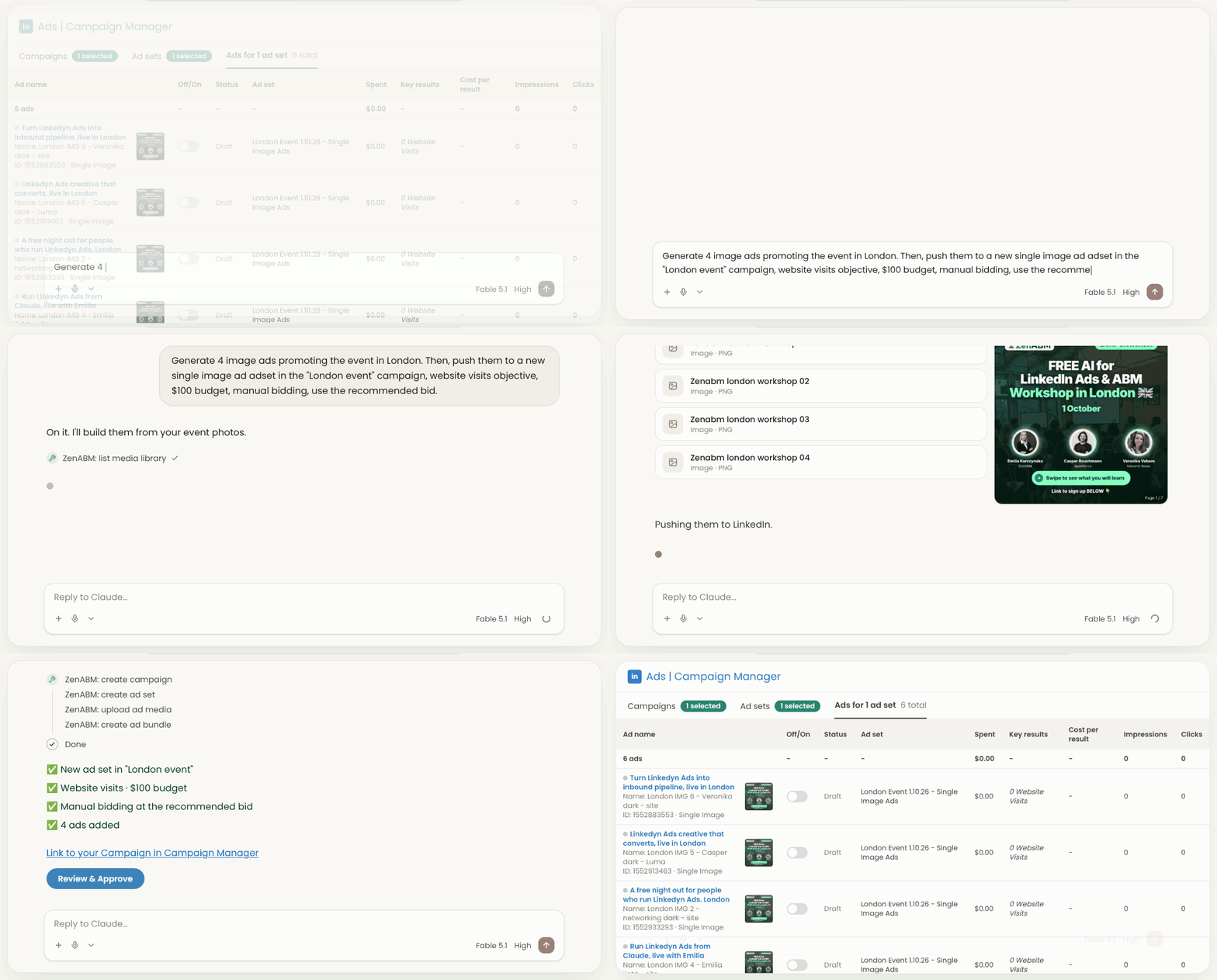
ZenABM's MCP server writes as well as reads, so you can create and manage campaigns, ad sets and ads from Claude, with confirmation on every change.
G2 rating: 5.0/5 from 6 reviews
Best for: teams that advertise mainly on LinkedIn and want engagement turned into CRM-ready intelligence and pipeline proof.
Skip it if: display advertising is your main channel, in which case you would pair it with a display suite.
Compared with Madison Logic: Madison Logic finds in-market accounts you have not touched with third-party intent, while ZenABM reads intent from your own LinkedIn ads and lets you act on it.
Company engagements. ZenABM matches LinkedIn ad impressions, clicks and engagements to the company behind them. Every engaging company appears with its engagement score, ABM stage and CRM data on one row, which Campaign Manager does not expose this way.

The dashboard below shows the top engaged companies across ABM campaigns.

Engagement score and ABM stages. You define stages as rules over LinkedIn engagement and CRM conditions. ZenABM then moves every account through them automatically and keeps the score current.

This dashboard shows the number of companies in each stage over a period.

Intent signals. Each ad set and campaign carries a theme. When an account engages, ZenABM attributes that theme to the account and syncs it to your CRM or pushes it over webhooks, so you can see whether an account responds to pricing-led or problem-led messaging before sales reaches out.
Signals. You label accounts by your own rules over LinkedIn ad metrics and HubSpot or Attio properties, such as clicked an ad in the last 30 days and has an open deal. Unlike an ABM stage, a company can carry several signals at once, and ZenABM re-labels every company whenever a rule changes. Here is the Signals page in ZenABM:

Audiences. You build LinkedIn audiences from rules over ABM stage, signals, intent, CRM properties and live LinkedIn metrics. ZenABM refreshes each audience daily and streams it to a LinkedIn company segment, so your retargeting and exclusion lists never go stale. You can exclude with it at once and target it once LinkedIn has matched 300 members.
CRM sync and webhooks. Engagement, scores, stages and intent are written onto company records in HubSpot, Salesforce or Attio, and ZenABM creates the properties for you. Webhooks push engaged accounts to Clay, n8n or your sales engagement tool.

The webhook configuration details page looks like this.

Deal attribution. Open a deal and you see the impressions, clicks, engagements and spend that touched the account before it opened and before it closed, by ad set and campaign.
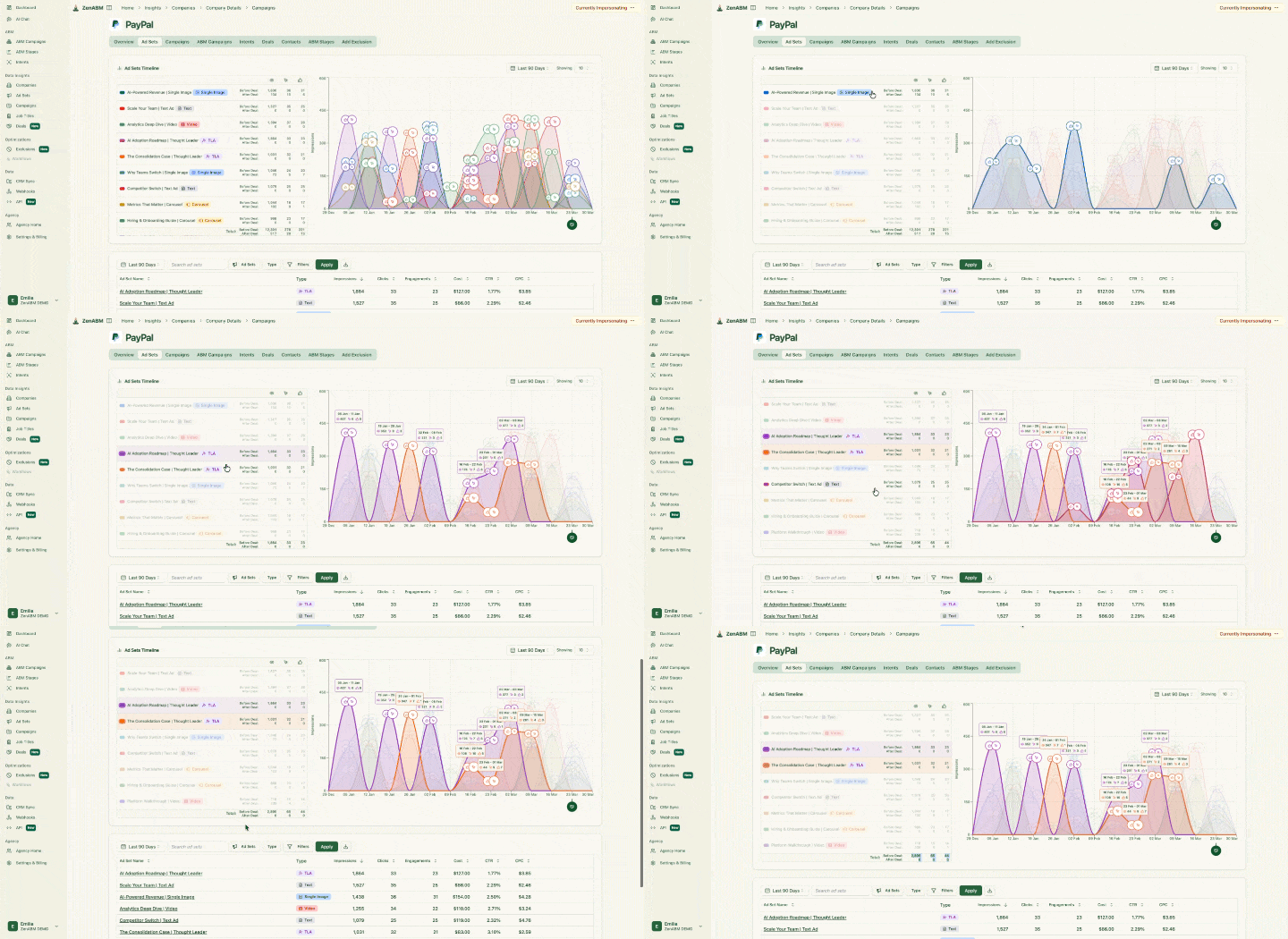
Zena, the AI agent. Zena reads your live workspace and answers questions about who is seeing your ads, which accounts moved stage and where budget is wasted, without exporting CSVs.

Job title engagement. Engagement is grouped by job title, so you can check whether your spend reached the buying committee.

Exclusions and Budget Savers. Exclusions apply across all campaigns, including new ones. Budget Savers switches off LinkedIn Audience Network and Audience Expansion on every ad set and re-applies the setting hourly. ZenABM also shows which accounts soak up impressions without clicking, and you can exclude them in a click.

ZenABM starts at $59/month billed annually, or $69/month billed monthly. The plans are Starter, Growth ($159/month), Pro ($399/month) and Agency ($479/month), all with monthly billing available. See the pricing page for limits and the current free trial. Higher tiers mainly raise limits.
All 6 G2 reviews are 5 stars. One reviewer wrote, "What I like best about ZenABM is that they understand ABM beyond theory." Another noted that "they've built a good API and MCP that we can build stuff on top of."
ZenABM is LinkedIn-first, so it does not buy display, CTV or audio, syndicate content, personalise websites or sell third-party intent data. That is a scope choice, and teams that need those usually run ZenABM for LinkedIn next to Madison Logic or a display suite.
Reviewers raise a few mild points. ABM takes time to compound, so results are not always immediate. One team using Pipedrive would like an integration, company data sometimes loads slowly, and some LinkedIn-side restrictions are annoying. The team ships new features fast and keeps improving the product based on customer feedback.
Bombora is a B2B data company, not a platform. It sells Company Surge intent data and delivers it into your CRM, marketing automation and ad stack. It is one of the intent sources inside Madison Logic's ML Insights, so it is the closest swap if intent is the only thing you need. I have no hands-on experience with it, so this section comes from vendor documentation, reviews and buyer questions.
Here is the kind of surge chart Bombora produces:

G2 rating: 4.4/5 from 161 reviews

Bombora does not publish pricing. Vendr puts annual contracts between $25,000 and $150,000+, with a median of about $25,000, and Docket reports a typical range of $25,000 to $80,000 a year.

Best for: teams that already have a stack ready to receive intent signals.
Skip it if: you want execution or measurement as well, because you will still need ad and reporting tools.
Compared with Madison Logic: Bombora is the intent layer only, with no activation or reporting suite.
Compared with ZenABM: Bombora tells you who is researching a topic anywhere, while ZenABM turns engagement with your own themed ads into intent signals per account and syncs them to your CRM.
Demandbase One is an enterprise suite built around its own B2B ad platform, with account intelligence, web personalization and attribution on top. I had a couple of demos with their team, and display advertising at very large scale is where it is strongest, which suits B2C companies especially. It has been on the market the longest, so it is often the default choice.

G2 rating: 4.4/5 from 2,012 reviews

The ad results dashboard covers LinkedIn and other channels.

Demandbase does not publish prices. Vendr's median is $68,591 a year (range $24,000 to $164,037, 187 purchases), so budget about $70K before ad spend.
Best for: enterprises looking for display advertising at scale.
Skip it if: you run mostly LinkedIn ads on a small team.
Compared with Madison Logic: Demandbase is broader and heavier, while Madison Logic is built more around intent-led activation and syndication.
Compared with ZenABM: Demandbase vs ZenABM comes down to scope. Demandbase covers display and personalization, while ZenABM is built to create and manage the LinkedIn campaigns themselves, at a fraction of the cost.
Madison Logic is better for intent-driven advertising if you want intent-led activation, because it combines its proprietary intent with content syndication. Demandbase is better if you want account engagement measured from its own ads, web personalization and sales intelligence in one platform. Neither publishes prices.
Madison Logic | Demandbase | |
|---|---|---|
Intent source | Proprietary ML Insights plus Bombora Company Surge | Its own account data and intent |
Channels | Syndication, display, LinkedIn, CTV, audio | Display, native, video, CTV, LinkedIn, Meta, Google |
Engagement measurement | ML Measurement tied to pipeline | Ad results and campaign influence dashboards |
Pricing | Custom quote | Custom quote; Vendr median $68,591/yr |
Choose Demandbase if you want one suite with ads, web personalization and sales intelligence. Choose Madison Logic if intent-led distribution and syndication is the point. ZenABM runs the LinkedIn side of either. For more options, see our Demandbase alternatives roundup.
6sense is an enterprise suite built around predictive scoring, third-party intent and multi-channel orchestration. I had a few demos and decided against it, because it was too complex and too expensive for our needs. It belongs in the same group as Demandbase and suits enterprises looking for display advertising.

G2 rating: 4.3/5 from 1,432 reviews

The revenue and pipeline influence report looks like this.

6sense does not publish prices. Vendr's median is $62,440 a year (range $11,376 to $176,809, 385 purchases), and contracts are typically annual or multi-year.
Best for: enterprises looking for display advertising at scale.
Skip it if: you will not use the full suite, or you run mostly LinkedIn ads.
Compared with Madison Logic: 6sense goes broader, with predictive scoring and orchestration, but it demands more ops bandwidth.
Compared with ZenABM: 6sense vs ZenABM is a scope question. 6sense's MCP server is read-only retrieval, while ZenABM's MCP can create and manage campaigns, and ZenABM treats your own LinkedIn ad engagement as first-party intent.
N.Rich is an execution-first platform built on its own B2B DSP, which turns intent into programmatic display and LinkedIn campaigns. I have no hands-on experience with it, so this section comes from vendor material and reviews.

G2 rating: 4.7/5 from 115 reviews

N.Rich publishes annual pricing: GROWTH from $34,830 a year and ENTERPRISE from $58,050 a year. It also asks for a 12-month ad spend commitment, and about $5,000 a month is a realistic start.
Best for: teams that can run programmatic ABM at scale.
Skip it if: your spend is mostly LinkedIn, because the display engine is the point of the platform.
Compared with Madison Logic: N.Rich is a more direct execution console, while Madison Logic has established syndication and cross-channel measurement.
Compared with ZenABM: N.Rich buys display off LinkedIn, while ZenABM focuses on creating and managing the LinkedIn campaigns and reading company engagement.
AdRoll ABM, formerly RollWorks, is an account-based advertising platform with a built-in DSP across display, LinkedIn and Meta. I evaluated it for my ABM programme at Userpilot in 2024 and had several demos with the team. It belongs to the traditional enterprise suite group but is easier to start with.

G2 rating: 4.3/5 from 655 reviews

The ICP Fit Grade screen shows two ICPs for different lists.

AdRoll's pricing page says Account-Based Retargeting has no platform fee, so you pay only for media. ABM, ABM + Advertising and Account-Based Advertising are quote-only. Vendr's parent-company page for NextRoll shows a median of $80,400 a year, but that covers more than ABM.

Best for: teams that want account-based ads without enterprise complexity.
Skip it if: your ABM budget is a few hundred dollars a month.
Compared with Madison Logic: AdRoll ABM is ad-first and simpler, and it is not an intent-led distribution and measurement platform.
Compared with ZenABM: RollWorks vs ZenABM is display-first versus LinkedIn-first. ZenABM creates and manages your LinkedIn campaigns and shows company engagement, which AdRoll ABM does not focus on.
Dreamdata is a revenue attribution platform. I had a demo with them, and it is the most complete attribution tool of its group, but it is not geared towards managing and running ABM campaigns on LinkedIn.

G2 rating: 4.7/5 from 271 reviews

Dreamdata has a free plan. Paid plans are custom, and Vendr's median is $35,440 a year (range $27,000 to $96,000).

Best for: data-driven teams that must prove ABM impact on revenue.
Skip it if: you need intent activation or campaign execution.
Compared with Madison Logic: Dreamdata is attribution-first and takes time to set up, and it does not run intent programs.
Compared with ZenABM: Dreamdata goes deeper on cross-system attribution, while ZenABM creates and manages the LinkedIn campaigns and shows deal attribution next to them, from $59/month.
Recotap is a mid-market ABM platform that unifies CRM, website and intent data with LinkedIn ad orchestration and 1:1 personalization. I have no hands-on experience with it, so this section comes from vendor material and reviews.

G2 rating: 4.7/5 from 57 reviews

Recotap Standard is $1,499/month billed annually, and Enterprise is custom, per a third-party listing.

Best for: mid-market teams spending $5K to $50K a month on LinkedIn ads.
Skip it if: your LinkedIn spend is below about $3K a month.
Compared with Madison Logic: Recotap is LinkedIn-first with built-in intent, without Madison Logic's syndication and CTV.
Compared with ZenABM: Recotap leans on personalization and orchestration at $1,499/month, while ZenABM starts at $59/month and focuses on company engagement, scoring and attribution.
Four narrower LinkedIn tools are worth a look if you do not need a suite:
Tool | Price | What it does for LinkedIn | G2 | Best for |
|---|---|---|---|---|
DemandSense | $89/mo Base, $149/mo Plus; first month free | Scheduling, frequency caps, audience tuning, visitor ID | 5.0/5 (14) | LinkedIn-primary teams wanting tighter ad control |
Linklo | $99/mo Core; 21-day trial | Ad scheduling and Company Flows, HubSpot sync | None found | Teams where pacing is the problem |
Satlo | Starter from €58/mo per ad account; 14-day trial | Company-level engagement analytics beyond Campaign Manager's limit | 5.0/5 (1) | Small teams wanting lightweight reporting |
LinkedScope | Not published; 15-day trial | Reached companies matched to CRM deals | None found | Teams wanting simple LinkedIn attribution |
The numbers above in one picture:

Here is the short version, one line per need:

Pick the tool for the job you need done, not the longest feature list. Otherwise you pay for the whole gym and use the treadmill 🤷♀️ And for many teams the answer is a pair, such as ZenABM for first-party LinkedIn engagement plus Bombora for an always-on third-party feed.
Replace the LinkedIn side of Madison Logic
Start a free trial and see which companies engage with your LinkedIn ads, scored and synced to your CRM.
Here is the ZenABM home dashboard, with influenced revenue and pipeline, campaign effectiveness and the top engaged companies on one screen:
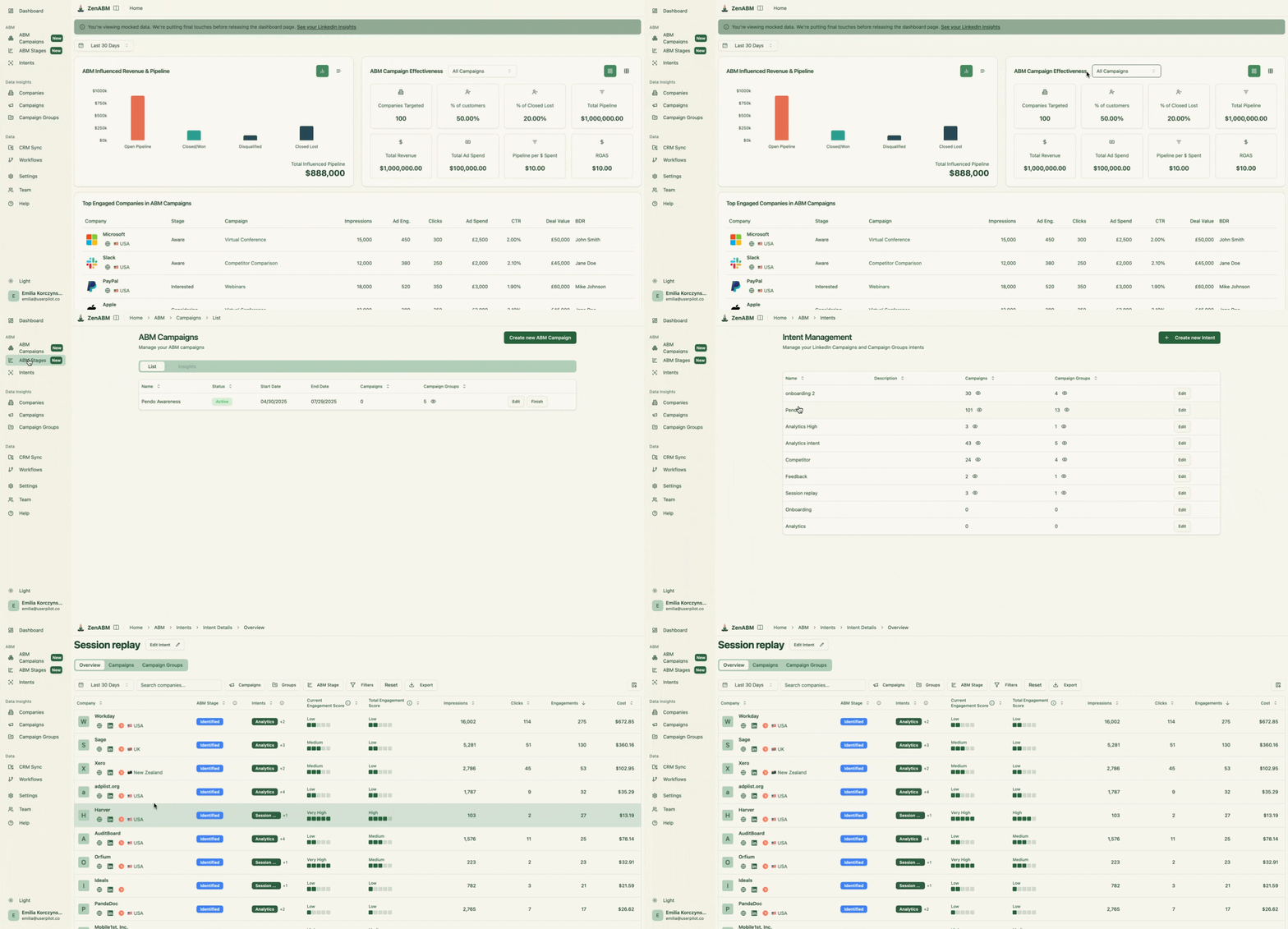
For LinkedIn-first ABM, ZenABM is the best alternative. It creates and manages campaigns, shows engaged companies and syncs to your CRM from $59/month. For the other parts, Demandbase One and 6sense replace the full suite, Bombora replaces the intent data, and N.Rich or AdRoll ABM cover ad execution.
Madison Logic does not publish prices, so you get a custom quote after a demo. A HubSpot Marketplace listing (updated August 2025) quoted $3,000/mo plus media for the Professional plan, and third-party estimates put enterprise contracts at $40K to $80K a year. Treat those as rough guides and ask for a quote.
It depends on your scale. Madison Logic holds 4.3/5 on G2 from 275 reviews. One TrustRadius reviewer wrote that "lead quality is especially good… team adheres to strict requirements and will swap out stale leads." The complaints are a steep learning curve, a clunky interface and leads skewing top of funnel. It suits large enterprises.
Madison Logic is better for intent-led activation and content syndication. Demandbase is better if you want ads, web personalization and sales intelligence in one suite. Neither publishes prices. See our Demandbase alternatives roundup for more options.
Yes. Madison Logic coordinates content syndication, display, LinkedIn, CTV and audio from one platform, and as a LinkedIn Marketing Partner it syncs account segments into Campaign Manager. The limits are an ops-heavy setup and LinkedIn reporting restricted to companies above LinkedIn's privacy threshold.
Yes. ZenABM starts at $59/month billed annually, AdRoll ABM has no platform fee for retargeting (you pay for media), and Dreamdata has a free tier. If only the intent data matters, Bombora is cheaper than a full suite, from about $25,000 a year.
About the author

