



ABM is not “marketing to a list.”
It is the discipline of treating every named account like a single market of one, because the precision bar is brutal.
This guide breaks down what ABM actually means in 2026, why the textbook definition has quietly shifted, the types of ABM most teams confuse, the best practices that took one program from $0 to a multi-seven-figure pipeline in two years, and how to pick the right ABM tools without overspending.
By the end, the concept will be explainable to a sceptical CFO without buzzwords.
Most of what follows is the opposite of what a first Google search for “ABM meaning” in 2023 would have returned.
Short on time?
Here’s a quick rundown:
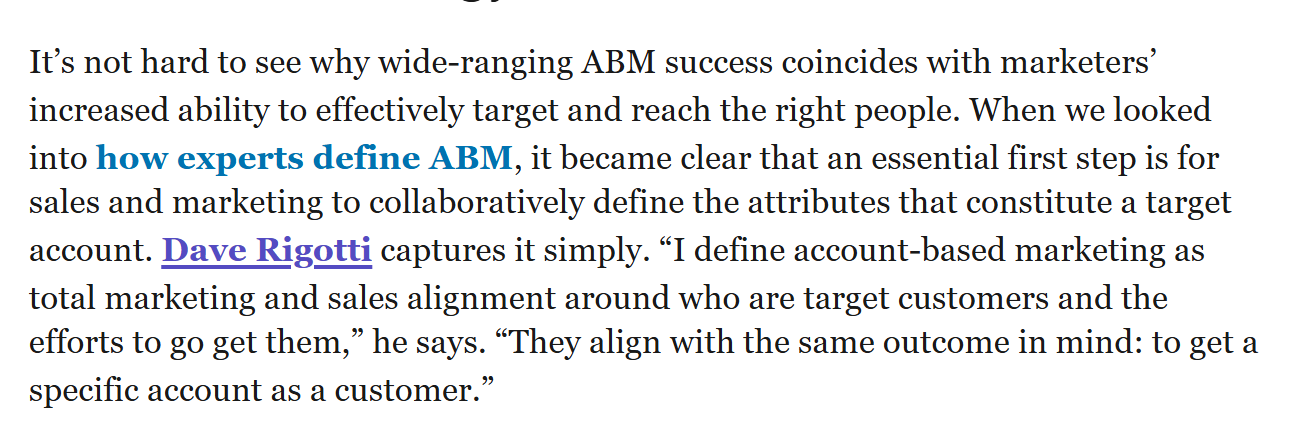
Account-based marketing (ABM) is a B2B go-to-market approach where marketing and sales agree on a finite list of high-value companies and run coordinated, personalised campaigns to win them, instead of casting a wide net and hoping the right buyers fill out a form.
That is the short version.
A longer version that actually holds up in team discussions:
ABM is the practice of treating named target accounts as the unit of measurement, the unit of targeting, and the unit of revenue, rather than treating individual leads as the unit. Every campaign decision, from the ad creative to the SDR follow-up cadence, is judged by what it does to the account, not what it does to the lead pile.
If reporting still asks “how many MQLs did we get this month?” the program is not yet doing ABM, regardless of what the ABM tools dashboard says. ABM reporting asks “which target accounts moved a stage this month, and why?
The most useful comparison for explaining this: traditional demand gen is fishing with a net, and ABM is spearfishing. Same ocean, completely different gear and skill set.
Ask 10 B2B marketers to define ABM, and 11 definitions come back.
The argument almost always lands on the same fault line: Is programmatic ABM (paid ads served to a target account list at scale) actually ABM, or is it just clever display advertising in a hoodie?
The traditionalist position, held mostly by enterprise ABMers who came up through ITSMA and Forrester, says no.
To them, “real” ABM is one-to-one or at most one-to-few, with deeply personalised assets, dedicated SDRs, and named-account business plans.
Anything else is just “list-based advertising.”
The modern position is that ABM is defined by the unit of measurement, not the level of bespoke effort per account.
If there is a finite target account list, campaigns are personalised at the account or industry level, and reporting happens at the account level, that is ABM.
Whether 50 accounts or 5,000 are in scope is a question of ABM strategy type, not ABM legitimacy.
This shift is happening because the tech has got dramatically better.
In 2015, it was genuinely impossible to personalise a LinkedIn ad to a 1,000-account list at scale.
In 2026, it is table stakes.
The 2015 definition stopped describing what is now possible.

The framework most marketers cite is the original ITSMA model: one-to-one, one-to-few, and one-to-many.
Bev Burgess, who coined ABM at ITSMA in 2003, has since expanded that into a five-type portfolio in her 2025 handbook.
The expanded version is more useful in 2026 because almost no real program runs only one of these.
Tier-1, “land the whale” accounts. Usually 5 to 25 accounts that are big enough to fund the program by themselves. Each gets a dedicated business plan, custom assets (sometimes including custom microsites), and a marketer paired with the account executive. This is what enterprise ABMers picture when they say the word ABM.
Tier-2, clustered accounts. You take 10 to 50 accounts that share an industry, persona, or use case and build campaigns for the cluster. Less custom than 1:1, but still personalised at the segment level. Most mid-market B2B teams operate here.
Tier-3, list-based at scale. Hundreds or thousands of accounts targeted via paid channels with role and industry-level personalisation. This is the type that purists argue about. It is also the type that, when paired with LinkedIn’s 2026 ad personalisation features, drives the most pipeline for teams without enterprise-level resources.
Burgess’s 2025 addition. Short, focused interventions tied to a specific event, like a competitor’s contract renewal window or a major industry conference. Not always-on, and not designed to be. It lands a punch and stops.
Marketing inside an active sales pursuit.
The account is already in the pipeline, the deal is competitive, and marketing’s job is to influence the buying committee from outside while sales works the deal from inside.
Most real programs run programmatic ABM as the always-on layer, ABM Lite for two or three key industries, and pursuit marketing on every six-figure deal in the late-stage pipeline.
Picking just one of these types is almost always the wrong call.
The mechanics behind every successful ABM program, regardless of type, follow the same five steps, and the order matters.

The most common mistake is skipping step 1 and jumping to step 3, because tools make it easy.
A LinkedIn campaign can be live in 20 minutes. Building a real ICP takes a week. Most “failed ABM programs” did not fail at the campaign level; they failed at step 1 and never knew it.
Three things changed in B2B between 2023 and 2026 that made ABM less of a “nice strategy” and more of a survival mechanism.
If broad-funnel demand gen is still running against the entire ICP, the cost per qualified opportunity has roughly doubled in two years.
ABM survives that math because the denominator (accounts targeted) is finite and the personalisation lifts conversion rates at every stage, so the same budget produces a more qualified pipeline.
Forrester 2024 report puts the average B2B buying committee at 13 people.
There is no version of “marketing generates a lead, sales closes it” that works against an 11-person committee, because a single point of contact rarely has unilateral authority.
ABM was designed for account-level coverage across all those stakeholders simultaneously, which is exactly what the modern buying motion requires.
CFOs stopped funding MQL-based marketing teams.
The teams that survived budget cycles are the ones that can defend marketing-influenced pipeline at the account level, which is the native unit of ABM.
The math behind this shift is covered in detail in the 2026 LinkedIn ABM benchmarks report.
“LinkedIn ads has just released one of the most interesting updates since Thought Leader ads. You can now personalize the description copy on sponsored content (newsfeed) ads based on each viewer’s profile, including company name, first name, job title, and/or industry. No other ad platform allows you to do this.”
– Tim Davidson, Founder at B2B Rizz, in his LinkedIn post
Davidson’s point is exactly why the “programmatic ABM is not real ABM” argument no longer holds.
When ad copy can be personalised by company name and job title at scale, the functional gap between a 1:1 program and a 1:many program collapses.
Compressed into eight rules, these are the checks that should happen before approving any new ABM campaign, based on Emilia Korczynska’s (VP of Marketing at Userpilot) learnings from the campaign that crossed multiple six figures in pipeline in two years:


A deeper version of this list with full implementation details is in Running ABM on LinkedIn: The Ultimate Guide.
The ABM tools market has split into two distinct camps, and most “ABM tool” listicles still pretend they are the same thing.
They are not, and conflating them leads to buying a $120k platform for a $15k AOV product.

These came up in the early 2010s alongside the original ITSMA model.
They specialise in serving display banner ads to target accounts across the open web, layered with intent data, predictive scoring, and orchestration.
They are powerful, expensive (typically $40k to $200k+ per year), and built for enterprise sales motions where deals are six or seven figures and the buying committee is 11 people deep.
The tradeoff: display click-through rates on the open web hover around 0.05%, and most of the value sits in the data and orchestration layer, not in the ads themselves. If the AOV is below $20k, the math gets very hard very quickly.
This category did not really exist before 2023.
The premise: LinkedIn is the only channel where B2B buyers self-identify by job title, company, and seniority at scale, so a B2B ABM program built on LinkedIn delivers higher CTR (the ZenABM benchmark is 2.68% median CTR on Thought Leader Ads vs 0.42% on standard single image, and far above any open-web display number) while the data layer sits on top of LinkedIn rather than trying to track buyers across the open internet.

The tradeoff is channel concentration.
If LinkedIn changes ad policies, the program feels it.
The benefit is far better unit economics for SMB and mid-market B2B SaaS, where the AOV does not justify a Demandbase budget.
A six-figure-AOV B2B SaaS ABM program probably should not run on display-only in 2026 because the numbers do not work at that deal size.
A seven-figure-AOV enterprise sales motion probably should not run only on LinkedIn either, because buying committees are too distributed across channels for a single-channel play to get sufficient coverage.
The right call is to pick the tool that matches the deal size and buying motion, not the one with the loudest brand presence at the next ABM conference.



ABM is not a platform purchase or a campaign type. It is a fundamental shift in how a go-to-market team defines success: from lead volume to account movement, from MQL counts to pipeline by named account, from broad reach to deliberate coverage of a finite list.
That shift is harder than it sounds because it requires sales and marketing to agree on the same list, report on the same metrics, and hold each other accountable to the same accounts week over week.
The teams getting this right in 2026 are not necessarily the ones with the biggest ABM budgets.
They are the ones who built a tight ICP first, kept their target account list short enough to actually personalise, and used account-level data to decide where to push and where to pull back.
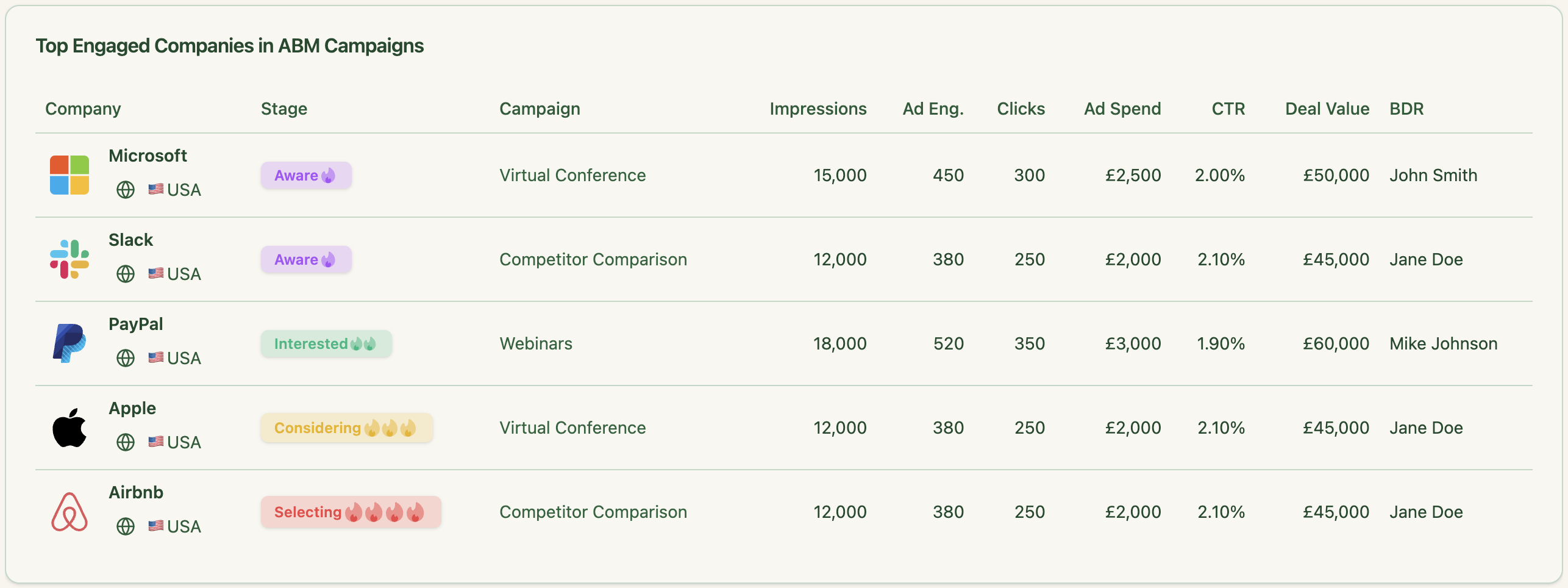
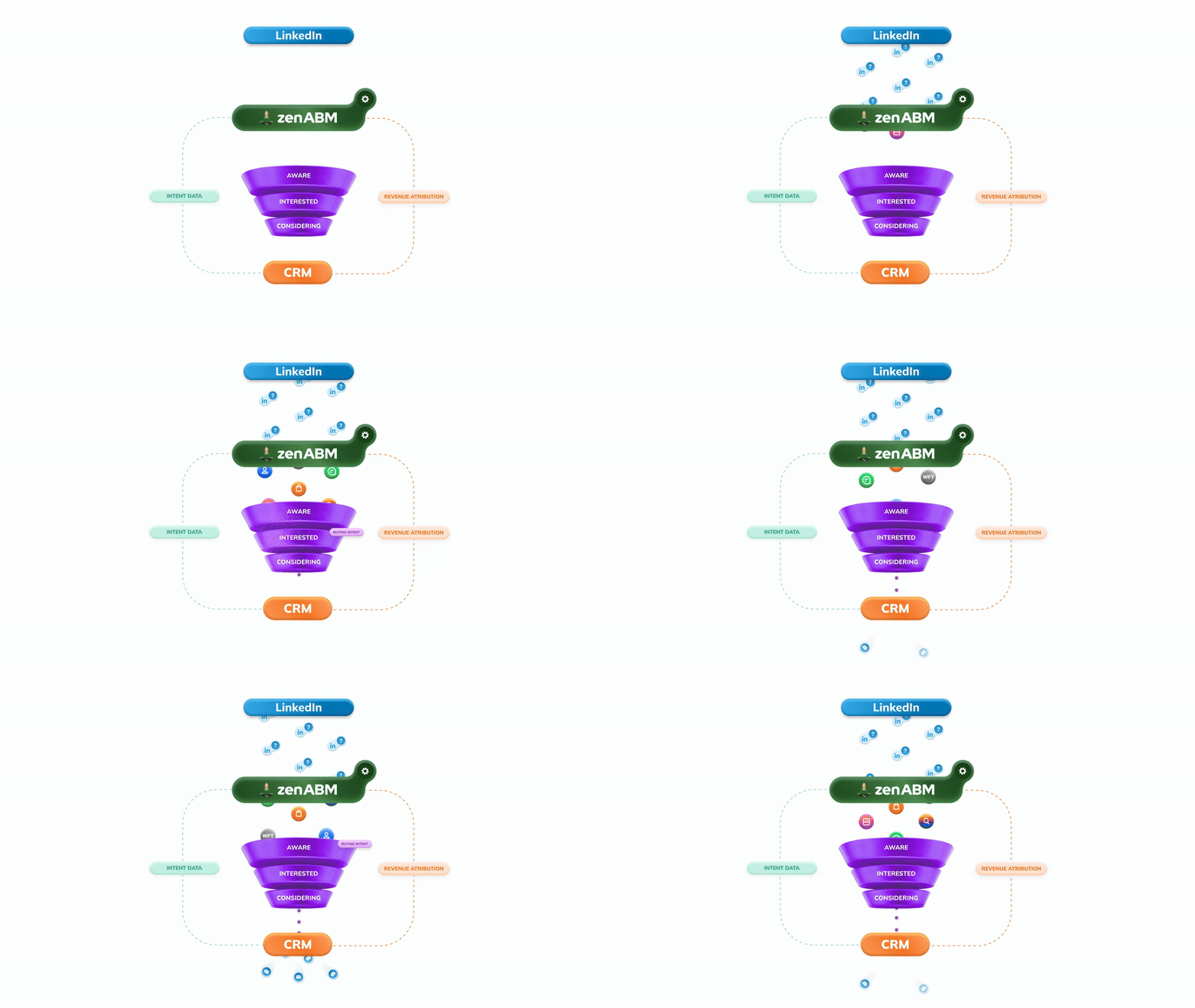
ZenABM gives mid-market B2B SaaS teams exactly that data: company-level impressions, clicks, and engagement scores per campaign, directly from the LinkedIn API, without a six-figure platform contract.
If the program is being built now or rebuilt from scratch, that is the foundation worth starting with.
You can try ZenABM on your own (37-day free trial) or book a demo to know more!
ABM stands for account-based marketing. It is sometimes also called account-based experience (ABX), account-based revenue, or key account marketing, depending on which vendor is selling the term that quarter. The strategy underneath is the same regardless of the label.
Traditional B2B marketing optimises for lead volume across the broadest possible audience, then qualifies leads down through a funnel.
ABM starts with a finite list of named accounts, personalises across multiple channels, and reports at the account level rather than the lead level. ABM is spearfishing.
Traditional demand gen is fishing with a net.
The comparison is covered in detail in ABM vs Traditional Marketing.
Yes, in 2026. The traditionalist view (only 1:1 and 1:few count) was correct in 2015 when the tech could not personalise to a 1,000-account list.
LinkedIn’s account-level personalisation, intent data layers, and account scoring tools have closed that gap.
As long as the unit of measurement is the account and the campaigns are personalised at the account, industry, or persona level, programmatic counts as ABM.
For most mid-market B2B teams, 200 to 1,000 accounts is the right range.
Below 50 there is not enough volume to learn from.
Above 1,000 the personalisation stops being meaningful.
Enterprise strategic ABM lists are smaller (5 to 25 accounts per program), and programmatic ABM lists can scale larger (1,000 to 5,000) if the budget supports meaningful frequency across those accounts.
No. An enterprise platform makes sense if the deal size, deal complexity, and orchestration needs justify $40k to $200k+ per year for the data and workflow layer.
For most B2B SaaS companies under $20k AOV, a LinkedIn-first stack with account-level reporting (which is what ZenABM provides) delivers roughly 80% of the value at a fraction of the cost.
The decision should be driven by deal economics, not by brand recognition in vendor reviews.
Plan for 6 to 9 months before the first closed revenue and 12 to 18 months before the program defends its own budget. ABM is not a quarter-by-quarter performance channel.
The first 90 days are list-building, ICP refinement, and creative testing.
Pipeline starts moving in months 4 to 6, and closed revenue follows the sales cycle from there.
If the CFO needs results in 60 days, ABM is not the right starting point.
