

©2026 ZenABM - All Rights Reserved.

Most B2B teams I talk to say they want a pipeline, but they still optimize their marketing like a lead factory.
The lead generation side of the org keeps asking, “How many leads did we get?” while the account-based marketing vs lead generation debate gets shoved into a slide deck nobody reads.
In this guide, I will compare account-based marketing vs lead generation as actual go-to-market motions, not as a vibe.
I will show where each one wins, where each one breaks, what to measure, and how I run a hybrid setup on LinkedIn using ZenABM to track account movement instead of stopping at clicks and form fills.
Short on time?
Here’s a quick rundown:

Lead generation is a marketing motion focused on capturing contact information from individual prospects, where the win condition is “we got a lead.”
Sales then qualifies it, the SDR books a meeting, and the AE either closes or recycles.
The common tactics under the lead gen umbrella are stable across the industry:
The metrics behind the motion are equally familiar: leads, MQLs, SQLs, CPL, conversion rate, demo requests, and cost per opportunity.
Lead gen is the best fit when your buyers actively search for the category, your ACV is mid-to-low, individual users can convert, and you want fast feedback loops.
I do not hate lead gen.
For instance, for a self-serve product with a 14-day cycle and a $99 plan, paid search and a clean signup flow will usually beat any ABM program on efficiency.
The same is true for category-defining inbound, where someone already has the problem and is shopping.
Lead gen is also great for fast experimentation because volume gives you a signal quickly.

Account-based marketing is a go-to-market strategy focused on a specific list of high-value accounts.
Instead of asking “who filled the form?”, ABM asks a different stack of questions:
The channel mix typically includes LinkedIn ads to a named account list, outbound, executive events, direct mail or gifting, retargeting on intent topics, and personalized landing pages.
ABM is the best fit when ACV justifies the focus, sales cycles are long, and the buying committee has more than one human in it, which covers mid-market and enterprise SaaS, sales-led GTM, and any motion where multiple stakeholders need to agree.
The biggest difference between account-based marketing and lead generation is the unit of measurement.
Lead gen counts people while ABM counts accounts and stage movement, and that changes everything downstream: targeting, content, sales involvement, attribution, and the dashboards your CMO looks at on a Monday.
Tim Davidson (founder at B2B Rizz) published one of the cleanest comparisons in this post:
“Account list targeting in LinkedIn returned 3X as much revenue than native industry targeting. Account List: $190k spend, $1.3M revenue, 6.7 ROI, 297 demo requests, $639 CPL. Industry Targeting: $175k spend, $403k revenue, 2.3 ROI, 486 demo requests, $360 CPL. On the surface, industry targeting looked cheaper, but the ABM list won where it actually mattered.”
That is the trap in plain numbers.
The lead gen view says industry targeting is cheaper, while the ABM view says account list targeting drove three times the revenue.
Same channel, same budget, and different unit of measurement, and completely different decision.
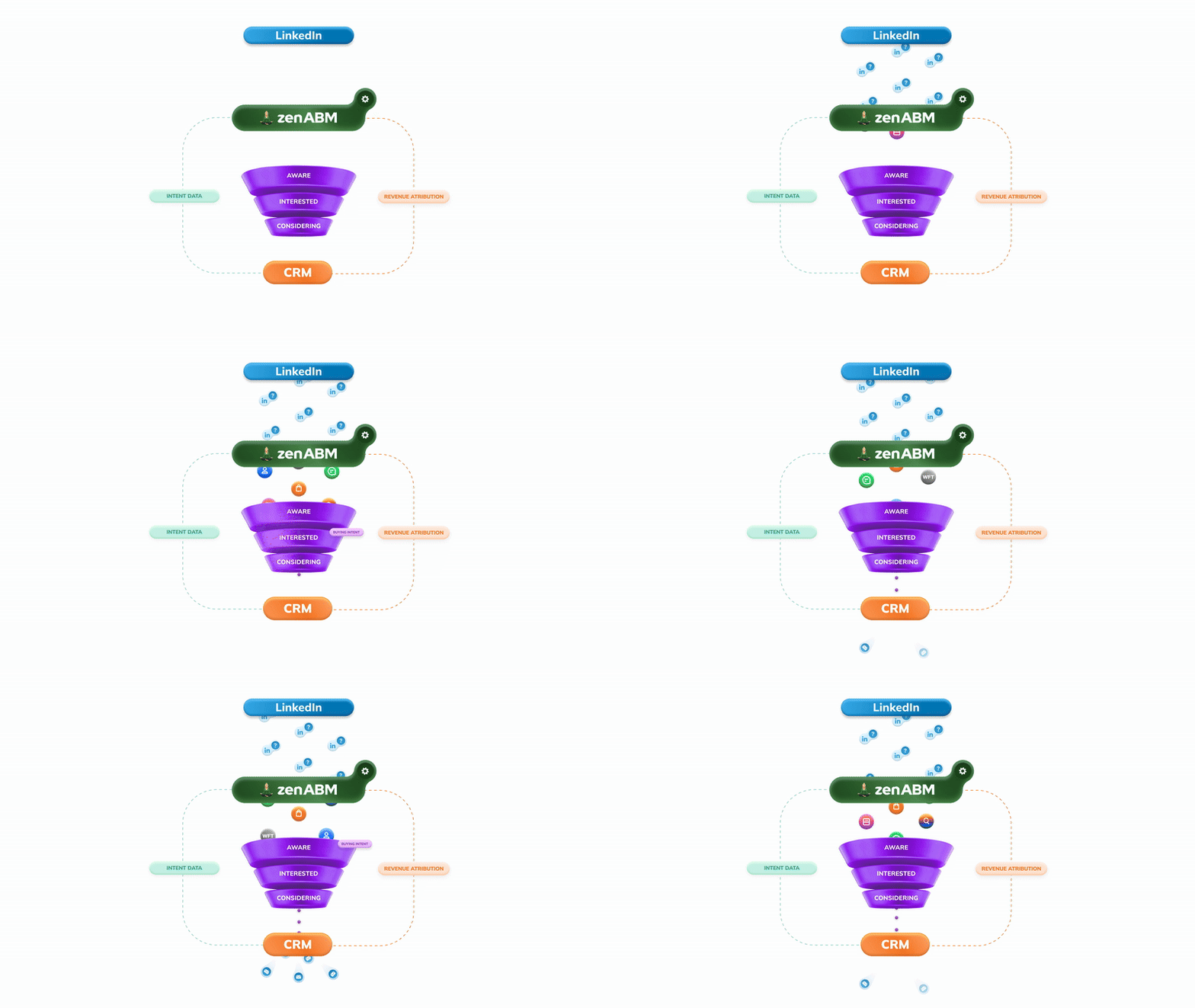
Here is the side-by-side comparison table you use to see where you sit on the account-based marketing vs lead generation spectrum.
None of this is about ideology.
It is about matching the motion to the buyer.
| Dimension | Lead Generation | Account-Based Marketing |
|---|---|---|
| Unit of measurement | Individual lead | Account and buying committee |
| Goal | Capture existing demand | Create and progress demand inside target accounts |
| Targeting | Broad audiences, keyword and persona-based | Named accounts, ICP lists, tiered segments |
| Primary metrics | Leads, MQLs, SQLs, CPL, conversion rate | Account reach, engagement, stage movement, pipeline per dollar |
| Sales involvement | After form fill, often light | Throughout the account journey, tightly coordinated |
| Content | Offers, gated assets, landing pages | Stage-based content, social proof, intent-led follow-up |
| Attribution | Contact-level, click and form-based | Account-level, view-through, plus engagement, plus CRM influence |
| Best ACV fit | Lower to mid ACV | Mid to enterprise ACV |
If you take one thing from this table, take the row on attribution.
Lead gen attribution is mostly about whether a person clicked and converted, while ABM attribution asks which accounts saw what, who in the buying committee engaged, and whether the account became pipeline.
Those are not the same question, and they cannot share the same dashboard.
Lead gen breaks down in predictable ways when you sell to enterprise or mid-market with a buying committee, and the first crack is volume looking healthy while the pipeline does not.
One lead does not represent the buying committee, because a single director downloading an ebook is not the same as five stakeholders engaging.
The form filler is rarely the decision maker in an enterprise; the person who fills the form is often a researcher, not a buyer.
Most touchpoints are also anonymous, since ad views, podcast listens, repeat visits, and peer recommendations never show up in lead gen reporting.
LinkedIn ads do not get last-click credit because they create awareness and influence, then a paid search click takes the credit.
Sales needs account context, and a name plus a job title without engagement history is just a cold name.
Worst of all, MQL volume can mask a weak pipeline, where CPL drops, MQLs go up, SQL conversion drops faster, and nobody hits quota.
Gabriel Ehrlich at Remotion put it bluntly in his post:
“You’re wasting your LinkedIn Ads budget, one stupid mistake at a time. Wasted on lazy targeting. Wasted on audiences that don’t, or won’t convert. Wasted on useless MQLs that will never reply to your BDRs. Wasted on careless bidding strategies that overpay on clicks. Maybe 20% is wasted. Maybe half. Maybe all of it.”

A cheap lead from a bad-fit account is not a win.
A high-fit account where ten stakeholders saw your ad and three engaged is much more valuable, even if nobody filled a form yet, and lead gen reporting cannot see that second case because ABM reporting is built for it.
ABM works better for strategic accounts because the model fits how those deals actually close: buyers are committees, awareness happens before any form fill, sales involvement starts earlier, and pipeline is the goal rather than lead volume.
When ABM is run properly:
I run my ABM stages the way most LinkedIn-first teams I work with do: Identified, Aware, Interested, Considering, Selecting, then Customer or Lost.

Each stage is defined by ad exposure, click depth, repeat engagement, and CRM activity, and ZenABM assigns the stage automatically per account.
If you want the longer build of this, the running ABM on LinkedIn guide walks through the full setup.
This is the misunderstanding I see most in pitches and audits.
A team uploads a list of accounts to LinkedIn, runs a “Download our ebook” campaign, and calls it ABM.
That is not ABM; that is targeted demand gen.
Bad ABM is running lead gen ads to a named list.
Real ABM is coordinating ads, content, intent signals, outbound, sales follow-up, and pipeline measurement around the same set of accounts, and the difference shows up in the campaign brief and the reporting view rather than in the audience builder.
A simple worked example illustrates this clearly.
A lead gen campaign might run “Download our 2026 benchmarks report” to anyone with a Director title in B2B SaaS, optimized for form fill volume.
An ABM campaign against the same budget would run a sequenced flow against 200 named accounts: awareness creative on a point of view first, retargeting for accounts that engaged twice, then BDR outreach when a stage flips to Interested, all measured in pipeline per dollar.
If your ABM program reports leads and CPL only, you are running targeted demand gen and calling it ABM.
The reporting layer is the giveaway, because real ABM reporting talks about accounts, stages, and pipeline, while lead gen reporting talks about people, forms, and CPL.
You can tell which motion you are actually running by looking at the dashboard your CMO opens first.
LinkedIn is expensive for generic lead generation because CPLs are higher than Google search, conversion is slower, and the platform punishes thin offers.
But LinkedIn is unusually good for ABM because it lets you reach specific companies, personas, seniorities, and buying committees with creative that fits the feed.
LinkedIn shines for a few specific ABM jobs:
Philip Ilic, who has spent his own money testing both sides, summed up, in his post, why list-based targeting is still the move for ABM-fit teams:
“I always start with list-based targeting when running LinkedIn Ads. The fact that we can literally upload a list of companies into Campaign Manager and only show ads to those exact companies is still wildly underrated. And when you pair that with a tool like Clay, you can get scarily specific.”
The catch is that LinkedIn Campaign Manager reports ad performance, not ABM performance.
It will tell you CTR, CPC, CPM, and form fills, but it will not tell you which named accounts saw the ad five times, which stakeholders engaged, what intent themes they responded to, or whether any of that turned into pipeline.
ZenABM solves that gap by reading first-party engagement data from the LinkedIn API and stitching it to your CRM, so the same campaign can be graded as ABM rather than as lead gen.

The metrics gap is where most teams get stuck. CPL is the most universally tracked B2B marketing metric on the planet, and it is also one of the worst metrics for grading an ABM program.
Here is the split I use.
Lead generation metrics:
ABM metrics:
CTR and CPC are useful diagnostics for both motions because they tell you whether the creative is working and whether the audience is right.
They are not enough to grade an ABM program on their own, though, because they ignore the buying committee and the account journey. CPL is fine for lead gen and actively misleading for ABM.
ZenABM provides most of these ad campaign performance and ABM metrics:

For more on the analytics layer, the ABM analytics dashboards guide shows the views I run.
Lead generation is the right choice when the demand already exists, the cycle is short, and individual users can convert without committee approval.
Use it when:
Good places to lean into lead gen:
None of that needs an ABM stage model to work.
ABM is the right choice when the deal is too important to leave to lead volume.
Use it when:
Good places to lean into ABM: LinkedIn ads to named accounts, retargeting by ABM stage, intent-led outbound, executive events, customer proof campaigns, and air cover on open opportunities.

The interesting answer to account-based marketing vs lead generation is “both, but with separate scoreboards,” because the two motions feed each other when you let them.
Lead gen handles high-intent inbound capture, search demand, educational content for broad audiences, volume top-of-funnel for product-led motions, and demo conversion from warm visitors.
ABM handles strategic named account lists, mid-market and enterprise pipeline, buying committee coverage, target-account retargeting and air cover, and sales-triggered follow-up on engagement signals.
Here’s how you can stitch together a workflow:
Most of the audits I run start the same way.
The team is running ABM-style campaigns on LinkedIn, but the dashboards are still lead gen dashboards showing leads, MQLs, CPL, and conversion rate.
ZenABM fixes that specific gap.

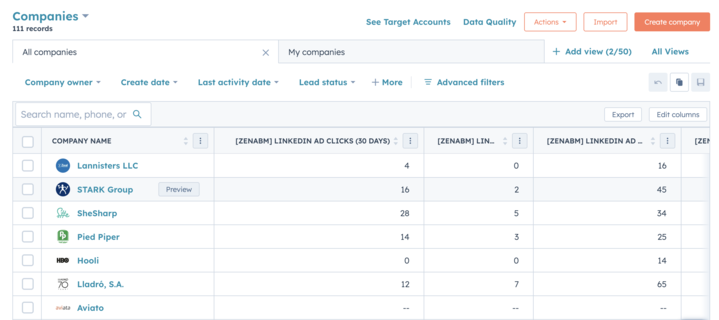
ZenABM reads which target companies saw your LinkedIn ads at the per-account level rather than just total impressions, and it tracks company-level clicks and engagements so you can see who is repeatedly engaging and on which creative.

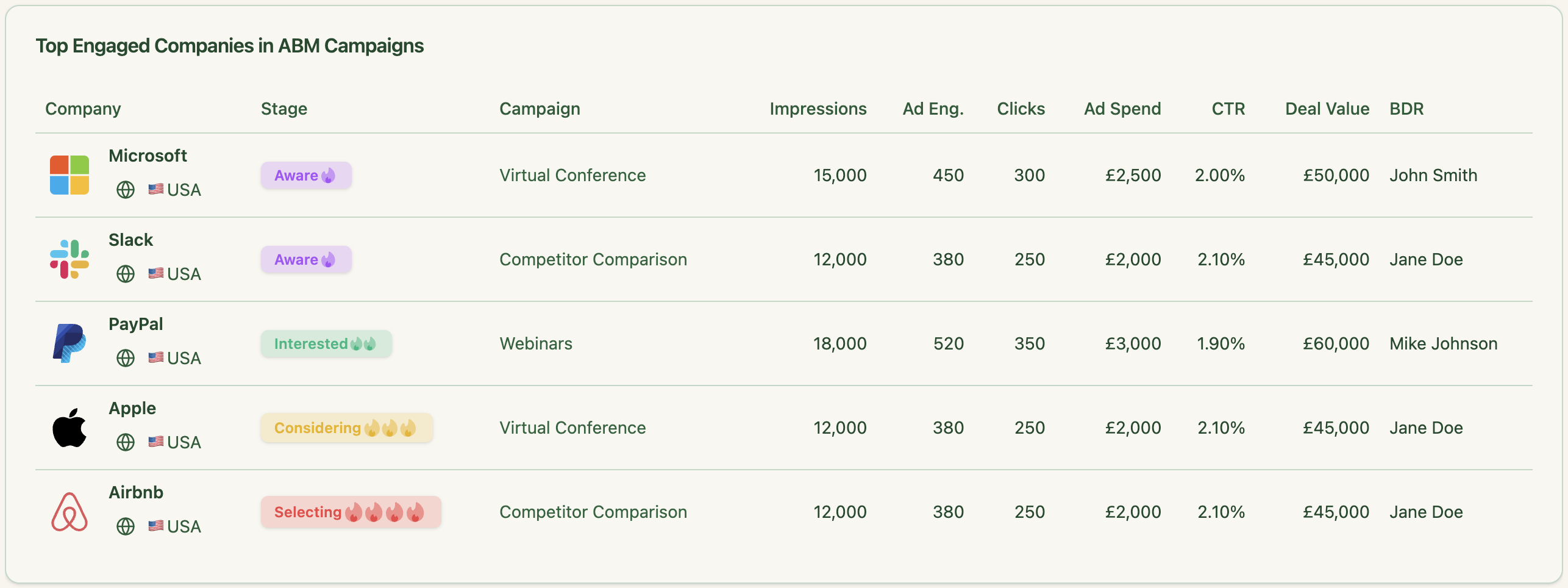
It assigns ABM stages automatically (Identified, Aware, Interested, Considering, Selecting, Customer or Lost), detects intent by campaign theme so that an account repeatedly engaging with the “ROI” theme is flagged differently from one engaging with “category education,” and scores accounts by engagement depth so that a single click is not treated the same as five stakeholders engaging twice each.

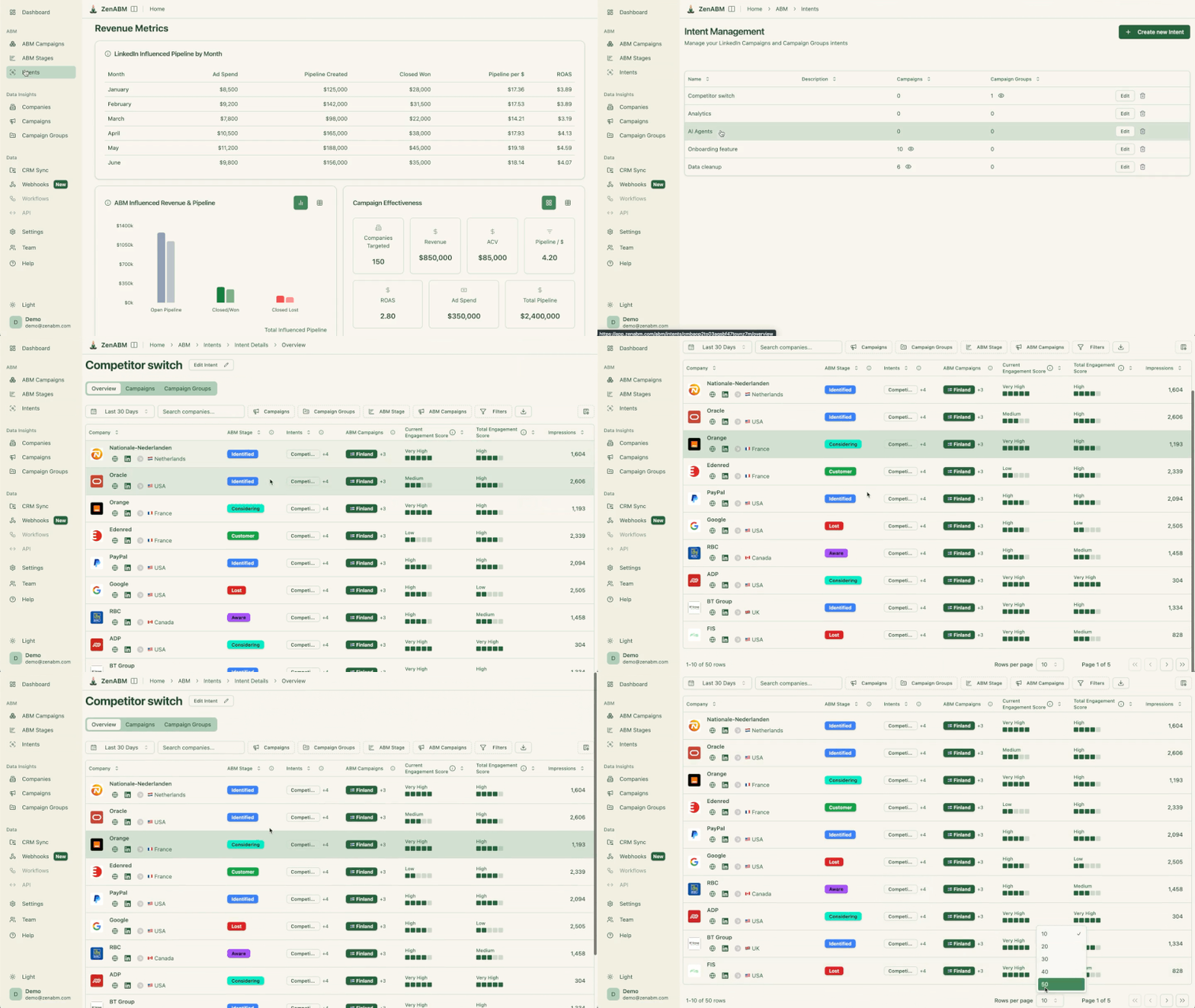
ZenABM pushes stage, score, intent, campaign names, impressions, clicks, and engagements into HubSpot or Salesforce as company properties rather than as a separate report, which means it triggers BDR workflows on stage movement so that Interested accounts go to the SDR immediately rather than sitting in a queue behind last week’s MQLs.

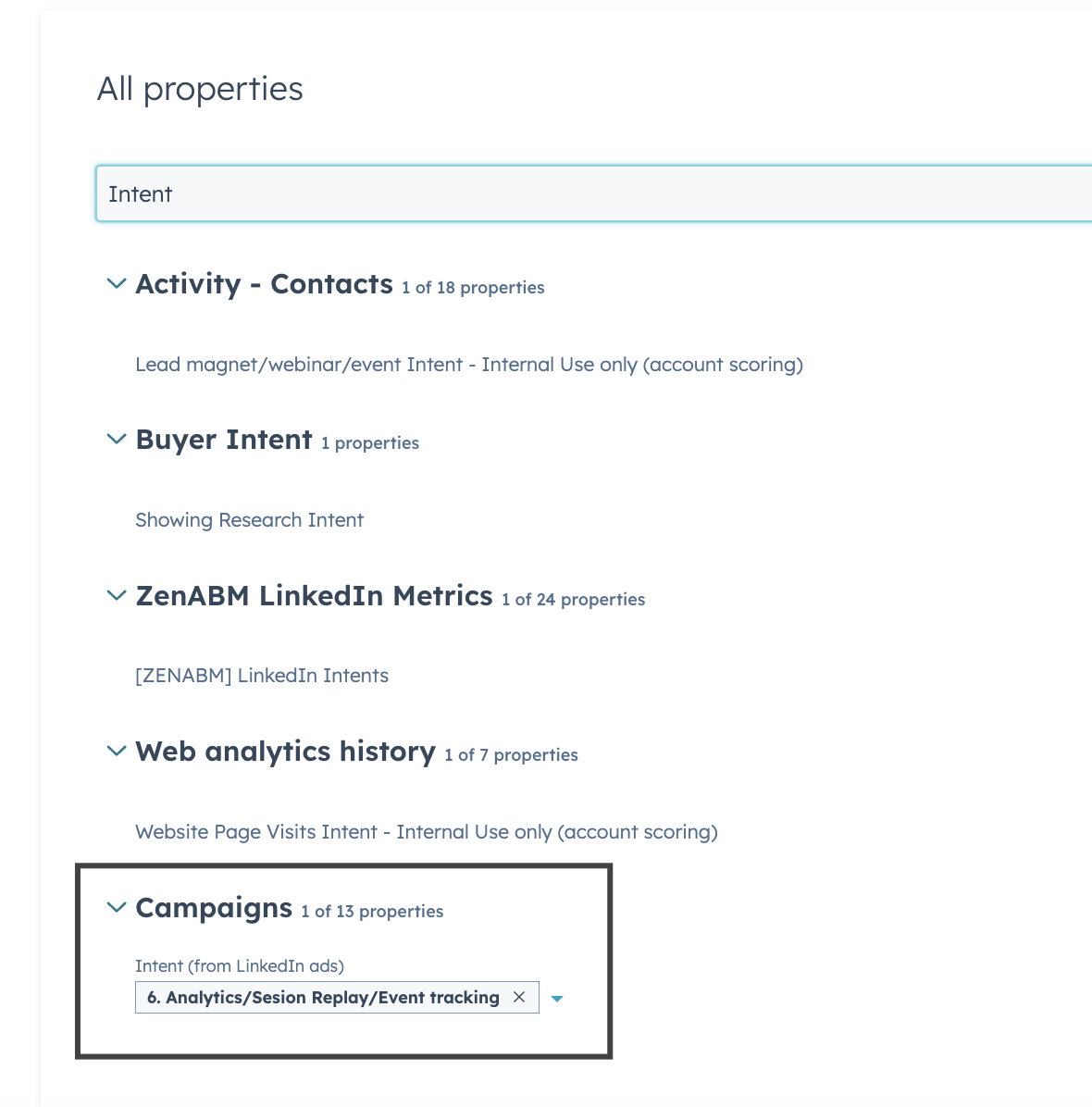
It also measures pipeline per ABM campaign (not just total spend, but pipeline per dollar per campaign) and calculates ROAS at the ABM campaign and account level, which is the metric that actually answers whether this is working.


Lead gen dashboards answer a single question: how many leads did we get this month?
ZenABM answers a different one: which target accounts are warming up, what do they care about, and which ones became pipeline. Same data feed, completely different decision surface.
After enough audits, the same mistakes keep showing up, and they are almost always reporting and process problems rather than creative problems.
Tim Davidson sees the same pattern from the other side of the desk:
“Series C SaaS company valued at $950M, now spending $76k per month on Linkedin Ads. Smart team. Solid strategy overall, but they were just donating money to LinkedIn like they were going to the mall around Christmas time. Every single ad was demo CTA focused. No social proof, no product education, just straight-to-demo.” Tim Davidson, in his LinkedIn post
That is what lead gen brain looks like in an ABM-fit account: big budget, big list, all of it pointed at the bottom of the funnel because the dashboard rewards demos and nothing else.
The account-based marketing vs lead generation debate is not really a debate once you match the motion to the buyer.
If your deals close because a committee of five people agreed, then counting the one person who filled a form is the wrong scoreboard.
If your deals close because a solo user signed up after a Google search, then running named-account ABM campaigns is overkill.
Most teams sit somewhere in the middle and need both motions running in parallel, each measured by metrics that actually reflect how those deals move.
The part that breaks most programs is not the strategy; it is the reporting.
When the same CPL dashboard governs both a self-serve demand gen campaign and a strategic account program, ABM always looks more expensive and less productive than it actually is.
The fix is separating the scoreboards before you separate the budgets, which means tracking stage movement and pipeline per dollar for the ABM motion rather than cost per form fill.
If you are running LinkedIn campaigns against a named account list and want to see what that activity is actually doing at the account level, ZenABM offers a 37-day free trial.
It reads company-level engagement from the LinkedIn API and surfaces which accounts are moving, what they are engaging with, and whether any of it is converting to pipeline, which is a more useful starting point than refreshing Campaign Manager looking for CPL trends.
You can also book a demo with us to know more!
Some common questions about ABM vs. lead gen:
Neither is universally better. ABM is a better fit for higher ACV, longer cycles, and committee buying, while lead gen is a better fit for lower ACV, short cycles, and self-serve buying.
Most B2B SaaS teams need both, but with separate metrics.
The mistake is grading ABM with lead gen metrics like CPL.
Yes, and the best teams do.
The trick is to keep separate scoreboards. Lead gen captures existing demand through SEO, paid search, and gated content, while ABM creates and progresses demand in named target accounts through LinkedIn, outbound, and events.
Shared CRM data ties them together so that an inbound lead from a target account graduates into the active ABM list.
LinkedIn lets you target specific companies, personas, seniorities, and buying committees, which is exactly what ABM needs. CPLs are higher than Google search, so generic lead gen on LinkedIn is expensive.
The platform pays off when you use it to reach named accounts with sequenced creative and measure account-level movement rather than just form fills.
For lead generation: leads, MQLs, CPL, demo requests, landing page conversion rate, SQL conversion rate.
For ABM: target accounts reached, account penetration, engaged accounts, stage movement, pipeline created from target accounts, pipeline per dollar spent, and revenue influenced. CTR and CPC are diagnostics for both motions, but they are never enough on their own to grade ABM.
ZenABM is built for the ABM side of the split. It reads company-level LinkedIn engagement from the LinkedIn API, assigns ABM stages, scores accounts by engagement depth, detects intent by campaign theme, and pushes all of it into HubSpot or Salesforce.
The result is a dashboard that answers “which target accounts are moving toward pipeline” rather than “how many leads did we get.”