Black Friday: up to 50% off ZenABM 💥Get up to 50% off ZenABM with our massive BlackFriday sale! 💥 - only 27-30 November!Get the deal12 Days of ABM Christmas · Report on your 2026 LinkedIn ABM & plan 2027 · Free webinars, 26 Nov – 9 DecSave your seat


Emilia Korczynska is Head of Marketing and co-founder at ZenABM. Before that she was VP of Marketing at Userpilot for nearly 7 years, where she ran a large ABM program primarily on LinkedIn ads.

The best Octane11 alternatives are ZenABM for LinkedIn account engagement and deal influence, Dreamdata for multi-channel revenue attribution, HockeyStack for predictive scoring, and 6sense or Demandbase One for enterprise intent and display.
Which one is right depends on the job you want Octane11 to keep doing. Teams usually leave it to replace one of four things: its dashboards, its multi-touch attribution, its CRM and data-warehouse imports, or its ABM measurement as a whole. I have run ABM on LinkedIn for years, first as VP of Marketing at Userpilot and now as co-founder of ZenABM, so I judge each tool on what it shows about real accounts and pipeline. We build ZenABM, so weigh my view with that in mind.
For the wider category, see our guide to ABM tools.
Use the comparison below to cut the list to two or three tools worth a demo, and to know exactly what to make each one prove on one of your real accounts.
Here is what each option replaces, what it costs and how reviewers rate it:
Alternative | Best for | Octane11 job it covers | Price | G2 rating |
|---|---|---|---|---|
ZenABM | LinkedIn account engagement and deal influence | ABM measurement and CRM sync | From $59/month billed annually; 37-day trial | 5.0/5 from 6 reviews |
Dreamdata | Multi-channel revenue attribution | Multi-touch attribution | Free plan; Advanced not published (Vendr median $27,000/year) | 4.7/5 from 282 reviews |
HockeyStack | Predictive scoring and multi-channel analytics | Attribution and account scoring | Not published (Vendr median $28,000/year) | 4.4/5 from 84 reviews |
6sense | Enterprise intent and display | Not a like-for-like swap: adds intent and display | Not published (Vendr median $54,250/year) | 4.2/5 from 1,595 reviews |
Demandbase One | Enterprise scoring and display | Not a like-for-like swap: adds scoring and display | Not published (Vendr median $68,591/year) | 4.4/5 from 2,025 reviews |
Your situation | Start with | Why |
|---|---|---|
You need to see which companies engage with your LinkedIn ads | ZenABM | Company engagement, stages and CRM sync are built around that job |
You need attribution across several channels | Dreamdata | Its models let you compare how touches receive credit |
You want predictive scoring alongside analytics | HockeyStack | Predictive scoring against closed-won deals is part of its analytics |
You want enterprise intent and display | 6sense | Intent data and display sit in one suite |
You want account scoring and display in an enterprise suite | Demandbase One | It combines account scoring with display |
Here are four job cards showing which alternative to demo for each Octane11 job, with a note that no single tool wins all four:

See LinkedIn account engagement in ZenABM
Book a demo to see how company engagement and deal influence appear in ZenABM.

Octane11 may include more analytics than you need, and it is priced as if you need all of it. Its Starter plan is $3,500 a month. There is no free trial, and it covers companies with up to $100M in revenue. A smaller team can often get the core account-level and pipeline views for less.
Two more things make me careful before paying for a replacement:
Here are the reasons to look for an Octane11 alternative, with the price and the two cautions on attribution and influence rules:

Match the job you want to keep to the tool you demo:
ZenABM is the tool I would shortlist when LinkedIn ads sit at the center of your ABM program and you need to tie company engagement to pipeline. It is our product, so I will also say plainly what it does not do: it is not a multi-source modelling suite like Dreamdata or HockeyStack.
Campaign Manager tells you how the ads performed overall, but not which companies engaged. ZenABM's Companies view puts each company's engagement, score and ABM stage on one row:

We built stages so nobody has to update accounts by hand. You define them from LinkedIn engagement and, if you connect a CRM, CRM conditions, and ZenABM places every account for you. Scoring is rule-based and customizable, not a black box.
Deal influence runs on an explicit rule, which is the part I care about most:
Influenced deal = 10+ ABM impressions in the 180 days before the deal was created
You can change the threshold and window in your CRM settings. The rule shows an account crossed the threshold before the deal opened, so it does not prove the ads caused the deal. The Deal Dashboard then lists impressions, clicks, engagements and spend before each deal opened and closed, with the campaigns involved:
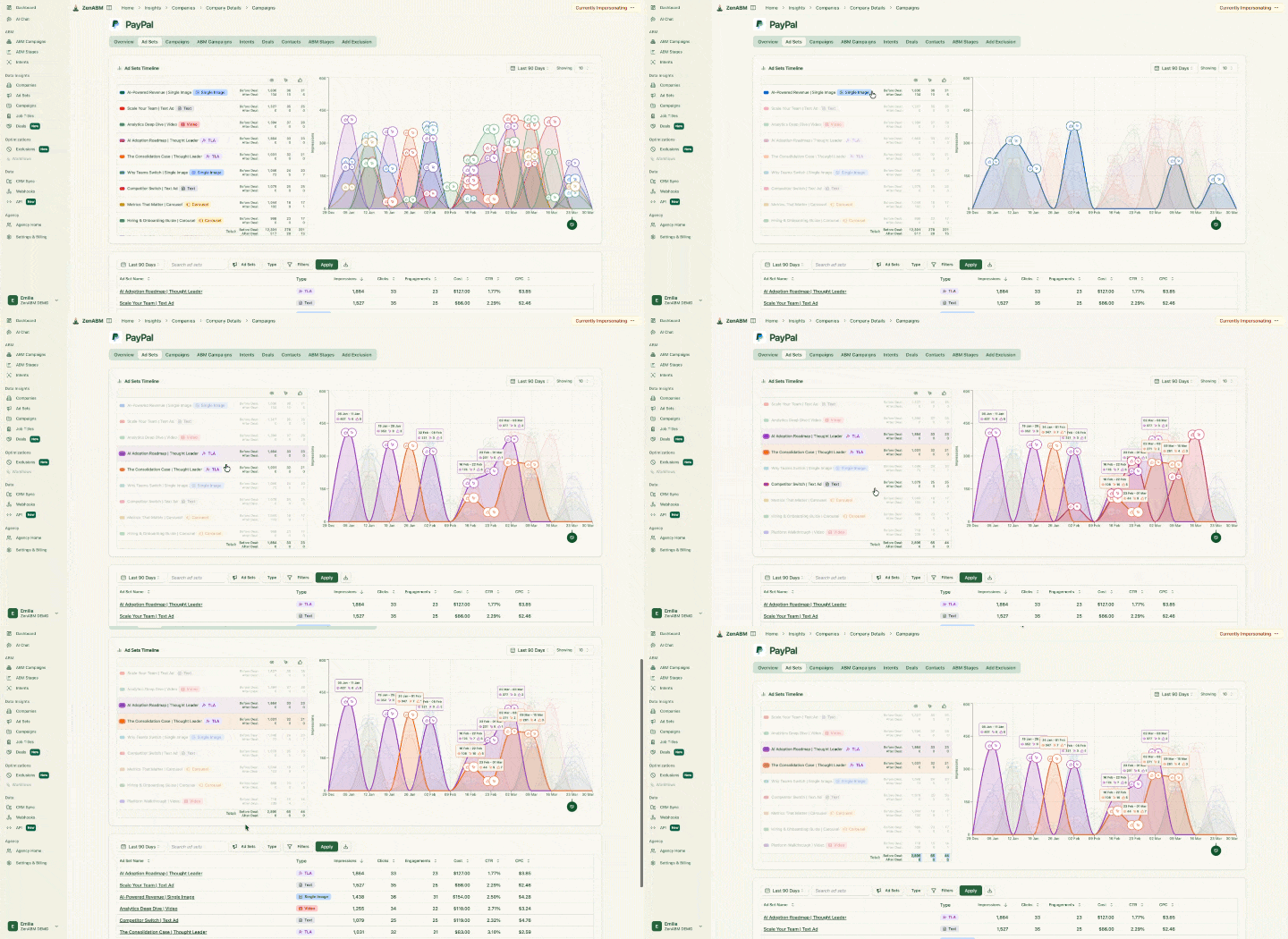
A beta coefficient view weights influenced pipeline instead of counting every qualifying deal at full value. In ZenABM's example, a $50,000 deal at a company with a coefficient of 44 adds $50,000 × 44% = $22,000 of influenced pipeline. I would check the underlying touchpoints in either view before using the number for a budget decision.
ZenABM also writes engagement, scores, stages and intent signals onto company records in HubSpot, Salesforce and Attio, and brings deals back. Google Ads, Reddit Ads, AI referral and organic touchpoints can sit on the same company timeline, but those currently depend on HubSpot. Beyond reporting, Zena (our AI agent) and the MCP server can build campaigns, ad sets and ads, and apply them only after you confirm.
Starter is $59 a month billed annually or $69 billed monthly, and includes one ABM campaign and 10 Zena chats a day. Growth is $159 annually or $199 monthly, with up to 3 ABM campaigns, Salesforce and Attio integrations, webhooks, the API and the MCP server. Pro is $399 annually or $499 monthly, and Agency is $479 annually or $599 monthly.
All plans have unlimited seats and a 37-day free trial, there is a free plan after the trial, and ZenABM never takes a cut of ad spend. For comparison, Octane11 Starter is $3,500 a month before ad spend.
Choose ZenABM if your main question is which accounts engage with your LinkedIn ads and which deals those ads touched, and you want sales to see it in the CRM. Skip it as a full replacement if your decision rests on multi-touch modelling across many channels.
Dreamdata is the attribution option for teams that need to examine the sequence of touches across channels around revenue. I would compare it with Octane11 when attribution is the job to replace, not a LinkedIn program.
Dreamdata's account timeline shows activity over time and can be filtered by channel:

Dreamdata offers first, last, linear, U-shaped, W-shaped, data-driven and custom attribution models. Each assigns credit differently, so the model you pick changes the report. It reconciles LinkedIn with web, Google, Meta and other channels, and it writes engagement, scores and stages to HubSpot and Salesforce records.
A model can help you compare touches, but it cannot tell you for certain which one mattered. I would open one account and check the touches behind a reported result before settling on a model. ZenABM goes the other way: it uses a threshold and lists the touchpoints behind each deal.
Its Audience Hub syncs account audiences built from that data to your ad platforms:

The free Starter plan has 5 seats, 1 sync, 3 stage models and 2 months of user history. It stays free until you exceed a monthly tracked-user limit. Advanced is a custom quote. Vendr's median is $27,000 a year, in a range of $24,594 to $30,450 across 10 purchases. Activation, Data Warehouse and SCIM login are unpriced add-ons, and there is a guided free trial.
Choose Dreamdata if you have enough cross-channel activity to analyze and want several ways to assign revenue credit; ask to see your own accounts in the model you plan to use. Skip it if you need to build and manage ads, or if a threshold-based influence report already answers your question.
HockeyStack combines multi-channel revenue attribution with predictive scoring. I would put it on the list when account scoring is part of the reporting question, not just attribution.
Its campaign analytics dashboard sits alongside the other channel reports:

HockeyStack applies predictive scoring against closed-won journeys and adds impression influence to its attribution. It also handles rep assignment, so scored accounts reach sales.
The benefit of combining channels is that you can look beyond the last touch. The catch is that a report is only as good as the data mapping behind it, so in the demo ask the team to trace one deal back to its source records. HockeyStack groups channel metrics in its CMO overview:

Plans are custom-built through a demo, and startup pricing is available. Vendr reports a median of $28,000 a year across 30 purchases, typically $22,000 to $43,200. Ask what implementation and data mapping the quote includes.
Choose HockeyStack when predictive scoring and multi-channel analytics are both on your list; bring a real account and ask how its score was produced. Skip it if you only need a simple view of engagement and influenced deals.
6sense is an enterprise option for teams that want intent data and display as part of ABM. I would consider it when replacing Octane11 also means rethinking how you find and reach accounts, not only how you report on them.
Its account highlights screen shows how the suite surfaces accounts:

6sense covers enterprise intent and display, which is broader than an analytics swap. Intent helps you identify accounts showing interest, while display is one way to reach them. In a demo I would ask how an intent signal is produced and how it becomes an audience your team can use.
Its ad setup screen shows format and audience options for display:

6sense does not publish its prices, so plans are quoted on request through a demo or sales contact. Vendr's buyer data shows a median of $54,250 a year across 322 purchases, typically $11,143 to $131,490. Ask what ad spend sits outside the quote.
Choose 6sense if enterprise intent and display are jobs you want to add; ask the vendor to show how an intent signal becomes a usable account list. Skip it if you only need account engagement and influenced pipeline reporting.
Demandbase One is an enterprise ABM suite to consider when account scoring and display both belong in the Octane11 replacement. Test whether its account views support the decisions your team makes before you compare the size of the feature lists.
Its Intent Visualizer shows intent keywords across account stages:

Demandbase One covers account scoring, intent and display. Scoring helps only if your team knows what to do with the result, so I would ask Demandbase to show how a scored account enters an audience and how it appears to sales.
Its target audience list builder includes company filters for selecting accounts:

Demandbase does not publish standard pricing, and all quotes are custom through its sales team. Vendr's buyer data shows a median of $68,591 a year. Ask for implementation costs and campaign spend separately.
Choose Demandbase One when scoring and display sit with the same team and both belong in the replacement; use a real account to test how a score becomes an audience. Skip it if your immediate need is a narrow reporting workflow.
The biggest difference between them is scope, so compare the jobs first and then ask each vendor to demo the details. "Not documented" means the vendor's public pages do not say, so verify it in a demo on a real account.
Tool | Account engagement or scoring | Deal attribution | CRM write-back | Intent or display |
|---|---|---|---|---|
ZenABM | LinkedIn company engagement and configurable stages | Threshold-based influence with touchpoints per deal | HubSpot, Salesforce and Attio | No third-party intent |
Dreamdata | Engagement scoring and company identification | First, last, linear, U, W, data-driven and custom models | HubSpot and Salesforce | Not documented |
HockeyStack | Predictive scoring and multi-channel analytics | Multi-channel attribution with impression influence | HubSpot and Salesforce, daily from custom Journey views | Not documented |
6sense | Enterprise intent | Not documented | Salesforce, HubSpot CRM and Microsoft Dynamics | Intent and display |
Demandbase One | Account scoring | Attribution is an add-on module (Salesforce) | Salesforce and HubSpot CRM, two-way sync | Intent and display |
Before you switch, test the same account and deal in each shortlisted tool. Check that the account your LinkedIn ads reached appears in the report, that the deal shows the underlying touches, and that the CRM fields you need land on the right record. If a workflow depends on webhooks, send a test event and confirm the receiving system gets the company data.
Here are the four test steps in order, from checking the reached account to sending a webhook test event:

Read related: LinkedIn ad and revenue attribution tools compared
It depends on the question your team needs answered, so shortlist by use case and then validate with your own account data.
Start with ZenABM if you need to see which companies engage with your LinkedIn ads, move them through stages and connect them to deals. Add Dreamdata as a second demo if the same team also needs to compare attribution across channels.
Dreamdata is the starting point when the question is how touches across channels receive credit. Compare HockeyStack if predictive scoring is also a requirement.
ZenABM Starter begins at $59 a month billed annually, and Dreamdata has a free plan. Test whether the free plan answers your reporting question, then price the scope you need. ZenABM's 2026 LinkedIn ABM Benchmarks Report, which covers 211 companies, found median monthly ad spend of $2,693, so keep software cost in proportion to ad spend before you sign an annual deal.
6sense is the candidate when intent and display are central. Demo Demandbase One too if account scoring matters in the decision.
ZenABM's Agency plan is $479 a month billed annually, and one MCP connection reaches every client workspace, with each call scoped to one client. Whichever tool you consider, ask to see a real client view and the report a client would receive.
If you rely on its dashboards, attribution, imports and ABM measurement together, no single alternative here replaces all four. In that case compare the total cost of two tools against Octane11 before you move.
Whichever suite you shortlist, validate it with the people who will run it day to day. For a switch, use the end of your contract to run old and new reports on the same accounts, and check the underlying touches before you trust either pipeline figure.
ZenABM replaces the LinkedIn account measurement part of Octane11, from engagement through to deal reporting. Use these views together rather than judging the program on one attribution number.
Track LinkedIn account engagement and deal influence
Try ZenABM with your LinkedIn ads and see the account and deal data together.

Pick the tool for the decision you need to make, not for the longest feature list. Then check a real account and its touchpoints before you trust the report.
It depends on the work you need to replace. Start with ZenABM for LinkedIn account engagement and deal influence, Dreamdata for multi-channel attribution, or HockeyStack if predictive scoring matters too. Teams that want enterprise intent and display should compare 6sense and Demandbase One. Test your shortlist on your own accounts before deciding.
Yes. Dreamdata has a free plan, and ZenABM has a free plan after its 37-day trial. Octane11 has no free trial. Check each plan's limits against the job you need done before you rely on it for reporting.
Octane11's Starter plan is $3,500 a month, with no free trial, and it covers companies with up to $100M in revenue. Ask for the full quote for your scope. Compare it with ZenABM from $59 a month billed annually, or Dreamdata's free plan.
It can replace the account engagement and deal influence views if your program runs mainly on LinkedIn. ZenABM also writes selected signals to HubSpot, Salesforce or Attio records. It does not do the multi-source modelling that Dreamdata and HockeyStack do, so check that before you switch.
Use a real account and a real deal before you cancel your contract. Check that LinkedIn engagement appears against the right company, inspect the touches behind the deal, and confirm the CRM fields you need are present. If your workflow uses a webhook, send a test event to the receiving system too.
About the author

