

©2026 ZenABM - All Rights Reserved.
Emilia Korczynska is Head of Marketing and co-founder at ZenABM. Before that she was VP of Marketing at Userpilot for nearly 7 years, where she ran a large ABM program primarily on LinkedIn ads.

Choose HockeyStack if you need one multi-channel record of everything an account touched before a deal. Choose ZenABM if your ABM budget goes to LinkedIn and you want a tool that shows which target companies engaged with your ads, scores them and builds campaigns with AI. Either way LinkedIn still serves and bills the ads, so you still buy the media through Campaign Manager.
I'm a co-founder of ZenABM, so weigh my view accordingly, and I have not used HockeyStack hands-on.
Think of HockeyStack as a flight recorder and ZenABM as a pilot. One records everything that happened on the journey. The other reads the instruments on LinkedIn and changes course.
Here is the whole post in one picture before the detail:

Here are both tools side by side on the points that usually decide the purchase:
Dimension | ZenABM | HockeyStack |
|---|---|---|
Main use case | LinkedIn ABM: company engagement, stages, CRM sync and campaign management with AI | Multi-channel revenue attribution across ads, web, CRM and offline |
Not built for | Full web journey analytics, display, programmatic, website personalisation, third-party intent | Running LinkedIn campaigns |
Price | From $59/month, no markup on ad spend | Not published; Vendr median $29,702 a year |
Campaign budget it needs | Your LinkedIn budget, nothing taken from spend | Your LinkedIn budget, paid separately |
Setup and people | LinkedIn Ads to CRM sync set up in about 10 minutes, one marketer can run it | Several weeks of setup; G2 reviewers point to needing an attribution owner |
Best size | Lean in-house teams, enterprise teams, agencies | Mid-market with a RevOps team (62.2% of its G2 reviews) |
Main channel | Many channels | |
LinkedIn execution | Yes: builds and manages campaigns, ad sets and ads | No |
Multi-channel attribution | LinkedIn, Google Ads, Reddit Ads, AI referrals and organic via HubSpot | Deeper, with several models and ad-level attribution |
CRM sync | Writes to HubSpot, Salesforce and Attio | Daily journey sync to HubSpot or Salesforce; Salesforce sync add-on pushes touchpoints |
AI and MCP | MCP server with 129 tools and 45 skills, and it writes to LinkedIn | Official MCP server and Odin analyst, focused on analytics |
G2 rating | 5.0/5 from 6 reviews | 4.5/5 from 82 reviews |
How we compared them. This comparison draws on vendor docs and pricing pages, HockeyStack's G2 reviews, Vendr contract data and sales conversations where buyers discussed these tools.
See which companies engage with your LinkedIn ads
ZenABM shows the companies behind your LinkedIn impressions and clicks, moves them through your ABM stages and syncs them to your CRM.

One example shows why the difference matters. A campaign manager at an industrial automation company told us LinkedIn Business Manager reported an 85-to-1 return on ad spend that the team knew was false. What they needed was correlation and influence, not proof, and that is a different job from either recording a journey or running ads.
ZenABM turns LinkedIn ads into account intelligence and then acts on it. It reads impression, click and engagement data per company from LinkedIn's official API (no cookies, no reverse IP lookup) and joins it to your CRM. It then scores accounts through stages and creates campaigns, ad sets and ads with AI.
Here is the Companies view, where every engaging account sits on one row with its stage:

Here is Claude connected to the ZenABM MCP server, creating ads without opening Campaign Manager:
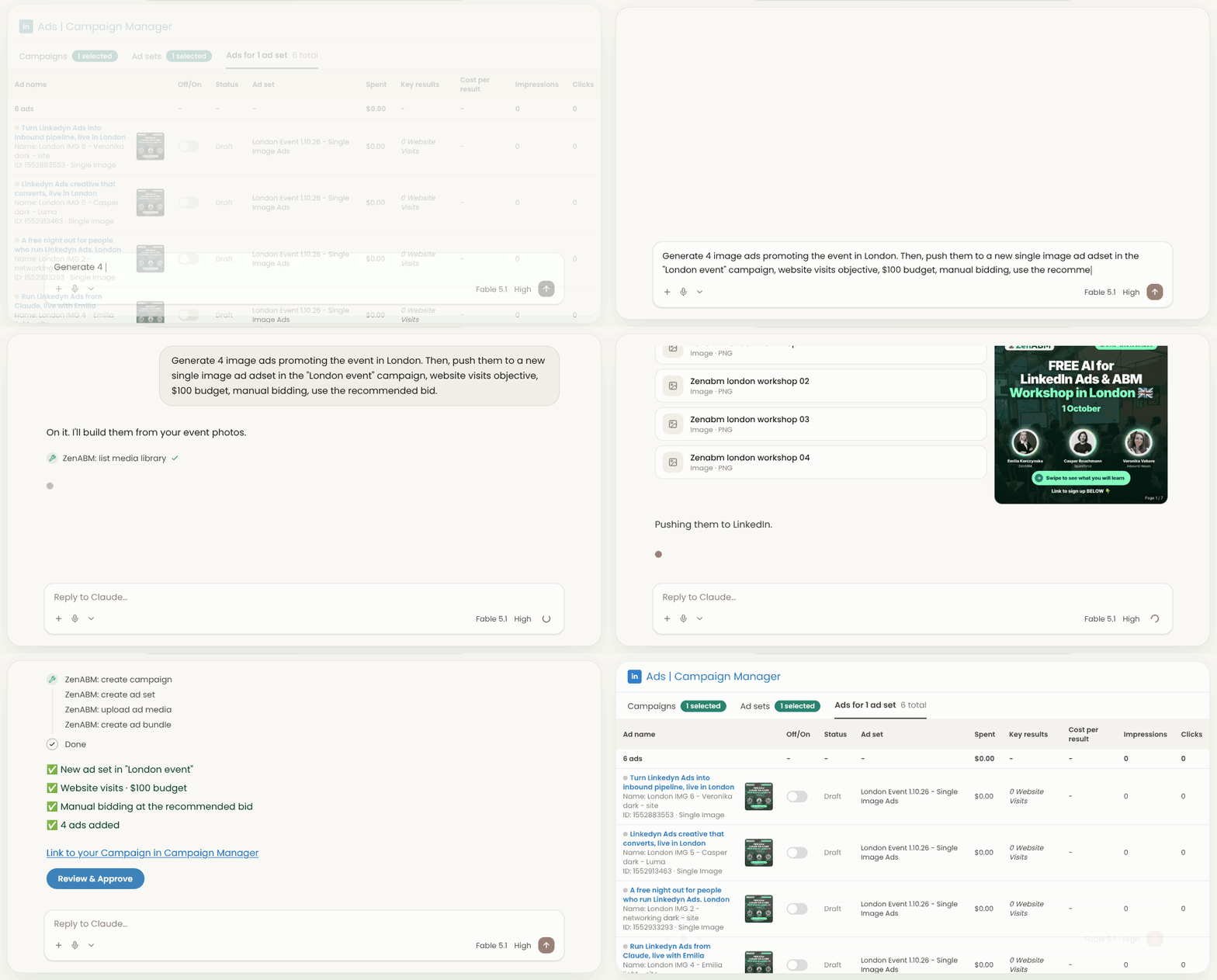
The weak spot is the web journey. ZenABM does not model every visit with cookies and regression analytics. Google, Reddit, organic and AI referral touches come in through the HubSpot integration, so that side is only as good as your HubSpot data.
HockeyStack pulls CRM data, ad platforms, website tracking (cookies and its own pixel) and offline activity into one account journey. LinkedIn impressions sit chronologically beside site visits and deals, and several attribution models run together. Its AI agents (Odin the analyst, Nova for research and scoring) read that data. Its LinkedIn data is company-level, with no job title breakdown.
Here is Odin, its conversational analyst:

And here is its LinkedIn campaign analytics dashboard:

HockeyStack is not a discontinued legacy product. It repositioned around "Revenue Agents for the Enterprise" in April 2026, and its October 2026 release notes still ship attribution updates. What it does not do is buy, run or edit LinkedIn ads. Campaigns are still created in Campaign Manager. HockeyStack's features explained goes deeper.
Liam Collins, founder of a LinkedIn ad agency that has run about a million Thought Leader Ads, called HockeyStack's ad-level attribution "really really good". Tools that stop at the ad set or campaign, he noted, leave you guessing which ad did the work. That is a real strength. ZenABM's deal view breaks touches down by ad set and campaign, not by individual ad.
Judge both tools against these six points before you look at features:

Stages are a good example of the people cost. Without a tool, someone checks engagement and CRM fields and updates each account by hand. ZenABM moves every account through the ABM stages you define, from ad engagement and CRM data, so the stage is computed rather than updated by hand.
A head of growth at a healthcare systems company compared HockeyStack, Dreamdata, CaliberMind and Factors.ai because they needed one attribution story across the entire pipeline. If that sounds like your week, you are in HockeyStack's territory. For the wider category, see cross-channel attribution tools.
This is the longest section because it is where the choice gets made. ZenABM is in the first column of every table, and each category ends with a winner. You can see the full list of ZenABM features alongside.
Capability | ZenABM | HockeyStack |
|---|---|---|
Company-level engagement | Yes: LinkedIn impressions, clicks and engagements matched to the company | Yes: company-level LinkedIn data as a LinkedIn Marketing Partner |
Intent signals | Yes: first-party, from themed ads | Partial: LinkedIn ad interactions feed scoring and intent audiences; Bombora through a partnership |
Account stages and scoring | Yes: stages you define, recalculated daily | Yes: funnel stages and predictive scoring |
Job title engagement | Yes | No: company level only |
HockeyStack covers company engagement, account-level journeys and predictive scoring well. ZenABM adds job title engagement, which shows which roles your spend reached and which of them engaged, and theme-based intent signals. A theme is attached to a campaign or ad set, and when a company engages, ZenABM attributes that theme to the company and syncs it to your CRM. You define the account stages as ordered rules over LinkedIn and CRM data.
Campaign Manager doesn't expose company-level engagement, so teams piece it together from exports and CRM records. ZenABM's Company engagements view shows every company engaging with your ads, with its engagement score, ABM stage and CRM data on one row. The score runs 1 to 5, calculated from clicks (counted twice) and engagements, divided by impressions.
LinkedIn hides company engagement data when a company has fewer than 3 interactions in a period, so ZenABM also aggregates at campaign group level.
Winner: ZenABM, for job title engagement, first-party intent and stages you define. HockeyStack is stronger on predictive scoring.
Capability | ZenABM | HockeyStack |
|---|---|---|
Build and manage campaigns | Yes, with AI | No |
Budget controls | Yes: Budget Savers | No |
Bidding | Yes: bid and budget changes with confirmation | No |
Exclusions | Yes: up to 200 per ad set | No |
Impression capping and frequency | Yes: as a routine built on exclusions and audiences | No |
This one is not close. HockeyStack is an analytics layer, so it can credit a LinkedIn touch but cannot change the campaign that produced it. ZenABM builds campaigns, ad sets and ads from chat, changes bids and budgets after you confirm, and keeps bad-fit companies out with exclusions.
Impression capping is a routine, not a single switch. Campaign Manager has no per-account spend limit, so you find accounts above a ceiling in the Companies list and exclude them.
Winner: ZenABM, clearly.
Neither tool buys display ads. HockeyStack syncs audiences to display and CTV and reaches Bombora intent through a partnership, while ZenABM does not offer display, programmatic or third-party intent.
Capability | ZenABM | HockeyStack |
|---|---|---|
Display and programmatic | Not offered | Audience sync to display and CTV |
Third-party intent | Not offered | Yes, through partnerships |
Winner: HockeyStack.
Capability | ZenABM | HockeyStack |
|---|---|---|
Dashboards | Yes: spend, influenced pipeline, ROAS, pipeline per dollar | Yes: 17 dashboard templates including CMO Overview |
Deal and pipeline attribution | Yes: deal dashboard with touchpoints before each deal | Yes: several models, six out of the box |
Multi-channel attribution | Yes, through HubSpot: LinkedIn, Google Ads, Reddit Ads, AI referrals, organic | Yes, deeper: ads, web, CRM and offline |
Ad-level attribution | Deal view by ad set and campaign | Yes, down to the individual ad |
HockeyStack wins on depth. Six attribution models, ad-level attribution and cookie-based web tracking go further than ZenABM's influence-based approach. Ad-level matters most for Thought Leader Ads, where different messages sit in separate ads.
ZenABM does cover the question most LinkedIn-first teams ask. A deal counts as influenced when the account engaged above your threshold within your window, and the deal dashboard shows impressions, clicks, engagements and spend before each deal opened and closed. ZenABM's Dashboards show ad spend next to influenced pipeline, ROAS and pipeline per dollar out of the box, so you don't have to join spend exports to CRM deals every month. With HubSpot connected, ZenABM also puts LinkedIn Ads, Google Ads, Reddit Ads, AI referrals and organic visits on one company journey, so you can see which channels touched a deal.
Winner: HockeyStack for multi-channel depth and ad-level attribution. ZenABM for influenced pipeline from your LinkedIn ads without an attribution project.
Capability | ZenABM | HockeyStack |
|---|---|---|
AI assistant | Zena | Odin (analyst), Nova (research and scoring) |
Automated reports | Yes: 10 aspect reports weekly, monthly and quarterly | Yes: Odin builds reports |
MCP server | Yes: 129 tools, 36 can change the ad account, 45 expert skills | Yes: official, OAuth sign-in, to query data and build reports |
Both have an MCP server, so you can use either from Claude or ChatGPT. HockeyStack's server exposes its analytics. ZenABM's server connects your LinkedIn ads to Claude, ChatGPT or Cursor and also creates and manages campaigns, ad sets and ads, which HockeyStack cannot do because it does not run ads. Every tool that changes something live is flagged, so the client asks first.
Zena also writes ten reports each cycle (Dashboard, Campaigns, Ad Sets, ABM Campaigns, ABM Stages, Companies, Contacts, Deals, Intents and Job Titles), each ending in recommendations with confirm-first fixes.
Winner: ZenABM for acting on LinkedIn. For cross-channel analysis, HockeyStack's Odin is the more mature analyst.
Capability | ZenABM | HockeyStack |
|---|---|---|
CRM sync | HubSpot, Salesforce, Attio: engagement, scores, stages, intent written to company records | Daily journey sync to HubSpot or Salesforce; Salesforce sync add-on pushes touchpoints |
Webhooks | Yes: every Monday after the weekly sync, to Clay, n8n, Zapier, Make, Outreach, Salesloft | Yes: Account Intelligence API can send view updates and workflows to webhooks |
API | REST API from the Growth plan | Account Intelligence API |
ZenABM's CRM sync writes to the field level: HubSpot analytics write back every Monday and deals refresh daily, and Attio gets 46 attributes. HockeyStack syncs journey views to HubSpot or Salesforce daily as a true or false flag per company, and its Salesforce sync add-on pushes touchpoints.
Winner: ZenABM, for writing engagement, scores, stages and intent onto company records.
Capability | ZenABM | HockeyStack |
|---|---|---|
Multi-client workspaces | Yes: Agency plan | Not documented |
Agency access to all clients | Yes: Agency MCP server | Not documented |
ZenABM's Agency MCP server reaches every client workspace from one connection, so agency reporting doesn't mean one login per client.
Winner: ZenABM.
HockeyStack is sold through a demo, with no self-serve signup. ZenABM has a 37-day free trial with no card needed, and a free plan after the trial, so you can test on your own account list.
ZenABM acts on the journey, while HockeyStack documents it.
Here is the split between what only ZenABM does and what only HockeyStack does:

ZenABM starts at $59 a month, while HockeyStack's median Vendr contract is $29,702 a year. Here is how the two compare:
ZenABM | HockeyStack | |
|---|---|---|
Plans | Starter, Growth, Pro, Agency | Custom quote |
Price | Starter $59/month annual or $69 monthly; Growth $159 or $199; Pro $399 or $499; Agency $479 or $599 | Not published; Vendr median $29,702 a year (range $24,040 to $77,500, 33 purchases) |
Free trial | 37 days, no card; free plan after | Not published |
Limits | Unlimited seats, no markup on ad spend | Demo-gated |
Total cost = subscription + ad spend + team time
See ZenABM's pricing for current plans. Starter is $59 a month billed annually or $69 billed monthly, Growth is $159 or $199, Pro is $399 or $499, and Agency is $479 or $599. The entry plan comes to $708 a year billed annually, plus your LinkedIn budget, with nothing taken from ad spend. All plans include unlimited seats and a 37-day free trial with no credit card, and there is a free plan after the trial.
HockeyStack does not publish its prices. Every plan is a custom quote arranged through a demo, so ask for one there. The Vendr median is about $29,702 a year before any LinkedIn spend, plus weeks of setup and likely an attribution owner or agency. G2's pricing summary warns that HockeyStack suits teams poorly without an internal attribution expert.
A partner call showed how heavy this class of tool gets. Tools like Dreamdata need server-side tracking, an internal agency and weeks to set up. HockeyStack reviewers also describe several weeks of setup. We once told a prospect that Dreamdata and HockeyStack cost "north of $15,000 to $20,000" and that ZenABM would not pretend to have the same multi-touchpoint data. Treat that as a conversation, not a quote.
Read related: Dreamdata vs. HockeyStack: Which is Better for ABM?
ZenABM | HockeyStack | |
|---|---|---|
G2 | 5.0/5 from 6 reviews | 4.5/5 from 82 reviews |
ZenABM's 5.0 comes from 6 reviews, so it is an early rating.
For HockeyStack, G2 reviewers praise attribution accuracy, multi-touch visibility and the Odin analyst. The complaints are a steep learning curve, setup effort, and a cluster of recent low ratings about data connectivity and support.
Here are both G2 ratings with what reviewers praise and criticise:

A multichannel marketing director said they chose HockeyStack for cross-channel attribution across paid and organic, but setup took multiple weeks and needed developer work.
For ZenABM, one Head of Revenue wrote on G2: "What I like best about ZenABM is that they understand ABM beyond theory." Another said: "The UI and UX are clean, intuitive, and easy to navigate."
Reviewers also raised mild points. ABM takes time to compound, one wanted a Pipedrive integration, and company data sometimes loads slowly. For other options, see our HockeyStack alternatives guide.
You still pay LinkedIn full price. HockeyStack shows you the journey, but it takes no action on waste like Audience Expansion. The campaign budget stays exactly as leaky as it was.
No owner means a reporting platform nobody reads. G2 reviews and our own conversations point the same way: without someone whose job is attribution, the dashboards go quiet.
Here are the three gaps in one picture:

Signals reach Sales without context. A fractional demand generation lead told us about a problem with tools like HockeyStack. A CEO ran five Thought Leader Ads, each with a different message. There was no way to match the ad-level number to the ad name, so Sales could not use the message context.
I think the buying mistake is expecting an attribution model to name the cause of a deal. Journey data should tell you what to send next, not just where to move CRM credit. If you want to see how measurement problems sink campaigns, why your LinkedIn ads aren't working goes deeper.
Choose ZenABM if LinkedIn owns your ABM budget, because it acts rather than only records: it builds campaigns, excludes accounts and switches off Audience Expansion, which HockeyStack cannot. It starts at $59/month against a Vendr median of $29,702 a year for HockeyStack, and its CRM sync takes about 10 minutes to set up, so one marketer can run it. The deal dashboard and Dashboards cover correlation and influence from LinkedIn, which is what the 85-to-1 ROAS team needed.
Choose HockeyStack if your motion spans Google Ads, paid social, web and offline and you want one account-level journey with several attribution models and ad-level attribution. It fits a RevOps-run program with a dedicated attribution owner, and it adds display and CTV audience sync and third-party intent through partnerships. Skip it if your main need is running and improving LinkedIn campaigns.
A flight recorder tells you what happened, and a pilot changes course. Before any demo, write down the one job, the yearly LinkedIn budget you can actually spend and the person who will run the tool. If any of the three is blank, you're not ready to buy.
Try ZenABM free for 37 days
Connect LinkedIn Ads and your CRM in about 10 minutes, see which target accounts engage and build campaigns with Zena.

They overlap on revenue attribution and company-level LinkedIn ad data, but their core jobs differ. HockeyStack is a multi-channel attribution platform that documents the whole buyer journey. ZenABM is a LinkedIn-first ABM tool that shows which accounts engaged and then runs or changes the LinkedIn campaigns, so it acts on the journey instead of only recording it.
ZenABM is cheaper. It starts at $59/month, while HockeyStack's median Vendr contract is $29,702 a year. The real comparison is total cost: HockeyStack also needs weeks of setup and often a dedicated attribution owner, and you pay for LinkedIn ad spend either way.
Only if your motion is multi-channel, analytics-heavy and run by someone who owns attribution. G2 reviewers say it suits teams without an internal attribution expert poorly, and setup can take several weeks. If LinkedIn is your main paid channel, ZenABM shows company engagement and runs the ads for far less.
Start from the subscription, with a Vendr median of $29,702 a year, then add a LinkedIn budget large enough to reach your target accounts. HockeyStack cannot manage delivery, so you also need time to monitor campaigns in Campaign Manager.
Dreamdata, Factors.ai, LeadsRx and Ruler Analytics are common multi-channel attribution alternatives. For LinkedIn-first ABM, ZenABM is the direct comparison, because it reads LinkedIn ad engagement at the company level and then runs the campaigns, which attribution-only tools do not do.
HockeyStack unifies ads, website, CRM and offline activity into account-level buyer journeys, from the first ad impression to closed revenue, and runs several attribution models on them. It does not buy or manage LinkedIn ads.
Yes. ZenABM has influence-based deal attribution and multi-channel revenue attribution that places LinkedIn Ads, Google Ads, Reddit Ads, AI referrals and organic visits on one company journey. It is not as deep as HockeyStack's cookie-based models, but it covers the channels most LinkedIn-first B2B teams use.
About the author

