Black Friday: up to 50% off ZenABM 💥Get up to 50% off ZenABM with our massive BlackFriday sale! 💥 - only 27-30 November!Get the deal12 Days of ABM Christmas · Report on your 2026 LinkedIn ABM & plan 2027 · Free webinars, 26 Nov – 9 DecSave your seat


Emilia Korczynska is Head of Marketing and co-founder at ZenABM. Before that she was VP of Marketing at Userpilot for nearly 7 years, where she ran a large ABM program primarily on LinkedIn ads.

Who should manage your LinkedIn ads depends first on how much you spend per platform. Below about $25k a month per platform an agency or specialist is the safer pick, and above it in-house can win on company context.
Software supports either one by taking over the tedious weekly work, for example through Zena, ZenABM's AI agent, but it won't replace expertise. If you run ABM on company lists, the account-level side matters even more.
Your situation | Pick | Why |
|---|---|---|
Under $25k a month per platform, no LinkedIn specialist | Agency or specialist | You get platform pattern recognition instead of a generalist learning on your budget |
Above $25k a month per platform, with a LinkedIn specialist and creative support | In-house | Your team knows the company context and owns the outcome |
Small team that wants to learn and run it themselves | Consultation package, then in-house | Specialists such as Maximilian Herczeg offer consultation-focused packages for teams that run LinkedIn ads internally |
Any budget, drowning in weekly ops | Add software | It handles the repetitive checks and changes, and you stay in charge of strategy |
Running ABM on company lists | Whoever can report at company level | Campaign Manager doesn't show company-level engagement |
The three options at a glance, with when to pick each and what each costs:

It involves seven jobs that repeat every week, which is why the cost is a salary or a retainer and never a one-off. Before choosing who does the work, you need to know what the work is:
Here are the seven jobs as a weekly cycle that loops back to setup:

That's why "set it and forget it" fails on LinkedIn: bids drift, ads decay, audiences saturate and reports come due every week, so an account nobody touches gets worse while it keeps spending.
Rob Muldoon wrote on 8 September 2026 that the most expensive thing about LinkedIn Ads is someone managing the platform as a side task, or without the right training. The unmanaged accounts he describes show no hygiene and no optimisation. They use standard formats, run no experiments and recycle creative. I agree with him, and I'll come back to the money in the costs section.
The scale of upkeep is easy to underestimate. In ZenABM's 2026 benchmarks of 211 companies, the median company spent $2,693 a month across 312 ads, 16 campaign groups and 44 ad sets. That is a lot of moving parts for something treated as a side task.
So if this is a recurring job, who should do it?
Pick based on monthly spend per platform, not on whether you can avoid a management fee. The rule below is Cristina Maliţa's:
Budget rule: below about $25k a month per platform, pick an agency or specialist; above it, go in-house only with a platform specialist and separate creative.
Monthly spend per platform | Pick | Condition |
|---|---|---|
Below about $25k | Agency or specialist | You have no dedicated LinkedIn expert in-house |
Above about $25k | In-house | A LinkedIn specialist plus a separate creative resource |
Any level | Software on top | You still hold strategy and context yourself |
The threshold exists because of who you can realistically hire. Maliţa says that at a low to mid ad budget an in-house hire almost always lands a generalist. A generalist covering LinkedIn, Google and Meta is rarely sharp on all three. Accounts set up by a Google specialist, for example, can carry over the wrong audience logic, account structure and bidding behaviour.
Agencies handle $50k, $80k or $100k+ monthly spends without their clients taking it in-house, which tells you where the line sits in practice.
Maliţa also tells a story of how this goes wrong. A CMO at a mid-sized B2B SaaS company consolidated three agencies into one in-house buyer, got "meh" results across all three platforms and was back to per-platform consultants within six months.
The rule tells you what to pick, so the next question is what each option costs.
Agency fees are flat or a share of spend: SaaS Hero's 2026 pricing comparison puts flat retainers at about $3k to $12k a month, indexed to ad spend, and percentage fees commonly run 10 to 20% of spend. In-house cost is a salary plus a creative resource, and the "free" side-task manager is the most expensive of all:
Option | Typical cost | What's included | Hidden cost |
|---|---|---|---|
Agency | About $3k to $12k a month flat, or 10 to 20% of ad spend, often plus a setup fee. Ad spend is billed separately | Specialist knowledge across accounts, often campaign management and reporting | Siloed work if the agency only checks its own platform; creative may cost extra |
In-house specialist | A salary, plus a separate creative resource | Company context, speed and ownership | A generalist hire at low budgets; no peers to learn from |
Side-task manager | Looks free | A share of someone's week | Waste from unmanaged campaigns, which Muldoon sizes below |
Software | From $59 a month (ZenABM Starter, billed annually; $69 billed monthly), 37-day free trial, unlimited seats, no cut of your ad spend | Reports, bid and budget changes, checks, expert skills | It doesn't bring strategy or tacit knowledge |
The side-task row deserves the most attention. Muldoon's point is that on a $200k to $300k yearly budget, skipping expertise can turn the whole $200k to $300k into waste, because an account that is merely active still spends every dollar. So when Finance blocks a management fee and calls it a saving, I think it is comparing the wrong things: the fee against the ad budget it protects.
Here are the four options and what each one costs, including the hidden cost of a side-task manager:

That makes the cheapest-looking option rarely the cheapest.
See which companies your LinkedIn ads actually reach
ZenABM shows every company engaging with your ads, so whoever manages your account can work at account level.

In-house beats an agency on company context and on "do what it takes", provided your spend and your specialist clear the bar from the budget rule. An in-house team knows the company's objectives, needs no briefing cycles and owns the outcome.
An in-house setup needs a few things in place:
The spend gate comes first, then all three must be in place:

There's a leaner version. In my experience, strategy and creative skills on one side and analytical ops skills on the other rarely live in the same head. So the lean setup is one strategist plus one ops owner, rather than one person asked to do both well.
Ali Yildirim shows how an in-house team can build skill together: his team holds a weekly paid-media call with structured presentations and live account teardowns. A team that shares what it learns across accounts gets some of the pattern recognition agencies have by default.
That makes in-house look expensive, which is fair, and it's why the threshold matters. So what if you don't have that team?
Without an in-house team, or below the spend threshold, an agency is the best choice, and I'll say that plainly. Agencies bring platform specialism and pattern recognition from many accounts. The risk is the siloed contractor who checks only their own platform and doesn't own your outcome.
Chris Konowal made this point on 22 September 2026: a head of marketing on a small team needs an embedded resource who can take over fixing what broke, with access to nearly every tool and channel, not a contractor who only checks their own platform. Hold that picture in mind when you shortlist.
Use this checklist when you choose:
I'd make them show you work, not a pitch. For example, ask them for a persona audit like this one, which shows whether the job titles your ads reach are core, secondary or out of scope:
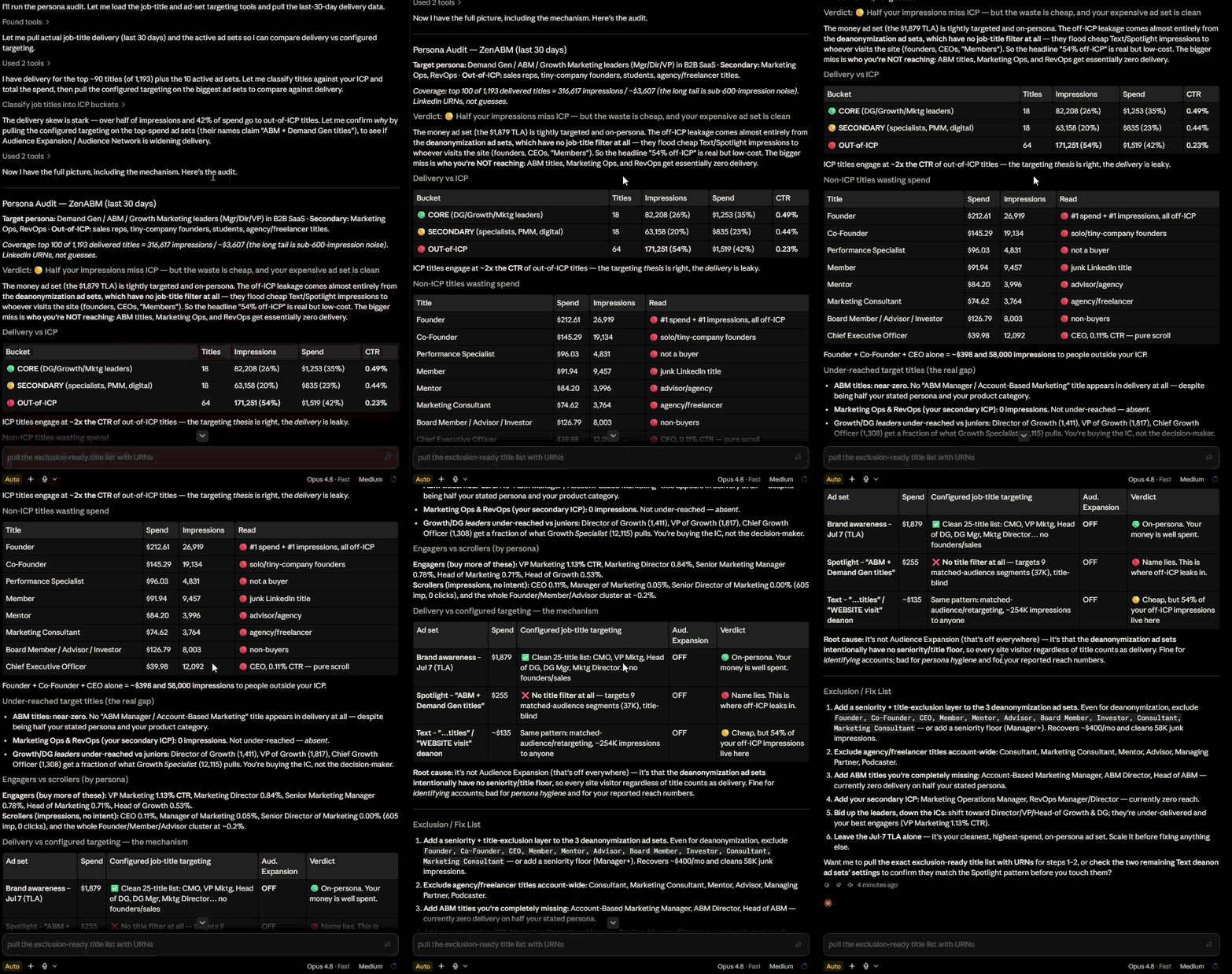
If an agency can't produce something like that for your account, I'd keep looking.
To build a shortlist, start with our LinkedIn ads agencies directory and our post on the top 13 account-based marketing agencies and how to choose one.
If you're an agency yourself, ZenABM's Agency MCP server reaches every client workspace from one connection, with each call scoped to one client.
So where does software fit in all this?
Software removes the tedious ops work and supports whichever team you pick, but it doesn't replace expertise or tacit knowledge. Fine-tuning an agent to your company takes a lot of context engineering, and few companies can do it. Positioning, ICP and strategy can't be outsourced to a model. Here is what software can take over:
Tedious task | How it's done by hand | What software does |
|---|---|---|
Switching off LAN and Audience Expansion | Untick both on every new ad set in Campaign Manager | Budget Savers keeps both off on the ad sets you choose, re-checks every hour and covers new ad sets automatically within an hour |
Spotting ad decay | Compare each ad's performance week over week | The Bidding agent flags an ad when its engagement rate has fallen for consecutive weeks |
Bids and budgets | Edit ad sets one by one against LinkedIn's suggested bid | Zena shows the suggested bid and the change, and writes it to LinkedIn only after you confirm |
Reporting copy-paste | Export, paste, reformat every week | Zena writes weekly, monthly and quarterly reports |
Take the first row, because it costs real money. Both settings are on by default in Campaign Manager, so a new ad set can ship spending on accounts you never chose. You can check this in ChatGPT connected to ZenABM, where the assistant lists active campaigns and whether Audience Expansion and Audience Network are delivering:
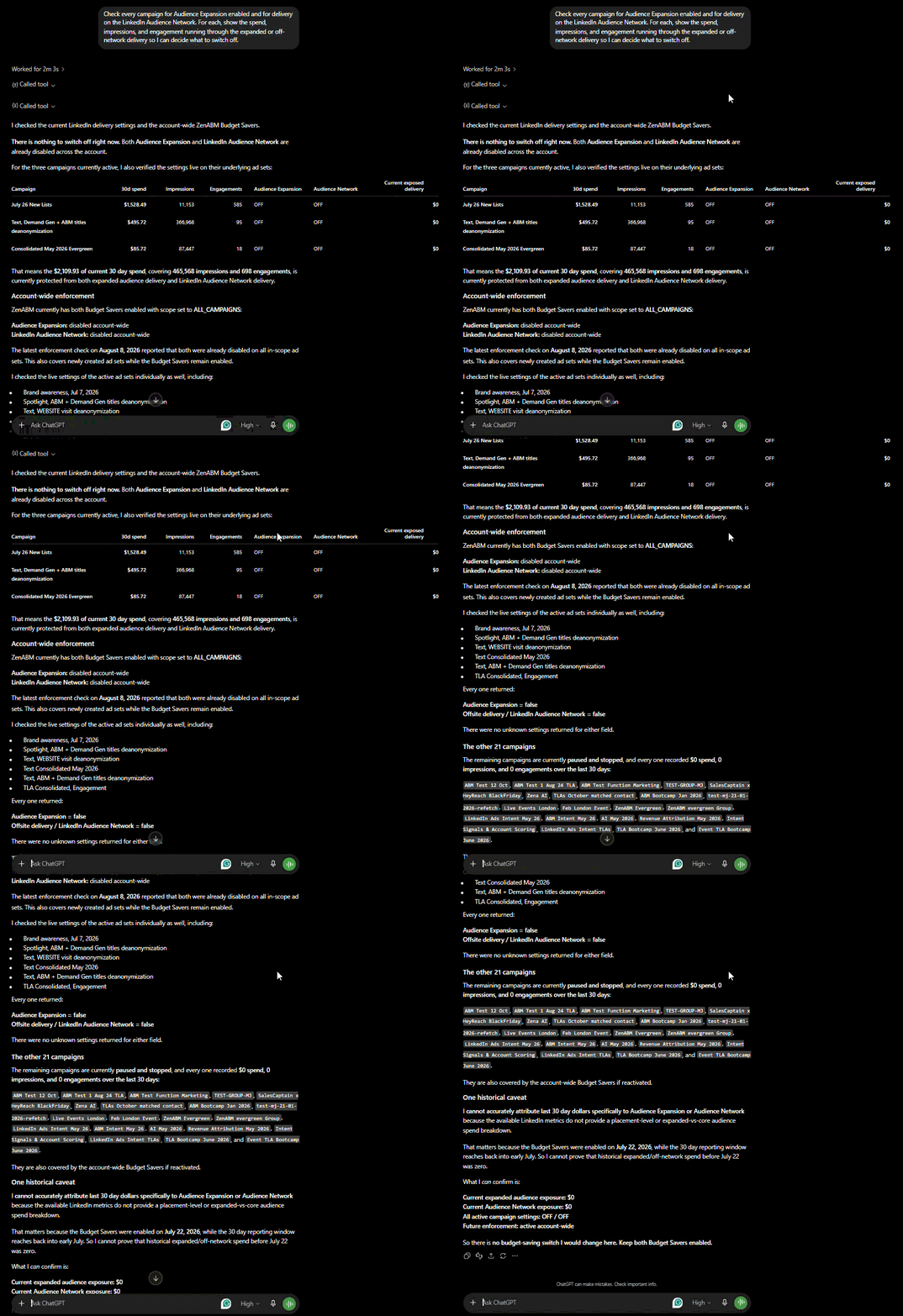
By hand, the fix means unticking both on every ad set, every time. ZenABM's Budget Savers switches LinkedIn Audience Network and Audience Expansion off on all campaigns or only the ones you pick. A campaign in scope covers ad sets added later, so nobody has to remember to untick them.
Ad decay is the second case. ZenABM's Bidding agent tracks each creative week by week, flags ads whose engagement rate has fallen for consecutive weeks and pauses them once you approve. It also reads LinkedIn's suggested bid live. Pacing needs the same attention, because LinkedIn can spend up to 150% of a daily budget on a strong day.
Reporting copy-paste goes too. Here Claude queries the ZenABM MCP server for the top ads over 90 days, with no export step:
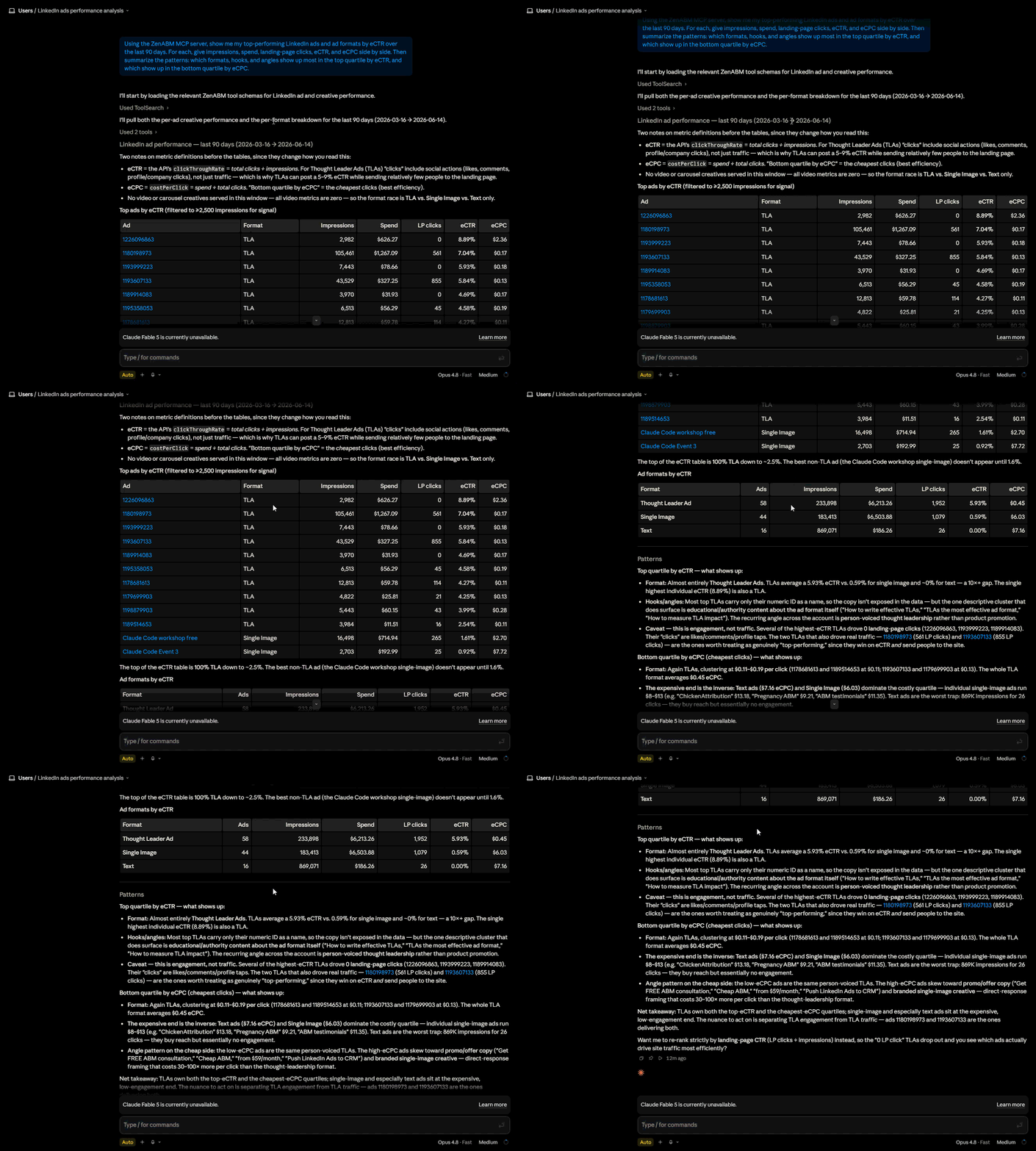
Now the limit. In my experience, companies that brag about running on "two people and AI" often pay three agencies with eight people behind them. Agents plus people works; agents instead of people doesn't, yet.
All of this assumes broad management, so how does it change when you run ABM on company lists?
ABM management is account-level work that Campaign Manager doesn't do: who engaged, which accounts are saturated or unreached, and who moved stage. With broad targeting you watch ad metrics, but with ABM you manage a list of companies, and the questions change:
Broad-targeting management | ABM management | |
|---|---|---|
What you watch | CTR, CPC, CPM by ad and ad set | Which target companies see your ads, engage and in what stage |
What you decide | Which ads and audiences get budget | Which accounts are over-exposed, unreached or ready for sales |
Campaign Manager doesn't expose engagement at company level, so this is work an agency or ops owner has to be able to do, and you should ask for it when you hire. In ZenABM's benchmarks the median company targeted 6,423 accounts a month, and I wouldn't track that many companies in a spreadsheet.
ZenABM's Company engagements view puts every engaging company on one row with its engagement score, ABM stage and CRM data. The score is clicks (counted twice) plus engagements, divided by impressions, on a 1 to 5 scale, and accounts sit in one of 7 default stages that recalculate daily. Here is the Companies view with engagement score and ABM stage for each target account:
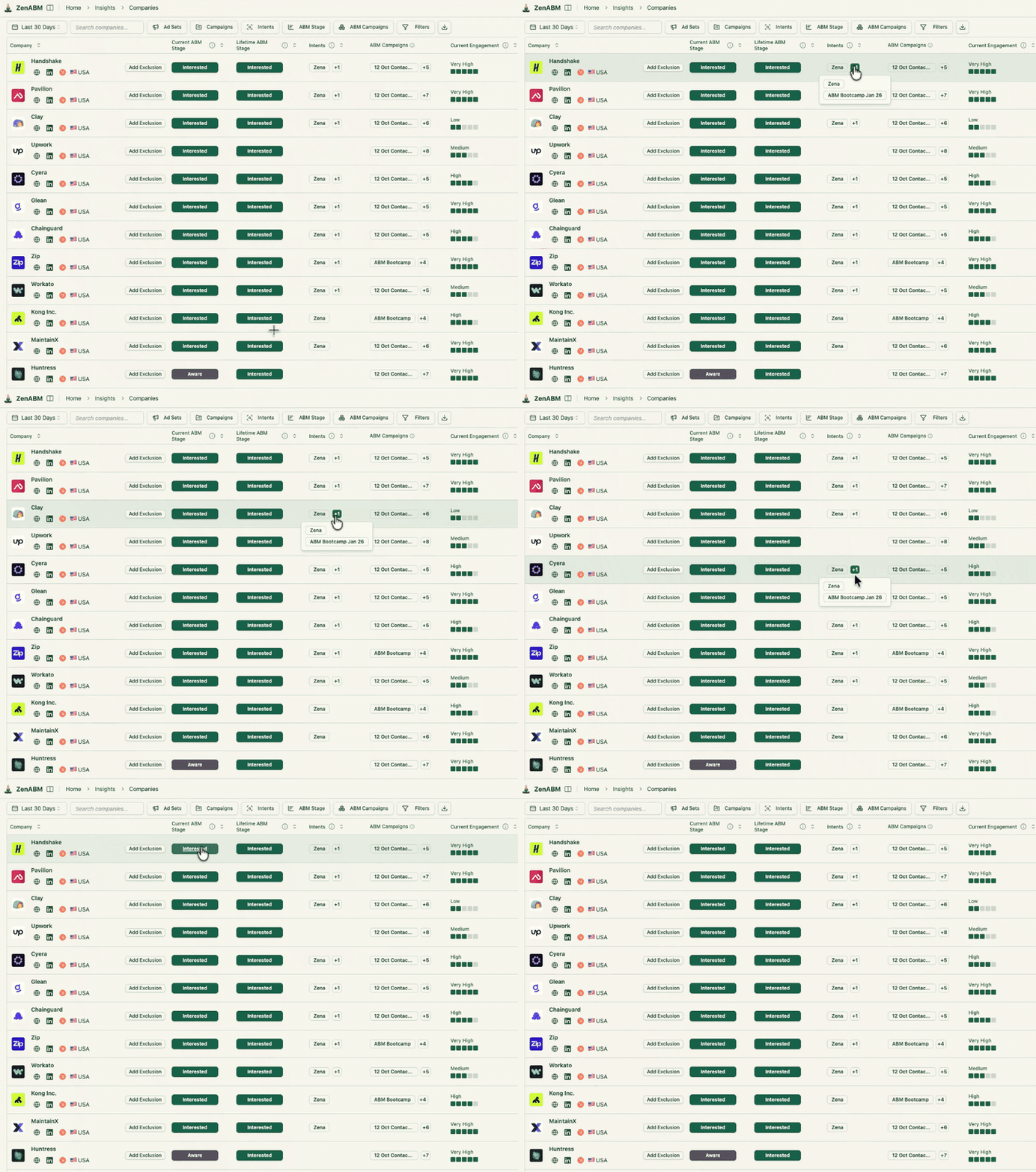
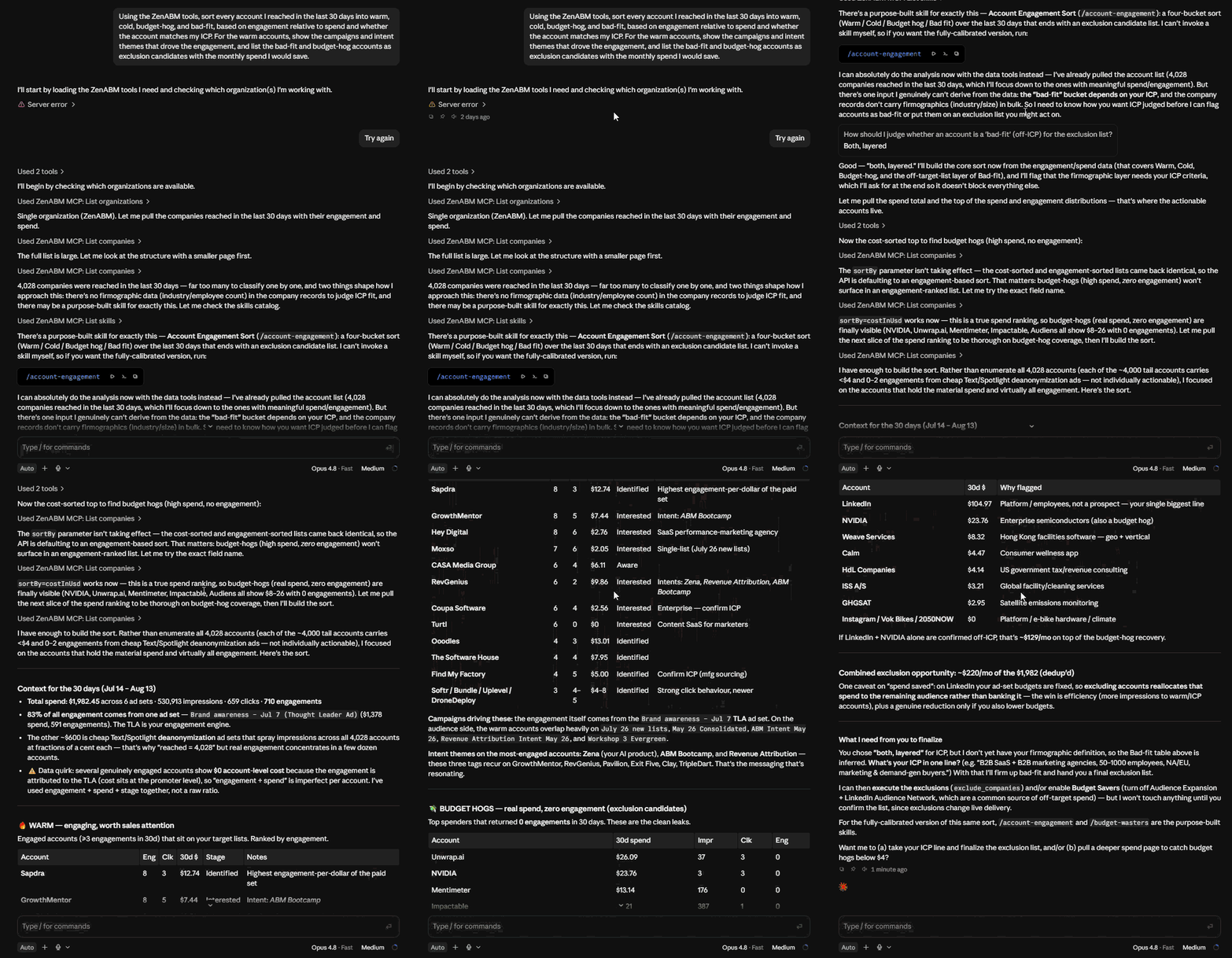
Here's a typical account-level fix. A few large accounts can absorb an ad set's budget without clicking, because they win more auctions. The fix is impression capping: find accounts above your impression ceiling with no clicks, then exclude them. This run sorts reached accounts into warm, cold, budget-hog and bad-fit:
List size also has to match people. Andrei Zinkevich points out that teams rarely discuss how many accounts one sales rep can realistically engage, and that number caps how many accounts you can usefully work.
Read related: ABM Team Structure: Roles, Responsibilities & Org Design
So what does a sensible setup look like at each budget level?
Apply the budget rule, then check three more things: your existing team, whether you have a creative resource, and how much company context the work needs. The answer is still "it depends", but now on named things.
Ask yourself four questions:
Here is the decision tree that turns these questions into a pick:

Three scenarios make the rule concrete:
Scenario | Pick | Why |
|---|---|---|
Under $25k a month, no team | Agency or specialist | A generalist hire is the likely outcome at this budget |
$25k or more, specialist and creative in place | In-house | Context and ownership; software takes the weekly ops |
Lean team with a fractional lead | A fractional lead plus an ops owner, with software | Strategy stays with the lead and software runs the repetitive layer |
There is a middle path for teams that want to learn. Maximilian Herczeg split his offer after prospects wanted only knowledge, and his consultation-focused packages suit teams that run their LinkedIn ads internally.
What does ZenABM do for each of these steps?
Here's which ZenABM capability does which management job:
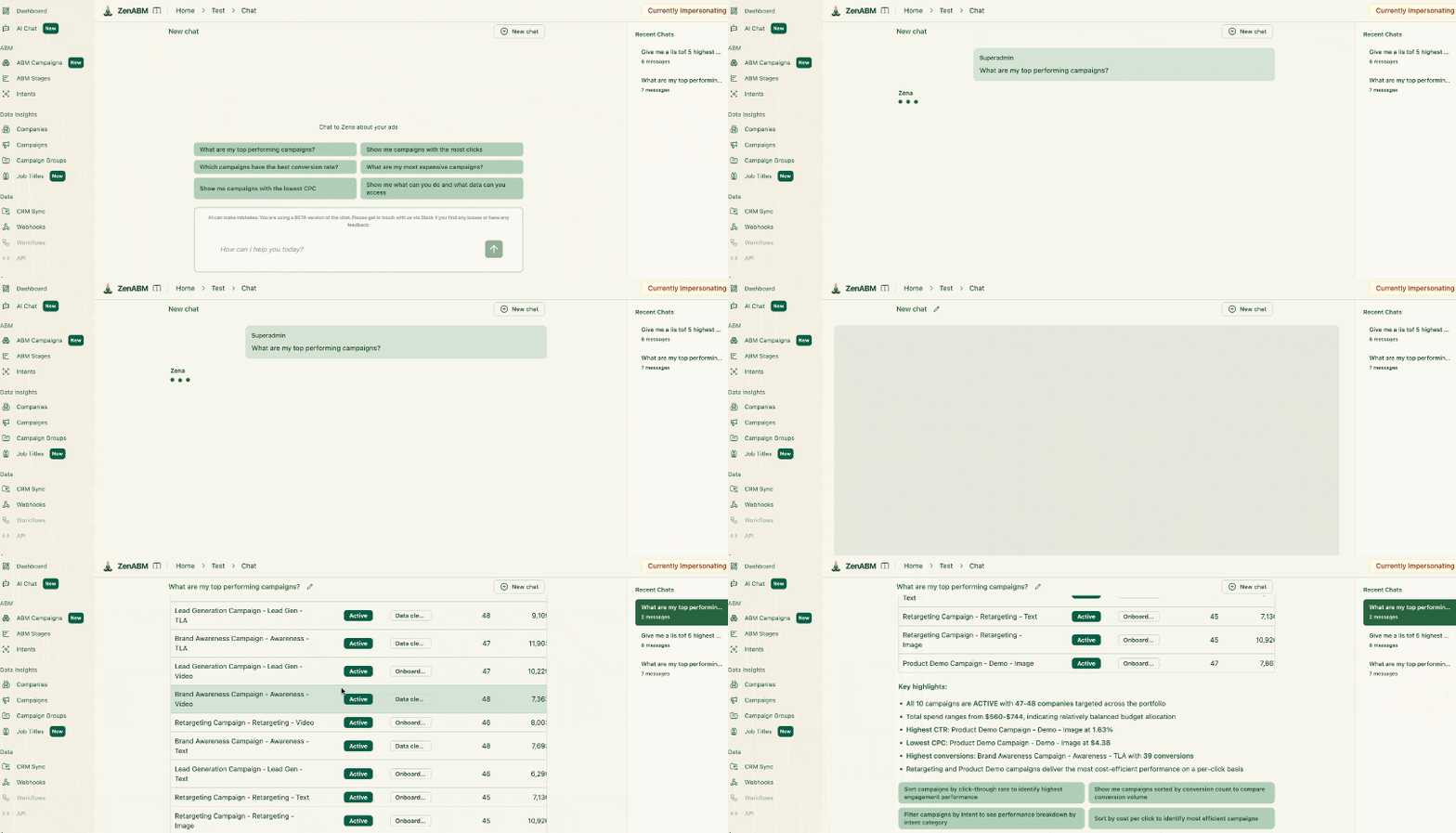
Here is Zena answering a question about LinkedIn ad performance inside the app:
The free trial lasts 37 days, with no credit card required.
Hand the repetitive LinkedIn ops layer to ZenABM
Budget Savers, the Bidding agent and Zena handle the weekly checks while you keep the strategy.

It depends on budget and context. Go in-house when you have the specialist and the context, hire an agency when you don't, and let software handle the repetitive layer either way. Expertise is the one part you can't automate.
Yes, it's called Campaign Manager, and it's where you build campaigns, ad sets and ads and set budgets and bids. It's the tool, not the management: someone still has to check bids, refresh decaying ads, review audiences and produce reports every week. That ongoing work is what an agency, a specialist or software takes off your hands.
In ZenABM's 2026 LinkedIn ABM benchmarks report of 211 companies, the median company spent $2,693 a month, with a median CPC of $11.04 and CPM of $78.30. That's ad spend only. Management is extra: common ranges are $3k to $12k a month flat or 10 to 20% of spend for an agency, while ZenABM starts from $59 a month.
Both show up in reporting, and your bidding setup decides what you control. In ZenABM's 2026 benchmarks the medians were $11.04 per click and $78.30 per thousand impressions. A bid applies only to manual or cost-cap bidding, while maximum delivery ignores it, which is one more reason who manages the account matters.
Published 2026 ranges put a flat retainer at about $3k to $12k a month, or 10 to 20% of ad spend, often plus a setup fee, with ad spend billed separately. Check whether creative is included before comparing quotes. Below about $25k a month per platform, Cristina Maliţa says an agency will almost always get you further than an in-house hire.
It can run the repetitive layer: copy-paste reporting, bid and budget changes you approve, flagging ad decay and keeping Audience Expansion and Audience Network off. It can't replace positioning, ICP or strategy. In ZenABM, Zena only changes your ad account after you confirm, so a person stays in charge of the decisions.
About the author

