

©2026 ZenABM - All Rights Reserved.
Emilia Korczynska is Head of Marketing and co-founder at ZenABM. Before that she was VP of Marketing at Userpilot for nearly 7 years, where she ran a large ABM program primarily on LinkedIn ads.

Looking for a LinkedIn ad attribution tool? There is something you need to know before you pick one: there are different ad attribution models, and ironically - not every attribution tool that covers LinkedIn ads is the best fit if you just need attribution for LinkedIn ads.
Below I compare 8 tools in four groups, including ZenABM's own LinkedIn and multi-channel revenue attribution, with the model each one uses, what it costs and who should skip it.
Tool | Use case | Company-level LinkedIn data | CRM sync | Entry price | G2 rating | Best for |
|---|---|---|---|---|---|---|
ZenABM | LinkedIn-first influenced pipeline | Yes | Yes (HubSpot, Salesforce, Attio) | From $59/month | 5.0/5 (6 reviews) | LinkedIn-first ABM on a lean team, in-house or agency; customizable influence rule, default 10+ impressions in 180 days before deal creation, but I recommend 200+ impressions plus engagement, tested on your data |
DemandSense | LinkedIn-first influenced pipeline | Yes | Yes (HubSpot, Salesforce, Attio) | $89/month (Base) | 5.0/5 (14 reviews) | LinkedIn ABM analytics with scheduling and frequency control |
HockeyStack | Enterprise revenue attribution | Yes, company impressions in account journeys | Yes (bi-directional sync may need the ABM add-on) | Quote only; Vendr median $29,702/yr | 4.4/5 (82 reviews, G2 seller page) | Mid-market and enterprise with long multi-channel cycles and a RevOps owner |
Dreamdata | Enterprise revenue attribution | Yes | Yes | Free Starter; Vendr median $35,440/yr | 4.7/5 (271 reviews) | Teams with a data or RevOps person and spend across many channels |
Factors.ai | Enterprise revenue attribution | Yes | Yes (check write-back in a demo) | Free Lite plan; paid plans on request | 4.5/5 (220 reviews) | Analytics-led teams that want account timelines and AdPilot controls |
Demandbase | Enterprise ABM suite | Partly (link to opportunity model needs a demo) | Yes (one CRM only) | Quote only; Vendr median $68,591/yr | 4.4/5 (2,012 reviews) | Enterprises looking for display advertising |
6sense | Enterprise ABM suite | Yes | Yes | Quote only; Vendr median $62,440/yr | 4.3/5 (1,570 reviews) | Enterprises looking for display advertising |
HubSpot Marketing | Contact-level, click-based | No, impressions never count | Native (it is the CRM) | Enterprise $3,600/month for 5 core seats | 4.4/5 (16,001 reviews, Marketing Hub) | Teams that live in HubSpot and accept contact-level attribution |
Here is the whole post on one page:

Most tools use the word "attribution" for one of three calculations, and mixing them up is how people end up comparing numbers that do not mean the same thing:
Getting the measurement right is worth the effort. Dreamdata's 2026 LinkedIn Ads Benchmarks Report (66 million sessions, 3.5 million customer journeys) found that LinkedIn is the only major ad platform delivering positive B2B ROAS, at 121% against 67% for Google Search and 51% for Meta.
Here is the same deal run through four calculations. This is a hypothetical $30,000 deal with four eligible touches: LinkedIn click, webinar, organic visit, sales meeting.
Model | LinkedIn credit |
|---|---|
First-touch | $30,000 |
Last-touch | $0 |
Linear | $7,500 |
Full-credit influence | $30,000 |
Last-click is the weakest default for LinkedIn. It hands 100% of the credit to the final touch, which is almost never LinkedIn, because direct, organic or branded search wins the last click every time. All four calculations can be implemented correctly, but none of them proves how much revenue would disappear without LinkedIn.
Here is how the three calculations relate to each other:

Here is how each tool in this post handles it, in one line each:
Tool | Models or rules documented | What it means for LinkedIn |
|---|---|---|
HockeyStack | First-touch, last-touch, linear, time-decay, position-based, custom, plus uniform | Imports company-level impressions into account journeys. Uniform gives every qualifying touch full credit; linear divides it. |
Dreamdata | First-touch, last-touch, linear, U-shaped, W-shaped, custom and Markov-chain data-driven, plus a separate impression model | Models exposure separately from tracked interactions, then combines their credit. |
Factors.ai | First-touch, last-touch, linear, U-shaped, time-decay, first/last non-direct and influence touch | Influence touch gives full credit to qualifying touches while deduplicating the conversion total. |
ZenABM | Customizable influence reporting | Connects company exposure to CRM deals. No first-touch, last-touch, linear or Markov menu. |
DemandSense | Configurable account-influence rules with Awareness, Engagement and Intent presets | Matches CRM deals to qualifying company activity before deal creation. |
Demandbase | Opportunity milestone weights totalling 100% | Allocates opportunity value across qualifying touchpoints. The docs do not clearly show which native LinkedIn impression events feed it. |
6sense | Account-level reach and timing-based influence | Documents account-level LinkedIn impressions. New Pipeline means opportunities opened within 30 days of an account receiving an ad. |
HubSpot Marketing | Ads dashboard: first/last ad interaction, re-engagement, all interactions. Broader reports: first, last, linear, time-decay and Empirical | Follows identifiable contact interactions and associated deals. HubSpot's documentation says Empirical replaces the U, W and J-shaped models, so confirm in your portal. |
For ABM on LinkedIn ads, influenced pipeline is the model that fits: target lists are small and most buyers see your ads without clicking (sponsored content CTR averages 0.44%), so click-based models miss most of the accounts you reached. ZenABM tracks influenced pipeline at company level, matching LinkedIn signals (a combinations of impressions, engagements and clicks on different ad formats to your CRM deals) and flagging every deal that crosses your threshold. The threshold is what makes the number credible, so read our guide to setting the right influence threshold before you pick one.
LinkedIn attribution software splits into four groups, and the right one depends on your budget and the job you need done, so pick the group before you compare tools:
Here is how the four groups line up:

The cost gap between the groups is large, as the chart shows for the tools with Vendr data. ZenABM and DemandSense are monthly prices, so they are stated in the text and left out of the chart:

A good LinkedIn attribution platform for ABM needs six things, and each one is something you can check in a demo:
Here are the six features as a checklist:

The data should come from LinkedIn's official API, because LinkedIn has been cracking down on scrapers and automation:

Website visitor deanonymization is unreliable too, and it only sees clicks:

The LinkedIn Ads API gives you impressions, clicks, engagements and spend at campaign group and campaign level, plus leads from Lead Gen Forms. Company-level views come from tools that match that data to companies. Leads from Lead Gen Forms never hit your site, so a pixel-based tool only tracks them if you set up a webhook.
When you sit down with a vendor, run through this demo checklist:
One more point worth keeping separate: an impression after the opportunity was created cannot explain its creation, but it could still be relevant to how the deal progressed. Those should be two separate calculations.
If you want something to sanity-check your own numbers, our 2026 ABM Benchmarks Report covers LinkedIn ABM performance across 161,256 ads and 211 companies.
These two report influenced pipeline with rules you control, which is the model the study above supports. Make it reliable the way I described: an engagement-based threshold, a window of 2x your sales cycle, tested on your data. Our post on influenced pipeline for LinkedIn ads revenue attribution covers the guardrails in detail.
ZenABM is a LinkedIn-first ABM tool designed specifically for running ABM campaigns on LinkedIn. It helps small to mid-market companies create, manage and optimise their LinkedIn ads with AI, either in the app or directly from Claude through the MCP server. It gives you account engagement at company level, extracts first-party intent signals and scores accounts automatically. It then hands you both the revenue attribution and the sales-ready hot accounts, with what to talk to them about.
When I was VP of Marketing at Userpilot, I struggled to run ABM on LinkedIn. My husband watched it up close and built ZenABM to fix it. I might be a bit biased as a co-founder, but I also know first-hand what it is like to struggle to find the right tool.
G2 rating: 5.0/5 from 6 reviews. A Head of Revenue wrote: "What I like best about ZenABM is that they understand ABM beyond theory." Another reviewer said: "The UI and UX are clean, intuitive, and easy to navigate." A VP of Marketing added: "ZenABM allows me to quickly query my LinkedIn ad performance data with AI." A fourth wrote that "they've built a good API and MCP that we can build stuff on top of."
ZenABM does not offer a menu of first-touch, last-touch, linear or Markov models. Instead, it reports influenced pipeline with customizable rules. The default is 10+ impressions in the 180 days before deal creation, but after the study above I recommend 200+ impressions plus 3+ clicks or 10+ engagements in the 180 days before the deal was created. You can set the threshold per ABM campaign and discount text-ad impressions from ABM influence. The cross-channel timeline uses HubSpot source history.
The stronger comparison between tools is not "we see account-level impressions", because others do too. It is how clearly each tool defines influence, shows the evidence behind a deal, handles overlapping campaigns, connects CRM outcomes and turns the findings into campaign actions.
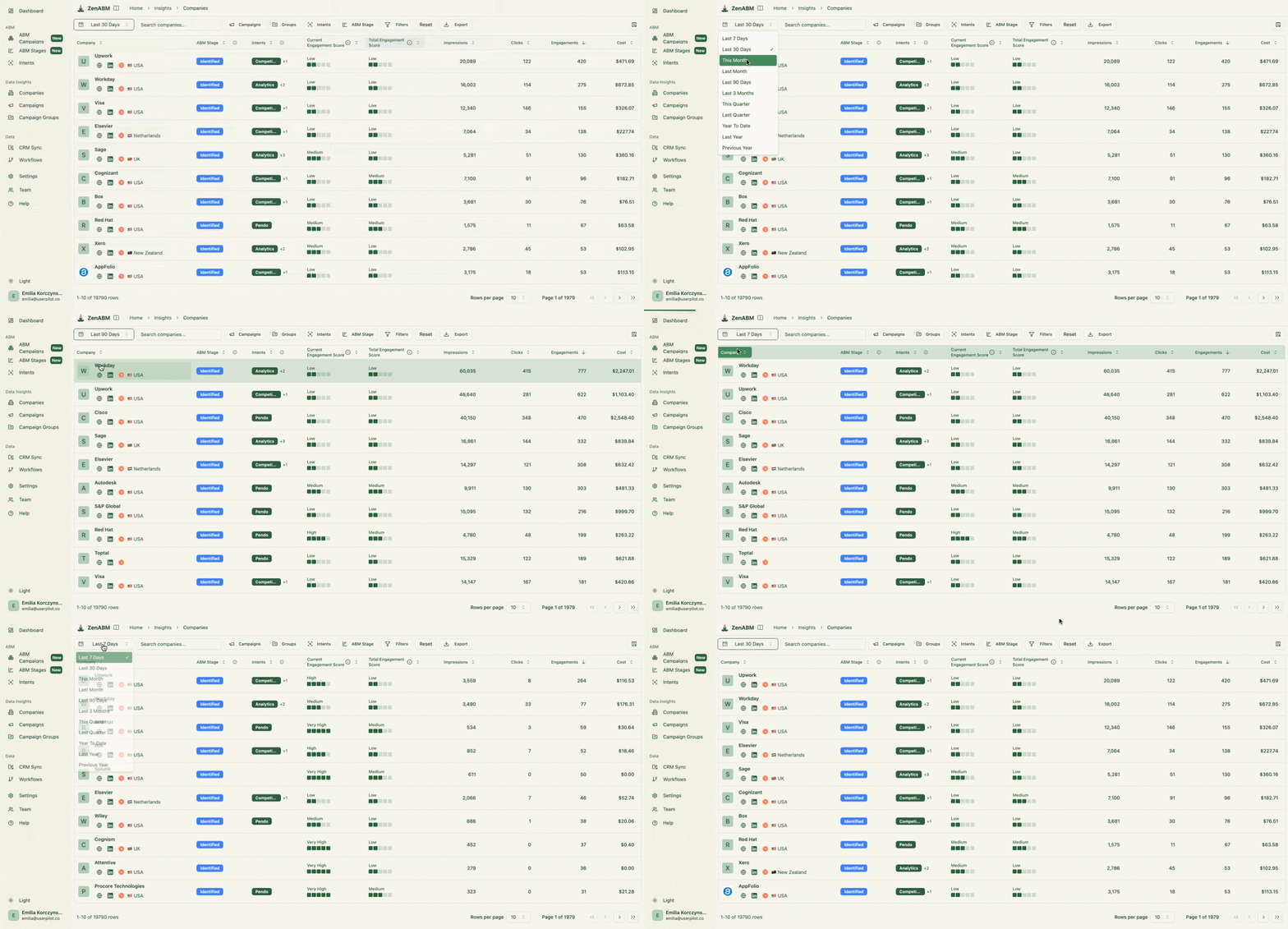

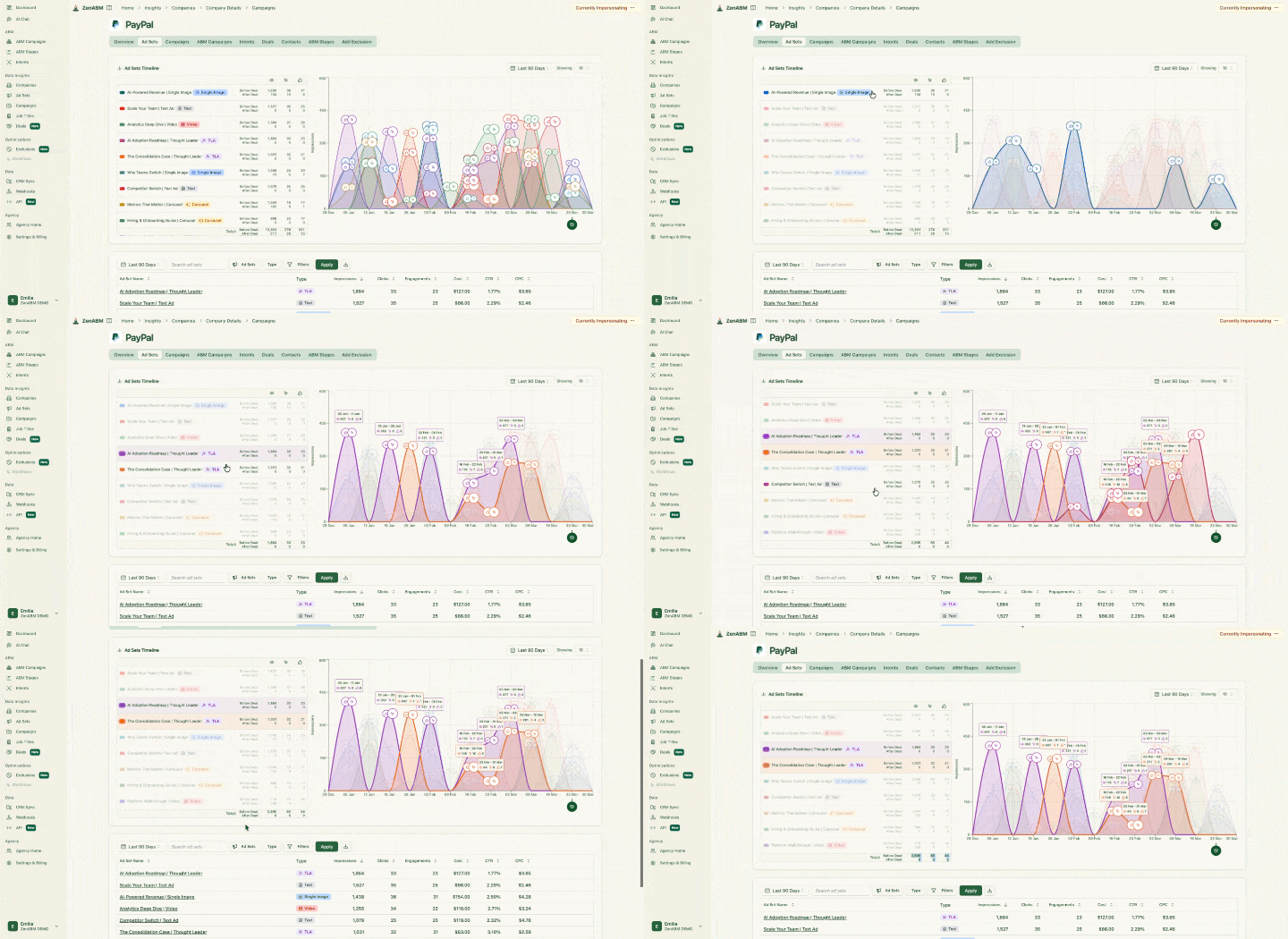


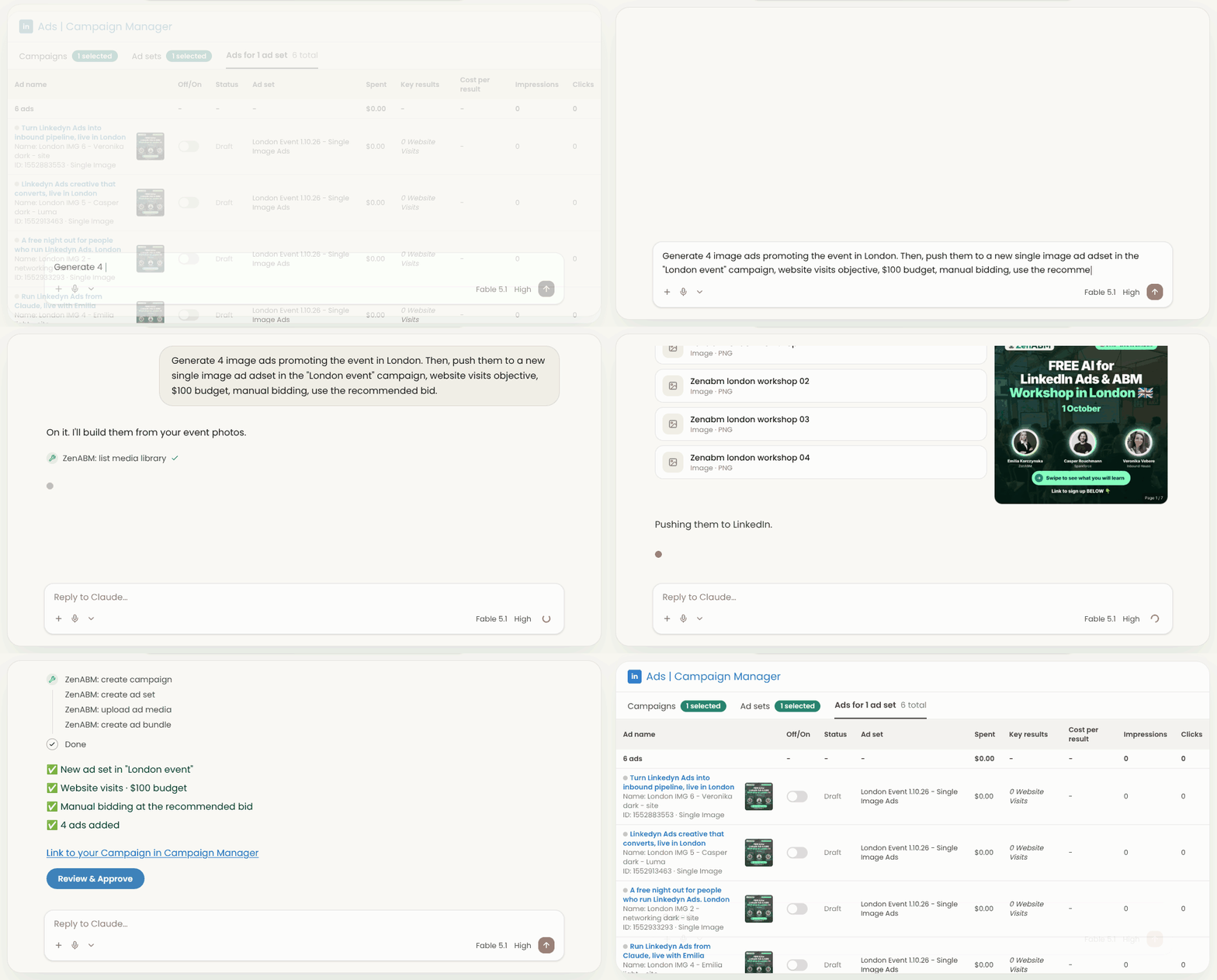

There are four plans: Starter from $59/month, Growth from $159/month, Pro from $399/month and Agency from $479/month, billed annually (see pricing for the monthly rates and the free trial). Next to the Vendr medians above, that is the affordable end of this list.
ZenABM is LinkedIn-first, so it does not buy display or programmatic ads, personalise your website or sell third-party intent data. Teams that need those usually run ZenABM for LinkedIn next to a display suite. Reviewers also mention that ABM takes time to compound, so results are not always immediate, and that they would like a Pipedrive integration. The team ships new features fast and keeps improving the product based on customer feedback.
Best for: LinkedIn-first ABM on a lean team, in-house or agency.
Skip it if: display advertising is your main channel, in which case pair it with a display suite.
DemandSense is the closest LinkedIn-first rival to ZenABM. It combines LinkedIn ABM analytics with delivery control: dayparting, pacing, frequency caps, exclusions, visitor identification, competitor monitoring and revenue attribution.
G2 rating: 5.0/5 from 14 reviews.
Model. Its attribution uses configurable account-influence rules with Awareness, Engagement and Intent presets, where you pick the thresholds and a lookback of 3, 6 or 12 months. It matches CRM deals to qualifying company activity before the deal was created. I did not verify a fractional cross-channel allocation model.
How hard it is. G2 reviewers praise attribution that goes beyond Campaign Manager, anonymous visitor identification and replacing several tools with one. They mention a steep learning curve, setup time (getting visitor identification tracking right is not an afternoon job) and an AI Co-Pilot that is still maturing. It also offers an MCP, which DemandSense documents as read-only and in early access.
Pricing. It costs $89 a month (Base) or $149 a month (Plus), the first month is free, and you get 200 or 500 data credits a month. Website Visitor ID and LinkedIn audience previews use credits, and the price of extra credits is not published.


Compared with ZenABM: DemandSense is fair value for scheduling, frequency capping, visitor ID and price. It controls campaigns that already exist but does not create them, and its MCP is read-only, whereas ZenABM's MCP and Zena build and manage campaigns, ad sets and ads.
Best for: LinkedIn teams that want scheduling and frequency control next to attribution.
Skip it if: you also want campaigns created and managed by AI.
These three have the deepest models, but that comes at the price of a high annual contract and a complex setup. Vendr medians run from $29,702 (HockeyStack) to $35,440 (Dreamdata) a year, before add-ons, setup and the time to learn them. Factors.ai has no Vendr median, and user reviews on G2 keep returning to learning curves.
Here is how they differ in one line each. Dreamdata is the most complete attribution tool, with a separate impression model. HockeyStack builds company and person-level journeys. Factors.ai leans towards analytics, with an influence-touch model and AdPilot controls.
HockeyStack is a B2B revenue analytics platform that unifies ads, website, CRM and offline activity into buyer journeys. I had a demo with their team, and the depth of journey data was the clear draw.
G2 rating: 4.4/5 from 82 reviews.
Models. It offers first-touch, last-touch, linear, time-decay, position-based, custom, plus uniform, where every qualifying touch gets full credit and linear divides it. Company-level LinkedIn impressions flow into account journeys, and the person-level view relies on cookies and reverse IP, so treat it with care. In April 2026 it announced Revenue Agents for the Enterprise and funding that brings the total to over $50M, and it now calls itself an enterprise Revenue Agent platform with 300+ customers. The announcement does not say the attribution product was discontinued, so confirm in your demo that it is still sold standalone.
How hard it is. G2 reviewers mention a learning curve (15 mentions), complexity and a need for custom reports, and G2 says it suits teams without an internal attribution expert poorly. Reviewers praise the support team and attribution accuracy.
Pricing. It is quote only. Vendr's median is $29,702 a year (range $24,040 to $77,500, 33 purchases), and Vendr says entry-level plans typically land between $12,000 and $24,000. G2 lists "from $2,200 a month", which is a third-party figure. Ask in your demo whether bi-directional CRM sync sits behind the ABM add-on.
Here is HockeyStack's LinkedIn campaign analytics view:

And its person-level touchpoint mapping, which shows LinkedIn next to other channels:

Here is its Odin AI assistant:

Compared with ZenABM: HockeyStack covers more channels and models, but it stops at the attribution layer and does not create LinkedIn campaigns, at a much higher price.
Best for: mid-market and enterprise B2B with long multi-channel cycles and a RevOps owner.
Skip it if: your programme is LinkedIn-first and you have no one to own the setup.
Dreamdata is a multi-channel revenue attribution platform and a LinkedIn Marketing Partner. I sat through a demo with them, and it is the most complete attribution tool of this group, though it is not geared towards managing and running ABM campaigns on LinkedIn.
G2 rating: 4.7/5 from 271 reviews.
Models. It offers first-touch, last-touch, linear, U-shaped, W-shaped, custom and a Markov-chain data-driven model, plus a separate impression model. The impression model has exposure-credit ceilings of 0%, 2.5%, 5% or 10%, with saturation and carryover. LinkedIn clicks can earn extra credit through the touch-based model, so "10% maximum" does not mean LinkedIn can only get 10% of revenue credit. Dreamdata itself says the Markov model detects correlation, not causation.
How hard it is. Reviewers cite a steep learning curve (26 G2 mentions) and missing features, and praise attribution accuracy, ease of use and support. A Capterra reviewer says the first 1 to 2 months are steep.
Pricing. The Starter plan is free (5 seats, 1 sync, 3 stage models, 2 months of history). Advanced is a custom quote, with a Vendr median of $35,440 a year (range $27,000 to $96,000). Activation, Data Warehouse and SCIM are unpriced add-ons, and Vendr notes that renewals often carry 5 to 10% annual escalators. LeadJourney, citing Vendr data, reports implementation fees of $5,000 to $10,000 or more on top. Dreamdata also offers audience sync, LinkedIn CAPI and a read-only AI agent and MCP.
Here is Dreamdata's company journey view:

And its revenue analytics dashboard:

Compared with ZenABM: Dreamdata goes deeper on multi-channel models, but it does not create or manage LinkedIn campaigns, and its AI and MCP are read-only.
Best for: teams with a RevOps or data person and spend across many channels.
Skip it if: you only run LinkedIn and want to act on the data inside the same tool.
Factors.ai is a multi-channel analytics platform with website visitor identification, account timelines and attribution. Its strength is data depth, and in November 2025 it announced it is an official LinkedIn Marketing Partner using the Company Intelligence API for company-level paid and organic impressions, clicks and engagement.
G2 rating: 4.5/5 from 220 reviews.
Models. It offers first-touch, last-touch, linear, U-shaped, time-decay, first/last non-direct and influence touch. Influence touch gives full credit to qualifying touches while deduplicating the overall conversion total. LinkedIn True ROI adds view-through measurement, though its exposure-weighting formula is not clearly disclosed. AdPilot adds an audience builder, LinkedIn CAPI and impression capping, and it is a paid add-on with no published price.
How hard it is. G2 reviewers mention a learning curve and want more customization for reporting and filtering. They praise real-time insights and identifying high-intent accounts. Check in a demo whether engagement is written back to your CRM as company properties.
Pricing. Factors.ai's pricing page shows a free Lite plan, and Basic, Growth and Enterprise are quoted on request. I found no Vendr median for Factors.ai.
Here is Factors.ai's all-accounts engagement dashboard:

And the AdPilot accounts dashboard:

Impression cap settings are how AdPilot stops overserving the same accounts:

Compared with Factors.ai vs ZenABM: Factors.ai wins on data depth and cross-channel analytics. It leans towards analytics, takes more effort to set up and use, and is less focused on running ABM campaigns. ZenABM is cheaper, lets you create and manage the LinkedIn campaigns themselves, is built for ABM and is easier to use.
Best for: analytics-led teams that want account timelines and impression controls.
Skip it if: you want to build and run the LinkedIn campaigns from the same tool.
Demandbase and 6sense are traditional enterprise suites. They suit display advertising at very large scale, which fits B2C companies especially, and they have been on the market the longest, so they are often the default choice. For LinkedIn ads ABM alone they are overkill, because you would be paying for 99% of features you will not use. If LinkedIn is your main channel, skip them and choose a LinkedIn-specific solution like ZenABM instead.
Demandbase One is an enterprise suite built around its own ad platform. I had a couple of demos with their team, and display is where it is strongest.
G2 rating: 4.4/5 from 2,012 reviews.
Model. It uses configurable opportunity milestone weights that total 100%, with engagement and ad thresholds and exclusions. Its docs do not clearly establish which native LinkedIn impression events enter that engine, so test it in a demo. It syncs bi-directionally with HubSpot, Salesforce, Microsoft Dynamics 365, Marketo, Pardot and Eloqua, though Demandbase One for Marketing allows only one CRM integration at a time. Its MCP (phased GA from April 2026) is read-oriented, and its Mojo marketing agent launched in September 2026.
How hard it is. G2 reviewers repeatedly cite a steep learning curve (86 mentions) and say reporting and customization complexity hinders use.
Pricing. It is custom, with a Vendr median of $68,591 a year (range $24,000 to $164,037, 187 purchases), so budget about $70K before ad spend. Buyers negotiate roughly 13% off list on average, and onboarding has run about $29K in some cases. The DSP often requires a minimum monthly ad spend of $5,000 to $10,000 on top of the platform fee.


Compared with Demandbase vs ZenABM: Demandbase covers display at scale, but it is heavy to run, and it does not create and manage your LinkedIn campaigns the way ZenABM does.
Best for: enterprises running multi-channel ABM at scale with dedicated ops headcount, looking for display advertising.
Skip it if: you run mostly LinkedIn ads on a small team.
6sense is the other enterprise suite in this group. I had a few demos and decided against it, because it was too complex and too expensive for our needs.
G2 rating: 4.3/5 from 1,570 reviews.
Model. I should correct something I used to say about 6sense: it does document company-level LinkedIn impressions and influenced-pipeline reporting. Its Performance Trend Report defines New Pipeline as opportunities opened within 30 days of an account receiving an ad. It also syncs segments to LinkedIn and launches LinkedIn campaigns from inside 6sense. Its MCP server (open beta from July 2026) is documented as read-only retrieval, so verify that before you rely on it.
How hard it is. G2 reviewers cite a steep learning curve (146 mentions), setup complexity (93) and missing features (87).
Pricing. It is custom, with a Vendr median of $62,440 a year (range $11,376 to $176,809), so budget roughly $60K before ad spend.


Compared with 6sense vs ZenABM: 6sense covers display and predictive depth, but it is far more complex and costly, and it is not built to create and manage LinkedIn campaigns.
Best for: enterprises looking for display advertising.
Skip it if: LinkedIn is your main channel.
HubSpot Marketing is great if you already live in HubSpot and accept contact-level, click-based attribution. But the lead-based, last-touch mindset behind it misses the majority of influenced deals, which defeats the purpose of ABM tracking.
G2 rating: 4.4/5 from 16,001 reviews (Marketing Hub).
Tiers and models. Contact-create attribution is on Marketing Hub Professional and Enterprise, while deal-create and revenue attribution are Enterprise only. The ads dashboard offers first and last ad interaction, re-engagement and all interactions. HubSpot's documentation says the Empirical model replaces the U, W and J-shaped models, but confirm in your portal.
How it works. A hubspotutk cookie ties a browser to a contact. An ad interaction is only recorded when someone clicks and lands on a tracked page, and deals inherit interactions from associated contacts, so impressions never count. HubSpot does sync Lead Gen Forms, build audiences for LinkedIn and send conversion events through CAPI, so it does retargeting audience sync.
Pricing. Marketing Hub Enterprise is $3,600 a month for 5 core seats, per G2's listing, and HubSpot's own pricing blog adds a $7,000 onboarding fee. G2 reviewers mention a steep learning curve (808 mentions), advanced features gated to higher plans (785) and prices that rise with contacts (666).
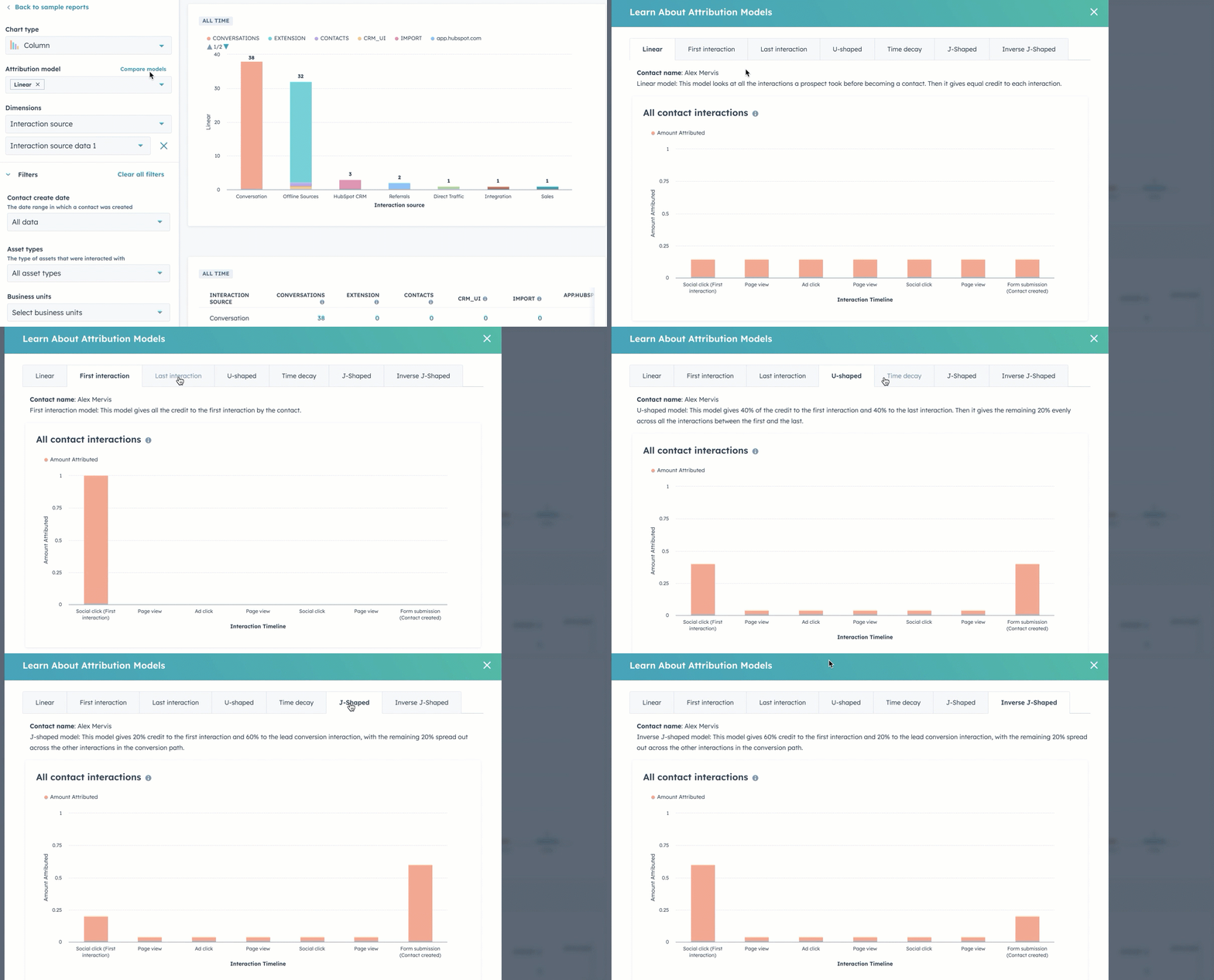

Compared with ZenABM: ZenABM adds company-level impressions on top and writes them back into HubSpot, which HubSpot's own attribution does not do.
Best for: teams whose tracking all lives in HubSpot and who accept contact-level attribution.
Skip it if: most of your reach is impressions, since they never count.
ZenABM covers the steps this post described:

For a walkthrough of setting an influence threshold, our webinar How to use AI for reporting and revenue attribution covers it with a live demo of ZenABM's AI reports.
LinkedIn attribution connects LinkedIn ad exposure (impressions, clicks and engagements) to the deals and revenue that follow. In practice the word covers three things: tools that split a deal's value between touches, tools that give full credit when a rule is met, and tools that only show you the touches.
Pull company-level impressions and clicks from the LinkedIn API, match them to your Salesforce accounts, and credit every campaign that reached the account before the opportunity was created. Then write the engagement back onto the account so sales sees it in Salesforce. Check the tool's match rate on your own accounts first.
Influenced pipeline with an engagement-based, tested threshold works best. For example, 200+ impressions plus 3+ clicks or 10+ engagements in the 180 days before the deal was created. Most buyers see your ads without clicking, so click-based models miss them, and a bare "10 impressions" rule showed no lift in ZenABM's data.
Only if you accept contact-level, click-based attribution. HubSpot records an ad interaction only when someone clicks and lands on a tracked page, so impressions never count, and deal and revenue attribution need Marketing Hub Enterprise at $3,600 a month. Pair it with a company-level tool to see the accounts you reached without a click.
It is reliable when the threshold is tested. All pipeline is influenced pipeline, and last click is just a threshold of 1 click. In ZenABM's study of 7,466 deals, influenced deals were about 3x bigger, but a bare 10-impression rule showed no lift, so require engagement and test the rule on your own data.
Pick one CRM as the source of truth, pull your ads data into a tool that matches it to companies and deals, and automate the weekly or monthly report from the live data. ZenABM's automated AI reports do this for LinkedIn and multi-channel paid. SEO shows up only as organic visits on the company journey.
Pick the tool for the job you need done, not the longest feature list.
Otherwise you pay for the whole gym and use the treadmill 🤷♀️
About the author

