

©2026 ZenABM - All Rights Reserved.

Almost every vendor claims to do everything, but after years of running ABM programs, sitting through demos, and reading contracts, I have realized that there is no single best account-based marketing platform.
There is only the platform that fits your company size, your CRM, your channels, and your budget.
This guide compares the top options for B2B teams in 2026, including 6sense, Demandbase, RollWorks, Terminus, HubSpot, and ZenABM, so teams can self-select rather than buy the loudest brand.
The intent here is to be even-handed.
The enterprise suites are genuinely excellent at what they do, and a $59/month tool does not replace a $150,000/year platform feature for feature.
What this guide does is lay out what each platform is actually known for, who it suits, where it gets expensive or heavy, and where a leaner, LinkedIn-first option makes more sense.
By the end, a clear short list to demo should emerge.
Short on time?
Here’s a quick table below that offers a quick comparison.
Note that pricing is discussed roughly on purpose, because every enterprise vendor quotes custom deals, and the public ranges move around.
Treat the price column as a rough order of magnitude, not a quote.
Platform | Best for | Known for | Main trade-off | Rough price level |
|---|---|---|---|---|
6sense | Enterprise, mature RevOps, $100M+ revenue | Predictive AI, buyer-stage prediction, deep intent data | Long implementation, high learning curve, premium cost | Enterprise/custom (high) |
Demandbase | Mid-market to enterprise on Salesforce, multi-product | Ad-native targeting, buying-group view, account intelligence | Complex, sales-led pricing, heavier to run | Enterprise/custom (high) |
RollWorks | B2B and SaaS under ~$50M, HubSpot-first | Ad-led ABM, clean HubSpot integration, faster setup | Lighter intent and predictive depth than 6sense | Mid (lower than enterprise suites) |
Terminus | Mid-market wanting multi-channel in one hub | Native ads, chat, email, web personalization, measurement | Add-ons stack up cost, opaque pricing | Mid to enterprise/custom |
HubSpot ABM | Teams already on HubSpot premium tiers | Target account index, engagement scoring, Breeze AI agents | Not a dedicated ABM ad platform, needs premium seats | Bundled into HubSpot Premium |
ZenABM | Lean teams running multi-channel ABM that is primarily focused on LinkedIn | LinkedIn ad engagement joined to CRM, multi-channel attribution, MCP/AI-native, low cost | Focused on LinkedIn, not a full enterprise suite | Transparent, from $59/month |
The sections below go platform by platform, keeping the same shape throughout: what it is, who it suits, strengths, and trade-offs.
If only one thing sticks, make it this: the price gap between these account-based marketing platforms is enormous, and so is the implementation effort. The right move is to match the tool to the motion, not to the analyst quadrant.
For a longer landscape view, a running list of the best ABM platforms with examples goes beyond the six covered here.

6sense Revenue AI is the platform most teams picture when they think of enterprise ABM.
It sits on a large intent data network and a predictive engine that scores accounts, predicts which buying stage an account is in, and increasingly runs AI agents to surface and prioritize accounts for sales.
For intent data quality specifically, most comparisons rank 6sense at the top of this group.
Companies above roughly $100M in revenue with a dedicated RevOps function and an enterprise sales motion.
The predictive scoring and buyer-stage prediction are materially more capable than the equivalents on the other platforms, and that depth pays off when there are hundreds of target accounts and a sales team that needs prioritization signals.
The predictive engine is the deepest in the category, and that is the whole reason teams buy it.
6sense scores every account, predicts the buying stage it is in, and increasingly runs AI agents that surface and rank accounts for sales, all fed by one of the largest third-party intent networks in B2B.
The account scoring is mature rather than bolted on, and because the orchestration reaches across both sales and marketing, a single account signal can trigger an ad, a sales task, and a routing rule without leaving the platform.


That breadth is the point. When there are hundreds of target accounts moving through the funnel, the prediction layer turns a flood of signals into a ranked list a sales team can actually work, which is something the lighter tools in this comparison do not really attempt.
The depth comes with weight, and the weight shows up before any value does. Implementation is the longest of the group, commonly three to six months, and the learning curve is steep enough that most teams need a dedicated RevOps owner just to operate it well. The pricing only makes economic sense at the upper end of the market, where the predictive depth genuinely changes how a full sales team prioritizes its week rather than serving as a nicer dashboard.

One nuance worth flagging: much of the value in 6sense comes from its anonymous-visitor de-anonymization and the breadth of its intent network, which only really compounds when a high volume of accounts is moving through the funnel.
A team running a tight one-to-few program with twenty named accounts will not see the same return on that machinery as a team orchestrating five hundred. The prediction engine earns its keep when there are enough accounts to feed it.
For teams weighing 6sense against a lighter, LinkedIn-focused approach, a direct 6sense vs ZenABM comparison walks through where each one earns its keep.
The short version: 6sense is the answer when third-party intent data and prediction across every channel are the whole point, and the team and budget exist to operate it.
ZenABM is the answer when the program is LinkedIn-centric and account-level clarity is the priority without the enterprise overhead.

Demandbase One started life as a B2B advertising-targeting product, and that heritage still shapes it.
The audience-to-ad path is smoother than on most competitors, and the platform leans into a buying-group view of accounts rather than scoring individual leads in isolation.
It pairs account intelligence and intent with native advertising, and it tends to land well in Salesforce-centric stacks with multi-product complexity.
Mid-market to enterprise B2B teams, often in the roughly $50M to $250M revenue band, that run on Salesforce and want advertising and account intelligence under one roof. When display advertising to target accounts is central to the motion, Demandbase’s ad-native architecture is a real advantage.
The advertising-native architecture is the differentiator.
Because Demandbase grew out of a B2B ad-targeting product, the path from an account list to a live display campaign is smoother than on tools that added advertising later, and the platform reasons about buying groups rather than scoring isolated leads.
It pairs that with solid account intelligence and intent data, and it fits deeply into Salesforce, which is where most of its customers already run their pipeline, so the account view and the CRM view stay close together.


It is a heavier platform to operate, and that shows up in two ways.
Pricing is sales-led and custom, so there is no public number to sanity-check a budget against until a rep has scoped it, and the breadth that makes it powerful for a large multi-product org means a smaller team usually pays for surface area it will never switch on.
The platform rewards a team with the time and headcount to run it properly, and punishes one that wanted a focused tool and bought a suite instead.
Demandbase and 6sense tend to compete for the same enterprise shortlist.

The simplest way to separate them: 6sense leads with prediction, Demandbase leads with advertising and buying-group orchestration.
Both are excellent and an investment.

RollWorks is the most accessible of the big three.
It is an ad-led ABM platform that handles account identification, audience building, display and LinkedIn-style targeting, and reporting, and it ships the cleanest HubSpot integration in the category.
Where 6sense and Demandbase own the Salesforce enterprise stack, RollWorks owns the HubSpot story.
B2B and SaaS companies under roughly $50M in revenue, especially those on HubSpot, that want a real ABM platform without an enterprise implementation.
For one-to-many programs with fifty to a few hundred target accounts, and for one-to-few programs with a handful of accounts at sub-$100K deal sizes, RollWorks covers most of the playbook at a fraction of the enterprise price and is usually operational in weeks rather than months.
RollWorks is built to be operational in weeks, not quarters.
The HubSpot integration is the cleanest in the category, account identification and audience building are straightforward to set up, and the ad-led targeting covers display and LinkedIn-style placements without an enterprise rollout, all at a price well below the suites.
For a growing team, that combination of speed and cost is usually the entire reason it makes the shortlist over a heavier platform.


The reporting is honest about pipeline rather than vanity metrics, which is part of why it suits teams that have to defend ad spend to a CFO.

The depth ceiling is the trade-off. Its intent and predictive modeling are lighter than 6sense, so a very large program, or one that leans hard on prediction across many channels, will eventually feel the limit and start wishing for the heavier machinery.
For most sub-$50M teams that ceiling is far enough away to be irrelevant, but it is the reason a scaling company sometimes graduates from RollWorks to an enterprise suite as the account list and the sales team grow.
RollWorks is often the right first dedicated ABM platform for a growing team.
For programs that are mostly LinkedIn rather than display, it is worth comparing them against tools built specifically for that channel, which the roundup of the best ABM tools for LinkedIn advertising covers in detail.
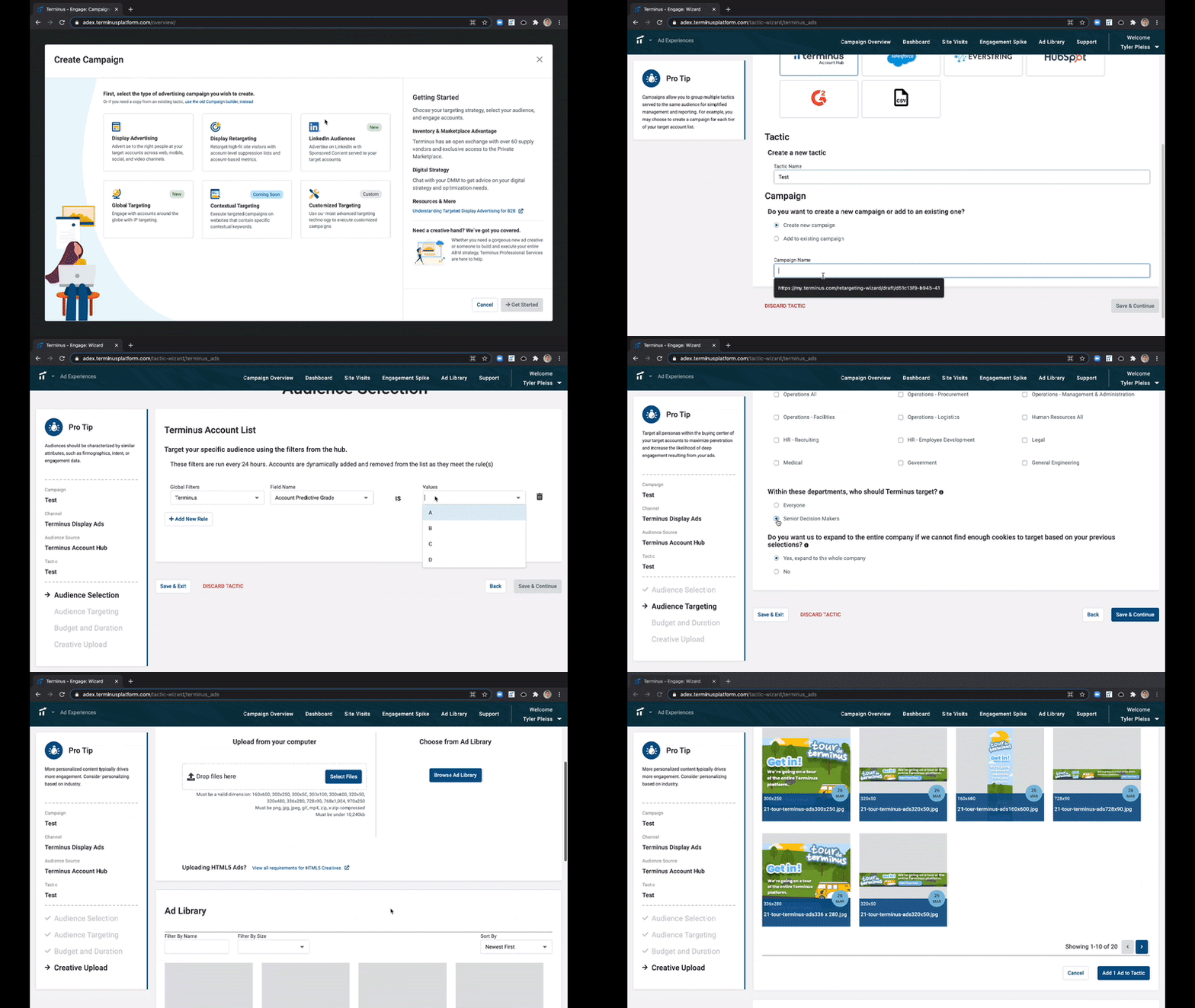
Terminus positions itself as a true account-based engagement platform.
The pitch is one hub for identifying best-fit accounts and then engaging them across native channels, including display ads, chat, email, and website personalization, with a built-in B2B customer data platform and account-level measurement on top.
Its Measurement Studio and Data Studio are a genuine strength for teams that want attribution and account analytics without bolting on a separate tool.
Mid-market teams that want several engagement channels coordinated in one place and care about account-level measurement.
It powers ABM for more than a thousand customers, including some large, recognizable brands, so it is a proven choice for multi-channel programs.
The strength is coordination in one place.
Terminus runs display ads, chat, email, and website personalization as native channels rather than integrations, sits on a built-in B2B customer data platform, and layers account-level measurement on top through its Measurement Studio and Data Studio.
For a team that wants several engagement channels and their attribution under one roof, that consolidation removes a whole stack of point tools and the reconciliation headaches that come with them.


Pricing is the first friction: it is not public, and the platform is modular, so display campaigns, web personalization, or third-party intent each arrive as add-ons that push the total up beyond the headline.
The second is fit, because the breadth that makes Terminus attractive to a mid-market multi-channel program is usually more platform than a smaller team can put to work, and unused modules are still paid-for modules.
There is also a channel-depth caveat for LinkedIn-led teams: company impression views are limited to Matched Audiences or CRM lists, so the account-level LinkedIn picture is narrower than a LinkedIn-first tool reading the API directly would give you.

For teams with a LinkedIn-heavy channel mix, Terminus’s measurement capabilities overlap with the broader category of LinkedIn ad attribution tools, which is worth reviewing when deciding how much of that capability to consolidate into a single platform.

HubSpot is not a standalone ABM platform in the way the others are, but its ABM features have matured considerably.
In the premium tiers, there is a Target Accounts index that acts as a command center, an Account Engagement Score that rolls up the activity of every stakeholder at an account, ICP-tier recommendations for building target lists, and a tight LinkedIn and Sales Navigator integration.
Breeze AI then adds agents: a prospecting agent that scans for company news, enrichment from a large business database, and a content agent that drafts account-tailored assets.
Teams that already run marketing and sales in HubSpot and do not want to buy and integrate a separate platform.
When the CRM is HubSpot and the ABM motion is one-to-many, the native tools cover a lot of the job without new contracts or data syncs.
The pull is that nothing has to be integrated. In the premium tiers the target account index acts as a command center, the account engagement score rolls up the activity of every stakeholder at an account, ICP-tier recommendations help build target lists, and the LinkedIn and Sales Navigator integration ties social selling back to the CRM record.
Breeze then layers agents on top, including a prospecting agent that scans for company news, enrichment from a large business database, and a content agent that drafts account-tailored assets, so a lot of the ABM job happens without buying or wiring up a second platform.

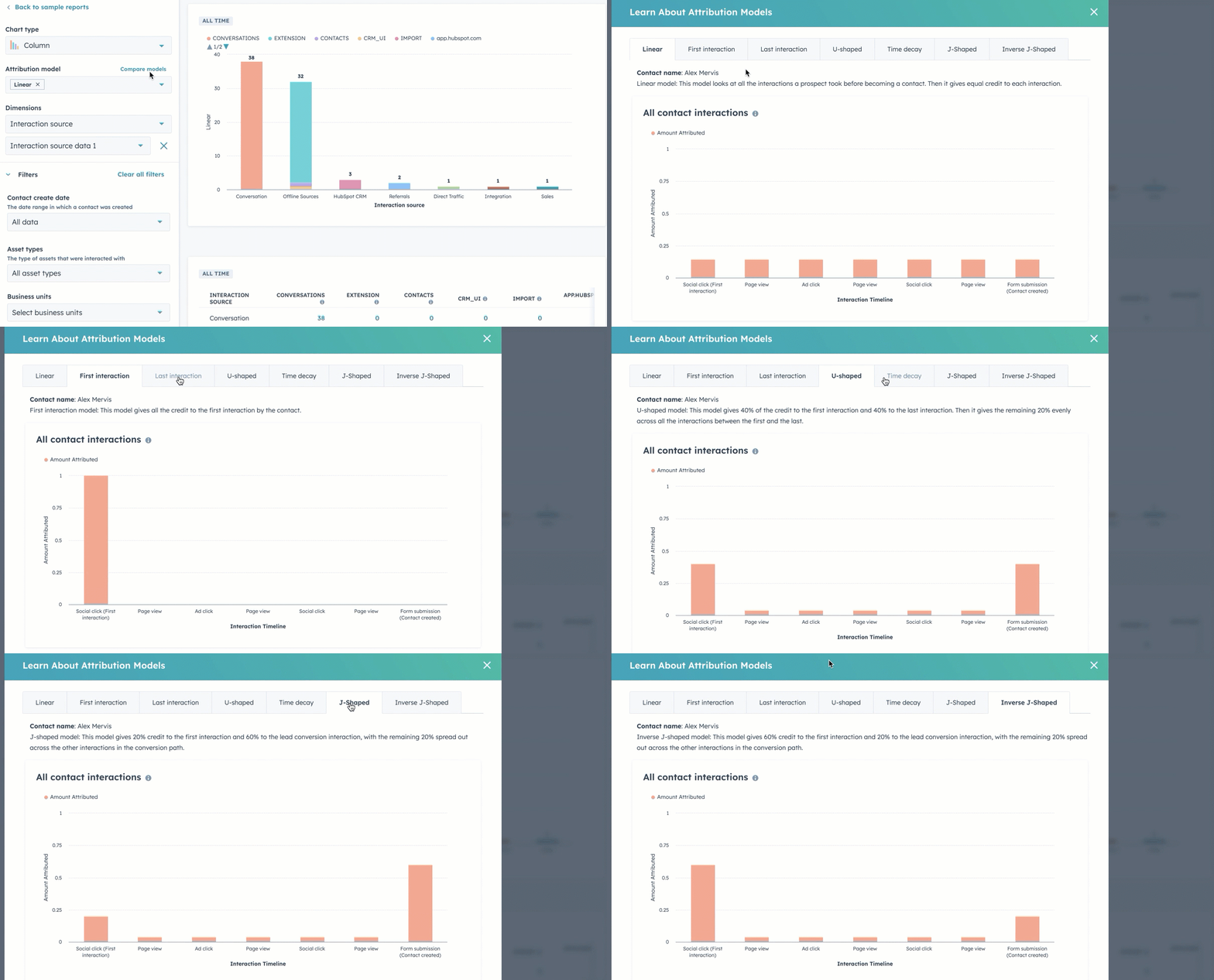
HubSpot is not a dedicated ABM advertising platform, and that is the honest limit.
The ABM features sit behind premium seats, so the capability arrives bundled with a tier upgrade rather than as a standalone cost a team can scope on its own, and for ad-heavy or intent-heavy programs a specialist tool alongside it is still necessary.
Where it stops short is account-level advertising measurement on a single channel, so a LinkedIn-led program will still want a focused attribution layer that HubSpot does not fully provide by itself.

The practical advantage here is that ABM data and CRM data are already one system, so there is no sync to maintain and no second source of truth to reconcile.
That is underrated.
A lot of ABM pain comes from accounts looking engaged in one tool and cold in another because the two systems never quite agree.
Keeping ABM native to HubSpot removes that friction for one-to-many programs.
HubSpot ABM works best as the foundation, with a focused ad or LinkedIn tool layered on top when the channel demands it.
That layering is exactly where a lean, channel-specific platform earns its place, which is why many HubSpot teams pair their native ABM tools with a dedicated LinkedIn attribution layer rather than replacing one with the other.
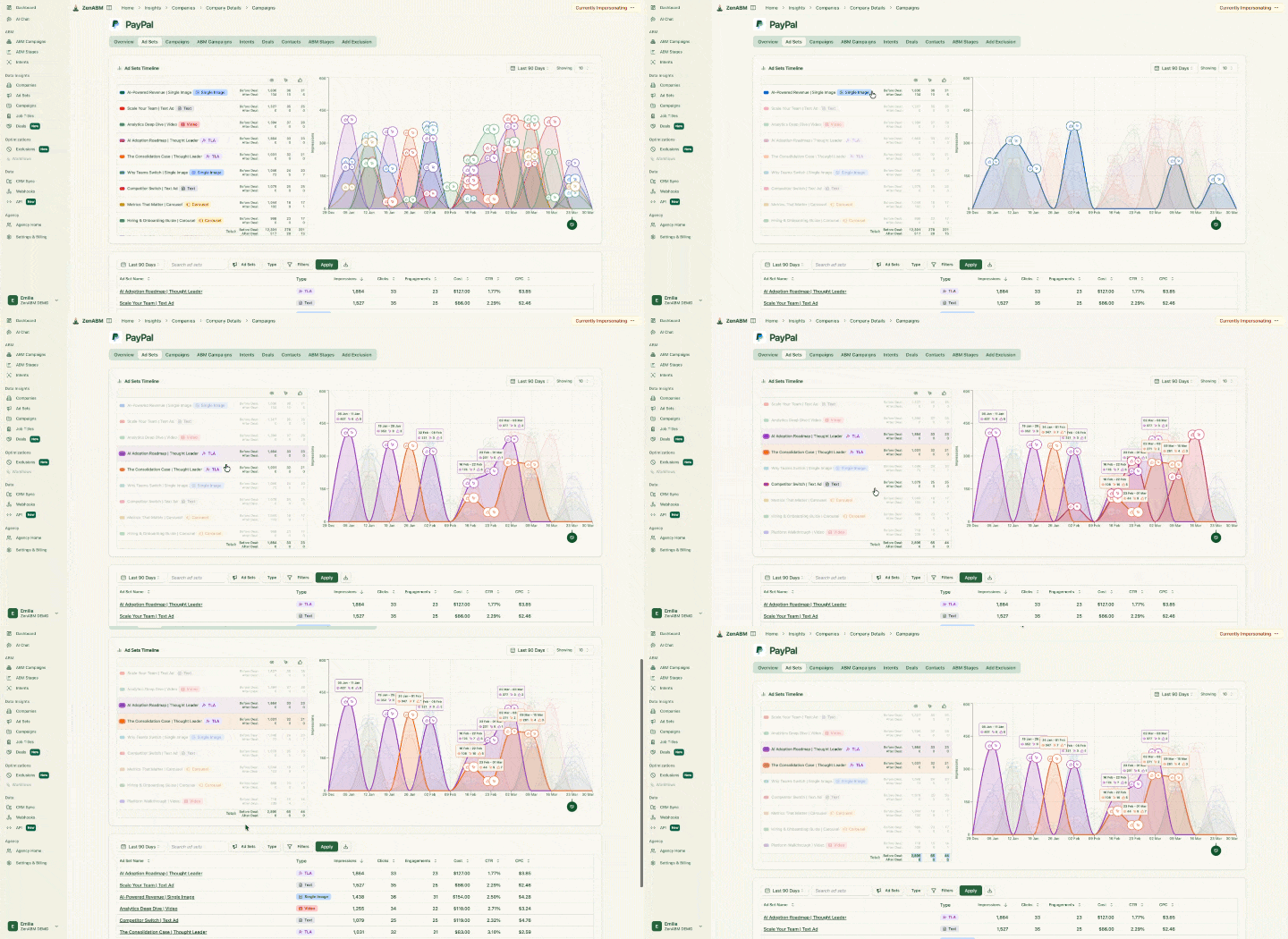
ZenABM’s position in this comparison is worth being direct about, because the point of this guide is to help teams self-select, not to oversell.
ZenABM is not trying to beat 6sense at enterprise prediction across every channel.
It is a focused, LinkedIn-first ABM platform for teams whose account-based motion lives mostly on LinkedIn (though it has multi-channel features, too), built AI-native from the ground up.

it joins company-level LinkedIn ad engagement data to the CRM, so teams can see which accounts are engaging, how they are moving through ABM stages, and which campaigns and creatives are influencing real pipeline and closed-won deals.


It surfaces metrics that LinkedIn Campaign Manager does not, including effective click-through rate to the landing page and effective cost per landing-page click, at the account level.


Because ZenABM pulls this data directly from the LinkedIn API, the engagement signals are first-party rather than panel estimates.
The AI-native part is the differentiator.
ZenABM exposes its data over a Model Context Protocol server, so teams can query LinkedIn ABM data in plain English inside Claude, ChatGPT, or Cursor, asking which accounts are surging, which ads are decaying, and which campaigns touched open deals, without exports or dashboards.
That MCP architecture is what makes it genuinely AI-native at this price point, rather than simply AI-marketed.

The depth is on LinkedIn specifically, which is the deliberate bet. ZenABM joins company-level LinkedIn ad engagement to the CRM, so the program is measured in accounts, ABM stages, influenced pipeline, and closed-won deals rather than impressions and clicks, and because the signals come straight from the LinkedIn API they are first-party rather than panel estimates.
The MCP server then makes all of that queryable in plain English inside Claude, ChatGPT, or Cursor, which is what makes it genuinely AI-native rather than AI-marketed, and the pricing is transparent from $59 a month with setup measured in minutes instead of months.

The focus is also the limit, and it is worth being plain about.
ZenABM is built for LinkedIn-led ABM, not to be a full multi-channel enterprise suite, so a program that needs display, chat, email, and website personalization coordinated in one hub will still reach for a Terminus or a Demandbase to cover that broader surface area.
It is deliberately narrow: account-level clarity on the channel where the spend actually goes, rather than a do-everything platform that does each thing a little.
Who it suits: lean and SMB B2B teams, founders running their own LinkedIn ABM, and anyone who wants account-level LinkedIn attribution and AI-driven reporting without an enterprise contract.
A fuller explanation of what ZenABM is and how it works covers the product in detail.

Every platform above is good at something.
The mistake that shows up most often is buying for the brand or the analyst report instead of the motion.
The framework below is a practical way to narrow a shortlist.
Above roughly $100M in revenue with a dedicated RevOps team and an enterprise sales motion, the prediction and intent depth of 6sense or Demandbase will pay off, and there are people to operate them.
Under about $50M, an enterprise suite is usually more platform, more cost, and more implementation than the team can absorb, and RollWorks, HubSpot’s native tools, or a focused LinkedIn-first tool will serve better.
The CRM and channels already in place rule out most of the list before you compare features.
On Salesforce with a heavy enterprise motion, 6sense and Demandbase fit naturally.
On HubSpot, RollWorks has the cleanest integration and HubSpot’s own ABM tools may be enough.
When most of the ABM spend goes to LinkedIn, a tool built for that channel specifically makes more sense than a general display platform, because account-level LinkedIn attribution is its own discipline.
The guide to running ABM on LinkedIn covers that in depth.
The price spread across these account-based marketing platforms runs from $59 a month to well into six figures a year, and implementation runs from a day to several months.
An enterprise suite that takes a quarter to implement and six figures to license is a great investment when the predictive depth changes how the sales team works.
It is a bad investment when a leaner tool would have covered 85 to 90 per cent of the playbook at a fraction of the cost.
Compare the price to the revenue the program is meant to influence before signing.
In 2026, the way data gets queried matters as much as the data itself.
The enterprise suites are adding AI agents, HubSpot has Breeze, and tools like ZenABM expose everything to AI over an MCP server, so questions can be asked in plain English.
For teams that already work in Claude or ChatGPT, native AI access means reporting is a single prompt instead of a weekly export.
It belongs on the evaluation checklist, scored like any other capability.
Whatever makes the shortlist, pilot it against one real program with a clear question: can it show which accounts are engaging and which campaigns influenced the pipeline, in a way the team will actually use every week?
If the answer takes a five-month rollout and a consultant, weigh that against a tool that connects in an afternoon.
Pick the platform the team will actually open every week.
The account-based marketing platform market in 2026 is mature, well-funded, and genuinely good at what it does.
That makes the buying decision harder, not easier, because the real risk is not choosing a bad platform; it is choosing a capable one that does not fit the program running underneath it.
The shortcut is to reverse the evaluation order.
Start with the motion, the channels the team actually runs, the CRM already in place, the number of target accounts, and the revenue those accounts represent.
Then look at what each platform does well inside those constraints. A $150,000 enterprise suite earns its price when predictive scoring across hundreds of accounts changes how a full sales team prioritizes its week.
A $59/month LinkedIn-first tool earns its price when the ABM program lives on LinkedIn and the team needs account-level clarity without a quarter-long implementation.
For teams whose LinkedIn spend is the core of the ABM motion, ZenABM connects company-level LinkedIn ad engagement directly to the CRM and exposes everything over an MCP server, so the account data is queryable in plain English, in Claude or ChatGPT, without exports or weekly dashboard pulls.
The 37-day free trial is enough time to run the full audit checklist against one real campaign and see whether the account-level view changes the conversation with sales.
You can also book a demo with us to know more!
It depends, and any honest answer starts there.
For enterprise teams with mature RevOps and budget, 6sense or Demandbase usually win on intent and prediction.
For HubSpot-based mid-market teams, RollWorks or HubSpot’s native ABM tools are often enough.
For multi-channel engagement in one hub, Terminus is strong.
For lean teams whose ABM runs on LinkedIn and who want AI-native access without an enterprise contract, ZenABM at $59 a month is the better fit. The best platform is the one that matches your size, stack, channels, and budget.
The range is wide. Enterprise suites like 6sense and Demandbase are typically custom, sales-led contracts that run into five and six figures a year. RollWorks sits lower, in the mid-range.
Terminus is modular, so add-ons change the total. HubSpot ABM is bundled into premium HubSpot tiers. ZenABM is transparently priced from $59 a month.
Always confirm a real quote with the enterprise vendors, because public ranges shift.
For a small team, an enterprise suite is usually too much platform, too much cost, and too long to implement. RollWorks and HubSpot’s native ABM tools are reasonable starting points, and for LinkedIn-first programs, a focused tool like ZenABM delivers account-level LinkedIn attribution and AI-native reporting from $59 a month without a long rollout.
Match the tool to the one or two channels the program actually runs on.
Not always. HubSpot’s premium ABM tools, including the target account index, account engagement scoring, ICP recommendations, and Breeze AI agents, cover a lot of one-to-many ABM natively.
A specialist tool becomes necessary when the program leans heavily on advertising or intent data, or when account-level attribution on a specific channel like LinkedIn is needed that HubSpot does not fully measure on its own.
AI features are agents and assistants bolted onto a dashboard.
AI-native means the underlying data is exposed for AI to query directly, usually over the Model Context Protocol, so questions can be asked in plain English inside Claude or ChatGPT and answered from live data without exports.
The enterprise suites are adding agents, HubSpot has Breeze, and ZenABM exposes its LinkedIn ABM data over an MCP server. For teams that already work in AI tools, native access is worth weighing in the platform decision.
