

©2026 ZenABM - All Rights Reserved.

Most teams I talk to say they run ABM, but they still report it like lead gen.
They count leads, MQLs, CPLs and last-click conversions, then wonder why the picture never matches what sales actually feels in the pipeline.
The ABM funnel is not a lead funnel with different labels.
It is an account journey.
Instead of tracking individual leads from MQL to SQL, an ABM funnel tracks how target accounts move through Identified, Aware, Interested, Considering, Selecting, and Closed Won or Closed Lost.
The unit is the account, not the form fill.
In this guide, I will walk through the full ABM sales funnel, the metrics that matter at each stage, the exact rules I use to move accounts forward, and the mistakes I see most often when teams try to bolt ABM thinking onto a lead funnel.
Short on time?
Here’s a quick overview:

An ABM funnel is a framework for tracking how target accounts move from a selected list to engaged accounts, opportunities, customers, or closed-lost accounts.
It mirrors a buying committee journey, not an individual lead path.
The differences from a traditional lead funnel are not cosmetic:
If you only track leads, you will miss most of the ABM journey, because buyers spend most of their time in dark social, ad impressions, peer conversations and self-research before any form is filled.
A lead funnel cannot see that.
An ABM funnel can.
This is the core idea behind running ABM on LinkedIn as a discipline.
You design the funnel around how buying committees actually behave, not around what your form fills show.

I use six stages in every ABM program I run.
Each one has a clear entry rule, a content type, a sales action and a metric.
Without those four ingredients, a stage is just a label.
The account is on your target list. Nothing else has happened yet.
The account has had enough exposure to know you exist.
I usually set the threshold at 50 or more LinkedIn ad impressions across people who match the buying committee.
The account has engaged meaningfully. My default rule is 5 or more clicks or 10 or more engagements across the buying committee, on a relevant intent theme. That is a real signal that something resonated.
The account has stronger buying intent. Signals include a demo request, trial signup, pricing or demo page visit, webinar attendance, consultation request or active sales conversation.
This is the stage where a lot of programs leak.
I wrote a separate playbook on how to move accounts from Aware to Considering, because the jump usually depends on adding a sales motion to ads, not on more impressions.
The account has an open opportunity. The buyer is now evaluating options.
The account completed the cycle.
The funnel does not end here.
The simplest way I have found to explain the ABM funnel to sales and finance teams is a side-by-side comparison.
Dimension | Traditional lead funnel | ABM funnel |
|---|---|---|
Unit of measurement | Individual lead | Target account |
Optimized for | Form fills, MQL volume | Account engagement and pipeline per account |
Stage labels | Lead, MQL, SQL, Opportunity, Customer | Identified, Aware, Interested, Considering, Selecting, Closed |
Attribution | Often last-click | Account-level, includes view-through and engagement |
Sales trigger | Lead converts to MQL | Account hits an intent or stage threshold |
Content rotation | Same nurture for everyone | Different ads and content by stage and intent |
Reporting cadence | Monthly MQLs and CPLs | Stage movement, account penetration, pipeline per dollar |
ABM does not replace sales qualification. It gives sales better timing and better context.
A BANT or MEDDPICC qualification still happens.
The ABM funnel just makes sure the conversation starts at the right account, on the right topic, at the right moment.
Tim Davidson (founder at B2B Rizz) made the same point about misaligned goals when teams report ABM through the lens of lead-gen targets in his LinkedIn post.
“Did you miss your growth goals because you aren’t good enough? Or were they plucked out of thin air and you were set up for failure. Probably the latter. What really sucks is when you double revenue or pipeline QoQ with less resources, best quarter in company history, you should be celebrating, but you feel like a failure because the goal was set against the wrong metric.”


Each transition between stages is a separate problem to solve.
Treating them as one motion is the fastest way to underperform.
This is a reach problem, so run cold awareness LinkedIn ads to your target accounts using thought leader ads, founder POVs, pain-point single image ads and educational document ads. Ignore CTR here, because the metric that matters is account reach and impressions per buying committee member, not click volume.
This is a relevance problem.
Retarget Aware accounts with more specific pain-point and educational content, including document ads, benchmark reports and product education, then look for repeated activity from the same account on the same intent theme.
Clicks alone are not the signal you want; repeated engagement on a theme is, because it tells you a topic has genuinely resonated rather than a single person randomly scrolling.
This is where ads-only programs stall, because you need to add proof, product relevance, offers and human follow-up alongside the ad layer. Use case studies, demos, webinars, comparison pages and consultations, and trigger BDR outreach from intent signals. Adding signal-based outbound to ads-only ABM is the single biggest unlock I see for moving accounts from Interested to Considering.
If your team needs a starting point, our guide on intent-based outbound maps cleanly onto this transition.
This is a sales problem with marketing support.
Coordinate around the buyer by showing ROI, implementation, security and customer proof, and make sure the marketing team is helping the champion build internal consensus rather than continuing to generate new opens.
This is about risk reduction. Use proof content, executive briefings and references to keep your champion’s case warm.
The ad layer is small here, but it still matters: a retargeting layer aimed at the buying committee with customer stories and security content reinforces the champion’s internal narrative while the deal is live.
The fastest way to break an ABM program is to measure it like a lead-gen channel. CTR and CPC are useful diagnostics, but they are not ABM funnel metrics.
The real metrics are stage-based and account-based.
Stage | Primary metrics |
|---|---|
Identified | Accounts on the target list, matched audience size, and ICP fit score |
Aware | Accounts reached, impressions per account, account penetration, cost per Aware account |
Interested | Clicked accounts, engaged accounts, engagement score, intent-theme engagement, cost per Interested account |
Considering | Demo requests, trials, meetings booked, qualified opportunities, stage conversion rate |
Selecting | Pipeline created, pipeline velocity, opportunity progression, win rate to-date |
Closed Won / Lost | Revenue, win rate, ROAS, pipeline per dollar spent, reactivation rate |
On top of those, I track cross-stage metrics: stage conversion rate, time in stage, pipeline velocity, deal open rate, intent-theme performance and persona engagement.
If you want a deeper benchmark layer, the LinkedIn ABM benchmarks report shows what good looks like at each layer.
Gabriel Ehrlich (Founder at Remotion) made the case for keeping pipeline as the anchor metric without becoming a metrics extremist in his LinkedIn post:
“Cash rules everything around me. I get it, not everything can or should be measured, not every single campaign or ad or tactic should have to be accountable for pipeline. For sure. But let’s not for one minute forget why your business exists. Even if you cannot prove yet how a new tactic will drive pipeline, you better have a plausible theory of how it could.”

This is where ZenABM does the work that LinkedIn Campaign Manager and most CRMs cannot, because ZenABM creates customizable ABM stages from real signals rather than from manual list updates.
The signal sources we combine:
An example rule set I use in my own program looks like this:
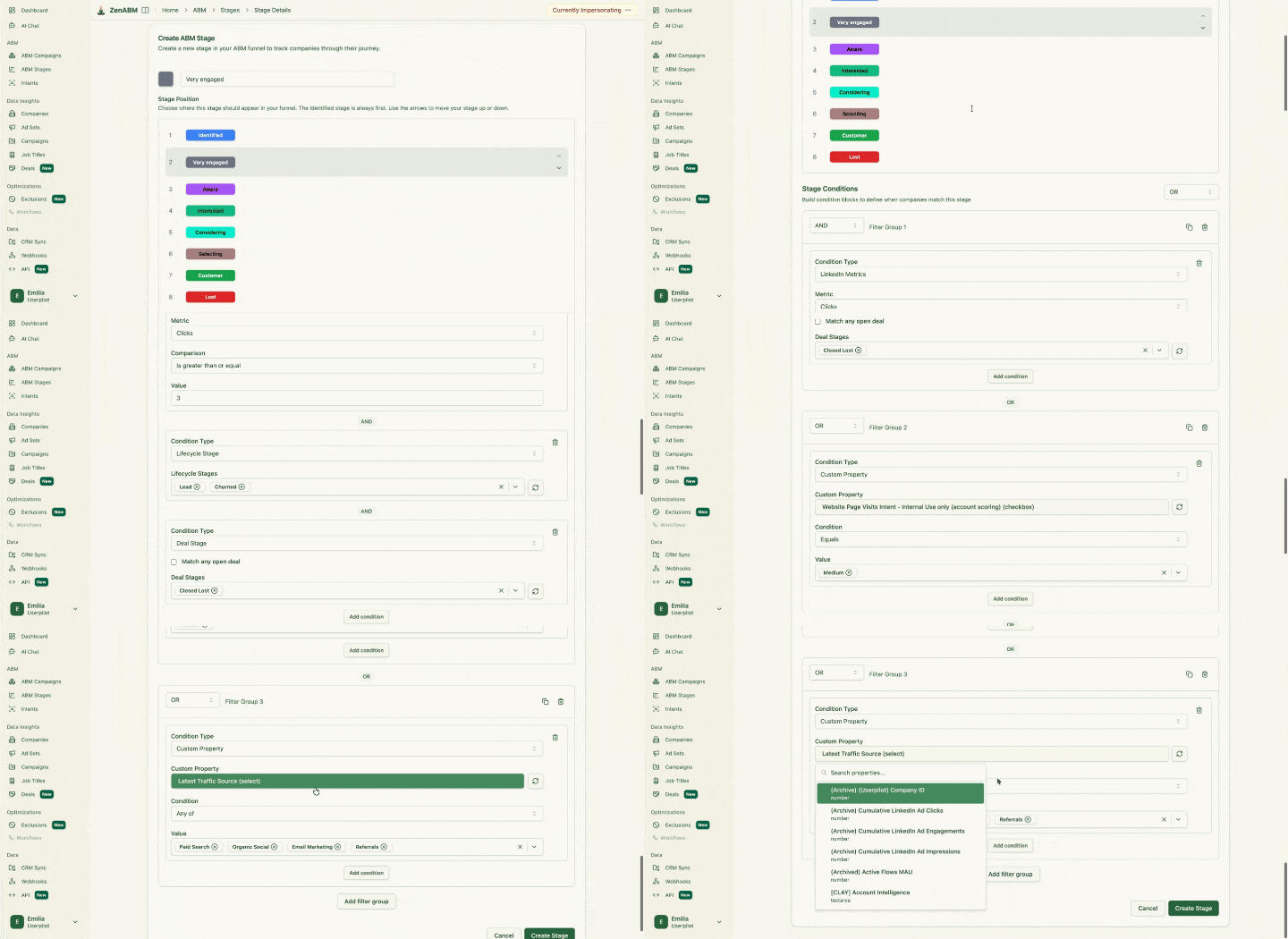

ZenABM then pushes the ABM stage, account score, intent themes and engagement detail into HubSpot or Salesforce as company-level properties so sales can act on them.


The same logic feeds ABM revenue attribution, so you can connect each stage transition back to ad spend and pipeline.
LinkedIn Campaign Manager tells you how ads performed.
The ABM funnel inside ZenABM tells you how accounts moved.
If every account sees the same ad regardless of funnel stage, you are not running an ABM funnel. You are running a static retargeting list.
The campaign architecture I run is one campaign group per stage, with creative and message tied to where the account is.
Gabriel Ehrlich (founder at Remotion) also pointed to the most common mistake here: overengineering the funnel logic until campaigns become unmanageable in his LinkedIn post.
“What if we showed these ads to these guys, and then only if they click on this ad we’ll show them that. Then we’ll use the intent data from 6sense to show them BOFU ads, and that’ll do the trick. I’ve audited so many accounts that are just overengineered like this. It’s killing your performance.”

The fix is simple: keep one campaign per stage with a small number of creatives, and let movement between stages do the segmentation work. The funnel structure itself is the personalization layer.
Sales should change behavior based on the stage context.
The same account at Aware and Considering deserves two different conversations.
An outbound opener I use for Interested-stage accounts looks like this:
“A lot of teams exploring LinkedIn attribution are trying to understand which campaigns actually create pipeline. Is this something your team is looking at this quarter?”
What you should never do is say “I saw you clicked our ad.”
It is creepy, it is lazy, and it converts worse than a thoughtful topic-level message.
Use account-level personalization, not click-level personalization.
Every team I have worked with hits at least three of these on the way to a working ABM funnel.
Once a team gets the ABM funnel definitions right, the next problem is operating it without a spreadsheet army, which is what ZenABM solves by automating stage tracking, scoring and CRM sync across every account in your program.
In ZenABM, you can:


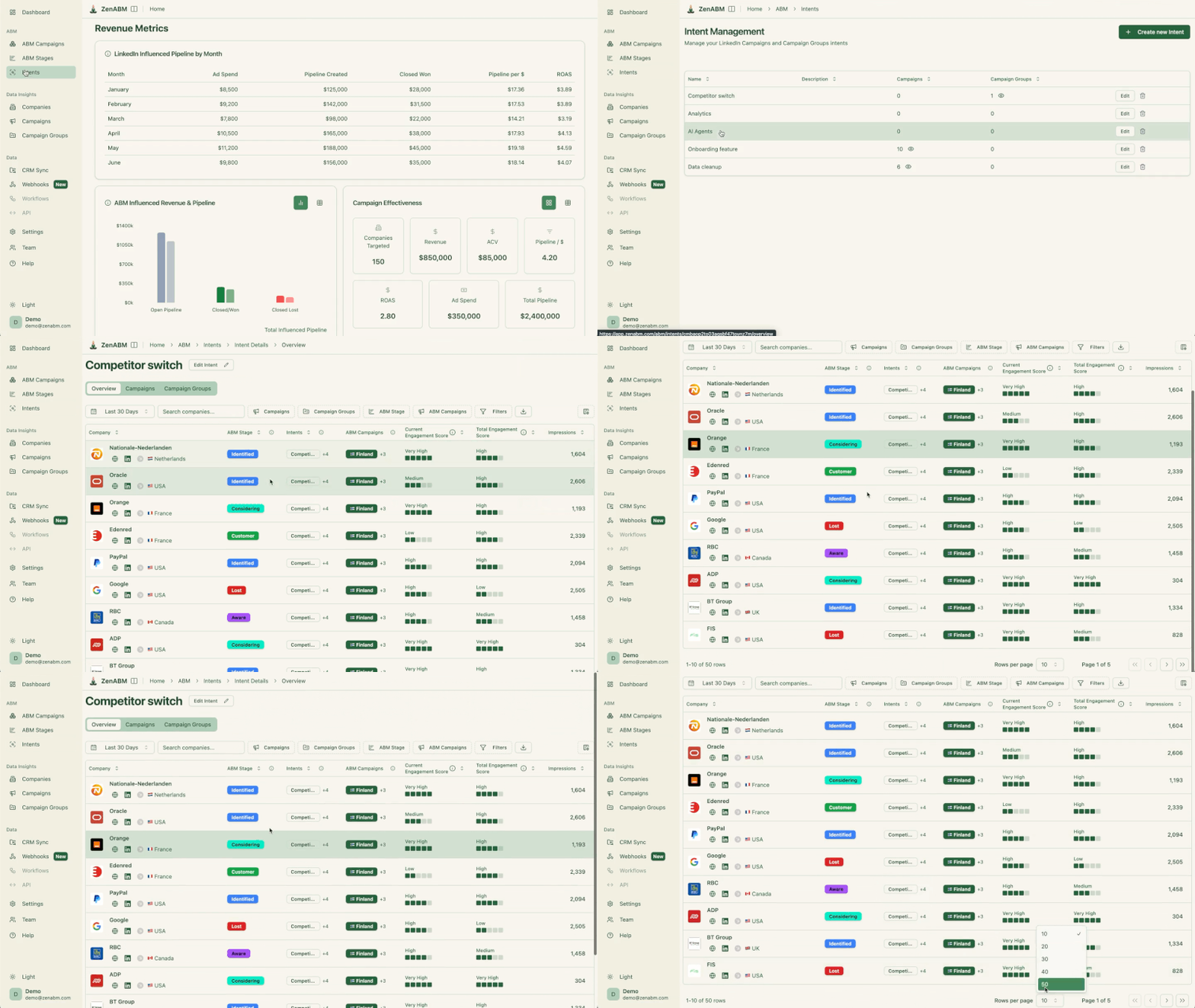


Campaign Manager tells you how the ads performed.
ZenABM tells you how accounts moved through the funnel and how that movement turned into a pipeline.
Most ABM programs fail not because the strategy is wrong but because the funnel is measured like a lead-gen channel. Every concept in this guide comes down to one operational shift: the account is the unit, stage thresholds replace opinions, and every signal from LinkedIn impressions to CRM outcomes feeds into one shared picture that both sales and marketing can act on.
The six stages outlined here (Identified, Aware, Interested, Considering, Selecting, and Closed) are only as useful as the infrastructure behind them. Without defined entry rules, CRM sync, and stage-based campaign architecture, you have a framework, not a working funnel.
ZenABM operationalizes everything covered in this guide. It combines LinkedIn ad impressions, clicks, engagements, and intent themes with CRM lifecycle data to assign every account a stage, an engagement score, and a set of intent signals automatically. Those signals push directly into HubSpot or Salesforce as company-level properties so sales knows exactly which accounts to contact, on which topic, and at what moment in the buying journey.
If your team is ready to move from reporting leads to managing an account funnel with real stage data behind it, ZenABM is a 37-day free trial at $59 per month.
So, start your free trial now or book a demo to know more!
The ABM funnel is a framework for tracking how target accounts move from a selected list through Identified, Aware, Interested, Considering, Selecting and Closed Won or Closed Lost. The unit is the account and its buying committee, not an individual lead.
A traditional lead funnel tracks individuals through MQL and SQL stages, optimized for form fills and last-click attribution. An ABM sales funnel tracks accounts through stage movement based on impressions, engagement, intent themes and CRM signals, optimized for pipeline per account.
Use stage-level metrics: accounts reached, impression depth per account, engaged accounts, cost per Aware or Interested account, stage conversion rate, time in stage, pipeline created, win rate and pipeline per dollar spent. CTR and CPC are diagnostics, not core ABM funnel metrics.
It breaks when teams rely only on ads to move warm accounts into opportunities. Adding signal-based outbound from BDRs, triggered by intent-theme engagement, is usually what unlocks the conversion.
ZenABM combines LinkedIn ad impressions, clicks, engagements, intent themes, account scores and CRM data, then applies customizable rules per stage. Stages, scores and intent are pushed into HubSpot or Salesforce so sales can act on them inside their CRM.
