

©2026 ZenABM - All Rights Reserved.

The biggest reason ABM (account-based marketing) programs stall is not bad targeting, weak creative, or a thin budget; it is the org chart. When the account-based marketing team structure is misaligned, every campaign becomes a coordination tax that nobody has time to pay.
This guide walks through the exact roles a strong account-based marketing team structure needs, how responsibilities are split between marketing, sales, and RevOps, and how to design the org so accounts actually progress instead of stalling in stage 2 forever.
Short on time?
Here’s a quick rundown:

Most B2B teams approach ABM as a pure marketing initiative, naming an ABM manager, handing them a list of 200 accounts, and expecting a pipeline within a quarter.
Six months later, the marketing team is exhausted, sales is ignoring the leads, and the CFO is asking what the program returned.
The root cause is almost always structural, because ABM is a cross-functional discipline at its core.
The moment marketing owns the strategy in isolation, sales treats the accounts as low-priority MQLs and the data flowing back from the CRM stops being useful for anyone, which is why the right account-based marketing team structure converts the program into a shared P&L rather than a marketing campaign.
Maximilian Herczeg (ex-LinkedIn) captured the shift well in a LinkedIn post on the marketing-sales relationship in B2B:
“Traditionally, marketing generates leads and sales reaches out to close them. Simple, right? Not anymore. In 2025, sales will realise it needs marketing more than ever. AI is accelerating this transformation big time.”
That mindset shift is what separates teams that can run real ABM from teams that just rebrand demand gen as ABM.
For a deeper view of how this plays out, see our ultimate guide to running ABM on LinkedIn.
When the structure is wrong, three things break:
Fixing this is not a tooling problem.
It is an org design problem.
Whether the team is two people or twenty, the same six responsibilities have to be owned.
The question is how many bodies sit behind each one.
This is the person who owns the program end-to-end, defining the ICP, setting the tiering (1:1, 1:few, 1:many), picking the channels, and deciding what good looks like.
They run the weekly account review with sales and the monthly business review with leadership.
In a lean team, this is usually the head of marketing or a senior demand gen lead.
In an enterprise team, it is a dedicated head of ABM with three to five direct reports.
Either way, the strategy lead has to be someone who can sit across from a sales VP without flinching.
The campaign manager runs day-to-day execution: building LinkedIn audiences, launching ads, managing budget pacing, swapping creative, and pulling reports as the operator who turns strategy into live campaigns.
On average, the strongest campaign managers spend 40 percent of their week on creative iteration, 30 percent on audience and budget hygiene, and 30 percent on reporting back to sales.
Anyone spending 80 percent of their week pulling reports is in the wrong tool stack.
RevOps is the spine of ABM, owning the target account list inside the CRM, building the account scoring model, syncing engagement data between LinkedIn, the website, and HubSpot or Salesforce, and ensuring the sales team sees the right signals at the right time.
Without RevOps, the program runs on screenshots and spreadsheets; with RevOps, every ad impression, click, and form fill becomes a row in the account record that sales can act on.
ABM creative is a separate discipline from brand creative, requiring a content lead who produces account-tier-specific assets (1:1 micro-sites, 1:few industry plays, 1:many vertical narratives) and briefs the in-house designer or agency on ad creative that matches the buyer journey stage.
Remember: ABM content cannot be outsourced to a generalist who also writes the company blog; it lives or dies on specificity.
This is the role most marketing-led ABM programs underweight, because the AEs and BDRs who actually work the target accounts need to be in the room when the list is built, when the creative is briefed, and when the engagement signals are reviewed.
They are not consumers of the program; they are co-owners.
The cleanest setup is to name one BDR or SDR as the ABM specialist, have them attend every weekly review, and measure them only on meetings booked from target accounts, with a quota structure that separates the ABM motion from the broader inbound and outbound numbers.
The last role closes the loop by translating raw engagement data into a weekly narrative:
In small teams, this responsibility sits with the campaign manager; in larger teams, it belongs to a dedicated marketing analyst who partners with RevOps.
The same six responsibilities exist whether the company has 30 people or 3,000.
What changes is how they get distributed.
For a startup or scale-up below series B, the program usually runs on two or three people:
This setup works because the feedback loop is short: the same person who launches the campaign can walk over to the AE and ask what they are seeing. The risk is burnout, since if the head of marketing is also writing every piece of content, strategy slips.
The fix is to ruthlessly limit the program to one ICP segment and twenty target accounts until the motion is repeatable.
Once the program proves out, the team usually expands to a structure like this:
At this stage, attribution becomes the bottleneck: marketing claims influence on every closed-won deal, sales credits cold outreach, and the CFO does not know who to believe, which is why structured pipeline reporting becomes a survival skill.
Our guide on how to structure LinkedIn ABM campaigns for pipeline growth covers the campaign architecture that makes attribution clean.
Enterprise ABM teams add specialization on top of the core six roles:
The risk at this size is the inverse of lean teams: too much specialization, too many handoffs, and the program loses speed.
The fix is the pod model, where a small marketing crew, a RevOps analyst, two AEs, and a BDR group operate around a single account segment and operate as a self-contained unit with one shared pipeline number.


The hardest line to draw in any account-based marketing team structure is the boundary between marketing-owned and sales-owned activities.
Get it wrong, and you end up with either a marketing team that ships untouched leads over the wall or a sales team that ignores marketing entirely.
Here is the split to use as a default:
| Activity | Marketing Owns | Sales Owns | Shared |
|---|---|---|---|
| Target account list | Drafts initial list | Adds and removes accounts | Final approval |
| ICP and persona definition | Documents and maintains | Validates with field input | Quarterly review |
| Ad campaigns and content | Builds and launches | Provides messaging input | Creative review |
| Account engagement signals | Captures and routes | Acts on signals | Definition of “engaged” |
| Outreach to engaged accounts | Provides intent context | Owns first touch | Cadence design |
| Pipeline reporting | Builds the dashboard | Reports stage progression | Same number, same review |
The last row is the most important one in that table.
If marketing reports on MQLs, while sales reports on SQLs, and nobody reports on the pipeline from target accounts, the program will drift apart within a quarter.
Maximilian (ex-LinkedIn) made this point bluntly when describing what a wasted budget looks like:
“My client wasted 38% of their LinkedIn ads-budget on low quality whitepaper lead campaigns. Fun fact: sales did not even use those leads.”
That is a structure failure, not a campaign failure: sales had no contract with marketing on what to do with the leads, so they did nothing.
The ritual that holds the structure together is the weekly account review: forty-five minutes with marketing and sales in the same room, working through:
If your team cannot run this meeting because the data lives in three different tools, the structure is leaking, which is the exact gap ZenABM’s account-level engagement tracking and CRM sync were built to close.

RevOps is the role we see underweighted in nine out of ten ABM team structures, because companies hire campaign managers and content writers before hiring the person who will actually wire the data together, then wonder why nothing connects.
A working RevOps function inside an ABM team owns:
If your CRM does not know which companies engaged with your LinkedIn ads, the campaign manager is operating blind, and the AEs are guessing.
ZenABM can help here.
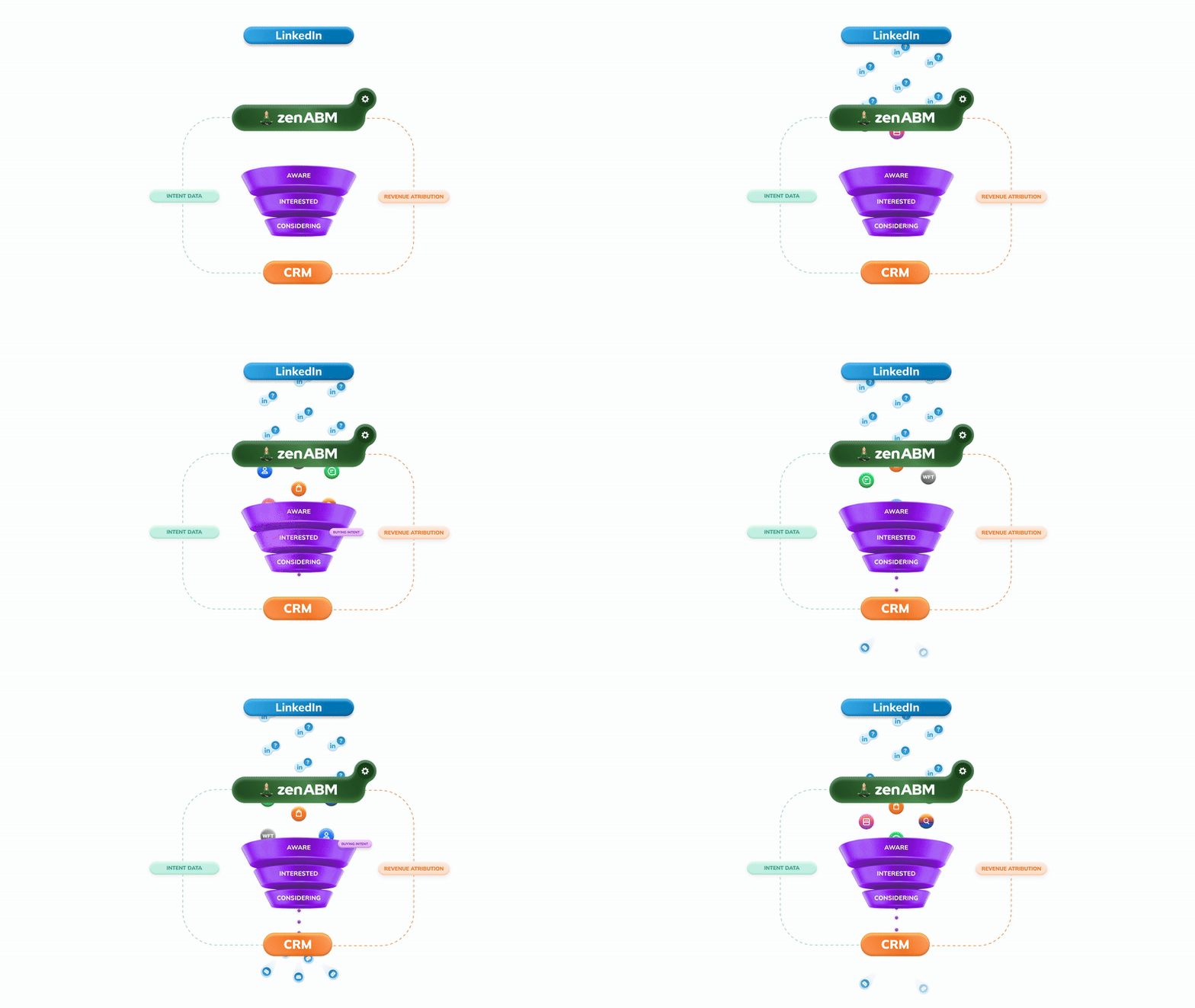
ZenABM pulls company-level LinkedIn ad engagement data straight from LinkedIn’s official API, scores accounts, determines their ABM stage, and pushes all this data to your CRM.
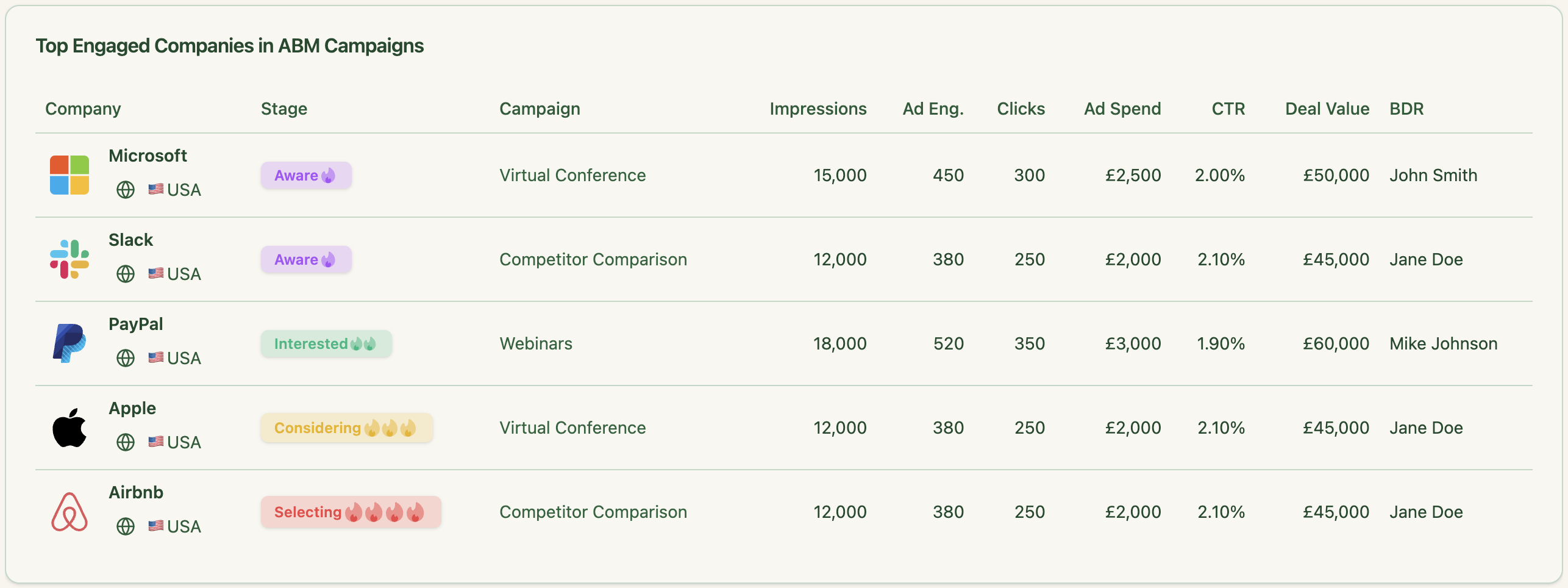


It also tracks other channels now, like Google Ads, Reddit Ads, traffic from LLMs, organic site visitors, etc.

The trigger you can use: when the campaign manager spends more than four hours a week pulling data from one tool and loading it into another, it is time to hire RevOps.
It does not have to be a full-time hire, since fractional RevOps with five hours of weekly attention beats a stretched generalist with zero.
Beyond the role definitions, the shape of the org matters.
Three patterns work, and one does not.
The pod is a self-contained unit: one marketer, one RevOps half-FTE, two AEs, one BDR, all working a defined account segment.
They share a single pipeline number, meet weekly, and report up to either a head of ABM or directly to a CRO.
This works because everyone in the pod has line of sight from impression to closed-won, which is why it is the model we default to when advising lean and mid-market teams.
In larger organizations, ABM sits as a central function that supports multiple sales pods, with the ABM team owning strategy, tooling, and account selection methodology while individual sales pods consume the output.
The risk is that the central team devolves into a service desk and loses ownership of the pipeline, which is why the mitigation is always to give the head of ABM a pipeline number from named accounts rather than a marketing-influenced metric.
Each major sales segment has a dedicated account marketer embedded inside it, reporting dotted-line to a head of ABM and solid-line to the segment’s sales VP.
This pattern is common in enterprise software and works well when segments are large enough to justify a full-time marketer.
The anti-pattern is when marketing runs ABM as a campaign tactic, sales is told about it after the fact, and there is no shared meeting, no shared list, and no shared number.
Every team that has tried this approach kills the program within twelve months and blames the tools.
Philip Ilic (LinkedIn ads expert) put it well in his playbook for sales-led B2B companies:
If you are starting from scratch, the order of hires matters more than people think.
The first three hires:
Content and analytics come fourth and fifth, in that order, depending on whether your gap is on the input (creative) or the output (reporting) side.
What to look for in each role:
The biggest compensation mistake is paying ABM marketers on MQLs, because they will optimize for MQL volume and undercut the entire program in the process.
The right structure is to pay them on a pipeline created from target accounts, with a kicker on closed-won, and to pay the embedded BDR on meetings booked from named accounts rather than total meetings.
The compensation plan is part of the org design.

The same five mistakes show up over and over.
If you are scoping the program for the first time, our breakdown of ABM mistakes to avoid covers the broader strategic traps that often get blamed on team structure but actually start somewhere else.
The right ABM team structure is not a headcount problem.
A two-person team with a clear strategy lead, a RevOps function (even fractional), and a named sales co-owner will consistently outperform a ten-person team where marketing and sales operate on different lists, different metrics, and different definitions of what “engaged” means.
The lever that matters most at every company size is closing the gap between the team that captures engagement signals and the team that acts on them.
When that gap is wide, the best creative and the sharpest targeting go nowhere because nobody is triggering the right outreach at the right moment.
ZenABM was built specifically to close that gap: it pulls company-level engagement data directly from the LinkedIn API, scores accounts by stage, and pushes everything into your CRM, so the weekly account review runs on live data instead of screenshots and gut calls.
If your current stack cannot tell you which target accounts engaged with your ads this week and where they sit in the funnel, that is the first structural problem to fix.
Start your 37-day free trial of ZenABM or book a demo to know more!
Some common questions people have while building their ABM team and their answers:
For a startup below series B, three roles cover it: a head of marketing wearing the strategy hat, a demand gen marketer running execution, and a named AE or founder owning the sales side.
Add fractional RevOps for data hygiene. Limit the program to one ICP segment and twenty target accounts until the motion is repeatable.
For most companies under 500 employees, ABM reports into marketing with a strong dotted line to the CRO. Above that size, it often reports directly to the CRO or sits inside a revenue function.
The reporting line matters less than the shared pipeline number.
If marketing and sales are measured on the same target-account pipeline, the structure follows.
Essential: strategy lead, campaign manager, RevOps support, and a named sales partner.
Nice to have at the start: dedicated content lead, dedicated analyst, field marketer.
The non-negotiable is that all four essentials exist in some form, even if compressed into two people.
Three signals: the weekly account review actually happens and produces decisions, the target-account pipeline is growing quarter over quarter, and sales reps reference marketing engagement data unprompted in their account notes. If any of those three are missing, the structure has a gap.
Demand gen teams optimize for lead volume across a broad audience.
ABM teams optimize for engagement and pipeline progression on a fixed account list.
The biggest structural difference is the embedded sales co-owner.
Demand gen ships leads over the wall.
ABM works the accounts jointly with sales from day one.
