

©2026 ZenABM - All Rights Reserved.

A lot of people have been recently asking me what’s the best way to move accounts from the Aware Stage to the Considering Stage in their ABM program – in other words, how to make the brand-aware accounts finally interested in buying your product.
In my experience (running 6-figure ABM programs for 2+ years), this gap between “this company has seen our ads” and “this company is actively evaluating us” does not close itself just with more ads.
Yes, LinkedIn ads are part of it – but you also want to consider Linkedin and email outreach (peronalized with intent signals from the ads + with the right, compelling offer), events, and gifting.
What you’ll learn in this post:
…to move accounts from Aware to Considering in an ABM program on LinkedIn.

Ok – now you’ve gotten the TL;DR for moving people from Aware to Considering ABM stage – let’s look at it in more detail, with some real examples.

Let’s start from the basics. In a typical ABM program, accounts pass through a few ABM stages (or stages of the awarness funnel):
I know a lot of people hate the idea of the marketing funnel – but you must admit this is the logial progression of the account through the process demand generation – whether there has been existing demand or not.
The transition from Aware to Interested and then Considering is arguably the hardest one to achieve because it requires a shift in the account’s behavior, not just their exposure.
And that shift typically happens as a result of a number of engagements with different content types – ads, webinars, blog posts, sometimes event.
ZenABM helps you sort your accounts into the ones that are still only passively consuming your ABM ads on LinkedIn (have only impressions, not engagements) and those that are already actively engaging with them – clicking on them, liking them.
But it doesn’t stop there – you can customize your “Interested” stage by selecting any other engagement type – by adding custom properties from your CRM as stage criteria:


Why does it matter?
You will be able to easily single out and double down on account that are really showing interest in your brand – not just with your ads, but also other types of content.
Now you need these stages to be able to push the “Interested” stage accounts into the “Interested stage” ABM campaign layer (ad campaigns, outreach, events) – regular “regtargering” ads on Linkedin inevitably fail to recognize these other engagement signals!
This is the reason why you need a tool that allows you to sort your accounts into these ABM stages – and use them as your “retargeting audience.
As Ali Yildirim, found of Linkedin Ads agency and GTM engineering agency Understory put it: “Ads should never exist in a silo. It’s our duty as good advertisers to make sure every dollar matters… If you think about it, this is a version of an intent signal. They haven’t necessarily raised their hand, but they’re definitely interested in what we’re marketing because they’re engaging with and clicking on our ads.”
So layering other engagement signals on top of ad engagements helps you determine which accounts you should double down on in the first place – because as I explained at the beginning of this post – moving accounts from “Aware” to “Considering” is a resource- intense process, going beyond just ads.
But since we’re talking about ads – let’s discuss which ones work best for moving accounts from the Aware stage to Considering!
Based on my experience running ABM campaigns for Userpilot, and also seeing many ad campaigns ZenABM’s customers are running – three formats consistently outperform at the consideration stage.
Free consultations, free audits, free trials – anything that gives the prospect value before they commit to a sales conversation.
This works because the account already knows who you are (they are past awareness). What they need is a reason to engage that does not feel like “sit through a demo pitch.”
Here are a few examples of offer-based ads:


Here’s a word of caution about these offers – a good one is one you can actually deliver – and that won’t ruin you in the process.
For instance – this ad was wildly successful in terms of driving engagement – but actually delivering on the promise was too resource consuming, and we had to pack this ad up quickly – not because it wasn’t working, but because it was working too well!

Here are some notes on good vs bad offers:

Not the polished, corporate-approved quote card.
Real photos of real customers with concise, specific results. “High price was one of the decision criteria to move from Pendo, because we were paying lots, and we were not using it” – that kind of raw, specific testimonial outperforms generic “we love this product” messaging every time.
Keep the text short. Let the face and the result do the work.

This is an underused format – probably because few marketers know they can use GIFs in single image ads on LinkedIn.
Short-loop GIFs are great for showing exactly how your product works for critical features – we tested a bunch of them on ZenABM for promoting our multi-channel revenue attribution features, and they even outperformed TLAs (Thouht Leader Ads) in terms of effective CTR (clicks to landing page)
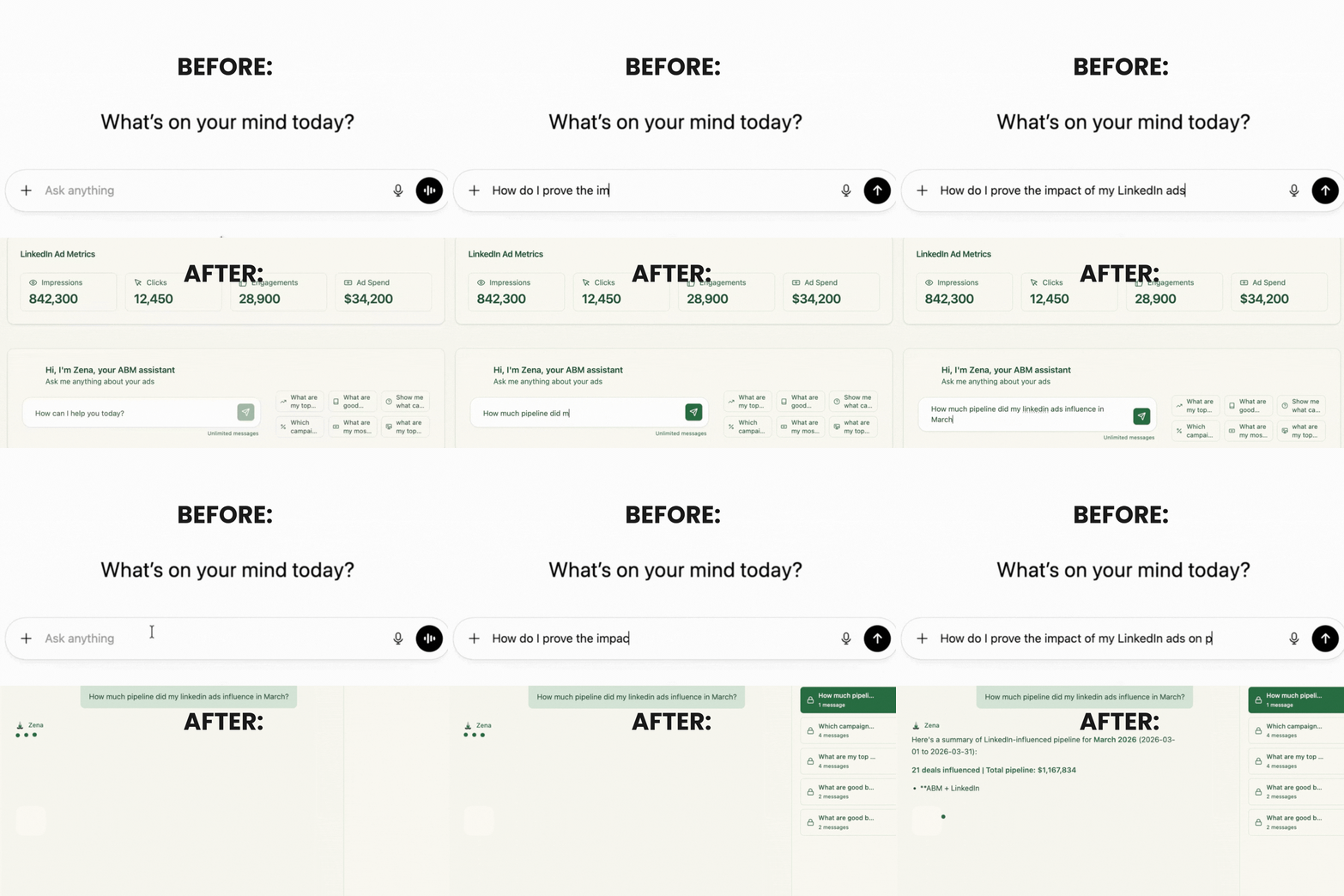
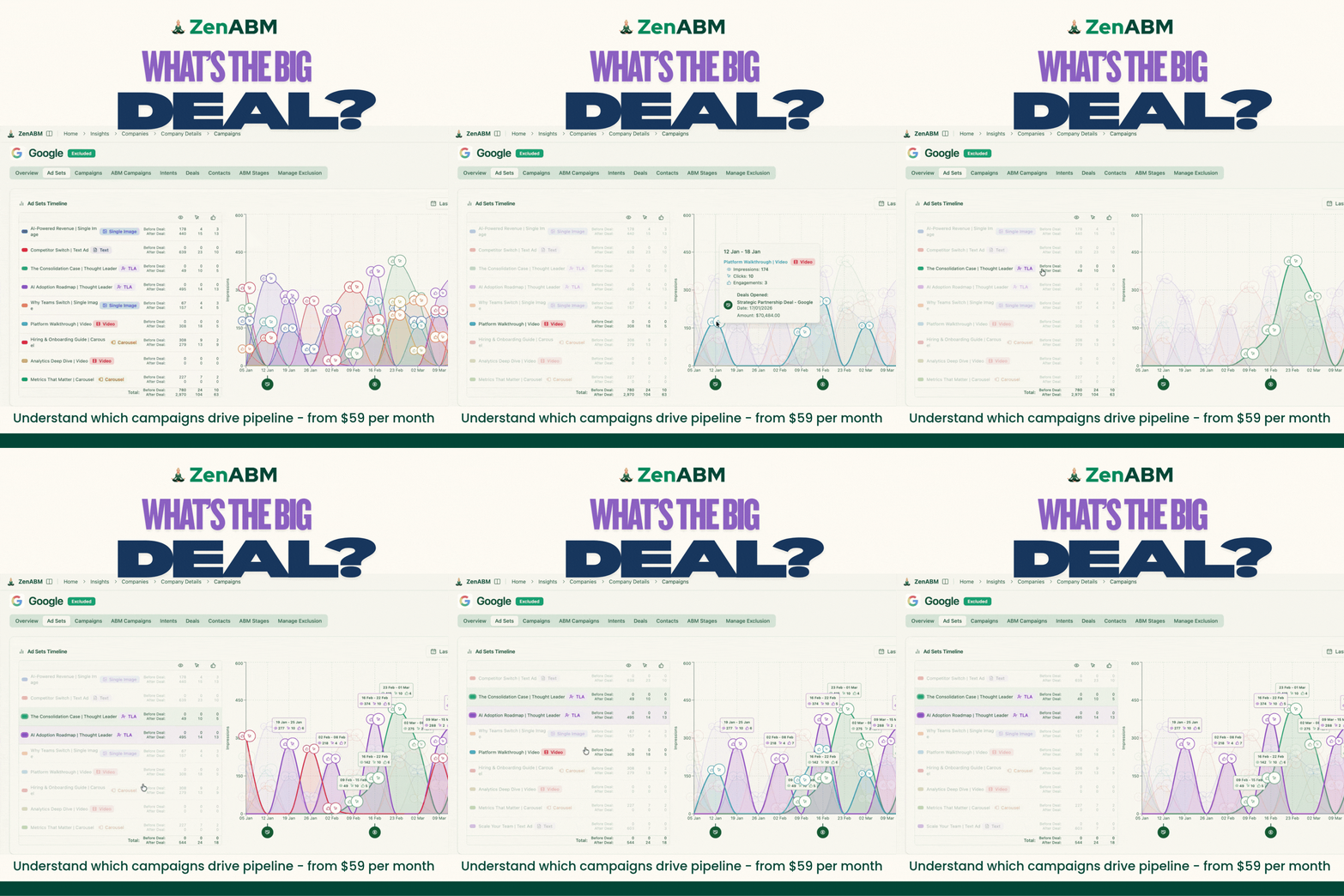
Upload them as single-image ads on LinkedIn (not video), and they autoplay in the feed without the user needing to click play. It is a product demo that runs on a 3-second loop, catching attention without demanding commitment. Stop telling accounts what your product does. Start showing them the problem it solves and the result it delivers!
Another great format that you should use for moving the accounts from interested to considering stage is TLAs. Testimonials work great for this stage – and so do LinkedIn posts written by your customers and influencers popular with your target audience. We source both through a) our advocacy program b) Passionfroot (a platform for paid collaborations with influencers):


Generic “retargeting” campaigns that serve the same message to all aware accounts are a waste of budget.
What works is structuring your consideration campaigns around specific pain points – ideally splitting the accounts (audience size permitting) by intent signals they’ve shown in the previous stages (again, ZenABM captures these intent signals for you automatically):

Here is the structure I’d recommend: one campaign containing multiple ad sets, each organized around a distinct pain point your product solves.
E.g. Three pain points = three ad sets, with ~5 ads per set.
Each ad set speaks to a specific challenge the account is facing, and the creative within it addresses that challenge from different angles.

For example, if you are selling a product analytics tool, your pain points might be:
This structure does two things. First, it lets you test which pain points resonate most with your target accounts.
Second, it lets ZenABM track intent at the ad-set level, so you can see which pain points are driving engagement for specific accounts. That signal becomes incredibly valuable for outbound.
One practical note: when running this structure on LinkedIn, disable Audience Expansion. You want these ads hitting only the accounts on your target list, not LinkedIn’s algorithmically-expanded audience. Use list segments with impression capping to prevent over-exposure to the same accounts.

Here is where most ABM programs leave the biggest opportunity on the table. You are running ads. Accounts are engaging. ZenABM is tracking which companies are clicking, which campaigns they are interacting with, and what intent signals they are showing.
And then… nothing.
Nobody reaches out. The accounts sitting in your Interested stage have already told you what they care about through their ad engagement. A company that keeps clicking on your session-replay campaign has a different need than one engaging with your cost-comparison content. That signal is gold – but only if you act on it.
“6-9 months ago I was personally convinced that outbound as a channel was dying… Except I was dead wrong about outbound. Outbound came back with a vengeance. We’re seeing the best results since we started this agency. Some of our clients are generating 20-30 qualified leads per day worth hundreds of thousands of dollars in pipeline.” – Alex Fine, Understory
This is exactly the problem the ZenABM Outbound Agent was built to solve. It is an open-source, AI-powered outbound agent that turns ABM intent signals into personalized outreach – automatically. I built it as a Claude Code skill because I was tired of watching intent data go to waste.

The agent runs an 8-step pipeline that connects your ABM data to your outbound:
The personalization is the critical piece. If a company has been engaging with your ABM bootcamp campaign and your AI agent content, the email opens with something like: “Since [Company] is running LinkedIn ads, you’ve been checking out our ABM bootcamp, and also been exploring our AI agent content – I figured this was worth a message.” Every email is unique. The agent uses a deterministic system (based on the contact’s email hash) to select from variant pools of openings, value propositions, and CTAs. Same contact always gets the same email if the pipeline runs twice, but no two people receive identical copy.
The agent is built as a Claude Code skill. Setup is straightforward:
Install this plugin: https://github.com/emikor/zenabm-outbound-agent-plugin and Claude handles the rest/outbound to start the skillOn first run, it walks you through configuring your API keys (ZenABM, Apollo, Smartlead), defining your ICP and target personas, and optionally customizing your email copy. After that, it runs on autopilot every Monday morning – pulling fresh intent data, finding new contacts, generating emails, and queuing them for delivery. You need a ZenABM account with LinkedIn Ads connected, an Apollo.io account (free tier gives you 10K records/month), and a Smartlead account for email delivery. The agent itself is free and open-source.

If ads create awareness and outbound starts conversations, events are what compress the consideration timeline.
A 30-minute conversation at a dinner or workshop does more to move an account forward than weeks of ad exposure.
I’ve seen this firsthand – one of my recent events generated 50 app sign-ups from a single evening. The economics are better than most teams realize.
A revenue dinner at a quality hotel venue can cost as little as 5,000 PLN (roughly $1,200) for a full meal service.
A London event venue runs about 500 GBP, with food and beverages adding 300-400 GBP.
Coworking spaces charge as little as 50 GBP/hour. And if you partner with venture capital funds or tech companies, you can often get premium venue space for free in exchange for visibility.
The attendance economics are also favorable. A well-run event targeting your ABM accounts can hit 35-40% show rates. One of our recent event had 120 confirmed attendees with 80 showing up – a 67% show rate. Events work at the consideration stage for a specific reason: they create a context where the prospect is learning, not being sold to. A workshop on “how to structure your ABM campaigns” or a mastermind dinner with peers positions your company as a practitioner, not a vendor. That is the exact frame shift that moves an account from “aware of this tool” to “seriously considering it.”
The key is using your ABM data to identify high-intent accounts and drive event invitations. Instead of blasting your entire database, invite accounts that are already showing intent signals. You may need to segment them by geography of course if the event if physical – but online events (like our ABM bootcamp) work just as well.

They are more likely to attend (they already know who you are), and the event becomes the nudge that moves them to the next stage.
Partnerships amplify this – team up with another company targeting the same audience, and you will both get your leads warmed up for half the cost.
None of this works if your data is stale.
This is the unsexy but critical piece that most guides on ABM stage progression skip entirely. Here is the reality: contact databases decay fast.
People change jobs, companies get acquired, email addresses go stale. If you are pulling contacts from a tool like Clay and running outreach campaigns without verification, you risk sending messages to people who no longer work at their listed companies. That is not just a waste – it damages your sender reputation and can get your domain blacklisted. A practical verification stack looks like this:

List building itself needs care. Revenue-based filtering in tools like Clay can cost tens of thousands in credits.
A more practical approach: filter by headcount instead. Companies with 40+ employees as a proxy for your revenue threshold.
Moving accounts from the ABM Aware stage to Considering is not a single tactic. It is a coordinated system with three layers:
Layer 1: Consideration-stage ads – shift from awareness messaging to offers, testimonials, and GIF demos. Structure campaigns around pain points, not product features. Double down on TLAs and image ads (they deliver 6x more engagement per dollar than video). Disable Audience Expansion and use impression capping.
Layer 2: Intent-driven outbound – use ZenABM intent signals to trigger personalized outreach to accounts showing engagement. The ZenABM Outbound Agent automates this end-to-end: pulling intent data, finding contacts, generating personalized emails, and pushing to your outbound tool. It runs weekly on autopilot.
Layer 3: Events and high-touch engagement – use your ABM data to invite engaged accounts to revenue dinners, workshops, and community events. The cost is surprisingly low. The conversion impact is disproportionately high.
And underneath all three layers: data hygiene. Verify contacts before outreach. Use headcount-based filtering instead of expensive revenue lookups. Refresh your lists weekly. Cache what you can to reduce API costs. The teams that nail this transition share one trait: they treat the Aware-to-Considering gap as a system design problem, not a media buying problem.
More ad spend will not fix it. A coordinated system of the right creative, automated outbound, and strategic events will.
An Aware account has been exposed to your brand through ads – they have seen your content but have not taken meaningful action. A Considering account is actively engaging: clicking through to landing pages, consuming multiple pieces of content, and starting to compare your solution against alternatives. The transition requires a shift in behavior, not just more impressions.
It depends on your sales cycle and deal size. For mid-market B2B SaaS (ACV around $19-25K), I typically see accounts spend 4-8 weeks in the Aware stage before progressing – assuming you are running consideration-stage tactics alongside your awareness campaigns. Without deliberate consideration tactics, accounts can sit in Aware indefinitely.
Ads alone can move some accounts, but you are leaving significant pipeline on the table. The most effective approach combines ads (for scalable touchpoints), outbound (for personalized 1:1 contact), and events (for high-touch acceleration). In my experience, adding signal-based outbound to an ads-only program typically increases the Aware-to-Considering conversion rate by 30-50%.
Track three things: (1) stage conversion rate (percentage of Aware accounts moving to Considering per month), (2) time-in-stage (how long accounts spend in Aware before progressing), and (3) pipeline velocity (how fast accounts move through your full funnel). ZenABM tracks all three natively through its ABM analytics dashboards.
Install Claude Code, then paste “Install this plugin: https://github.com/emikor/zenabm-outbound-agent-plugin” into the terminal. Claude clones the repo and sets everything up. Type /outbound to start. You will need API keys for ZenABM, Apollo.io, and Smartlead. The first run walks you through all configuration.
If you are running ABM campaigns and watching accounts pile up in the Aware stage without progressing, it is time to layer in consideration-stage tactics. Start by installing the ZenABM Outbound Agent to start acting on your intent data automatically. Then restructure your campaigns around pain points instead of product features. And look at your calendar for the next event you can host or partner on. Book a demo to see how ZenABM tracks account progression through ABM stages and surfaces the intent signals that power this entire playbook.
