

©2026 ZenABM - All Rights Reserved.

A prospect sees your LinkedIn Thought Leader Ad in January.
In February, they Google your company name and click a paid search result.
In March, they read two blog posts through organic search.
In April, a BDR sends a cold email. In May, they booked a demo from a retargeting ad.
In July, the deal closes.
Which channel gets the credit?
If your team is like 67% of B2B marketing teams, the answer is whatever happened last.
And that answer is wrong.

Cross-channel marketing attribution is the practice of stitching those disconnected touchpoints into one company journey, then assigning revenue credit more fairly across the channels that actually contributed.
It matters because without multichannel attribution, your reporting makes it look like Google Ads drove the deal, so you cut spend on the channels that warmed and educated the account long before the final conversion.
In reality, LinkedIn may have built awareness over four months, organic content may have deepened understanding, and Google Ads may have simply captured the last click before the form fill.
If you want to stop over-investing in the final touch and under-investing in everything that created demand, this post will walk you through:

Short on time?
Here’s a quick rundown:
Most attribution tools track individuals.
Person A clicked Ad X. Person A visited Page Y.
Person A filled out Form Z. In B2B, that misses the point.
A buying decision at a company with a $50K ACV often involves 5 to 11 people.
The CMO sees the LinkedIn ad. The VP of Product reads the blog post.
The analyst downloads the comparison guide.
The CTO receives the outbound email.
The champion books the demo.
If you track only one of those people, you are seeing only a narrow slice of the real journey.
Cross-channel marketing attribution in B2B has to be built at the account level.
You need to combine touchpoints from everyone at the company into a single timeline, then attribute revenue based on the company’s collective journey, not one person’s path.
That is also why, as Emilia Korczynska wrote from her own experience in her post, LinkedIn ads looked like a waste of money when we measured them through individual lead attribution.

Once we switched to account-level influence, those same campaigns showed up repeatedly in the journeys of our highest-value closed-won deals.
Building a cross-channel journey means combining data from platforms that were never designed to work together.
Each one uses its own identity system, data structure, and reporting limits.
Here is what you are actually dealing with:
Data Source | What It Gives You | Identity Resolution |
|---|---|---|
LinkedIn Ads API | Impressions, engagements, and clicks per company, per campaign | Company name + LinkedIn org ID (reliable) |
Google Ads | Clicks, conversions, and cost per keyword | No company data requires gclid + CRM matching or reverse IP |
Website analytics | Page views, sessions, referrer data, and UTMs | Anonymous, unless you add reverse IP or cookie-based matching |
CRM (HubSpot/Salesforce) | Contact activity, deals, revenue, and company associations | Known contacts with a company association |
Reverse IP tools | Company identification for anonymous website visitors | Company name, usually with a 20 to 40% match rate |
Outbound tools | Email opens, replies, and sequence activity | Known contact + company |
The real challenge is merging all of this into one timeline per company.
The closest common key is usually the company name or domain, but matching across systems gets messy fast.
“Acme Corp” in LinkedIn might appear as “Acme Corporation” in HubSpot and “acme.com” in your reverse IP tool.
This is exactly the problem cross-channel marketing attribution tools are built to solve.
They normalize company identity across sources, merge the timelines, and give you one view of every touchpoint that happened before a deal was created or closed.
Here is the practical workflow I use.
This is not theoretical, it is how these journeys actually get built.
You need these integrations in place first:

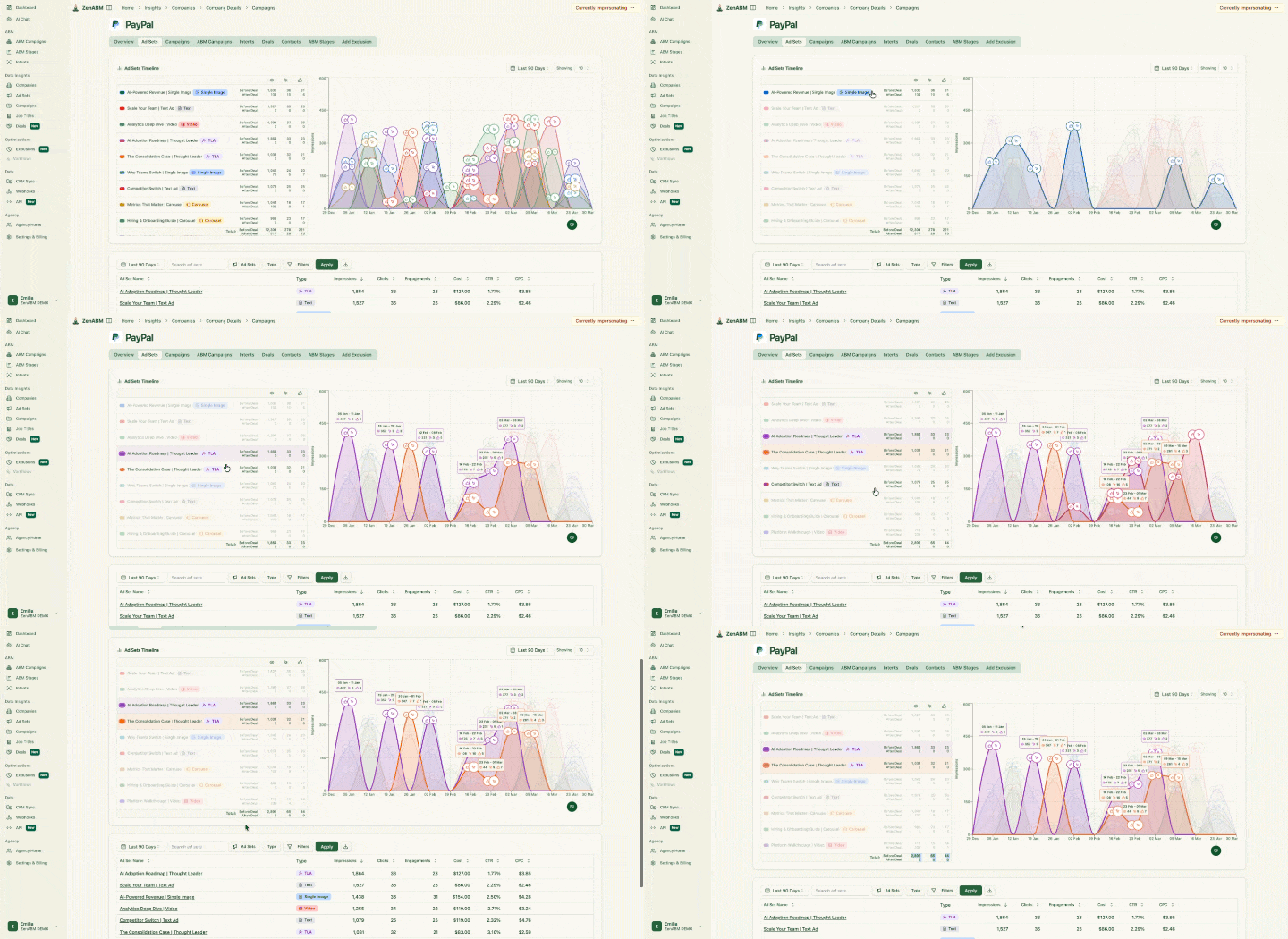
For every company with an open or closed deal, reconstruct the full engagement history:
The output should be a chronological timeline for each company, from the first LinkedIn impression all the way to the closed-won deal.
Not all touchpoints deserve equal weight. In the timeline, mark the milestone events:
These milestones become the anchors for W-shaped or position-based attribution models.
The channels present at those moments usually receive the largest share of credit.
Now distribute revenue credit across touchpoints using the model you chose.
For a $100K deal using a W-shaped model:
Once you do this across all deals, you can aggregate the outcomes: LinkedIn influenced $2.4M in pipeline, Google Ads influenced $800K, organic content influenced $1.1M, and outbound influenced $1.5M.
Those numbers overlap because the same deal can be influenced by multiple channels, and that is exactly the point. You want to see which channels appear most often in winning journeys.
Once the journeys are built, the real value comes from reading the patterns inside them. Here are the ones I look for most often.
A company sees LinkedIn ads for 3 to 6 months, with plenty of impressions and a few engagements.
Then it visits your website through organic search or direct traffic.
Then someone fills out a form.
Then a demo gets booked.
This is one of the most common B2B journeys I see. LinkedIn creates awareness, and other channels capture the demand later.
Last-touch attribution gives LinkedIn zero credit. Multi-touch attribution shows it was present in a huge share of closed-won journeys.
As Ali Yildirim (Founder at Understory) highlighted from the Factors.ai 2026 LinkedIn Benchmark Report in his post, “Accounts exposed to LinkedIn ads showed 46% higher paid search conversions.”
That kind of cross-channel multiplier only becomes visible when you study the full journey.
A BDR sends a cold email. Nothing happens.
The company then starts seeing LinkedIn ads because it was already on the target list.
After 2 to 3 weeks of ad exposure, the BDR follows up again.
This time, the prospect replies.
This is the pattern Philip Ilic (LinkedIn ads specilaist) has built much of his agency model around and share sin his post:
“LinkedIn Ads + Outbound are far the best combo for B2B SaaS. LinkedIn warms accounts, outbound closes.”

Without cross-channel attribution, you end up arguing about whether outbound drove the deal or LinkedIn drove the deal.
With cross-channel journeys, you can see that both channels worked together.
A company clicks on a LinkedIn ad and lands on a page, but does not convert.
Two weeks later, it returns through organic search and reads three blog posts.
Then it comes back again via direct traffic and books a demo.
Content is rarely the first touch or the final touch, but it often does the heavy lifting in the middle of B2B journeys.
Without cross-channel attribution, content can look invisible.
With it, you start to see that companies consuming three or more pieces of content often convert at a much higher rate than companies that do not.
As I mentioned in my post on revenue attribution, the hardest part is not picking an attribution model.
The hardest part is getting the data.
Here are the biggest gaps, and how to close them.
These platforms tell you that a click happened, but not which company the person works for. The fix has two parts:
The solution is similar. Use reverse IP for anonymous visitors, then use CRM matching for known contacts.
For AI referrals in particular, track referrer URLs in your analytics. They often appear as referral traffic from chat.openai.com, perplexity.ai, and similar domains.
From there, apply reverse IP to identify the company behind the visit.
Someone shares your content in Slack. A prospect hears about you on a podcast.
A customer refers a friend. None of that appears neatly in attribution reports.
This is the honest limitation of every attribution system.
As Tim Davidson (B2B RIzz) put it:
“The best marketing that actually drives business results can’t be tracked. Yet the hardest things to get approved are the things you can’t track.”
Cross-channel attribution gives you the best picture available, but it will never be complete.
Accept that, then use self-reported attribution (“How did you hear about us?”) to fill part of the gap qualitatively.
If a full multi-touch attribution model feels overwhelming, start with something simpler.
Instead of trying to distribute precise credit, ask: “Which channels were present in the journeys of closed-won deals?”
That is influenced revenue, and it is much easier to calculate:
You will end up with numbers like, “LinkedIn influenced $3.2M in pipeline. Google Ads influenced $1.8M. Organic influenced $2.1M.”
Those totals will exceed your actual pipeline because deals are influenced by multiple channels, and that is correct.
The overlap is the insight.
This is essentially what ZenABM’s deal attribution feature already does for LinkedIn, mapping CRM deals to the companies that engaged with your ads and showing the influenced pipeline per campaign.
The newer cross-channel tracking extends that logic to non-LinkedIn touchpoints as well, so you can see the full timeline of LinkedIn impressions, Google clicks, organic visits, and outbound touches for every company tied to a deal.

Cross-channel attribution is what stops B2B teams from starving the channels that actually create demand just because another channel happened to get the final click.
When you stitch LinkedIn ad exposure, organic visits, paid search clicks, outbound touches, and CRM deal movement into one account-level journey, your budget decisions get a lot smarter.
You stop asking, “Which channel closed it?” and start asking, “Which mix of channels consistently shows up in closed-won journeys?”
If LinkedIn is a major part of that mix for you, ZenABM helps you connect company-level LinkedIn engagement, CRM deals, and cross-channel touchpoints into one timeline, so you can see what is influencing pipeline instead of guessing.
Try ZenABM’s 37-day free trial or book a demo now!
Some common questions about cross channel marketing attribution:
Cross channel marketing attribution is the process of tracking how multiple marketing channels, such as LinkedIn Ads, Google Ads, organic search, email, and outbound, contribute to a single deal or revenue outcome. Instead of crediting only one channel, it maps the full journey across all channels and assigns credit based on each channel’s contribution. In B2B, this has to be done at the account level by aggregating touchpoints from everyone at the same company.
The LinkedIn Ads API gives you company-level data natively. For Google, Reddit, organic, and most other channels, you need a combination of reverse IP tools to identify anonymous companies and CRM contact matching to connect UTMs and click IDs back to company records. Neither method is perfect on its own, but together they usually cover most of the journey.
Most B2B sales cycles run from 3 to 12 months. Use a minimum 90-day lookback window, and ideally 180 days. LinkedIn’s native reporting only goes back 90 days, which is why tools like ZenABM store data beyond that window, so you can still see journeys that started six or more months before a deal closed.
Attributed revenue uses a formal model, such as first-touch or multi-touch, to divide a deal’s value across channels, so the total always equals the deal value. Influenced revenue simply asks whether a channel was present anywhere in the journey, without splitting the credit. That means a $100K deal can appear as $100K influenced by LinkedIn and also $100K influenced by Google Ads. Influenced revenue is easier to calculate and often more useful for strategic decisions.
For basic attribution, you can start with CRM reporting plus solid UTM discipline. For account-level cross-channel journeys, dedicated tools make a real difference. ZenABM is focused on LinkedIn + CRM + cross-channel timelines and starts at $59/month. Dreamdata and HockeyStack go broader across channels, but they come with higher pricing and more setup complexity. The right choice depends on whether LinkedIn is your main growth channel or just one channel among many.
