

©2026 ZenABM - All Rights Reserved.

Cross-channel marketing attribution software solves a very specific problem: it connects touchpoints across LinkedIn, Google, organic, email, and outbound to the deals and revenue sitting in your CRM.
Without that connection, you are making budget decisions from isolated fragments of the buyer journey rather than from the full path to conversion.
Emilia Korczynska has tested most of the major tools in this category while running a 7 figure ABM program as a VP of Marketing, and from the five tools below, She has either used or evaluated all of them through trials, demos, or live implementation (Dreamdata, 2 x trial + demos; ZenABM, using; RB2B, using; Vector, using; Hockeystack, trial + demos).

She shared that the differences between these tools are real because every channel gives you a different kind of data, and no single platform handles every attribution problem equally well.
Based on the insights she shared, this review will cover:
I am not ranking these from 1 to 5, because they solve different problems.
A tool that makes sense for an enterprise team running six channels can easily be excessive for a growth team that mostly relies on LinkedIn and outbound.
Tool | Best For | LinkedIn Company Data | Other Channel Attribution | CRM Integration | Pricing |
|---|---|---|---|---|---|
ZenABM | LinkedIn-first ABM teams | Yes (native API) | Yes (cross-channel timeline) | HubSpot, Salesforce | $59 to $499/mo |
Dreamdata | Full multi-channel B2B attribution | Yes (via API) | Yes (all channels) | HubSpot, Salesforce | Free to $2,499/mo |
HockeyStack | GTM intelligence + attribution | Yes (via API) | Yes (all channels) | HubSpot, Salesforce | Custom (typically $1,000+/mo) |
Vector | Website visitor identification | No (company ID layer) | Identifies companies, not attribution | Limited | Custom |
RB2B | Person-level website visitor ID | No (visitor ID layer) | Identifies visitors, not attribution | Via integrations | Free to $349/mo |
The main distinction is simple: ZenABM, Dreamdata, and HockeyStack are attribution tools, which means they map touchpoints to pipeline and revenue, while Vector and RB2B are identification tools, which means they tell you which companies or people showed up on your site without building the revenue journey on their own. In practice, many teams need both layers working together.
The reason ZeABM exists is straightforward.
As a practitioner, Emilia kept running into the same limitation inside LinkedIn Campaign Manager: it showed aggregate company engagement, but it did not connect that engagement to deals, did not give campaign-level company breakdowns, and did not preserve the data beyond 90 days.

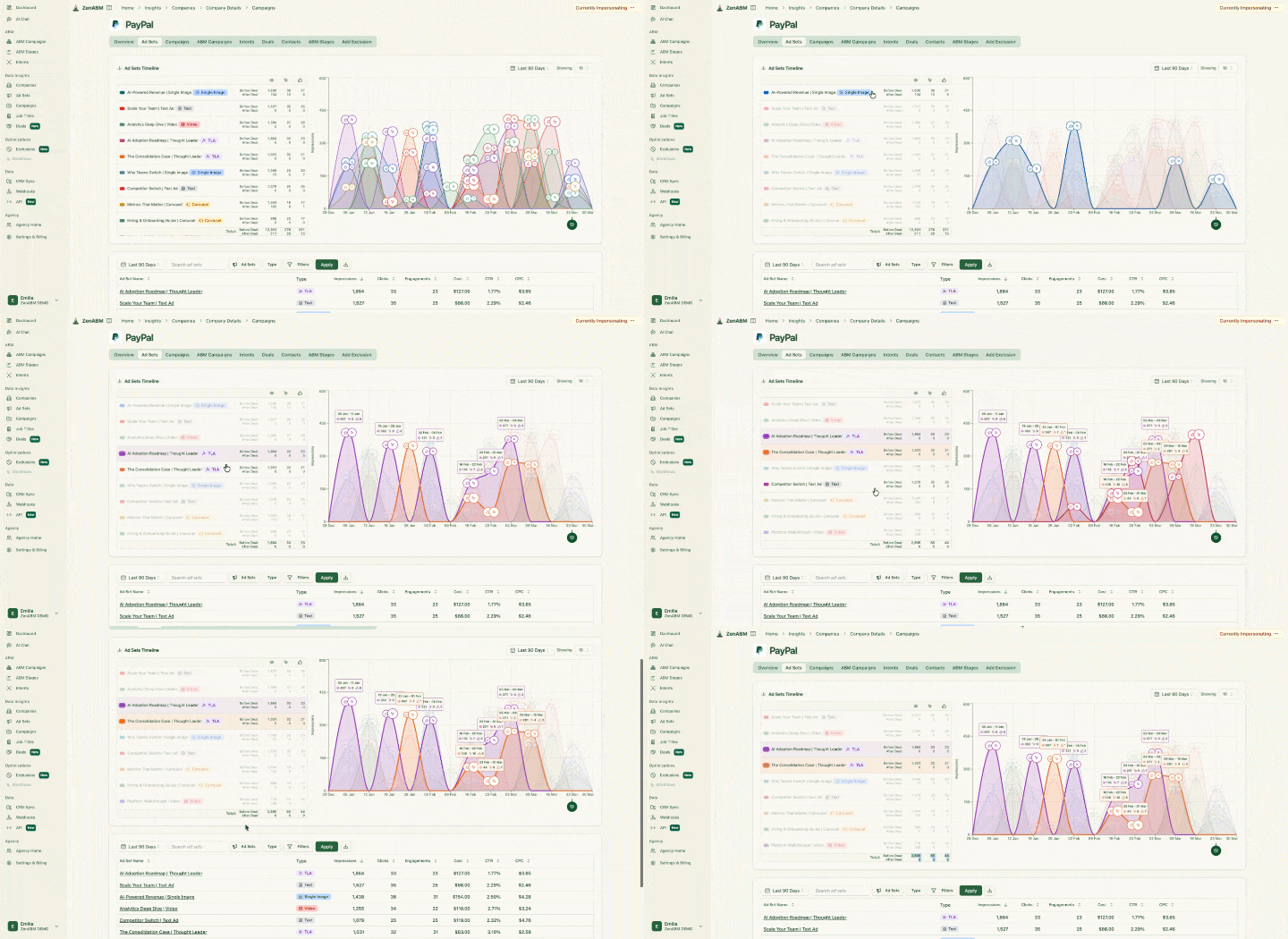
ZenABM pulls company-level LinkedIn engagement data, including impressions, clicks, and engagements by company and by campaign, directly from the LinkedIn Ads API and stores it historically.


It then connects that data to your CRM, whether HubSpot or Salesforce, so you can see which companies engaged with ads, which of those companies opened deals, and how those deals moved through the pipeline.


What makes ZenABM relevant to this comparison, however, is its newer cross-channel layer.
It now collects clicks and touchpoints from channels beyond LinkedIn and places them on a unified company timeline, so instead of seeing isolated signals, you can follow one account across the entire journey.
In practice, that means you can view a sequence like this on one timeline: Acme Corp saw 47 LinkedIn ad impressions in January, clicked a Google ad in February, visited the pricing page through organic in March, and became an opportunity in April.

ZenABM has the following strengths:


Some limitations of ZenABM:
ZenABM is best for growth and demand gen teams that treat LinkedIn as their main paid channel and want account-level engagement data, CRM integration, and deal attribution without committing to an enterprise price point.
It is also a strong fit for LinkedIn Ads agencies that need to show client ROI at the campaign level rather than relying on vague top-line reporting.

Dreamdata is a B2B revenue attribution platform built for teams that want the complete customer journey across LinkedIn, Google, organic, email, website activity, and even product usage.
Among the tools in this comparison, it is the most complete option for teams running a broad, genuinely multi-channel motion at scale.
Dreamdata connects to ad platforms, website analytics, CRM systems, and other data sources to build account-level journeys that span every channel.
It then applies multiple attribution models, including first-touch, last-touch, linear, U-shaped, W-shaped, and data-driven, so revenue credit is distributed across the journey rather than pinned to a single touchpoint.
Its standout feature is the account journey view, because it lets you see every touchpoint a company has had across channels, in chronological order, alongside deal milestones.
This is the clearest example in the market of what multi-touch attribution is supposed to look like when implemented properly.
The major strengths of Dreamdata:

Some limitations of Dreamdata:
Dreamdata is best for mid-market and enterprise B2B teams running four or more meaningful channels, especially when they need model-agnostic attribution and detailed visual account journeys.
It makes the most sense when a team also has dedicated marketing ops or RevOps support to implement and maintain it properly.


HockeyStack is a GTM intelligence platform that combines attribution with broader go-to-market analytics.
In other words, it goes beyond answering which channels influenced revenue and starts answering which accounts sales should prioritize right now, which campaigns are accelerating pipeline, and where buying signals are clustering.
HockeyStack tracks marketing and sales touchpoints across ads, website activity, email, CRM activity, and product usage, then builds account journeys with multi-touch attribution layered on top. Its differentiator is the predictive layer. Instead of stopping at historical reporting, it helps teams decide which accounts appear most ready for outreach and which campaigns are moving accounts through the funnel most efficiently.
That makes it useful for teams that want attribution tied directly to action. Rather than simply saying LinkedIn influenced $2M in pipeline, it can also point to the specific accounts showing high engagement right now and surface them for sales follow up.
Major strengths of HockeyStack:
Some limitations of HockeyStack:
HockeyStack is best for growth-stage and enterprise B2B teams that want attribution combined with account scoring, predictive analytics, and broader GTM intelligence.
It is particularly well suited to teams that have both the budget and the operational capacity to implement a platform that does much more than standard attribution.

Vector is not an attribution tool in the traditional sense. It is a visitor identification layer that tells you which companies are visiting your website, even when those visitors never fill out a form.
That makes it especially valuable for channels that do not give you native company data, such as Google Ads, Reddit, and organic search.
Vector uses reverse IP lookup and related identification methods to match anonymous website visitors to companies. So when someone clicks a Google ad and lands on your site, Vector can identify the company behind that visit.
This matters because it fills one of the biggest gaps in non LinkedIn attribution: without an identification layer, traffic from Google Ads, Reddit, direct, or organic stays anonymous, which means you cannot build account-level journeys for those channels.
Vector works best when paired with attribution platforms like ZenABM, Dreamdata, or HockeyStack. It supplies the identification layer, while those tools handle the attribution logic and revenue mapping.
Core strengths of Vector:
Vector is best for teams that need to identify which companies are engaging through non LinkedIn channels, then pass that data into a CRM or attribution system.
It pairs especially well with ZenABM if you want deeper LinkedIn attribution plus broader website identification, or with Dreamdata and HockeyStack if you want a fuller enterprise attribution setup.

RB2B takes website identification one layer deeper by identifying individual people rather than only companies.
So instead of merely telling you that someone from Acme Corp visited your pricing page, it can tell you that Jane Smith, VP of Marketing at Acme Corp, visited that page.
RB2B identifies individual visitors on your website and enriches them with fields like name, job title, company, and LinkedIn profile.
That makes it useful for cross-channel attribution because it adds a person-level layer to your account journey data, which can be extremely valuable for outbound follow-up.
Like Vector, though, RB2B is not a complete attribution system on its own. It works best when paired with CRMs and attribution platforms that can map those visits back to the pipeline and revenue.
Major strengths of RB2B:
Some limitations of:
RB2B is best for US-focused B2B teams that want person-level website identification to improve sales follow-up and enrich attribution data.
It is especially useful for intent-based outbound workflows where knowing the specific person, not just the company, materially changes how personalized the outreach can be.
No single tool covers every layer of cross-channel marketing attribution.
In practice, most teams end up using two or three tools together, because attribution and identification solve related but different problems.
Stack | Tools | What You Get | Monthly Cost |
|---|---|---|---|
LinkedIn-first (budget-friendly) | ZenABM + RB2B (free tier) | LinkedIn attribution + deal mapping + person-level visitor ID | From $59 |
LinkedIn + website ID | ZenABM + Vector | LinkedIn attribution + company-level cross-channel ID + deal mapping | From $59 + Vector pricing |
Full multi-channel | Dreamdata + ZenABM | Complete cross-channel attribution + deeper LinkedIn and ABM features | From $1,058 |
Enterprise GTM | HockeyStack + Vector | Full attribution + GTM intelligence + predictive layer + visitor ID | $1,000++ |
As Ali Yildirim (founder at Understory) puts it in his post:
“Ads should never exist in a silo. It’s our duty as good advertisers to make sure every dollar matters.”

That is exactly why stack choice matters.
The right combination depends on how many channels you run, how complex your buying journey is, and what your budget can support.
A team spending $5K/month on LinkedIn does not need a $2,500/month attribution platform, but a team spending $50K/month across five channels very likely does.
Ask these questions to narrow the field:
The best path for most B2B teams I speak with is to start with ZenABM for LinkedIn attribution, because LinkedIn is often the primary paid channel in B2B, then add RB2B or Vector for website identification, and only move to Dreamdata or HockeyStack when your channel mix and operational complexity genuinely justify it.
That logic matches what Tim Davidson (founder at B2B RIzz) described when reviewing a $68K deal for a client: the account appeared to have come in through organic, according to last-touch CRM reporting, but the company timeline revealed 12 months of LinkedIn ad impressions before conversion.
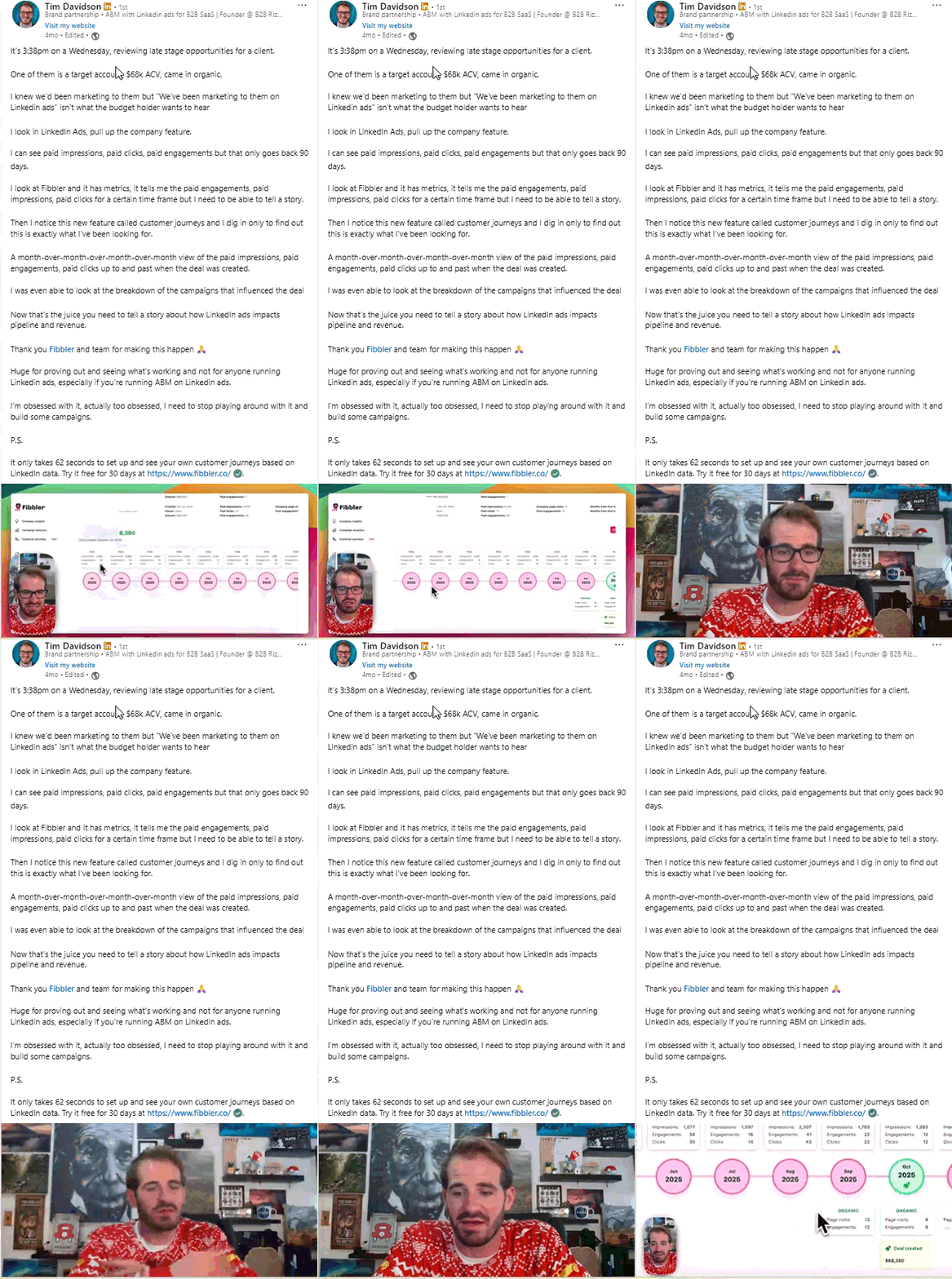
That one insight, seeing LinkedIn’s influence on a deal that would otherwise be credited to organic alone, can justify the entire investment.
Some common questions about cross-channel marketing attribution software:
Cross-channel marketing attribution software tracks touchpoints across channels like LinkedIn, Google, organic, email, and outbound, then maps those touchpoints to deals and revenue inside your CRM.
The goal is to answer which combination of channels influenced a deal, rather than giving all the credit to a single touchpoint.
B2B focused tools like ZenABM, Dreamdata, and HockeyStack do this at the account level by aggregating activity from multiple people inside the same company.
ZenABM starts at $59/month and includes LinkedIn Ads API integration, CRM deal attribution, and cross-channel company timelines.
RB2B has a free tier for person-level website identification, and Dreamdata also offers a free tier for lighter usage.
Among full attribution products that include deal mapping and revenue attribution, ZenABM is the most affordable option in this group.
Usually, yes. Attribution tools like ZenABM, Dreamdata, and HockeyStack map touchpoints to revenue, while visitor identification tools like Vector and RB2B identify the companies or people visiting your site from channels that do not provide company data natively, including Google, organic, and direct.
When you combine the two, you get a much more complete cross-channel picture. Some attribution platforms are adding identification features, but dedicated identification tools still tend to offer stronger match rates.
ZenABM is the best fit if LinkedIn is your primary paid channel. It has the deepest LinkedIn Ads integration in this comparison, including company-level engagement data by campaign and by ad, and historical data storage beyond.
LinkedIn’s 90-day limit, account scoring, ABM funnel stages, CRM sync, and a cross-channel timeline that captures non-LinkedIn touches as well.
At $59/month, it is built for LinkedIn ABM teams that want real attribution without enterprise-level cost or complexity.
Both are strong multi-channel attribution platforms, but they lean in different directions. Dreamdata is more attribution-focused, with visual account journeys, multiple attribution models, and content attribution across channels.
HockeyStack leans more toward GTM intelligence because it adds predictive analytics, account prioritization, and highly flexible dashboards on top of attribution.
Dreamdata has transparent pricing, from free up to $2,499/month, while HockeyStack uses custom pricing.
Both usually need dedicated ops support for proper setup and maintenance.
If your main need is attribution, Dreamdata is usually the cleaner fit. If you want attribution plus sales intelligence, HockeyStack is stronger.
