



Polished B2B ads often look expensive and feel forgettable.
The selfie ads on LinkedIn that win in 2026 do the opposite: they look like a real person had a real opinion and got behind a small budget to share it.
This post covers what selfie ads on LinkedIn actually are, why authentic LinkedIn ad creative beats overdesigned brand ads in B2B SaaS, how to build them on top of founder-led content, where they fit across the ABM funnel, and how to measure them at the account level instead of stopping at click-through rate.
I will also share the benchmarks I see in my own ZenABM data and the patterns I keep stealing from operators like Ali Yildirim, Philip Ilic and Tim Davidson (all LinkedIn ads experts).

When I say selfie ads on LinkedIn, I mean LinkedIn ads that use real human creatives instead of polished brand visuals.
The format matters less than the feeling it creates in the feed.
In practice, that looks like:
A selfie ad is not automatically good because it is informal.
It works when the person is credible, the message is sharp, and the audience’s pain is specific.
An informal photo with corporate copy underneath it is still a brand ad regardless of the creative format.

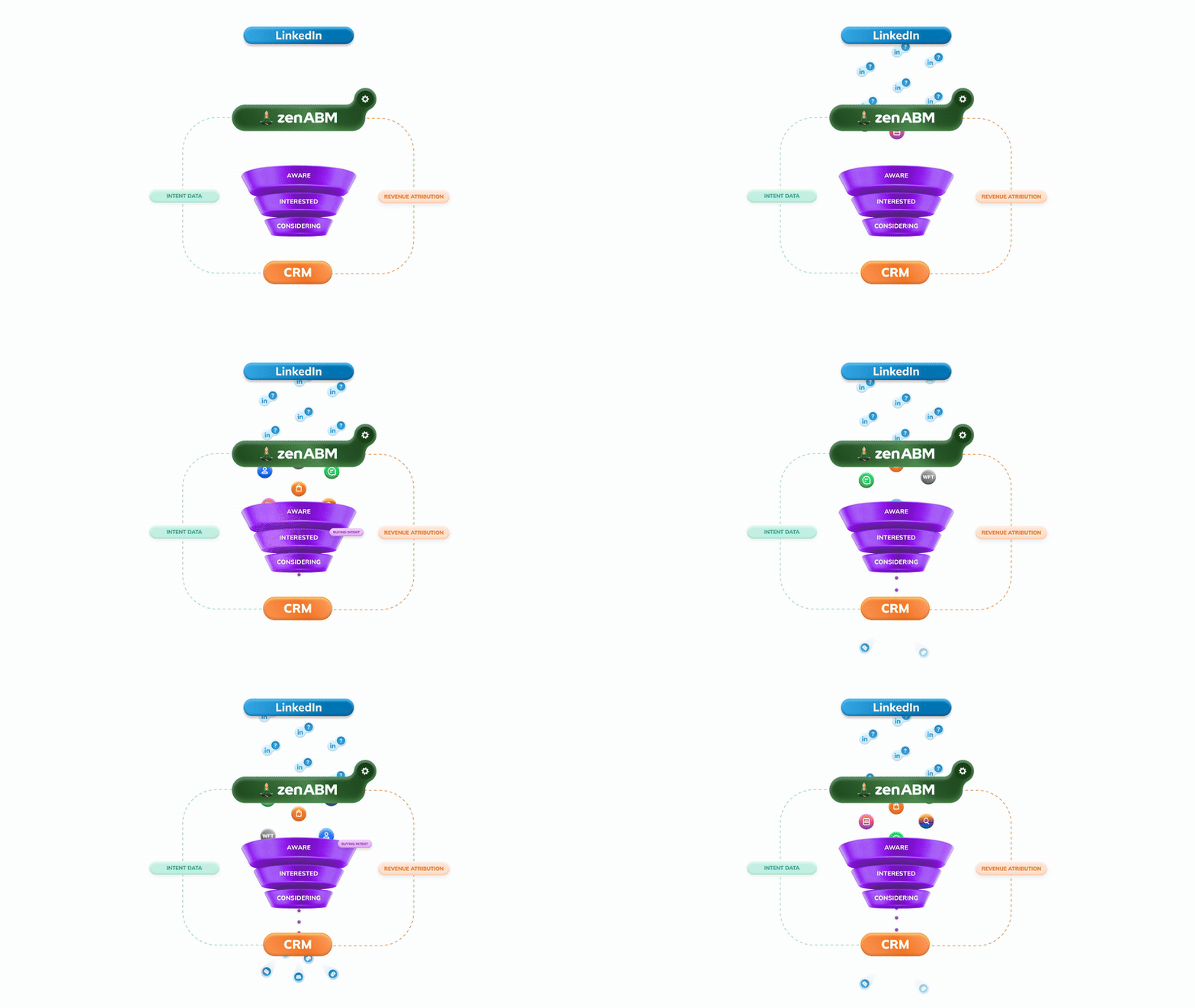
The LinkedIn feed is a stream of people, posts, comments and lessons, which means brand ads have to compete with that context rather than with each other.
When a polished image ad shows up next to a founder explaining how they lost a deal, the brand ad is the one that gets scrolled past because the brain processes it as an interruption rather than content.
Authentic LinkedIn ad creative works for a few reasons that I see consistently across my own ad accounts:
The benchmarks I see in ZenABM’s LinkedIn ABM benchmarks data back this up clearly.
Thought Leader Ads sit at a 2.68% median CTR and a $2.29 median CPC.
Single image ads run at 0.42% CTR and $13.23 CPC.
Video runs at 0.24% CTR and $15.61 CPC.
The format that looks the most like content is by far the most efficient, which means the creative decision is also a budget decision.

Ali Yildirim at Understory summed up the same pattern from his agency’s own LinkedIn ad accounts in his LinkedIn post:
“One client was burning through budget at $40 per click on image ads targeting C-suite marketers. Switched the same budget to thought leader posts from their CMO. CPCs dropped to below $10. Same audience, same message, different format. The bigger lesson is that ad format matters more than most people realize.”
The mistake I see most often is treating selfie ads as a creative idea when they are actually distribution for content that already exists, or that should exist before any campaign brief gets written.
If you are running a niche B2B SaaS product with a small budget and very few people typing your category into Google, paid search will not save you because the demand is not there yet.
You have to create awareness and trust before the buyer is in market, and founder-led content is the cheapest way to do that because the founder has the perspective, the scars and the authority that no marketing manager can manufacture from a content brief.
That is why my own ad strategy starts with content rather than creative briefs.
The flow looks like this:
Ali Yildirim at Understory describes the same loop after spending hundreds of thousands of dollars on this format in his LinkedIn post:
“When an organic post performs well, we wait for the natural engagement to slow down, then sponsor it. Your organic posts become free market research. High performers turn into paid campaigns. Low performers save you from wasting ad spend. The whole system creates a feedback loop that compounds over time.”
This is also why I lean on Thought Leader Ads as the default selfie ad format.
The post comes from a real person, the engagement is real, and the social proof shows up on the ad itself rather than being manufactured in a design tool.

The second mistake I see is what I call performative authenticity.
Founders post a phone selfie with a generic line about “the journey” and expect it to convert, but authenticity only gets attention when a clear Job to Be Done makes the message worth acting on.
Without that anchor, the reader feels the warmth and keeps scrolling.
Before I write any selfie ad, I write down the job the buyer is trying to get done, and the creative has to map to that job in plain language that the buyer would use themselves.
A few examples that have been used at ZenABM, or I have watched work in practice:
Each of those works because there is a real reader on the other side who has tried to do that exact job and felt the friction.
The selfie carries the message, and the message carries the buyer through to the click.
If you are still mapping out the strategy layer, our running ABM on LinkedIn guide walks through how I think about audience, creative and stages together so the JTBD mapping does not stop at the ad level.
Not every selfie ad has to be a literal selfie.
Here are the formats I keep coming back to, along with where each one earns its place in an ABM program.
Best for category education, contrarian takes and trust-building at the top of the funnel.
The format is simple: a phone photo of the founder, a hook in the first 150 characters, and a story or framework underneath that delivers real value before the reader decides whether to click.
This is the cheapest way to introduce a niche category to people who have never searched for it because the founder’s face does the credibility work that a logo cannot.

The native format for selfie ads on LinkedIn, because you boost an existing organic post from a real person’s profile and the engagement and comments carry forward into the paid distribution.
As per ZenABM’s data, 65% of the top-performing TLAs use first-person “I” voice and 75% place the link in the bottom 25% of the text.
They are also 77% cheaper per landing page click than single image ads, which makes them the default choice for almost any budget level.

A real customer photo, quote or short story used as the ad itself, which is what most case study ads should look like and almost never do.
A slightly blurry phone photo of a customer at a conference with a quote about a workflow they fixed beats a designed quote card every time, because the imperfection signals that the story is real rather than manufactured.
The best one, though, is always a small, laid-back interview clip.
Event photos, team build moments and product build-in-public updates work best for relatability and demand creation because they tell the buyer there are humans behind the product who care about the same problems they care about.
This format is especially effective in the early stages of account warming when the goal is familiarity rather than conversion.
A founder or practitioner explaining one specific problem in plain English in under 90 seconds, with no studio and no b-roll.
Philip Ilic (LinkedIn ads expert) described this format well when explaining his warmbound play in his LinkedIn post:
“Run video Thought Leader Ads (simple Loom-style videos, not polished stuff). The goal is to become familiar. Let them hear your voice, see your face, and recognise your name before you show up in their inbox.”
Here’s an example of a casual selfie that one can boost as an ad before doing more targeted and sophisticated marketing:

A screenshot of a LinkedIn post, a customer Slack message, a dashboard or a workflow used as the ad image, paired with a hook that gives context and a clear takeaway.
This format works because the asset already looks like content the reader has seen before, which means the brain processes it as information rather than as an ad.

I have built a short checklist that I run through before pushing any selfie ad live.
If the creative does not pass most of these, I send it back for a revision rather than letting spend run on a weak execution.
Tim Davidson, who runs B2B Rizz and obsesses over creative quality, made a similar point about how trust compounds on LinkedIn in his post:
“Linkedin impressions decreased 58% year over year. Which sucks because 99.381% of my new business comes from LinkedIn. Yet, my business actually grew 45%. The posts have gotten better which drove more business.”
The lesson I take from that is that better posts beat more impressions, and the same logic applies directly to paid creative.
A smaller volume of sharp selfie ads will out-pull a flood of polished banners because the quality of engagement compounds in a way that impression volume does not.
The reason a lot of selfie ads flop is not that they are too informal. It is that they are informal in the wrong way, which strips the format of its only real advantage without replacing it with anything the reader values.
The pattern I see when an authentic creative does not work usually includes one or more of these:
The most common one in my experience is the last one.
Teams launch a great founder ad, get strong CTR, and never look at which companies actually clicked.
Six weeks later, they cannot tell whether the campaign warmed up the right accounts.
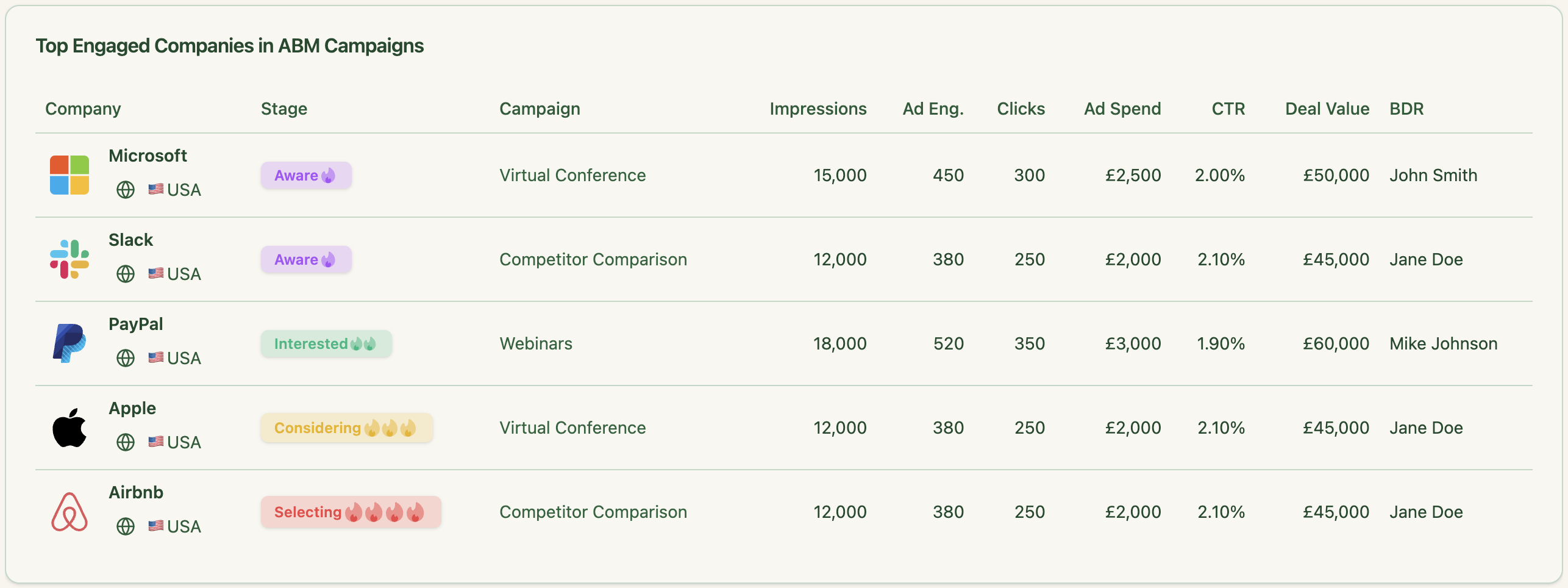
To fix that, you have to see which companies engaged with each LinkedIn ad at the company level, not just how many clicks the campaign generated overall.
ZenABM can help you with that.
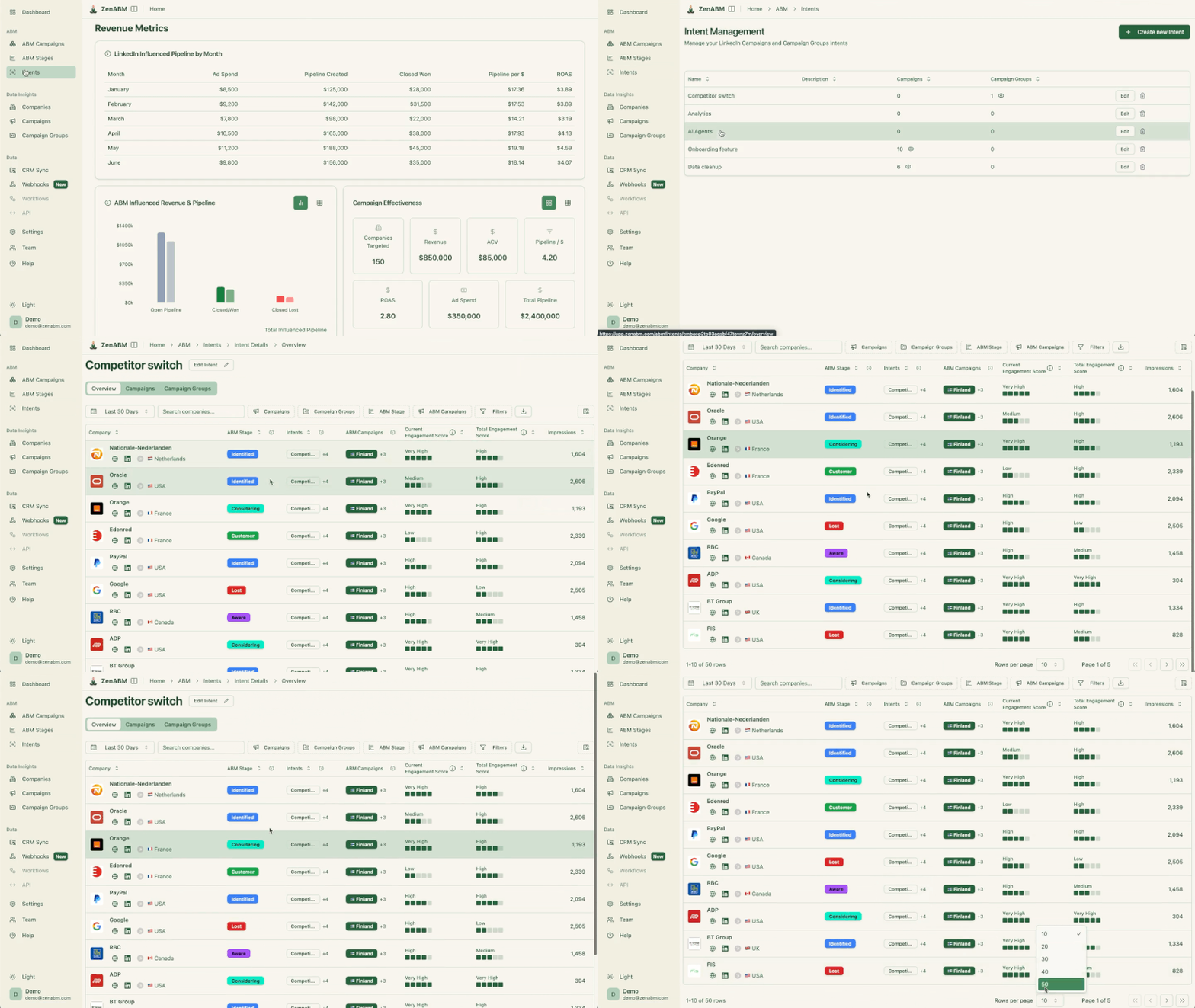
ZenABM pulls company-level ad engagement data for each ad creative from LinkedIn’s official ads API, calculates engagement scores, and determines the ABM stage for each account.



This is the playbook to roll out authentic LinkedIn ad creative without having a full content team:
Ali Yildirim at Understory shared a clean example of this loop ending in a $120K contract in his LinkedIn post:
“We just closed a $120K ACV contract with a publicly traded company off $2,035.17 in spend on a Thought Leader ad. Most people think success with Thought Leader ads comes down to budget or optimization tricks. That’s not where this gets won or lost. Good content. Precise targeting. Clean tracking.”
Selfie ads are not only a top-of-funnel tool.
They can support every stage of the ABM funnel as long as the message matches the stage and the CTA matches what you can reasonably ask the account to do given how much it knows about you.
Here is how I split them.
Founder POV, relatable pain and category education with a CTA to read, watch or learn.
The goal is to build name recognition with target accounts before they are ready to talk, which is why I lean on Thought Leader Ads most heavily here.
The cost per impression is low and the format does the warming up without requiring the account to commit to anything.
Founder or customer proof, case study moments, product lessons and practical frameworks, with a CTA along the lines of “see how it works,” “view the example” or “read the benchmark.”
The accounts in this layer have already been touched by cold awareness content, so the creative can get more specific about the problem being solved and the method being used to solve it.
Trust-building from the founder or executive sponsor, implementation proof, customer proof and risk reduction, with a CTA to book a demo, talk to the team or see the ROI.
Selfie ads still work at this stage because the buyer wants to see that there are real people on the other side of the contract before they commit.
If you want a deeper view of how to structure LinkedIn ABM campaigns across these stages, that breakdown pairs well with the framework above.
| Stage | Selfie ad angle | Format | CTA |
|---|---|---|---|
| Cold awareness | Founder POV on a category problem | TLA, founder selfie image ad | Read, watch, learn |
| Warm consideration | Customer proof, practical framework | TLA, video selfie, doc ad | See how it works |
| Bottom of funnel | Founder or executive trust signal | Founder video, customer-style image | Book a demo |
Most teams stop at CTR, CPC, likes and comments, which works fine for direct response on a platform like Google Search, but is not enough for ABM, where the goal is to move specific companies through stages rather than to generate a page of aggregate engagement numbers.
What I track instead, in this order:
ZenABM helps you track all of the above metrics:


Selfie ads on LinkedIn are not a creative hack. They are a distribution strategy for perspective that already has proof.
The format works because it bypasses the ad-resistance that kills most brand creative in the LinkedIn feed. But the format alone does not close the pipeline.
What closes the pipeline is a message tied to a real buyer job, distributed to the right accounts, and measured at the company level rather than at the aggregate click level.
The playbook is the same regardless of your budget. Interview the founder, find the posts that attract the right ICP, boost the winners as Thought Leader Ads, and track which target accounts engaged with each creative rather than stopping at CTR.
If you are running LinkedIn ads as part of an ABM program and you cannot currently see which companies engaged with each ad, which personas inside those accounts clicked, or how that engagement maps to stage movement, ZenABM closes that gap.
It pulls company-level engagement data directly from LinkedIn’s official ads API and connects it to the pipeline so every selfie ad you run has a business answer attached to it, not just a media answer.
Start your free 37-day trial of ZenABM and see which accounts your selfie ads are actually warming up, or book a demo with us to know more!
No. Selfie ads work across the full ABM funnel because the hook and the CTA change by stage even when the format stays the same. Cold awareness selfie ads use a soft CTA like “read this” to build familiarity before asking for anything. Bottom-of-funnel selfie ads from a founder or customer can drive demo bookings because they reduce the perceived risk of committing to a conversation at the moment of decision.
Two things. First, treat the post itself as the primary asset rather than the photo, and spend the bulk of your time on the hook, the story and the takeaway. Second, tie the creative to a clear Job to Be Done so the reader gets value even before they click. A phone photo with a sharp opinion that solves a real problem always beats a studio photo with generic copy, because the problem-solving is what earns attention and trust.
This is exactly where they perform best. If no one is searching for your category yet, paid search will not save you because the demand simply does not exist to capture. Founder-led content and authentic LinkedIn ad creative create awareness and trust before the buyer is in market, which is why this format is so common in SaaS ABM strategies for niche tools that are defining a category rather than competing in one.
Track target accounts reached, target accounts engaged, engagement by persona inside each account, stage movement and pipeline influenced. Campaign Manager will not show you most of that data because it aggregates across all audiences rather than filtering to your ICP. ZenABM shows which companies engaged with each ad, how they moved between funnel stages, and how that engagement connects back to revenue so the measurement layer matches the ABM strategy layer.
Fewer than you think. I would rather run 3 to 5 strong selfie ads tied to specific JTBDs than 15 versions of the same post with different photos, because volume hides what is working while a small set of clear creatives makes it easy to see which POV resonates with which segment of your target accounts. The signal-to-noise ratio is what drives learning, not the number of active creatives.
