

©2026 ZenABM - All Rights Reserved.

Most teams kill their LinkedIn cold awareness campaigns three weeks in, then complain that LinkedIn does not work for ABM.
The campaigns did not fail.
The expectations did.
The pattern repeats consistently across B2B SaaS teams: cold campaigns get measured like lead gen campaigns, the numbers look bad on day 14, and good campaigns get switched off before the awareness ever compounds.
This guide covers what LinkedIn cold awareness campaigns are actually for, how to measure them at the account level, the ad formats that work in 2026, and how to move warmed accounts from awareness into the pipeline.
Short on time?
Here’s a quick rundown:

A LinkedIn cold awareness campaign is a paid campaign aimed at accounts and personas that have not yet engaged with a brand in any meaningful way.
In ABM, cold means cold by relationship, not by relevance, which is a distinction worth keeping in mind when setting expectations for what these campaigns should produce.
The audiences most commonly used for cold awareness on LinkedIn come from one of these sources:
The most common setup mistake is treating LinkedIn Audience Expansion as a shortcut.
For ABM, the platform should not be allowed to decide the ICP.
The whole point of cold awareness is to control which companies are receiving impressions, not to maximize cheap reach at the cost of account fit.
Cold awareness sits at the front of the ABM funnel.
In the ZenABM LinkedIn ABM playbook, three early stages define the funnel: Identified, Aware, and Interested.

Cold awareness campaigns are responsible for the first two, and they reveal which accounts are ready for the third.
The thresholds used by default inside ZenABM are:
Without per-company visibility into those numbers, it is impossible to tell whether a cold awareness campaign is working.
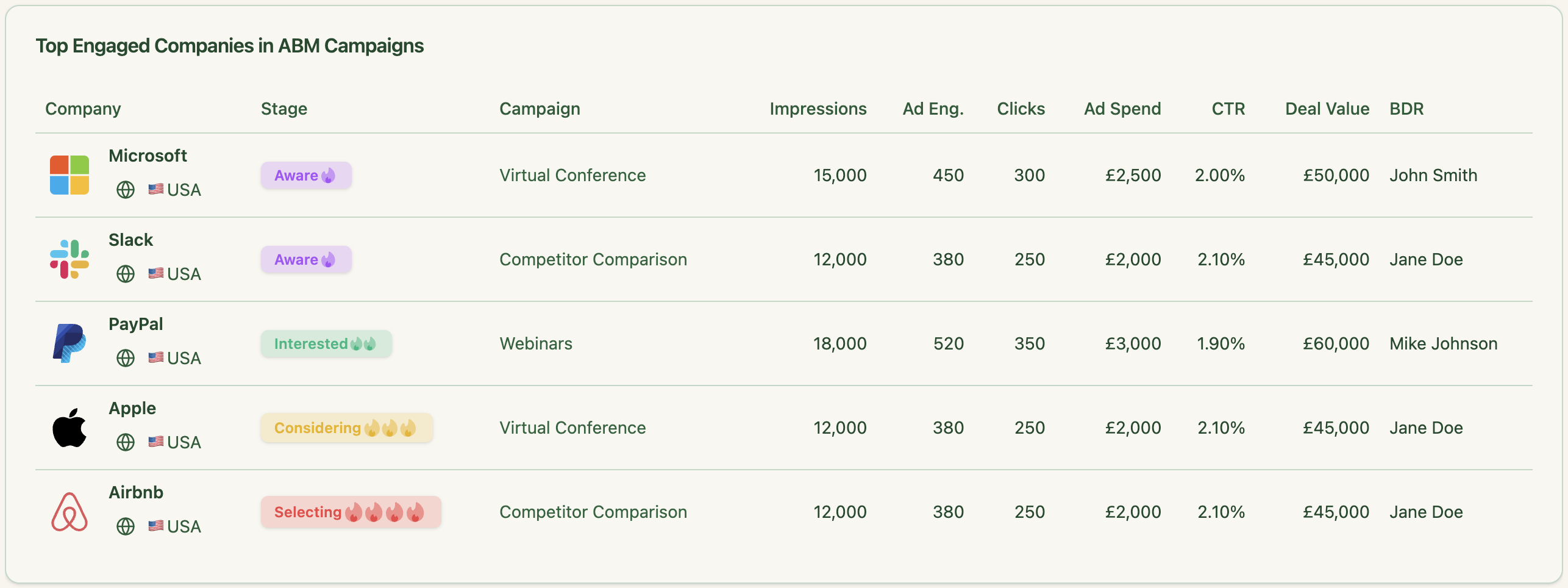
Campaign Manager will show aggregate clicks, but it will not show that out of 800 target accounts, 312 are now Aware and 41 are Interested.

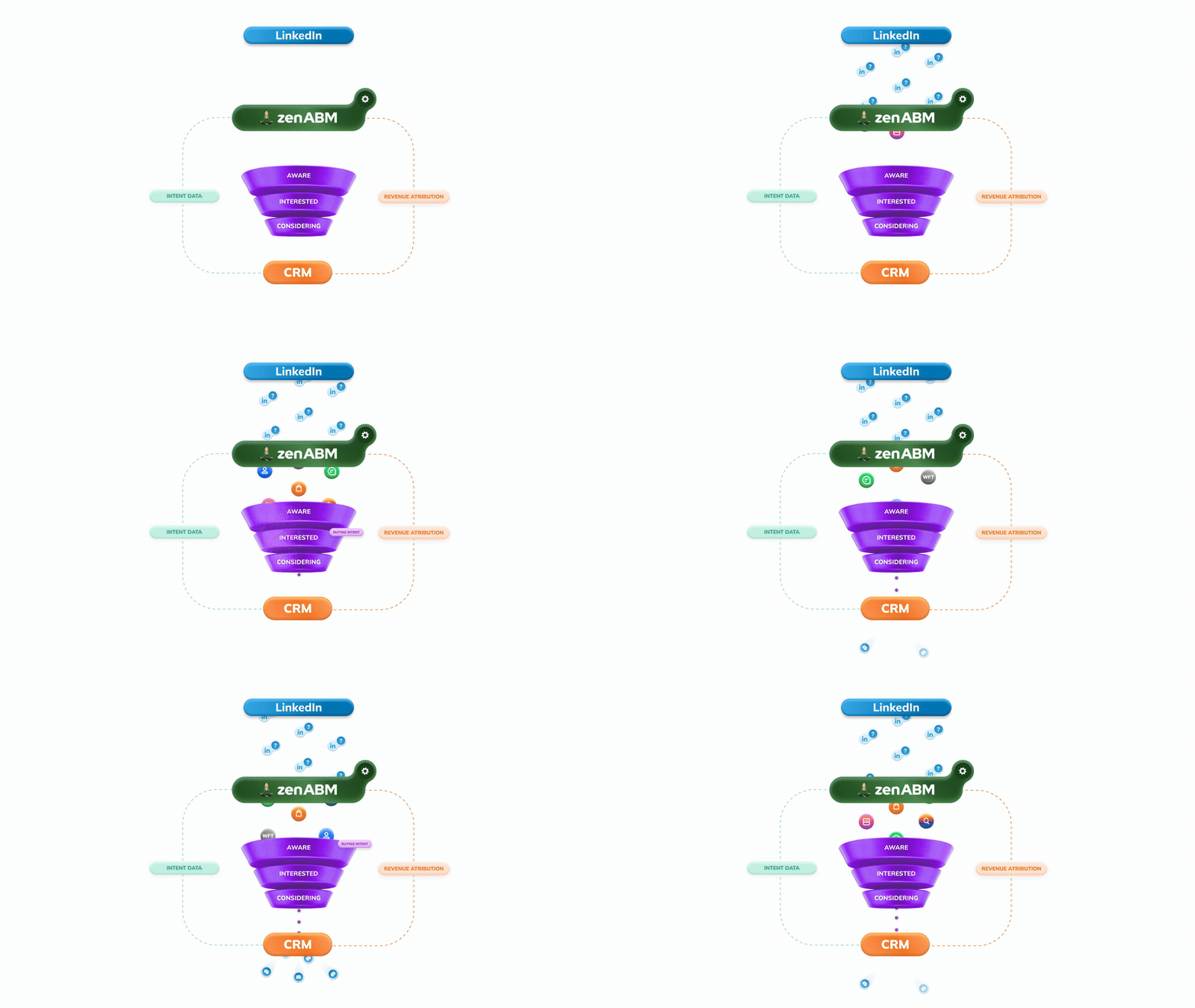
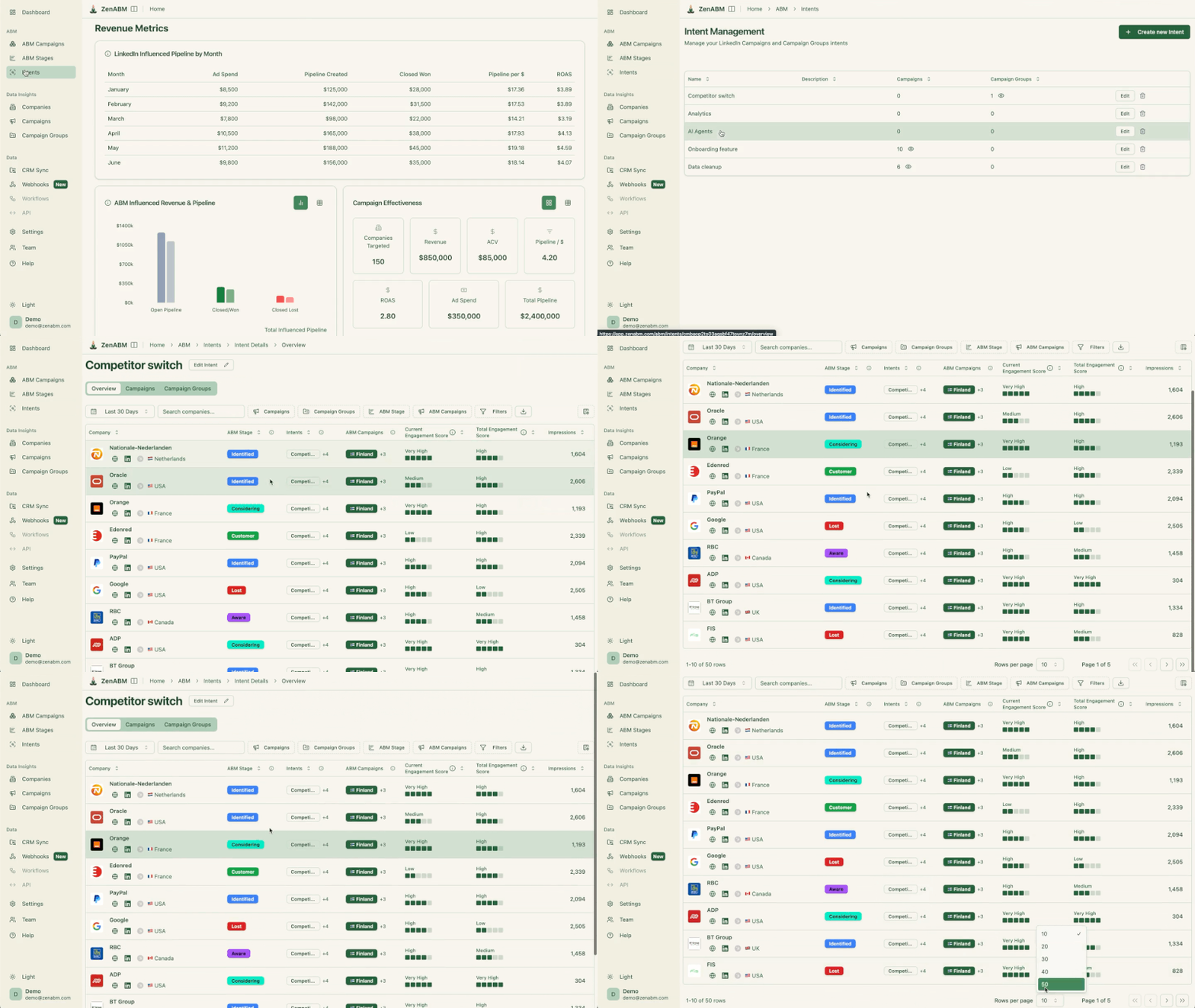
ZenABM, on the other hand, pulls company-level ad engagement data for each creative and combines it with data from your own CRM to finally give engagement scores (current and lifetime) and account ABM funnel stage (current and lifetime).


“LinkedIn ads are rarely instant. With a recent client in Month 1 we got 2 cold SQLs. Month 2: a few more trickled in from retargeting. By month 3-4, things started to click. Most of the magic happens in months 3-6 onwards.”

That timeline is exactly why measuring cold awareness against a 14-day demo window produces the wrong conclusion.

Cold awareness campaigns are still routinely judged by the same KPIs as retargeting campaigns aimed at warm accounts, and that comparison is never going to look favorable.
Cold awareness should not be measured primarily by:
The reasons are practical rather than philosophical.
Most cold accounts are not ready to buy, LinkedIn CPCs are high relative to other channels, and B2B buying committees need repeated exposure to a problem before anyone raises their hand.
ABM works at the account level, not the lead level, which means the right measurement unit is accounts moving through stages, not individual clicks converting to forms.
Expecting cold awareness campaigns to produce cheap demos immediately leads to one of two bad outcomes: good campaigns get killed too early, or teams optimize toward whatever low-quality leads happen to convert, which almost always means non-ICP accounts and tire-kickers.

The format priority for cold awareness in 2026:
The data behind that ranking comes from the LinkedIn ABM Benchmarks Report from ZenABM, covering 161,256 ads, 211 companies, 29 countries, and $5.5M in ad spend.
Median LinkedIn ABM performance across that dataset is a 0.69% CTR, $11.04 CPC, and $78.30 CPM. Format-level numbers tell a clearer story:
| Ad Format | Median CTR | Median CPC | Median CPM | Best For |
|---|---|---|---|---|
| Thought Leader Ads | 2.68% | $3.06 | $82.14 | Cold awareness, value |
| Single Image | 0.42% | $13.23 | $59.15 | Scalable reach |
| Carousel | 0.49% | $11.28 | $52.36 | Step-by-step stories |
| Document | 0.52% | $13.04 | $62.06 | Educational engagement |
| Video | 0.24% | $15.61 | $38.94 | Reduce; usually overspent |

TLAs are the recommended starting point for any brand that has a credible founder, expert, or practitioner posting on LinkedIn.
They are the cheapest way to buy attention from cold ICP accounts because they feel native, carry personal credibility, and get rewarded by the LinkedIn algorithm in ways that branded ad units do not.
The benchmark data confirms this. TLAs delivered a 2.68% median CTR against 0.42% for single-image ads, which works out to roughly 77% cheaper per click and a much higher probability that any given target account on the list will actually see and engage with the post.

The Valueships case study makes the gap even starker.
Their TLAs generated 169,571 impressions, 18,113 clicks, and 2,669 landing-page clicks, hitting a 10.68% CTR, a $2.31 CPM, and $0.15 cost per landing-page click.
TLAs drove 83% of all website clicks while using only 6% of the total ad budget, and the campaign booked 12 meetings from cold in under two weeks.
The full breakdown is in the Valueships TLA case study.
What works inside TLAs for cold awareness:

What kills TLAs for cold awareness: corporate “we” voice, hashtag spam, generic motivational content, and webinar CTAs as the only offer.

Once TLAs are in market, a single image ad layer is in for scale.
They are the workhorse for testing pain-point hooks, diagrams, benchmarks, and offer angles across a wider account list, because iteration is faster and cheaper than with video or carousel.
What works in single-image ads for cold awareness:
Single-image ads can also be used to retarget warm accounts with clearer product angles, but for cold awareness, their primary job is reach, combined with pain-point validation.
If a single image ad generates clicks from a meaningful slice of the target account list, that hook is worth recycling into TLA and document ad formats.

Document ads work for cold audiences when the document is genuinely useful rather than a disguised brochure. Cold accounts will not open a thinly veiled product pitch, which means the bar for what qualifies as a document offer is high.
What works as a document offer:
The useful secondary effect of document ads is that the document itself becomes intent data. If an account opens a document on LinkedIn ad attribution, that is attribution intent.
If they open a benchmarks report, that is planning intent.
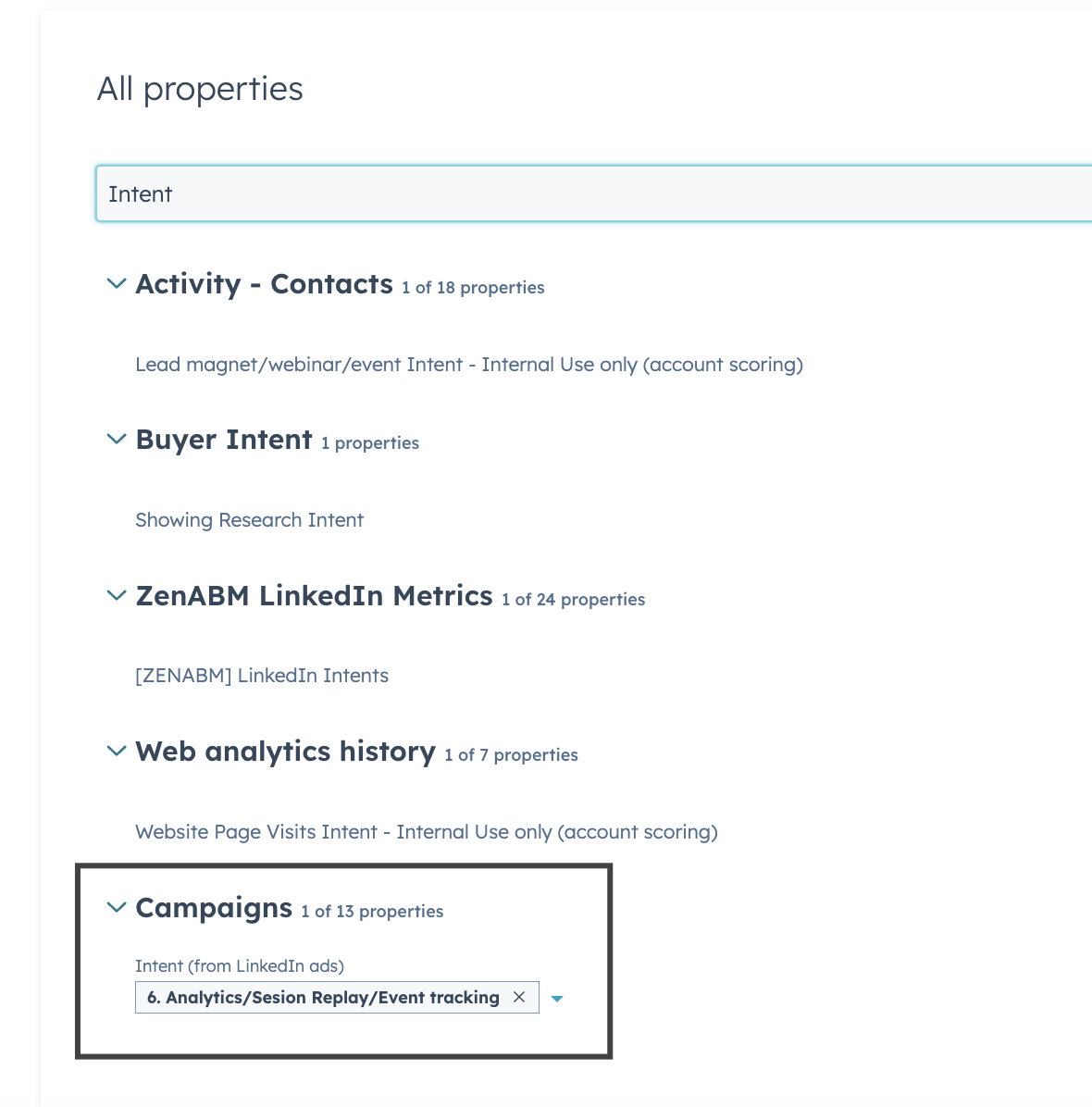
When document campaigns are tagged by intent theme, every engagement communicates something actionable about that company’s current priorities.
Inside ZenABM, those theme-level engagements get pushed into the CRM as intent signals for ABM.

Video has a reputation problem in LinkedIn ABM.
Teams assume it is the strongest awareness format because it feels engaging, but the benchmark data does not support that assumption at the budget allocations most teams use.
In ZenABM’s dataset, video received 31.72% of the total ad budget but delivered the lowest median CTR at 0.24% and the highest median CPC at $15.61.
Video can work for short founder clips, native-feeling explanations, product walkthrough snippets, and event teasers. It does not work as the default cold awareness workhorse, which is how most teams treat it.
“LinkedIn CPCs jumped to $40+ on multiple accounts in early October. Happened fast. We saw it across several clients. Cybersecurity, sales tools, martech. Same pattern showing up. Image ads became prohibitively expensive.”
That cost spike makes the case for TLAs even stronger and for video even weaker.
Test video selectively, cap the budget share well below 30%, and reallocate toward TLAs and single image ads where the same audience and message will perform better per dollar.

Carousel ads belong in step-by-step education, framework explainers, before-and-after narratives, and multi-part stories where each frame genuinely advances the argument.
They should not be used to make a normal image ad look more complex without adding substance.
In the Valueships case study, carousel ads underperformed TLAs by an order of magnitude: 0.47% CTR, $55.38 CPM, and $11.69 CPC against TLAs at 10.68% CTR, $2.31 CPM, and $0.15 per landing-page click.
The format can earn its place, but it needs content that genuinely requires multiple frames to deliver the message.
When starting a fresh LinkedIn ABM program, the recommended order for building the cold awareness layer is:
Stopping at CTR and CPC is the most expensive measurement mistake in LinkedIn ABM.
Those numbers show whether the creative is working in aggregate, but they do not show which target accounts are warming up, which is the only information that matters for ABM execution.
The metrics worth tracking for cold awareness:
Campaign Manager delivers aggregate clicks and impressions.
ZenABM shows the company-level engagement behind those numbers, tracking which specific accounts hit the Aware and Interested thresholds, and making the difference between guessing at funnel progress and actively managing it.


The starting point is always the ICP and the named account list, not broad targeting.
The strongest cold awareness audiences combine firmographic and persona filters on top of a defined account list, because that combination keeps every impression inside the ICP while still reaching the full buying committee at each target company.
Audience source priorities:
Firmographic filters worth applying: company size, industry, geography, revenue or funding stage, tech stack, and growth signals. Persona filters: job function, seniority, titles, and department.
LinkedIn Audience Expansion should be avoided in tightly controlled account-based campaigns because it defeats the core purpose of the targeting exercise.

The trade-off is straightforward. Too narrow means weak delivery, high CPMs, and slow learning because the algorithm cannot find enough daily opportunities to serve ads.
Too broad means wasted spend on bad-fit accounts that will never convert.
For ABM, the answer is broad enough to reach the full buying committee, narrow enough to stay inside the ICP account list.
The default structure to follow:
Cold audiences do not care about the product yet. They care about whether the brand understands their problem well enough to be worth paying attention to. Cold awareness creative should lead with:
What to avoid in cold awareness creative: “Book a demo,” generic feature lists, polished brand claims, “we are the #1 platform for X,” and product screenshots without context. Cold awareness hooks that perform well include:
Soft CTAs consistently outperform hard demo CTAs at the cold stage, because the ask is proportionate to the relationship that exists at that point.
The CTAs that perform best in cold awareness include:
Demo CTAs belong in warmer retargeting once an account has shown repeated engagement, on smaller strategic account lists, or in industries with very short consideration cycles.
A demo CTA on a truly cold ICP account is asking for too much too soon and typically produces either very low conversion rates or very low-quality conversions.
Keeping the cold awareness structure clean enables theme-level engagement to be reused as intent data downstream, which is the reason to care about campaign structure beyond organizational tidiness.
The recommended default:
The benchmark dataset provides a useful starting reference.
Median LinkedIn ABM monthly spend across the 211 companies in ZenABM’s dataset is $2,693.
The top 25% by pipeline per dollar spent run at $6,576 per month. Median target account list size is 6,423 per month, with median ad volume of 312 ads across 16 campaign groups and 44 ad sets.

The simple planning logic for cold awareness budget:
Worked example:
The practical catch is that LinkedIn does not distribute impressions evenly across accounts.
Without account-level monitoring, some companies get overserved while others receive almost nothing, which is exactly the gap that impression-by-company reporting inside ZenABM was built to close.
Cold awareness campaigns should be always-on for strategic segments, because the awareness compounds over time rather than delivering in a single burst. The creative, however, should not stay static.
The recommended pattern:
“Not LinkedIn sneakily rolling out frequency capping to other optimization goals. Just noticed it’s now an option for the reach optimization goal rather than just awareness. Also, do not choose 30 impressions for 7 days, that’s CRAZY.”
Frequency control matters more than most teams admit.
Too low, and the awareness never compounds into recognition.
Too high and goodwill gets burned before the account is ready to engage, which pushes the Aware-to-Interested conversion rate down precisely when it should be climbing.
Cold awareness is wasted if there is no clear trigger for what happens when an account warms up. Having the triggers defined before the campaign launches ensures that engaged accounts flow into the right next stage automatically, rather than sitting in cold campaigns indefinitely.
The recommended triggers are:
What happens after an account warms up:
Based on the analysis of LinkedIn ABM programs covered in our guide on moving accounts from Aware to Considering, ads alone can move some accounts, but the most effective approach combines ads, outbound, and events.
Adding signal-based outbound to an ads-only program typically increases the Aware-to-Considering conversion rate by 30 to 50% across the programs in ZenABM’s data.
“Thought leader ads + email + convo ads work super well in unison. When you push Thought Leader ads and you nurture and show content about who you are, what you do, why you are different, people see your profile image over and over. Once they are warmed up with the TL ads and they get a convo ad from the same profile or an outbound email with the same profile picture there should be some recognition to it.”
One impression is not intent.
Repeated account engagement is. BDRs can use cold awareness data to prioritize accounts, choose outreach timing, reference relevant pain points, select the right persona to reach out to, and avoid completely cold messaging that ignores available context.
An outreach angle that works well:
“I noticed your team has been engaging with our content around LinkedIn ad attribution. Usually, that comes up when marketing teams are trying to understand which accounts are engaging and which campaigns are actually driving pipeline.”
What does not work is creepy personalization.
Saying “I saw you clicked our ad” crosses a line that most prospects find uncomfortable and that undermines the credibility the awareness campaign was building.
Framing the signal at the account or topic level keeps the outreach feeling informed rather than surveilled.
The engagement data should inform the BDR’s choice of angle, not become the angle itself.
Here, ZenABM can help.
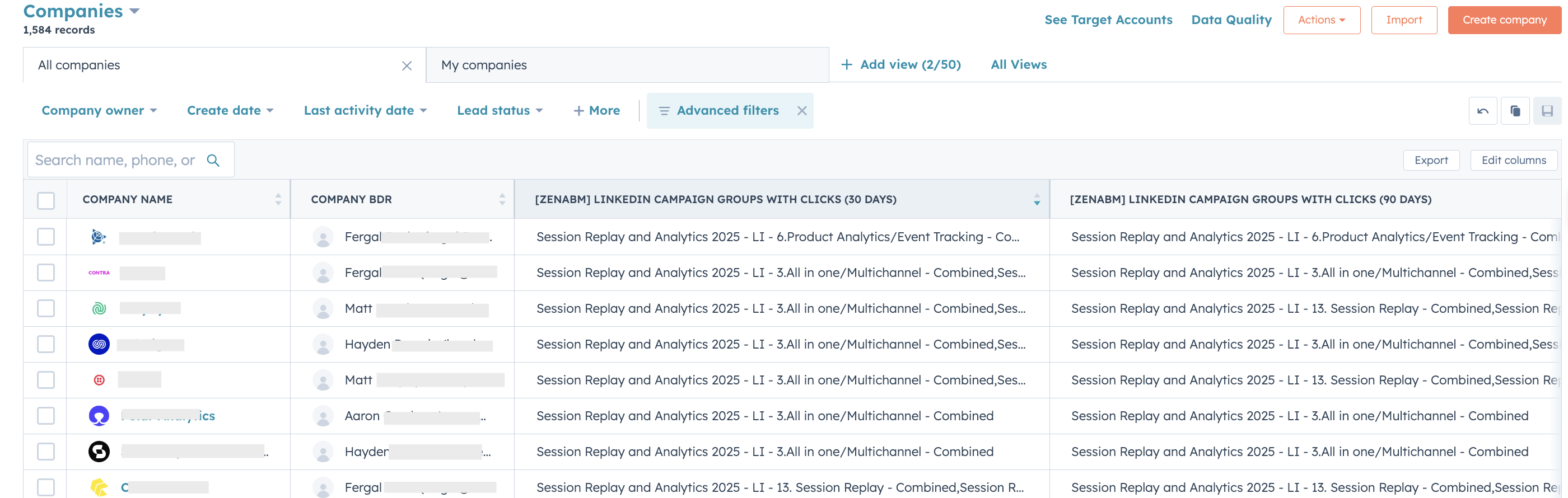
It tracks company-level engagement for each ad creative and theme (i.e., qualitative intent) and pushes it to your CRM, and also assigns hot accounts of the BDRs in your CRM for timely outreach.
The patterns that appear most often when auditing a LinkedIn ABM program that is underperforming:
Cold awareness is a compounding investment, not a 14-day experiment.
The accounts that eventually book demos, respond to BDR outreach, or show up as high-intent signals in your CRM almost always have 8 to 12 prior touchpoints behind them, most of which look like “no conversion” in Campaign Manager.
The practical takeaway from everything covered here:
The teams that get LinkedIn ABM right are not running better creative than everyone else.
They are measuring differently at the account level, by stage, by theme and making decisions based on which companies are actually warming up rather than which ad had the best click rate last week.
If you want visibility into which target accounts are reaching Aware and Interested thresholds, and which ones are ready for BDR outreach, ZenABM pulls company-level engagement data directly from the LinkedIn API and maps it to ABM stages automatically.
Start a free 37-day trial or book a demo to know more!
A LinkedIn cold awareness campaign is a paid campaign that targets accounts and personas that have not yet engaged with a brand. In ABM, its job is to move accounts from Identified to Aware and reveal which ones are ready to become Interested. It should not be judged by demo requests in the first 30 days.
Track account reach, impressions per company, frequency by account, engaged accounts, theme-level engagement, and stage movement. Aggregate CTR and CPC are not enough. Tools like ZenABM expose company-level engagement behind the Campaign Manager numbers.
Thought Leader Ads. ZenABM’s benchmark dataset shows TLAs at 2.68% median CTR and $3.06 CPC against 0.42% and $13.23 for single image ads, with the Valueships case study showing TLAs driving 83% of website clicks on 6% of budget.
Median LinkedIn ABM spend in ZenABM’s dataset is $2,693 per month, with top performers at $6,576 per month. A simple planning rule: number of target accounts times target impressions per account, multiplied by expected CPM divided by 1,000. For 1,000 accounts at 50 impressions each at a $60 CPM, that is roughly $3,000.
The recommended thresholds are 50 or more impressions to qualify as Aware, and 5 or more clicks or 10 or more engagements to qualify as Interested. Engagement with a bottom-of-funnel theme, multiple engaged personas at the same account, or a demo page visit should also trigger a move into warmer campaigns and a BDR alert.
