

©2026 ZenABM - All Rights Reserved.

Maximum delivery is LinkedIn’s default bidding strategy, and that default is costing most advertisers more money than they realize.
It’s the strategy LinkedIn wants you to use, because it spends your budget as fast as possible.
But “fast” and “efficient” are, well, very different things.
That said, writing off maximum delivery entirely would be a mistake.
There’s one specific combination where it actually makes sense, and a few other niche scenarios where it’s the right tool for the job.
The key is knowing the difference.
Based on discussions about bidding strategies with former LinkedIn employees in the ZenABM ABM Bootcamp, this guide will cover all you need to know about LinkedIn maximum delivery bidding.
Short on time?
Here’s a quick overview:


Maximum delivery is LinkedIn’s fully automated bidding strategy.
When you select it (or leave the default unchanged), you’re telling LinkedIn: “Spend my entire daily budget and get me as many results as possible. I don’t care what each result costs.”
Here’s what happens behind the scenes:
The problem is clear: LinkedIn has no incentive to win auctions cheaply.
Its goal is to spend your budget, not to save you money.
Every dollar you “save” on a cheaper auction is a dollar LinkedIn’s algorithm will spend on a more expensive one to exhaust your budget.
Here’s how to set up maximum delivery bidding:

For maximum delivery, the brand awareness objective makes the most sense.
This tells LinkedIn to optimize for impressions rather than clicks or conversions, which aligns with maximum delivery’s strength.
If you use website visits or lead generation objectives with maximum delivery, you’ll pay a premium for each click or lead because LinkedIn bids aggressively in every auction.
Thought leader ads are the ideal format for maximum delivery campaigns.
Their low baseline costs and organic appearance minimize the overpaying risk.
Standard single-image ads with maximum delivery will result in significantly higher CPCs.
Maximum delivery is LinkedIn’s default, so if you haven’t changed anything, you’re already using it.
You can also explicitly select it in the Budget & Schedule section.
This is important. Because maximum delivery spends aggressively, set a daily budget you’re comfortable spending in full every day.
Don’t set aspirational budgets with maximum delivery, because LinkedIn will spend every dollar.
Use this formula as a starting point:
Daily budget = (Target audience size / 1,000) x Expected CPM x Desired daily frequency

For ABM campaigns, estimating your required budget upfront prevents overspending.
This is one place where ZenABM’s ABM budget calculator can help.

The consensus among experienced LinkedIn advertisers is strongly against maximum delivery as a default strategy.
“Maximum delivery… most people don’t like it, myself included. It’s most likely costing you more money than manual bidding.” – Maximillian Herczeg, former LinkedIn employee, Founder at Kamrat
In the ZenABM ABM Bootcamp, experts consistently listed using the max delivery bidding strategy as one of the top 8 ABM mistakes on LinkedIn.
Here’s why:
Maximum delivery consistently produces higher CPCs and CPMs compared to manual bidding.
Without a bid ceiling, LinkedIn’s algorithm has no reason to be efficient.
The 2026 benchmarks show a median CPC of $13.23 for single-image ads, but manual bidding advertisers using the floor-finding technique routinely achieve CPCs 20-40% below that.
Maximum delivery users typically pay at or above the median.
Maximum delivery often burns through your daily budget by midday.
This means your ads stop showing in the afternoon and evening, so you’re missing half your audience’s active hours.
With manual bidding, a lower bid spreads your budget across the entire day.
With manual bidding, you know your maximum cost per click because you set it.
With maximum delivery, your cost per click varies wildly from auction to auction.
You only see the average after the fact, with no ability to control individual auction outcomes.
Maximum delivery reaches your full audience, which sounds good but isn’t always optimal.
Some members of your audience are much more expensive to reach than others (C-suite executives, for example, have more advertisers competing for their attention).
Maximum delivery pays premium prices for these expensive members when manual bidding might have reached them at a lower cost with a well-calibrated bid.
Despite all of this, there are legitimate use cases for maximum delivery.
The key is being intentional about when you use it.
This is the one combination where maximum delivery can genuinely make sense:
“It can work, in my opinion, in combination with thought leader ads and the brand awareness objective.” – Maximillian Herczeg, former LinkedIn employee, Founder at Kamrat
Why this combination works:
In this scenario, maximum delivery gets your thought leader content in front of your full target audience as quickly as possible, at CPMs that are already reasonable due to the TLA format.
If you’re running a time-sensitive campaign, like promoting a webinar that’s in 4 days, or a product launch announcement, maximum delivery speed is an advantage.
Manual bidding’s floor-finding technique needs 2-3 days to calibrate, which eats into a short campaign window.
For bursts, accept the higher cost per result in exchange for guaranteed full delivery within your timeframe.
When you’re entering a new audience segment with no performance data, running maximum delivery for 3-5 days gives you baseline CPM and CPC data.
You can then switch to manual bidding with informed bid levels rather than guessing.
If your daily budget is so large relative to your audience that manual bidding would deliver it all anyway, maximum delivery doesn’t add much additional cost.
This is rare in ABM but can happen with very small target lists and proportionally large budgets.
If you’re running maximum delivery, you need to monitor it more closely than manual bidding because you’ve given up cost control.
Here’s what to watch.
Maximum delivery CPMs and CPCs can creep up over time as the algorithm exhausts the cheaper segments of your audience.
If your CPC is climbing week over week, the algorithm is running out of affordable auction opportunities.
Action: If CPC increases 20%+ over 2 weeks, consider switching to manual bidding or reducing your daily budget to slow delivery.
Maximum delivery can drive high frequency on small audiences.
If the same people see your ad 8-10 times in a week, you’re wasting budget on diminishing returns.
Monitor frequency in Campaign Manager and cap it mentally at 4-5 impressions per week per person for awareness campaigns.
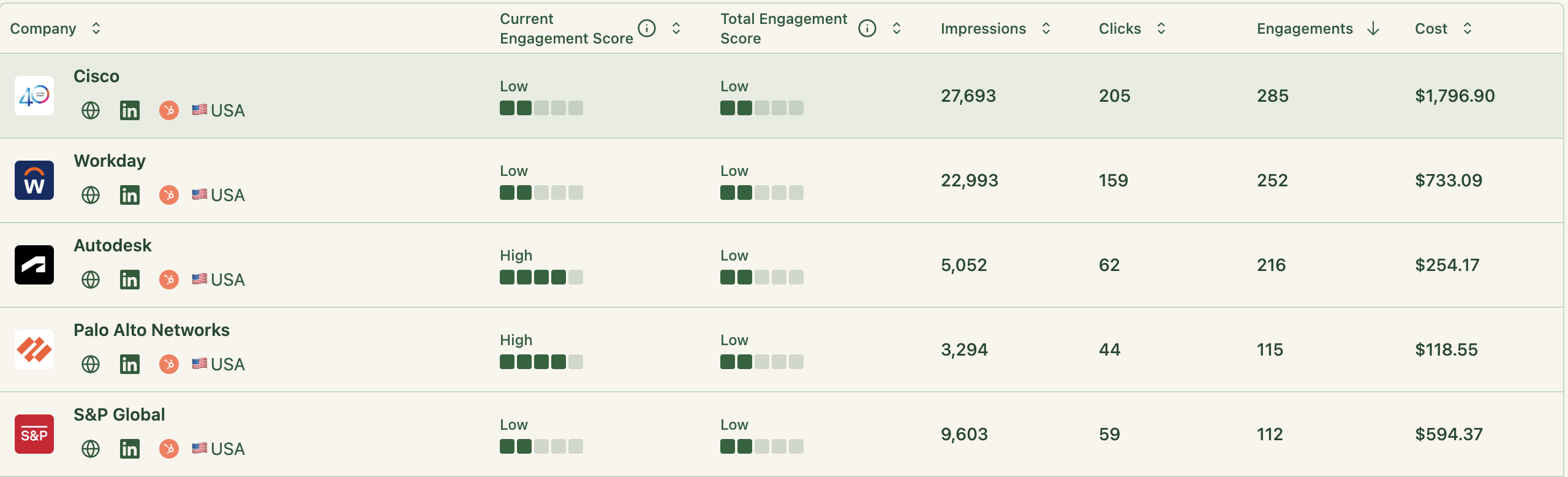
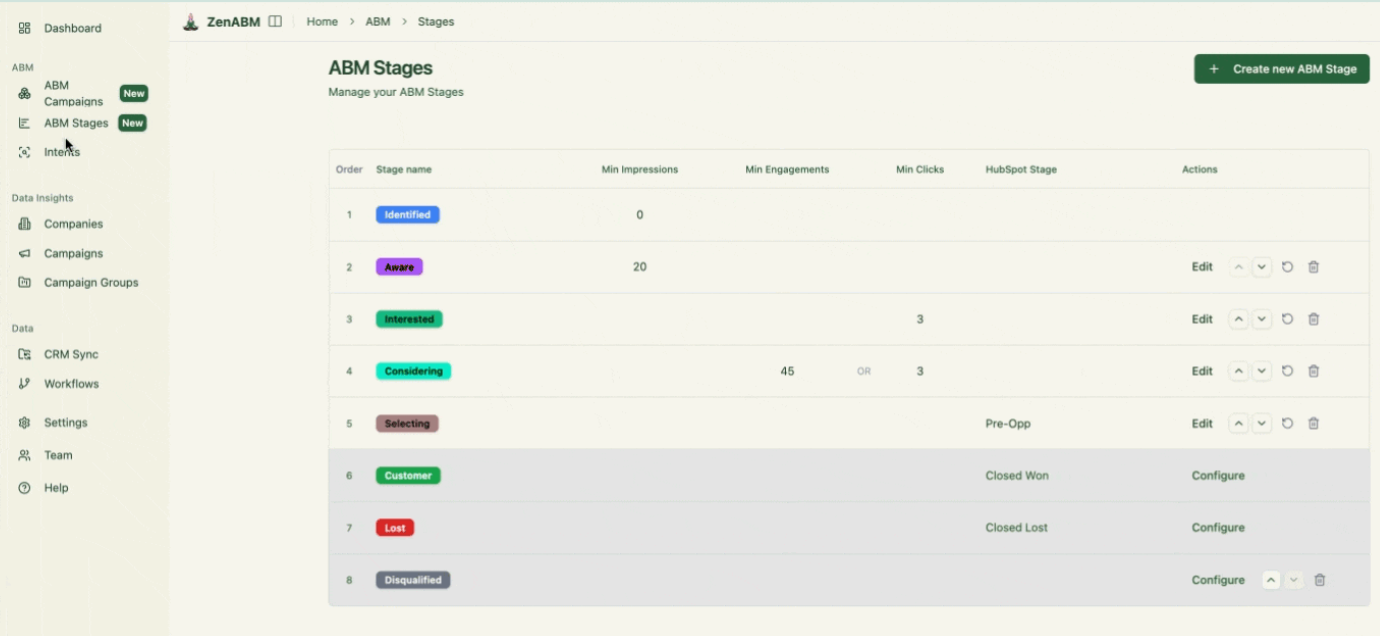
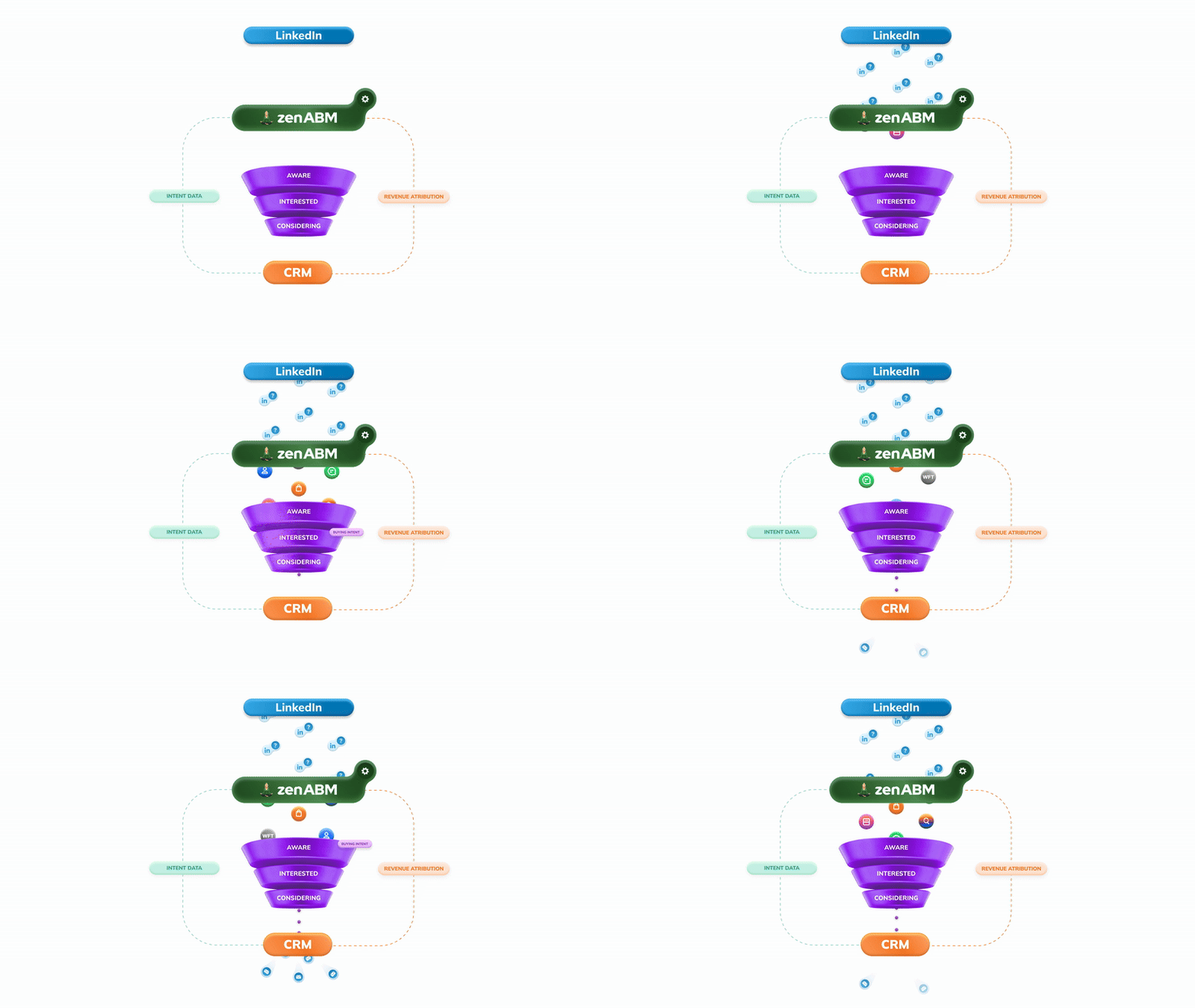
ZenABM helps a lot here because its company-level engagement shows which accounts are getting repeated exposure, and account scoring plus ABM stages help you decide whether that repeat exposure is acceptable or just a waste.
If an account is already deeply engaged or already in the pipeline, high frequency may be redundant rather than helpful.

If your budget is spent by 10 am, LinkedIn is front-loading delivery in the cheapest morning auctions and missing your audience during the rest of the day.
Consider reducing your daily budget so it stretches across more hours.
This is non-negotiable for ABM campaigns.
Maximum delivery optimizes for volume, not for reaching specific accounts.
Use company engagement tracking to verify that your target accounts are actually seeing your ads, not just random members of your audience who happen to be cheap to reach.
Run a parallel test: duplicate your campaign and run one version on maximum delivery and one on manual CPC bidding for 2 weeks.
Compare CPCs, total results, and most importantly, company-level engagement with target accounts.
This data will tell you definitively which strategy works better for your specific audience.
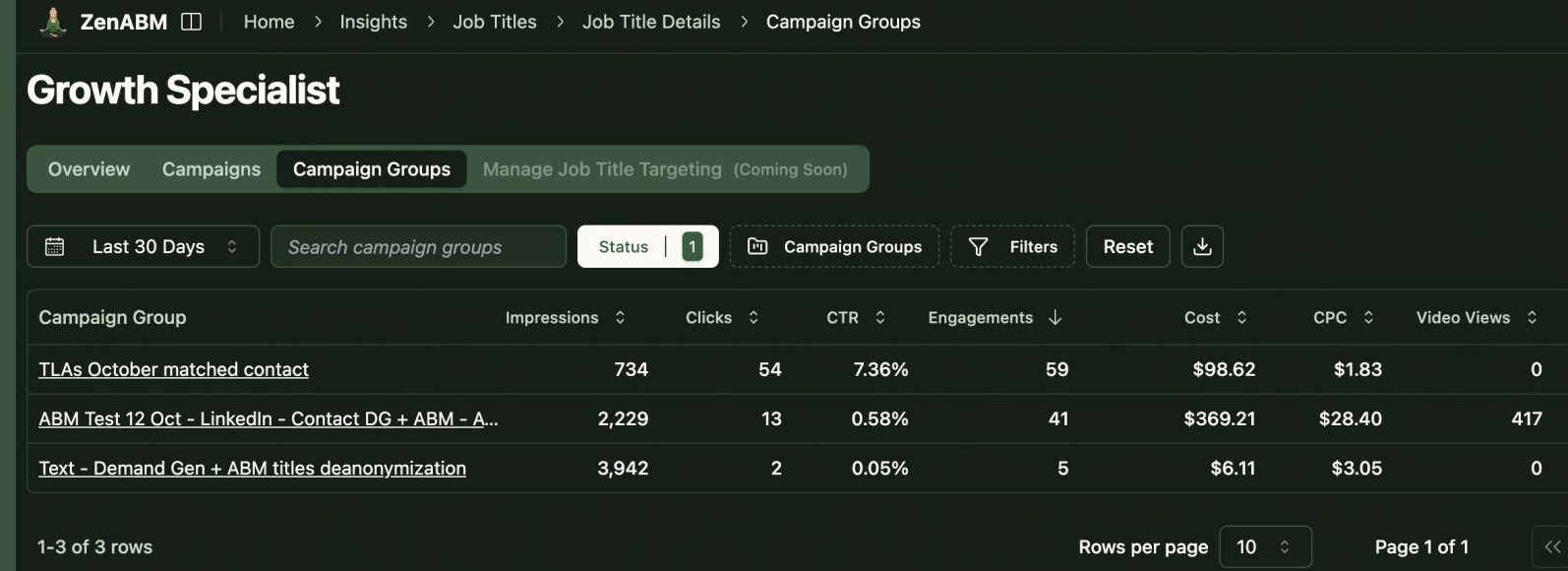
And when you compare those two campaigns, ZenABM’s job title analytics can help you catch an easy trap: one version may look cheaper overall but attract lower-value roles.
If the manual version pulls in more of the actual buyers and champions you care about, that is the better campaign, even before pipeline data fully matures.
Here’s a realistic example of how costs differ between the two strategies for a typical ABM campaign:
| Metric | Maximum Delivery | Manual Bidding (floor-finding) |
|---|---|---|
| Daily budget | $100 | $100 |
| Average CPC | $16.50 | $8.20 |
| Daily clicks | ~6 | ~12 |
| Monthly clicks (22 days) | ~132 | ~264 |
| Monthly spend | $2,200 | $2,200 |
| Cost per target account click | Higher (less control) | Lower (more control) |
Same budget, 2x the results with manual bidding.
This is a pattern seen consistently across ABM campaigns.
Gabriel Ehrlich, Founder of Remotion, makes an important point about budget and efficiency:
“If you just doubled [budget], and your CPM went up because of that, then that’s a problem.” – Gabriel Ehrlich, Founder of Remotion
With maximum delivery, increasing your budget often increases your CPM because the algorithm bids more aggressively.
With manual bidding, increasing the budget at the same bid level simply gets you more results at the same cost.
What matters in ABM, though, is not just cheaper clicks.
ZenABM helps you see whether those clicks came from the right companies that progressed through ABM stages after the campaign.
That is a much better filter for judging maximum delivery than raw CPC alone.

If you’re currently running campaigns on maximum delivery and want to switch, here’s the step-by-step process:
Most advertisers who go through this process see CPC reductions of 30-50% with minimal impact on delivery volume.
The savings compound over months of campaigning.
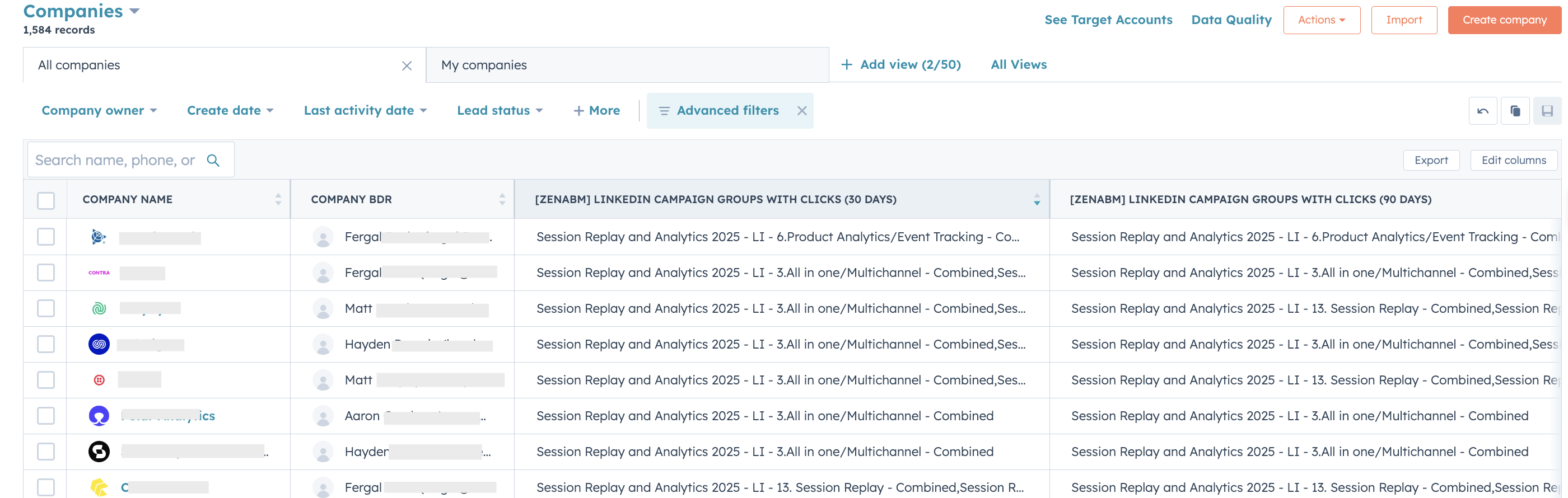
If you’re operationalizing that handoff inside ZenABM, a few features help a lot.
Company exclusions let you suppress accounts that are already saturated, custom webhooks can push high-engagement accounts into downstream workflows, and automated BDR assignment can route genuinely engaged accounts to sales once they cross the threshold you care about.


Stay on Maximum Delivery If:
Switch to Manual Bidding If:
Maximum delivery is LinkedIn’s default for a reason; it spends fast.
But for most ABM campaigns, speed without cost control is a bad trade.
In most cases, manual bidding gives you lower CPCs, better pacing, and more control over how your budget is distributed across your target accounts.
That said, maximum delivery is not always wrong.
It can make sense for thought leader ads with a brand awareness objective, short campaign bursts, or audience benchmarking when speed matters more than efficiency.
The mistake is not using it; the mistake is using it by default without understanding the tradeoff.
If you want to judge bidding strategies based on actual account progression rather than surface-level campaign metrics, ZenABM helps you do that.
You can see which target accounts engaged, which job titles clicked, how accounts moved across ABM stages, and whether high-spend campaigns were actually influencing the pipeline.
Try ZenABM’s 37-day free trial or book a demo to see which LinkedIn bidding strategy is really working for your ABM program.
Some common questions about LinkedIn maximum delivery bidding and their answers:
Maximum delivery is LinkedIn’s default, fully automated bidding strategy. LinkedIn bids whatever is needed in each auction to spend your entire daily budget and deliver as many results as possible. There is no cost cap or bid ceiling; LinkedIn controls how much you pay per click or impression. It prioritizes spend velocity over cost efficiency.
Maximum delivery is LinkedIn’s primary automated bidding option. LinkedIn also offers cost cap, which is semi-automated (you set a target average cost). When people refer to “automated bidding” on LinkedIn, they usually mean maximum delivery. It’s the default setting on all new campaigns.
Maximum delivery spends budgets faster, which generates more ad revenue for LinkedIn. Former LinkedIn employee Max Herzeg confirmed that manual bidding, which gives advertisers more cost control, was almost removed from the platform. LinkedIn keeps maximum delivery as the default because it maximizes their revenue per advertiser.
The primary recommended use case is running thought leader ads with the brand awareness objective, where baseline costs are already low. Other valid scenarios include short 3-5 day campaign bursts where speed matters, benchmarking a new audience before switching to manual bidding, and situations where your budget is small relative to your audience size.
In typical ABM campaigns, maximum delivery produces CPCs that are 30-100% higher than optimized manual bidding. If manual bidding delivers clicks at $8-9 using the floor-finding technique, maximum delivery on the same audience often costs $14-18 per click. The exact difference depends on your audience, competition, and ad relevance scores.
You can, but it’s not recommended. Lead generation campaigns with maximum delivery will result in high cost per lead because LinkedIn bids aggressively in every auction. Manual CPC bidding for lead gen campaigns typically delivers leads at 30-50% lower cost. As a compromise, you can bid for clicks (instead of leads) using manual bidding, which is usually even cheaper.
