

©2026 ZenABM - All Rights Reserved.

AI ABM tools are changing how ABM gets done in 2026. They make shipping ad creatives and personalized landing pages faster and cheaper, they show you how campaigns perform and which target accounts engage (now through MCP servers too), and they help you optimize campaigns e.g. with bidding agents.
But as usual, it’s hard to find one tool that covers everything an (LinkedIn first) ABM campaign needs:
…all without losing quality or trust.
So in this article, I’m reviewing the best AI ABM tools by job-to-be-done, with real user reviews where available.
Here’s the full shortlist as a table, grouped by the eight jobs, so you can scan it before we get into the details.
| Tool | What it does | Real price (2026) | Worth it when |
|---|---|---|---|
| Job 1: Target account list building | |||
| Clay | ICP finder plus Claygent research to build and score a list | Free, $167, $446/month | You want a custom, enriched list from scratch |
| Apollo | Large B2B database to pull a list fast | Free plus paid seats | You need a quick contact list on a budget |
| ZenABM | Builds a warm list from accounts already engaging your LinkedIn ads | From $59/month | You run LinkedIn ads and want the warmest accounts first |
| AgentSource | Claude Code plugin: ICP filtering and enrichment via Apollo and Crustdata | Free, open source | You live in Claude Code and want a list in minutes |
| Job 2: Intent signals (first-party) | |||
| ZenABM | Company-level LinkedIn ad engagement, scores, ABM stages, buyer intent themes | From $59/month | LinkedIn is your main channel |
| RB2B / Warmly | Website visitor de-anonymization | From $129/month (RB2B) | You want named visitors to feed the agents |
| Common Room | Intent signal aggregation across web, product, community | Custom, free tier | You have many scattered intent signal sources |
| Job 3: Enrichment and research | |||
| Clay (Claygent) | Waterfall enrichment and AI research across a list | Free, $167, $446/month | Almost always, as the data layer |
| Apollo | All-in-one database, enrichment and sequences | Free plus paid seats | You want data and outreach in one cheaper tool |
| Job 4: ABM ad creation | |||
| AdCreative.ai | AI-generated display and social ad creative at volume | From ~$25/month | You need many display variations fast |
| Creatify | Turns a URL into short-form video ads | From ~$39/month | Video for ABM nurture and mid-funnel |
| Synter | Agentic creative that pushes ads into LinkedIn, Meta, Google | Custom | You want generation plus direct publishing |
| LinkedIn Ad Designer | Claude Code skill: 23 on-brand LinkedIn ad patterns from your guidelines | Free skill | You want on-brand LinkedIn ad variants in seconds |
| Job 5: Ad and landing page personalization | |||
| Tofu | Per-account content: pages, emails, ads, microsites | Custom, demo-gated | You need 1:1 content at volume with CRM data |
| Mutiny | AI agent for all customer-facing GTM assets | ~$37,800 median per year | Sellers need microsites, deal rooms, business cases |
| Userled | AI-personalized microsites plus LinkedIn ads | Custom, demo-gated | Multi-channel personalization |
| Job 6: Campaign and ad performance management and optimization | |||
| ZenABM | Zena AI analyst, one-click ad pausing and company exclusion, 60-plus-tool MCP server | From $59/month | You optimize LinkedIn on who engaged, not just clicks |
| Metadata.io | Autonomous paid-campaign bidding, testing, budget | From ~$43k per year | You spend $50k-plus a month on paid social |
| Factors.ai | AdPilot bid and budget optimization | Lower entry, demo-gated | Growth-stage optimization plus attribution |
| Claude Ads | Claude Code skill: 250-plus audit checks across ad platforms, health score | Free, open source | You want a fast cross-platform ad account audit |
| Job 7: Reporting and revenue attribution | |||
| ZenABM | Campaign-level attribution, company insights, AI reporting over MCP | From $59/month | LinkedIn-led attribution and reporting |
| HockeyStack | Deep multi-touch attribution across 17-plus sources | From ~$2,200/month | Cross-channel attribution at scale |
| Dreamdata | Full B2B journey attribution, strong on paid | From ~$750/month | Extensive multi-channel programs |
| LinkedIn ABM Reporter | Claude Code plugin (ZenABM API): period reports, attribution, stage moves | Free, open source | You want automated ABM reports via /abm-report |
| Job 8: Outreach and follow-up automation | |||
| ZenABM outbound agent | Open-source Claude Code plugin: engagement to Apollo to Smartlead | Free plugin (uses your accounts) | You want engaged accounts worked automatically |
| Qualified (Piper) | Inbound AI SDR that works your website | ~$40k to $68k per year | High inbound volume on Salesforce |
| 11x / AiSDR | Autonomous outbound AI SDR | $39 to $120/meeting; from ~$250/month | You know the accounts and need execution volume |
| Legacy stack (for context, rarely worth it below enterprise) | |||
| 6sense / Demandbase | Predictive third-party intent and orchestration | ~$62k to $66k median per year | Enterprise with RevOps headcount |
| RollWorks / Terminus | Mid-market ABM advertising and orchestration | ~$12k to $80k per year, plus media | Mid-market display ABM, HubSpot shops |

Before we get to tool names, here’s the filter I use. It kills most of the list on its own.
The one test that decides everything: can a human verify the intent signal the AI is acting on?
A third-party intent score that says “Acme is in-market” with no way to see why is a bet on a vendor’s model. It’s exactly the kind of input that gets an AI SDR shut down after a quarter.
A first-party intent signal (Acme’s team clicked your ad three times, two people from Acme hit your pricing page) is something your AE and your agent can both act on with confidence.
Kyle Poyar made the same point when building the modern ABM engine on Growth Unhinged: as agents start triggering outreach on their own, the quality of the intent signals feeding them becomes the single most important factor in the program.
The second filter is price-to-value: almost every job below can be done for a fraction of what a legacy suite charges, if you buy the sharp tool for the job instead of the box that claims to do all of them.
Everything starts with who you’re going after. Get the list wrong, and every job after it gets more expensive.
There are two ways to build it: cold, from an ICP definition, or warm, from accounts already showing interest. Use both.

Clay’s ICP finder builds a cold list from filters (industry, size, job title, seniority, location). Then Claygent, its AI research agent, qualifies each account, so you’re not just buying a raw firmographic pull.
You set the job-title and persona filters, the experience and geography, and let it find the right people at each company.


The trade-off is the same everywhere Clay shows up: it’s a builder’s tool with a learning curve, and credits burn fast if you research huge lists carelessly.
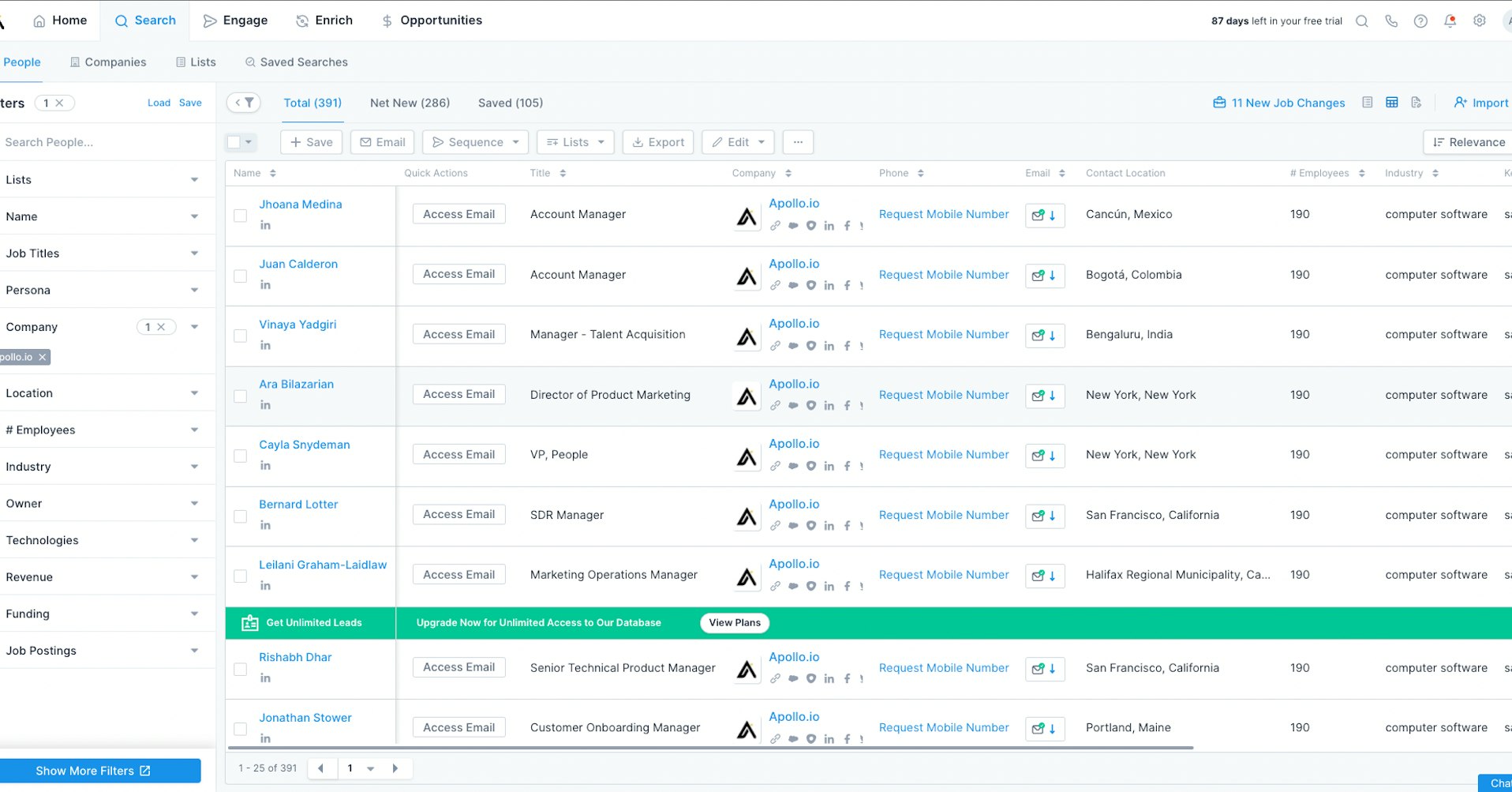
If you don’t have a GTM engineer to run Clay, Apollo is the practical pick: a large B2B database you filter down to a list, then export or sequence, with a free tier and cheap seats.
You trade Clay’s flexibility and waterfall depth for speed, and accuracy varies by segment. But for a first list, it gets you moving in an afternoon.
The best target list isn’t a guess. It’s the accounts already raising a hand.
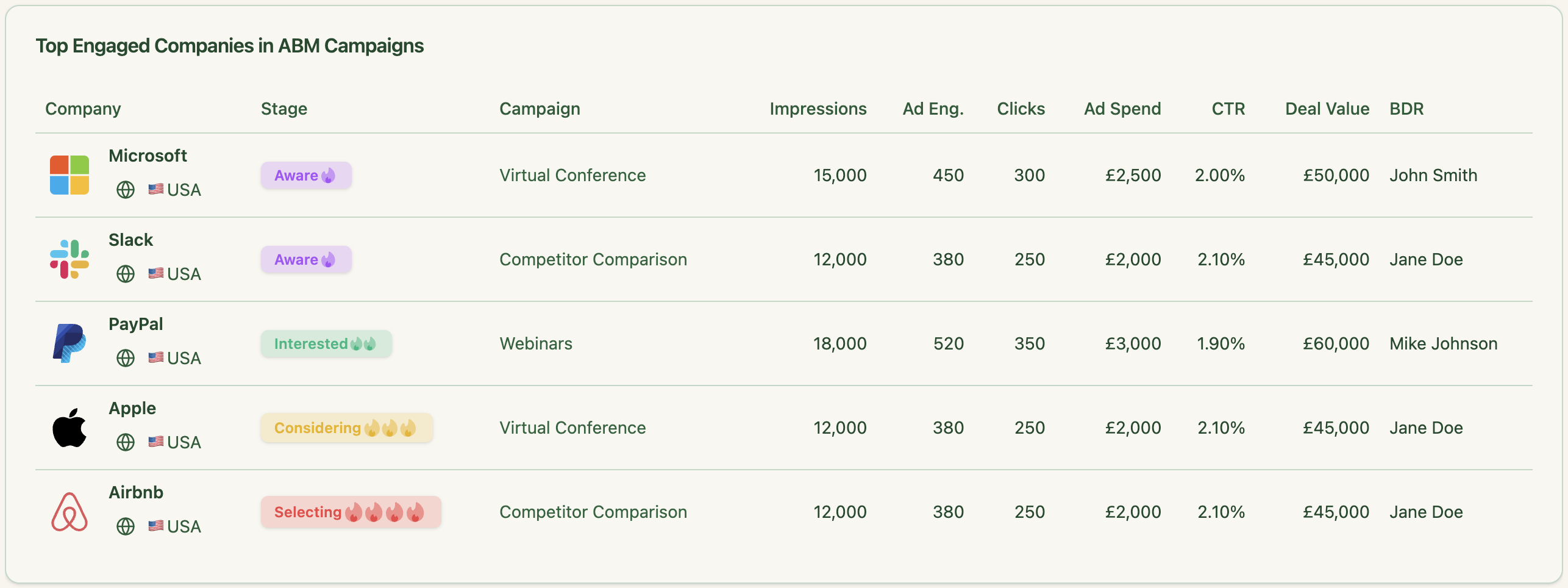
If you run LinkedIn ads, ZenABM lets you build the list from accounts that actually engaged with your campaigns, filtered to the ones with no open deal yet, straight from a prompt against its MCP server.
That’s a warm list your reps won’t roll their eyes at.
Pull the last 90 days of LinkedIn ad engagement at the company level. Group engaged accounts into tiers by total engagements, then list the top 20 accounts that have 5 or more engagements and no open deal in the CRM. For each, show the campaigns they engaged with and their current ABM stage.

If you already work in Claude Code, you don’t have to buy a tool for this job at all.
AgentSource ships a free, open-source Claude Code plugin that filters accounts by your ICP criteria, enriches each one with firmographic and technographic data through the Apollo and Crustdata APIs, and exports a CSV list.

It cuts account research from 15-25 minutes down to under 2 minutes per account. That’s the whole reason the Claude Code for ABM plugins exist: if a skill does the job for free, use the skill.
Once you have a list, the real question is which of those accounts are showing interest right now, in a way a human can verify.
Three tools cover it, and they complement rather than compete: ZenABM for LinkedIn ad engagement, RB2B and Warmly for website visitors, and Common Room when you have many intent signal sources to pull together.
If LinkedIn ads are your main channel, your strongest first-party intent signal already lives there. Most teams throw it away, because Campaign Manager only shows engagement at the campaign level, not which companies engaged with which of your campaigns.
ZenABM reads company-level ad engagement straight from the LinkedIn Ads API: impressions, engagements and clicks per company, per campaign, per ad, across 7, 30 and 90-day windows.
You can see that Acme engaged with three of your ads this week. Not a model’s guess that Acme is in-market.

Current and total engagement scores (current is engagements over impressions in your window, total is all-time) surface the hottest accounts without you scanning rows.

Raw engagement isn’t enough for an agent to act on, so you shape it.
You define custom ABM funnel stages with your own thresholds (say, 5 or more engagements in 30 days moves an account to Interested and fires a BDR task), tag campaigns with intent themes so engaged accounts inherit the label, and sync all of it both ways with HubSpot or Salesforce so reps see the intent signals where they already work.

The intent themes are the part most tools miss.
Because you tag each campaign with a theme (Analytics, Security, AI Features, whatever you sell), an account that engages doesn’t just get flagged as hot. It inherits what it’s hot about.
That qualitative buyer intent tells you which message actually landed, which is exactly the context an outreach or content tool needs to not sound generic.
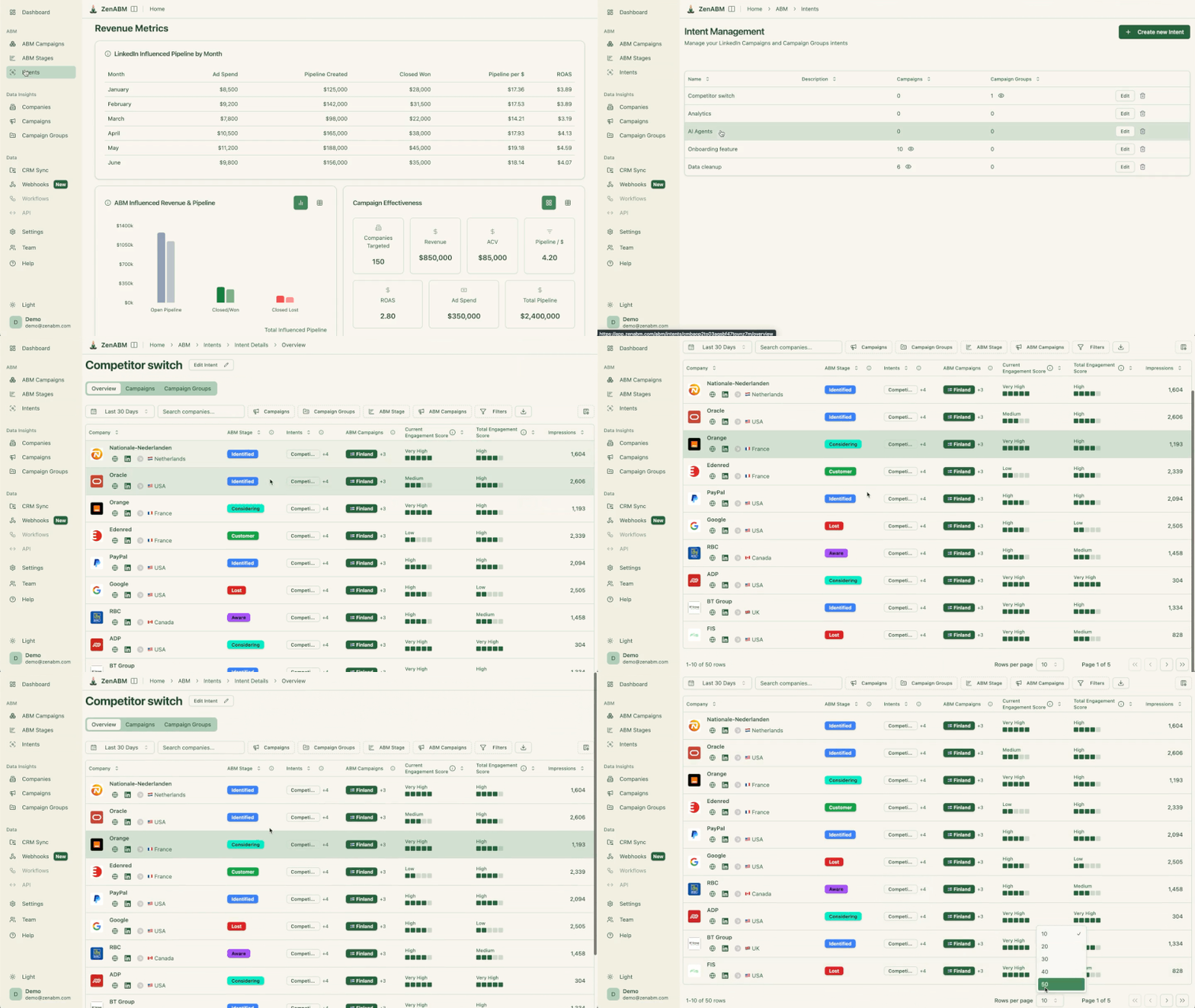
The CRM sync is bi-directional: ZenABM’s engagement scores, stages and intent themes land as company properties inside HubSpot or Salesforce, and your CRM properties flow back to shape the stages.
Reps never have to leave the CRM to see the intent signal.
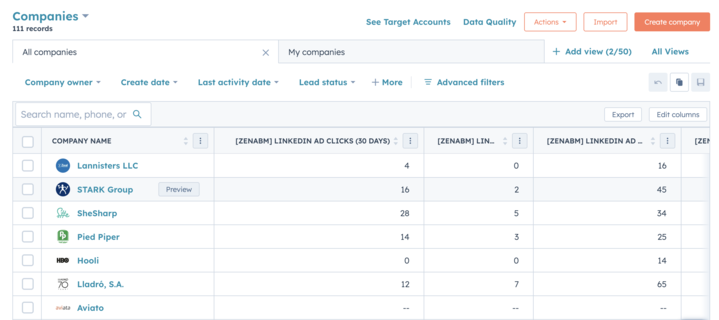
And when an account crosses your Interested threshold, ZenABM can assign it to a BDR in the CRM automatically, so the hottest intent signal becomes a task in someone’s queue instead of a chart nobody opens.
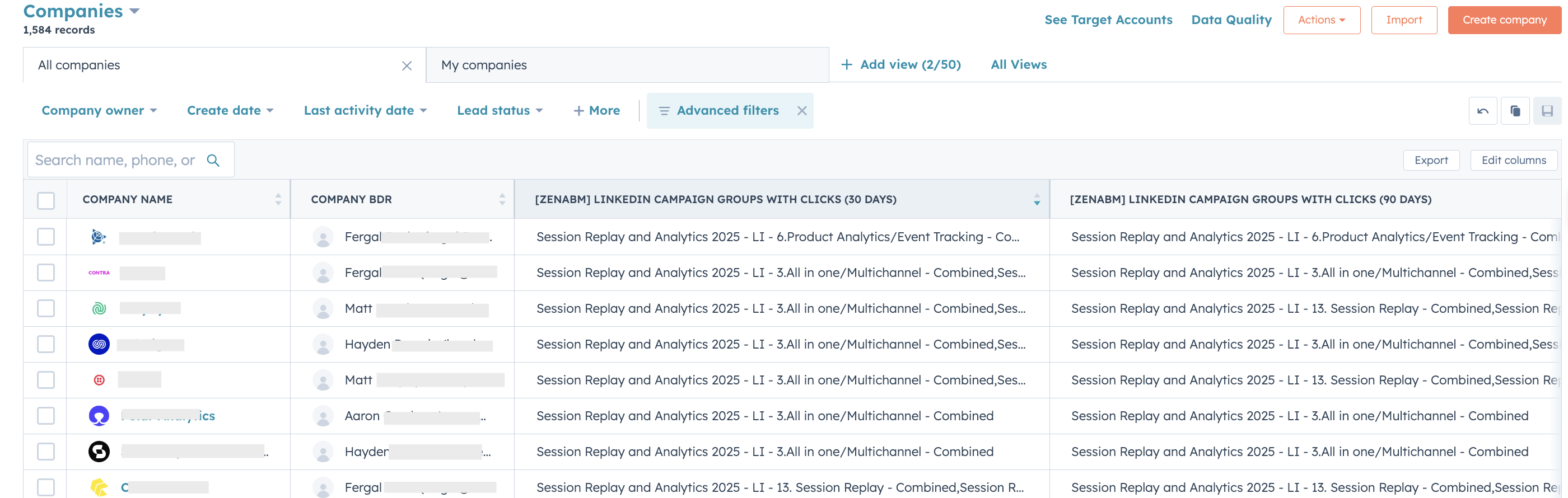
And since we’re talking about AI ABM tools: everything above, and more, is accessible via ZenABM’s MCP server inside your Claude Code or Codex terminal (more on ZenABM’s MCP server later in this article).

ZenABM’s limitation: it’s LinkedIn-first. Multi-channel intent signals (Google Ads, Reddit Ads, organic, AI chatbot referrals) were added in 2026, but it’s not a third-party intent database the way 6sense is, and website-visitor de-anonymization is on the roadmap rather than shipped. That’s exactly why you pair it with the two tools next.
It starts at $59 a month with a 37-day free trial.
The other half of first-party intent signals is your own website.
RB2B does person-level identification of US visitors, pushed to Slack, from $129 a month, which for a US-heavy SDR team is a stronger buying intent signal than any predicted intent score.

Warmly is the broader cousin. It identifies up to 65% of visiting companies and up to 15% of individuals, then layers orchestration on top, so a revealed visitor can trigger a chatbot, a sequence or LinkedIn outreach automatically.

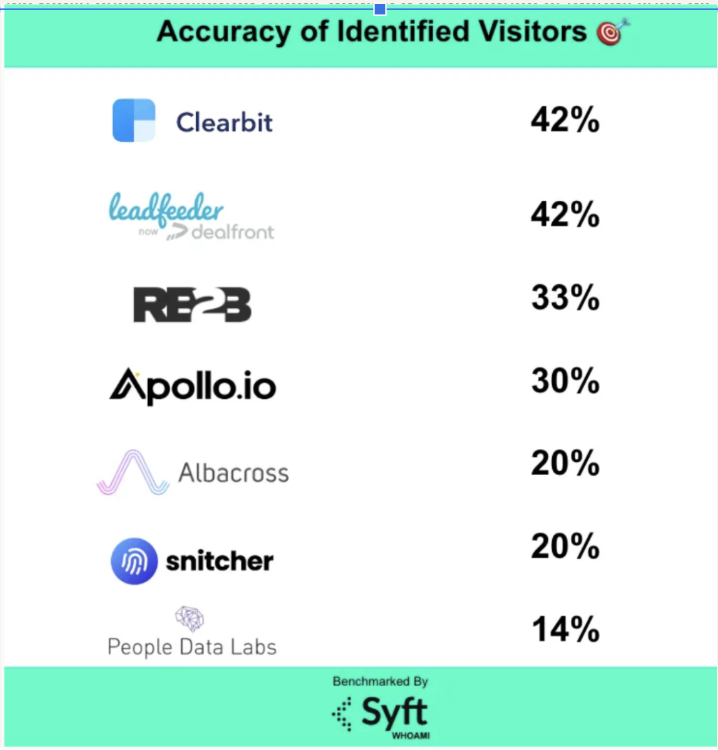
The limit on both: de-anonymization is partial, around 20 to 40% at the company level per the Syft accuracy study, and person-level is lower and US-skewed.
Treat them as a stream of warm intent signals, not a complete database.
Paired with ZenABM’s LinkedIn engagement, they give your agents two independent, verifiable first-party intent signals to act on.

Common Room sits one level up: it pulls scattered intent signals (web, product usage, community, social, CRM) into one person-and-account view and uses AI to surface who’s worth acting on.
It gets unusually warm community sentiment for the category, though people also warn about the high pricing.
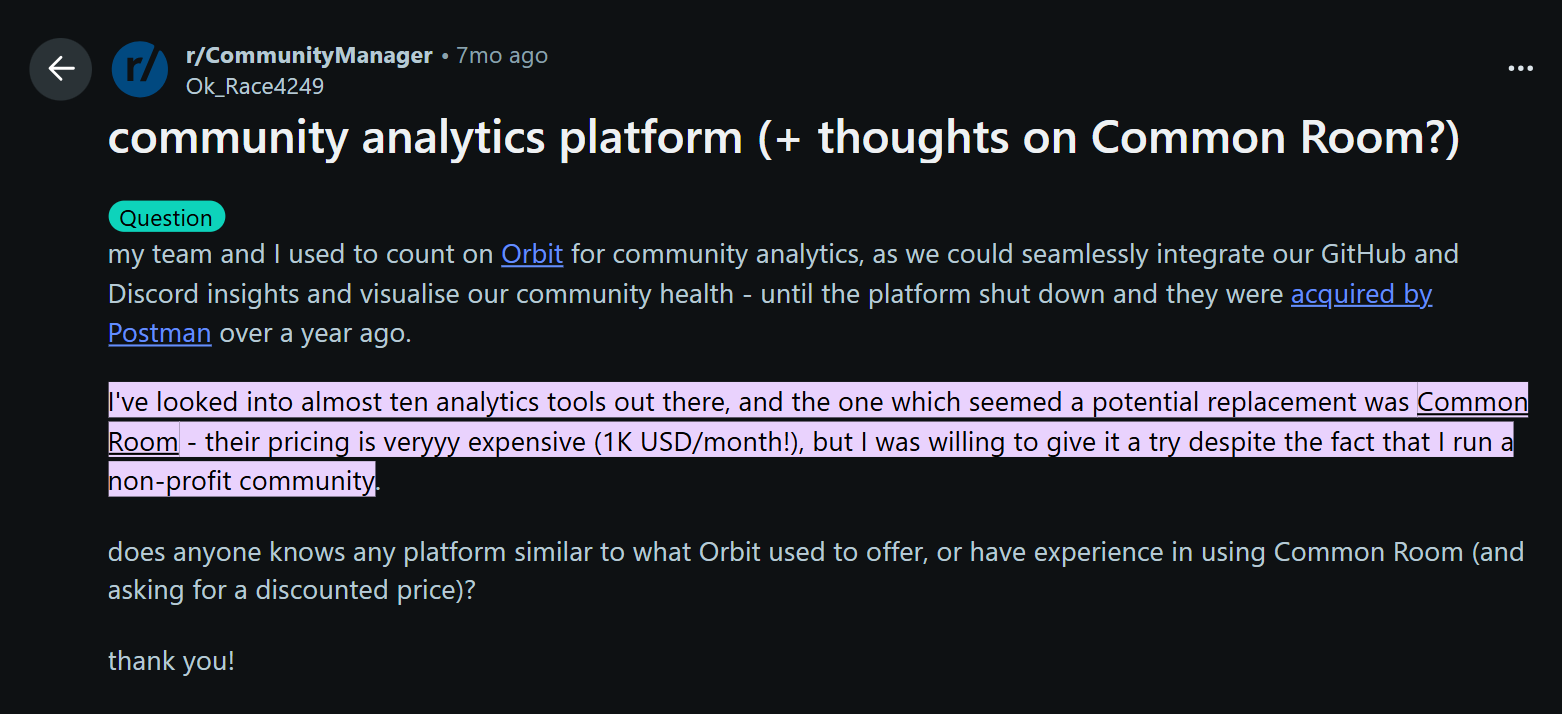
The trade-off: it only makes sense if you genuinely have many intent signal sources to unify. If your intent signals are mostly LinkedIn ads or website visits, a focused tool is cheaper and sharper: ZenABM for company-level LinkedIn ad engagement, RB2B or Warmly for site visitors.
Pricing is custom, above a free tier.
Once the intent signals tell you which accounts are hot, this job answers the next question: who exactly do I contact there, and what do I know about them?
This is where the GTM-engineer role lives.

Clay is an AI-powered data enrichment and workflow automation platform that go-to-market teams use to scale outbound sales, lead generation, and account-based marketing.
Its edge is waterfall enrichment plus Claygent, its AI research agent. Instead of one data provider, it queries many in sequence so match rates climb, and Claygent runs natural-language research across a whole list (find a competitor’s customers, infer budget, pull each LinkedIn profile, qualify by title).


Clay restructured its pricing in March 2026 into Free, Launch ($167/month) and Growth ($446/month), and credits burn fast at volume.
The most important thing to get right is what you point it at. Clay is the data layer, not the intent signal source.
If LinkedIn is where you spend, point Claygent at accounts ZenABM has already flagged as engaged (pushed in via webhooks, CRM sync or the MCP server) rather than at a cold list. That keeps the credit spend on accounts worth researching.


Apollo is the cheaper all-in-one for teams that want a large B2B contact database, enrichment and sequences in one place, without wiring providers together.
You trade Clay’s waterfall depth for simplicity, and data freshness varies by segment. But lean teams start here and graduate to Clay when the plays get more custom.
This job is about generating the ad creative itself (copy, image, video), not just personalizing an existing asset.
It’s also the least mature job on this list.
If you already live in Claude Code, this job doesn’t need a paid tool either.
The LinkedIn Ad Designer skill by Advanced Client ships 23 pre-built, on-brand ad patterns (stat highlights, product screenshots, grid layouts, testimonials, case studies). You upload your brand guidelines once, and it generates on-brand variants, cutting production from about 30 minutes to 30 seconds per variant.
For LinkedIn specifically, it sidesteps the weakness of the general ad generators (that 40% quality gap on single-image ads) by working from patterns that already fit the format.

Creation makes the asset. Personalization makes it speak to the specific account.
When your intent signals tell you Acme is engaged (the ZenABM Interested stage, a named RB2B visitor), these tools build Acme the experience.

Tofu is the strongest AI-native content engine on this list. It generates entire content experiences per account (emails, landing pages, one-pagers, ads and microsites) by pulling in your CRM data along with firmographic and intent signals, so the messaging reflects each account’s industry, pain points, tech stack and buying stage.


The output is only as good as the data you feed it.
Teams that point it at thin CRM records get generic content with a personalized name field, which prospects spot instantly.
This is exactly where ZenABM’s intent signals help: feed Tofu the specific campaigns and intent themes an account engaged with, and the personalization has something real to say.
Pricing is custom and demo-gated, and it needs a human editor in the loop.

Mutiny started as AI website personalization and has grown into an AI agent for the full set of customer-facing GTM assets: 1:1 ABM pages, microsites, deal rooms, business cases, pricing proposals, even meeting recaps. Any seller or marketer can ask the agent to generate what they need for a specific account in minutes, and it tracks leads and attribution per page.

It carries a 4.7 on G2, and reviewers cite LaunchDarkly building 100-plus account-specific microsites in 60 days and hitting 150% of their quarterly meeting goal.
The catch is the price: the median contract runs around $37,800 a year (Vendr), so it’s an enterprise purchase, and the breadth only pays off if your motion uses all of it.


Userled bundles LinkedIn ads management for ABM at scale with personalized microsites, landing pages and event invites, plus sales plugins that track visitors on those pages. It’s the pick when you want personalization and experimentation across more than just your website.


Your paid LinkedIn program deserves its own AI layer, and the job splits in two: analysis (which companies engaged, which ads work, where the money leaks) and optimization (pause the losers, shift budget, tune bids).
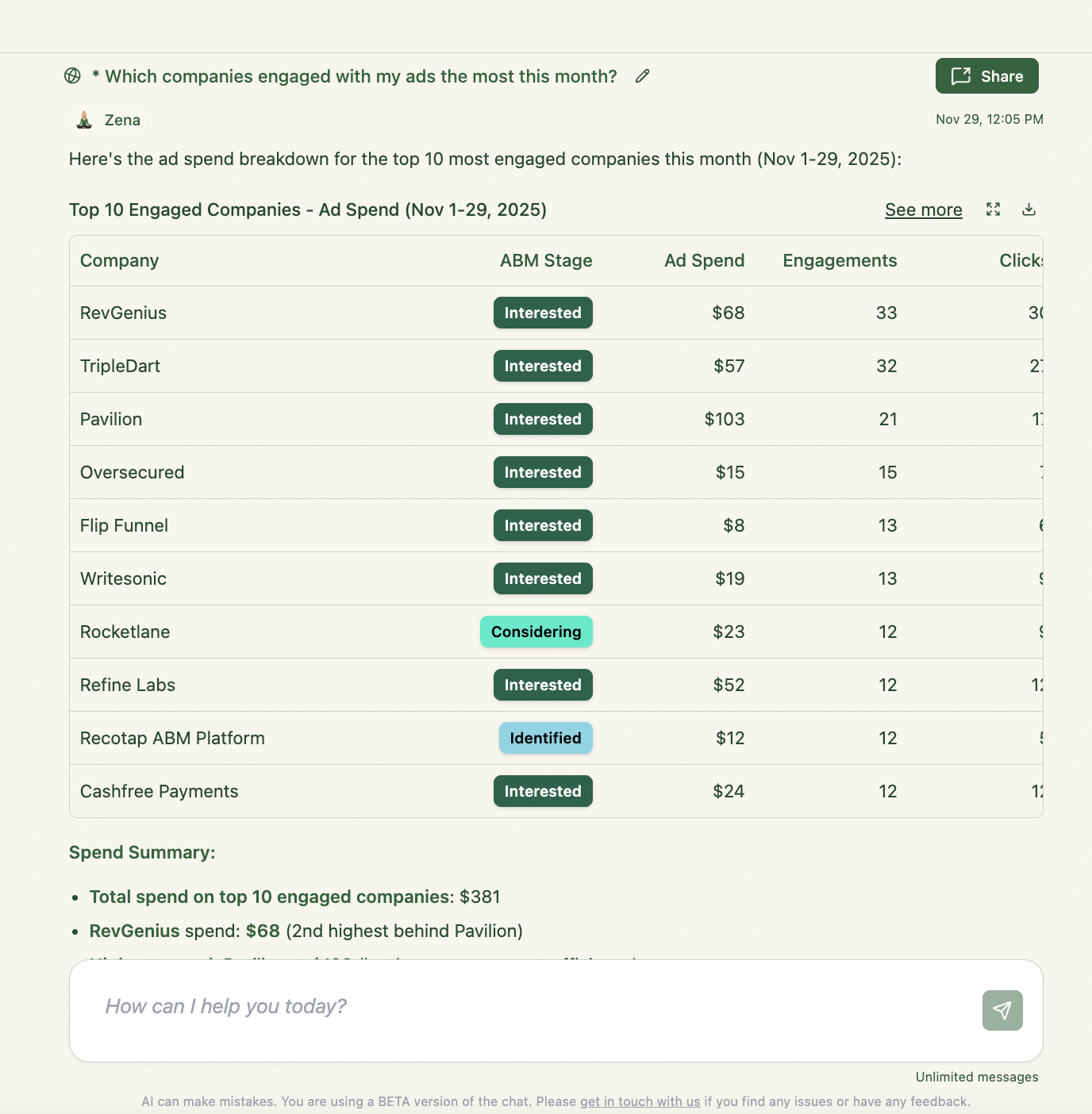
Zena, ZenABM’s built-in AI chatbot, analyzes your LinkedIn ad performance in plain English. Ask it for your top engaged companies, your best ads by CTR, or your underperformers, and it answers without SQL or a dashboard hunt.

It also acts on that analysis. Zena can surface underperforming ads and pause them, and exclude oversaturated or unresponsive companies from all your campaigns in one click. The whole optimization loop (spot the bottom ads, pause them, cut the dead accounts, reallocate budget) runs from a chat box against live engagement data.
What makes it different from the tools below: ZenABM optimizes on who engaged (a company-level target-account intent signal), not just surface ad metrics. That’s why you can pause an ad with a fine CTR that’s only reaching the wrong accounts.

Here’s the part that makes ZenABM genuinely AI-native rather than a dashboard with a chatbot bolted on.
The MCP (Model Context Protocol) server exposes all of your ZenABM data and a set of safe actions to any MCP client (Claude, Claude Code, ChatGPT, Cursor).
Connecting it is one config block: point the client at the ZenABM endpoint, drop in your API token (OAuth is also supported), then run /init so Claude writes a CLAUDE.md with the context it needs.
{
  "mcpServers": {
    "zenabm": {
      "url": "https://app.zenabm.com/api/mcp",
      "headers": {
        "Authorization": "Bearer YOUR_ZENABM_API_TOKEN"
      }
    }
  }
}It ships 60-plus tools in five groups:
list_companies, list_campaigns, list_ad_sets, list_creatives, list_deals).get_company_overview, get_company_timeline, get_company_deals).get_campaign_overview, get_ad_set_companies, get_creative_performance).get_abm_campaign_overview, get_abm_stage_history).find_ad_sets_or_campaigns, update_ad_status, update_ad_set_or_campaign_status), each behind a confirmation so nothing changes without your say-so. Some write actions are still rolling out.A prompt I run against Zena or the MCP server to handle the optimization half:
Show me my LinkedIn ads from the last 30 days ranked by CTR and cost per result. Flag the bottom five by CTR that have spent more than $500 and are not driving engagement from target accounts, and pause them.


Metadata.io is the closest thing to a self-driving paid-social layer. It automates targeting, bidding, creative testing and budget optimization across LinkedIn, Meta and Google, with AI agents (a Bid Agent and an Analyst Agent) doing the tuning a paid manager used to do by hand. It rates 4.6 on G2 across roughly 298 reviews.

The trade-off: it’s built for big spenders. The Campaigns plan starts around $43,200 a year and only makes sense once you run roughly $50k a month or more in paid social.
Where ZenABM tells you which accounts your ads reached and lets you pause on that, Metadata is the heavier automation layer for high-volume paid experimentation.

Factors.ai straddles this job and the next.
Its AdPilot (LinkedIn and Google) automates bid and budget optimization off account-level intent signals. And because it also does account identification and multi-touch attribution, the optimization is tied to what influenced pipeline rather than to clicks.
Entry pricing is lower than the enterprise attribution tools, though it’s now demo-gated.
Before you optimize, it helps to know what’s broken. There’s a free skill for that too.
The Claude Ads skill by Agrici Daniel runs 250-plus audit checks across Google, Meta, YouTube, LinkedIn, TikTok, Microsoft and Apple ad accounts, produces a health score out of 100, and hands you a prioritized action plan, all running locally.
It’s the fastest way to get a cross-platform audit without a consultant, and it pairs naturally with ZenABM: Claude Ads tells you which ad settings are misconfigured, and ZenABM tells you which ads are reaching the wrong accounts.

Three reporting jobs share the same tools: ad-performance reporting, company-insights reporting, and revenue attribution. All three get much better with an AI layer you can query in plain English.
ZenABM does reporting in the same place it does intent signals and optimization: deduplicated revenue attribution per ABM campaign, with pipeline per dollar, ACV and ROAS by campaign, plus multi-channel attribution across LinkedIn, Google, Reddit, organic and AI-chatbot referrals.
If your program is LinkedIn-led, this often removes the need for a separate attribution line item entirely.


The company insights and attribution reporting are also fully AI-accessible. The same MCP server (covered in Job 6) lets Claude, ChatGPT or Cursor answer questions like “which companies entered the Interested stage this week and what did they engage with” or “show ROAS by campaign for Q2” without you building a dashboard. Zena answers the same questions in-app.
In our 2026 benchmark of 211 companies, 161,256 ads and $5.5M in spend, the median program returned $5.21 in influenced pipeline per dollar and 1.62x ROAS, while top performers hit $15.20. This is where you put your own number next to those.
It starts from the same $59 a month as the intent signals layer (see pricing for higher tiers).
If you’d rather have the report come to you, there’s a free skill for exactly this.
The LinkedIn ABM Reporter plugin (emikor/zenabm-linkedin-abm-reporting) connects directly to the ZenABM API and, on the /abm-report command, generates period-over-period reports with deal attribution, top engaged accounts, ABM stage moves and auto-detected red and green flags.
It’s the reporting half of the same open-source toolkit as the outbound agent, so you can run your weekly ABM readout from Claude Code without touching a dashboard.

HockeyStack is the depth option. It stitches 17-plus touchpoint sources (LinkedIn ad impressions, G2 intent, CRM, calls, web) into one unified journey, with a genuinely self-service dashboard builder.
It starts around $2,200 a month, which prices out smaller teams, and its CRM integration is one-way, so reps won’t see LinkedIn intent signals in Salesforce without a workaround. Buy it when you need attribution across many channels and have the budget.
Factors.ai doubles as the more approachable attribution pick, combining account identification, multi-touch attribution and its AdPilot optimization at a lower entry price than HockeyStack.
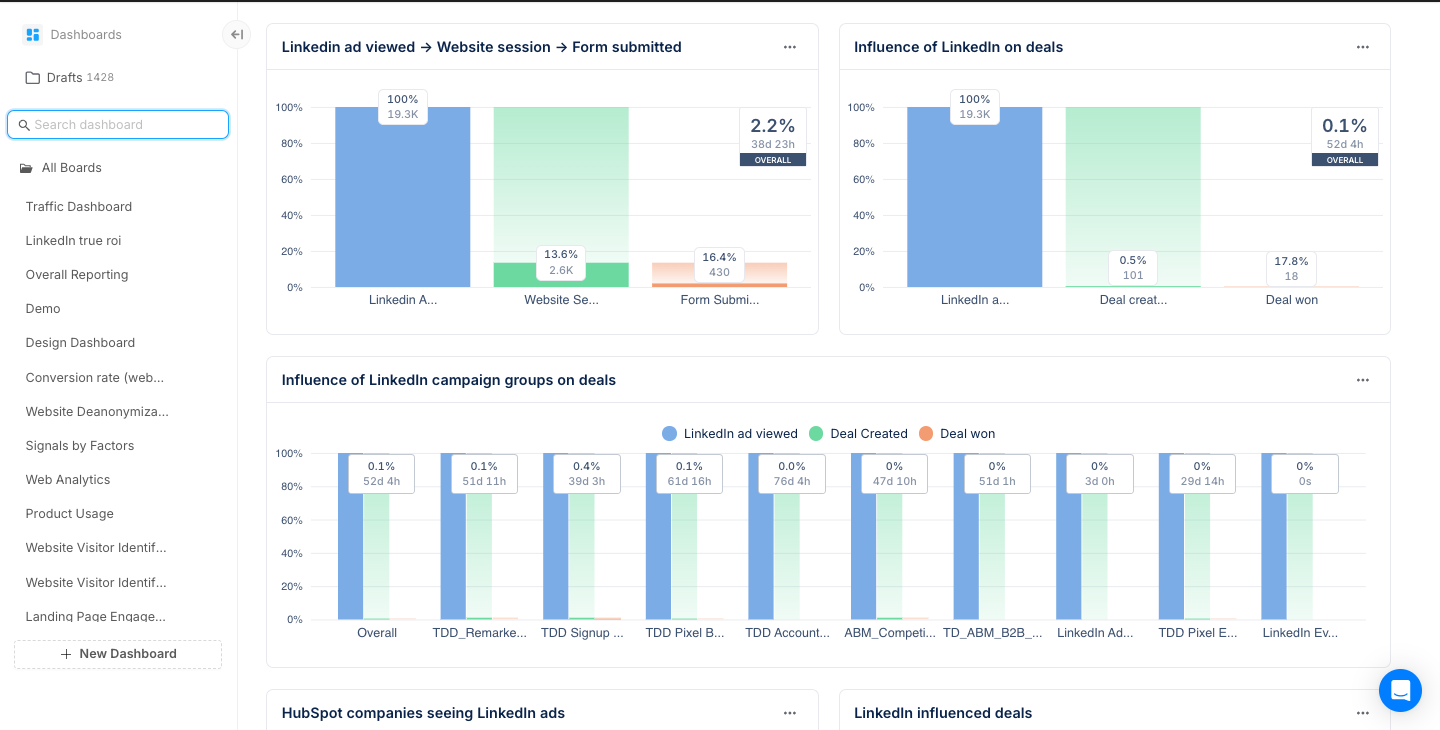
Dreamdata is the other strong campaign-level option, built around full B2B customer journeys and unusually good on paid data.
Its Activation Starter plan runs around $750 a month. And its 2026 LinkedIn Ads benchmark (from 3.5 million customer journeys) found LinkedIn delivering a 121% ROAS, outperforming Google Search at 67% and Meta at 51%, per Demand Gen Report. That’s a useful outside-in confirmation of why the LinkedIn-first stack in this article holds up.

The last job is turning all of the above into an actual first touch, at machine scale, without the sloppy automation that burns domains.
ZenABM ships an open-source intent-led outbound agent that closes the whole loop.
It’s a Claude Code plugin that runs the full intent-to-outreach motion end to end. It pulls the accounts genuinely engaging with your LinkedIn ads from ZenABM, finds the right contacts through Apollo.io, writes a cold email for each that references the exact engagement (the specific campaign and creative), pushes the prospects and copy into Smartlead, and sends on a weekly schedule (Mondays at 10 AM GMT+2).
You install it by opening Claude Code, telling it to install the plugin from the repo, and running /outbound. It asks once for your ICP, personas and messaging, then handles prospecting, personalization and launch on its own.
The point: an account never goes cold between engaging with your ad and getting a relevant first touch, because an intent signal you can audit is doing the triggering.


Qualified, owned by Salesforce, is an AI-powered conversational marketing and sales execution platform, and its Piper agent is the highest-rated AI SDR in the category (4.9 on G2 across 1,400-plus reviews).
The reason it works where outbound agents fail: it’s an inbound agent that lives on your website and acts on the strongest possible intent signal, someone being on your site right now.

It’s built to run on Salesforce, so off-stack teams feel friction, and third-party estimates put it at roughly $40k to $68k a year per MarketBetter’s 2026 review.
It only helps if you have inbound traffic worth qualifying.
For outbound, 11x (its agent is called Alice) is the most heavily marketed autonomous option, booking meetings at a reported $39 to $120 each. That sounds efficient until you factor in the domain risk. AiSDR is the transparent entry point, publishing its rates from around $250 a month, and its strength is speed-to-launch for a lean team with no SDR.

The cautionary tale is Artisan, whose agent Ava ran outbound aggressively enough that the company got banned from LinkedIn for roughly two weeks across late 2025 and early 2026.
The lesson across all of them: an outbound AI agent pointed at a cold list is a liability. The same agent pointed at accounts your intent signals flagged as engaged is a genuine multiplier.
These are the platforms most “AI ABM tools” lists lead with.
They’re not AI-native. They’re pre-AI ABM platforms that have bolted AI onto a predictive-intent core, and they’re where the most money gets burned. Worth knowing, rarely worth buying unless you’re enterprise.
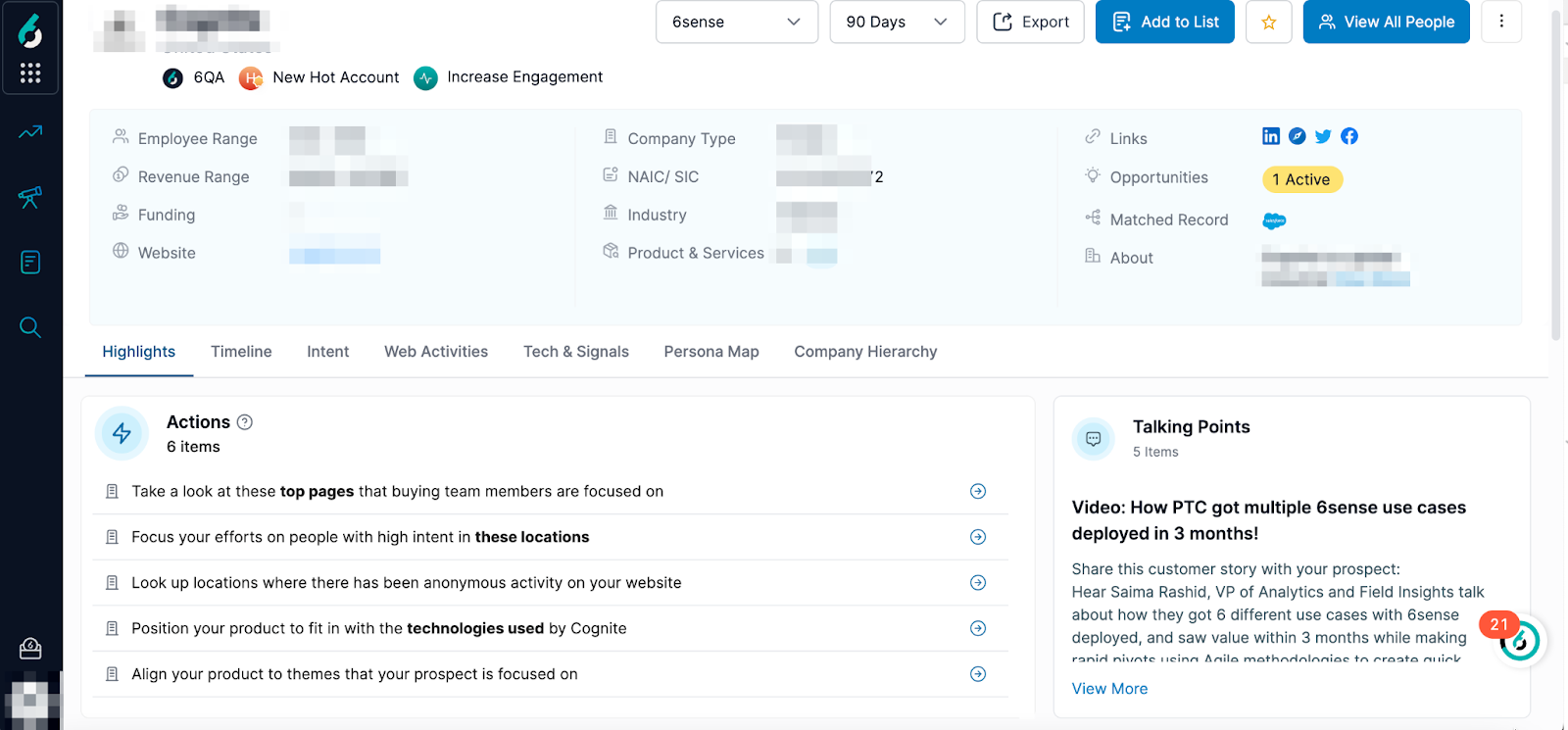
6sense is genuinely good at aggregating billions of third-party intent signals into an account-level prediction, and it carries a 4.3 on G2 across roughly 870 reviews.
The catch: onboarding runs 60 to 90 days, and the loudest theme in the G2 cons and in honest roundups like MarketBetter’s 2026 review is data quality (contacts that don’t match, stale company data, intent that doesn’t line up with what reps see, so SDRs stop trusting the score).
At a median of around $63k a year (Vendr), that’s enterprise pricing before you know whether the model fits your market.


Demandbase is the most complete platform here, covering identification, intent, advertising and orchestration in one place after folding in Engagio and InsideView.
The complaints are predictable for something this broad: reviewers flag the pain of integrating Demandbase One with a custom Salesforce build, and the loudest frustration is attribution.
The honest read on both: excellent for an enterprise with a RevOps team to feed them, a money pit for everyone who buys the prediction and skips the operational discipline.
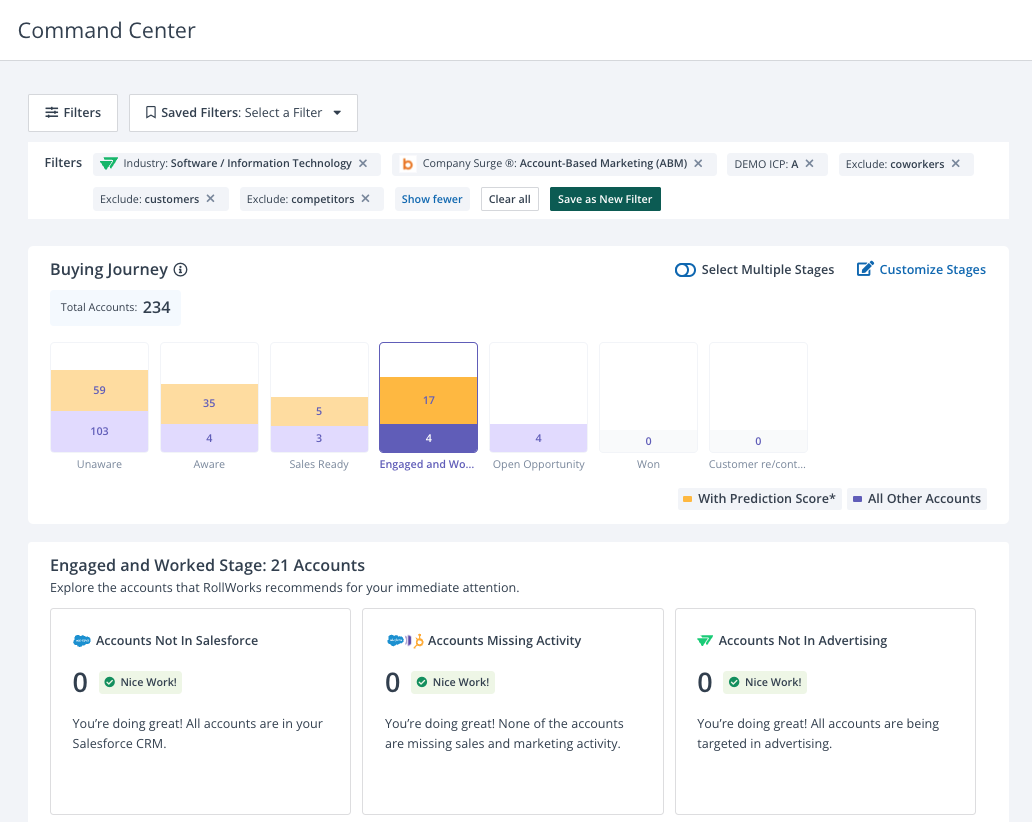
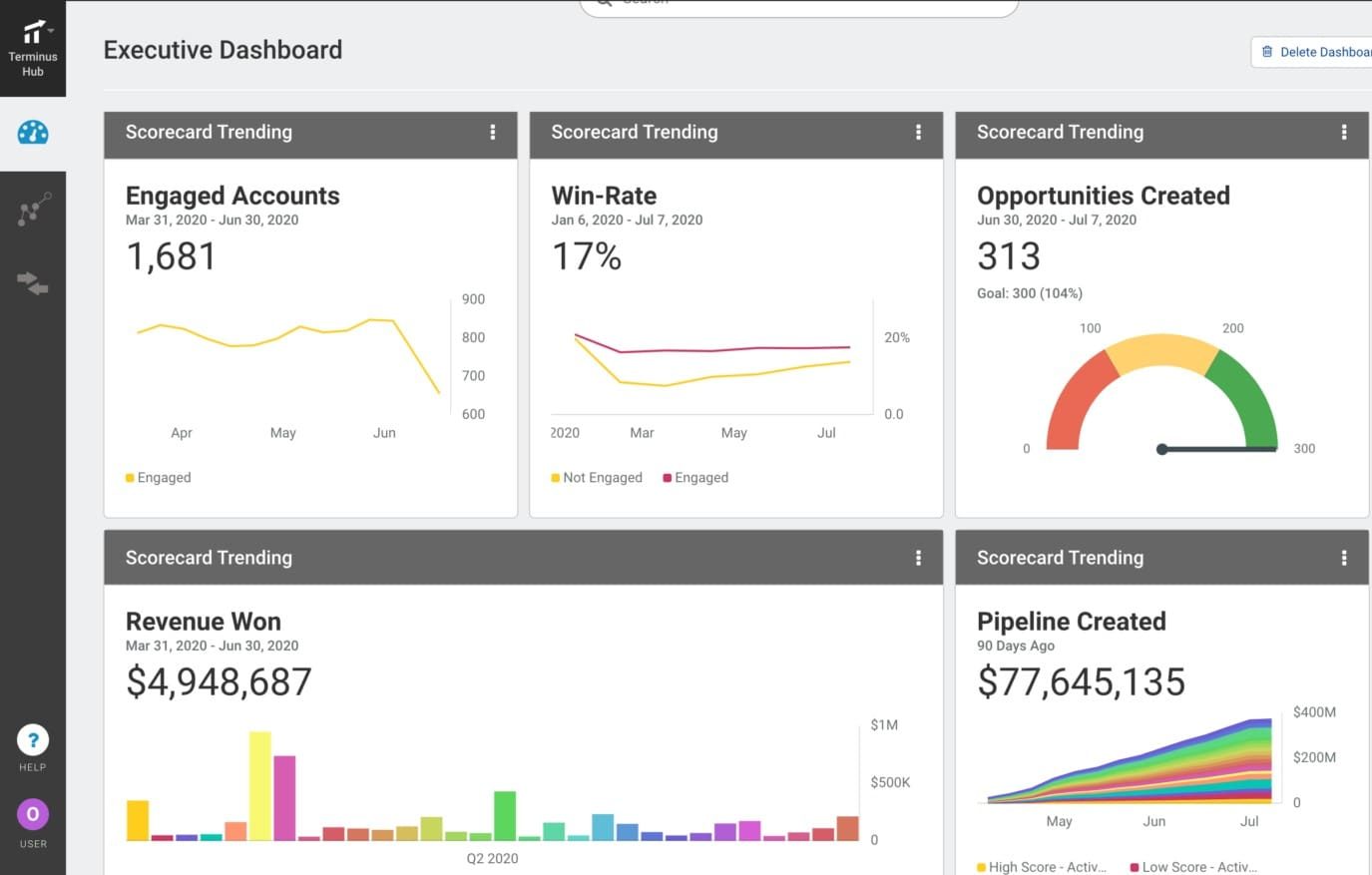
These two are the mid-market middle ground, roughly $12k to $80k a year, covered in our RollWorks vs Terminus breakdown. RollWorks is the easiest entry point, with a best-in-class HubSpot integration and a starting price just under $1,000 a month. Terminus has the strongest multi-channel orchestration but a higher floor.
The cost line nobody quotes: display ad spend is mandatory on most journey templates, so budget another $30k to $100k a year of media on top.
The point of organizing AI ABM tools by job is that you build a stack instead of buying a box. Every tier below costs less than one seat of 6sense.
ZenABM from $59 for intent signals, list building, optimization and attribution; RB2B from $129 for named US visitors; Clay’s Free or Launch tier (or Apollo) for enrichment; and Mutiny for landing-page personalization.
That covers six of the eight jobs. Skip the paid ad-creation and outreach agents until you have the volume to justify them, and write the per-account assets by hand off Clay’s research on the accounts ZenABM flagged.
Keep ZenABM across intent, optimization and attribution. Add Clay Growth ($446) so Claygent runs at volume, AdCreative.ai for display variations, AiSDR (from around $250) as your outreach agent pointed only at engaged accounts, and Tofu once you have clean CRM data.
Still under what RollWorks costs once you add the mandatory media.
This is the tier where I’d add 6sense or Demandbase for open-web third-party intent, Metadata.io for high-volume autonomous paid optimization, Mutiny for seller-facing assets, Qualified’s Piper for inbound, and HockeyStack for cross-channel attribution.
Even here, run a verifiable first-party layer (ZenABM for LinkedIn engagement, RB2B or Warmly for visitors) alongside the predictive platform. The fastest way to rebuild rep trust in any AI output is to show it next to an intent signal the rep can see for themselves.
The AI in “AI ABM tools” is real in 2026, but it lives in the eight jobs, not in the legacy platforms that lead every other list.
Map the best AI-native tool to each job you actually need. Then do the one thing that separates the teams who keep these agents from the teams who shut them off: point them at an intent signal a human can verify.
That’s one of the differences between the $5.21 median in our benchmark and the $15.20 the top performers hit.
If LinkedIn is where you spend, start by turning that spend into a list, intent signals, optimization and pipeline you can see. Then layer the other jobs on top.
You can try ZenABM’s 37-day free trial or book a demo to learn more.
The best tool depends on the job. For list building: Clay, Apollo, ZenABM. For intent signals: ZenABM, RB2B, Warmly, Common Room. For enrichment: Clay and Apollo. For ad creation: AdCreative.ai, Creatify, Synter. For personalization: Tofu, Mutiny, and Userled. For optimization: ZenABM, Metadata.io, Factors.ai. For reporting and attribution: ZenABM, HockeyStack, Dreamdata. For outreach: ZenABM’s outbound agent, Qualified (Piper), 11x, AiSDR. Assemble by job, don’t buy one box.
They work only when pointed at verifiable intent signals. OneAway’s 2026 benchmarks found 41% of enterprise B2B teams run at least one AI SDR, but most underperform, burn domains, or get shut down within 90 days because they were fed cold lists. Inbound agents like Qualified’s Piper (4.9 on G2) perform best because they act on visitors already on your site. Pair any outbound agent with an intent signals layer that flags engaged accounts, and keep a human reviewing the output.
Yes, but unevenly. AI ad creation tools like AdCreative.ai and Creatify generate display and video ads at 10x human speed and land within about 8% of manual quality on display. On LinkedIn single-image ads, though, humans still beat them by around 40%, so use AI for volume and testing, not the hero creative. Personalization is more mature: Tofu, Userled and Mutiny tailor ads and landing pages per account, and they work best when fed a real intent signal (which campaign or theme an account engaged with) rather than just a company name.
Yes. ZenABM’s AI chatbot Zena can analyze your LinkedIn ad performance, surface underperforming ads and pause them. The ZenABM MCP server (60-plus tools) lets you drive the same ad and campaign status changes from Claude Code, ChatGPT or Cursor in plain English, each behind a confirmation step. Because it works off company-level engagement data, you can pause the ads that aren’t reaching real target accounts, not just the ones that look cheap on CTR. For high-volume paid social, Metadata.io automates bidding and budget more aggressively.
Far less than one enterprise platform seat. A lean stack of ZenABM (from $59/month), RB2B (from $129/month) and Clay’s free or $167 tier runs under $500 a month. A mid-market stack with Clay Growth ($446), an SDR agent like AiSDR (from around $250) and an ad or content tool lands around $1k to $3k a month. Enterprise platforms like 6sense and Demandbase sit separately at $62k to $66k median per year, and AI content platforms like Mutiny near $37,800 a year.
Clay is the AI data and research layer most ABM stacks run on, not a standalone ABM platform. It builds and enriches target lists, finds buying committees, scores fit and runs AI research agents (Claygent) across your lists, then pushes results to your channels. It doesn’t generate the intent signal itself, so you pair it with an intent signals layer (ZenABM’s LinkedIn engagement or a visitor de-anonymization tool) that tells it which accounts to act on.