

©2026 ZenABM - All Rights Reserved.

The B2B intent data market is growing exponentially, and there are dozens of tools competing for your budget, but the companies winning with intent data share three traits:
Well, this article follows the same logic.
You’ll get a comprehensive reference list of B2B buying signals worth tracking, organized by category, and the tools and methods to detect and track each one.
Also, just before sharing the list for each category, I have also rated the importance of each type of signal and how to utilize it.
If you’re too short on time to read the entire guide and only want a quick reference list, here it is:
| Category | Top Signals | Reliability | Detection Tools | Response Time |
|---|---|---|---|---|
| 1. LinkedIn Ad Engagement | 5+ clicks/30 days, engagement acceleration, campaign-level intent (competitor, product, use case) | Highest (100% company-level) | ZenABM ($59/mo) | Same-day |
| 2. Website Engagement | Pricing page visit, demo page without form fill, comparison page, 3+ sessions in 7 days | Very High (but 40% match rate) | HubSpot + Vector/RB2B | Same-day |
| 3. Content and Email | Gated content download, webinar attendance, positive email reply, chatbot engagement | Medium (high when stacked) | HubSpot, email tools | 24 to 48 hours |
| 4. Social Engagement | TLA comments, content shares, connection requests from target accounts | High (champion indicators) | LinkedIn notifications (manual) | Same-day |
| 5. Third-Party Intent | G2 profile visits, topic surges, competitor website visits | Medium (prioritization filter, not trigger) | Bombora ($25K to $75K/yr), 6sense ($50K to $150K+/yr), G2 | 1 to 3 days |
| 6. Corporate Events | Funding rounds, new VP hires, headcount growth, contract renewals, M&A | Contextual (not intent-based) | Clay, Crunchbase, Sales Navigator | 2 to 4 weeks |
| 7. Product and Technology | Trial signups, feature usage spikes, integration setups, tech stack changes | Very High (for PLG companies) | Product analytics, BuiltWith, Slintel | Immediate to 3 days |
Before I share the list of B2B buying signals, let’s first establish the importance of detecting the right B2B buying signal instead of relying on signal volume, which makes this curated list so important.
My argument: according to various reports, like the 6sense Buyer Experience Report, 70% of the buying journey happens anonymously in the “Dark Funnel,” and 95% of the time, the winning vendor is already on the buyer’s Day One shortlist. Gartner’s research also confirms this: B2B buyers spend only about 17% of their total buying time talking to suppliers, and with buying committees averaging 6 to 10 people, any single vendor gets roughly 5 to 6% of the decision-making process. The other 94 to 95% is the dark funnel. That means the window to influence through buying signals is narrower than most teams realize, which is exactly why detection speed and signal quality matter more than signal volume.
These are the most actionable B2B buying signals because they come directly from the LinkedIn Ads API with company-level attribution, which means you know exactly which company engaged and with which campaign.
No probabilistic matching, no IP-based guesswork, no co-op data that might be three weeks stale.
LinkedIn is the only ad platform that provides this level of company-level attribution natively.
First-party intent signals from your own campaigns will always outperform third-party data for one simple reason: someone clicking your ad about competitor switching is a fundamentally stronger signal than someone reading a generic article about your category on a third-party publisher site.
The first tells you they care about your positioning.
The second tells you they care about the topic.
The LinkedIn API is the only ad platform that gives you this data at the company level, which is why these signals form the foundation of any ABM buying signal strategy.
The “engagement acceleration” signal deserves special attention because it is the single strongest predictor of active evaluation in our data.
A company that went from 2 clicks per month to 8 clicks this week is not casually browsing; they are actively comparing solutions, and the window to reach them is measured in days rather than weeks.
Convinced about how important LinkedIn engagement signals are?
Here’s the list of specific LinkedIn ad engagement signals you must track:
| Signal | Strength | Detection | Action |
|---|---|---|---|
| 5+ ad clicks in 30 days | High | ZenABM auto-moves to “Interested” stage | Trigger BDR outreach with intent data |
| 10+ ad engagements in 30 days | High | ZenABM engagement scoring | Move to warm campaign + outbound |
| 50+ impressions in 30 days | Medium | ZenABM auto-moves to “Aware” stage | Continue warming, monitor for escalation |
| Engagement with competitor-topic campaign | High | ZenABM campaign-level intent classification | Competitive comparison outreach |
| Engagement with product-education campaign | Medium-High | ZenABM campaign-level intent | Product-focused follow-up |
| Engagement with use-case-specific campaign | Medium-High | ZenABM campaign-level intent | Use-case-personalized outreach |
| TLA comment or share | High | LinkedIn Campaign Manager/manual | Immediate LinkedIn outreach with a personal connection |
| Engagement acceleration (rapid increase in clicks) | Very High | ZenABM week-over-week comparison | Priority outreach: account is actively evaluating |

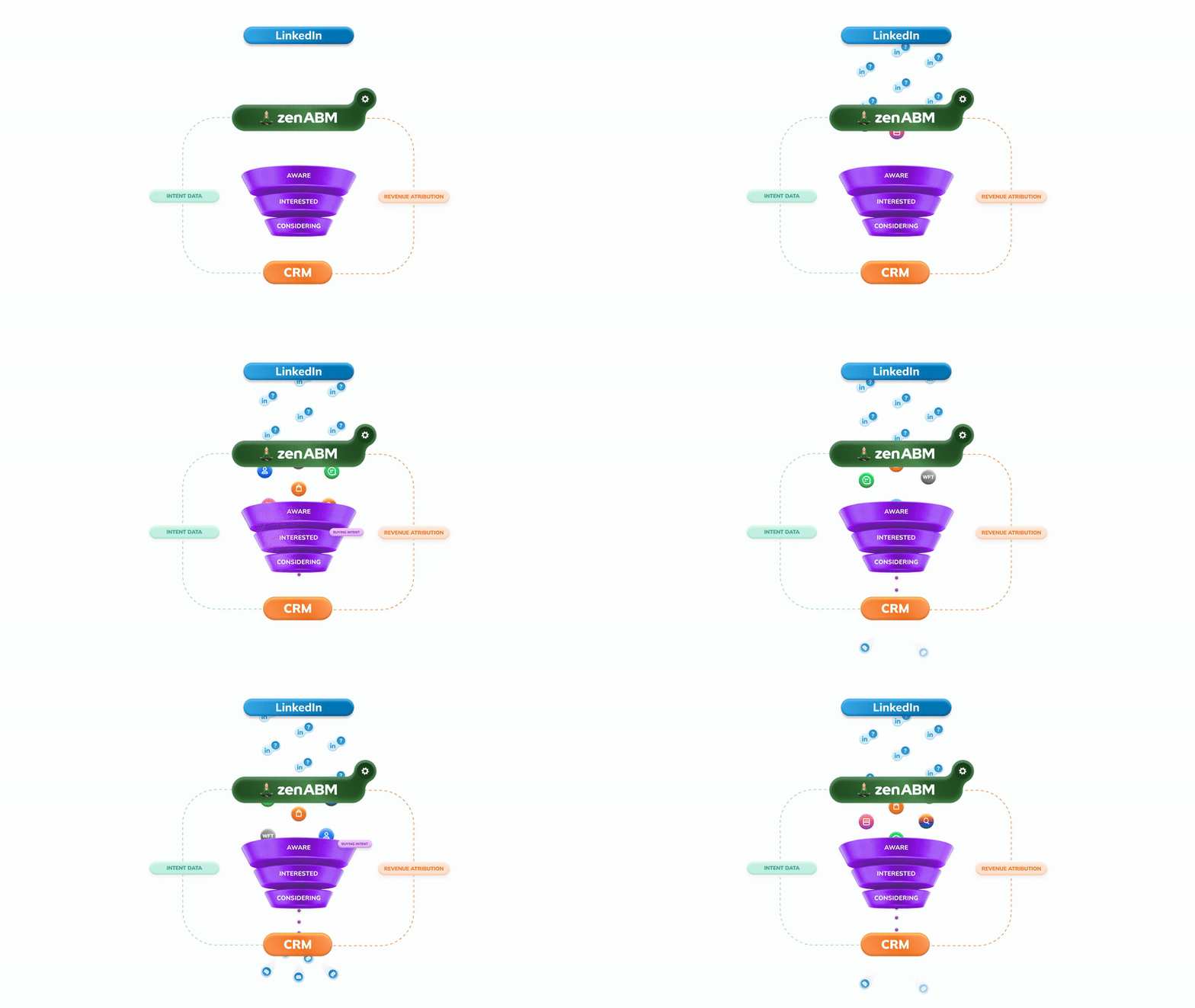
Website signals are the second most valuable category because they show direct interest in your brand (not just your category), but they come with a significant limitation: you need a visitor identification tool to connect anonymous web traffic to specific companies.
For known CRM contacts, HubSpot tracks page visits natively.
For anonymous visitors, you need Vector, RB2B, or a similar reverse IP tool to de-anonymize them.
The match rates tell the story of why these signals should complement LinkedIn signals rather than replace them.
In fact, website de-anonymization match rates peak at a mere 40%, reports Syft.
This means you miss at least 60% of visits, while LinkedIn API data is 100% reliable at the company level.
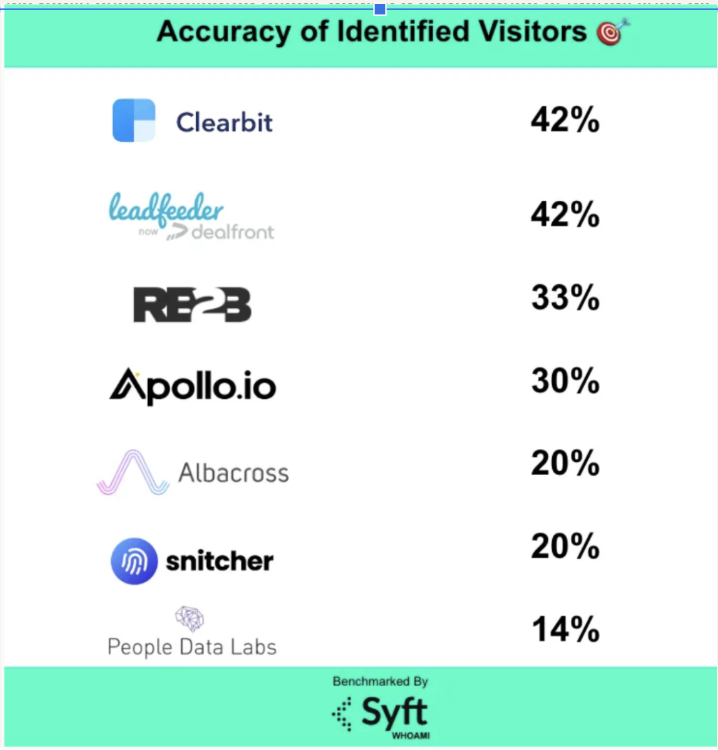
That said, the signals you do capture from website visits are extremely high intent, especially pricing and demo page visits, which is why they deserve P0 response priority when they come from a target account.
Here’s the list of the specific website engagement signals to track:
| Signal | Strength | Detection | Action |
|---|---|---|---|
| Pricing page visit | Very High | HubSpot tracking + reverse IP (Vector/RB2B) | Same-day BDR outreach |
| Comparison/alternative page visit | High | HubSpot tracking + reverse IP | Competitive positioning outreach |
| Multiple sessions in 7 days | High | HubSpot / GA4 + reverse IP | Account is actively researching: outreach within 24h |
| Case study or testimonial page visit | Medium-High | HubSpot tracking | Send the relevant case study directly |
| Blog post engagement (3+ posts) | Medium | HubSpot tracking | Continue nurturing, note topics for outreach |
| Demo page visit without form fill | Very High | HubSpot + reverse IP | Immediate outreach: they considered but hesitated |
Content and email signals are first-party data you already own, which makes them free to collect and easy to act on if your CRM is configured properly.
The limitation is that they are lower intent than ad clicks or website visits, because someone opening an email or downloading a whitepaper is engaging with your content, but has not yet demonstrated the kind of active research behavior that pricing page visits or sustained ad engagement represent.
That said, content signals are valuable as part of a composite picture.
A gated content download on its own is a medium-strength signal, but a gated content download from an account that also has 50+ LinkedIn ad impressions and visited your comparison page this week is a very different story.
The stacking principle (covered later in this guide) is what turns medium signals into high-priority outreach triggers.
Anyway, here’s a list of the must-track content and email engagement B2B buying signals:
| Signal | Strength | Detection | Action |
|---|---|---|---|
| Gated content download | Medium-High | HubSpot form submission | Nurture sequence + BDR follow-up within 48h |
| Webinar registration or attendance | Medium-High | Webinar platform + CRM | Post-event outreach referencing the topic |
| Email open + click (multiple emails) | Medium | HubSpot / email tool | Indicates engagement with your messaging |
| Email reply (positive) | Very High | Email tool | Immediate follow-up: book a meeting |
| Chatbot engagement | High | Chat tool (Intercom, Drift, etc.) | Route to BDR if the target account |
Social signals are first-party and free to detect, but they require manual monitoring because LinkedIn does not push these notifications into your CRM automatically.
A comment on your TLA from a VP at a target account is a high-intent signal that most teams miss entirely because nobody is systematically checking for it.
The key insight with social signals is that they reveal champions.
Someone who shares your content or comments on your TLA is publicly associating themselves with your brand, which means they are likely already an internal advocate or willing to become one.
These are the people your BDR should be building relationships with, not just adding to an outbound sequence.
Convinced that social signals are a must-track?
So, here are the specific social signals that matter the most:
| Signal | Strength | Detection | Action |
|---|---|---|---|
| Comment on your LinkedIn post / TLA | High | LinkedIn notifications/ manual | Personal LinkedIn message + add to warm list |
| Share of your content | High | LinkedIn notifications | Champion signal: nurture the relationship |
| LinkedIn connection request from the target account | Medium-High | LinkedIn notifications | Accept + start a conversation |
| Company page follow | Medium | LinkedIn page analytics | Continue content targeting |
Third-party intent data, the kind that Bombora, 6sense, and similar platforms sell, is useful for identifying accounts that are researching your category, but it comes with important caveats that most vendors understate.
Third-party intent tells you that someone at a company searched for a topic.
It does not tell you who, why, or how serious the intent is.
The data typically comes from cooperative networks of B2B publisher websites (Bombora tracks 17 billion interactions monthly across 5,000+ sites), and the signal represents elevated content consumption above baseline, not a specific buying action.
The Reddit and practitioner community consensus, as summarized by iBeam Consulting’s analysis of ABM forum discussions, is blunt:
“Use intent data as a filter rather than a trigger. Do not cold call someone because their company searched for ‘CRM.’ Instead, use that signal to prioritize which accounts in your existing list get the highest-value outreach.
This is the right mental model.
Third-party intent is a prioritization signal, not a buying signal.
First-party engagement (ad clicks, website visits) is a buying signal.
Anyway, here’s a list of third-party signals that must be on your radar, regardless of whether you treat them as prioritization signals or buying signals:
| Signal | Strength | Detection | Action |
|---|---|---|---|
| G2 profile/category page visit | High | G2 Buyer Intent | Competitive outreach: they are comparing |
| Competitor website visit | Medium-High | Bombora, 6sense, or similar | Competitive positioning outreach |
| Topic-level research surge | Medium | Bombora, 6sense | Add to campaign targeting, start warming |
| Search for your brand name | High | Google Search Console + SEM tools | Ensure you are visible in search results |
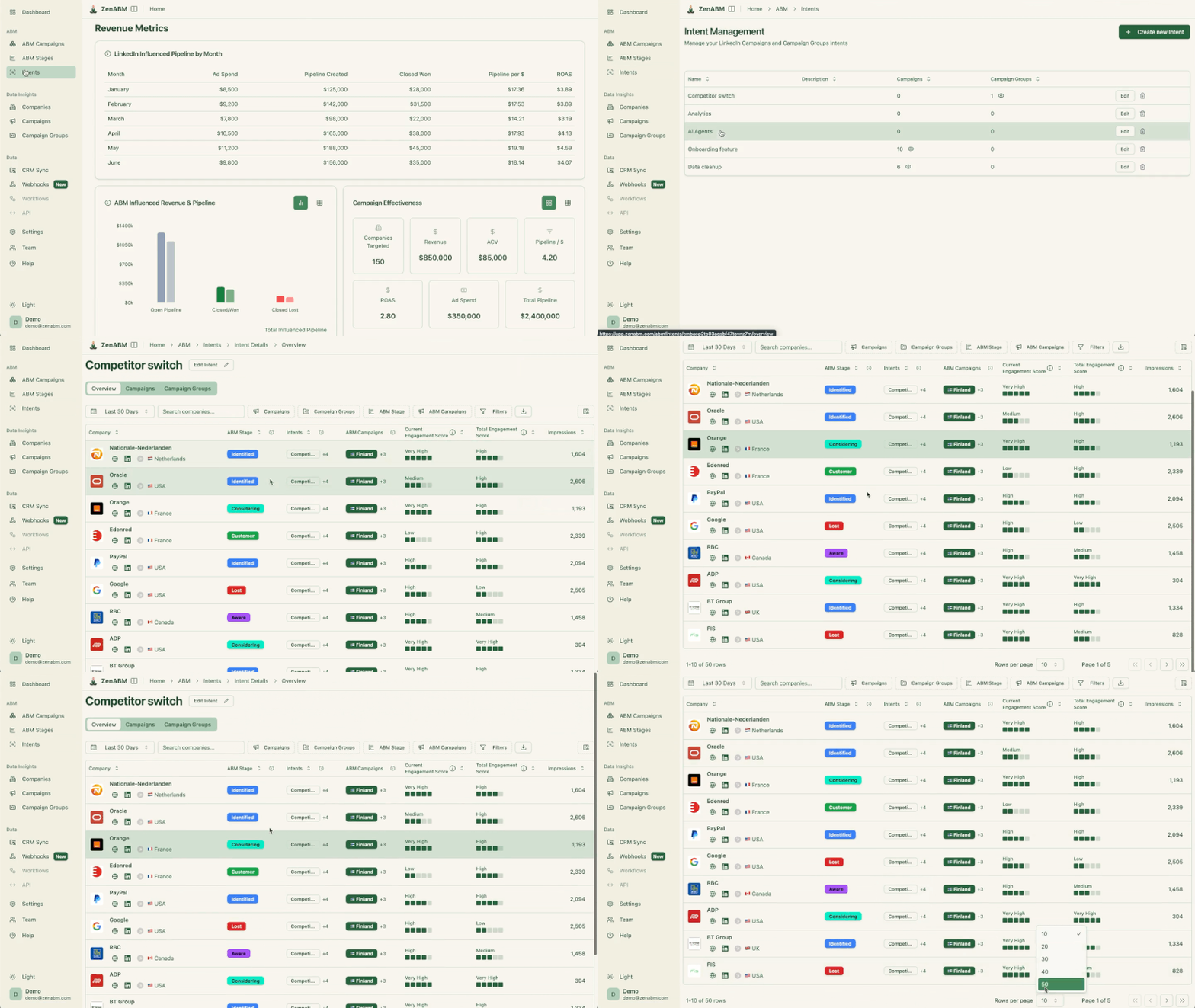
Pro Tip: Bombora typically costs $25,000 to $75,000 per year, 6sense and Demandbase charge $50,000 to $150,000+ annually, while G2 Buyer Intent comes at a lower price point as part of their review platform subscription. ZenABM starts at $59 per month and provides something none of those tools offer: qualitative intent from first-party data. Because ZenABM tracks engagement at the individual campaign and creative level, it knows whether an account engaged most with your competitor-switching ad, your onboarding analytics campaign, or your pricing-focused offer. That is functionally the same insight Bombora provides through topic-level research surges, except ZenABM’s version is first-party (from your own campaigns, not third-party publisher networks), tied to your specific messaging (not generic category keywords), and costs a fraction of what enterprise intent providers charge.
Corporate signals are contextual rather than intent-based, which means they tell you that conditions are favorable for a purchase rather than that someone is actively researching solutions.
That distinction matters because the response timeline is different: intent signals (ad clicks, pricing page visits) require same-day action, while corporate signals open a window of 30 to 90 days during which the account is more receptive to outreach.
Forrester’s 2025 research found that 92% of B2B buyers start with at least one vendor in mind, and 41% have already selected a preferred vendor before formal evaluation begins.
This means corporate signals are most valuable when they help you become the vendor buyers already know and trust before the buying process kicks off, rather than as cold outreach triggers after a funding round or leadership change.
Here are the corporate signals that must be on your radar to make the most out of this in-person channel:
| Signal | Strength | Detection | Action |
|---|---|---|---|
| Recent funding round | Medium-High | Crunchbase, Clay, news alerts | Outreach 2 to 4 weeks post-announcement. Reference growth. |
| New VP/C-suite hire | High | Sales Navigator alerts, LinkedIn, Clay | 30 to 90 day window. New leaders bring new vendors. |
| Headcount growth (10%+ in 90 days) | Medium-High | LinkedIn, BuiltWith, Clay | Growing teams need tools. Reference their growth. |
| Job postings for relevant roles | Medium | LinkedIn, Indeed, Clay | They are investing in the function your tool serves. |
| M&A activity | Medium | News, Crunchbase | Integration and consolidation create buying opportunities. |
| Contract renewal approaching (competitor) | High | Slintel, Clay, customer intel | Time outreach to pre-renewal evaluation window. |
| Earnings call mentions of relevant topics | Medium | Earnings transcripts, Clay | Strategic priority signal: reference their stated goals. |
Note: The funding + new VP hire combination is one of the highest-converting signal pairs in B2B. New money plus new leadership creates a 30 to 90-day window where the new leader is actively building their stack and open to new vendors. This is a well-documented pattern across sales organizations, and it is one of the few corporate signal combinations that approaches the conversion reliability of first-party intent signals.
Product signals are the highest-intent signals available for companies with a self-serve or free-trial motion, because they represent actual usage of your product rather than engagement with your marketing.
A trial signup is not someone who might be interested; it is someone who has already invested time in evaluating your solution, which puts them further along the buying journey than any ad click or website visit.
Tech stack changes, on the other hand, are a different type of product signal: they tell you that a company has either adopted or dropped a tool in your category, which creates either a complementary selling opportunity (they added a tool your product integrates with) or a competitive replacement opportunity (they removed a competitor and need an alternative).
Here are the product and technology-related signals you must track and utilize accordingly:
| Signal | Strength | Detection | Action |
|---|---|---|---|
| Trial signup / free tier activation | Very High | Product analytics, CRM | Product-led sales follow-up |
| Feature usage spike | High | Product analytics | Expansion conversation |
| Integration setup | High | Product analytics | Committed user: ensure success, plan expansion |
| Tech stack change (added/removed tool) | Medium-High | BuiltWith, Slintel, Clay | If they removed a competitor, they need an alternative |
Not all signals warrant the same response, and treating every signal as equally urgent is one of the fastest ways to burn out your BDR team while missing the signals that actually predict deals.
Use this matrix to match your response speed to the signal’s urgency:
| Priority | Signal Characteristics | Response Time | Example |
|---|---|---|---|
| P0: Immediate | First-party, high-intent, conversion signal | Minutes to hours | Demo request, pricing page + ad clicks |
| P1: Same Day | First-party, engagement threshold crossed | Hours | ZenABM stage change to “Interested” |
| P2: This Week | Third-party high-intent or stacked signals | 1 to 3 days | G2 visit + LinkedIn engagement, new VP hire |
| P3: This Month | Context signals, single medium-intent events | 1 to 2 weeks | Funding announcement, job posting |
The most common mistake: treating all signals as P1 or ignoring P3 entirely. A balanced approach monitors all categories but allocates BDR time according to priority. Our intent-based outbound guide covers the full workflow for each priority level.
The real power of buying signals is not in any individual signal but in the combination of multiple signals on the same account within the same time window.
Two signals on the same account convert at 5 to 10x the rate of a single signal, because each additional signal reduces the probability that the engagement is coincidental and increases the probability that the account is genuinely in-market.
High-converting signal stacks to watch for:
Also, the best signal detection stacks in 2026 are modular rather than monolithic.
High-performance teams layer HubSpot (first-party web signals) plus ZenABM (first-party LinkedIn ad signals) plus Clay (corporate event signals) plus G2 (competitive research signals) rather than relying on a single $100K enterprise platform that tries to do everything.
This modular approach costs less, produces higher-quality signals, and avoids the vendor lock-in that makes teams hesitant to switch when a tool underperforms.
The difference between a signal strategy that generates pipeline and one that generates dashboards nobody checks comes down to two things: starting with the right signals and building action workflows around them.
Start with first-party LinkedIn ad engagement signals because they are the highest-reliability, highest-specificity, and lowest-cost buying signals available in B2B.
They tell you not just that a company is interested, but what they are interested in, because the campaign and creative they engaged with reveals their specific pain point, competitive situation, or use case before your BDR writes a single word of outreach.
Layer website signals and content engagement on top to create signal stacks that convert at multiples of any single signal. Add corporate event signals and third-party intent as your team scales.
And accept the dark funnel: you will never see the full buying journey, but acting fast on the 30% you can see puts you ahead of competitors who are still waiting for form fills.
ZenABM is the detection layer for the most valuable category on this list: first-party LinkedIn ad engagement.
It tracks company-level impressions, clicks, and engagements from the LinkedIn Ads API, classifies qualitative intent based on which campaigns and creatives each account engaged with, assigns ABM stages automatically, and pushes everything into HubSpot or Salesforce so your reps see buying signals in their daily workflow rather than in a separate platform they will never check.
Starting at $59 per month with a 37-day free trial, it delivers the same category of insight that enterprise intent providers sell for $25K to $150K per year, except from first-party data that is specific to your messaging rather than generic topic surges.
Try ZenABM free for 37 days and start detecting the buying signals your competitors are missing.
Some expected questions about the list I shared and B2B buying signals in general:
The strongest B2B buying signals combine first-party engagement with high-intent behavior: demo page visits, pricing page visits, combined with sustained LinkedIn ad engagement, trial signups, and positive outbound email replies. Among LinkedIn signals specifically, engagement acceleration (a sudden increase in ad clicks from an account) is the strongest indicator of active evaluation. Stacked signals (two or more signals from different categories on the same account within the same time window) consistently outperform any single signal by 5 to 10x. See the full categorized list above for signal-by-signal strength ratings.
Start with the signals you can actually act on. For most ABM teams, that means LinkedIn ad engagement (via ZenABM), website visits (via HubSpot + visitor ID tool), and content engagement (via CRM). Add third-party intent and corporate event signals as your team capacity grows. It is better to act reliably on 5 signals than to monitor 30 and respond to none. The companies winning with intent data in 2026 share three traits: they start with first-party signals, they layer multiple types, and they build action workflows rather than dashboards.
Core stack: ZenABM for LinkedIn ad engagement signals ($59 per month), HubSpot for website/email/form signals, and Slack for real-time alerts. For broader coverage: Vector or RB2B for website visitor identification, Clay for corporate event signals (funding, hiring, tech changes), and G2 Buyer Intent for review site activity. Third-party intent providers (Bombora at $25K to $75K per year, 6sense at $50K to $150K+ per year) add topic-level research signals but are optional and significantly more expensive than first-party alternatives.
First-party intent data comes from your own properties: your LinkedIn ads (tracked via ZenABM), your website (tracked via HubSpot + visitor ID), your emails, and your product. It tells you who is interested in YOU specifically. Third-party intent data comes from external publisher networks (Bombora tracks 17 billion interactions across 5,000+ sites) and tells you who is researching your CATEGORY. First-party is always higher intent and more reliable. Third-party is broader but noisier. The best approach uses first-party signals as the foundation and third-party signals as a prioritization layer on top.
Automate the detection-to-outreach workflow. ZenABM detects LinkedIn engagement signals, scores accounts, and pushes stage changes to your CRM. CRM workflows route high-priority signals to BDRs via Slack. Webhooks push interested accounts to prospecting tools (LeadMagic, Prospeo) that automatically find contacts. Outreach sequences fire via SmartLead/Instantly (email) and HeyReach/Expandi (LinkedIn). The full workflow is covered in the ABM orchestration guide.
