



LinkedIn Conversation Ads are one of the easiest LinkedIn formats to abuse.
They land directly in the inbox, so bad targeting or lazy copy feels far more intrusive than a sloppy feed ad ever could.
That same intimacy is also what makes a well-executed LinkedIn conversation ads strategy so effective.
When the message is specific, the audience is warm, and the next step is genuinely useful, the inbox stops feeling like spam and starts functioning as a guided decision path.
This guide covers when to use Conversation Ads, when to avoid them, how to map them to ABM funnel stages, five templates built for specific program scenarios, and how to trigger them from intent signals captured in ZenABM rather than blasting cold ICP lists.
Before the deep dive, here is the version worth taping to a campaign manager’s monitor:
The single takeaway: a Conversation Ad is the next logical step for an account that has already raised its hand, not a megaphone for shouting at strangers.

Conversation Ads are part of LinkedIn’s Sponsored Messaging family.
They appear in a member’s LinkedIn inbox under the sender name of a real person from the advertising company and let the recipient choose between multiple CTA buttons inside the same message.
Each button can route to a different landing page, lead form, or follow-up message.
The format is often confused with Message Ads, the older single-message Sponsored Messaging unit, and the difference matters more than it sounds.

That branching is the entire point.
A good Conversation Ad gives the buyer a small menu instead of a hard choice between yes and no.
The branching also yields cleaner data on what recipients actually want, because the CTA they pick is itself a signal about their intent and stage.
The inbox feels personal.
Even when LinkedIn clearly labels the message as Sponsored, recipients still treat it as direct outreach.
That perception is an asset when the message earns it and a liability when it does not.
Conversation Ads are not simply ads. They are paid InMail with branching, and they need to read like something a thoughtful human would actually send.
Conversation Ads perform best as a follow-up channel, almost never as a first touch.
The format does heavy lifting once an account is already aware of the brand and warm enough to engage with a direct message.
Used cold, it trains the ICP to mute the sender name.
Here is how the use cases split.
Best use cases:
Use cases to avoid:
Ali Yildirim (founder at Understory) has been writing about this format for a while, and his data lines up with what practitioners see in the field. In one of his recent posts on shifting budget away from expensive image ads, he wrote:
“Conversation ads delivered even better results. One client was paying close to $1,000 per lead on single image ads. Switched to conversation ads and dropped cost per lead to $400-500. Same targeting, massive difference in efficiency. That spread gives you real room to scale without blowing up your CAC.”
– Ali Yildirim, LinkedIn post

The takeaway is not “switch all spend to Conversation Ads.”
It is when the audience is right, the format compounds, because every click is qualified by the CTA button the recipient chose.

The single biggest mistake teams make with Conversation Ads is decoupling them from the account stage.
They get treated like a generic sales tactic instead of a stage-specific tool.
When running ABM on LinkedIn properly, every format has a job, and Conversation Ads have a narrow but powerful one.
Usually not the right place to start. Feed ads, Thought Leader Ads, document ads, and founder-led awareness content come first. The point of these formats is to earn enough recognition that an inbox message later does not feel like an ambush.
Conversation Ads can be used sparingly here, but the ask must stay soft. Educational resources and event invitations work, while hard demo asks do not. Good CTAs at this stage: “read the guide,” “register for the webinar,” “see the benchmark report.”
This is the sweet spot. The account has clicked, watched, opened, or otherwise engaged with relevant content, making a Conversation Ad the natural next step. Good CTAs: “see how it works,” “compare options,” “get a consultation.”
Stronger offers belong here. The account is evaluating, so Conversation Ads can carry direct asks like “book a demo,” “talk to us,” “get an audit,” or “see ROI for your stack.” This is also an effective moment for benchmarking and business case content.
Use carefully and coordinate with sales. The last thing to want is a Conversation Ad landing in the buyer’s inbox while an AE is in a procurement thread with the same person. At this stage, ads should reinforce, not interrupt.
For teams still figuring out how to move accounts from Aware to Considering, that is the single most useful exercise to complete before touching Conversation Ads. The format is leverage, and leverage applied at the wrong stage is just noise.
The shift that makes this format work is straightforward: stop sending Conversation Ads to everyone in the ICP audience and start triggering them off engagement signals captured at the company level.
Here’s how you should go about triggering conversation ads based on signals:
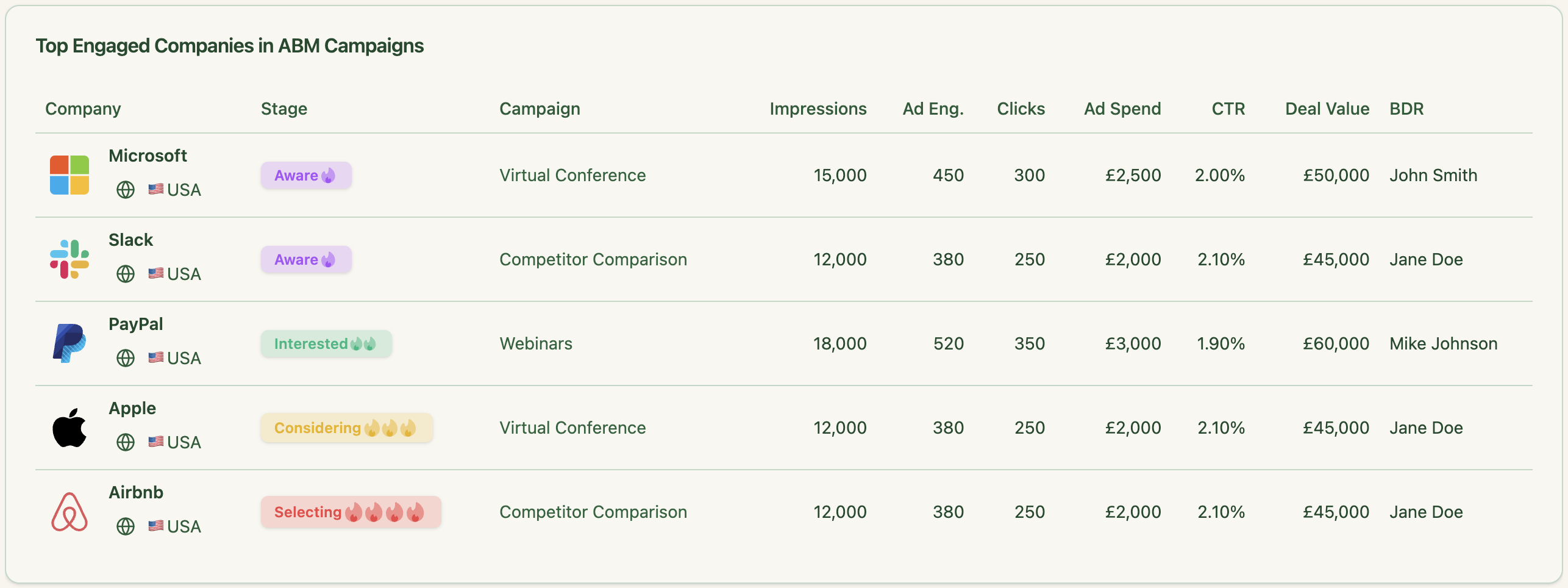
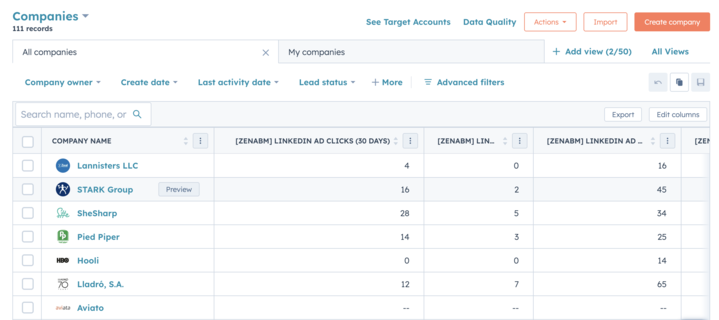
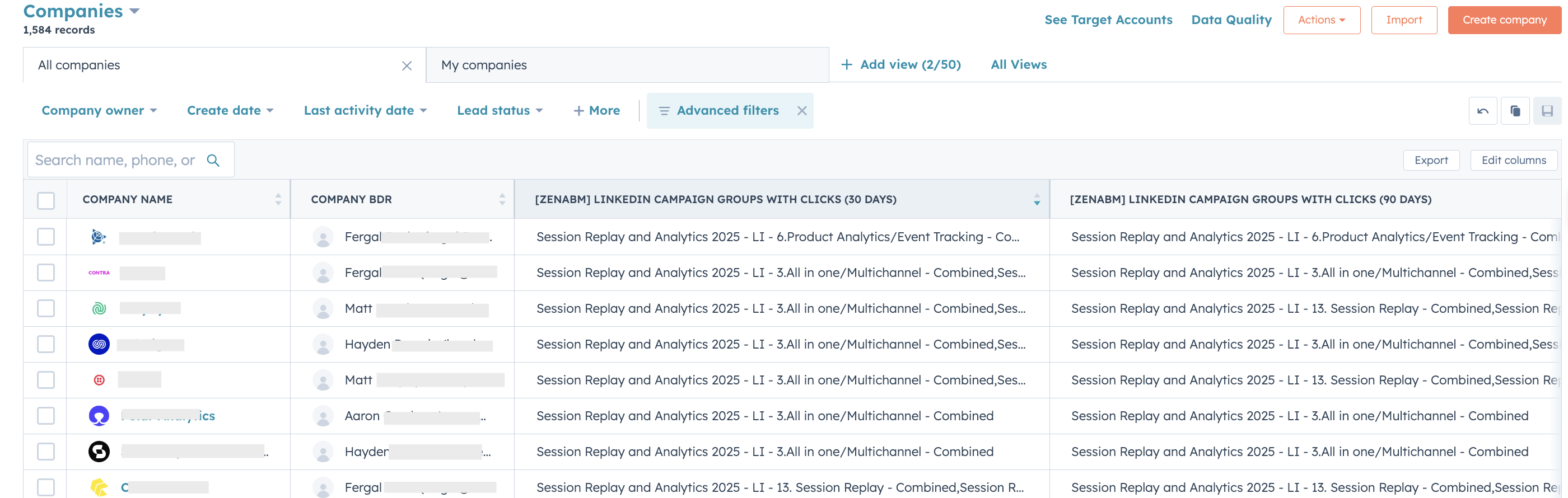
By the way, ZenABM can help you track the company-level engagement data for each specific ad and also provides company engagement scores and ABM stage. closed-attribution, AI analytics, CRM sync, BDR workflows, and a lot more – so all that you need for your LinkedIn conversion ads strategy is available in one place in ZenABM.



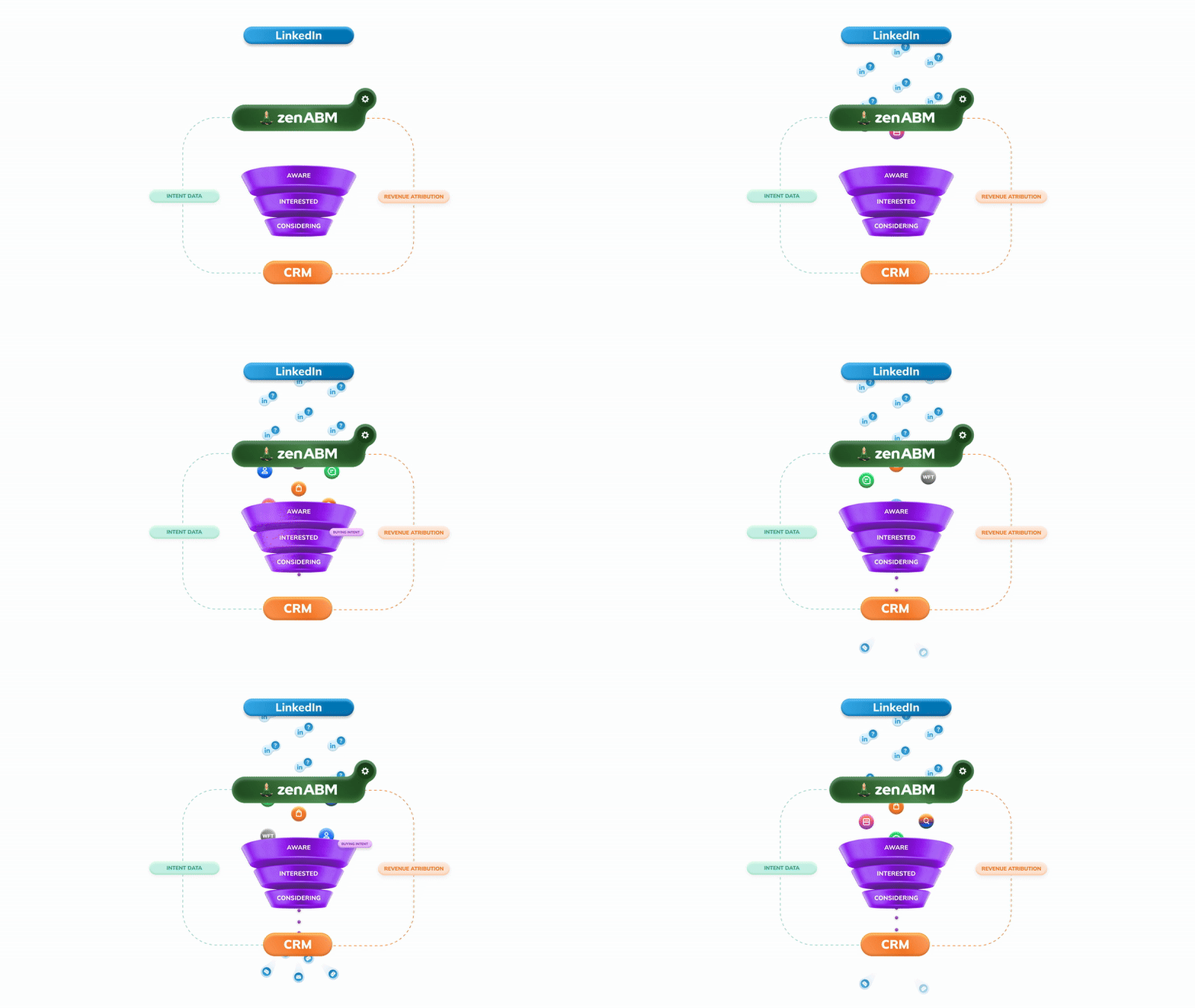
An illustrative flow you can take inspiration from:
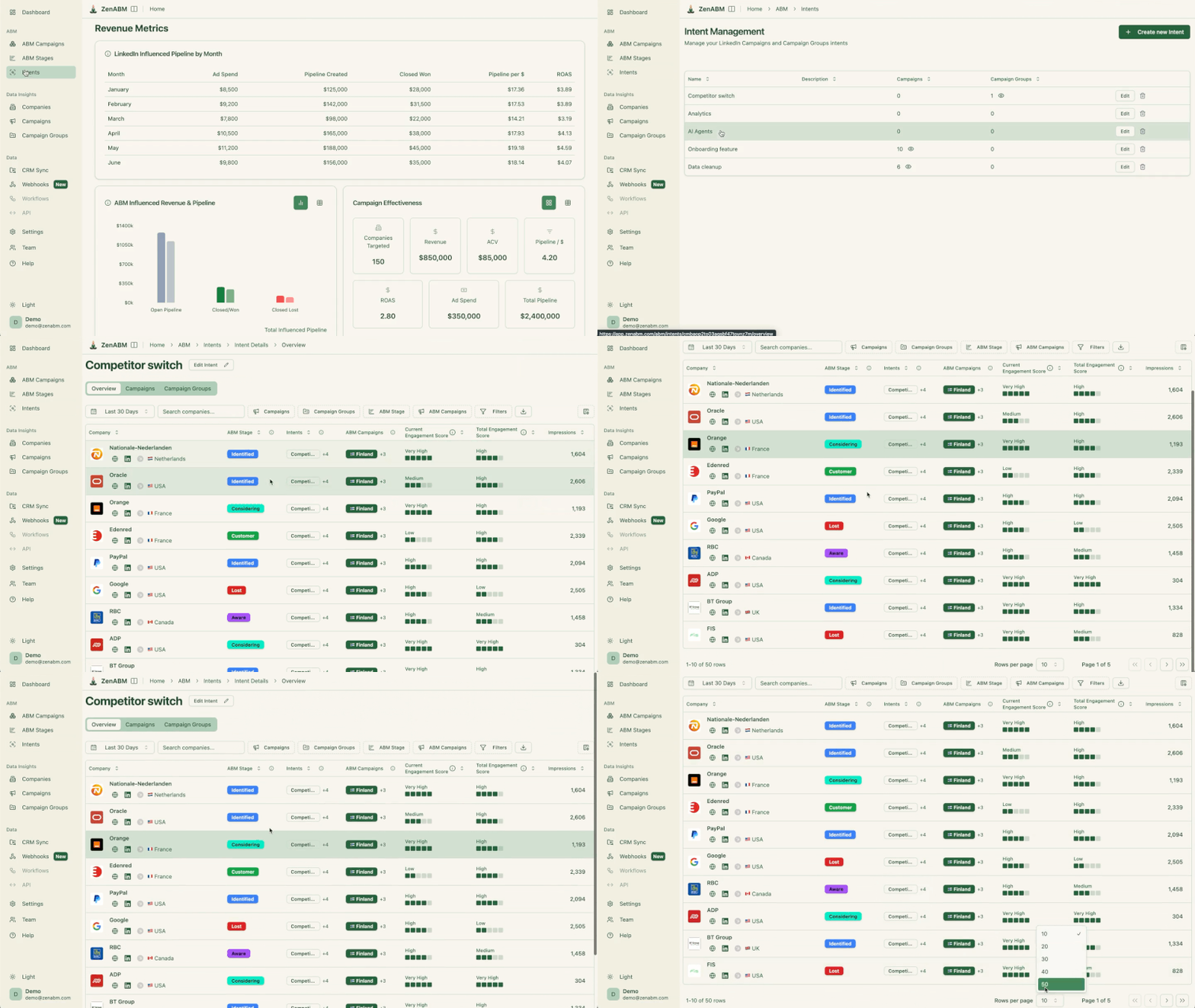
The CTA selection itself is data.
Someone who clicks “send me the benchmark” is a different prospect from someone who clicks “book a walkthrough,” and they should not receive the same follow-up sequence. Identifying high-intent accounts from LinkedIn ad data is what turns a Conversation Ad from a clever format into an actual pipeline lever.
Philip Ilic (LinkedIn ads specialist) has been pulling apart what makes Conversation Ads work and fail at scale.
He summed up the analysis bluntly:
“I’m currently analysing 10s of thousands of pounds in conversation ads to work out why some do so well and others fall flat. Incentives work really well. Every time I put an incentive into these, they seem to get a lot more engagement.”
– Philip Ilic, LinkedIn post
Incentives can absolutely work, but they only work cleanly when the audience is already qualified.
Bolting a $100 gift card onto a cold blast simply attracts low-intent clicks.
Bolting it onto an already-engaged Interested cohort can compress weeks of nurture into a single message.
Across dozens of examples in the wild and campaign-level data from practitioners, the pattern is consistent.
The Conversation Ads that actually work tend to share a short list of traits:
Bad Conversation Ads almost always violate one of two rules: they pretend to be more personal than they are, or they escalate the ask to “book a demo” before the relationship can support it.
The five templates below map cleanly to ABM funnel stages.
Treat them as starting points and rewrite them to match the specific program voice.
Best for: Aware or early Interested accounts.
Opening: “A lot of B2B SaaS teams are trying to figure out which LinkedIn campaigns are actually influencing pipeline, not just generating clicks. We pulled the benchmarks from 200+ ABM accounts.”
CTAs:
Best for: Interested accounts with topic-level intent (for example, attribution).
Opening: “If your team is exploring LinkedIn ad attribution, this might save you a few hours. Here is the workflow used to tie LinkedIn spend back to pipeline at the company level.”
CTAs:
Best for: warm target accounts and existing engaged contacts.
Opening: “There is a 30-minute practical session running on turning LinkedIn ad engagement into ABM pipeline. Bring your CRM. Leave with a workflow.”
CTAs:
Best for: Interested or Considering accounts.
Opening: “Want to see which companies are engaging with your LinkedIn ads, not just how many clicks you got? An audit covers the last 90 days and walks through what the data shows.”
CTAs:
Best for: closed-lost accounts showing renewed engagement on LinkedIn.
Opening: “Since the last conversation, account stages, intent signals, and company-level LinkedIn ad engagement reporting have all been added. The product is not the same one that was evaluated.”
CTAs:
Notice that every template gives the recipient an exit: “Not relevant,” “send me the overview,” “show me later.” Giving people a graceful out is what keeps the sender’s name off the mute list.
CTAs should get more direct as the account gets warmer.
That is the entire principle, and mismatched CTAs are why most Conversation Ads underperform.
So, you must first have an ABM stages framework setup.
Something like this:

And then you should match the CTAs to the stage like this:
| Stage | CTA Examples | Tone |
|---|---|---|
| Aware | Read the guide, see the benchmark, register for webinar, view examples | Educational, low-commitment |
| Interested | See how it works, watch demo, get audit, compare tools | Solution-aware, exploratory |
| Considering | Book demo, talk to sales, get implementation plan, build business case | Direct, decision-focused |
| Selecting | Coordinate with sales only, usually no new ad | Reinforcement, not interruption |
One pattern that consistently improves CTA selection: include one “soft exit” button on every ad. “Not relevant,” “send me later,” “I am not the right person.”
That button protects sender reputation and produces a real signal when an account self-selects out.
There is a thin line between relevant and surveillance-grade, and Conversation Ads cross it more often than feed ads because they feel like direct messages.
Do:
Do not:
Better: “For teams trying to connect LinkedIn engagement to pipeline, here is the workflow.”
Worse: “We saw you clicked our LinkedIn attribution ad yesterday.”
The first one references a job.
The second references surveillance. Both might technically come from the same data, but only one is a message anyone wants to receive.
Most Conversation Ad reporting stops at opens, sends, and CTR, which is useful for diagnostics but does not answer the only question that matters: did this format influence the pipeline for accounts that were actually worth reaching?
Vanity metrics to log but not optimize against:
Metrics that actually matter:
LinkedIn Campaign Manager will give you the first list.
Connecting the second list requires account-level tracking.
That is the gap ZenABM closes: see which companies engaged with your LinkedIn ads, push that engagement into HubSpot or Salesforce, and tie the results back to the pipeline.

Patterns that appear again and again, often within the same campaign:
Tim Davidson talks about this from the ABM side, especially the part about treating warm and cold audiences with completely different formats.
Segmenting “WARM = activation (retargeting, DM/convo ads, offers)” from cold awareness is the difference between ads that build a pipeline and ads that simply spend budget.
Conversation Ads are one of the few LinkedIn formats where the mechanics directly reward good ABM discipline. The branching CTA structure means every recipient self-sorts by intent, the inbox placement means only relevant messages survive, and the format fails loudly when targeting is lazy, which makes it a useful forcing function.
The teams that get the most out of this format share one habit: they treat the Conversation Ad as the third or fourth step in a sequence, not the opening move. Feed ads and Thought Leader content build the recognition. Intent signals confirm the readiness.
The Conversation Ad closes the gap between “this account has raised its hand” and “sales has a qualified conversation booked.”
That sequencing is also what makes measurement clean.
When Conversation Ads fire only to accounts that have already hit an engagement threshold, the pipeline attribution is defensible because the audience was pre-qualified before the send.
The tools, templates, and trigger logic in this guide are all executable without a large budget or a complex tech stack. The only non-negotiable is account-level engagement data, because without it, there is no reliable way to separate warm accounts from cold ones, and the format reverts to expensive cold outreach with extra steps.
ZenABM surfaces that company-level engagement data directly from the LinkedIn API, stages accounts automatically, and syncs everything into HubSpot or Salesforce so Conversation Ads fire at the right moment rather than the first available one.
The 37-day free trial covers enough time to run a full intent-triggered sequence and see the pipeline impact firsthand.
Try ZenABM for free now or book a demo to know more!
A LinkedIn conversation ads strategy is a plan for using Sponsored Messaging conversation ads as a stage-specific follow-up channel for warm and engaged accounts, rather than as a cold outreach format. The strategy covers when to use the format, which CTAs map to which funnel stages, and how to trigger sends from intent signals captured in ZenABM or a connected CRM.
Yes, when used as a warm follow-up format. Conversation Ads work best for Interested and Considering accounts that have already engaged with feed ads, Thought Leader Ads, or founder content. Used as a cold blast to ICP audiences, they tend to underperform and burn sender reputation. The economics often improve when paired with account-level engagement data so sends only go to accounts that have already raised a hand.
Define thresholds for stage progression: 50+ impressions for Aware, 5+ clicks or 10+ engagements for Interested, and demo or pricing page visits for Considering. Capture those signals at the company level, sync them to a CRM, and only fire Conversation Ads to accounts that hit Interested or Considering. ZenABM handles this end to end for LinkedIn engagement, including pushing stage and intent into HubSpot and Salesforce.
Message Ads are single-message, single-CTA Sponsored Messaging units. Conversation Ads use the same inbox placement but offer 2 to 5 branching CTA buttons inside one message. The branching gives recipients more control and gives advertisers richer signal, because the CTA chosen reveals stage and intent.
The CTA should match the account’s funnel stage. For Aware accounts, soft asks like “read the guide” or “see the benchmark” work best. For Interested accounts, “see how it works,” “get an audit,” or “compare tools” perform well. For Considering accounts, direct asks like “book a demo” or “talk to sales” are appropriate. Always include a soft exit option like “not relevant” so recipients can self-select out without muting the sender name.
