ZenABM ABM Bootcamp 2026: Everything We Learned from 19 Sessions in 4 Weeks
Yashasvi Saxena
Share this post
Over 300 B2B marketers signed up.
19 sessions.
10 guest experts.
5 core workshops.
4 weeks.
One goal: help you launch your first LinkedIn ABM campaign from scratch, and do it right.
The ZenABM ABM Bootcamp 2026 is officially done.
Below is a full summary of every session, covering what we discussed, the key takeaways, and links to every recording on YouTube.
Top 10 Takeaways from the ABM Bootcamp
Before we get into each session, here are the biggest lessons that came out of 4 weeks of workshops and expert talks.
TLAs are 5x cheaper per landing page click than image ads. Live data from our Workshop 4 campaign showed $1.78 per click for TLAs versus $9.64 for image ads, with the same audience and same budget.
Four LinkedIn default settings silently burn your budget. Audience Expansion, LinkedIn Audience Network, Maximum Delivery bidding, and Budget Optimization are all ON by default. Turn them OFF every single time.
“Ugly” text-heavy ads outperformed polished creative for warm audiences. Bullet points, product screenshots, and dense copy beat the design team’s best work.
A bad target account list is a silent budget killer. If 30% of your accounts are a bad fit, you train LinkedIn’s algorithm to optimize toward non-ICP companies. Your CPMs look fine, but the pipeline never materializes.
47% of leads at one company were never touched by sales. The campaign worked, but the system was broken. ABM fails when routing fails.
Adding a CTA link to TLAs took one client from 1 demo per month to 6. Most people skip the link entirely. Do not skip the link.
LinkedIn’s TLA CTR metric is misleading. The Performance tab counts likes, comments, shares, and “see more” clicks rather than landing page clicks. Go to the Engagement tab for real numbers.
The median Deal Open Rate from LinkedIn ABM is 0.58% based on our 2026 benchmarks report analyzing 211 companies and $5.5M in ad spend.
CTV ads have 50% cheaper CPMs than LinkedIn feed and 100% view rate, making them an underused B2B channel that drives incremental lift in organic search and direct traffic.
Signals decay. A job change from 6 months ago is not a hot signal today. Account scoring must be a living system that refreshes constantly.
Now let’s dig into each session, week by week.
Week 1: ABM Foundations
Let’s start by looking at the learnings from the sessions held in the first week of the bootcamp:
1. Campaign Strategy and Plan (LinkedIn Ads) by Emilia Korczynska, VP Marketing at Userpilot
The opening session covered end-to-end ABM campaign strategy.
Emilia Korczynska (VP of marketing at Userpilot) walked through how she built Userpilot’s ABM program from zero to $5M+ in influenced pipeline and 2x ROAS in under 18 months on approximately $490K in total ad spend.
Key takeaways:
Reverse-engineer your budget from revenue goals. Revenue target / ACV = deals needed. Deals / 0.58% deal open rate = accounts needed. Work backwards to impressions and budget.
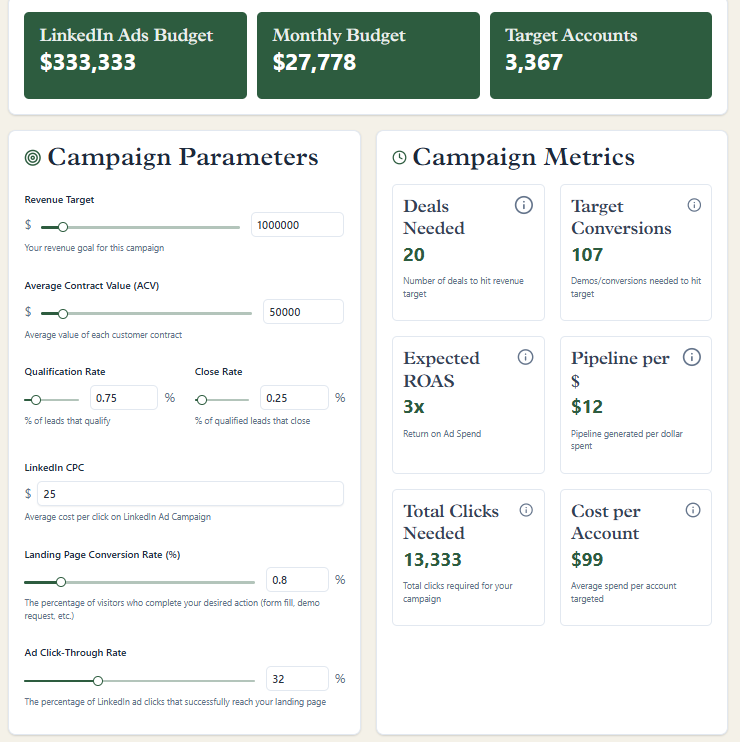
Budget determines structure, not ideas. $10,000 per month / 30 days = $333 per day. At $8 CPC and 4 clicks per ad per day, that is 10 ads max. Use the ZenABM ABM budget calculator to run your numbers.
2. LinkedIn Ads + GTM Outbound Strategy by Philip Ilic, Founder at Kiln
Philip’s outbound strategy
Philip covered how to combine LinkedIn advertising with outbound GTM motions, and the core idea is straightforward: LinkedIn ads warm accounts, outbound captures them.
Use LinkedIn ads as the warm-up layer for your outbound sequences, because accounts that have seen your ads are significantly more receptive to cold outreach.
Coordinate timing: run ads for 2 to 3 weeks before starting outbound to the same accounts so they have enough exposure to recognize your brand when the email arrives.
Track which accounts are engaging with ads and prioritize those for outbound follow-up rather than running outbound against the entire list blindly.
3. Multi-Channel ABM: How to Combine Paid Media + GTM Engineering by Ali Yildirim, Understory
Ali broke down how to orchestrate ABM across multiple paid channels and GTM engineering workflows rather than relying on LinkedIn alone.
LinkedIn is the starting point, not the entire strategy. Layer in email, direct mail, events, and other paid channels as budget allows.
GTM engineering bridges the gap between marketing signals and sales action by automating the handoff so engaged accounts do not sit in a queue waiting for manual review.
Budget allocation should follow signal strength, not channel preference. Put more money where you see more engagement, not where you are most comfortable.
4. From Segmentation to Signal: AI + ABM Workflows by Katya Tarapovskaia
Katya’s recommended stack for AI ABM workflows that she shared in the ZenABM ABM Bootcamp 2026
Katya explored how AI is changing ABM workflows, from smarter segmentation to signal detection and automated account scoring.
AI classification of ICP fit using models like GPT-4o mini achieves 90 to 95% accuracy at minimal cost.
Use AI to analyze closed-won and closed-lost patterns to build better target account lists based on what actually predicts success rather than what you assume does.
Automate signal detection rather than relying on manual review of engagement data, because by the time a human reviews it, the signal has often already decayed.
Clay centralizes enrichment from multiple data sources (Apollo, ZoomInfo, Sales Navigator) into one workflow so you are not juggling separate tools for each data type.
Build “derived data” by using AI to create characteristics that do not exist in raw form but can be derived from enrichment and AI analysis of public information.
Push enriched, scored accounts directly to LinkedIn ad audiences and outbound tools so the output of your enrichment workflow feeds directly into campaign execution.
6. ABM in 2026: The Ups and Downs of the Old Dog by Casper Rouchmann, Sparkforce
Casper gave a candid assessment of where ABM stands in 2026, what has changed, what still works, and what marketers keep getting wrong.
ABM is not new, but the execution is evolving fast. The fundamentals (target the right accounts with relevant messaging) have not changed, but the tools and tactics have.
The biggest mistake: overcomplicating it too early. Start simple with one persona and one campaign, prove ROI, then expand.
Sales alignment is still the number one failure point for ABM programs in 2026.
Done with the sessions of the first week, let’s summarise the ones in the second:
7. Why Your ABM Campaigns Deserve Better Landing Pages by Tas Bober, Founder at The Scroll Lab
Tas shared her “Where” framework for building ABM landing pages that actually convert, and the core principle is to create for where the buyer is in their journey, not just who they are.
“Create for where, not who.” Personalize landing pages by buying stage rather than just by account name or industry.
Build your landing page like a business case because the buyer needs to justify the purchase internally to a committee, not just convince themselves.
Most ABM landing pages fail because they try to do too much. One page, one message, one action.
8. List Building Workshop with Clay by Bilal Ahmad, GTM Engineer at Userpilot
https://ie.linkedin.com/in/bilalahmad-
Bilal walked through the full process of building a target account list using Clay, from the “truth list” approach to AI-powered scoring.
Start with your existing customers as the “truth list.” Enrich them, analyze patterns with AI, then find lookalike accounts based on the data rather than assumptions.
A bad list is a silent budget killer. If 30% of accounts are a bad fit, LinkedIn’s algorithm optimizes toward those non-ICP companies and the damage compounds over time.
Contact activity proxy: below 200 to 300 LinkedIn connections means the person is likely inactive on LinkedIn, so do not push them to ad audiences.
AI classification with GPT-4o mini costs less than $1 for thousands of accounts and achieves near-perfect accuracy.
9. LinkedIn Ads TLA Q&A by Gabriel Ehrlich, Founder at Remotion
Gabriel brought 10+ years and 250+ LinkedIn ad accounts worth of experience to this live Q&A. Remotion’s clients include Monday.com, Gong, and Yotpo.
Minimum viable ABM budget: $2,000 to $3,000 per month. Below that, it is hard to see meaningful results.
Company lists have much better match rates than contact lists, so always prefer company lists when uploading to LinkedIn.
Use open text fields for self-reported attribution, not dropdowns. UTMs combined with self-reported attribution captured 70% of the total pipeline for one client.
Company page organic reach is basically useless for B2B demand generation, so focus on individual organic reach instead.
Tier 2 ($10K to $50K ACV): Strategic gifting, handwritten notes, and custom reports. One team shipped Argentinian wine to Latin American prospects and closed an account immediately.
Tier 1 (approximately $10K ACV): Research co-creation, podcast invites, and LinkedIn articles tagging them.
The “Account Love Letter”: Build a custom plan for a target account, publish it as a LinkedIn post, and tag their decision makers. Stefan’s COO of a target company reached out within days.
14. ABM for Lean Teams and Fractional Leaders by Veronika Vebere, Founder at Inbound House
Veronika shared a practical guide for marketers with limited resources who want to run ABM on LinkedIn.
The number one mistake: mismanaging expectations. A client asked “We spent $600 last week, how much pipeline?” when their ACV was $75K with a 12-month sales cycle.
5 pillars of a successful ABM pilot: Can you afford it? Watertight target account list. Signal plus conversion tracking. Crystal clear brief. Weekly reporting.
Budget: allocate 5 to 10% of the total marketing budget to experiments. Aim for 3 to 5x ROAS (5x is stellar, 10x is exceptional).
ABM is a pipeline and revenue assist motion, not a standalone demand channel. Especially at higher ACV, you need events, dinners, and direct outreach alongside ads.
19. Live Workshop: Your ABM Ads Teardown by Emilia Korczynska and Nihal
The grand finale.
We reviewed real performance data from the campaign we launched 2 days earlier in Workshop 4.
TLAs: $1.78 per landing page click. Image ads: $9.64. Five times cheaper for the same outcome.
LinkedIn’s TLA CTR is misleading. The Performance tab counts likes, comments, shares, and “see more” clicks. Real metric: go to the Engagement tab and calculate Clicks to Landing Page / Impressions.
Text-heavy, “ugly” ads had the highest CTRs. The most visually creative ads barely crossed the 0.35% CTR floor.
The 1,000 impression / frequency 2 rule: Never make ad decisions before hitting both thresholds.
Copyright warning: The “Dude with a Sign” meme creator sued Userpilot for $150,000. Use AI to regenerate meme formats instead of using the original.
Square ad format significantly outperforms rectangular.
Think you absorbed everything from 4 weeks of bootcamp?
Take the ZenABM ABM Knowledge Test, which is 12 questions covering budget calculation, campaign setup, ad formats, and account scoring.
Get a certificate of completion when you pass.
And if you are planning your first ABM campaign, start with the free ABM budget calculator to figure out exactly how much you need to spend to hit your pipeline targets.
Everything Taught in the ZenABM ABM Bootcamp 2026: The Final Takeaway
The ZenABM ABM Bootcamp 2026 made one thing crystal clear: ABM success is not about flashy creative or massive budgets. It’s about precision, timing, and measurement.
The data speaks for itself.
TLAs outperform image ads by 5x.
Text-heavy creative beats polished design work.
Bad target account lists silently destroy ROI. Sales alignment failures kill campaigns that actually generate engagement. And 47% of leads go untouched because systems break before channels do.
If you walked away with one takeaway, let it be this: ABM is a system, not a channel. It lives at the intersection of smart targeting, relevant messaging, account-level engagement data, and operational activation.
Campaign Manager gives you ad performance. But account-level engagement, stage progression, and pipeline influence require a tool built specifically for ABM – one that bridges LinkedIn Ads and your CRM, automates routing, and surfaces the signals that matter.
That’s why companies like Userpilot went from zero to $5M+ in influenced pipeline in 18 months.
They didn’t get lucky. They built a system, measured it obsessively, and moved fast.
Start small.
Pick one persona.
Build a TAL grounded in your closed-won patterns, not assumptions.
Reverse-engineer your budget from revenue targets, not channel preference.
Run ads for 2 to 3 weeks before outbound. Then measure everything at the account level.
All 19 bootcamp recordings are free on YouTube.
The frameworks, benchmarks, and speaker playbooks are all there.
The hard part is not learning what to do – it’s actually doing it.
Ready to implement what you learned?
ZenABM gives you the visibility and automation layer to turn LinkedIn ad engagement into a pipeline.
Multiple speakers recommended a minimum of $2,000 to $3,000 per month to see meaningful results, with $10,000 per month as the recommended starting budget for a proper ABM program.
Take the ABM Knowledge Test, which covers the core concepts from all 4 weeks.
Pass, and you get your certificate.
Will there be another ABM Bootcamp?
We are considering running another cohort. Follow ZenABM on LinkedIn for announcements.
What tools do I need to run LinkedIn ABM?
At minimum: LinkedIn Campaign Manager, a CRM (HubSpot or Salesforce), and a way to track account-level engagement (ZenABM).
For list building and enrichment, Clay was the most-recommended tool across bootcamp speakers. For outbound automation: SmartLead or LemList for email, and HeyReach for LinkedIn.