

©2026 ZenABM - All Rights Reserved.

LinkedIn warm campaigns are the part of the funnel most B2B teams skip, and that gap is usually why LinkedIn ads “do not convert.”
The typical pattern is a single cold awareness campaign pointed at a large audience, with no follow-up after the initial impression.
Accounts that saw the ad never received a second touch, so the awareness spend evaporated without producing a pipeline.
This post separates two concepts that get mixed up constantly: a warm campaign, which describes who you target, and a LinkedIn consideration objective, which describes what LinkedIn optimizes for.
Once those two ideas are distinct, the sequencing logic from cold to warm to consideration becomes clear, and accounts can actually progress toward the pipeline rather than stalling after the first exposure.
The single biggest unlock in account-based programs on LinkedIn has never been a clever creative.
It is the order.
The warm audience gets built first, and then the consideration budget gets spent on the people who already raised their hands.
Let’s dive into this much deeper in the article.
Short on time?
Here’s a quick summary:
A warm campaign is any campaign that targets an audience of people or accounts who have already interacted with the brand.
That is the whole definition.
The warmth comes from the audience, not the ad format and not the objective.
Cold targeting uses a list, a job-title filter, or a company filter pointed at people who have never heard of the product. Warm targeting uses a retargeting audience built from a signal of prior interest.
On LinkedIn, the most common warm audiences are:
Warm campaigns matter so much in B2B because the buying window is long and multi-touch.
Maximilian Herczeg, a LinkedIn ads consultant and former LinkedIn employee, makes this point repeatedly, like in a LinkedIn post.
“You need countless touchpoints coming from different efforts (e.g. LinkedIn + Sales) to make them convert. This takes time (3-6 months and longer). Your Marketing and Sales Mix are puzzle pieces that work together, not in silos.”
If conversion takes six months and a dozen touches, a single cold campaign was never going to close it.
The warm campaign is the mechanism that delivers touch two through twelve to the right people, maintaining presence across the full buying window rather than disappearing after the first impression.

LinkedIn organizes its campaign objectives into three buckets that map to the funnel: awareness, consideration, and conversion. The objective chosen when creating a campaign tells LinkedIn what action to optimize delivery for, and it changes which bid types and ad formats are available.
The consideration tier sits in the middle of that funnel and contains three objectives:
Above consideration sits awareness (optimizing for impressions and reach).
Below it sits conversion (Lead Generation, Website Conversions, and similar).
The key distinction to internalize is that “consideration” describes the optimization goal, while “warm” describes the audience. A consideration objective can run against a cold audience or a warm one.
The results improve substantially when consideration objectives run against warm audiences, because the budget is directed toward driving deeper engagement from people who already know the brand.
Here’s a side-by-side comparison of warm campaign versus consideration ads:
| Question | Warm Campaign | Consideration Ad |
|---|---|---|
| What does it describe? | The audience (who gets targeted) | The objective (what LinkedIn optimizes for) |
| Built from | Prior engagement: ad engagers, video viewers, site visitors, list engagers | Website Visits, Engagement, or Video Views optimization |
| Main job | Deliver touch two through ten to known accounts | Drive a click, a view, or a social action |
| Best paired with | A consideration or conversion objective | A warm or cold audience, depending on stage |

Warm campaigns only work if there is actually a warm audience to target, and most teams under-build this layer.
The order below runs from cheapest to highest intent, because building the pool correctly at each stage determines the quality of retargeting available in the next.
A cold awareness or engagement campaign with a short video or a strong Thought Leader Ad builds an engaged audience that can be retargeted immediately.
Herczeg describes exactly this play for the top of the funnel in his LinkedIn post.
“1st campaign: prospective customers that don’t know about us. Communicate value proposition, show your main product/service, use videos (15-40 seconds). Why videos? Low cost per video view, low barrier for users to watch the video, easy to create an ‘engaged’ audience.”
The “easy to create an engaged audience” point is the core mechanic.
A video-view campaign is not just brand reach; it is an audience-building machine for the warm campaign that runs next, so the objective of the cold campaign should be evaluated on audience pool size, not lead count.


Installing the LinkedIn Insight Tag and building matched audiences from website traffic creates a retargeting layer tied to real purchase intent.
Retargeting all visitors with one message squanders that signal, because intent is not uniform across the site.
A pricing-page visitor deserves a different consideration ad than someone who read a top-of-funnel blog post, so the audience should be split by page type before the campaign is configured.
For account-based programs, the most valuable warm audience is the subset of the target account list that has already started engaging.
These are accounts that were chosen for a strategic reason and are now showing a real signal.
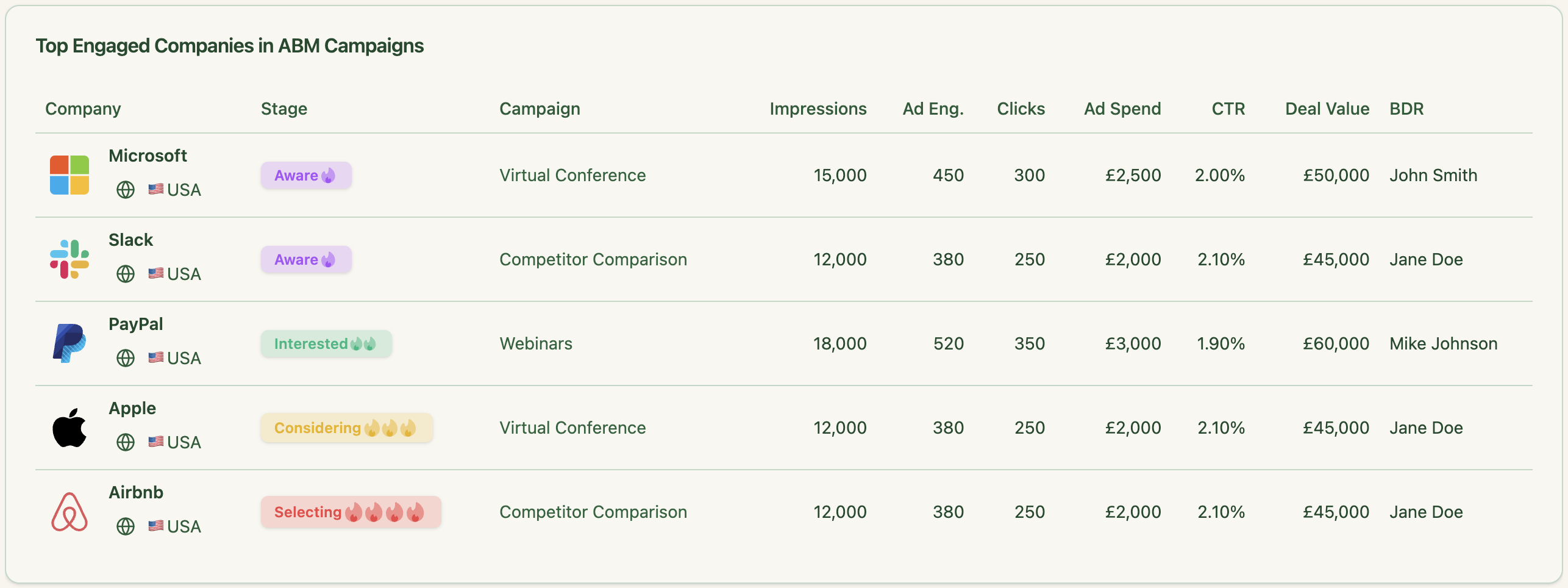
The challenge is that LinkedIn Campaign Manager shows company engagement at a coarse level, so identifying which named accounts are warming up requires account-level tracking.
Seeing which companies engage with LinkedIn ads at the individual account level changes the audience-building logic, because the next campaign can be built around accounts that are clearly heating up rather than treating the full target list as equally cold.
ZenABM can help here as it tracks company-level engagement for each LinkedIn campaign and even other channels like Reddit ads, Google ads, etc.




Try ZenABM Free
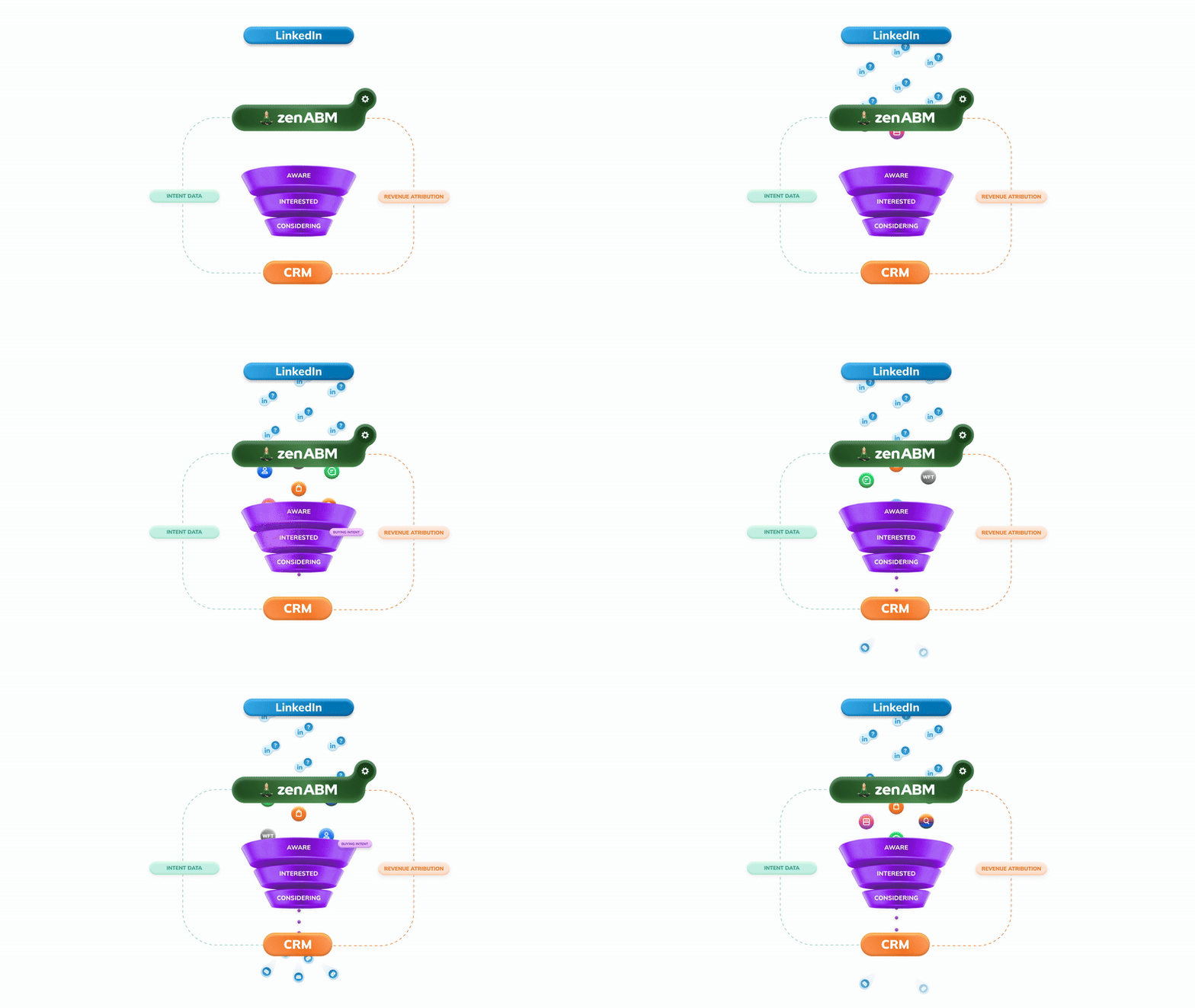

This sequencing is what turns scattered campaigns into a funnel.
The goal is a deliberate progression where each stage feeds the next, so an account is never asked to jump from “never heard of you” straight to “book a demo.”
A complete sequence does not stop at the demo.
A warm campaign running against open opportunities serves case studies and proof to keep the deal warm between meetings, which prevents deals from going cold during long procurement cycles.
For a full account-based version of this sequencing, the ultimate guide to running ABM on LinkedIn walks through the campaign structure end to end.

Not every format belongs at every stage.
The consideration stage rewards formats that earn attention and let an account go deep, rather than formats that push for a click too early before trust has been established.
Format choice should match the objective.
If the campaign uses an Engagement objective to grow a warm pool, lead with a Thought Leader Ad.
If the campaign uses Website Visits to move warm accounts to an asset, a document ad, or a strong Thought Leader Ad with the link handles the job.
The same account needs a different message depending on how warm it is.
Reusing one piece of copy across the whole funnel is the most common mistake that sinks warm campaigns: the warm audience gets served the same cold “here is who we are” ad, and it is already ignored, so the retargeting spend produces nothing beyond frequency.
The rule of thumb: cold copy talks about the buyer’s world, warm copy talks about the vendor’s evidence, and hot copy talks about the decision.
If a warm ad still sounds like a cold ad, the sequence is broken even if the audience setup is technically correct.
The uncomfortable truth about warm campaigns is that the metrics LinkedIn surfaces cannot confirm whether they are working. CTR, CPC, and impressions describe individual ad performance but say nothing about whether an account moved from aware to interested, or whether a warm campaign is pulling accounts down the funnel or simply spending money on people who will never buy.
Measuring progression requires two things that live outside Campaign Manager.
First, engagement is tracked at the account level, so it is possible to see which named companies are warming up rather than just an anonymous click count.
Second, ABM stages, so accounts can be watched crossing from one stage to the next over time, rather than measuring only point-in-time ad metrics.
Herczeg is direct about the differentiated measurement that consideration campaigns require in his LinkedIn post:
“Using the same metrics for all campaigns? Better: differentiate the KPIs per campaign goal. Brand Awareness: reach, impressions, frequency. Website Visits: CTR, CPC. Video Views: eCPV, view rate, completion rate.”
Each objective needs its own KPI, and there is one layer above that: the metric that actually matters for a warm program is stage movement.
How many accounts crossed from aware to interested this month, how long they sat in each stage, and which campaigns drove the movement are the questions that reveal whether the program is working.
The two metrics worth defining are eCTR, the effective click-through rate to the landing page, and eCPC, the effective cost per landing-page click, because they measure real intent rather than a social reaction.
ZenABM joins company-level LinkedIn ad engagement to CRM data, assigns accounts to ABM stages, and surfaces which accounts are progressing, stalling, or surging so the warm campaign can be optimized on stage movement rather than guessing from aggregate click counts.


Once stage progression is visible, the warm campaign stops being a black box.
It becomes clear which consideration ads move accounts and which generate cheap engagement that never converts, and the budget can be reallocated accordingly.
It also clarifies where a warm program fits among the different ABM strategy types, because one-to-many warm retargeting and one-to-few high-touch sequences need different measurement frameworks to assess effectiveness.
Try ZenABM Free
A few patterns sink more warm programs than anything else, and they are all fixable once named clearly.
Fixing those five patterns shows up fast in the numbers, because warm audiences are inherently cheaper and higher-converting than cold ones.
The budget is no longer spent introducing the brand to strangers; it is spent deepening a relationship that already exists.
The reason most LinkedIn ad programs stall is not budget, creative, or targeting.
It is the absence of a second act.
A cold campaign gets launched, impressions are generated, and then the budget resets for the next campaign rather than retargeting the people who already responded.
The warm campaign is what keeps an account in motion between those touchpoints, delivering the proof, depth, and repeated presence that B2B buying cycles actually require before a deal enters the pipeline.
Building that sequence correctly, cold to warm to hot to in-pipeline, requires knowing which accounts are responding at each stage.
That is not information LinkedIn Campaign Manager surfaces natively, because its reporting aggregates across audiences and reports at the ad level rather than the account level.
Knowing that a specific target account went from seeing a Thought Leader Ad to clicking a case study to visiting a pricing page is the signal that tells both the campaign manager and the sales rep that something is worth acting on.
ZenABM tracks exactly that progression at the company level, pulling first-party engagement data from the LinkedIn API and mapping it to ABM stages so the movement from aware to interested to hand-raiser is visible in one place rather than inferred from disconnected ad reports.
The result is a warm program that can be optimized on the metric that actually matters: how many target accounts advanced a stage this month, and which campaigns drove that movement.
You can run a free 37-day trial to see the account-level view that their current reporting is missing, or book a demo with us to know more!
A warm campaign is defined by its audience: the target is people or accounts who already engaged, such as ad engagers, video viewers, or website visitors. A consideration ad is defined by its objective: LinkedIn optimizes for Website Visits, Engagement, or Video Views. A consideration objective can run against a cold or a warm audience, and the strongest results come from running consideration ads against a warm, retargeted audience where the groundwork has already been laid.
LinkedIn groups campaign objectives into awareness, consideration, and conversion. The consideration tier includes Website Visits (optimizing for clicks to the advertiser’s site), Engagement (optimizing for social actions on LinkedIn, which builds a warm audience for retargeting), and Video Views (optimizing for video plays, which is the cheapest way to build a large engaged pool). These sit between top-funnel awareness and bottom-funnel conversion objectives like Lead Generation.
Start by running cold campaigns that generate engagement, such as a short video or a Thought Leader Ad, so LinkedIn can build an engaged audience from viewers and engagers. Then add website retargeting through the Insight Tag, narrowed to high-intent pages, and layer in company-list engagers for account-based programs. The richest warm audience is the subset of the target account list that has already started engaging, which account-level engagement tracking in ZenABM surfaces at the named-account level rather than as an anonymous aggregate.
CTR, CPC, and impressions cannot confirm that an account progressed, so account-level engagement and ABM stage tracking are needed on top of LinkedIn’s native metrics. Watching how many accounts cross from aware to interested, how long they sit in each stage, and which campaigns drive the movement is the real measure of a warm program. ZenABM joins LinkedIn ad engagement to CRM data to surface exactly this, so stage movement is visible rather than inferred from click totals.
For most warm B2B campaigns, Website Visits is the safer choice. LinkedIn’s algorithm struggles to optimize for conversions on the smaller volumes typical of account-based programs, so a Website Conversions objective often costs more for similar results. Website Visits is the right objective for moving a warm audience to an asset, with conversion objectives reserved for the hottest and highest-intent retargeting pools where volume is large enough for the algorithm to learn.
