

©2026 ZenABM - All Rights Reserved.

LinkedIn conversation ads are the interactive evolution of LinkedIn message ads.
Instead of sending a single message with one CTA, conversation ads let you build branching paths with multiple buttons that lead to different follow-up messages, each with their own CTAs.
Think of them as a choose-your-own-adventure experience inside your target accounts’ LinkedIn inboxes.
I have tested conversation ads across multiple ABM campaigns tracked through ZenABM, and the results are pretty nuanced.
They can work well for specific use cases, but they also add complexity that is not always justified.
In this guide, I will cover when conversation ads make sense for ABM, how to set them up, and when you are better off with simpler message ads.
Here’s a quick overview of the guide:

LinkedIn conversation ads are an inbox-based ad format that allows you to create interactive message flows.
When a recipient opens the ad, they see a message with multiple CTA buttons.
Each button leads to a different follow-up message, which can have its own set of buttons, creating a branching conversation tree.
The following are the key characteristics of LinkedIn conversation ads that you must note:

The honest answer is that for most ABM use cases, simple message ads are more effective than conversation ads.
Here is why:
When you are running ABM on LinkedIn, you typically have a clear objective for each campaign to drive target accounts to a specific landing page, invite them to a specific event, or offer them a specific piece of content.
So, you require one message and one CTA provided by message ads.
On the contrary, the branching paths in conversation ads can dilute the action you actually want people to take.
Building a conversation ad requires creating a decision tree: initial message, multiple button options, follow-up messages for each path, and potentially additional branches.
This takes time to set up and test.
For most ABM campaigns, that effort is an overkill and is better spent optimizing the targeting and creative of simpler formats.
Conversation ads make sense when you genuinely need to segment or qualify the recipient within the ad experience.
Specific scenarios where they work for ABM:
Here are the steps to set up LinkedIn conversation ads:

For ABM conversation ads, use the Website Visits objective.
As Maximillian Herczeg (LinkedIn ads specialist and founder at Kamrat, a marketing agency) recommends:
“Do not use website conversions. It’s a more expensive version of website visits.” – Max Herzeg, former LinkedIn employee and Founder of Comrade

Upload your company list, layer in job function and seniority filters, and turn off audience expansion.
This is standard for any ABM format on LinkedIn.

Choose a sender whose profile photo, name, and title will resonate with your target audience.
Here, the same rules apply as message ads: the sender matters more than the message copy in determining open rates.
This is where conversation ads get interesting (and complex).
Here is a structure that works for ABM:
1. Opening message: Keep it short. Reference something relevant to the recipient’s industry or role. End with a question or set up the button choices.
2. Button options (2-3 max):
3. Follow-up messages: Each path gets a short message (2-3 sentences) with a single CTA button linking to the appropriate landing page.
Do not build more than 2 levels deep.
One initial message with buttons, leading to one follow-up message with a CTA.
Deeper trees have diminishing returns because people do not want to click through multiple rounds of a chatbot-like experience in their LinkedIn inbox.

When I think about where conversation ads fit within a broader ABM campaign structure, they are a mid-to-bottom funnel tactic.
They work best when the recipient has some existing awareness of your brand.
Use thought leader ads, spotlight ads, and text ads for awareness.
Conversation ads are too expensive and too personal for cold audiences who have never heard of you.
This is where conversation ads can add value.
Target accounts that have engaged with your top-of-funnel content might appreciate an interactive message that lets them self-select their interest area.
The branching format works as a lightweight qualification tool.
For bottom-of-funnel, simple message ads with a direct demo or meeting CTA typically outperform conversation ads.
When someone is ready to convert, you do not want to add extra steps between them and the conversion action.
Some tips you can consider while utilizing conversation ads for account-based marketing:
Too many choices create decision paralysis.
So, about two or three buttons is the sweet spot.
That’s enough to let people self-select, but not so much that they close the message without clicking anything.
Each branch of your conversation tree should deliver genuine value.
If someone clicks “Show me the data,” they should get a link to real data.
If they click “Not right now,” respect that with a graceful exit, not another sales push.
If paths aren’t valuable, their very purpose is defeated.
Including a “Not now” or “Not interested” button might seem counterproductive, but it actually improves the experience.
It shows respect for the recipient’s time and can include a soft CTA like “Follow us for updates” that keeps the relationship alive.

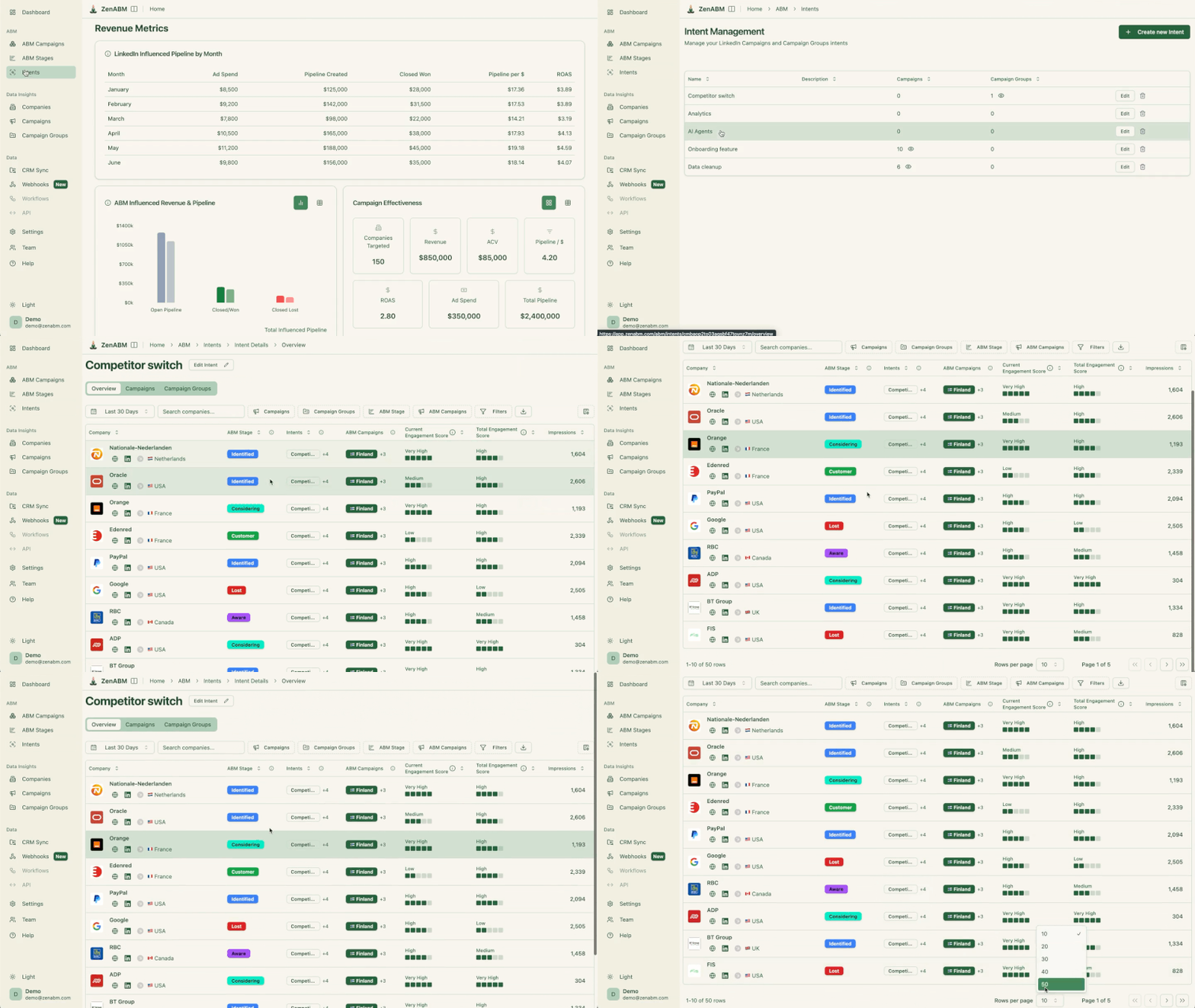
One advantage conversation ads have over message ads is the ability to track which buttons people click.
This gives you intent data.
For instance, if someone at a target account clicks “Show me pricing,” that is a stronger signal than clicking “Show me the blog.”
You can use company engagement tracking to feed this data back to your sales team.
And if you want that intent data to be operational rather than just interesting, ZenABM’s CRM sync, first-party qualitative intent, and account scoring can help you distinguish low-stakes curiosity from genuine buying signals across target accounts.


Before committing to conversation ads, run an A/B test against a simple message ad with the same offer.
In my experience, the simpler format often wins for ABM because it removes friction from the conversion path.
Some common mistakes that you must avoid when you are running conversation ads for ABM:
One more practical point: when a target account starts engaging more deeply, that is usually the moment you want action, not just observation. ZenABM’s automated BDR assignment and custom webhooks can help teams route those engaged accounts into follow-up workflows faster, which is especially useful when conversation ads are being used as a qualification layer rather than a standalone tactic.


LinkedIn conversation ads can be useful for ABM, but only when the format serves a real strategic purpose.
If you need to qualify interest, route different personas, or let engaged accounts choose their next step, they can work well.
But if your goal is simply to drive one clear action, message ads are often the better choice.
The key is not to get distracted by interactivity for its own sake.
In ABM, clarity beats cleverness most of the time.
Use conversation ads when the branching logic adds value, keep the flow simple, and measure what happens after the click, not just inside the inbox.
And if you want to go beyond surface-level metrics, ZenABM can help connect conversation ad engagement to account stages, intent signals, and actual pipeline movement.
Try ZenABM for free (37-day free trial) or book a demo now to know more!
Not necessarily. For most ABM use cases, simple message ads with a single CTA are more effective because they reduce friction. Conversation ads work best when you genuinely need to segment or qualify recipients within the ad experience, such as routing different personas to different content.
Conversation ads use the same cost-per-send pricing model as message ads. Costs are comparable. Expect to pay between $0.50 and $1.00 per send for ABM audiences. The frequency cap is also similar, around once every 45 days per advertiser.
Yes, LinkedIn allows you to attach Lead Gen Forms to conversation ad CTA buttons. However, for ABM campaigns, I recommend driving to landing pages instead. Lead gen form leads tend to be low intent, and in ABM, you already know which accounts you are targeting.
Keep it simple: 2-3 buttons on the initial message, each leading to one follow-up message with a single CTA. Do not go deeper than 2 levels. The more branches you add, the more the experience feels like a chatbot rather than a personal message.
Yes. Like message ads, conversation ads are delivered to the LinkedIn inbox and can be opened on both desktop and mobile devices. The branching experience works on both platforms.
