



When our CEO asked me “What’s the ROI on our ABM program?” six months into our first campaign, I did not have a good answer. I had click-through rates. I had cost per click. I had impressions. But I could not draw a clean line from our LinkedIn ad spend to pipeline and revenue.
That was the moment I realized most ABM teams are measuring ROI wrong – or not measuring it at all. The tools and attribution models that work for demand gen do not work for ABM. And if you cannot prove ABM ROI, you cannot scale it.
After 16 months of running ABM on LinkedIn, we generated $5.29M in pipeline from $490k in ad spend. That is $10.79 in pipeline per dollar spent and over 2x ROAS in closed-won revenue. In this post, I will walk through exactly how we measure ABM ROI – the metrics, the attribution model, the dashboards, and the mistakes that most teams make – and the ABM ROI benchmarks we’ve seen across 211 users of ZenABM in our Linkedin ABM Benchmarks report 2026.

ABM ROI measurement is fundamentally different from demand gen ROI. Here is why most teams struggle with it.
Our average time from first ad impression to deal creation is 60-90 days for mid-market accounts and 90-180 days for enterprise. You cannot measure ABM ROI after 30 days (let alone less 🤡).
The pipeline does not show up that fast.
Teams that evaluate ABM performance on a monthly conversion basis will always conclude it is not working – even when it is.
B2B purchases involve 6-10 stakeholders. Your LinkedIn ad might reach the VP of Product, the Director of Engineering, and the CFO at the same company – all seeing different ad formats at different times. Traditional attribution tracks individual clicks. ABM ROI needs to track account-level engagement across all those individuals.

A target account might see 30-50 ad impressions across TLAs, single image ads, and retargeting before anyone books a demo. Which impression created the pipeline? All of them did. No single touchpoint deserves 100% of the credit – and no single touchpoint deserves 0%.
This is the core problem. Click-based last-touch attribution – the default model in Campaign Manager and most analytics tools – systematically underreports ABM ROI. It credits only the last ad clicked before conversion, which means every awareness touchpoint that built trust and familiarity gets zero credit.
I have seen teams shut down successful ABM programs because their attribution model told them the ROI was negative – when the real issue was that the model was ignoring 80% of the influence.

Let me walk through a real example to show why click-based attribution breaks ABM ROI measurement.
Account: Acme Corp (target account, $50k ACV product)
Under click-based last-touch attribution, the retargeting ad gets all the credit. The TLAs that started the whole buying journey? Zero credit. The single image ad that educated the product team? Zero credit.
Now multiply this across 200 target accounts and 12 months. Your attribution model is telling you that TLAs generate no pipeline and retargeting generates all of it. So you cut TLA budget and double retargeting spend. Pipeline drops. You conclude ABM does not work.
The problem was never the ABM program. The problem was the attribution model.
Influence-based attribution solves this by asking a different question. Instead of “which ad did they click last?”, it asks “which campaigns touched this account before the deal was created?”
When I switched from click-based to influence-based attribution for our ABM campaigns, three things happened:


Based on our data and the 2026 benchmarks across 211 companies, here are the ABM ROI metrics I track and report on.
These predict future pipeline. If they are trending up, pipeline will follow.
| Metric | What It Measures | Target |
|---|---|---|
| Target account reach | % of TAL with 1+ ad impression | 50%+ within first 60 days |
| Engagement rate | % of reached accounts with clicks or interactions | 15-25% of reached accounts |
| Stage progression | Accounts moving from Aware to Engaged to Interested | 5-10% monthly stage movement |
| Account engagement score trend | Average engagement score increasing over time | Upward trend quarter over quarter |
| Ad spend efficiency | Cost to reach one target account | Decreasing as campaigns mature |
These are the ABM ROI numbers your leadership and board care about.
| Metric | Formula | Benchmark (from our data) |
|---|---|---|
| Pipeline influenced | Deal value from accounts with ad engagement | $5.29M from $490k spend (our 16-month result) |
| Pipeline per dollar | Influenced pipeline / ad spend | $10.79 per dollar spent |
| ROAS (closed-won) | Closed revenue from influenced accounts / ad spend | Over 2x (we achieved this after 16 months) |
| Deal open rate | % of engaged accounts that created a deal | Varies by ACV – 5-15% typical |
| Average deal size lift | Deal size from ABM accounts vs non-ABM | ABM accounts typically 20-40% larger |
| Sales cycle impact | Days to close for ABM vs non-ABM accounts | 10-30% shorter for engaged accounts |
The critical insight: ABM ROI should always be measured using pipeline per dollar, not cost per lead. ABM does not generate leads in the traditional sense. It influences buying committees at target accounts. Measuring cost per lead will always make ABM look expensive compared to demand gen, even when it is generating 5-10x more pipeline.

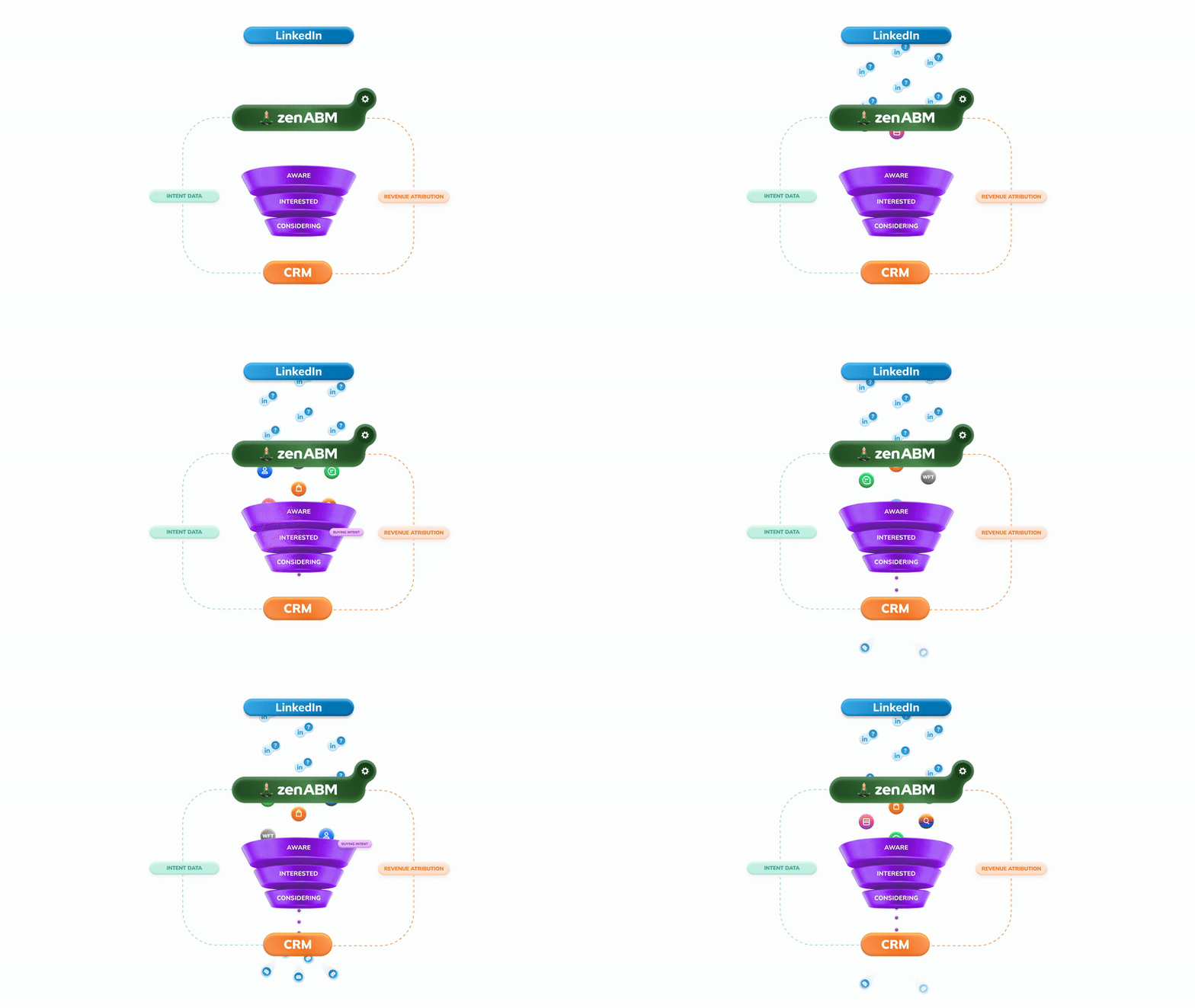
Here is the step-by-step process I use. It is the same framework I have built into ZenABM.
Your TAL is the foundation. Every ABM ROI calculation depends on it. Upload your list to LinkedIn Campaign Manager and to your ABM analytics tool. Score accounts by fit before they enter campaigns – not every company on your list deserves the same budget.
You need a tool that captures which companies are engaging with your ads – not just campaign-level aggregates. ZenABM connects to LinkedIn’s API and captures engagement data at the company level for every campaign, including impressions, clicks, and engagement scores.
Map your funnel stages and set engagement thresholds:
Push your LinkedIn engagement data into your CRM. At minimum, you need engagement scores and ABM stage as company properties. This lets sales see which accounts are ad-engaged before outreach, and lets you match deals back to ad exposure for attribution.

Set up the logic: when a deal is created in your CRM for a company that appears in your LinkedIn engagement data, flag that deal as “influenced.” Credit all campaigns that touched the account before the deal creation date.
ZenABM does this automatically. It connects your CRM deals to your LinkedIn ad data and calculates pipeline influence, ROAS, and pipeline per dollar for each campaign.
Your dashboard should show:

Here is what ABM ROI looks like in practice, using data from our own campaigns and from ZenABM customers.
Looking back, three things had the biggest impact on our ABM ROI:
1. Budget concentration on top performers. From our benchmarks data, monthly ad spend has the strongest correlation with pipeline (Spearman rho = 0.511, p=0.002). Top performers spend $6,576/month – 144% more than the median of $2,693. Spending enough to reach your target list with sufficient frequency matters more than perfect creative.
2. TLA-heavy format mix. TLAs get only 7-10% of average ABM budget, but they have the highest efficiency score (9.5 out of 10). We allocated 40-50% of budget to TLAs. The low CPC ($2.29 vs $13.23 for single image) means we reached more accounts more frequently with the same spend.

3. Influence-based attribution from day one. Because we measured using influence-based attribution, we could see the true impact of awareness campaigns. This prevented us from cutting TLA budget when leadership pushed for “more conversions” – because we could show the pipeline influence trail.

Based on data from our benchmarks report and ABM Bootcamp participants, here is what realistic ABM ROI looks like at different stages.
| Timeline | What to Expect | ABM ROI Target |
|---|---|---|
| Months 1-3 | Building awareness, reaching target accounts, gathering engagement data | No pipeline ROI yet. Focus on leading indicators: reach, engagement rate, stage movement |
| Months 3-6 | First influenced pipeline appearing, accounts moving to Interested/Opportunity | 2-5x pipeline per dollar. May not have closed-won revenue yet |
| Months 6-12 | Pipeline maturing, first closed-won deals from ABM-influenced accounts | 3-5x ROAS target. $5-10 pipeline per dollar |
| Months 12+ | Mature program with compounding returns | 5x+ ROAS. $10+ pipeline per dollar. This is where ABM gets really efficient |
The critical mistake: evaluating ABM ROI too early. If your ACV is $50k+ and your sales cycle is 6+ months, you should not expect closed-won ROAS before month 9-12. Use leading indicators (account reach, engagement, stage progression) to prove momentum in the early months.
ABM ROI = (influenced pipeline or closed-won revenue – ad spend) / ad spend. The key is using influence-based attribution, not click-based. Track all ad touchpoints at the account level, connect them to CRM deals, and credit every campaign that touched an account before the deal was created. Our result: $10.79 in pipeline per dollar of ad spend.
Aim for 3-5x ROAS (closed-won revenue divided by ad spend). 5x is strong. 10x is exceptional but rare. For pipeline-to-spend ratio, $5-10 in pipeline per dollar is a good target after 6 months. Our campaigns achieved $10.79 per dollar after 16 months and over 2x ROAS.
Because it gives 100% of the credit to the last ad someone clicked before converting. In B2B, buying committees of 6-10 people experience dozens of touchpoints over months. Click-based attribution ignores all the awareness-stage touchpoints that built trust and familiarity. It systematically undervalues Thought Leader Ads and top-funnel campaigns that actually drive the majority of buying influence.
Expect to see pipeline influence at months 3-6, and closed-won ROAS at months 9-12. This depends on your ACV and sales cycle length. Do not evaluate ABM ROI on a 30-day basis. Use leading indicators (account reach, engagement rate, funnel stage progression) to track momentum in the first 3 months.
You need three things: a company-level engagement tracking tool (like ZenABM) that captures which accounts engage with your LinkedIn ads, a CRM with deal tracking, and a pipeline attribution tool that connects ad engagement to deals. ZenABM provides all three in one platform – it tracks company-level engagement, syncs with your CRM, and calculates influence-based pipeline attribution automatically.
