



Wondering what LinkedIn Thought Leader ads are and if you should use them for your ABM strategy? Short answer: yes you should. I’ve analyzed 119 Thought Leader Ads and over $300K in LinkedIn ad spend for our 2026 LinkedIn ABM Benchmarks Report – and the data is clear: TLAs are the highest-performing ad format for B2B account-based marketing.
Not by a small margin. By a lot. But what do I mean by “performing”?
TLAs deliver a 2.68% median CTR compared to just 0.42% for single image ads (yes I know these are “all engagments” vs actual “landing page clicks” – but even LP clicks are at 0.29% – compared to 0.24% for video). When we consider *actual* landing page clicks (although data here is directional as not all the companies running TLAs in the sample actually included liks in the post copy) – they are still 77% cheaper per landing page click than single image ads. And when done right, they can even close six-figure deals from a single post – as e.g. per the story Ali Yildirim from Understory: “We just closed a $120K ACV contract with a publicly traded company off $2,035.17 in spend on a Thought Leader ad.”
This guide breaks down everything I’ve learned about running TLAs for ABM for the past 2+ years as part of our 7-figure Linkedin ABM stratety – the data, the creative patterns that work, examples of successful TLAs, Thought Leader Ads mistakes to avoid, and how to operationalize TLAs as part of your broader ABM strategy.

Thought Leader Ads (TLAs) are LinkedIn ads that promote posts from individual profiles rather than company pages. They appear in the feed as regular posts from real people-no “Sponsored” badge on the content itself, just a small “Promoted by [Company]” note.
This matters because B2B buyers trust people, not logos. When a founder or practitioner shares their perspective, it resonates in a way that corporate messaging never can l – because they “lend” the company their personal authority & credibility (and if done well, LinkedIn TLAs don’t look “salesy”).
As Ali Yildirim explained in his post: “The advantage of thought leader ads is they appear as regular posts from individuals rather than company pages. No ad badges or corporate messaging that people instinctively scroll past.”
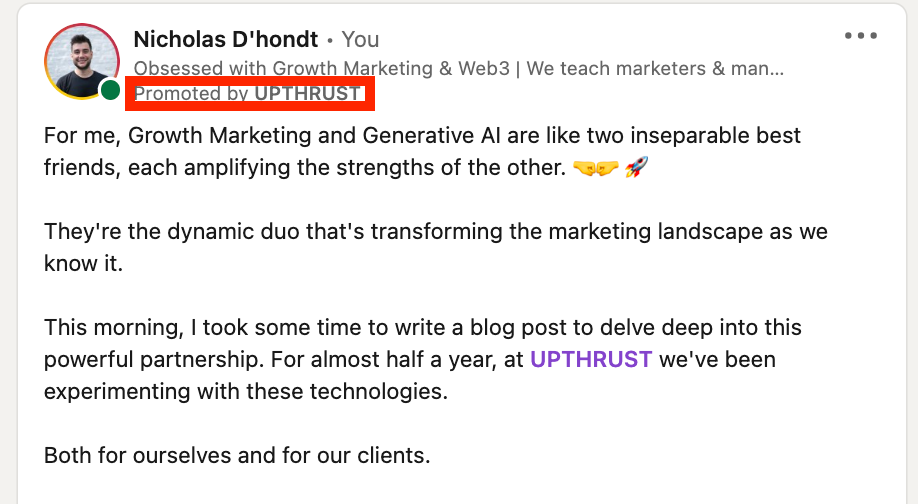
Publishing a TLA on LinkedIn is not like publishing other ad formats – they don’t appear in the ad formats at all, so you might be confused how people even knew they existed.
Well, that’s Linkedin Campaign manager for you. What you need to do to post a TLA is the following:


Now, that was it. Simple? Not really 😛 Worth it? Absolutely. Now let’s see how TLAs perform on average, and how to create winning TLAs (with some examples of high performers ofc)
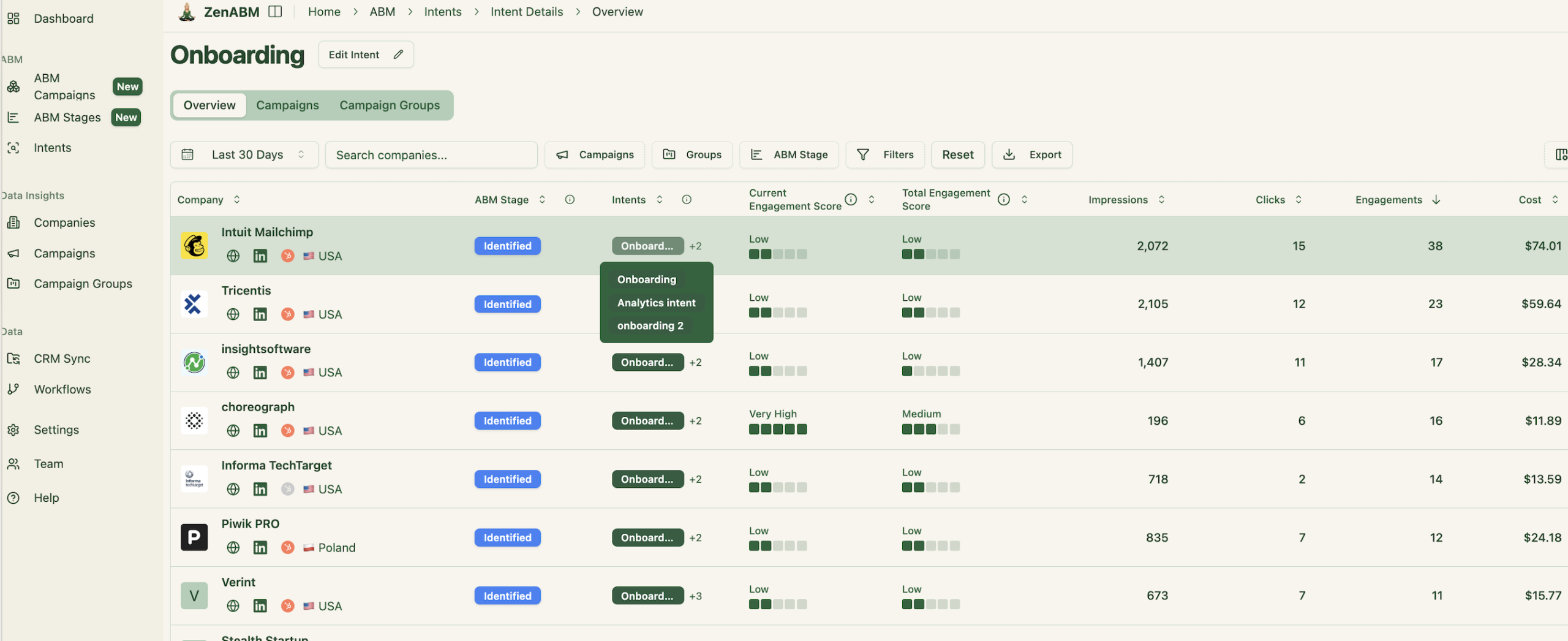
Oh and if you want to track your TLA campaigns’s ad performance – you’ll be able to do it on ZenABM:


Not all TLAs perform equally. There are clear patterns separating top performers (≥2.00% CTR) from bottom performers (based on our analysis in this report) – I’ve generated the “perfect TLA” based on all these patterns (I will show you some *real* examples of great TLAs that really worked for us below too):

TL;DR – TLAs work when they sound…authentic and human:
The winners are long-form (1–1.5k characters), and structured as “problem – solution” story. The best-performing linkedin TLAs also contain specific worksflows (esp those workflow graphics!) and metrics and specific free offers – but not webinars, not brand fluff, just clear value, proof, and a confident “here’s what to do next 👇”.
Here’s what we found in our report:
Example (3.42% LP CTR):
“I’ve seen so many businesses still running operations on Excel spreadsheets. It works, until it doesn’t.”
Top Hooks:
Winning Arc:
Here are the results of our top performing LinkedIn TLAs – and the examples of the ads below. Which patterns could you detect?


| Pattern | Top Performers | Bottom Performers |
|---|---|---|
| Voice | First-person “I” (65%) | Corporate “we” (45%) |
| Link Placement | Bottom 25% of text (75%) | Mid-text placement |
| Character Length | 1,000-1,500 characters | Too short or too long |
| Opening Hook | Specific pain point (65%) | Generic statements |
| Social Proof | Concrete metrics (45%) | Vague claims |
| CTA Type | Specific resource/link | Webinar CTAs (0% in top 20) |
The winning hook pattern: “I’ve seen so many businesses still running operations on Excel spreadsheets. It works, until it doesn’t.”
Gabriel Ehrlich from Remotion puts it bluntly: “We treat creative as a strategic lever, not a design task-the ‘who this resonates with’ is the whole game in B2B. We make ads sound like humans, not AI slop.”

Our analysis of 119 TLAs compared to other ad formats tells the story:
| Ad Format | Median CTR | Median CPC | Efficiency Score |
|---|---|---|---|
| Thought Leader Ads | 2.68% | $2.29 | 9.5 (highest) |
| Single Image | 0.42% | $13.23 | 3.2 |
| Carousel | 0.32% | $13.30 | 2.4 |
| Video | 0.24% | $15.61 | 1.5 (lowest) |
Key insight: TLAs deliver the most cost-effective landing page traffic at $3.06 per click-77% cheaper than single image ads. Reallocating budget from video to TLAs can yield 2-3x more landing page traffic for equivalent spend.


Now you know how to create perfect TLAs – here’s what performance benchmarks you should aim for: Across the top-performing TLAs, overall CTR ranges from 4.49% to 17.39% (with an 8.32% average), which already puts them miles ahead of most sponsored formats.
But the real signal is downstream: landing page CTR sits between 0.81% and 3.42% (avg 1.18%), while the median LP CTR is 0.35%.

TLAs and ABM are a natural fit for three reasons:
When you’re running ABM, you’re targeting specific accounts with multiple stakeholders. These people don’t want to see corporate ads-they want to learn from practitioners who understand their problems.
Ali Yildirim describes the approach: “When an organic post performs well, we wait for the natural engagement to slow down, then sponsor it. We focus on posts that directly address your target audience in the first two lines, not broad topics that get lots of likes but miss your actual buyers.”
Unlike demand capture ads that chase immediate conversions, TLAs build familiarity and trust over 3-6 months. Your target accounts see your founder’s perspective repeatedly, and when they’re ready to buy, you’re already a known entity.
Philip Ilic puts it simply: “Organic content + LinkedIn Thought Leader Ads + Warm Outbound = the best go-to-market strategy for sales-led SaaS right now.”

This is where TLAs become a strategic weapon for ABM. When accounts engage with your TLAs, that’s an intent signal. You can track which companies are clicking, commenting, and engaging-then trigger personalized outbound.
Philip describes the workflow: “Run ~5 Thought Leader Ads to your ICP. Work from a list of about 1,000 companies. Watch the ‘Companies’ tab inside your ad account, see which companies are clicking, commenting, engaging. Export that list → upload to Clay → enrich with contacts → warm outbound.”
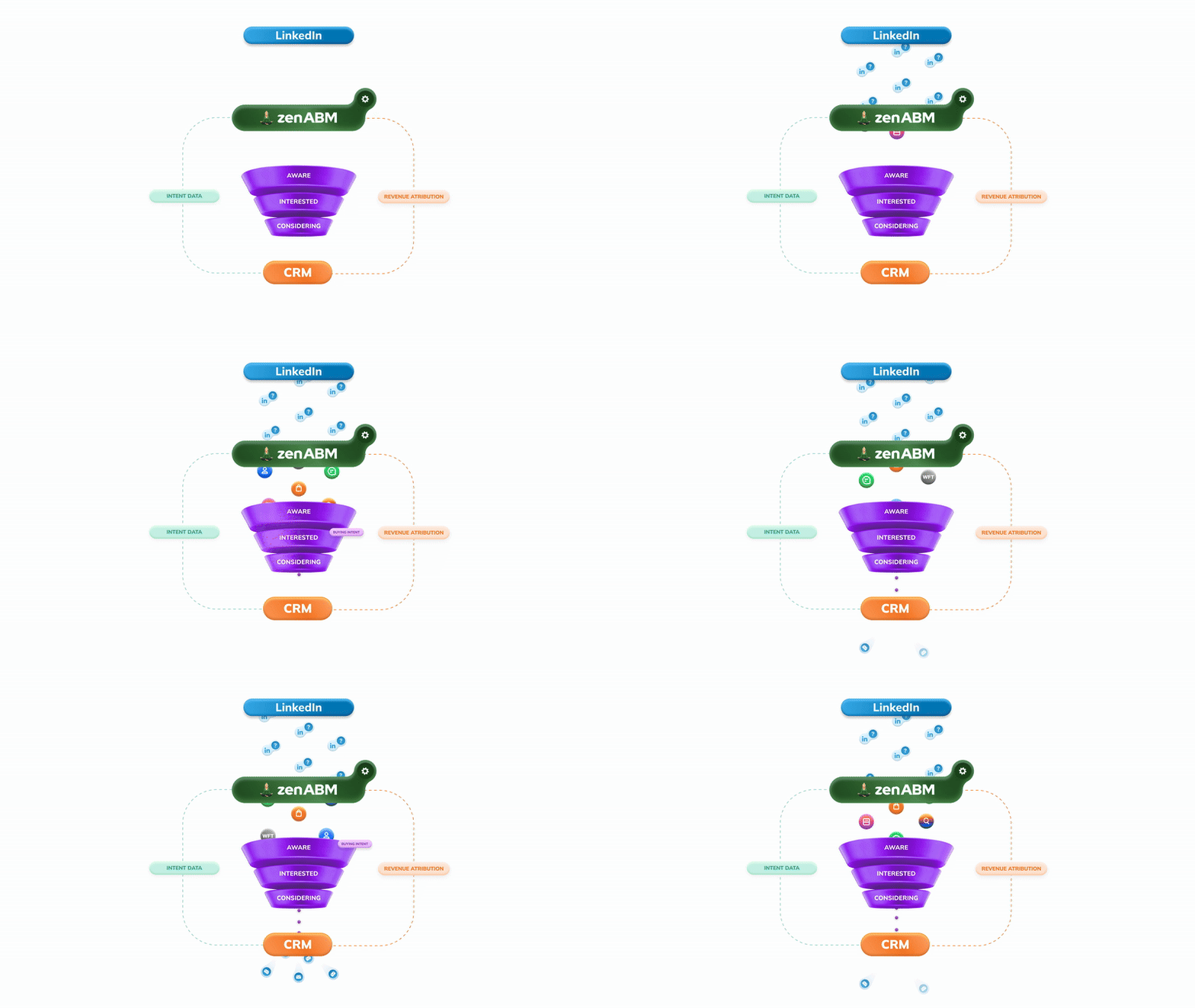
In ZenABM, I built this workflow directly into the product. When accounts engage with your TLAs, we track which companies engaged, assign intent labels based on which campaigns they interacted with, and can trigger webhooks to Clay for immediate outbound sequences.
Tim Davidson shared a simple but powerful insight: “Demos from LinkedIn thought leader ads went from ZERO a month to 6+ a month. 8 turned into opps and 1 closed won. All from one small change: editing the post and adding a CTA link. Nothing too crazy, just made it easier for people to convert.”
This aligns with our data: 75% of top-performing TLAs place their links in the bottom 25% of the text-after the value has been delivered, not interrupting the narrative.
Our analysis found clear anti-patterns in low-performing TLAs:
Gabriel Ehrlich called out a particularly egregious example: “I just got targeted with this Thought Leader Ad from Mastercard-and it’s a masterclass in everything you’re doing wrong: targeting is way off, the whole post smells of AI, weak hook, hashtags in TLA. Fortunately for Mastercard, they can afford to make dumb mistakes like this. Unfortunately for you-you can’t.”

Running TLAs effectively requires more than just boosting random posts. Here’s the operational framework I recommend:
You need a steady stream of organic content to test before promoting. Ali Yildirim explains the process: “Most people think success with Thought Leader ads comes down to budget or optimization tricks. That’s not where this gets won or lost. Write content people actually want to read. The first filter is simple: does this feel like an ad? If yes, you’re already behind.”
Philip Ilic recommends a systematic approach: “Post content on LinkedIn every day. Show up consistently. It brings inbound leads and lets you test which content performs best before turning it into Thought Leader Ads.”

Don’t run the same TLAs to your entire target account list. Segment by persona and intent.
Philip explains: “The most effective thought leader ads are niche-specific posts to niche-specific audiences. I see a lot of posts that are too high-level or too general. Design and release posts which are targeting your ICP more specifically-a post targeting sub-segment companies in your TAM.”
Ali found the same pattern with RB2B: “When we grouped Adam’s organic posts by persona (founders, agencies, marketers, sales), the founder segment drove 3x more signups than any other group.”

Philip tested this extensively: “Should you optimise for Brand awareness or Engagement with your thought leader ads? I analysed £300k worth of TLA data… When optimising for Engagement, the average CPC to the landing page was £4.80, compared to £7.90–£12+ for Brand Awareness-up to 2x more efficient.”
Tim Davidson notes an important nuance: “LinkedIn is starting to roll out flexible ad creation where you can put video, text, and image all in one campaign. Currently, you have to separate out video and image into their own campaigns. It’s the most annoying for thought leader ads where you have to separate image and text from video.”

This is where TLAs become a true ABM engine. Philip describes the full workflow:
“Their thought leader ads get a steady flow of reactions/comments. So we automatically pull all that engagement into Trigify → send it to Clay for ICP checks → and then warm contacts go into a small HeyReach sequence (with an Instantly email fallback).”
In ZenABM, I built webhooks specifically for this use case. When an account reaches “Interested” status based on TLA engagement (5+ clicks or 10+ engagements), you can automatically trigger a webhook to Clay for enrichment and outbound sequences.

Philip identifies the core measurement challenge: “Most people fail with LinkedIn Ads because they can’t track influenced pipeline. If you’re spending budget on content + distribution with LinkedIn ads, and can’t prove it’s influencing pipeline or revenue... your boss (or client) will shift budget to Google Ads and bottom-of-funnel lead gen forms. Because that’s where the attribution looks cleaner. But that’s a trap.”
Gabriel Ehrlich agrees: “We don’t confuse activity with outcomes-spend and clicks are not a strategy.”
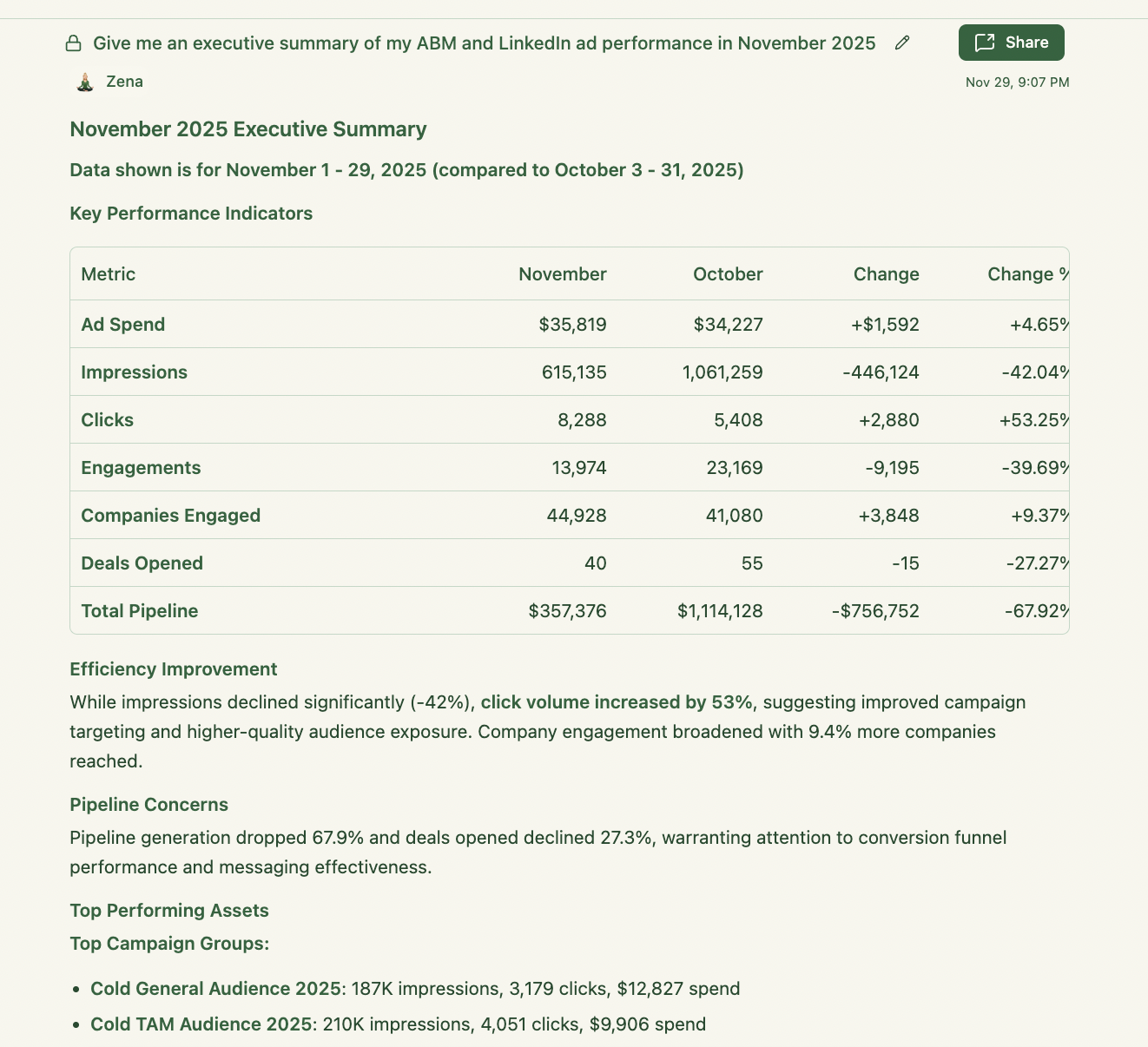
This is exactly why I built ZenABM. The platform connects your TLA engagement data directly to CRM pipeline, giving you de-duplicated revenue attribution that shows actual pipeline per $ spent-not just engagement metrics.

The most common TLA mistake is budget dilution. Here’s how to structure campaigns effectively.
LinkedIn requires minimum daily budgets per campaign, and TLAs need enough engagement volume to optimize. Based on our benchmarks:
Philip explains the math: “Make sure your budget matches your audience size. If you’re spending £2k/month and your audience is 300k people, no one’s seeing your stuff.”
Philip recommends a three-tier structure:
“I set up accounts mostly with 3 campaign groups: Prospecting, Nurture, and Convert.
1. Prospecting – Cold campaigns designed to reach new, relevant audiences and feed your retargeting pools.
2. Nurture – Middle-of-funnel campaigns focused on education, brand, and credibility. Zero-click TLAs.
3. Convert – Retarget Thought Leader Ad engagement with conversation ads. This combo is fire.”

Philip describes the complete system for sales-led B2B:
“For SALES-led B2B SaaS, I would always start with a list of your top companies. This list can then be used in the best Go-To-Market strategy I am aware of: Thought leader ads + warm outbound.
1. Upload the list to LinkedIn and use thought leader ads to warm the list.
2. Deliver content via LinkedIn ads which tells them what you do (features) and who you are (values).
3. Watch engagement signals and trigger outbound to warm accounts.
Ali Yildirim shared this result from Understory: “We just closed a $120K ACV contract with a publicly traded company off $2,035.17 in spend on a Thought Leader ad.”
The key? “Most people think success with Thought Leader ads comes down to budget or optimization tricks. That’s not where this gets won or lost. Write content people actually want to read.”

Philip Ilic tested a concentrated TLA strategy: “This month we spent more and the budget was super concentrated on just one ad initiative: Thought leader ad → landing page (asking for email) → ridiculously strong follow-up. Our cost per call dropped by close to half. Cost per lead stayed roughly the same at $18.82. 8 phone calls scheduled. 2 clients acquired at roughly $1,615 CAC.”
Tim Davidson’s simple optimization: “Demos from LinkedIn thought leader ads went from ZERO a month to 6+ a month. 8 turned into opps and 1 closed won. All from one small change: editing the post and adding a CTA link.”
Maximilian Herczeg advises: “Don’t run just 1 post as a campaign. Better: 4 to 6 variants with different content. This gives you comparison data and nurtures the audience with multiple perspectives.”
Multiple experts agree: no hashtags in TLAs. Gabriel Ehrlich: “Don’t use hashtags in TLA. We pay to reach the right people-hashtags are unnecessary if your targeting is set up correctly.”
Gabriel calls this out directly: “The whole post smells of AI-the em dashes, the vocabulary-it’s all AI. We make ads sound like humans, not AI slop.”
Philip found this in his analysis: “Most people are boosting the wrong content. Posts that do well organically aren’t always the ones that convert in paid. You need posts that directly address your target audience’s pain points.”
Tim Davidson’s experience: Adding a CTA link took demos from zero to 6+ per month. Maximilian adds: “At the end of the post, I always add a clear call-to-action. Super important!”
Here’s how I use ZenABM to operationalize the TLA → ABM → Pipeline workflow:
The result: a closed-loop system where TLA engagement directly feeds your ABM pipeline, with full attribution visibility.
Based on our analysis of 119 TLAs and insights from practitioners running millions in LinkedIn spend:
Ready to run Thought Leader Ads that actually drive pipeline? Try ZenABM free for 37 days and see which accounts are engaging with your TLAs.
Minimum $1,500-3,000/month per TLA campaign to get enough engagement data. Make sure your budget matches your audience size-if you’re spending $2K/month on a 300K audience, frequency is too low to build familiarity.
Engagement. Philip Ilic’s analysis of £300K in TLA spend showed Engagement delivers CPCs that are 50-200% cheaper than Brand Awareness for driving landing page traffic.
4-6 variants with different content. Running just one post per campaign limits your ability to test and doesn’t nurture accounts with multiple perspectives.
Yes, but they work best as part of a full-funnel system. Use TLAs for awareness and nurture, then retarget engaged accounts with conversation ads for direct conversion.
LinkedIn’s Companies tab in Campaign Manager shows aggregate engagement, but for CRM integration and ABM stage tracking, you need a tool like ZenABM that syncs company-level engagement data to HubSpot or Salesforce.
