



N.Rich positions itself as an agile, execution-first account-based go-to-market platform built for mid-market and enterprise B2B teams.
At its core, N.Rich combines a purpose-built B2B demand-side platform (DSP) for account-based programmatic advertising with intent scoring, dynamic ICP building, and account-level analytics.
This guide explains what is N.RIch, what it does, what you actually get inside the platform, pricing, and where an alternative like ZenABM can make more sense (especially for LinkedIn-first ABM motions).

If you want the short version:

N.Rich is usually evaluated as an “execution layer” for ABM and account-based GTM. These are the platform capabilities most teams care about:

N.Rich can ingest CRM opportunity data to help define your ideal customer profile and prioritize accounts.
Instead of building an ICP purely from firmographics and opinions, the ICP builder is designed to use your historical opportunity outcomes as an input to model which accounts fit your strongest patterns.
You can then build target account lists quickly using filters like industry, company size, technographics, geography, and other account attributes.

This is intended to reduce “gut-feel” account selection. The results depend heavily on data quality and consistency in your CRM, because the model can only learn from what it is given.

N.Rich combines first-party signals (for example, engagement it can observe and attribute at the account level) with external intent feeds to flag accounts researching relevant topics.
Accounts can be scored so teams can prioritize “hot” accounts rather than treating every target account as equally ready for outreach.
N.Rich’s positioning emphasizes a consent-based approach to privacy and intent collection, which is especially relevant for teams operating under stricter privacy expectations.
In practical terms, sales teams can use intent topic signals and account scores to time outreach and tailor messaging. For example, if a target account shows a surge on a category topic or competitor topic, outreach can be aligned with that theme rather than using generic sequences.
N.Rich includes a built-in advertising module positioned as a B2B DSP for running account-based programmatic campaigns.
This typically means you can activate account segments into programmatic placements and measure engagement beyond “impressions,” with the platform emphasizing engagement actions (clicks, reads, visits, video views) as performance signals.
Some user reviews describe the ad campaign workflow as easier after initial setup, but it is still a system that expects ABM operations discipline (segments, governance, reporting definitions, and CRM alignment).

N.Rich provides account-level analytics intended to show how engagement connects to pipeline outcomes.
The platform’s attribution and opportunity analytics aim to connect account engagements (ads and other measurable touchpoints) with influenced opportunities, pipeline, and revenue.

For example, you can compare accounts that had meaningful engagement (clicks, visits, video views, or reads) against those that did not, and evaluate whether engaged accounts moved into opportunity stages more frequently.
N.Rich also supports “Sales Velocity” style analytics designed to focus attention on accounts that are likely to convert faster based on historical opportunity patterns.

Depending on plan and configuration, these metrics can be synced into your CRM so sales reps can see account-level context in the systems they live in.
N.Rich integrates with major CRMs and can connect to marketing automation and ad platforms.
Common integrations include Salesforce and HubSpot, along with LinkedIn ads sync.

N.Rich publishes tiered pricing and positions its packages as straightforward and subscription-based.
For small revenue teams looking to activate intent-driven strategies.
Includes: 1 Intent Report & 10 Intent Topics; 1 Marketing user seat & 3 Sales user seats; 1 N.Rich account; 1 ABM campaign; Chat support
Core features:
Designed for growing revenue teams improving sales-marketing alignment and activating high-fit accounts.
Includes everything in LITE, plus:
For established teams that need broader orchestration, expansion plays, and deeper automation.
Includes everything in GROWTH, plus:
All plans center on account data, intent scoring, and advertising activation, with higher tiers adding more automation, integrations, and attribution depth. For exact packaging details, it’s still worth validating with sales, since platform capabilities can evolve.
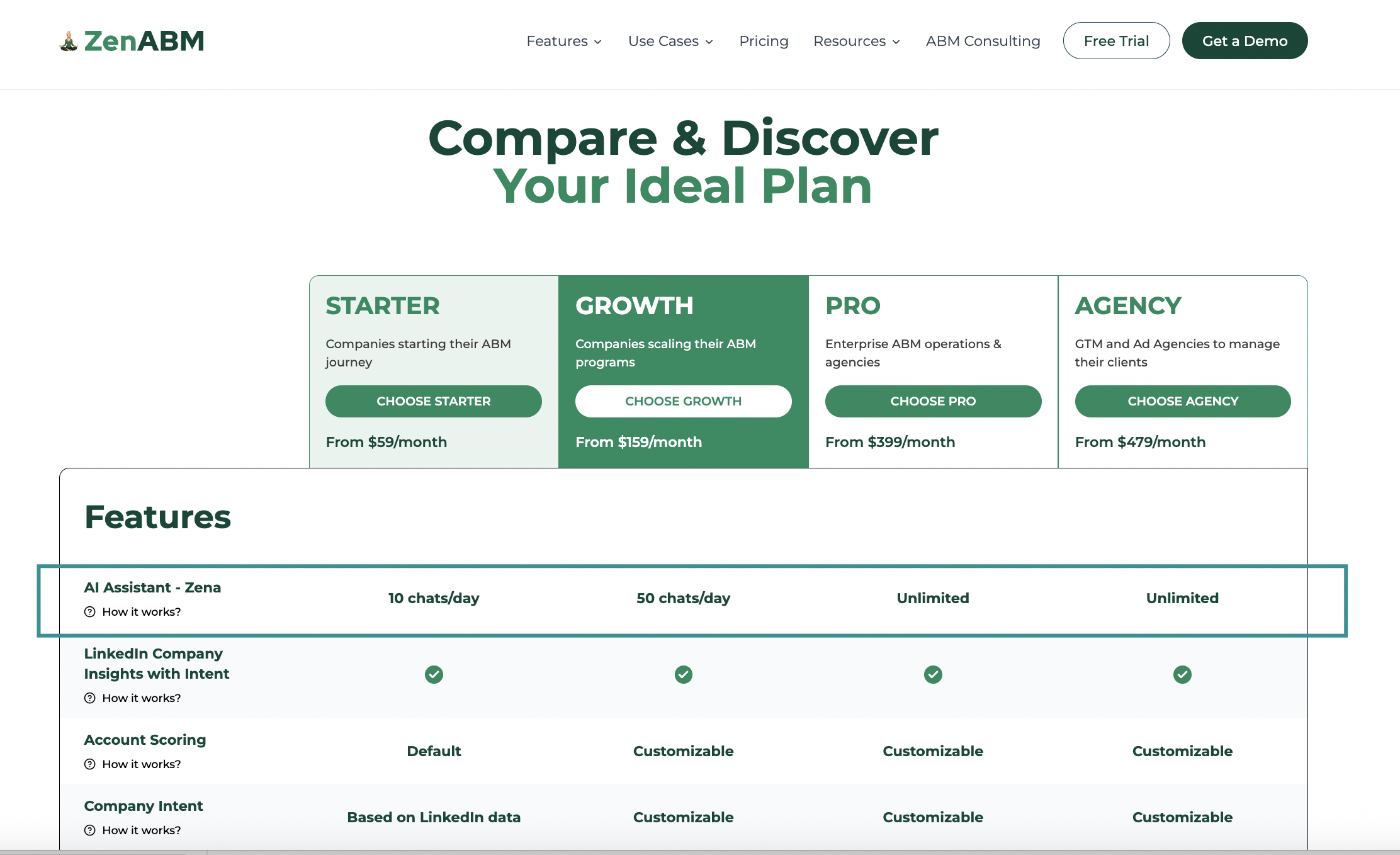
Note: considering that N.Rich’s most basic plan costs over $10K/year, ZenABM appears to be a smarter alternative, starting at ~$59/month for a starter plan and its highest tier also doesn’t exceed $6k/year. Plus, you get all you need for LinkedIn ABM: account-level ad engagement tracking, account scoring, ABM stage tracking, assignment of hot accounts to BDRs, bi-directional CRM sync, custom webhooks, qualitative company buyer’s intent tracking, and plug-and-play ROI attribution dashboards.

N.Rich is rated around 4.7 out of 5 on G2, with roughly ~100 reviews depending on how G2 groups listings and products.

Here’s what user feedback commonly highlights, both good and bad:


One alternative to N.Rich is ZenABM.
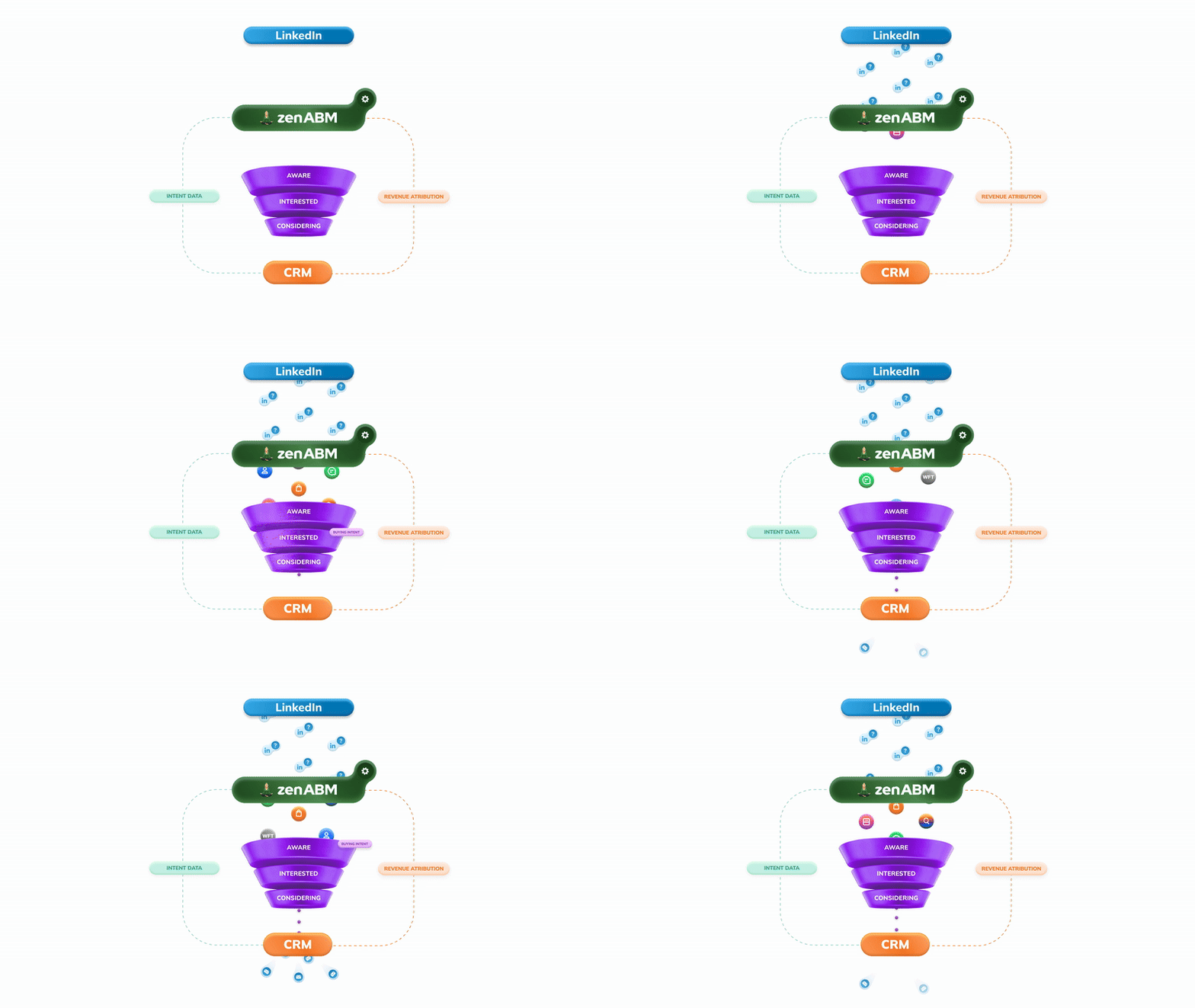
ZenABM is designed specifically for LinkedIn ABM. That makes it a viable primary platform for teams whose ABM motion is mostly LinkedIn, and a complementary layer for teams using broader ABM suites but still needing cleaner first-party LinkedIn engagement data, stage tracking, and revenue dashboards.
Let’s look at those features:
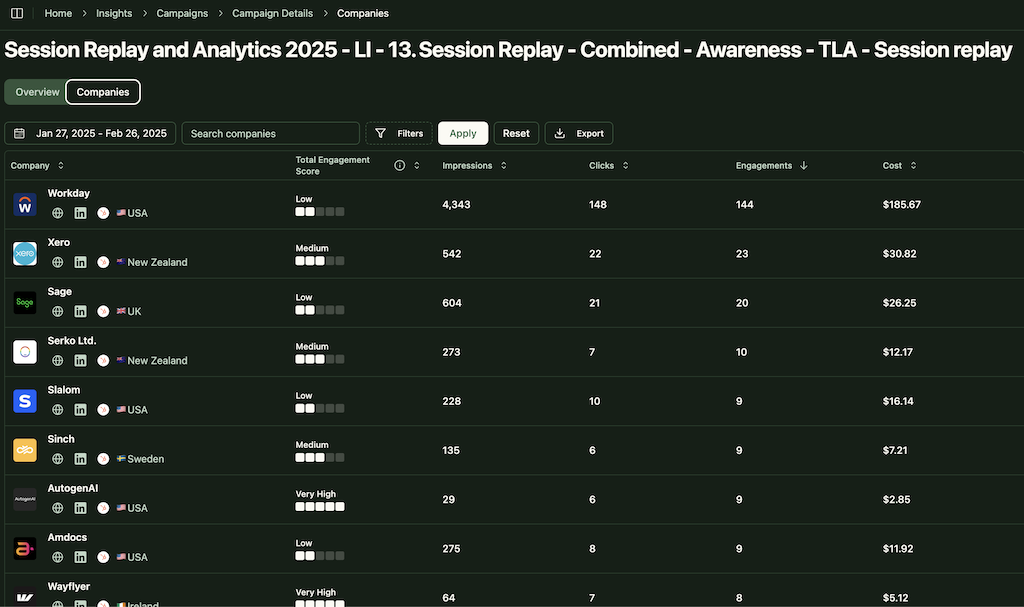
ZenABM connects to the official LinkedIn Ads API and captures account-level data for all campaigns so you can see which companies see, click, and engage with your ads.
Because this is first-party data from LinkedIn’s environment, it is more reliable than IP or cookie-based visitor ID.
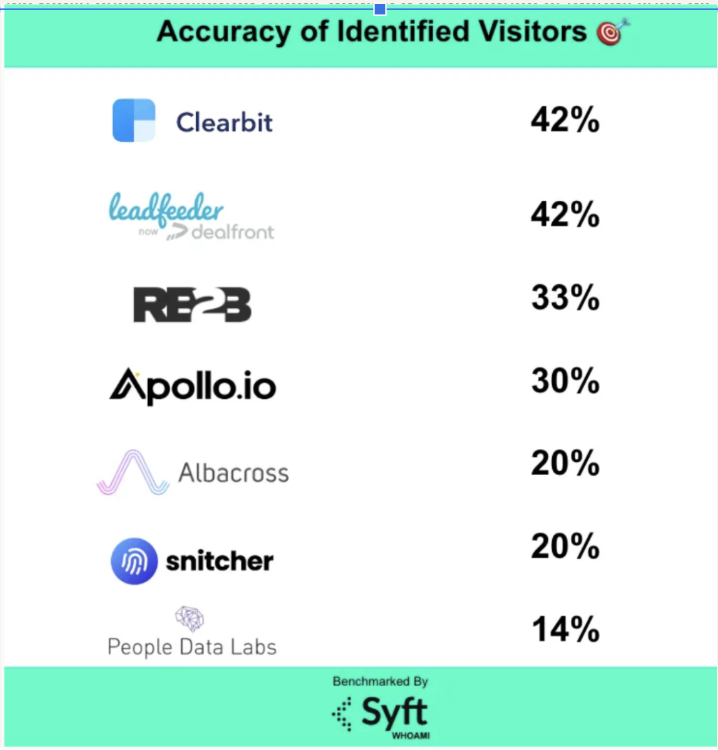
A Syft study puts IP-based identification at around 42 percent accuracy.
ZenABM treats LinkedIn ad engagement itself as first-party intent. When several people in one company keep engaging with your ads, that is a strong buying signal without rented intent feeds.
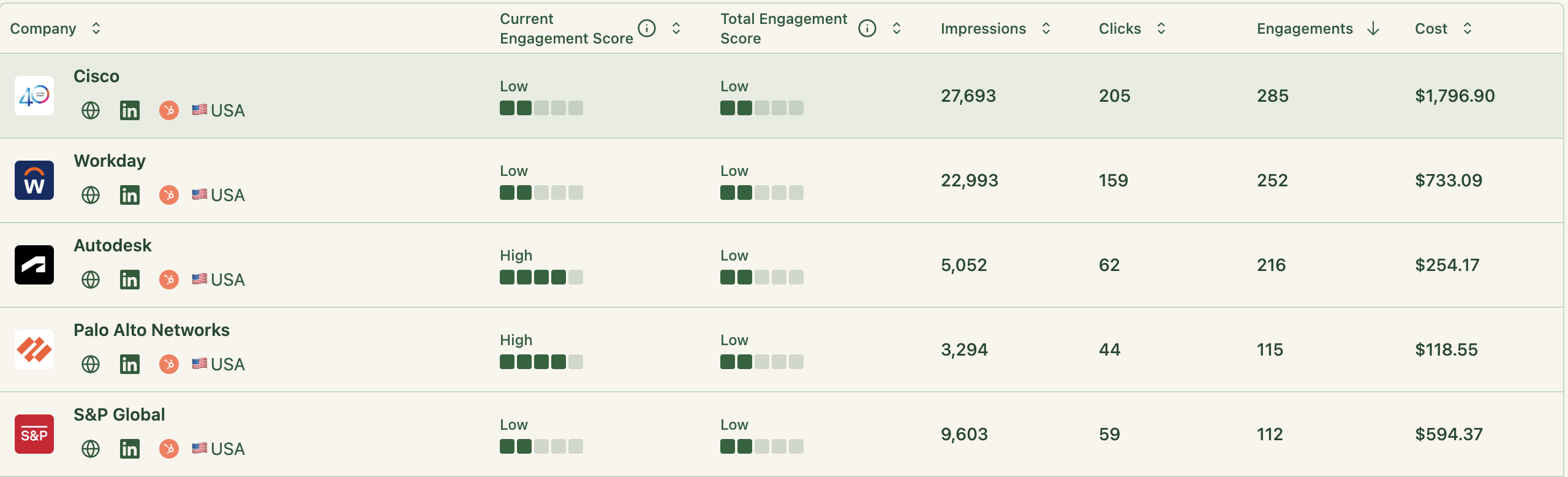
ZenABM updates engagement scores as accounts interact with your ads across campaigns, so you can see who is heating up over short or long windows and let marketing and sales prioritize accounts that show real intent.
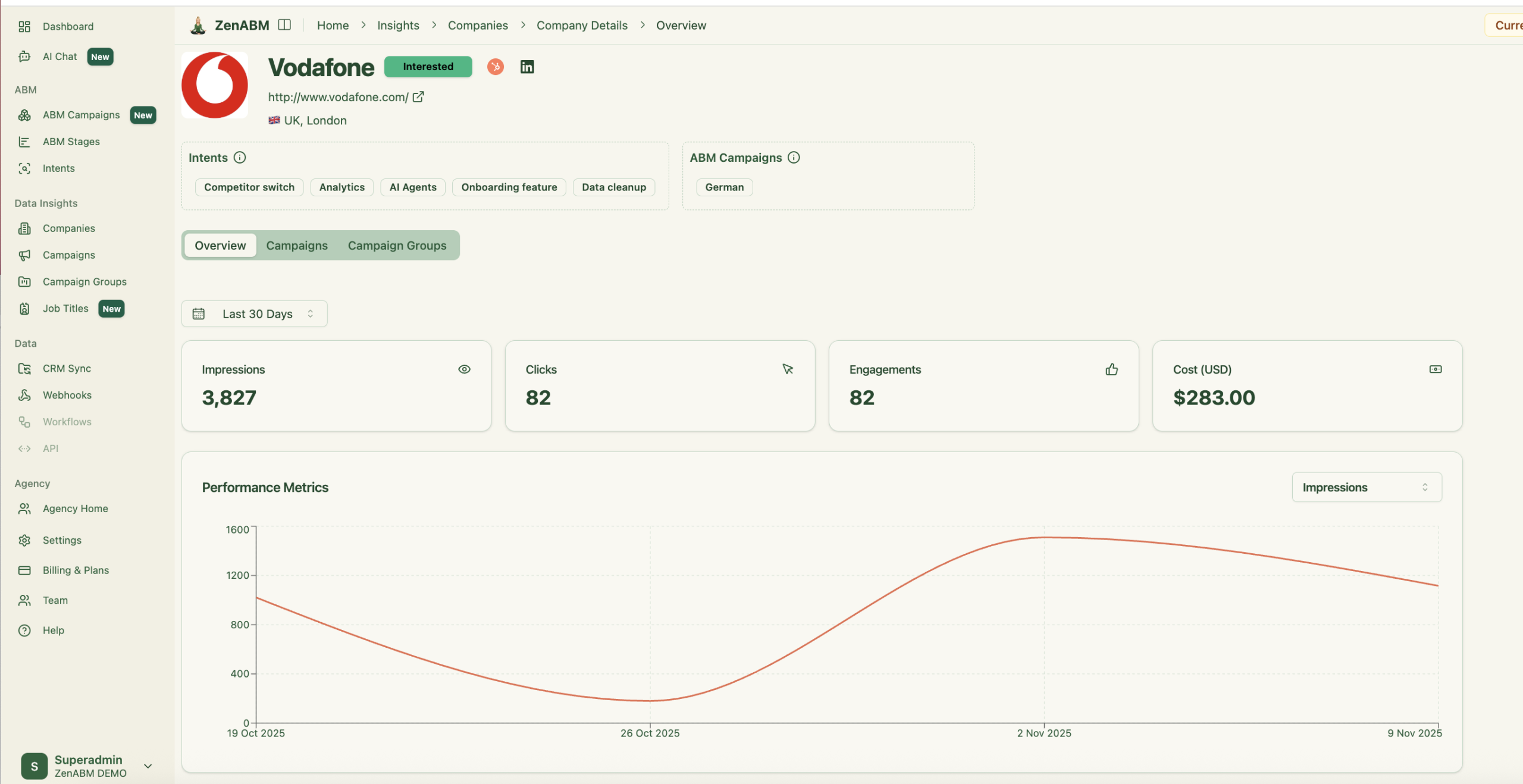
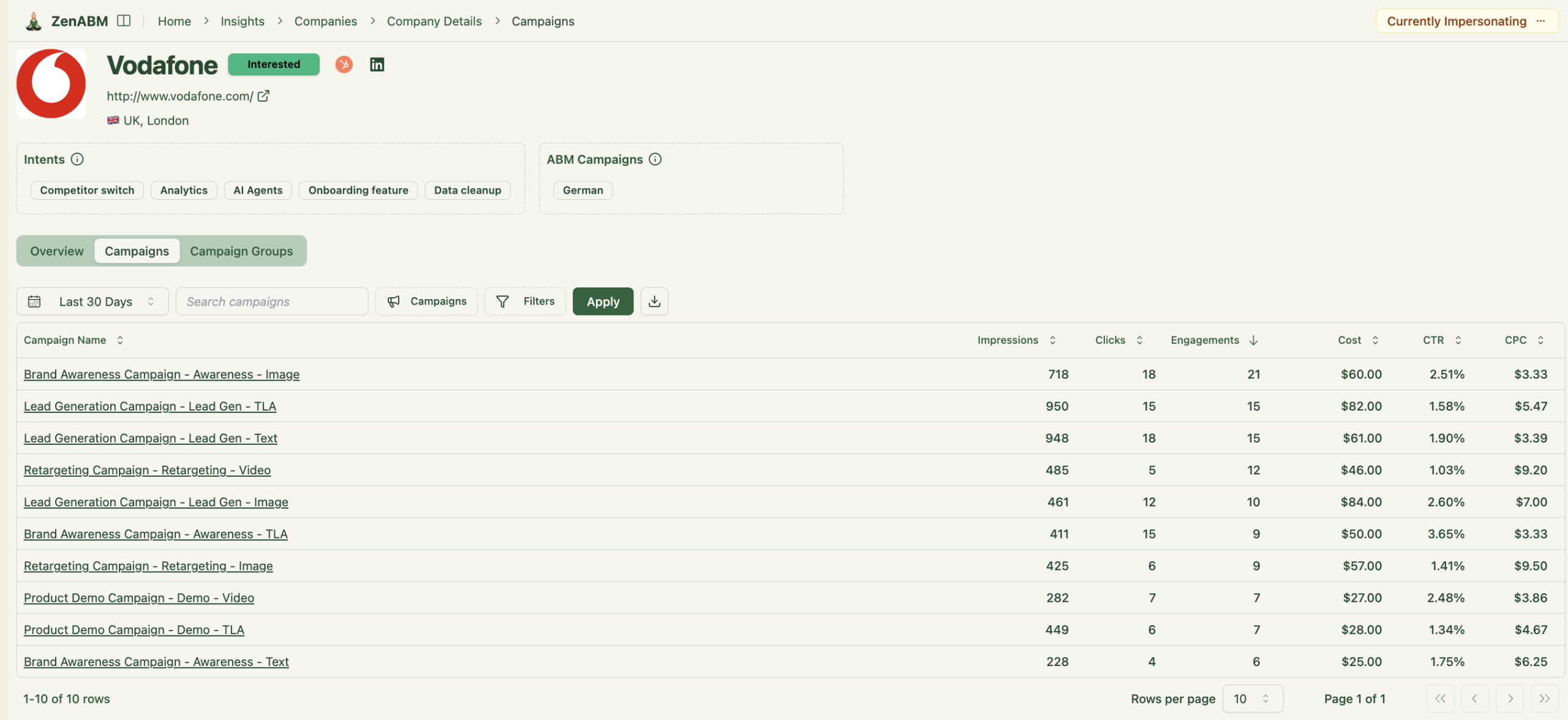
ZenABM also shows the full touchpoint timeline for each company:
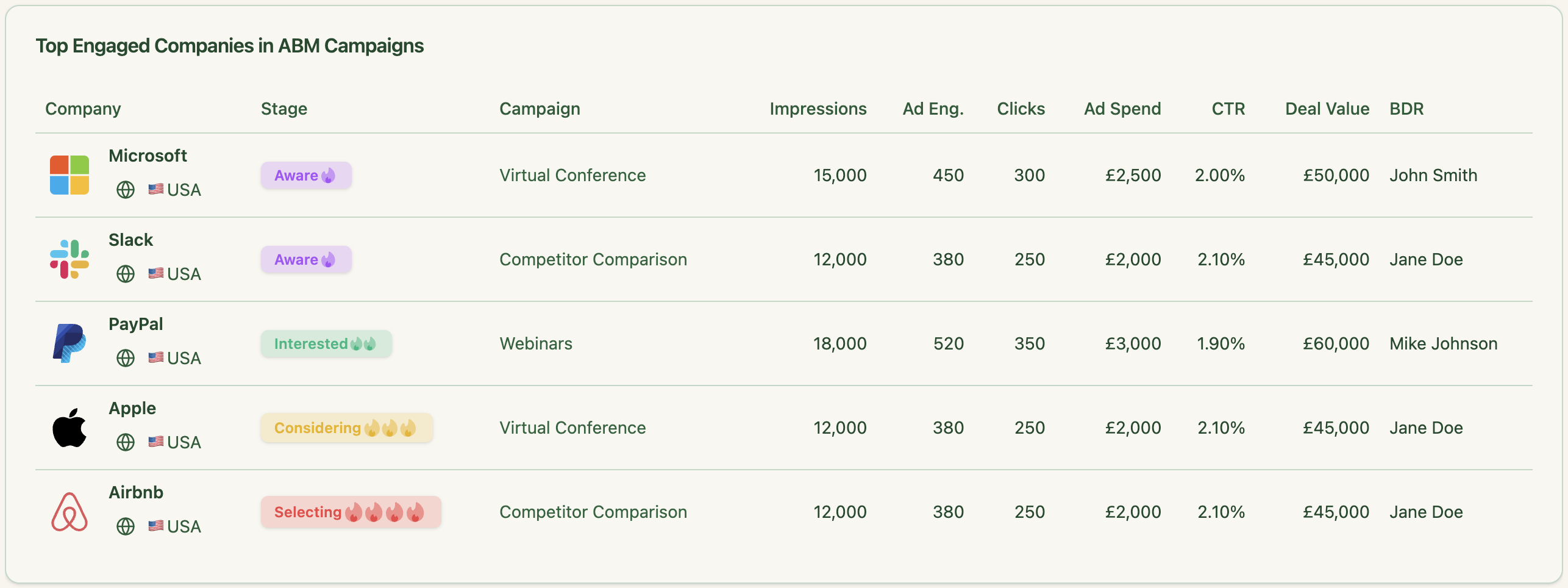
ZenABM lets you define stages such as Identified, Aware, Engaged, Interested, and Opportunity and automatically places accounts in the right stage using scores and CRM data.
You control thresholds, and ZenABM tracks movement over time.
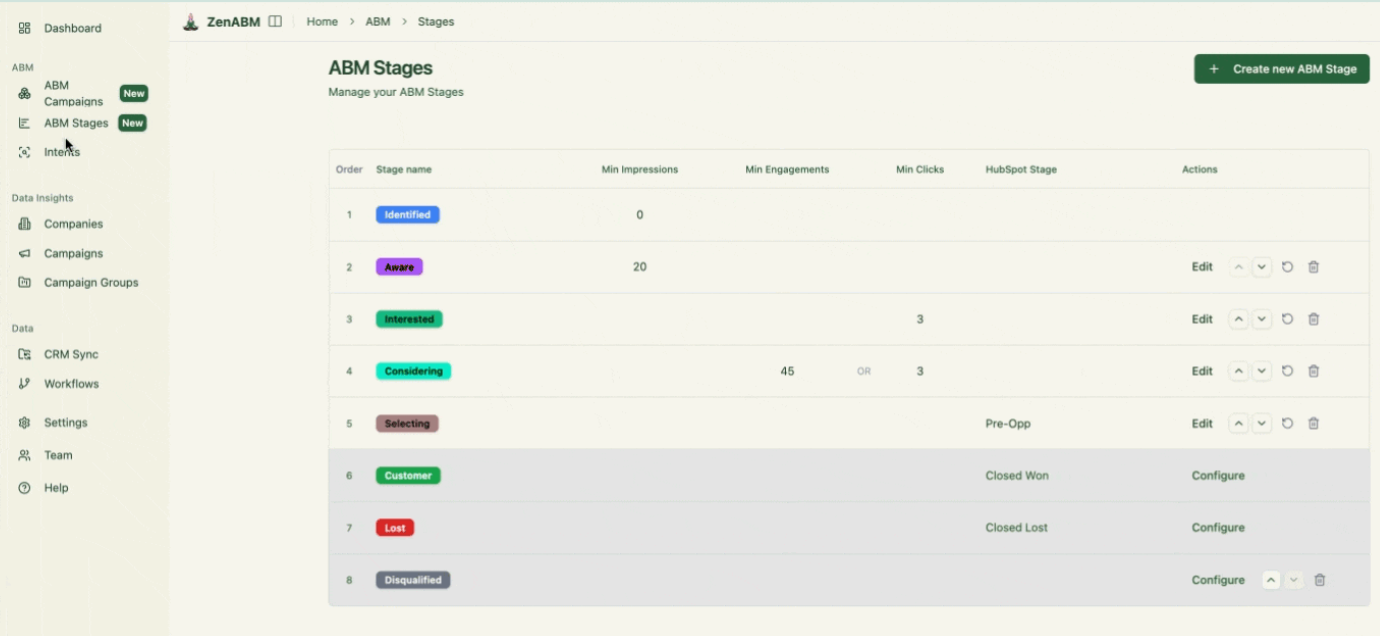
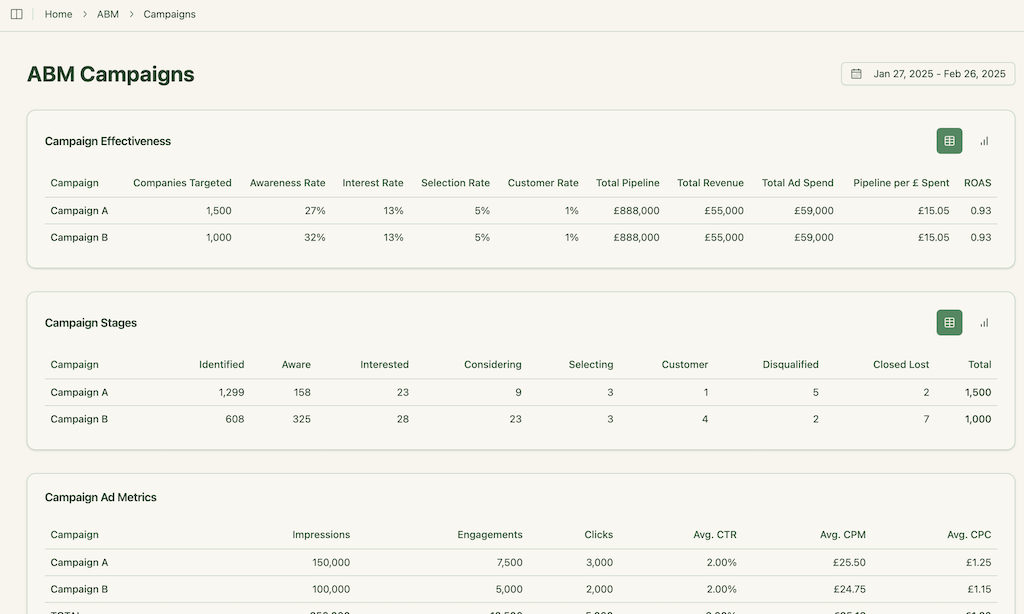
This gives you funnel visibility similar to larger suites, but powered by LinkedIn data.
ZenABM integrates bi-directionally with CRMs like HubSpot and adds Salesforce sync on higher tiers.
LinkedIn engagement data flows into the CRM as company-level properties:
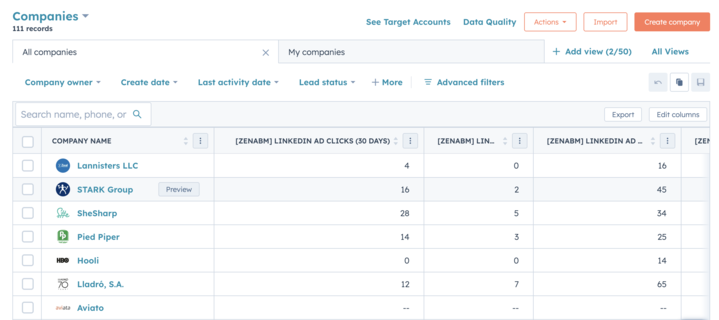
Once an account crosses your score threshold, ZenABM updates the stage to Interested and automatically assigns a BDR.
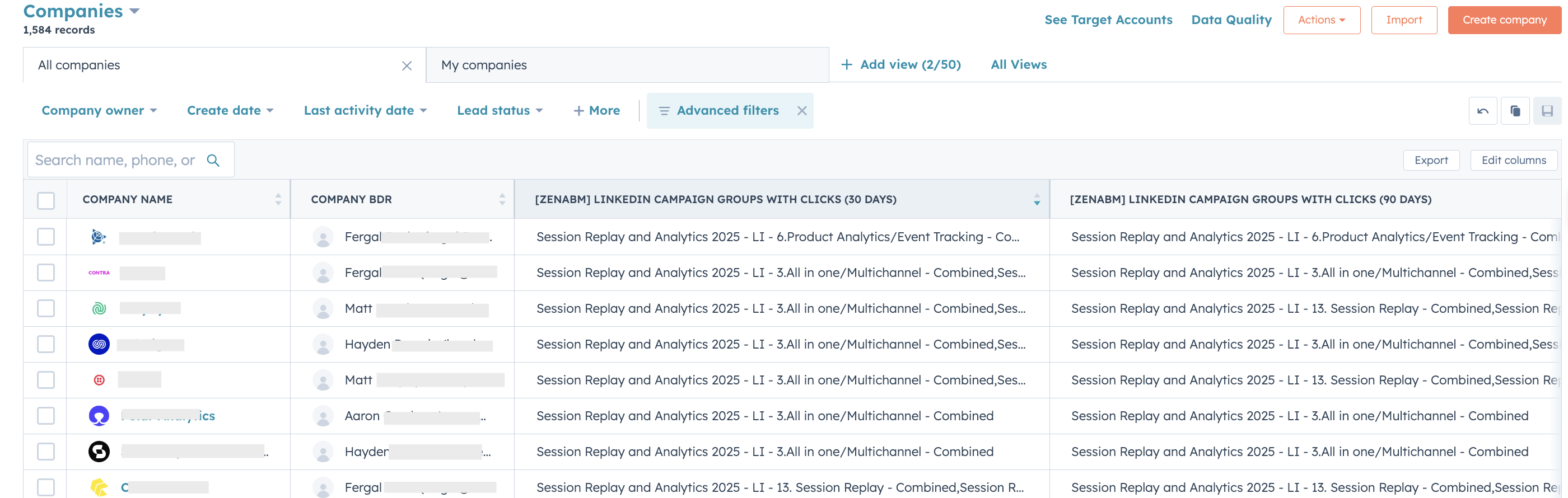
ZenABM lets you derive intent topics from LinkedIn campaigns by tagging campaigns by feature, use case, or offer.
ZenABM then shows which accounts engage with which themes.
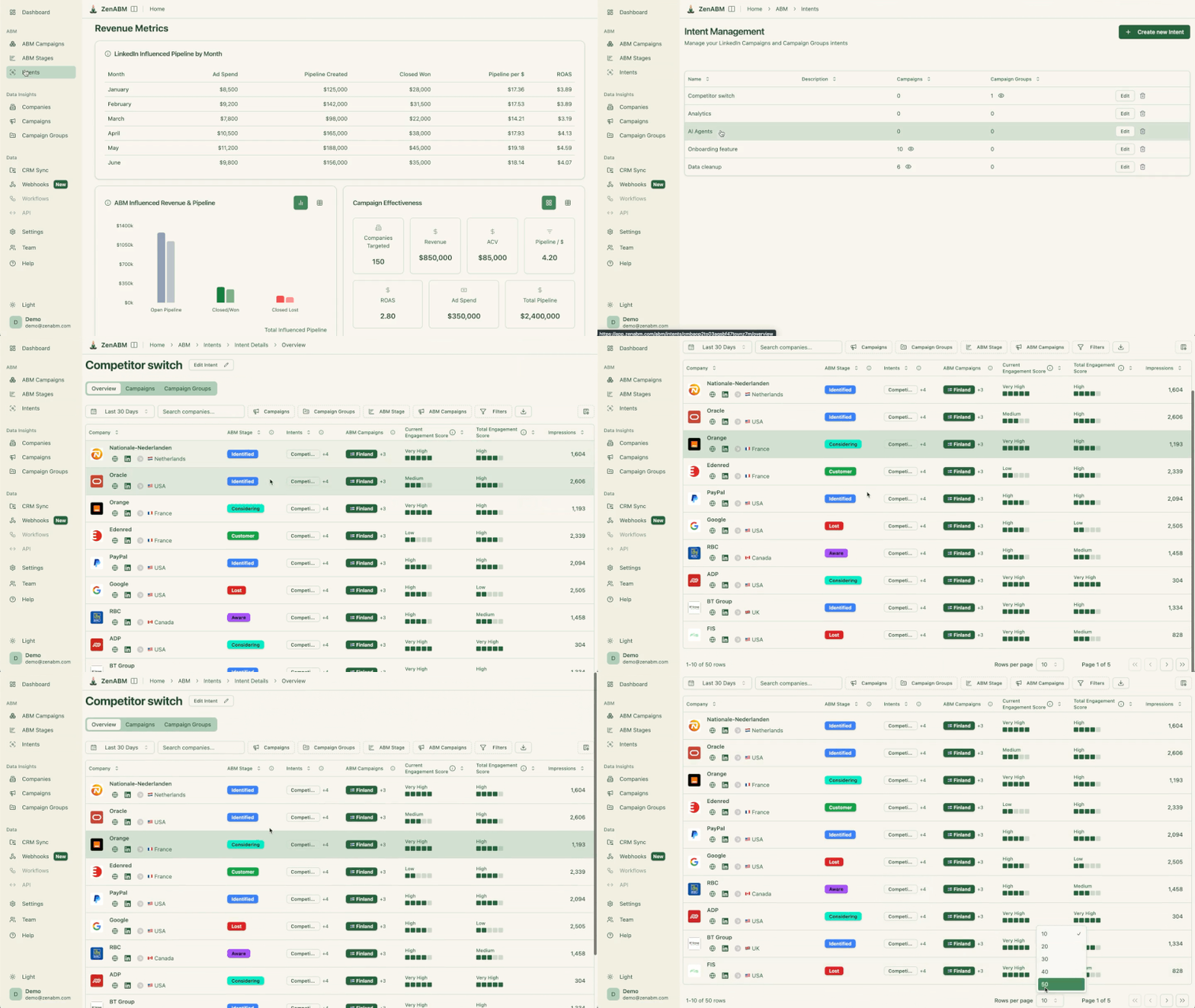
This is clean, first-party intent from owned interactions.
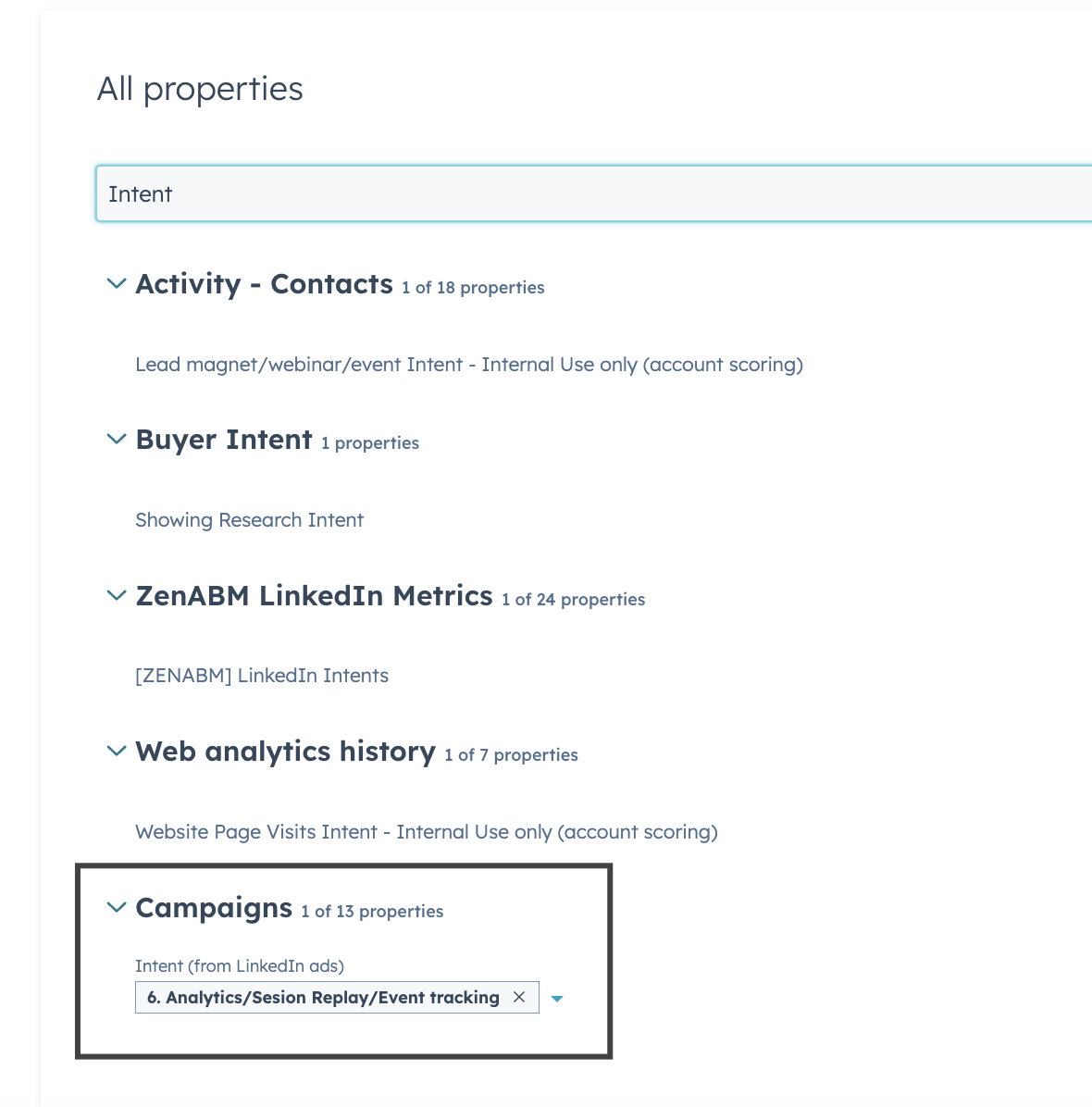
You can push these topics into your CRM, so sales and marketing can tailor outreach to what each company has actually explored.
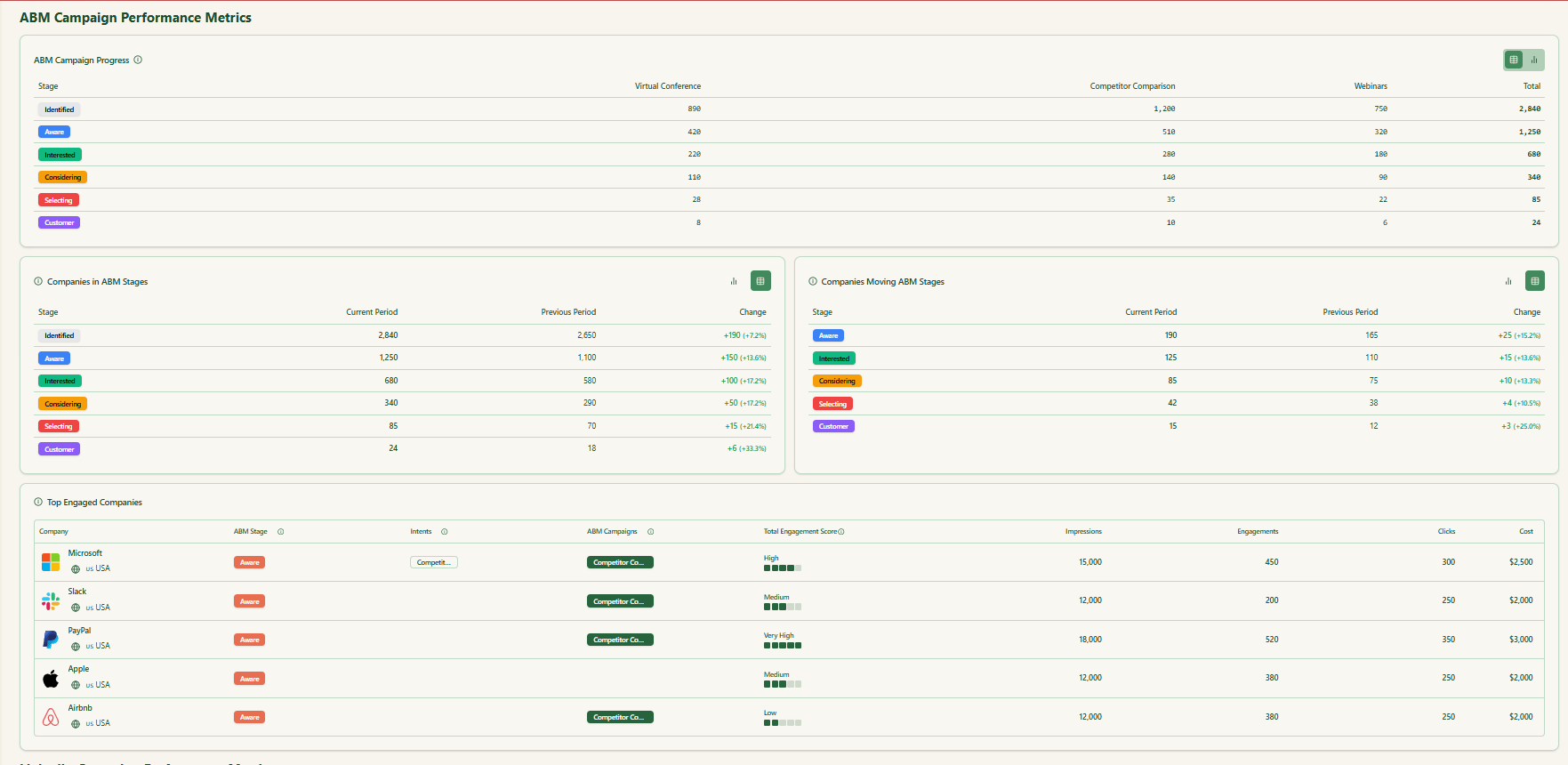
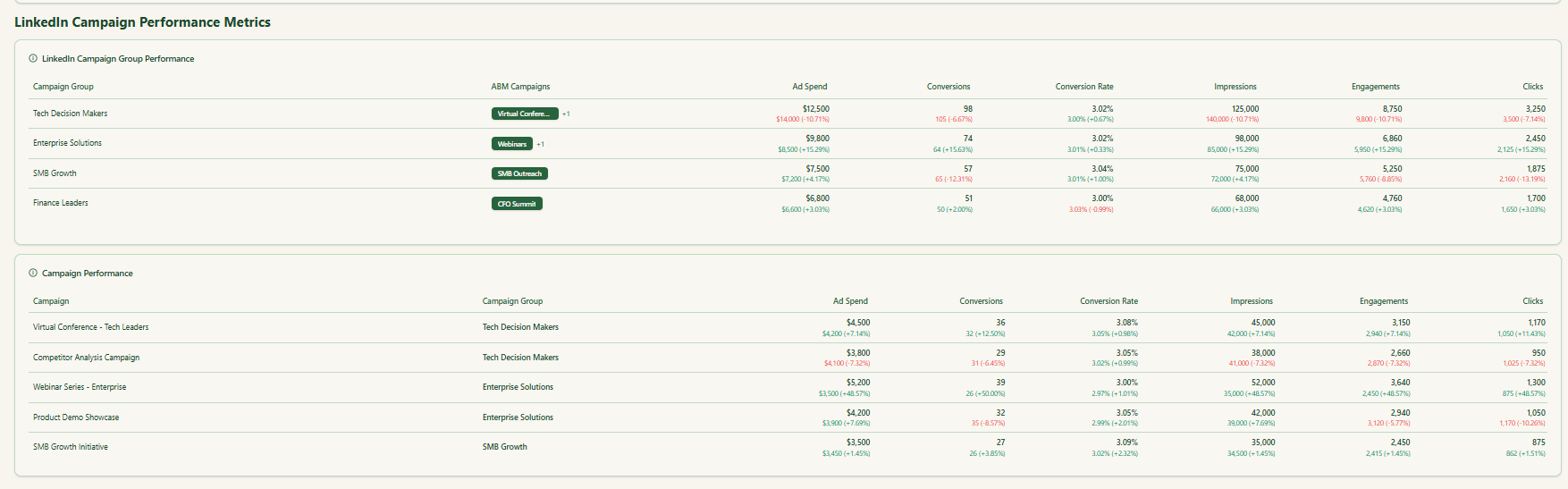
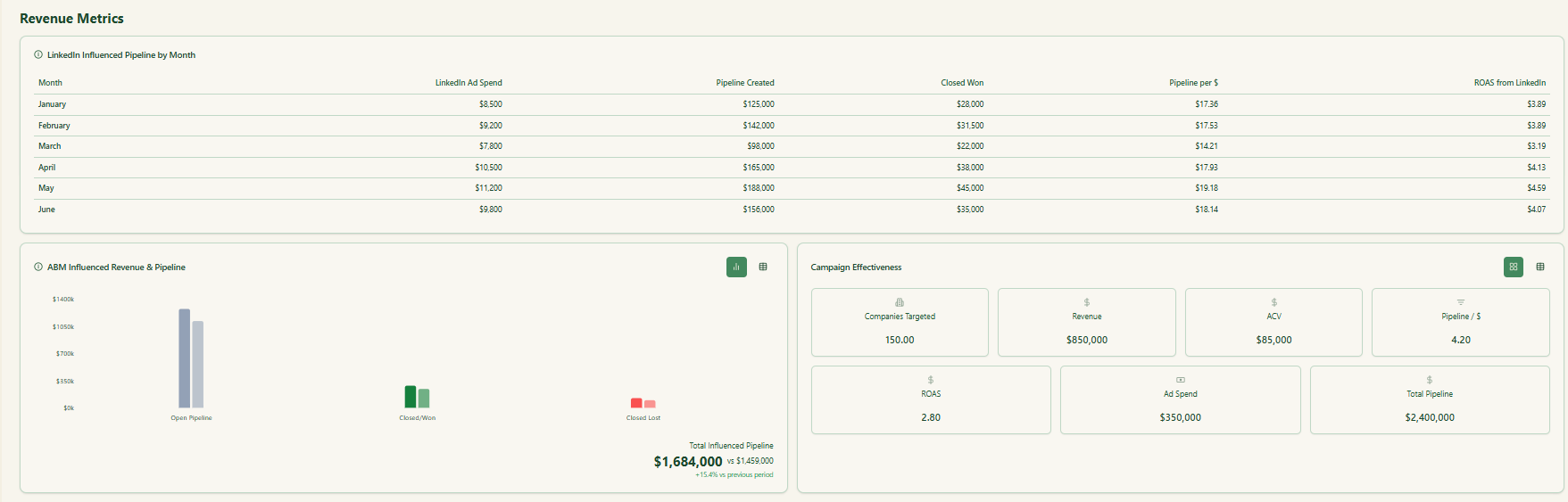
ZenABM ships with dashboards that connect LinkedIn ads to account engagement, stage movement, and revenue.
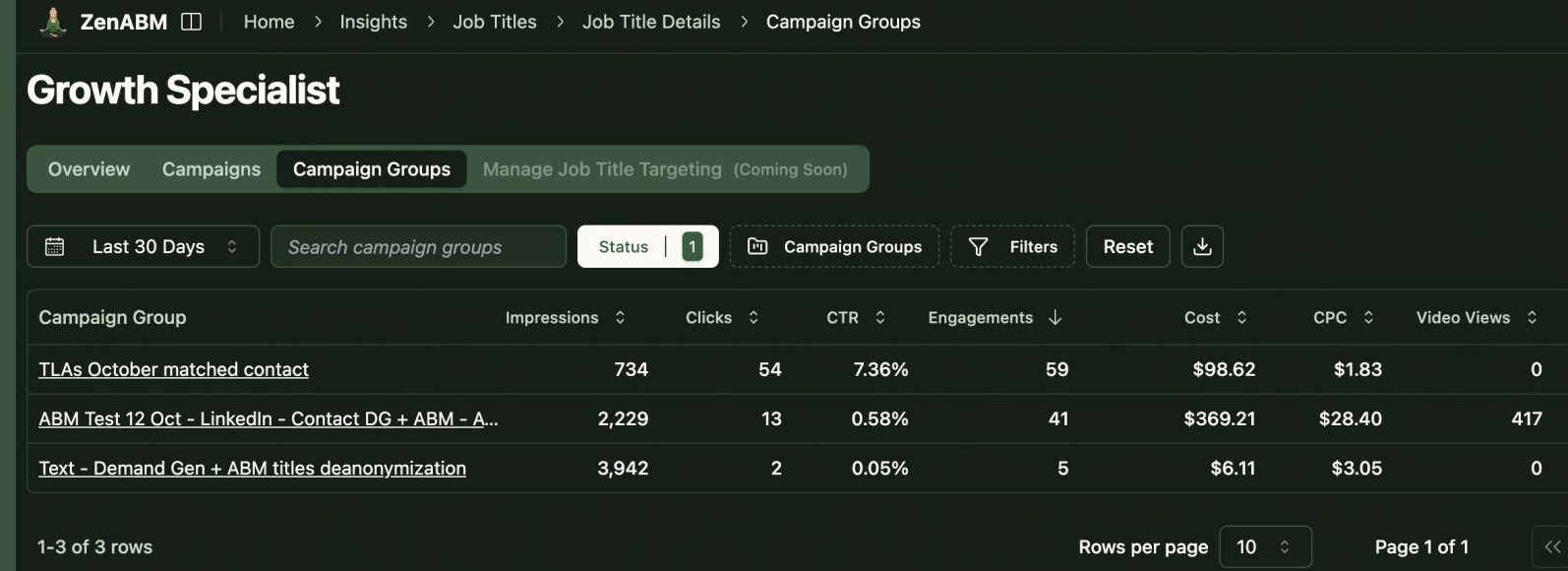
ZenABM shows which job titles engage with your creatives and gives dwell time and video funnel analytics.
ZenABM provides its AI chatbot called Zena that basically answers all you want from ZenABM in natural language.
You can ask Zena open-ended questions like you would a smart analyst and get company-level answers about:
Under the hood, Zena combines OpenAI with a library of carefully designed prompts and endpoints to join ad engagement, spend and CRM deals so it can explain which campaigns drove pipeline, which accounts turned into opportunities, which formats perform best and which companies are high intent but untouched by sales.
Instead of exporting spreadsheets and stitching pivot tables, you get plain language insights, ready to drop into strategy reviews, weekly sales standups or executive updates.
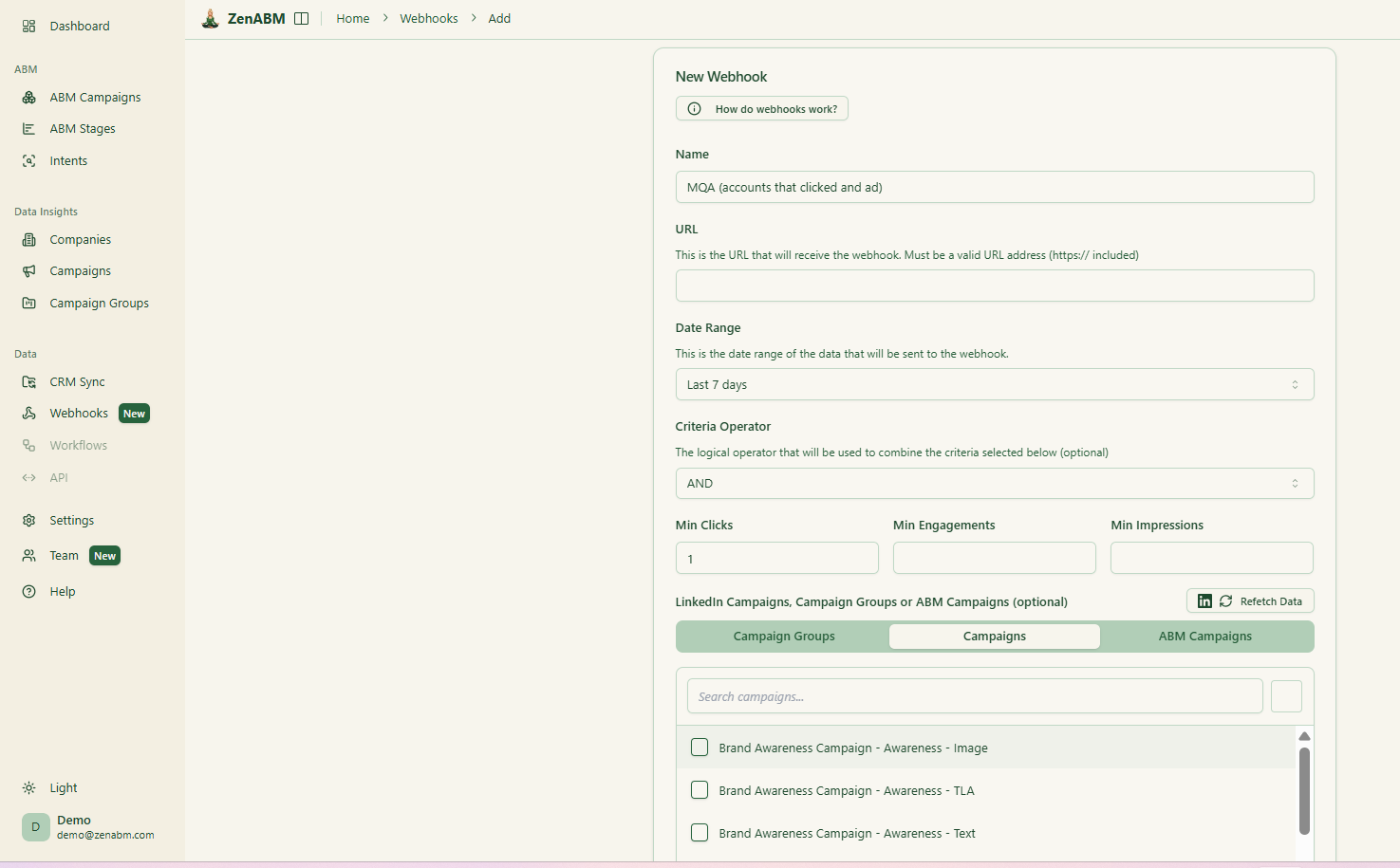
ZenABM’s custom webhooks let you push events into your stack, for example, Slack alerts, enrichment flows, or other ops automations.

Most tools treat each LinkedIn campaign separately. ZenABM lets you group several into one ABM campaign object so you can see performance across regions, personas, or creative clusters.
Instead of juggling fragmented reports in Campaign Manager, you see spend, pipeline, account movement, and ROAS for the entire initiative.
For agencies, ZenABM offers a multi-client workspace.
You can manage multiple ad accounts and clients in one environment, each with its own ABM strategy, dashboards, and reporting, instead of constantly switching accounts in Campaign Manager.
ZenABM pricing details:
N.Rich is best understood as an account-based GTM platform that combines a B2B DSP for programmatic advertising with intent scoring, dynamic ICP modeling, and account-level analytics.
It is a fit for teams that want to run multi-channel ABM programs, can invest in setup and operations, and need deeper attribution narratives tied to pipeline and revenue.
For teams whose ABM execution is primarily LinkedIn, a leaner tool can often deliver faster time-to-value with less overhead.
ZenABM is designed for that LinkedIn-first reality, helping teams track first-party ad engagement, prioritize accounts, sync insights into CRMs, and measure impact with plug-and-play dashboards at a much lower starting price point.
Give ZenABM a try for free now or book a demo to know more!
N.Rich is an account-based go-to-market platform that combines intent scoring, dynamic ICP modeling, account-level analytics, and programmatic account-based advertising through its B2B DSP. It is primarily used by B2B teams running ABM or account-based GTM programs across multiple channels.
N.Rich is used to identify and prioritize high-fit target accounts, activate them through programmatic advertising, and track account engagement with analytics that can be tied to opportunities and pipeline outcomes. It is typically positioned as an execution and measurement layer for ABM.
Yes. N.Rich can be used alongside LinkedIn Ads, including syncing audiences and using intent/ICP changes to keep matched audiences updated. Teams often combine programmatic engagement with LinkedIn retargeting or coordinated LinkedIn account-based campaigns.
N.Rich blends first-party signals (engagement and website-related signals depending on configuration) with third-party intent feeds and predictive intent (higher tiers) to identify buying signals across topics relevant to your category and competitors.
N.Rich supports CRM integrations including Salesforce and HubSpot. These integrations can be used to pull opportunity data for ICP modeling and attribution, and to push account-level intent and engagement data back into the CRM.
Users commonly describe N.Rich as intuitive once configured, but with an initial onboarding and setup curve. Teams typically need time to configure segments, intent reports, workflows, and CRM connections before it becomes operationally smooth.
All tiers center on account data, intent scoring, analytics, and advertising activation.
N.Rich’s official privacy positioning emphasizes consent-based processing and GDPR compliance, including privacy-center access and documented consent practices. Teams still need to implement cookie consent correctly on their own sites to align with that framework.
Not entirely. N.Rich focuses on ABM advertising, intent, segmentation, and analytics. Most teams still run email automation and lifecycle workflows in tools like HubSpot, Marketo, or similar systems, using N.Rich as an execution and intelligence layer.
N.Rich is typically best for mid-market and enterprise B2B revenue teams running multi-channel ABM who want programmatic activation plus intent scoring and attribution. If your motion is mainly LinkedIn-based or you want a lighter, faster-to-implement stack, ZenABM can offer better value.
