

©2026 ZenABM - All Rights Reserved.

Not all LinkedIn ad formats perform equally when you’re running account-based marketing, and picking the wrong one for the wrong funnel stage is one of the fastest ways to burn through budget without moving target accounts forward.
After analyzing data from over 500 ABM campaigns in ZenABM’s 2026 Benchmarks Report, the performance gaps between ad formats turned out to be far wider than most marketers assume.
Thought Leader Ads deliver a 2.68% median CTR while video ads sit at just 0.24%, which means choosing the wrong format at the wrong stage can quietly waste thousands of dollars in ad spend before anyone notices.

In this guide, I’ll break down every LinkedIn ad format available for ABM campaigns, share benchmark data for each one, and (more importantly) explain which formats actually work best at each stage of the ABM funnel so you can allocate budget with confidence rather than guesswork.
In case you want a quick overview before diving into the full breakdown:
Before we get into the individual formats, here’s a summary of performance benchmarks across all LinkedIn ad formats, drawn from ABM campaigns tracked through ZenABM.
Understanding the baseline numbers is what lets you spot outliers in your own data and make smarter allocation decisions:
Ad Format | Median CTR | Median CPC | Best ABM Stage | Efficiency Score |
|---|---|---|---|---|
Thought Leader Ads (TLAs) | 2.68% | $2.29 | Awareness + Engagement | 9.5 |
Single Image Ads | 0.42% | $13.23 | Engagement + Conversion | 3.2 |
Carousel Ads | 0.32% | $13.30 | Engagement | 2.8 |
Video Ads | 0.24% | $15.61 | Awareness | 1.5 |
Document Ads | Varies | Varies | 3.0 | |
Text Ads | 0.02-0.05% | $0.50-3.00 | Awareness (high volume, low cost) | N/A |
The efficiency score measures the ratio of engagement to cost, where higher is better, and TLAs dominate with a 9.5 score that’s nearly 3x the next best format, which makes a pretty compelling case for leading your media mix with them.

Thought Leader Ads are the top-performing LinkedIn ad format for ABM by a wide margin, and the reason comes down to how they show up in the feed.
They look like organic LinkedIn posts from a person rather than a company page, which means they blend naturally into the scroll and consistently pull higher engagement because people are far more inclined to stop for a human voice than a brand logo.
Key stats from our data:

When to use TLAs for ABM:
Read the complete guide: LinkedIn Thought Leader Ads for ABM

Single-image ads remain the most commonly used LinkedIn ad format, and for good reason: they’re straightforward to create, easy to A/B test across multiple creative variants, and flexible enough to work across all campaign objectives.
For ABM specifically, single-image ads tend to perform best in the engagement and conversion stages of the funnel, where accounts are already familiar with your brand and a clear CTA can drive them toward a meaningful next step.
Key stats:

When to use single-image ads for ABM:
Best practices:
Deep dive: LinkedIn Single Image Ads Best Practices for ABM
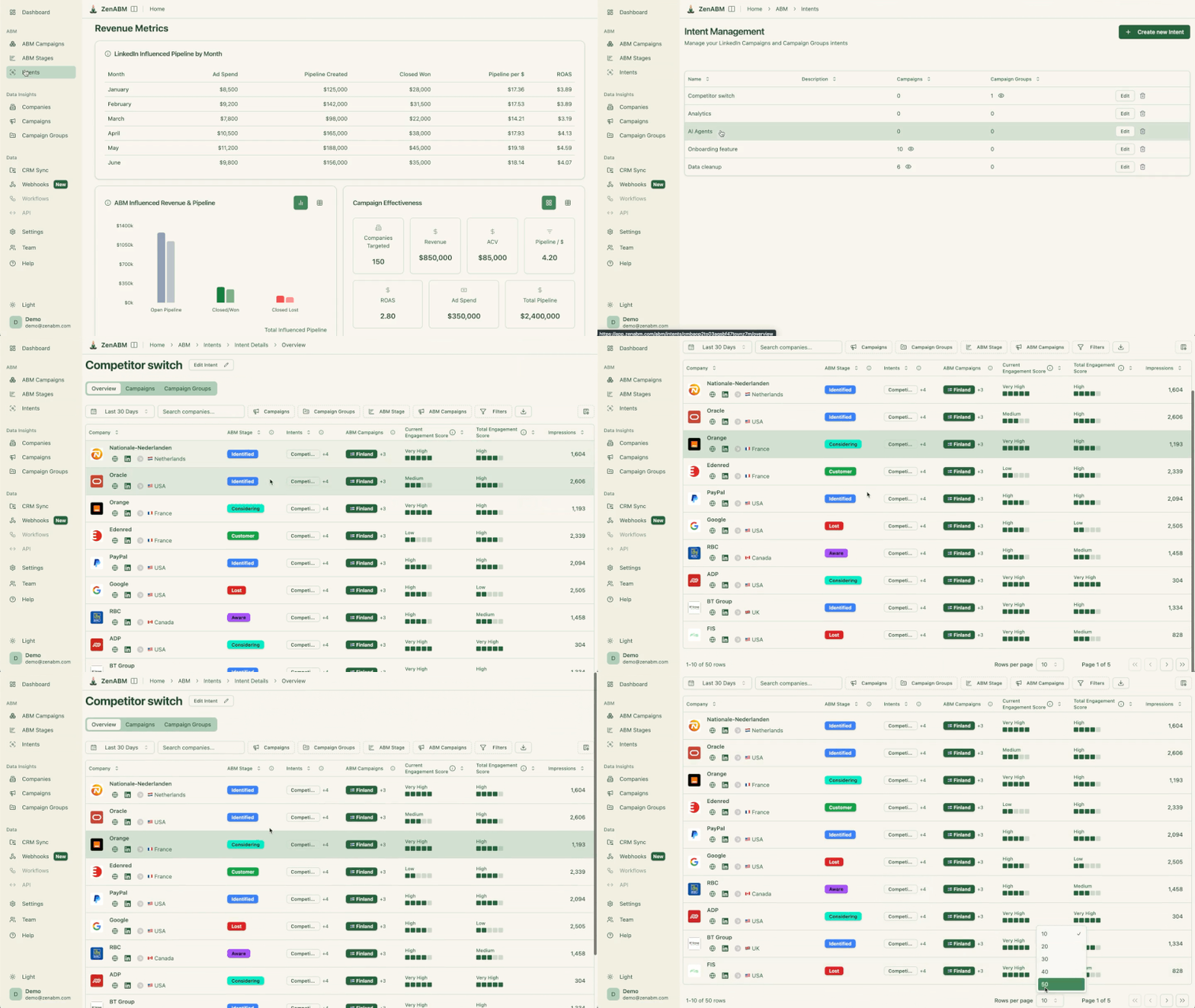
ZenABM adds another layer here that goes beyond the standard CTR and CPC metrics most teams rely on.
Because it de-anonymizes engagement at the company level, you can see exactly which companies clicked, which personas and job titles within those companies engaged, and what qualitative intent signals followed after the click.
That visibility makes it much easier to judge whether a competitor comparison or demo creative is attracting genuine buying intent or just idle curiosity from accounts that were never going to convert.



Carousel ads give you the ability to tell a story across multiple swipeable cards, which makes them uniquely suited for content that requires a logical sequence: a narrative arc that builds understanding of your product, your approach, or a customer outcome as the user moves from card to card.
For ABM, this sequential format works especially well for educational content, because target accounts in the engagement and consideration stages often need to absorb a multi-step argument before they’re ready to take the next action.
Key stats:

When to use carousel ads for ABM:
Best practices:
Carousel ads are also a particularly good fit for ZenABM’s qualitative intent analysis, because the format naturally reveals what kind of narrative your target accounts are choosing to spend time with.
If an account swipes through a comparison-focused carousel but ignores an educational one, that behavioral signal tells you whether they’re leaning toward evaluation mode versus still in early research, and that distinction matters when you’re deciding what to serve them next.

Video ads on LinkedIn have the lowest CTR of all the formats we measured, but that number is misleading if you evaluate them by the same direct-response criteria you’d use for image or carousel ads, because video ads serve a fundamentally different purpose in an ABM program.
They’re about building brand recognition and trust over time, not driving immediate clicks, and a target account that watches 50% or more of your video is arguably more warmed up and familiar with your positioning than one that merely glanced at a static single-image ad in passing.
Key stats:

When to use video ads for ABM:
Complete guide: LinkedIn Video Ads for ABM

Document ads let users preview a PDF directly in the LinkedIn feed without leaving the platform, which creates a uniquely low-friction way to deliver in-depth content to your target accounts.
They can be gated (requiring a lead gen form to access the full document) or ungated, and for ABM specifically, ungated document ads that deliver genuine value up front tend to build considerably more trust than gated ones.
This is because target accounts at enterprise companies are increasingly skeptical of trading their contact info for content that might turn out to be a thinly disguised pitch deck.
Key stats:

When to use document ads for ABM:
Deep dive: LinkedIn Document Ads: The Ultimate Guide with Examples
Document ads often create a layer of educational engagement that builds familiarity and credibility well before pipeline intent becomes obvious, which means they’re doing real work even when they don’t immediately show up in your attribution reports.

Text ads and spotlight ads appear in the sidebar and top bar of LinkedIn, and while their CTRs are extremely low (0.02 to 0.05%), they compensate by generating thousands of impressions at a CPM that’s a fraction of what you’d pay for feed-based formats.
For ABM, they serve as “surround sound,” keeping your brand persistently visible to target accounts in the periphery of their LinkedIn experience without burning through the budget you need for higher-intent formats lower in the funnel.
“LinkedIn’s text ads and spotlight ads are extremely significant to my ABM strategy template as they generate a huge number of impressions for a very low CPM.” – Tim Davidson, B2B Rizz

When to use text/spotlight ads for ABM:
Pro Tip: LinkedIn text ads are so cheap that you can use them as a near-free website deanonymization layer. Just build a text ad audience from your site visitors, let LinkedIn serve low-cost impressions back to those accounts, and use ZenABM’s official LinkedIn API-based tracking to surface which companies came back, turning anonymous traffic into identifiable account-level intent.

The best LinkedIn ad format for any given moment depends entirely on where your target accounts are in the buying journey, because a format that excels at awareness can actively underperform if you deploy it at the conversion stage, and vice versa.
Here’s how to map formats to ABM funnel stages so that each dollar goes toward the right objective:
ABM Stage | Primary Format | Secondary Format | Goal |
|---|---|---|---|
Awareness | TLAs + Text Ads | Video Ads | Get in front of target accounts at low cost |
Engagement | TLAs + Single Image | Carousel + Document Ads | Drive meaningful interactions and content consumption |
Consideration | Single Image + Document | Carousel | Share case studies, comparisons, and detailed content |
Conversion | Single Image | Message Ads | Drive demo requests and meetings |
The best LinkedIn ad format for ABM is not one universal winner for every situation. It depends on what stage the account is in, what action you want next, and how much friction that account is ready for.
Thought Leader Ads may dominate in efficiency, but the strongest ABM programs still combine formats deliberately across awareness, engagement, consideration, and conversion.
The more important lesson is that format decisions should not be made on CTR and CPC alone. You need to know which companies engaged, which personas responded, and whether those interactions actually pushed accounts closer to the pipeline.
That is where ZenABM becomes genuinely useful. If you want to move beyond surface metrics and see which LinkedIn ad formats are actually working on your target accounts, ZenABM is a strong layer to add.
Try ZenABM for free (37-day free trial) or book a demo now!
Some common questions about the best LinkedIn ad formats for account-based marketing, answered based on our benchmark data and campaign experience:
Thought Leader Ads (TLAs) are the best LinkedIn ad format for ABM based on our benchmark data, delivering a 2.68% median CTR and $2.29 median CPC, which significantly outperforms every other format we measured. They work especially well for the awareness and engagement stages of the funnel because they look like organic posts from a real person, which means they earn attention and trust in a way that branded creatives simply can’t replicate.
Thought Leader Ads have the highest CTR at 2.68% median, followed by single image ads at 0.42%, carousel ads at 0.32%, and video ads at 0.24%. Text ads sit at the bottom with a 0.02 to 0.05% CTR, though they compensate with extremely low CPMs that make them valuable for always-on awareness rather than click-driven campaigns.
Yes, but only if you’re using them for the right purpose and measuring the right metrics. Video ads have the lowest CTR and highest CPC of all formats, which means they’re a poor choice if your goal is driving clicks, but they excel at top-of-funnel brand awareness, customer testimonials, and product demos, where view-through rate is the metric that actually reflects whether your content is landing with target accounts.
I recommend using 3 to 4 ad formats across your ABM funnel so that each stage has the format best suited to its objective. At minimum, run TLAs for awareness and engagement, single-image ads for conversion, and text ads for always-on brand visibility. Then layer in carousel or document ads as your budget allows, since those formats strengthen the engagement and consideration stages where accounts are actively building their understanding of your product and category.
Text ads and spotlight ads are the cheapest per impression, which makes them ideal for always-on awareness campaigns that need to reach a large account list without straining the budget. If you’re optimizing for cost per click instead, TLAs are the clear winner at $2.29 median CPC, while single-image and carousel ads are the most expensive per click at roughly $13 CPC, so they should be reserved for mid-to-lower funnel stages where each click carries higher intent and justifies the cost.
