



DemandSense is a B2B marketing tool that focuses on LinkedIn ad control, LinkedIn ads analytics, and intent-style workflows like website visitor identification and prospecting.
In this article, you’ll learn what is DemandSense, what it does, how its key modules work, what features matter most in practice, how pricing is structured, and what public reviews currently say.
I’ll also cover when DemandSense is a practical fit for your ABM or demand-gen motion, and where a lean, LinkedIn-first alternative like ZenABM may be a better primary tool or a useful complementary layer due to its distinct features.
Let’s get started!

Try ZenABM Now
If you only need the essentials:


DemandSense is a LinkedIn-centric platform that aims to help B2B teams do three things:
In practical terms, DemandSense sits “on top of” LinkedIn Campaign Manager. It pulls LinkedIn advertising data into its own interface and adds controls and reporting workflows that are not always convenient to manage inside LinkedIn alone.
It also promotes an intent layer. This includes website visitor identification and “reveal” features that attempt to identify the companies behind anonymous site visits and convert those signals into audiences and follow-up actions.
If you are running LinkedIn ABM and care about timing, account-level efficiency, and faster iteration on audience quality, DemandSense is positioned as an operational control and analytics layer.
If you are not running LinkedIn as a primary channel, or if you do not need hour-by-hour optimization and audience tuning workflows, the platform may be unnecessary.
DemandSense combines LinkedIn ads controls, reporting, and intent-style workflows into one product surface.
Its capabilities typically show up in these areas:

DemandSense markets “visitor identification” and intent features that aim to turn anonymous website traffic into identifiable companies and, in some cases, contacts.
In plain language, this category of tooling attempts to answer: which accounts are researching you, even when they do not submit a form.
DemandSense’s Visitor ID style workflows typically rely on a site script plus matching methods such as reverse IP lookup to connect sessions to organizations. It can then route those accounts into audiences and, depending on configuration, into systems like a CRM.
One user on G2 claims: “Being able to identify which companies are coming to our site before they fill out a form… gives us a clear signal for when to engage.”

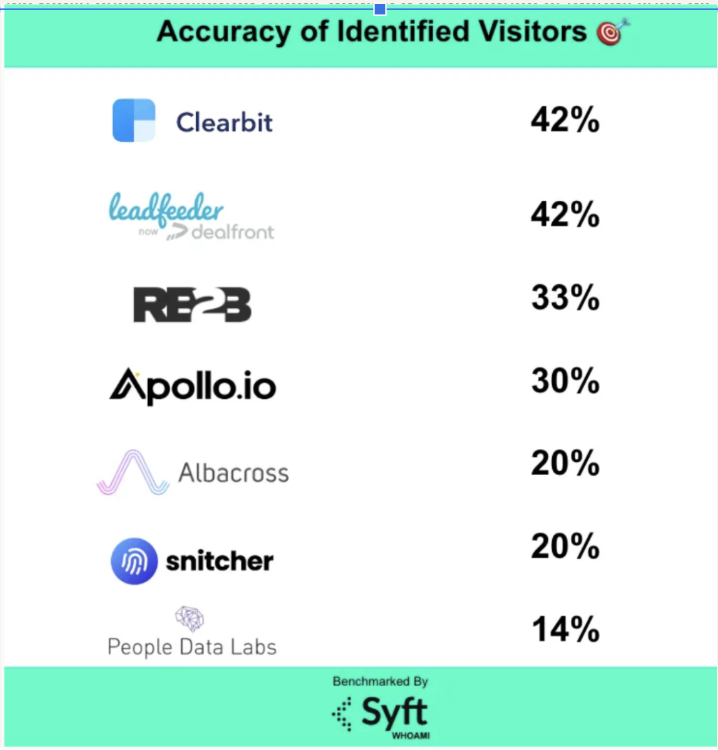
Note: Website visitor identification is commonly driven by IP-based matching and cookies. IP matching often degrades with remote work, VPNs, shared networks, and stale IP-to-company databases. Cookies also face increasing browser restrictions. Even a study by Syft found that IP-matching accuracy tops out at about 42%.
Once DemandSense collects engagement and site signals, it can be used to group accounts by intent and engagement patterns and then build audiences from those segments.
This is most often used for retargeting and “follow the account” style LinkedIn ABM, where your audience evolves based on behavior.
DemandSense also emphasizes reducing waste by helping you exclude weak segments and control account-level delivery. This is meant to prevent a small subset of accounts from consuming budget via repetitive impressions.
DemandSense is primarily positioned as a control layer for LinkedIn ads. It adds operational features designed to help teams run cleaner experiments and reduce spend on low-performing time windows or audiences.
It highlights functions such as:


DemandSense is marketed as LinkedIn-first, but it also references the ability to activate audiences across other channels such as Meta or programmatic environments.
In practice, this usually means: build or refine account audiences using LinkedIn and site signals, then reuse those audiences for cross-channel retargeting and follow-up.
For teams that run multi-channel ABM, the operational value depends on whether DemandSense becomes the “audience brain” or whether it stays limited to LinkedIn execution improvements.

DemandSense positions itself as more than a LinkedIn convenience tool. It also aims to connect engagement activity to revenue workflows.
A common pattern is pushing engagement signals into a CRM and syncs with tools like HubSpot and Salesforce, so company records can reflect ad exposure, clicks, and engagement indicators.
This is intended to give sales teams usable context, for example: a target account engaged with ads, then visited key pages, then showed a spike in activity.
By the way, ZenABM also pushes account scores and engagement into CRM company records as company properties (starts @$59/month only!).
DemandSense also markets hour-by-hour views of LinkedIn performance, which are used to detect patterns such as low-performing time windows, device differences, and weekday vs. weekend behavior.

DemandSense lists public pricing and frames the product around a Basic tier and a Plus tier.
The practical difference is that Plus includes a monthly credit allocation for data-driven actions, for example visitor and contact reveals.
As currently listed:
In a credit-based model, the headline subscription is only part of the cost story. For teams with meaningful traffic volume or heavy research workflows, credit consumption and any overage pricing will determine the real monthly spend.
DemandSense’s Basic and Plus prices are straightforward, but the Plus plan’s included 250 credits is a structural limiter for teams that want frequent visitor or contact reveals.
If your ABM motion requires consistent volume, credits can become the dominant cost driver, and the effective price can diverge from the listed subscription.
ZenABM appears to be a simpler pricing alternative starting at ~$59/month, and its agency-tier pricing remains under $6k/year without a credit-based system.
ZenABM focuses on core LinkedIn ABM needs: account-level ad engagement tracking, account scoring, ABM stage tracking, assignment of hot accounts to BDRs, bi-directional CRM sync, custom webhooks, qualitative company buyer’s intent tracking, job-title-level ad engagement tracking, and plug-and-play ROI attribution dashboards.
ZenABM can also be used as a practical website visitor identification workaround. Retarget website visitors with low-cost LinkedIn text ads, and ZenABM can list the companies that were served impressions, which effectively reveals many website visitors at the company level while also supporting incremental awareness.

DemandSense does not yet have broad public review coverage.
On G2, DemandSense currently shows a single agency review.

Yes, that is based on one reviewer at the moment:
The reviewer highlights LinkedIn integration, targeting efficiency, and ROI outcomes, and also flags that the platform has a learning curve. The practical interpretation is that teams should expect setup effort and should plan time to configure workflows properly, potentially with vendor support.
One alternative to DemandSense is ZenABM.
ZenABM is designed for LinkedIn ABM. For teams that operate primarily on LinkedIn, it can be a direct alternative to DemandSense.
For teams running multi-channel ABM, ZenABM can also be a complementary layer because it emphasizes first-party LinkedIn engagement data and downstream activation into CRM.
Let’s look at those features:
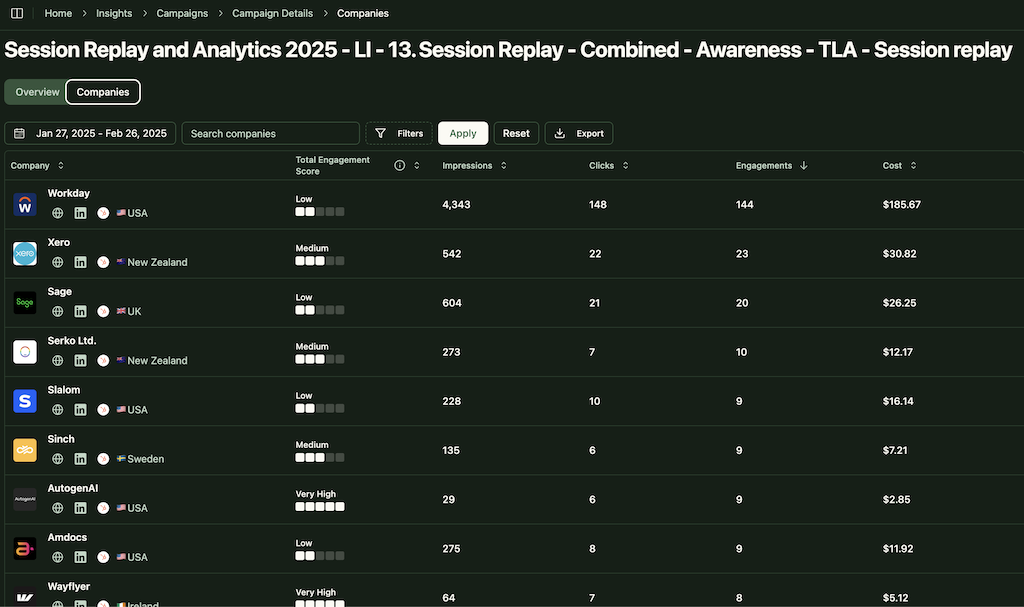
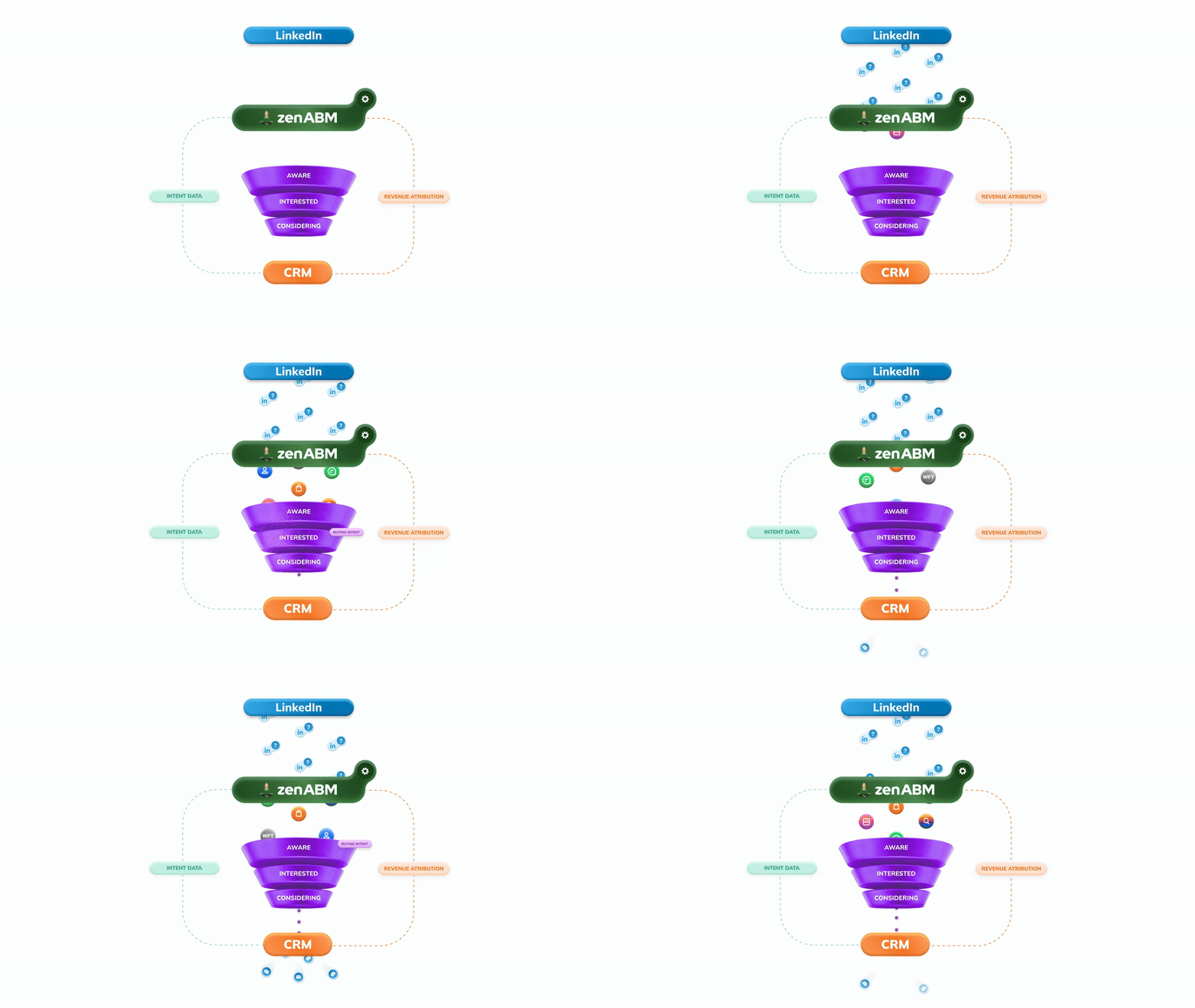
ZenABM integrates directly with the LinkedIn Ads API to pull account-specific data from all campaigns.
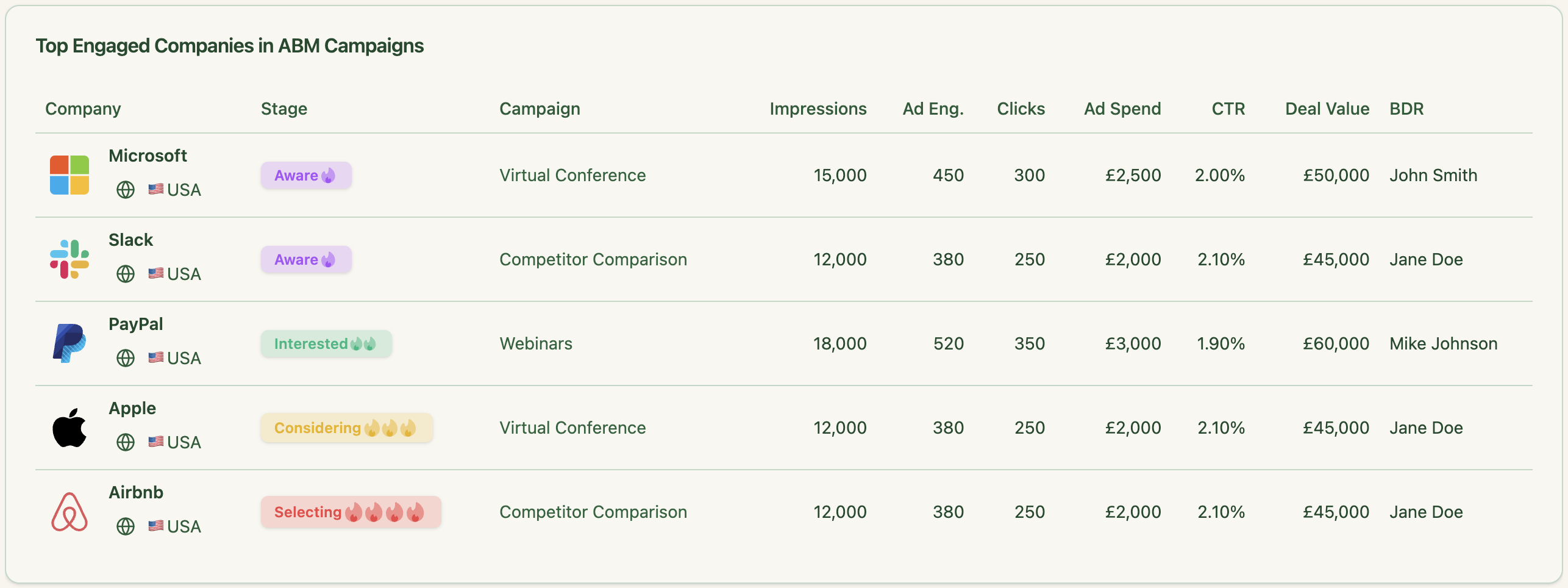
This allows you to identify precisely which target accounts are interacting with your LinkedIn ads (impressions, clicks, etc.), all mapped to individual companies.
Pro Tip: ZenABM can also reveal anonymous website visitors for free. Retarget them with inexpensive LinkedIn text ads, and ZenABM will identify the companies that saw your impressions.
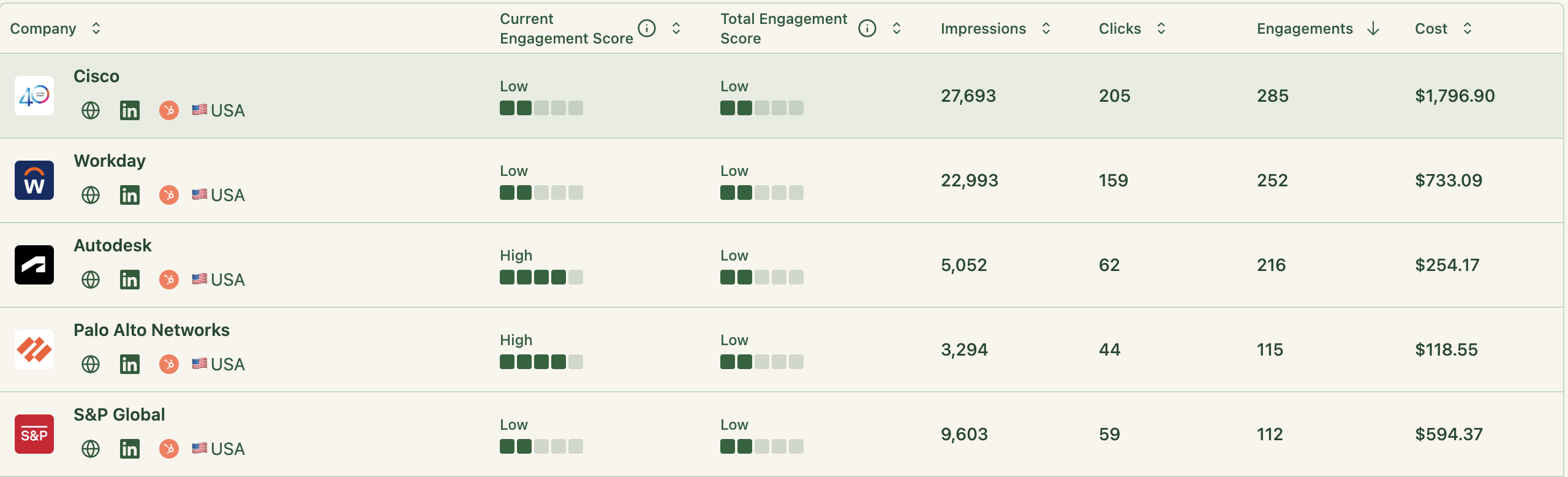
ZenABM continuously updates engagement scores from ad interactions. You can monitor recent trends (like the past week) or historical patterns to identify accounts heating up.
These scores help marketing and sales prioritize high-value accounts for follow-up.
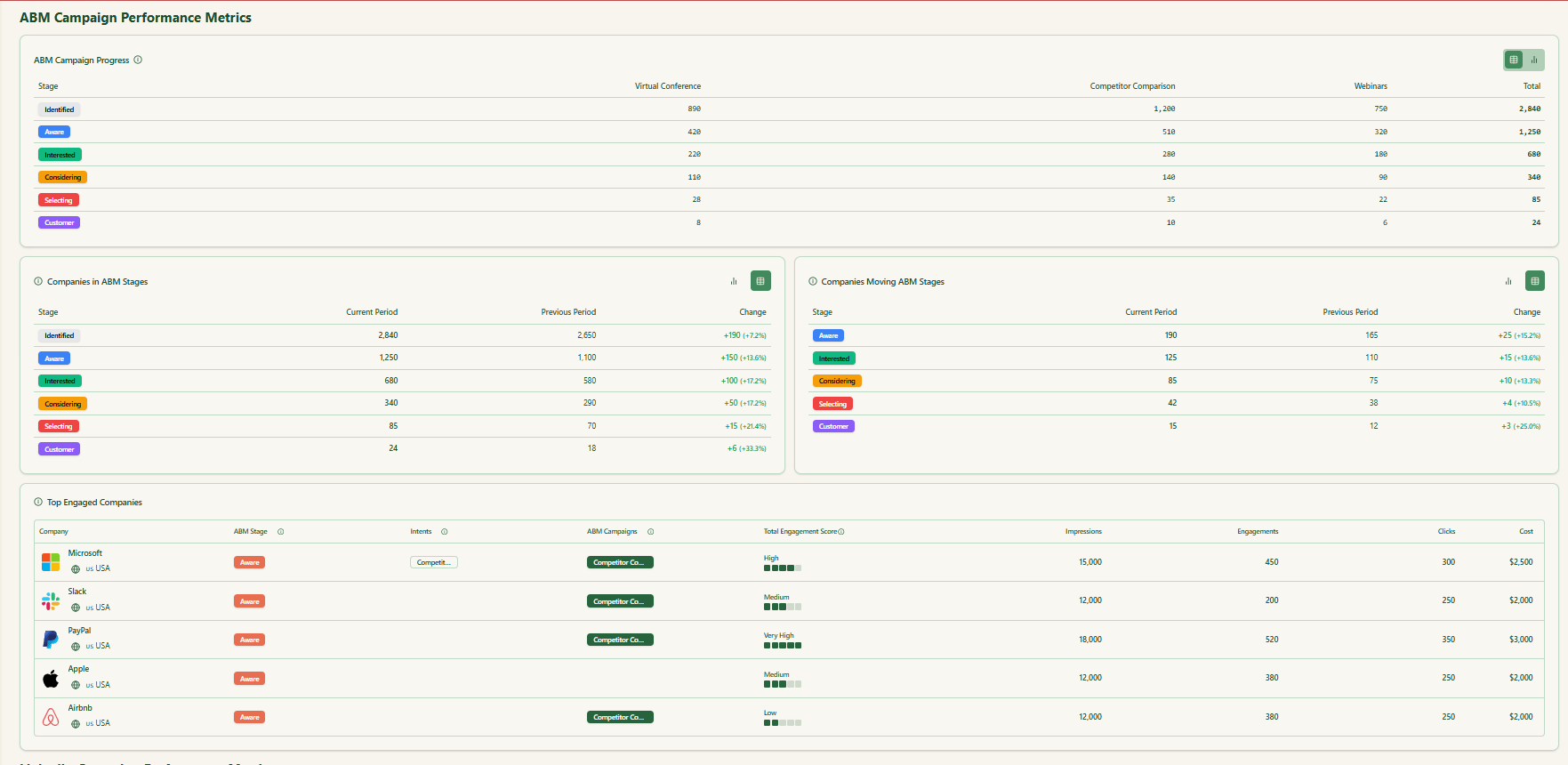
ZenABM enables you to define your ABM funnel stages (e.g., Identified → Aware → Engaged → Interested → Opportunity) and automatically classifies accounts using engagement and CRM information.
You can set your own thresholds for “Engaged” or “Interested,” and ZenABM will track stage transitions automatically.
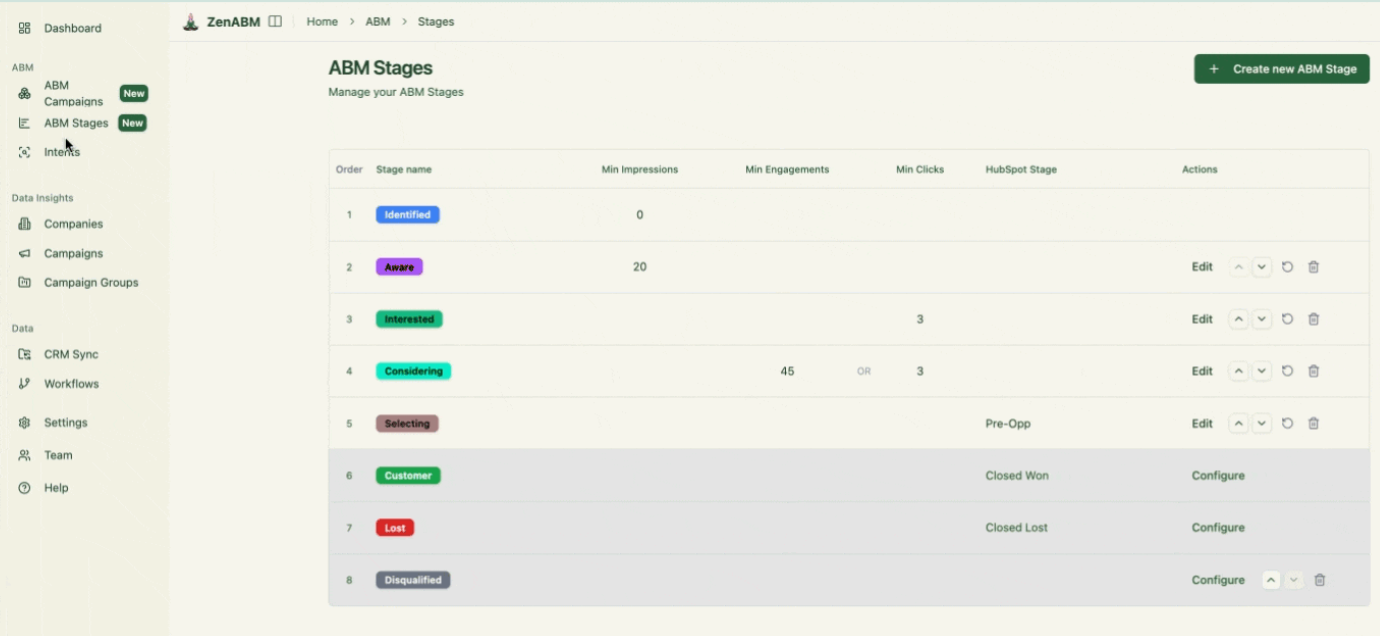
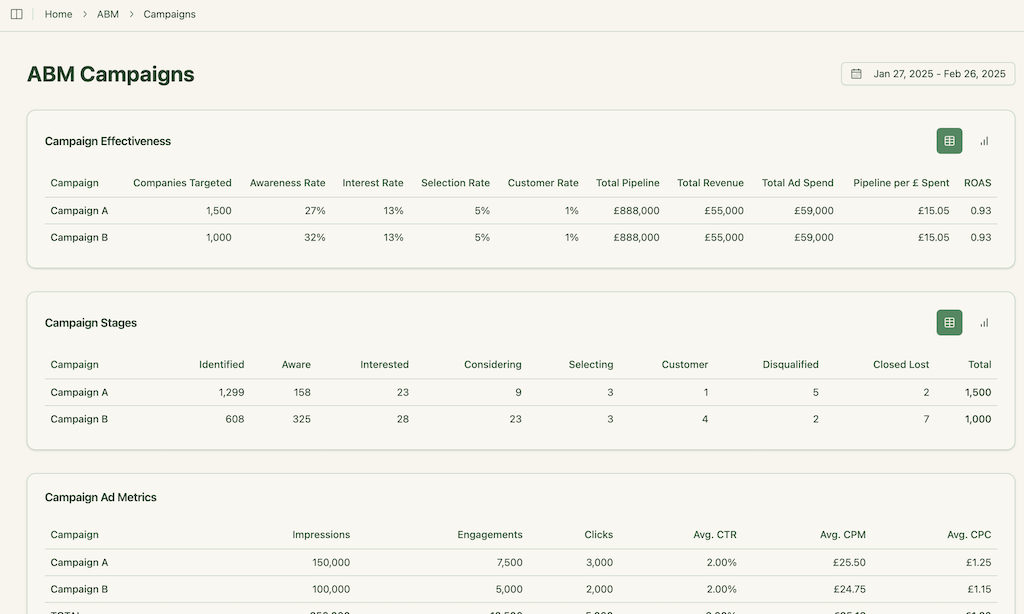
This delivers full-funnel visibility like enterprise ABM platforms, highlighting where accounts stall and where progress accelerates.
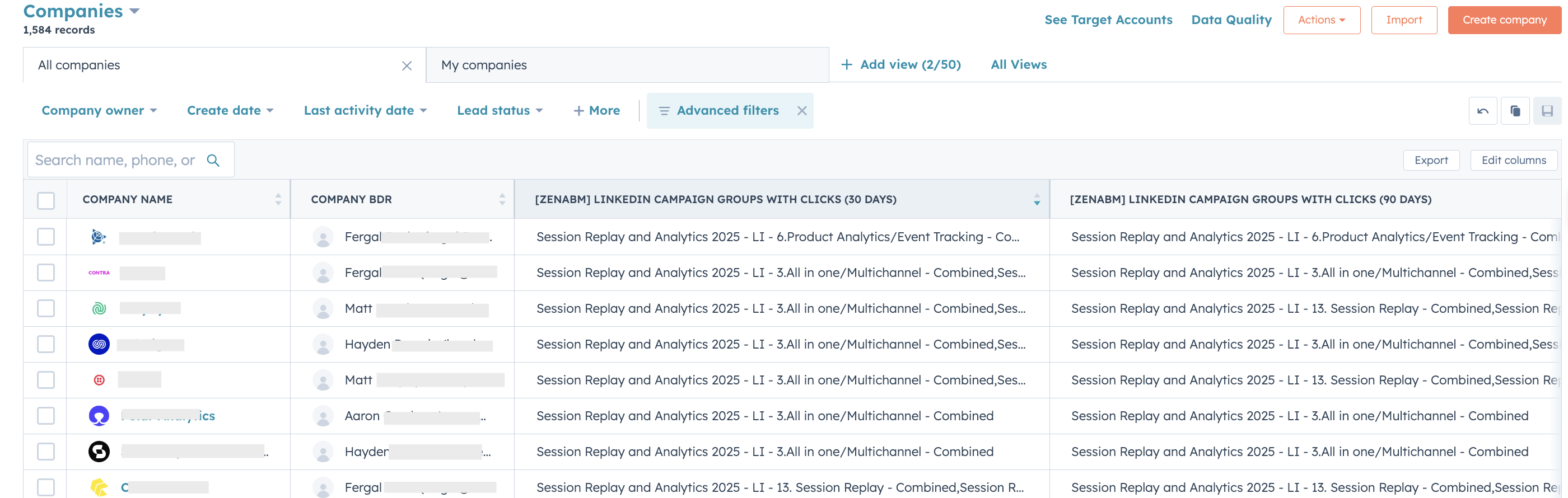
ZenABM integrates bidirectionally with CRMs such as HubSpot (Salesforce available on higher plans).
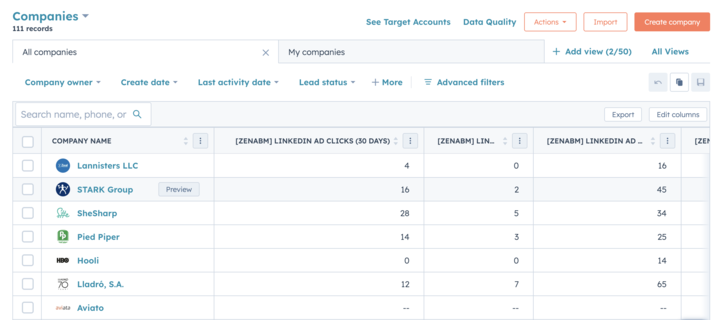
LinkedIn engagement data feeds directly into your CRM as company-level properties, keeping sales teams informed:
ZenABM can auto-update account stages to “Interested” when engagement passes a set threshold and assign accounts to specific BDRs for follow-up.
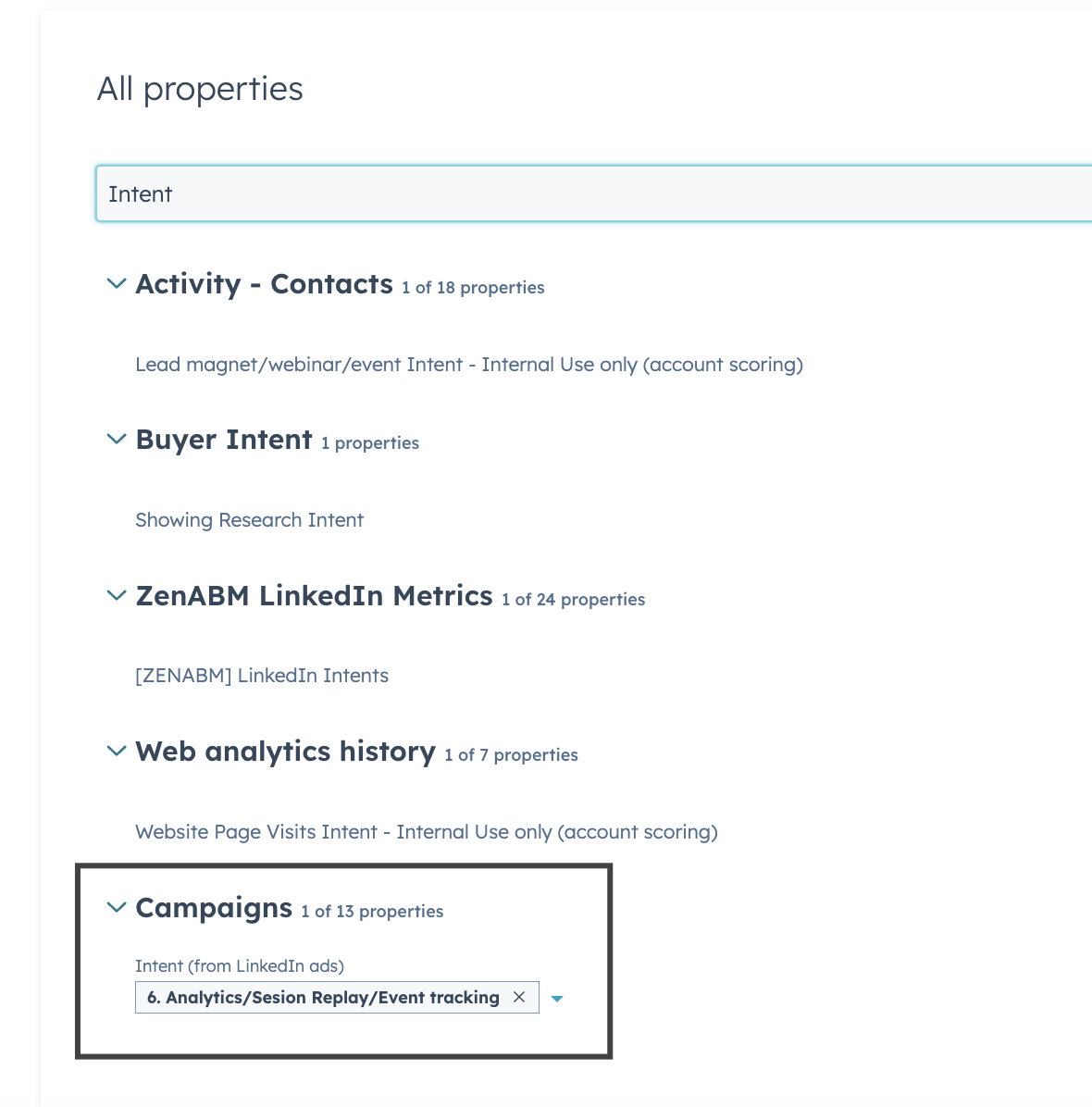
ZenABM allows you to tag campaigns by theme (like “Feature A” vs. “Feature B”) and shows which accounts engage with which themes, revealing their priorities.
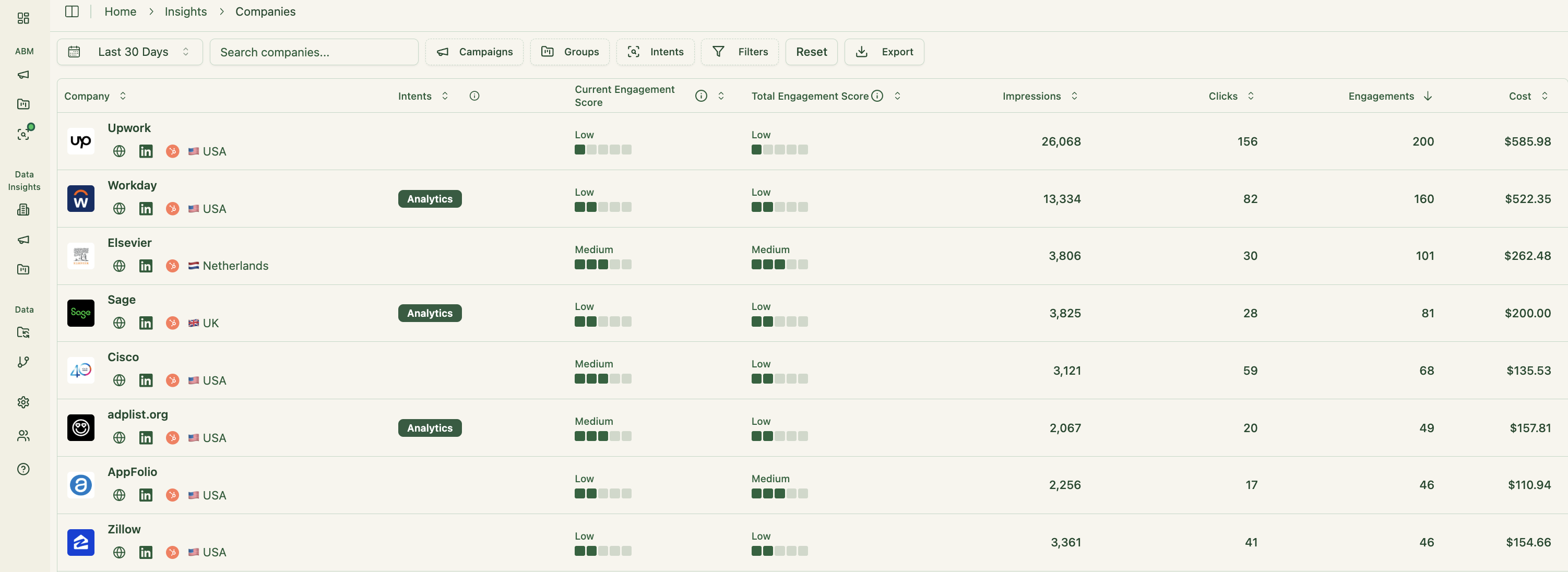
This is first-party intent based on owned interactions.
These insights also sync to your CRM, supporting relevant outreach and messaging.
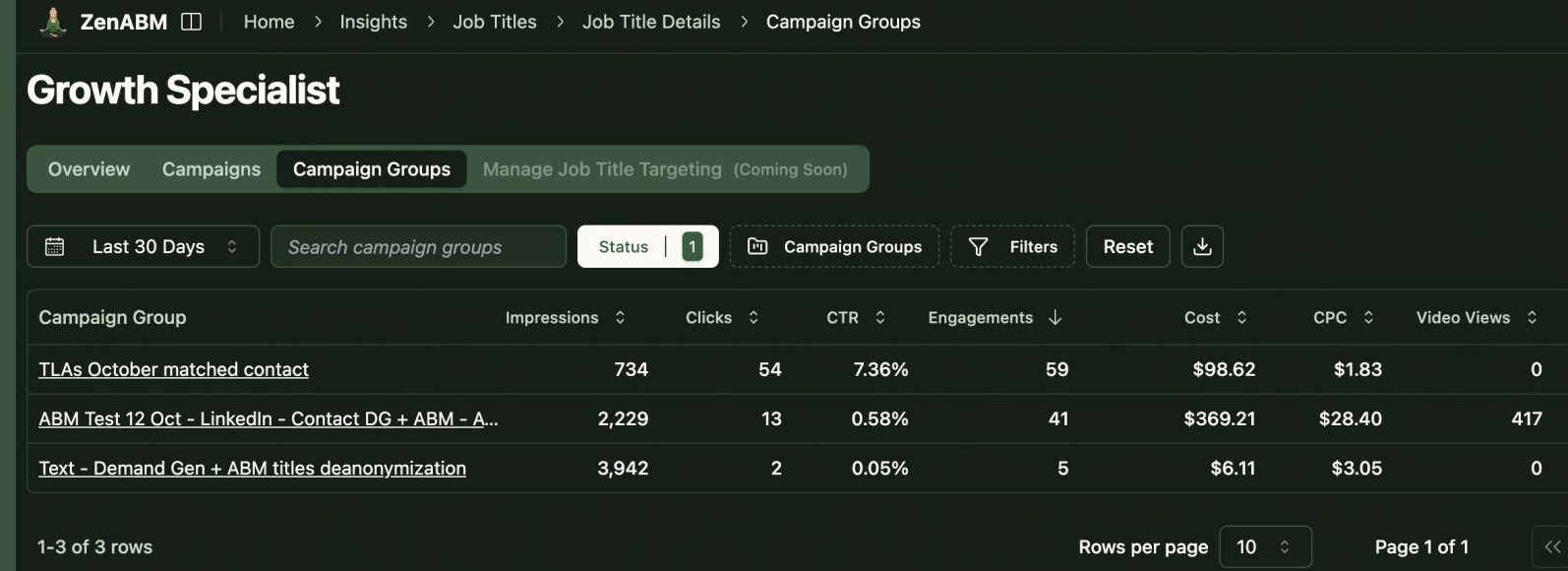
ZenABM also gives a breakdown of the job titles that interact with your ads, including engagement metrics, dwell time, and video funnel behavior.
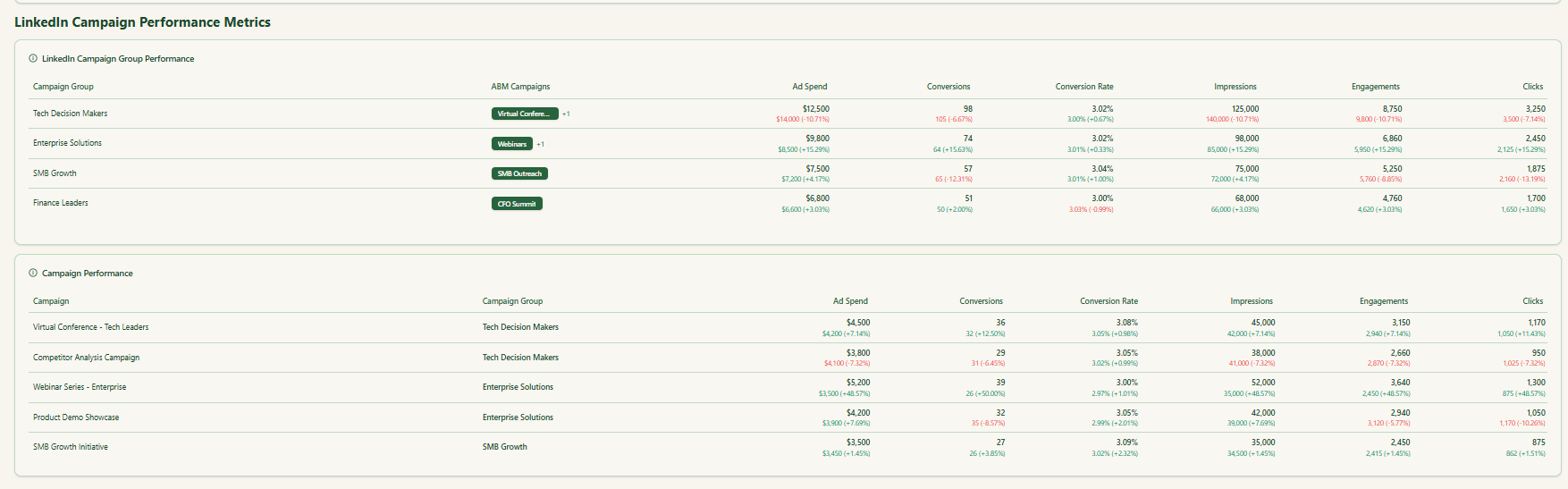
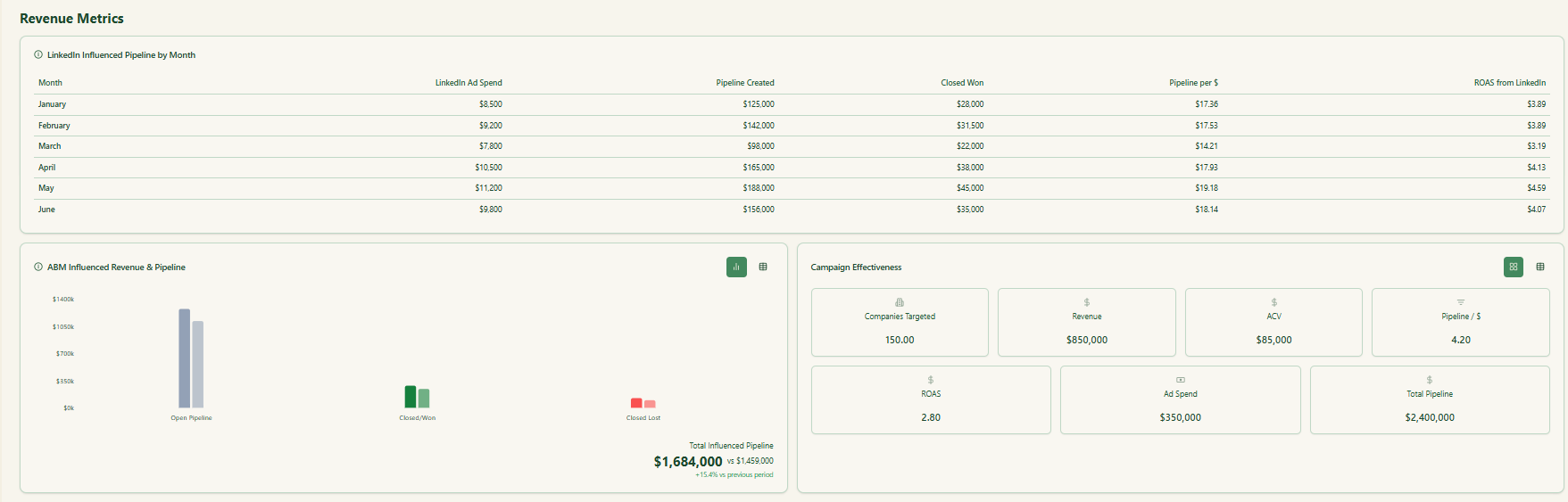
ZenABM includes pre-built ABM dashboards linking ad exposure, engagement, funnel stages, and pipeline metrics.
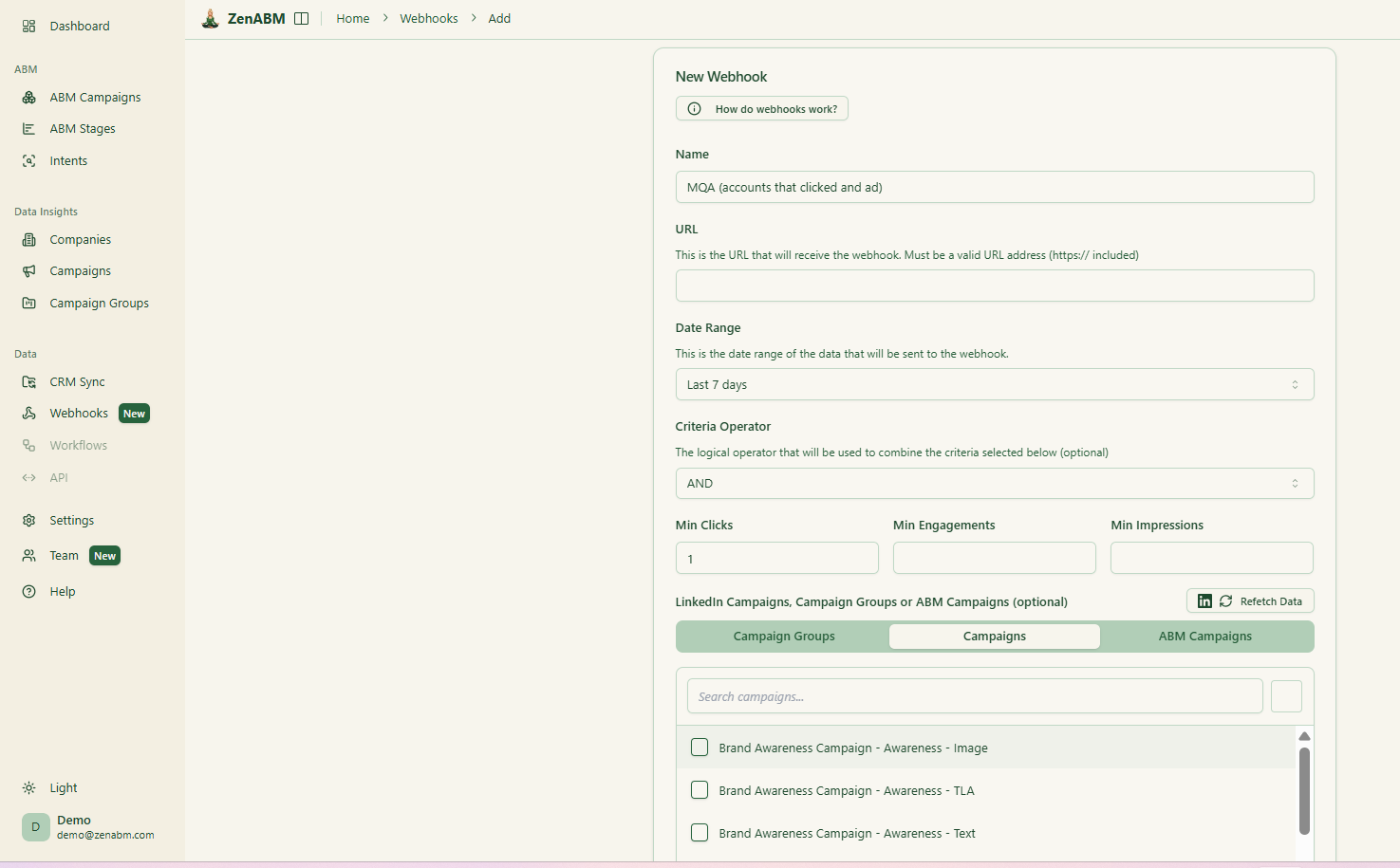
With the newly rolled out custom webhooks, ZenABM can fit into workflows such as Slack alerts, enrichment, routing, and ops automation.
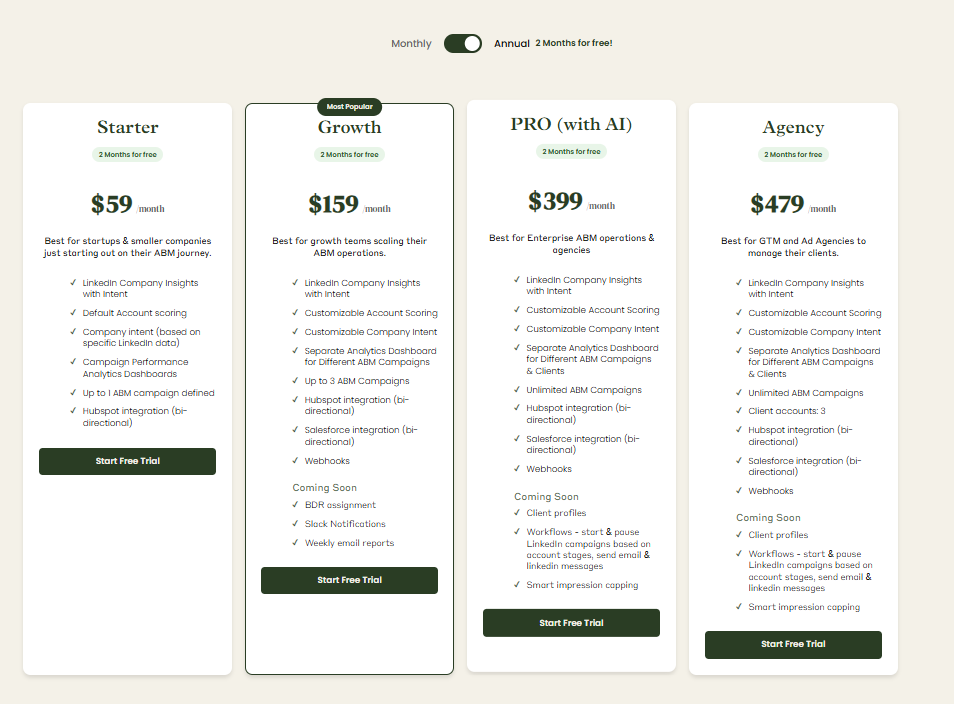
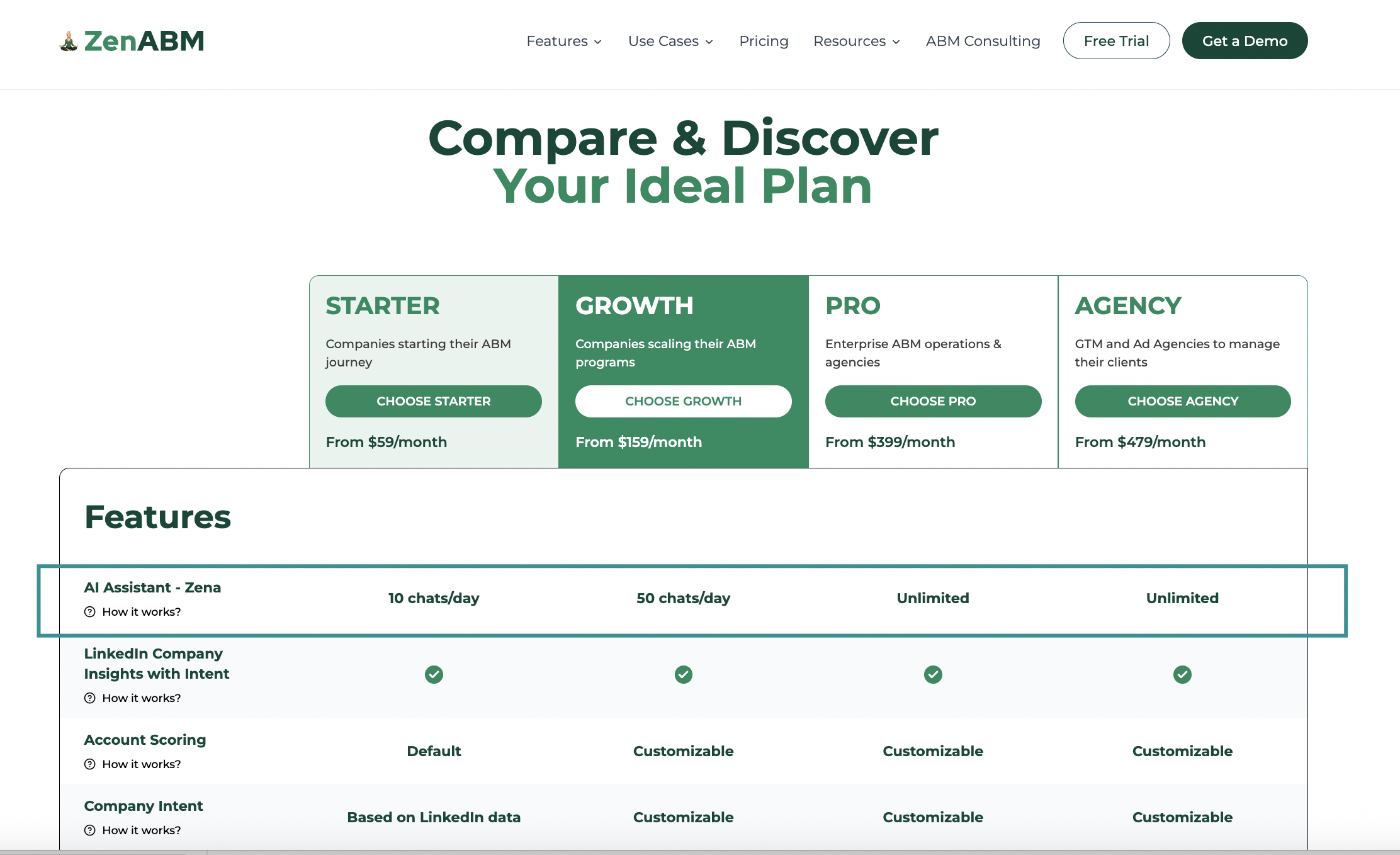
Plans start at $59/month for Starter, $159/month for Growth, $399/month for the Pro (AI) tier, and $479/month for the agency tier.
Even the highest tier costs under $6,000/year, far less than what DemandSense can cost if you factor in a credit-based model where the Plus plan includes only 250 monthly credits.
All plans cover essential LinkedIn ABM functions, with higher tiers mostly expanding limits or adding Salesforce integration.
Pricing is flexible (monthly or annual with two months free), and a 37-day free trial allows teams to try before buying.
DemandSense is a LinkedIn-first product that combines ad controls, reporting, and intent-style workflows like visitor identification.
It is most relevant for teams that actively manage LinkedIn as a primary channel and want tighter control over timing, frequency, audience quality, and hour-level performance patterns.
The key tradeoff is that deeper data workflows appear tied to credits, so the true ongoing cost depends on usage volume, not just the subscription number.
If your main goal is first-party LinkedIn engagement visibility, CRM-ready activation, account scoring, and clear pipeline impact without a credit system, ZenABM is typically the cleaner operational choice.
Whether you replace DemandSense or complement it, the most important decision is whether you need an “ad controls” layer, an “intent reveal” layer, or a first-party LinkedIn ABM analytics and activation layer.
