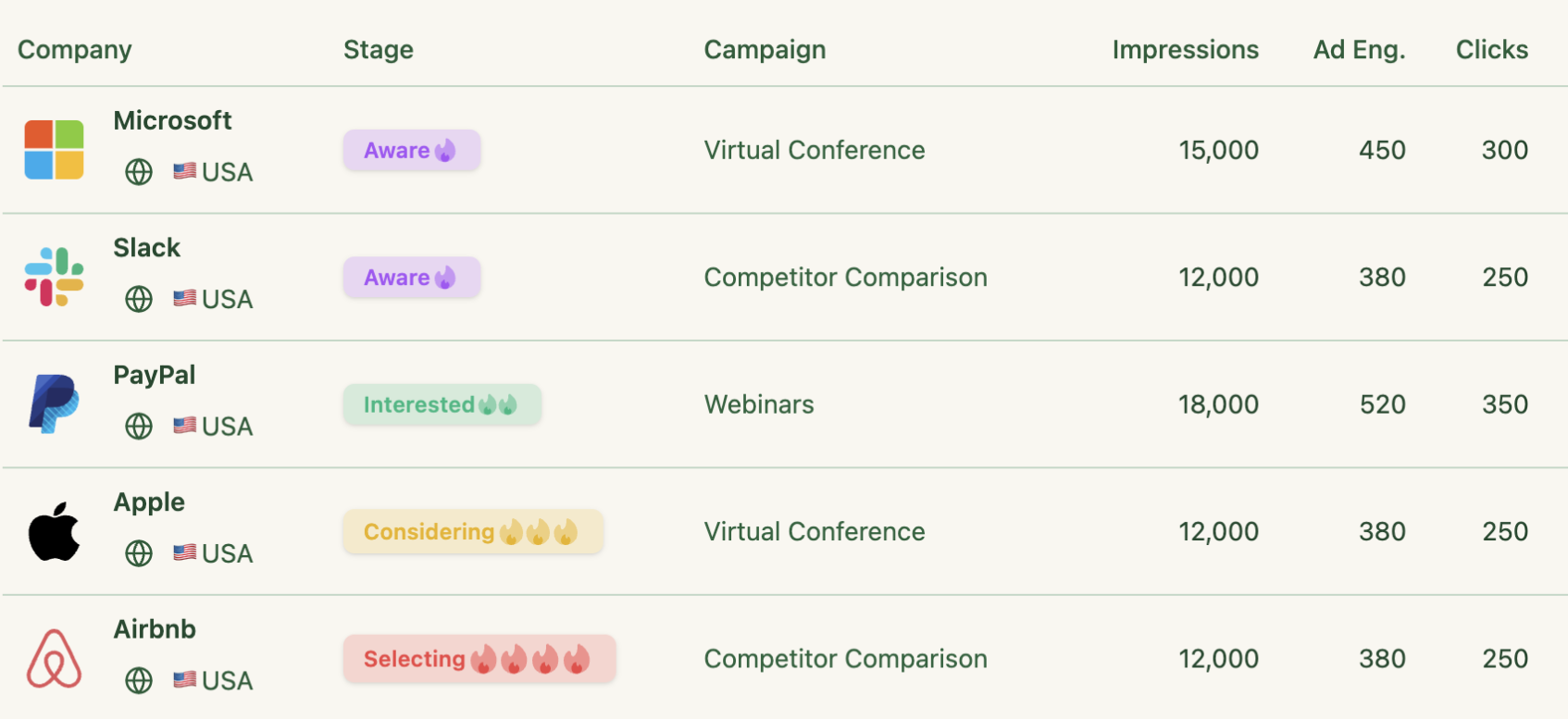

![Fibbler vs ZenABM 🦁 🧘♀️ – Which is better for LinkedIn ABM? [Updated April 2026]](/_next/image?url=https%3A%2F%2Fwp.zenabm.com%2Fwp-content%2Fuploads%2F2026%2F01%2FZenABM-vs-Fibbler-which-should-you-choose-for-LinkedIn-ABM-.png&w=1920&q=75)
When choosing a tool for running ABM campaigns on LinkedIn, many folks compare ZenABM vs Fibbler. They have a similar (affordable!) price point, both share the core functionality of deanonymizing LinkedIn ad engagements on company level, and pushing them to your CRM. But they also have different features and were built for a different purpose.
The single biggest one, and the reason I’d start here if I were you: Fibbler cannot create, edit or manage a single one of your LinkedIn campaigns. It shows you what happened, caps impressions, schedules your ads – and then you go back to Campaign Manager and do the actual work by hand. ZenABM lets you build campaigns, ad sets and ads with AI – from Zena, or straight from Claude / ChatGPT through its MCP server – and then keeps the spend sane with Budget Savers and the Bidding Agent. Everything else below matters, but that’s the one that changes your week.
I know because I’ve used both for my LinkedIn ABM campaigns (I’ve been running a 7-figure ABM program with LinkedIn ads – read my blog post about it here or the Case Study on it published on Kyle Poyar’s Growth Unhinged to find out how I manage it btw!) – in fact, I’ve used them both at the same time (ZenABM for data & revenue attribution, Fibbler for impression capping). Let’s see how they compare in a nutshell so you can make an informed decision whether ZenABM or Fibbler are better for running ABM campaigns on LinkedIn.
Update (September 2026): Since this post was first published, both tools have evolved significantly (oh the joys of building a SaaS in the times of AI! 😁) ZenABM now supports multi-channel engagement signals (Google Ads, Reddit Ads, organic traffic, and AI chatbot referrals), serves 70+ customers including enterprise companies, offers extensive implementation services, added Attio to the CRM integrations – and, the big one, you can now create and manage your LinkedIn campaigns inside ZenABM (with AI, and with your approval on every single write). More on that below. Fibbler has expanded to support Google Ads attribution (as a paid add-on), added Attio as a CRM integration, shipped a read-only MCP server on its top two plans, and now reports 500 marketers on the platform. Fibbler has also published a “ZenABM Alternatives” article with several claims about ZenABM (most of which weren’t supported by evidence or actual usae of the tool – as you can tell from the lack of any screenshots etc.) that we address in detail at the bottom of this post. I’ve updated this comparison to reflect the current state of both tools.

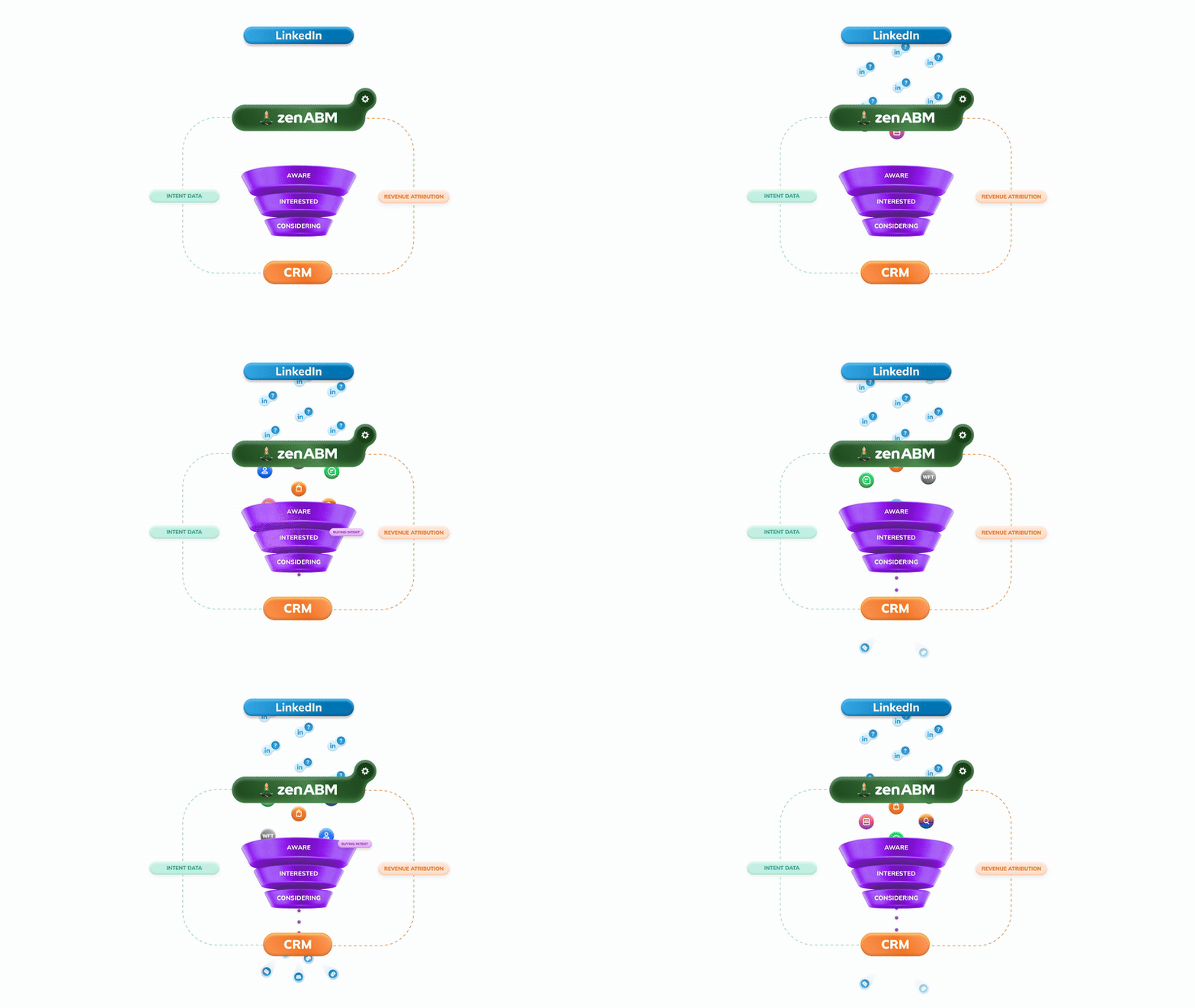
For those of you who want a quick overview – here’s Fibbler vs ZenABM comparison for LinkedIn ABM in bullet points:


Want more details? See how ZenABM vs Fibbler compare in this quick feature-by-feature overview (even more details below).
Before I give you a drill down on the differences between ZenABM and Fibbler for each use case, here’s a quick overview:
| Criteria | ZenABM | Fibbler |
|---|---|---|
| Campaign Creation & Management with AI |
|
|
| ABM Use Case Functionality |
|
|
| Company Insights |
|
|
| Campaign Insights |
|
|
| Analytics (Dashboards) + Revenue attribution + AI analytics |
|
|
| Channels Supported |
|
|
| Customer Support & Services |
|
|
| Usability |
|
|
| Data Quality & CRM Company Match Rate | Higher data capture (e.g. 26% more clicks in 7-day windows), better match rate via multi-factor matching. | Lower data volume and match rate (~40%) in my own testing, due to reliance on exact domain matches. In fairness: Fibbler is an official LinkedIn Marketing Partner and claims a higher match rate via the Company Intelligence API – so treat both numbers as vendor numbers and test on your own account. |
| Pricing |
|
|
Let’s start with the difference that actually changes how you spend your Tuesday.
Fibbler cannot create or edit anything. No campaigns, no ad sets, no ads. Its MCP server is read-only (and only on the top two plans), so even if you point Claude at it, your assistant can read your numbers and then… tell you about them. Every actual change happens by hand, in Campaign Manager.
ZenABM lets you build and manage the campaigns from inside the tool – by asking Zena, or from Claude Code, ChatGPT or Cursor through the MCP server (97 tools, 26 of them writes). Every write asks for your approval before it touches LinkedIn, so nothing happens behind your back:
On top of creating things, you get the bits that stop LinkedIn eating your budget:

The honest caveat: Fibbler still wins on time-based scheduling and on a true per-company monthly impression cap. ZenABM excludes high-impression, low-engagement accounts today, and the full cap is waiting on LinkedIn’s API access. Both are coming.
So the question to ask yourself when comparing the two: after you’ve seen the data, who changes the campaigns? With Fibbler, that’s still you, by hand. 😉
In a nutshell – ZenABM has been designed with running ABM campaigns on LinkedIn in mind, while Fibbler – for collecting LinkedIn ads insights.
ZenABM supports grouping your LinkedIn campaigns into ABM campaigns (a separate campaign object), which allows it to offer a lot more granular analytics and accurate revenue attribution for both all your campaigns – and each ABM campaign separately:
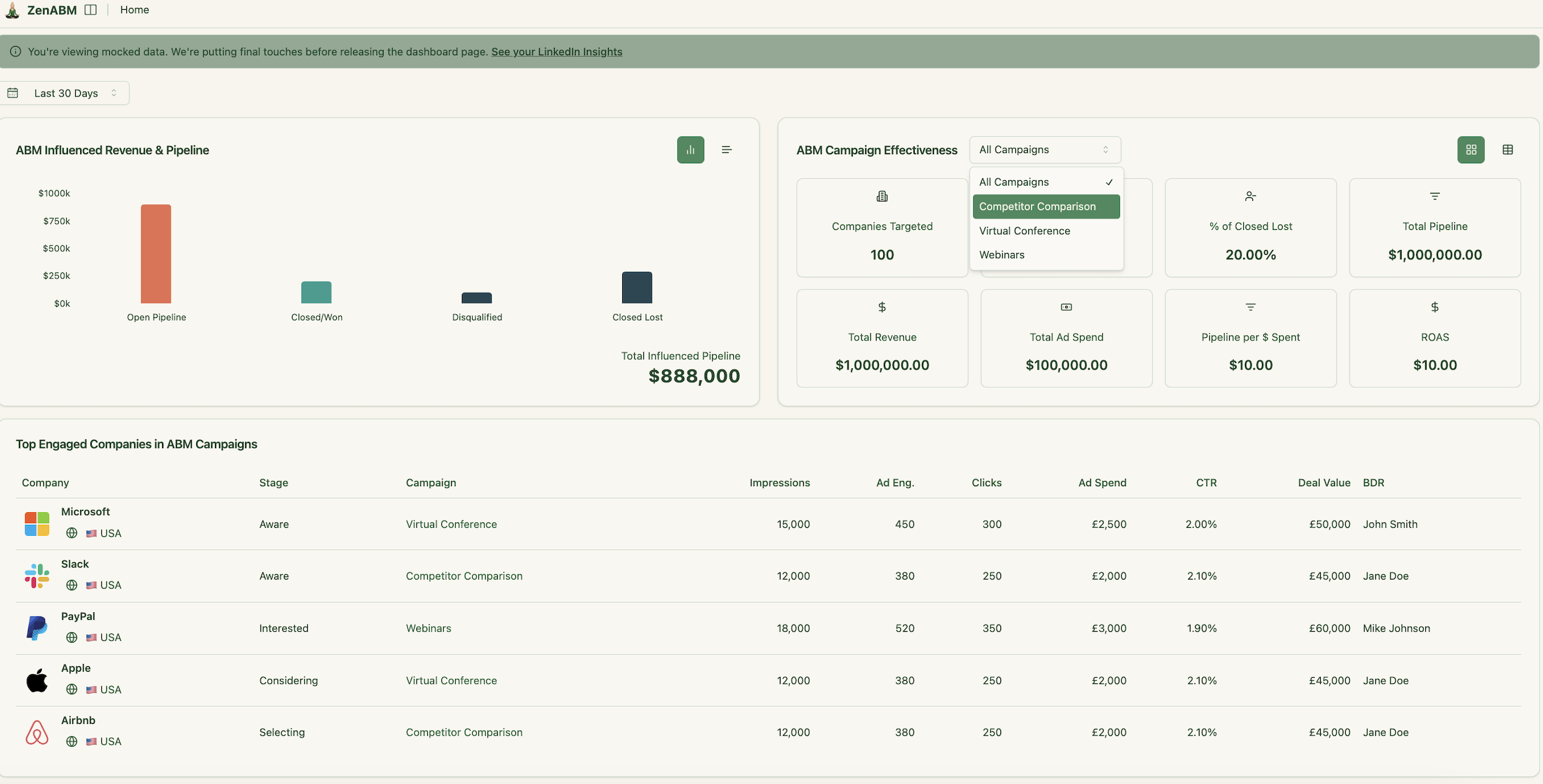

It provides you with both leading and lagging success indicators and campaign effectiveness metrics:
ZenABM captures company intent signals from company-level ad engagements:

As well as the stages of the funnel each company is in, as defined by you in the “ABM stages”:

ZenABM’s ABM stages are fully customizable (you can define them yourself, add or remove them) – and are based on a combination of LinkedIn Ad engagements, CRM deal or lifecycle stages, and custom properties:

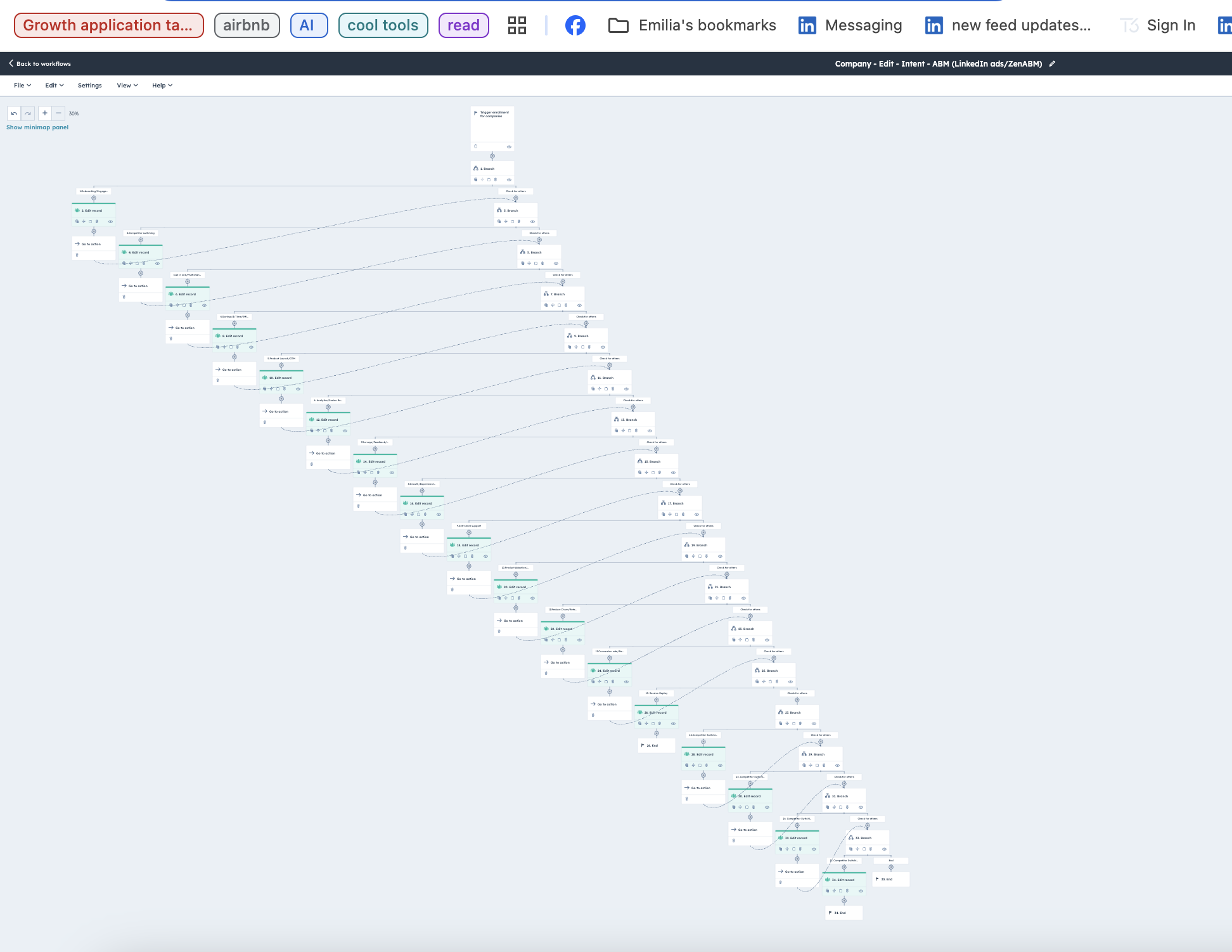
Fibbler doesn’t have any of these features. And this is the main reason why I switched to ZenABM – because using raw data from Fibbler to run ABM campaigns – create the attribution logic per campaign, and analytics dashboards in Hubspot required massive revops and very time-consuming and vulnerable workflows in Hubspot. E.g. this is a workflow for setting ABM stages based on raw impression & click data.
These ABM account stages (or account scoring/funnel stages) are 100% customizable in ZenABM (unlike what Fibbler claims) and do not consist of single clicks – in fact, you can build them out based on several different interactions – both from LinkedIn, your company lifecycle stages, or other company engagements (website visits, Google Ads engagements, form fills, past deals etc.)
ZenABM gives you both the raw data (company engagements, impressions and clicks – in 7, 30 and 90 days, as well as cumulative totals) as well as the processed data – account stages in the awareness funnel and intent.
Fibbler gives you just the raw company engagement data.
Let’s see how the tools compare on those.
Fibbler and ZenABM offer similar data when it comes to company-level LinkedIn Ad engagement insights – both give you company engagements, impressions and clicks – in 7, 30 and 90 days, and push these data to your CRM (Salesforce / Hubspot or other CRM via Webhooks).
‼️ The information that ZenABM’s data is limited to 15,000 companies claimed by Fibbler is not true and not even supported in the API documentation linked, and can be easily refuted by looking at company reports and dashboards of our customers running large campaigns to 20,000+ and 30,000+ accounts:

Company engagements in ZenABM:

Company engagements in Fibbler:

ZenABM provides detailed company page for each company with a list of campaigns the company engaged with, and timeline of touchpoints:
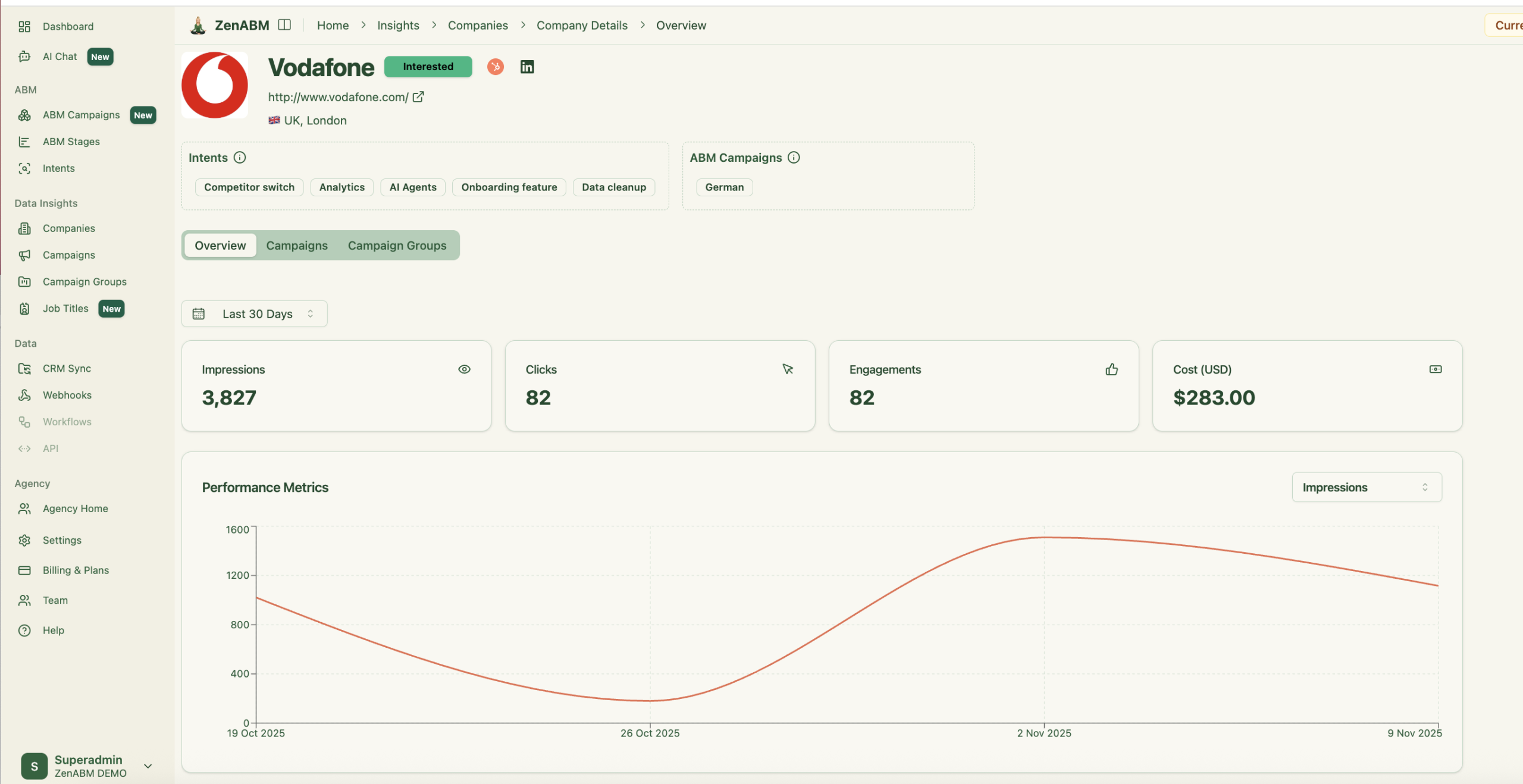
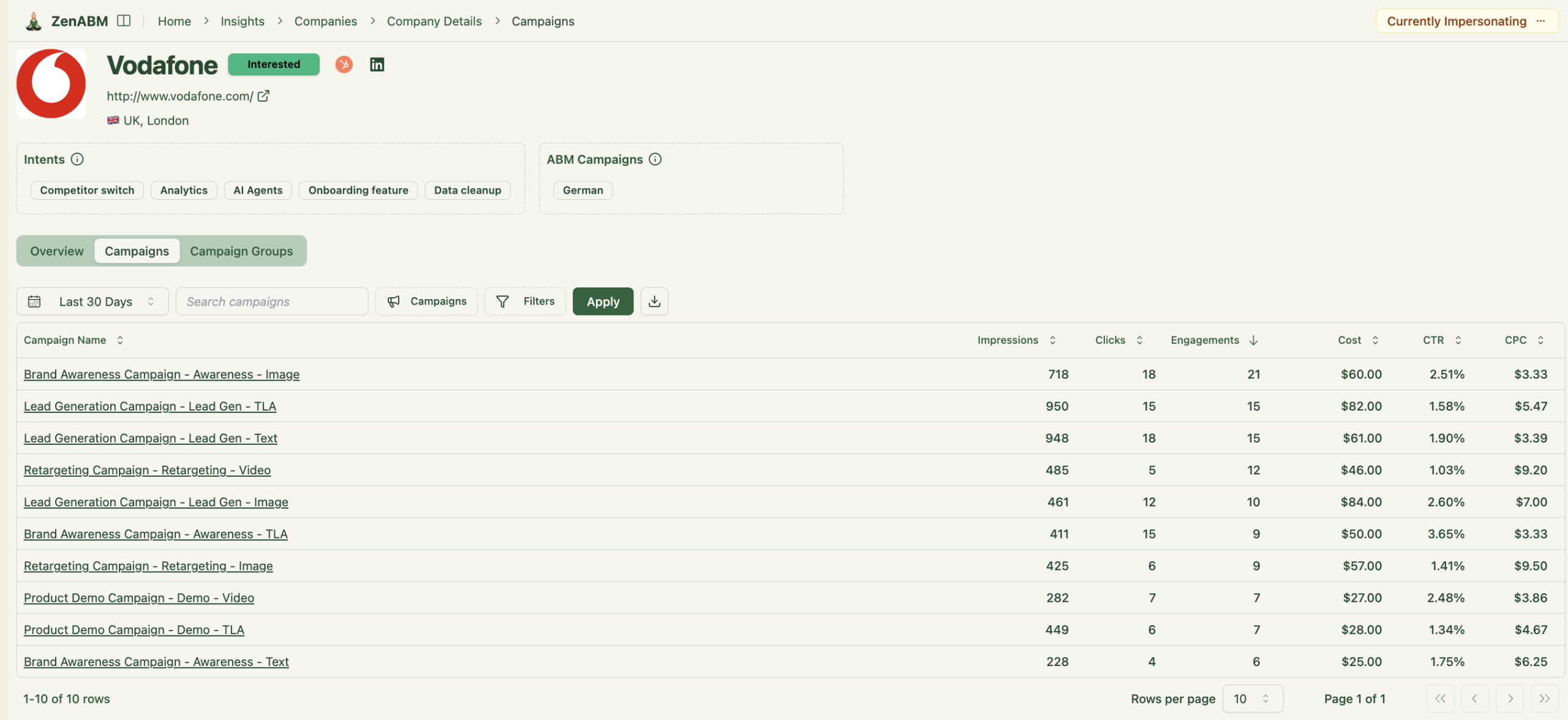
As you can see – ZenABM showcases all the data about the company (including intents, ABM campaign its in) on its page. The data is searchable and exportable.
Fibbler doesn’t have dedicated company-level pages. It opens the campaign engagements in a dialogue window – which you cannot search, filter or export.

Due to the technical differences between the tools, ZenABM displays the data much faster. See how the two tools compare in terms of company-level ad engagement data:
| Fibbler Loading Speed (when changing data timeframe) | ZenABM Loading Speed (when changing data timeframe) |
|---|---|
 |
 |
ZenABM pushes the Campaign Names per company as an automatically created company property – and Fibbler doesn’t:


You can use the intent data and stage directly to assign the companies to BDRs / push the associated contacts into a specific follow up email sequence.
Meanwhile – this is how Fibbler pushes the company level data into the CRM (Hubspot):

This is why you need to do all the heavy lifting with the workflows to use of that data for your ABM Campaigns.
What about campaigns? Again, both Fibbler and ZenABM provide insights on Campaign Performance.
ZenABM allows you to click on each campaign to see a list of companies that engaged with it:

Fibbler gives you total engagements per campaign, without breaking it down by company:

Note it provides you with ‘influenced deals’ on each campaign level – the tool itself has a disclaimer ‘Note: Deals can appear in multiple campaigns. Use this to spot trends, not to sum totals.’ Since the same deals are attributed to multiple campaigns, it’s hard to see what’s really going on.
Meanwhile – in ZenABM you can group several LinkedIn campaigns into one ABM campaign – and track total influenced pipeline from all the assets in these campaigns. This is particularly helpful when you want to compare how targeting different audiences/ different personas/ different markets/ different messaging – affects pipeline generation, and which campaigns you should double down on.

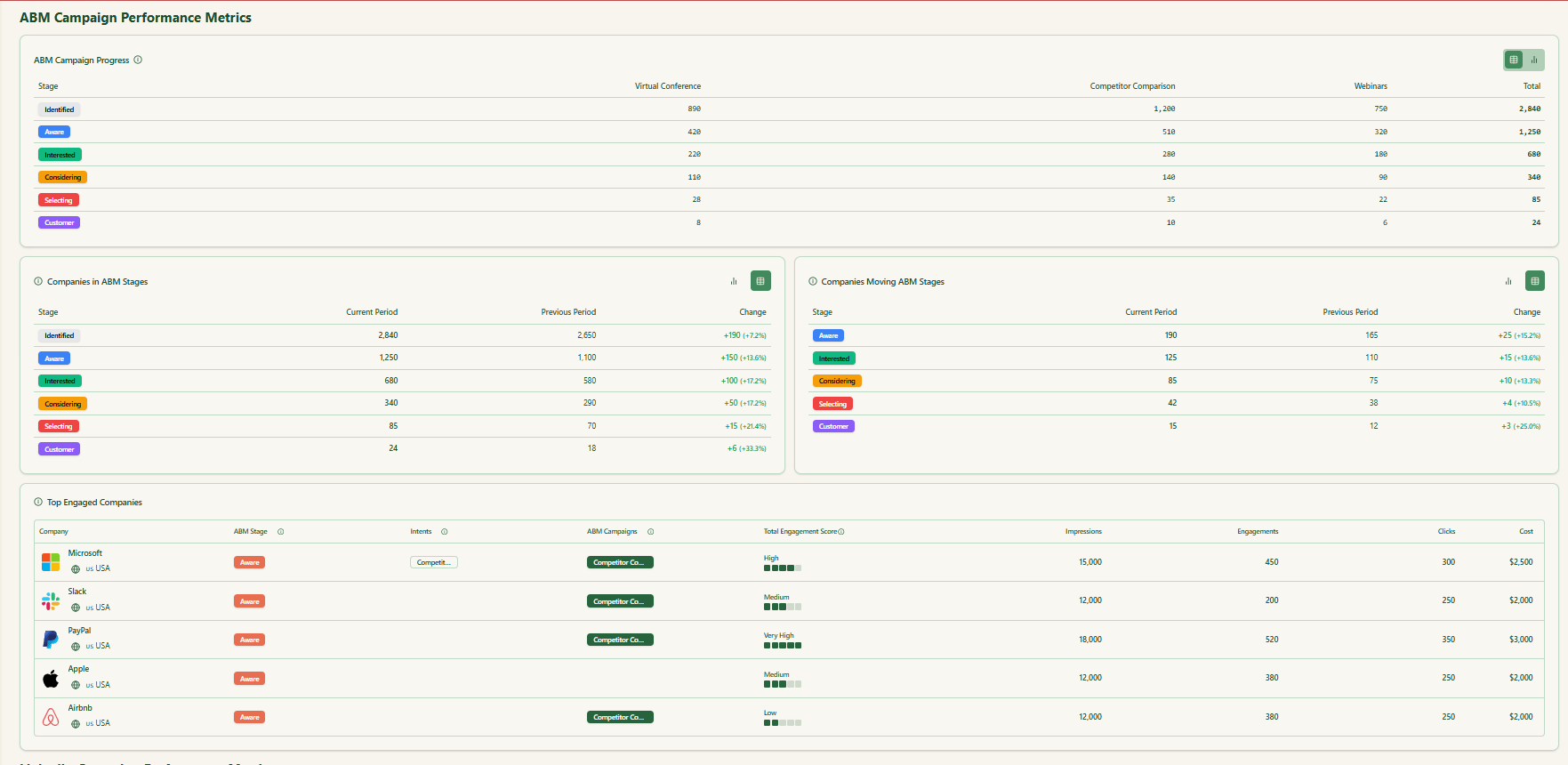
ZenABM was built for strategic ABM performance tracking, while Fibbler is designed for LinkedIn ad analytics and optimization.
In ZenABM, analytics are centered around ABM campaign objects – meaning you can group multiple LinkedIn campaigns into one ABM initiative and measure funnel performance, account progression, and pipeline attribution per campaign. ZenABM’s dashboards go far beyond impressions and clicks: they show pipeline per $ spent, account movement across ABM stages (identified -> aware -> selecting -> won), and ROI by campaign or market segment.

The data is processed and stored in-app, giving instant load times, custom time-period comparisons (e.g., this quarter vs. last), and deduplicated revenue attribution (so the same deal isn’t counted twice across multiple campaigns).


ZenABM provides detailed company attribution journeys – across all main acquisition channels, and on individual campaign (both LinkedIn and ABM campaign), adset – and soon also ad level:

Also – ZenABM’s AI chatbot also lets you query your data conversationally and uncover insights without manual filtering:
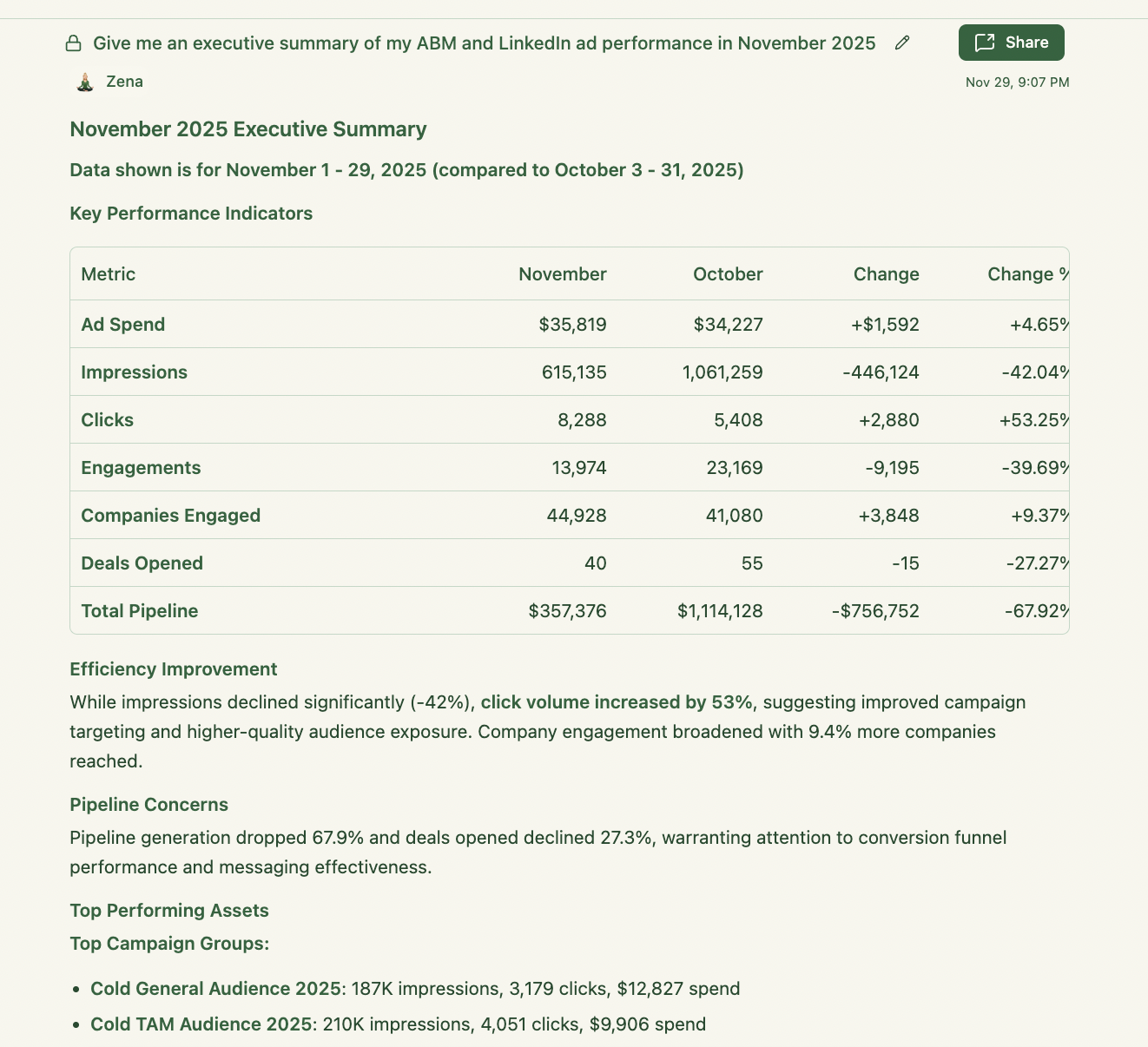
It’s also enriched with expert knowledge from LinkedIn posts and webinar transcripts of such LinkedIn ads experts like Tim Davidson, Maximilian Herzeg, Kamil Rextin etc. – making Zena by ZenABM a great co-pilot for asking strategic questions as well:
You can actually try Zena out & get LinkedIn ads advice completely for free, without setting up ZenABM’s account here! (It only won’t have access to your campaign data then of course – so better sign up for a trial 😉)

Fibbler, on the other hand, focuses on ad engagement and revenue data – impressions, clicks, and deals influenced by campaign. It lacks ABM segmentation, intent scoring, and de-duplication, which can lead to inflated or unclear ROI metrics when deals appear across several campaigns. Its dashboards show total engagements and influenced revenue, but not pipeline per campaign or funnel stage movement.
Fibbler provides only limited “ROI reporting” which is based on the timeframes you’ve selected for your entire ad campaign. ZenABM breaks the reporting up by the specific ABM campaigns you’re running. It also gives the all-time analytics for all your LinkedIn Ads in the main dashboard.


Also – ZenABM allows you to report on more metrics:
Let’s see how the analytics in the two tools compare:
In short:
ZenABM = full-funnel ABM analytics + AI insights + clean revenue attribution.
Fibbler = raw ad performance + basic ROI view for media optimization.
This is probably the most significant difference.
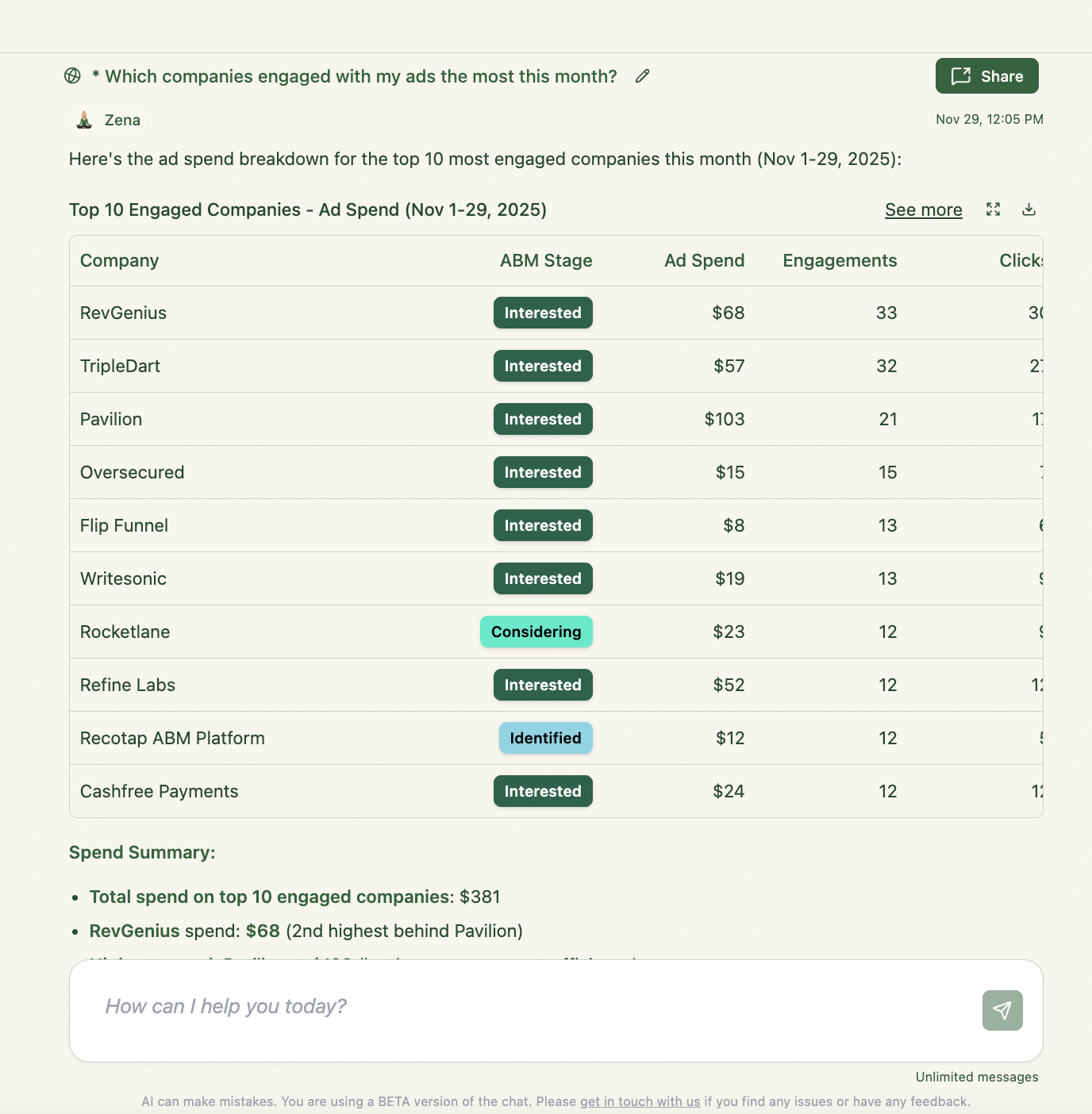
ZenABM integrates an MCP server, Rest API and an AI chatbot that allows you to query your LinkedIn ad and ABM data in natural language – asking questions like “Which accounts moved from Interested to Selecting this quarter?” or “What’s my pipeline per $ spent across campaigns?”
It also allows you to connect your LinkedIn ads performance and ZenABM data to any LLM easily – e.g. Claude Code – and build bespoke dashboards, analytics and LinkedIn ads performance repots that are fully tailored to your company’s needs, and even build agents yourself to act on your data (e.g. execute outreach).

Its AI layer pulls from both raw LinkedIn engagement data and ZenABM’s processed insights (intent, account scoring, funnel stages), giving you on-demand, context-aware answers & recommendations. ZenABM gives you useful starter prompts and then follow up prompts for each query:

This makes it far more interactive and actionable for marketers to understand how their LinkedIn ad ABM programs are performing. If you’re still copying and pasting your LinkedIn ad performance data – try ZenABM with AI chatbot and chat to your LinkedIn ads for free.

ZenABM’s Zena AI chatbot bases its answers on information from several different LinkedIn APIs and user CRMs, using the latest and most advanced LLM models most appropriate for each task. It has also been trained on LinkedIn posts from top LinkedIn ad experts and webinar transcripts from the ABM Bootcamp conducted by these experts. This means the AI doesn’t just report numbers – it interprets them with domain expertise.
And because the MCP server isn’t read-only – 26 of its 97 tools are writes – you can ask Claude or ChatGPT to actually do things: spin up a campaign, duplicate an ad set, update a pile of budgets at once, pause an ad that’s decaying. ZenABM asks you to approve each one before it reaches LinkedIn, so no AI goes off spending your money behind your back 😉
Zena also writes your weekly, monthly and quarterly reports for you and emails them over with ranked action items – so you get the “so what should I do about it” bit, not just the numbers:

And there’s a library of prebuilt AI skills (audits, strategy, reporting, sales handoff) you can run as a single command from the MCP or from Zena:
Fibbler, on the other hand, has no in-app AI agent. It does now ship an MCP server, but it’s read-only and limited to its top two plans – so an assistant can query your campaigns through it, but can’t change anything. Fibbler focuses purely on extracting and displaying raw engagement and revenue data from LinkedIn Ads, leaving any interpretation, analysis, or workflow automation to be built manually inside your CRM or BI stack. In short: ZenABM turns your ABM data into a conversation – and now also into actions – Fibbler just hands you the spreadsheet.
Both Fibbler and ZenABM offer very affordable pricing – so it won’t be a major barrier for either tool.
Fibbler begins at $89/month for its Growth tier, which is limited to just 3 data synchs, 3 impression caps or 3 campaign shedules – and to one user and one ad account. To unlock more, you need to upgrade to $129/month for the Unlimited tier (seats become unlimited there), and $159/month for the Agency plan (2 workspaces, and $69 for every extra one). Note that Google Ads company identification is a separate paid add-on at $59/month, bringing the effective cost to $148+/month if you need multi-channel coverage.
ZenABM – ZenABM’s starter plan gives you company-level LinkedIn ad engagement insights, and pushes the company-level engagement data as custom properties in your CRM. To get access to ZenABM’s analytics dashboards, webhooks or the AI capabilities, pricing starts at $59/month for its Starter tier, then $159/month for Growth and $399/month for Pro – offering account scoring, LinkedIn company intent insights, and full ABM dashboards. Multi-channel engagement signals (Google Ads, Reddit Ads, organic traffic, AI chatbot referrals) and the AI campaign management are included in all paid plans at no extra cost, and seats are unlimited on every plan.
| ZenABM Pricing | Fibbler Pricing |
|---|---|
 |
 |
Both Fibbler and ZenABM offer free trials – of 30 and 37 days respectively. ZenABM offers a FREE plan and a “reverse trial” on the FREE plan – you get access to all ZenABM’s features in the 37 day free trial, and then get downgraded to a free plan unless you upgrade.
Both Fibbler and ZenABM offer insights into Audience engagement (job titles etc.) and account journeys:
ZenABM offers more granular insights into each job title’s engagement – a breakdown by campaigns and campaign groups, video views per job title


Fibbler doesn’t offer video views insights, nor a timeline of the engagements by job title.

Let’s see the differences between these two tools in terms of features that don’t overlap:


At the time of this update (September 2026), Fibbler offers impression capping, campaign scheduling and job title exclusions.
This is the bit that has changed most since I first wrote this post: ZenABM’s campaign management is live now, and it goes well beyond a scheduler. You can create and edit campaigns, ad sets and ads from inside ZenABM – by asking Zena, or from Claude Code, ChatGPT or Cursor through the MCP server – and every write waits for your approval before it touches LinkedIn.
You also get Budget Savers, which is the one I personally wish I’d had years ago: it switches off Audience Expansion and the LinkedIn Audience Network (LAN) and then re-checks every hour, so they can’t creep back on and spend your budget on accounts you never chose:

Plus the Bidding Agent (compares your bids against LinkedIn’s suggested bid, updates budgets in batches, pauses ads that are decaying) and exclusions at four levels – team, campaign, ad set or ABM campaign – including excluding the accounts that rack up impressions but never engage.
What’s still on the list: a true per-company monthly impression cap (waiting on LinkedIn’s API access) and time-based scheduling, both coming soon. Impression capping is also something that can be done natively with LinkedIn Campaign Manager’s audiences.
The technological differences between Fibbler vs ZenABM lead to how much data each tool is able to display to you.
LinkedIn API obfuscates data that are fewer than 3 clicks or that came from fewer than 3 members in any specific timeframe:

Now, the practical implications for this is that if you query LinkedIn API in real time for short timeframes – you get very little data. This is what happens when you ask Fibbler for 7 day data.
ZenABM fetches your 7 day date range out of its own database, where it stores your data for the longest permissible time period.
Again – in sum: Fibbler is LinkedIn ads optimization/attribution tool. ZenABM is a tool for running ABM campaigns on LinkedIn (and now across multiple channels), using the de-anonymized company engagement data for account scoring etc.
Let’s look at the quick summary of main differences between Fibbler and ZenABM: functionality (LinkedIn ads vs. account scoring) – especially for ABM, technological, performance, data quality and scope, and of course – pricing and integrations.
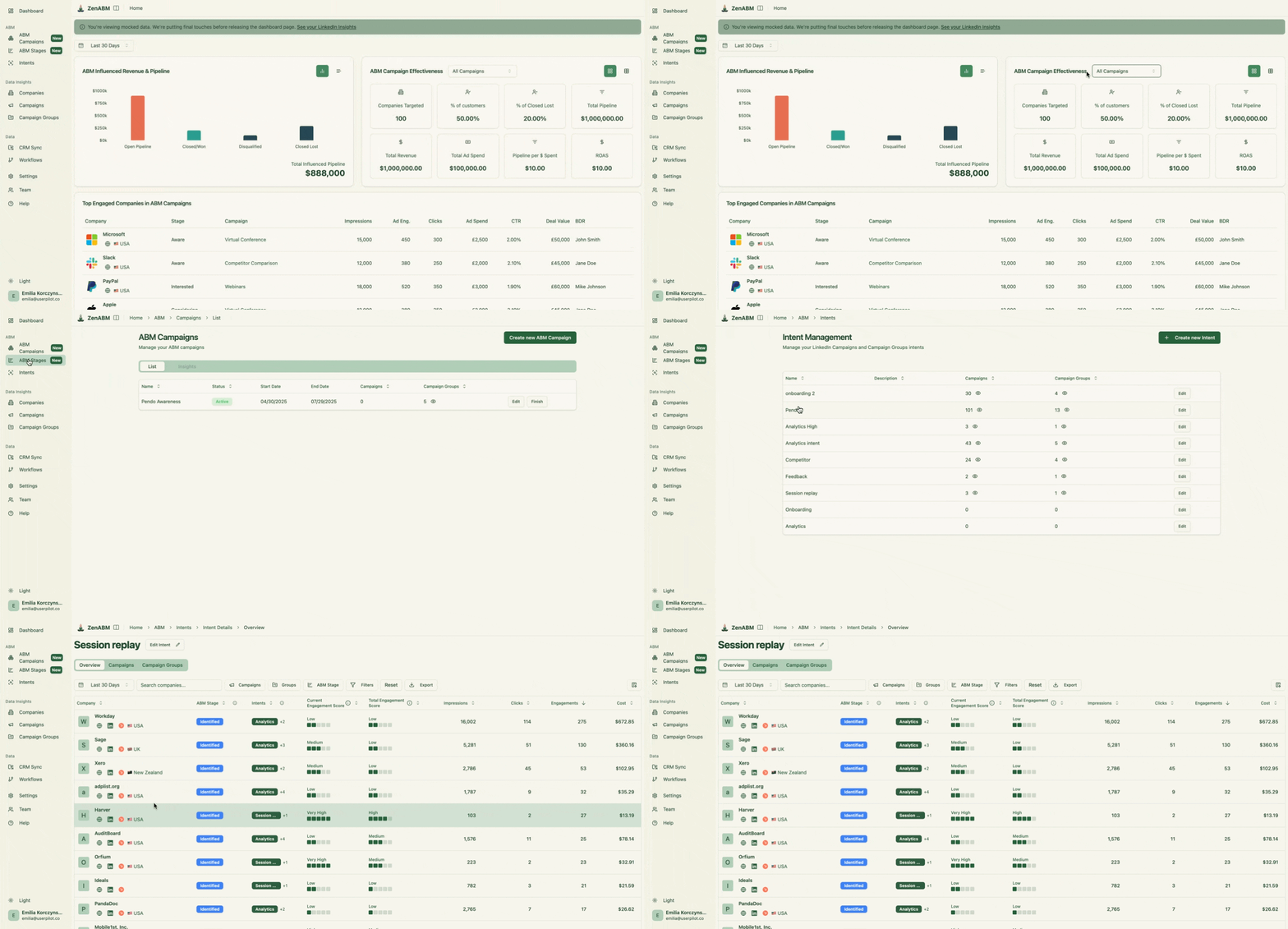 This includes:
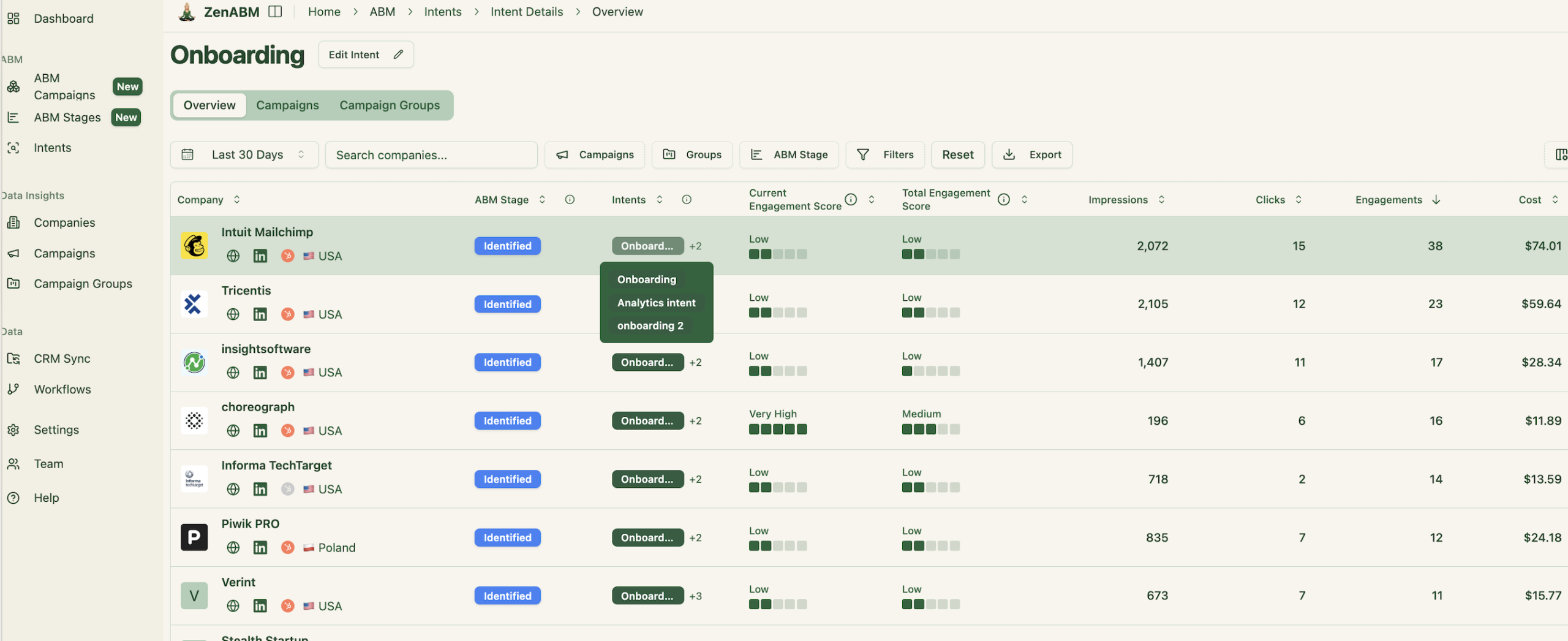
 In Fibbler, you only see Total Ad Spend, Total “Influenced pipeline” and “Total influenced revenue” – without any breakdown by ABM campaign. As a result – you can’t really compare the effectiveness of your different ABM campaigns – only each of your LinkedIn campaigns one by one – because Fibbler does not provide an “ABM Campaign” object. This was really annoying for me when using Fibbler, as I then had to build all these custom dashboards on Hubspot.
ZenABM now offers campaign and ad creation and editing (via Zena, the MCP server and the API, with approval on every write), Budget Savers, the Bidding Agent, exclusions at four levels, automated AI reports and prebuilt AI skills. Fibbler still wins on time-based scheduling and on a true per-company monthly impression cap – ZenABM excludes high-impression, low-engagement accounts today, and the full cap is waiting on LinkedIn’s API access. But the scope is the other way round now: Fibbler schedules and caps, ZenABM builds and runs.
Fibbler recently published a “ZenABM Alternatives” article that contains several claims about ZenABM. We believe in transparency, so rather than ignoring these claims, we want to address each one directly. Here are the 9 specific objections from Fibbler’s article and our responses.

This claim is simply inaccurate. The LinkedIn API documentation that Fibbler references as their source does not state anywhere that the companies we can fetch are capped at 15,000. As many ZenABM users can confirm by looking at their own analytics dashboards, they are able to see far more than 15,000 companies in ZenABM. We encourage anyone skeptical of this to sign up for the free trial and see the data volume for themselves.
This claim is untrue and misleading. ZenABM’s funnel stages are fully customizable by every user. They can be built based on any combination of LinkedIn ad engagements – for example, the volume of engagements over time (e.g. three clicks, five engagements, and ten impressions in the last 7, 30, or 90 days, or any other custom time period):

They can also be built by combining LinkedIn engagement data with any other properties that exist on the company level in the user’s CRM – form submissions, website visits, webinar sign-ups, deal stages, lifecycle stages, and any custom property:

ZenABM provides some default funnel stages to help new users get started quickly, but these defaults can be changed in a few clicks to match whatever engagement model and business logic makes sense for your specific ABM programme. Calling fully customizable, multi-signal account stages “ABM Theater” misrepresents how the feature actually works and shows lack of research and understanding.
ZenABM’s AI chatbot Zena bases its answers on information available from several different LinkedIn APIs and user CRMs, using the latest and most advanced LLM models most appropriate for each specific task. It has also been trained on LinkedIn posts from top LinkedIn ad experts and webinar transcripts from the ABM Bootcamp sessions conducted by these experts.
Zena provides context-aware analysis that pulls from both raw LinkedIn engagement data and ZenABM’s processed insights (intent signals, account scoring, funnel stages). The AI layer doesn’t operate on “fractional market information” – it operates on the same comprehensive data set that powers ZenABM’s dashboards, enriched with domain expertise from leading practitioners.
See the examples of questions you can ask Zena, and anwers it provides – below:

A lot of this data is pulled from LinkedIn APIs, some in real time – so calling it inaccurate = calling LinkedIn ad data inaccurate. Well, no data is perfect – but that’s life 😉


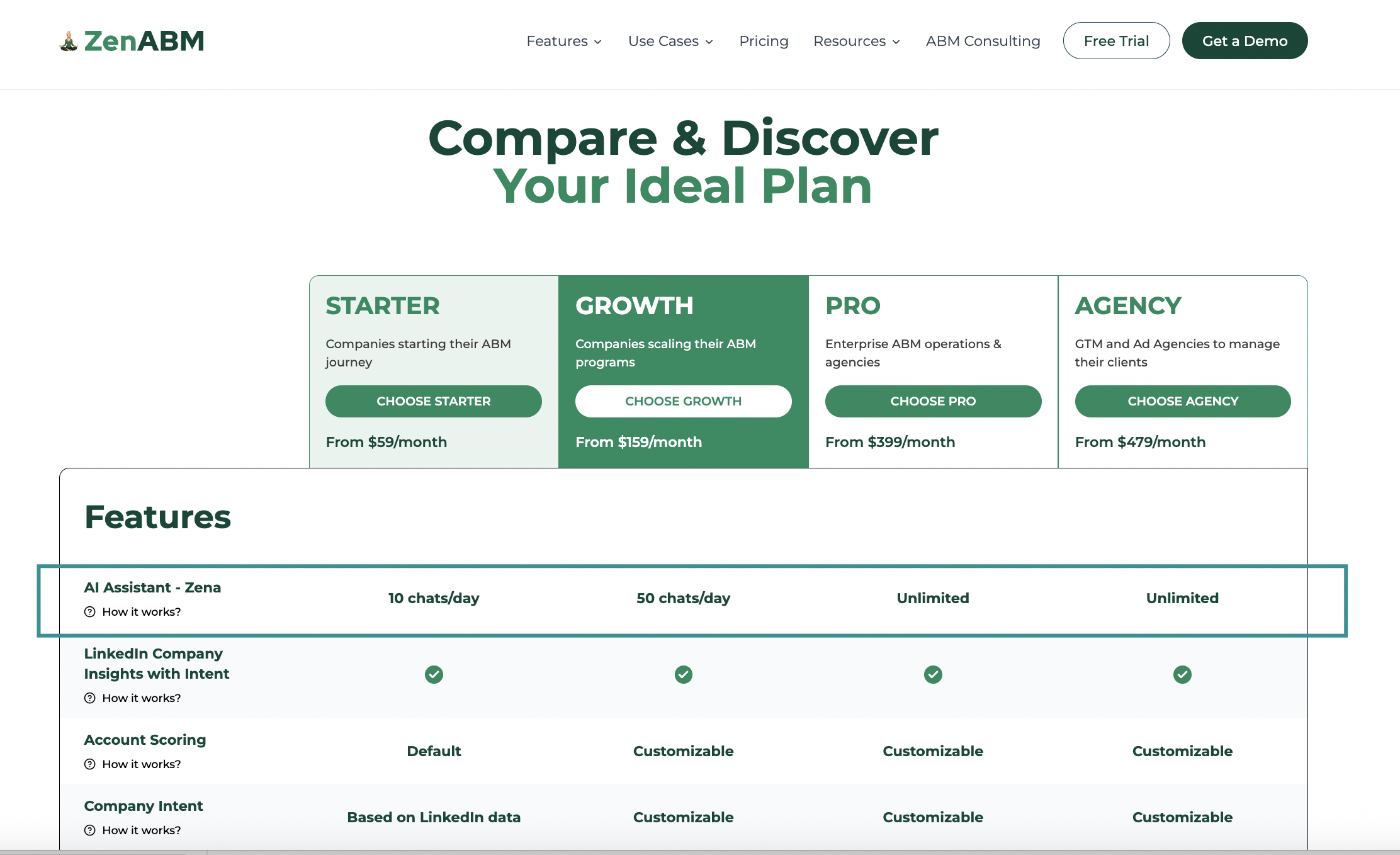
We are not sure what Fibbler means by “pricing deception.” ZenABM’s Starter plan at $59/month is designed for small companies that are just beginning their ABM journey and don’t need to run multiple ABM campaigns simultaneously or maintain a complex campaign structure. This plan is currently used by several happy ZenABM customers who simply have smaller budgets and smaller needs. Not every company needs an enterprise-grade setup from day one.
By the same logic, Fibbler’s own Growth plan at $89/month severely limits Fibbler’s core functionality: it offers only up to 3 campaign syncs, up to 3 signals, and up to 3 impression caps or campaign schedules. It also does not include Salesforce integration. So if “limited starter plans” constitute “pricing deception,” then both tools (and virtually every SaaS product with tiered pricing) would be guilty of the same thing.
The difference is that ZenABM’s Starter plan is $30/month cheaper than Fibbler’s equivalent tier, and ZenABM also offers a completely FREE plan that Fibbler does not.
This claim is outdated. As of September 2026, ZenABM is not limited to a single channel. ZenABM currently offers engagement signals from all major acquisition channels, including:

These are all included in ZenABM’s paid plans at no extra cost.
ZenABM, unlike Fibbler, also provides contact level information – where contacts have already been captured on your website – and a full company activity history:

Fibbler doesn’t provide any of the above.
ZenABM is also currently implementing additional website visitor deanonymization, including traffic from Google Ads, through the same service provider that Fibbler uses (Leadfeeder).
By contrast, Fibbler charges an additional $59/month for Google Ads company identification as a separate add-on, capped at 1,000 companies per month.
Fibbler does not currently offer Reddit Ads, organic traffic, or AI chatbot referral tracking.

Fibbler’s “lift analysis” refers to a metric that compares the ACV (average contract value) of LinkedIn Ads-influenced deals to the average ACV of deals that have not been influenced by LinkedIn Ads. While this sounds useful on the surface, this metric actually produces a false sense of success for LinkedIn ads.
Here’s why: most marketers running ABM campaigns on LinkedIn deliberately select target accounts to target. These accounts tend to be larger companies with a higher propensity to pay. The deals that come from outbound strategies like account-based marketing naturally tend to be larger than the average size of inbound deals. Comparing ABM-influenced deal sizes to your overall average deal size and calling the difference “lift” is a misleading attribution of causation.
ZenABM allows to easily calculate the average ACV for every ABM campaign run across the LinkedIn ads platform. Our users can easily compare the average ACV from specific ABM campaigns or older campaigns to the average ACV for all companies in their CRM.

We intentionally do not replicate all CRM data to compare LinkedIn Ads-influenced deal ACV to non-influenced deal ACV inside our product, because we believe this metric can be misleading and may lead to poor decision-making.
True lift analysis requires controlled experimentation (e.g. holdout groups), not a simple ACV comparison between self-selected cohorts.
ZenABM provides detailed deal analysis, and allows you to see not only how many impressions, engagements and clicks each company got before and after the deal was opened: but also different ABM and LinkedIn ad campaigns influence on the deal:


Claiming that ZenABM has only 10 customers because we list 10 logos on our website is like claiming that Fibbler has only four customers because it lists four customer logos on its homepage. This is, of course, an absurd argument.

Yes, ZenABM has been on the market for a shorter time than Fibbler. Yes, it’s built by a team of engineers and product-first marketers that have focused on building ZenABM’s product the best product for the Linkedin-fist ABM campaign use case – so we didn’t have the time to chase G2 reviews. But full disclosure: We currently serve ~70+ happy customers, including in-house marketing teams and LinkedIn ads agencies with several clients on enterprise plans. We serve both SMBs and large, publicly listed enterprise companies.

Here are some of our published customer success stories:
Unlike Fibbler, ZenABM offers extensive customer support and implementation services, including LinkedIn ad strategy and ABM strategy programmes, as well as GTM engineering support and implementation. This is one of the key reasons why many of our customers – roughly 50% who go with the service package – have achieved significant results from their ABM campaigns in terms of ROI on budget spent and pipeline per dollar spent.

Meanwhile, none of Fibbler’s case studies mention the impact of Fibbler’s support on their customers’ success. As a two-person company serving 500+ marketers and proudly positioning itself as completely self-serve and PLG, you may wonder what kind of hands-on support you would actually receive from a team spread that thin.
Well – this one has aged 😁
Campaign management shipped. You can now create and edit campaigns, ad sets and ads from inside ZenABM – by asking Zena, or from Claude Code, ChatGPT or Cursor through our MCP server (97 tools, 26 of them writes, every one of them asking for your approval before it touches LinkedIn). Fibbler’s MCP server, for comparison, is read-only.
On top of that there’s Budget Savers (Audience Expansion and the LinkedIn Audience Network switched off and re-checked hourly), the Bidding Agent (bids vs suggested bid, batch budget updates, pauses decaying ads), exclusions at four levels, automated weekly, monthly and quarterly AI reports, and a library of prebuilt AI skills for audits, strategy, reporting and sales handoff.
So yes – we took longer than a simple scheduler would have taken. That was the point: we preferred to build comprehensive campaign management rather than rush a minimal feature to market. ZenABM is now the tool that allows you to plan, manage, and optimise your campaigns, not just report on them.
What’s genuinely still outstanding: a true per-company monthly impression cap, which is waiting on LinkedIn’s API access (a platform dependency, not a product decision – in the meantime ZenABM excludes high-impression, low-engagement accounts), and time-based scheduling, which is coming soon. Fair play to Fibbler on those two.
Once again, Fibbler is misleadingly and incorrectly claiming that ZenABM’s ABM account stages are fixed and “automated.” As explained in detail in point #2 above, ZenABM’s ABM account stages and account scoring are fully customizable. Users define their own stages, set their own thresholds, and combine LinkedIn engagement signals with any CRM properties they choose. There is nothing “automated” about them in the way Fibbler describes – they are as sophisticated or as simple as the user wants them to be.
The “95:5 rule” (the idea that only 5% of your market is in-market at any given time) is a valid marketing concept. But it has nothing to do with how ZenABM’s stages work. ZenABM’s stages reflect the observed engagement behavior of specific accounts with your specific campaigns, combined with your CRM data. They don’t claim to predict who is “truly buying” – they show you who is engaging and to what degree, based on rules you define. That is the entire point of first-party intent data.
Yes, ZenABM’s founder’s wife (yours truly) is a former customer of Fibbler. This was a long time ago, but it seems to be an issue for one of Fibbler’s founders, who has communicated it in several disgruntled LinkedIn posts. But hey, we’re doing software comparisons here, not therapy 😉 The reason why ZenABM exists is that I couldn’t find a single tool that would do all I needed well – this included Fibbler (yes, after making feature requests first, and hearing the company is not going in that direction).
From the start, ZenABM has been built with ease of use and the ABM use case in mind, and is planning to focus on end-to-end campaign management and smart, AI-powered insights. Fibbler started as a simple LinkedIn ads management tool and now seems to be moving in the direction of general marketing ROI attribution. The two tools serve different needs and have a different focus. Ultimately, it’s up to you to decide which one is a better fit for your use case – and the best way to decide is to try them yourself and compare which one works better for what you need.
Try ZenABM for free for 37 days and get 90 days of your data backfilled instantly.

Hope this post helped you understand the differences between Fibbler and ZenABM and evaluate which tool is better for your needs. The two tools were built for different purposes – ZenABM for planning, running, optimising and measuring ABM campaigns across multiple channels, Fibbler for LinkedIn ad analytics and optimization. Since both tools offer free trials – the best way to really learn what works best for you is to sign up for each and find out.