

©2026 ZenABM - All Rights Reserved.

Using Claude Code for ABM is not a theoretical concept anymore.
It is already reshaping how B2B marketers run account-based marketing from their terminals.
With 78.7% of companies now incorporating AI into their ABM programs (State of ABM 2025), and the shift from “AI-assisted” to “AI-orchestrated” marketing in full swing,
Claude Code has emerged as the most practical tool for marketers who want to move fast without building custom software from scratch.
This post will walk you through every use case we have found, the free plugins and public repos that make it all possible, and exactly how to get started with a strong focus on LinkedIn-first ABM.
Short on time?
Here’s a quick summary:
Claude Code is Anthropic’s CLI tool that runs directly in your terminal.
Unlike ChatGPT or other chat interfaces, it can read and write files on your machine, run shell commands, call APIs, and chain multi-step workflows together.
Claude Code also supports a collaborative mode called Co-work (previously known as “background agents”) where multiple Claude instances can work in parallel on different parts of a project.
The real unlock for ABM practitioners is plugins (also called “skills”).
A plugin is a markdown file that contains structured instructions, context, and workflows.
You install one by pasting a GitHub repo URL into Claude Code, and it clones the repo, sets up dependencies, and registers the skill.
From that point on, you can trigger the workflow with a simple slash command like /outbound or /abm-report.
No hours spent building agents.
No wrangling API connections.
No code to maintain.
This is the difference between 2025 and 2026 in AI marketing: in 2025, we were asking AI to write copy.
In 2026, we are building entire systems that discover, target, engage, and report on accounts directly from the terminal.
And the plugin ecosystem means you do not need engineering resources to get started.
After extensive research across GitHub repos, marketing newsletters, and practitioner communities, here is the full list of Claude Code use cases for account-based marketing.
Some of these have dedicated plugins already. Others are workflows marketers are building from scratch.
All of them are real.
Claude Code can research companies in batches, filter by ICP criteria, enrich with firmographic and technographic data, and output structured target account lists.
Tools like AgentSource and Crustdata offer MCP integrations that let Claude Code pull from company databases, score accounts by fit signals (funding, hiring, tech stack), and export CSV lists all in one workflow.
AgentSource, in fact, has an open-source plugin published on GitHub:

Once you have a target list, Claude Code can find the right people within those accounts.
Traditional SDR research takes 15-25 minutes per account, which means researching 50+ accounts becomes impractical.
With Claude Code, you can build complete account dossiers (company overview, recent news, tech stack, key decision makers, personalization hooks) in under 2 minutes per account, which means researching 50+ accounts per day becomes practical instead of impossible.
With the right plugin, Claude Code generates on-brand LinkedIn ads without Canva, Figma, or a designer.
The LinkedIn Ad Designer skill by Advanced Client includes 23 pre-built ad patterns, like stat highlights, product screenshots, grid layouts, contrarian hooks, before/after comparisons, testimonials, and case study formats.
You upload your brand guidelines once, and every ad follows them.

This is where it gets interesting for day-to-day campaign management.
Through MCP (Model Context Protocol) integrations and APIs, you can manage your LinkedIn ad campaigns directly from Claude Code using plain English.
For example:
As Ali Yildirim (founder at Understory) shared in his post after deploying custom MCPs for both LinkedIn and Google Ads:
“Both let us query campaign data in natural language through Claude. No exports, no dashboards, just direct API access to live performance data. Even in this raw state, it’s already saving hours every week.”
This is the direction ad management is heading, and it works today.
You can do this through ZenABM’s API in Claude Code directly, using the free plugin that enables it.
ZenABM’s API gives you access to company-level engagement data, campaign performance, deal attribution, ABM stage progression, and more, all queryable from your terminal.


The Claude Ads skill by Agrici Daniel is a free, open-source plugin that runs 250+ audit checks across Google Ads, Meta, YouTube, LinkedIn, TikTok, Microsoft, and Apple Ads.
It generates a weighted health score (0-100), flags red flags like wasted spend and poor conversion tracking, and provides prioritized action plans.
For LinkedIn specifically, it covers 27 checks, including B2B targeting quality, Thought Leader Ad setup, lead gen form configuration, and CRM integration health.
All analysis runs locally so no ad data leaves your machine.

The LinkedIn ABM Reporter plugin generates comprehensive performance reports directly from your ZenABM account.
Type /abm-report or ask “Give me last week’s LinkedIn ABM report” and it pulls live data, computes period-over-period comparisons, surfaces insights, and flags issues.
We will go deep on this one below.
By combining audit data with performance reporting, Claude Code can recommend specific optimizations: which campaigns to scale, which to pause, which ad formats are underperforming relative to benchmarks, and where budget is being wasted on impression hogs.
The reporting plugin flags companies receiving more than 5x the median impressions with no pipeline progression so you can exclude them and redirect budget.
Through ZenABM’s API, Claude Code surfaces the top engaged companies sorted by clicks, with ABM stage, intent signals, spend, and CTR per account.
It also tracks companies newly entering “Interested” or “Considering” stages, giving you a live feed of accounts worth pursuing.
The reporting agent plugin automates this entirely.

ZenABM has a free plugin for intent-based outbound that reads ZenABM engagement data, finds contacts at engaged accounts via Apollo.io, generates personalized emails referencing actual ad interactions, and pushes everything to Smartlead for delivery.
It runs weekly on autopilot.
We will cover this in detail below.

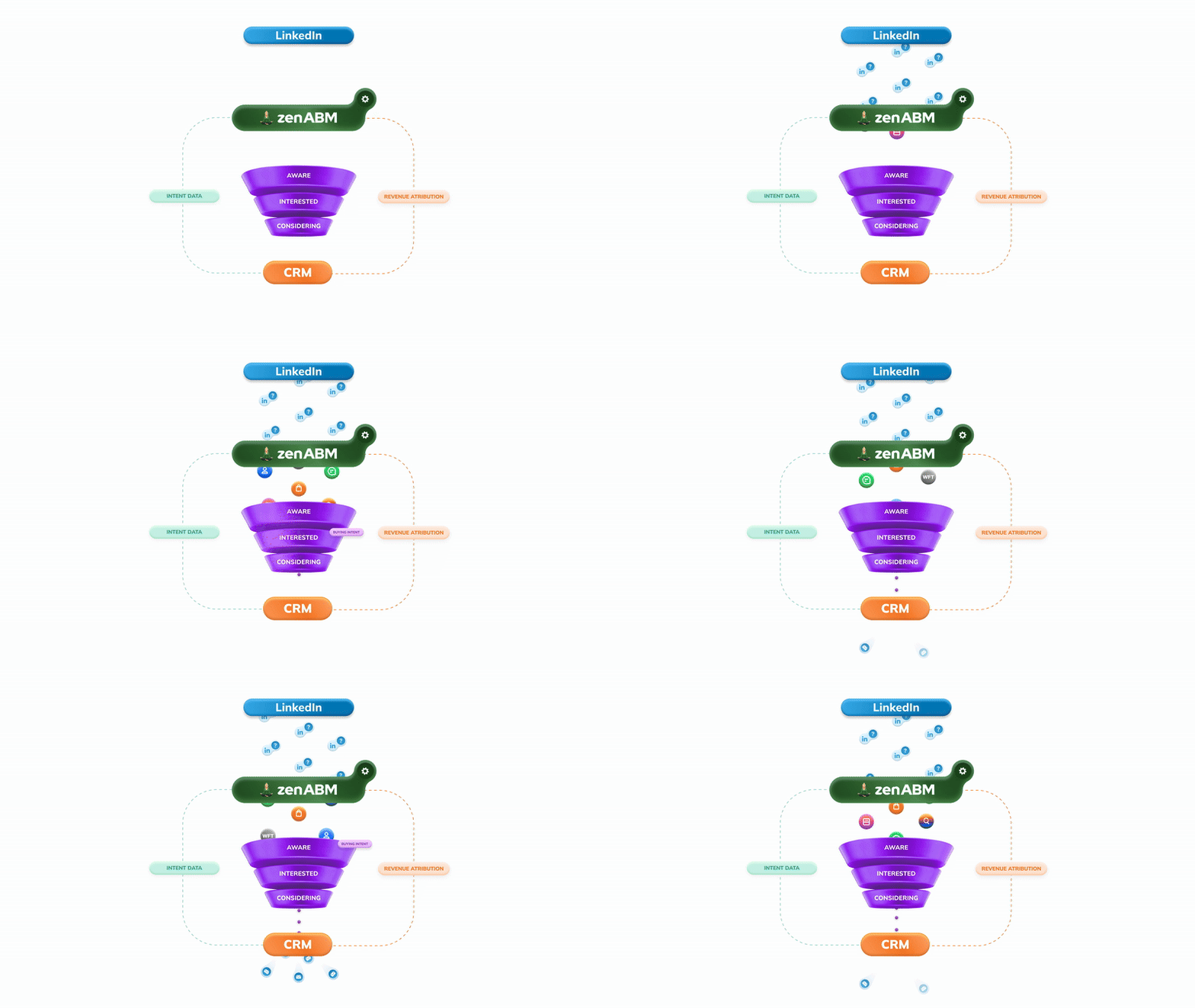
The first and most foundational use case is building your target account list.
Traditionally, this means hours in spreadsheets cross-referencing firmographic filters, tech stack data, hiring signals, and funding rounds.
Claude Code collapses this into a single workflow.
MarketBetter documented a four-step process that starts with confirmed intent signals (not cold lists), feeds them into Claude Code with structured prompts requesting specific information (company overview, recent news, tech stack, open roles, decision makers), and outputs complete account dossiers.
Their results: research time per account dropped from 20 minutes to roughly 2 minutes, enabling SDRs to research 50+ daily targets while reclaiming about 3 hours for actual selling.
Crustdata published a similar approach using MCP integrations with Apollo and Databar APIs.
Their four-stage workflow (Find, Enrich, Qualify, Outreach) uses reusable slash commands like /prospect and /qualify.
The output is 10-50 high-quality, signal-triggered messages per week, with per-prospect research fully automated.
The key insight across all these approaches: start with signals, not static lists.
AgentSource, in fact, has published an open source Claude code plugin to automate your target account-list building.
Creating LinkedIn ads at scale is one of the most time-consuming parts of ABM campaign management.
Each ad format, each persona, each stage of the funnel requires different copy, different creative, different CTAs.
The LinkedIn Ad Designer by Advanced Client solves this with a Claude Code skill that generates on-brand ads directly in your conversation, no external design tools needed.
Here is how the process works:
The skill includes 23 pre-built ad patterns spanning formats like stat highlights, product screenshots, grid layouts, contrarian hooks, before/after comparisons, testimonials, and case study formats.
As the guide emphasizes:
“The richer the context, the better every ad will be.”
For ABM specifically, this means you can generate persona-specific ads for each tier of your target account list. Instead of creating 3-4 ad variants and hoping one resonates, you can generate dozens of variants targeting specific pain points, industries, and job functions all following the same brand guidelines.
Generation Digital reported reducing ad production time from 30 minutes to 30 seconds per variant, a 60x speedup.
Emilia Korczynska (VP of marketing at Userpilot has seen this pattern across her ABM program at Userpilot: different ad formats work for different purposes.
Our benchmarks data shows TLAs at 2.68% median CTR and $2.29 median CPC, while single image ads drive 0.42% CTR at $13.23 CPC.

Having Claude Code generate variants for each format, each with proper brand context, means you can test more creative angles without bottlenecking on design resources.
This is the most exciting use case.
The ZenABM Outbound Agent plugin is a free Claude Code skill that turns ABM intent signals into personalized outreach, fully automated and running weekly on autopilot.
Here is the five-step workflow:


Installation takes minutes: install Claude Code, paste the GitHub URL, let Claude configure dependencies, then type /outbound.
The skill asks for your API keys, ICP definition, target personas, and helps you customize your email copy.
What makes this different from generic outbound tools is the intent signal layer.
These are not cold emails.
Every prospect the agent reaches has already engaged with your ads.
As Philip Ilic (LinkedIn ads specialist) described in his post, when building a similar system for his clients: “LinkedIn Ads plus Outbound are far the best combo for B2B SaaS”, combining social engagement, content leads, company-level engagement, and website visitors into warm outbound flows.

When you email someone who has already clicked on three of your TLAs and visited your pricing page, the reply rate is fundamentally different.
You need three accounts to get started: ZenABM (with LinkedIn Ads connected), Apollo.io (free tier works), and Smartlead for email delivery.
The LinkedIn ABM Reporter plugin is a free Claude Code plugin that generates comprehensive performance reports directly from your ZenABM account.
Ask Claude for a weekly, monthly, quarterly, or annual report, and it pulls live data, computes comparisons, surfaces insights, flags red flags, and optionally exports a styled PDF, all without leaving your terminal.
This is not a generic metrics dump.
The reporting agent covers:
This is the question I get asked most: why not just connect LinkedIn’s Marketing API directly to Claude Code
Here is why that is a bad idea:
| Factor | LinkedIn API Direct | ZenABM API |
|---|---|---|
| Time to first data | 2 to 4 weeks (MDP approval) | 5 minutes (generate token) |
| Authentication | OAuth 2.0 with browser redirect | Bearer token |
| Token expiry | 60 days (access), 365 days (refresh) | Long-lived, no refresh needed |
| Company-level data | Not available | Full company engagement, clicks, impressions |
| Deal attribution | Not available | CRM deals with LinkedIn influence flags |
| ABM stages | Not available | Stage progression, history, transitions |
| Intent signals | Not available | Built-in intent signal tracking |
| Data complexity | Dozens of endpoints, different schemas | Clean REST API, consistent JSON |
The pattern across all of these use cases is clear: Claude Code turns disconnected point solutions into a unified system. Instead of logging into LinkedIn Campaign Manager, exporting a CSV, uploading it to a spreadsheet, running formulas, copying results into a slide deck, and emailing it to your team, you type one command and get a comprehensive report with insights, red flags, and actionable recommendations.
For LinkedIn-focused ABM specifically, the benefits compound:
As Ali Yildirim (founder at Understory) put it in his post:
“Ads should never exist in a silo. It’s our duty as good advertisers to make sure every dollar matters.”
Claude Code makes that possible by connecting your ad data to your outbound, your outbound to your CRM, and your CRM back to your targeting, all from one terminal.
The ROI measurement challenge that plagues most ABM programs becomes tractable when your reporting agent can pull deal data, map it to LinkedIn exposure, and tell you which campaigns most commonly appear before deals close.
That is not “interesting data.”
It is how you defend your budget in the next QBR.
Claude Code removes the biggest ABM infrastructure gap: the gap between insight and action.
You see a signal (account moved to “Interested”), you want to act (trigger outreach), but you need company-level data first. LinkedIn’s API won’t give it to you.
Your spreadsheet won’t process it fast enough. Your team definitely won’t do it manually.
ZenABM solves the data problem.
Claude Code solves the execution problem.
Together, they turn ABM from a campaign you run to a system you operate.
Ready to upgrade your ABM infrastructure?
Connect your LinkedIn Ads, see company-level engagement in real time, and plug the free Claude Code plugins into your terminal.
You can also book a demo with us to know more about ZenABM.
Some common questions about Claude Code for ABM:
No. Claude Code runs in a terminal, but plugins handle all the technical complexity.
You install by pasting a GitHub URL, configure by answering questions Claude asks you (API keys, ICP definition, etc.), and operate by typing natural language commands or slash commands like /outbound or /abm-report.
If you can use a command line, you can use Claude Code for ABM.
Claude Code itself requires an Anthropic subscription (Claude Pro or Team plan). All the plugins and repos referenced in this post are free and open source. You will also need accounts with the relevant tools – ZenABM (37-day free trial), Apollo.io (free tier with 10,000 records/month), and Smartlead if you are running outbound.
Yes, through MCP integrations or API connections.
With ZenABM’s API, you can query performance data and surface insights. For direct campaign management (pausing, budget changes), you can use LinkedIn Ads MCP servers that provide read and write access to your LinkedIn Campaign Manager.
The analysis workflow is fully documented.
Chat interfaces are stateless, they forget your brand guidelines, your ICP, your campaign structure between sessions. Claude Code has persistent context through CLAUDE.md files, can read and write files on your machine, execute scripts, call APIs, chain multi-step workflows, and run on schedules. It is the difference between asking AI a question and having AI run your operations.
Start with the LinkedIn ABM Reporter if you are already running LinkedIn campaigns and want better visibility into performance. It is the fastest to set up (under 5 minutes) and delivers immediate value. From there, add the outbound agent to act on the insights, and the Claude Ads audit skill to identify optimization opportunities.
