 AI for ABM & LinkedIn Ads Week28 Sep – 2 Oct · Reserve your seatAI for ABM & LinkedIn Ads Week · 28 Sep – 2 Oct · Reserve your seat
 AI for ABM & LinkedIn Ads Week28 Sep – 2 Oct · Reserve your seatAI for ABM & LinkedIn Ads Week · 28 Sep – 2 Oct · Reserve your seat
The biggest leak in most ABM programs does not happen at targeting or creative.
It happens at the handover.
Marketing warms an account with LinkedIn ads, builds familiarity over weeks, and generates real engagement signals.
Then sales reaches out with a cold, generic message because none of that engagement context ever made it into the rep’s workflow.
That is what account-based sales development fixes.
It ensures that reps work the same accounts marketing is warming, use campaign engagement and intent signals to time and personalize outreach, and measure progress at the account level rather than the lead level.
It is not just “SDR outreach for ABM,” but the operational layer that connects account-based marketing to the pipeline.
In this guide, I will cover:

If you only want the short version, here it is:
Traditional demand generation has a neat handoff model.
Marketing generates leads, then passes them to sales.
That model does not work well in ABM because there is no single handoff moment. Marketing and sales are both interacting with the same accounts throughout the journey. Ads warm the account, website visits deepen intent, outreach starts once interest is clear, and marketing often needs to keep supporting the deal even after the pipeline is created.
So when teams try to force ABM into a traditional lead handoff system, two things happen:
That is why account-based sales development needs a different architecture. The engagement data has to move automatically from the campaign layer into the sales workflow, in real time, with enough context for the rep to know why the account matters right now.
Without that architecture, “ABM leads” are just names on a list with no useful signal attached.
LinkedIn is unusually powerful for account-based sales development because it gives you account-level engagement context that most other channels cannot match.
When a company engages with your LinkedIn ads, a tool like ZenABM can help you know:
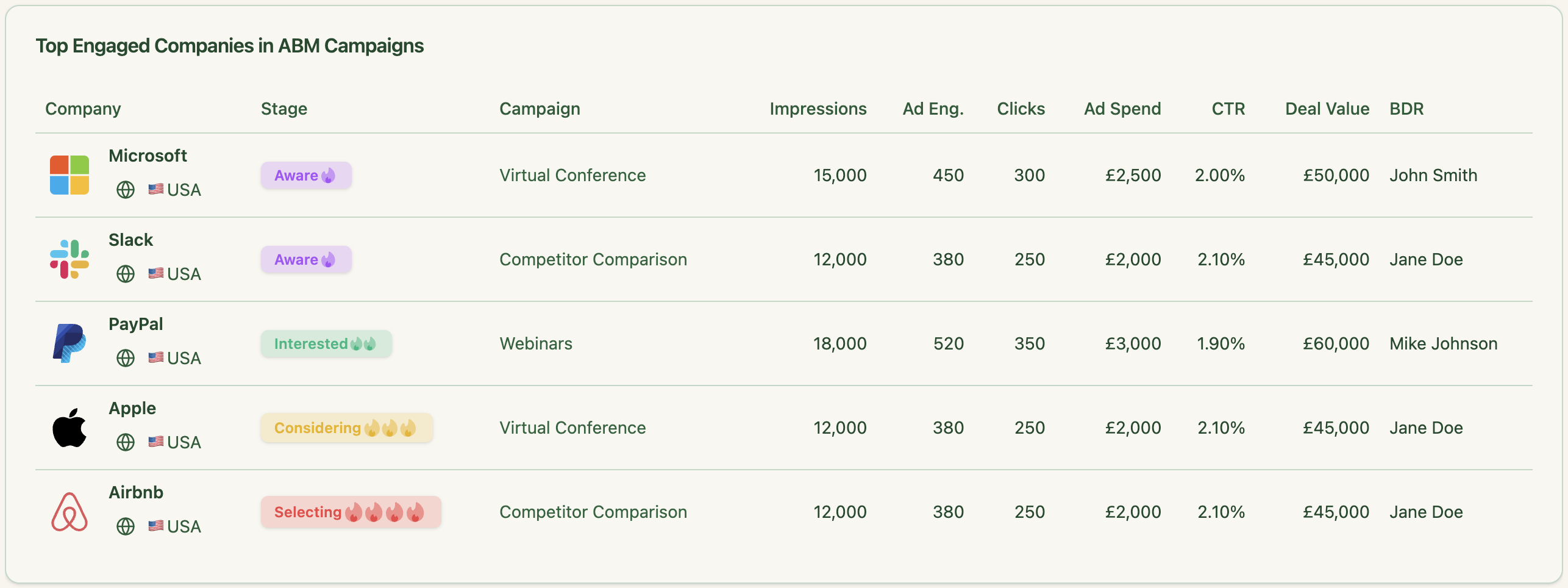
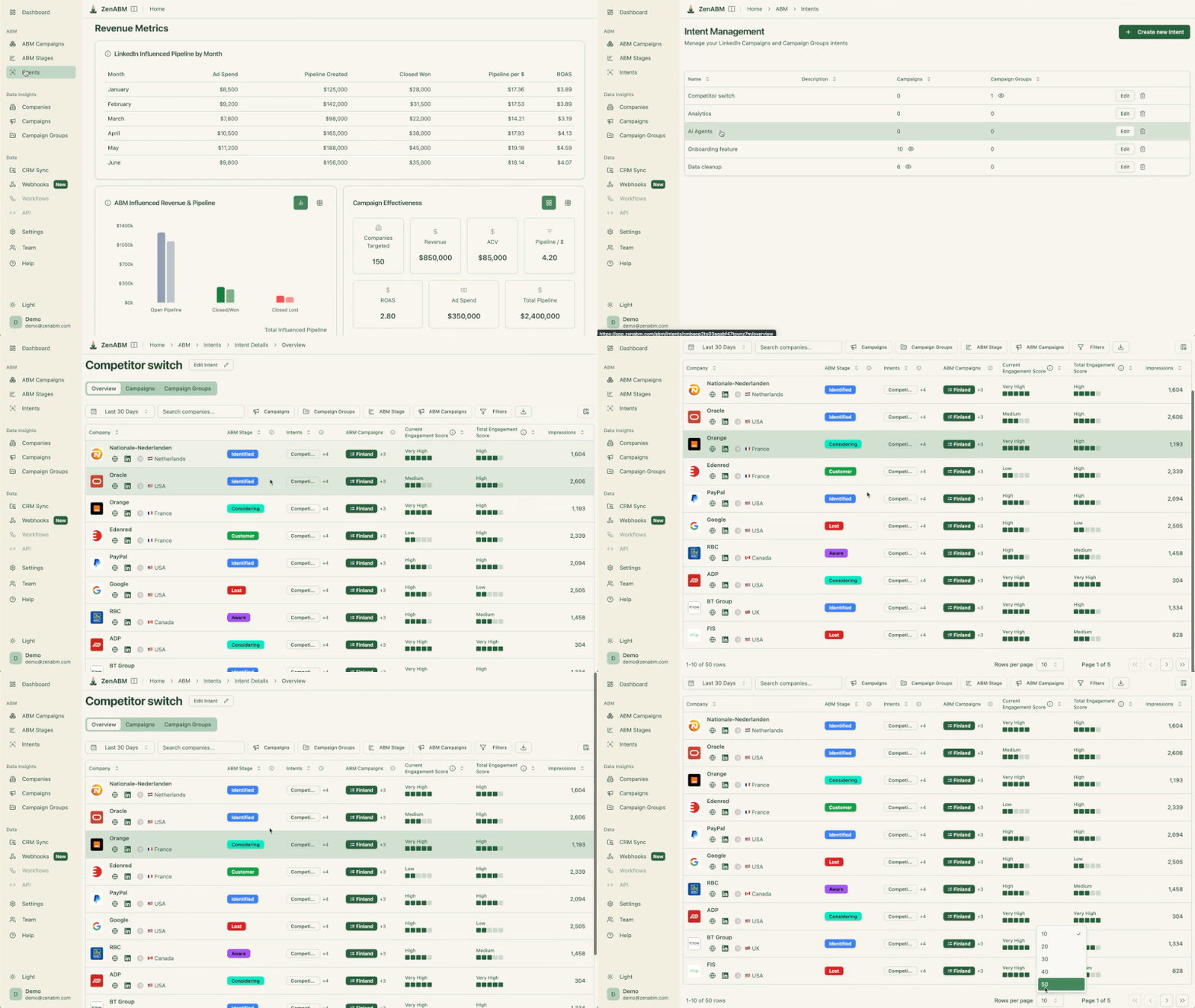
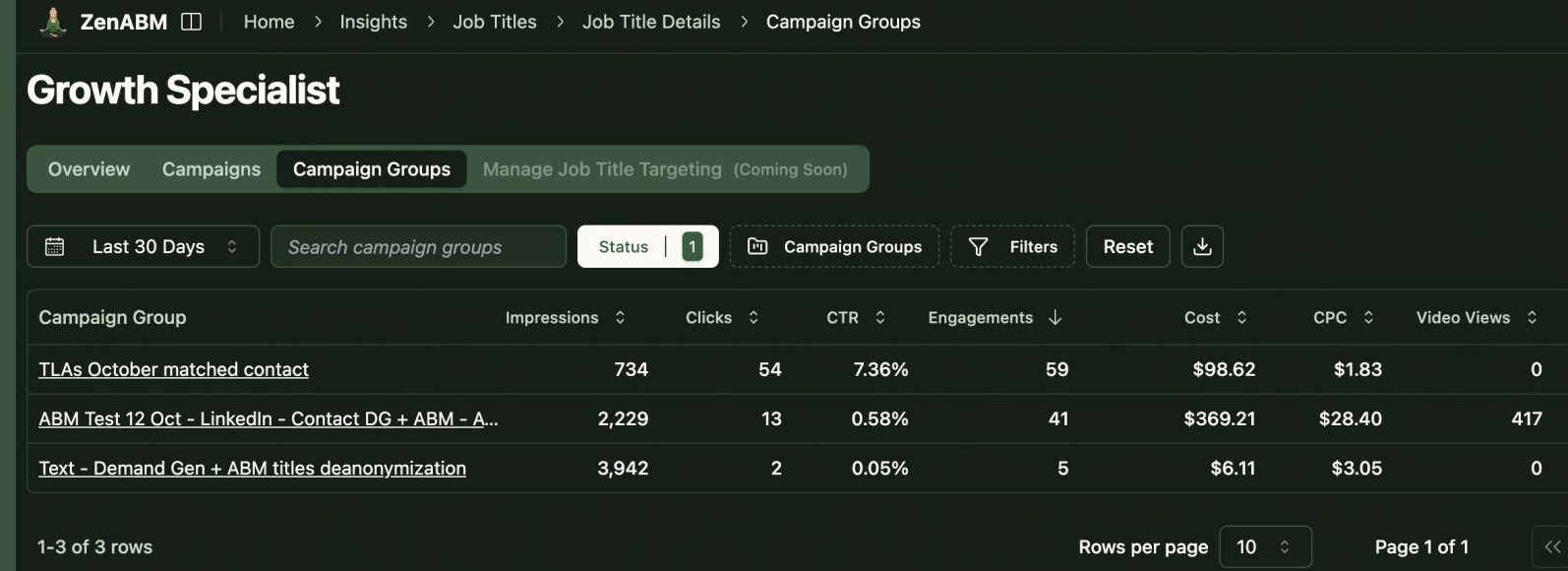
This is the raw material for account-based sales development.
Instead of BDRs working from static lists, they work from behavioral evidence. The account is not being contacted because it fits the ICP on paper.
It is being contacted because it has already shown signs of interest through repeated exposure, clicks, engagement, or deeper interaction with specific messaging.
The most valuable signals are not generic category interest.
They are signals tied to your positioning.
If an account repeatedly engages with your competitor-switching campaign, that is more useful than knowing the company broadly researched your category somewhere else on the internet.
It tells sales development both that the account is active and what angle is likely to resonate in outreach.
Even though this guide is focused on sales development, ABSD only works when the three layers stay connected:
| Layer | Role | When They Engage | What They Need to See |
|---|---|---|---|
| Marketing | Warms target accounts with ads and content | From the first impression through active pipeline support | Campaign performance, account progression, topic-level engagement |
| BDRs / SDRs | Convert engaged accounts into conversations and meetings | Once accounts cross the Interested threshold | Stage, engagement level, campaign intent, contacts, timing signal |
| AEs | Run discovery, navigate the buying committee, close the deal | After meetings are booked and opportunities form | Full engagement history, intent topics, persona engagement, deal influence |
The BDR is the bridge between marketing awareness and the sales pipeline.
That is why account-based sales development cannot be reduced to “prospecting with a warmer list.” The rep needs enough context to know when to act, what message to lead with, and why the account is warm in the first place.
Raw impression counts are not a workflow.
Sales development needs a decision system.
The simplest way to make engagement data useful is to translate it into ABM stages that define ownership and action.
A typical model looks like this:
| Stage | Engagement Threshold | Sales Development Action |
|---|---|---|
| Identified | On target account list | No outreach yet, marketing owns awareness-building |
| Aware | Meaningful ad exposure, for example 50+ impressions | No outreach yet, continue warming and monitor for stronger signals |
| Interested | Sustained engagement, for example 5+ clicks or 10+ engagements | BDR outreach triggered, this is the core handover point |
| Considering | Demo booked, trial started, or equivalent buying action | Sales takes over, BDR supports fast follow-up and coordination |
| Selecting | Active deal in CRM | AE-led process, marketing continues supporting the committee |
The most important stage for account-based sales development is Interested.
That is the point where the account has moved beyond passive awareness and shown repeated enough engagement that outreach is no longer a blind interruption.
ZenABM operationalizes this by turning LinkedIn ad engagement into account scores and ABM stages, then syncing that stage data into HubSpot or Salesforce as company properties, and even enrichment tools like Clay.
So the moment an account becomes “Interested,” sales development can see it inside the CRM instead of waiting for a spreadsheet export or weekly review meeting.
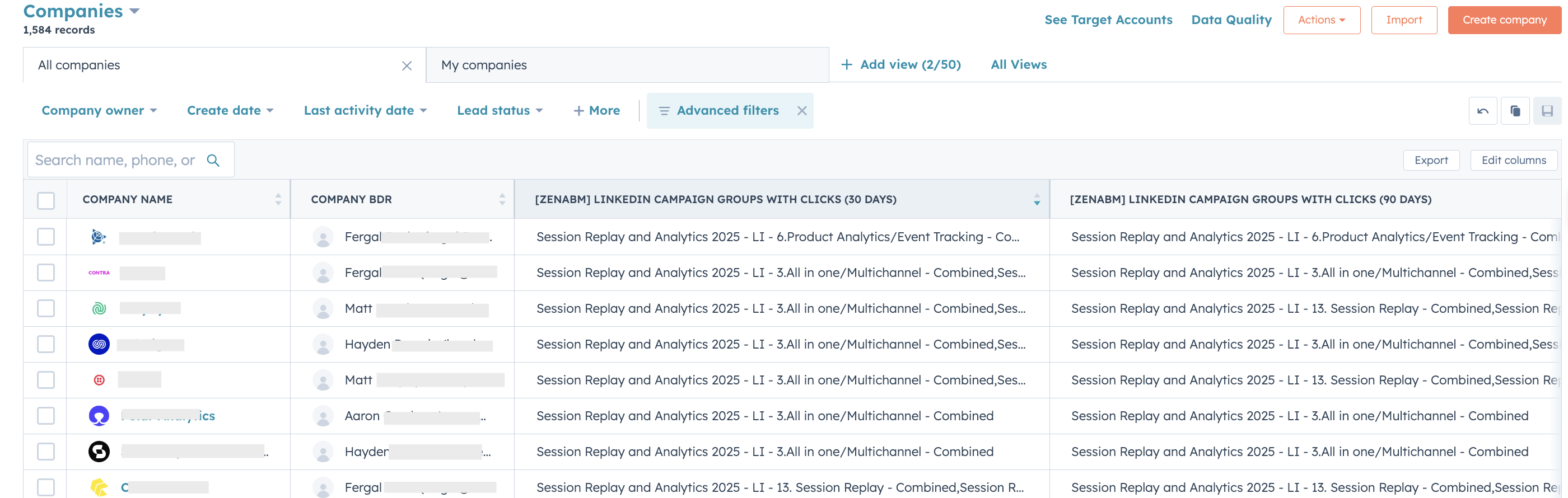


The handover only works if the data lands where reps already work.
If engagement signals stay locked inside an ad analytics tool, BDRs ignore them. If they show up as usable company properties and alerts inside CRM and workflows, reps act on them.
That is why the data flow matters as much as the signal itself.
With ZenABM, LinkedIn ad engagement can be pushed into HubSpot or Salesforce at the company level, including:
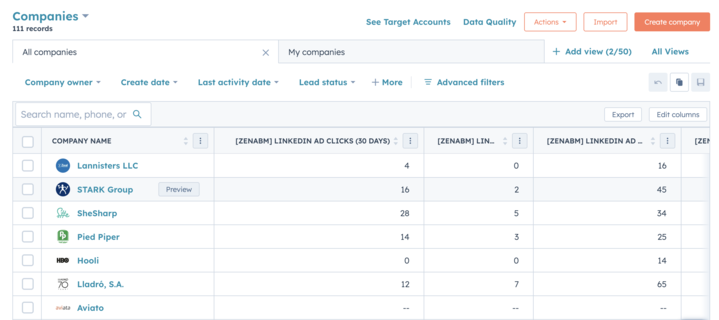

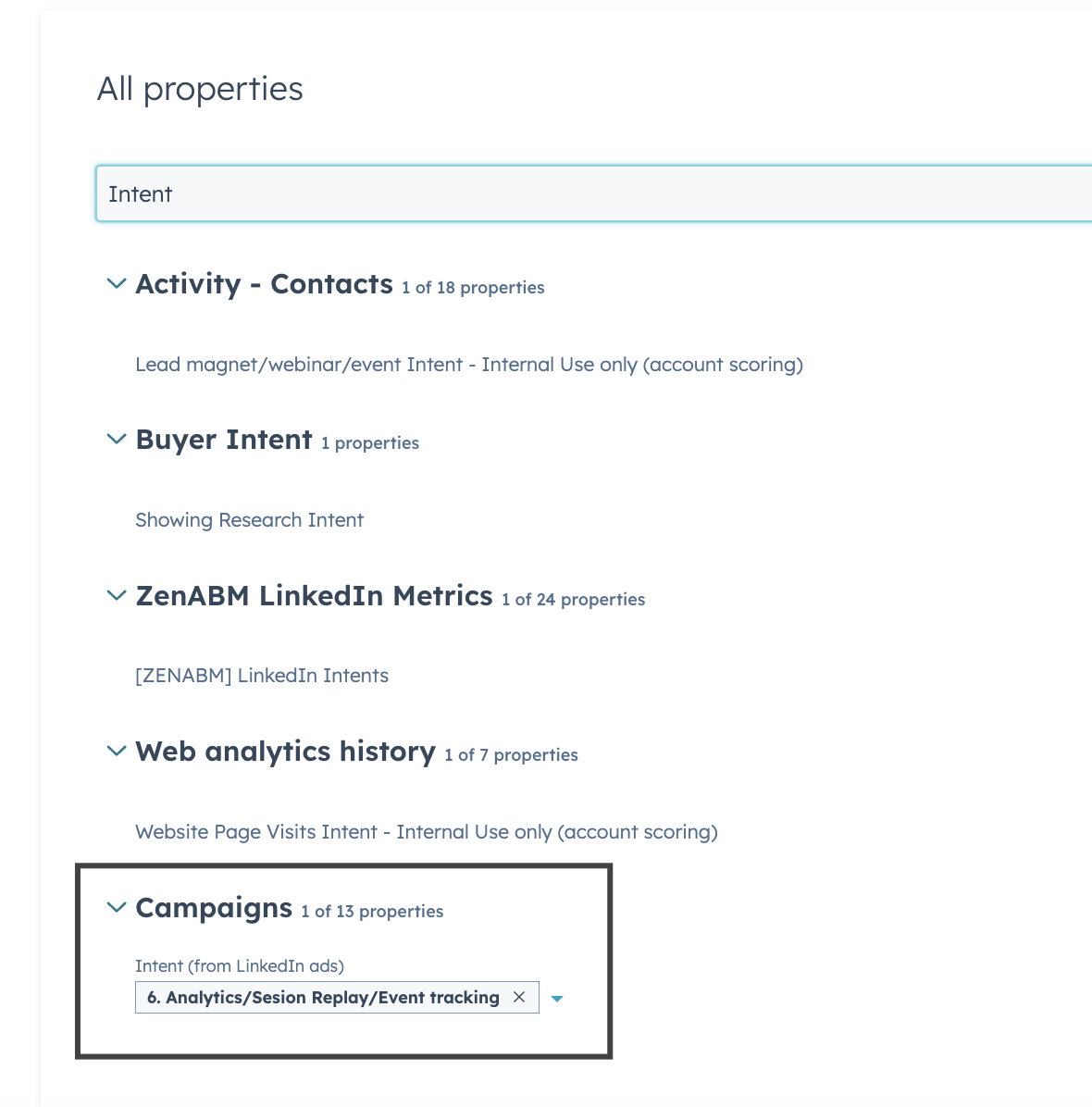

That means when a BDR opens a company record, they can see something like:
This company clicked six times in the last 30 days, engaged most with competitor-switching messaging, and just crossed into the Interested stage.
That one view answers three critical questions:
That is the difference between account-based sales development and list-based prospecting.
To make the workflow usable, you need more than just synced data. You need role-specific views and simple automation.
At the company level, configure properties such as:
Then create role-specific views:


You also want notifications that force action instead of passive observation:
The system should remove the need for sales development to “check the ABM dashboard.” The signals should come to them.

This is where the real performance improvement comes from.
Account-based sales development is not just about reaching out to warmer accounts. It is about matching the message to the reason the account is warm.
If your LinkedIn campaigns are segmented properly, the campaigns themselves tell you what kind of problem the account is responding to.
For example:
This is the practical value of intent data. It changes the rep’s opening line from generic to specific.
Instead of:
Hi, your company might be a fit for our platform.
You get something closer to:
Hi, I noticed your team has been engaging with content around switching from [competitor]. We recently put together a migration guide and comparison workflow that might be useful.
That is not just better copy. It is better timing plus better context.

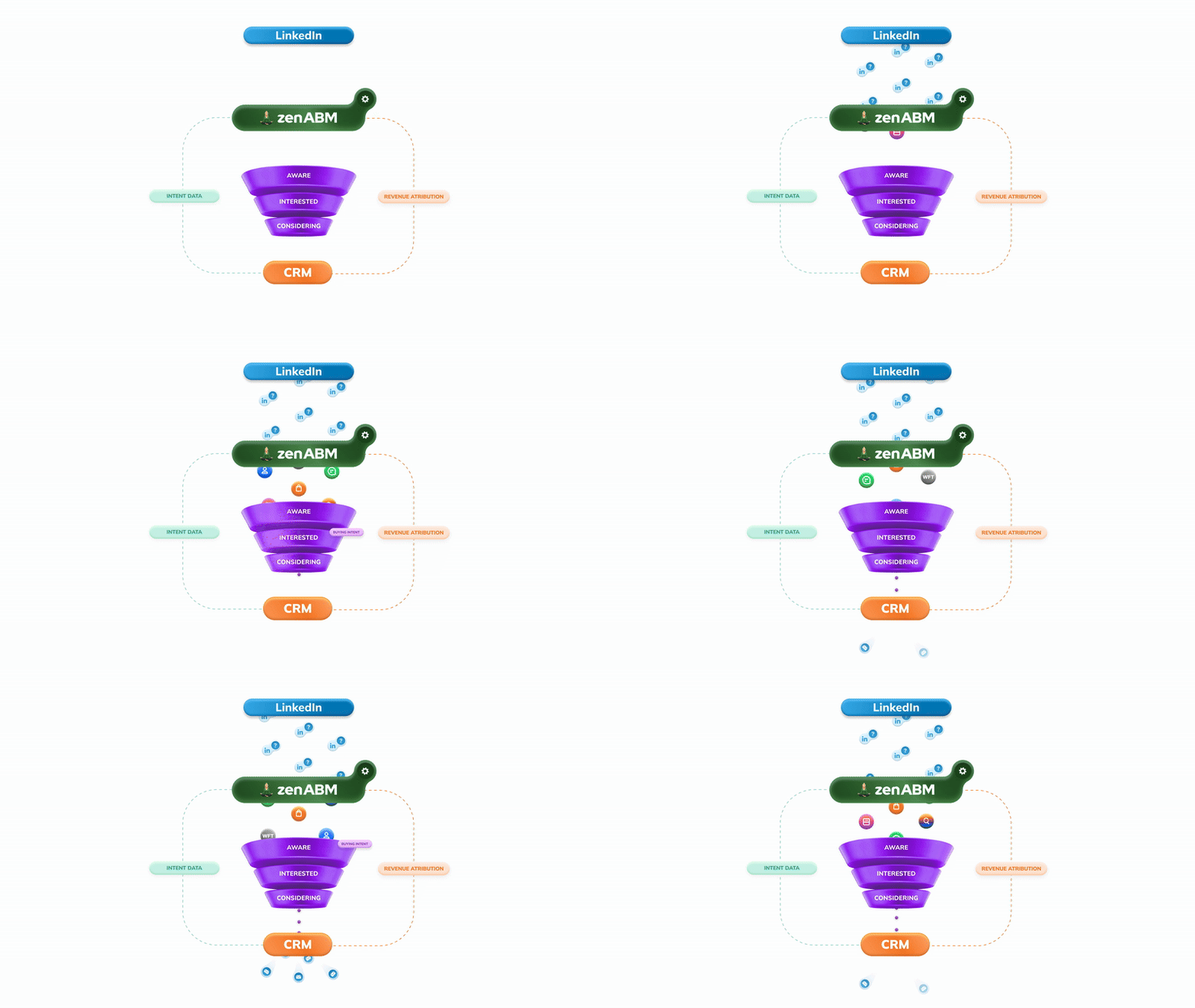
ABSD works best when the signal, enrichment, messaging, and delivery layers are connected.
| Layer | Primary Tools | What They Do |
|---|---|---|
| Intent detection | ZenABM | Pulls company-level LinkedIn ad engagement, scores accounts, assigns ABM stages, captures campaign-level intent, pushes to CRM |
| Prospecting / enrichment | Lead Magic, Prospeo, Clay | Finds the right contacts inside interested accounts and enriches with role, email, LinkedIn, tech stack, or hiring context |
| Email outreach | SmartLead, Instantly | Runs outbound sequences, warm-up, inbox rotation, deliverability, and testing |
| LinkedIn outreach | HeyReach, Expandi, MeetAlfred, Sales Robot | Handles connection requests, LinkedIn messages, and multi-channel follow-up |
| AI personalization | Claude Code | Generates account-specific messaging using persistent context plus real-time research and intent signals |
| System of record | HubSpot or Salesforce | Stores stage, account data, ownership, and alerts so sales can act in one place |
ZenABM is the signal layer. Without it, the rest of the stack is just automation pointed at a list.
Once ZenABM flags an account as Interested, that company can be pushed through webhooks into prospecting tools, sequencers, or AI workflows so outreach starts from a real behavioral trigger rather than a guess.
This is where account-based sales development gets significantly more scalable.
If you already have the account signal and the campaign intent, the next bottleneck is message creation. Most teams either send generic templates or make BDRs do manual research that does not scale.
Claude Code changes that, if it is set up with proper context.
The workflow looks like this:
The value is not that AI writes prettier emails.
The value is that it can combine:
The result is outreach that feels researched, timely, and relevant, but is produced in seconds instead of half an hour.
Here is the full workflow from first ad impression to booked meeting and beyond:
The key idea is simple: sales development should not start from zero.
By the time a BDR reaches out, the account should already have accumulated meaningful exposure and interaction with your brand. The outreach is not a cold interruption. It is the next step in a conversation that marketing already started.
Account-based sales development is focused on the BDR handoff, but the same data becomes even more valuable once meetings are booked.
AEs can use the engagement timeline to prepare for discovery calls, see which campaign themes mattered most, understand which personas interacted, and avoid walking into the first conversation blind.
If an account spent most of its time with competitor-switching campaigns, the AE should not open with generic product education. If the strongest engagement came from technical or security content, the AE should expect those topics to matter in evaluation.
This is also where marketing should keep running WARM ads during the deal cycle. The AE rarely gets direct access to every stakeholder in the buying committee, but continued ads let your message keep reaching the wider group during internal evaluation.
So account-based sales development should not be treated as a disconnected SDR play. It is the front end of a broader account-based sales system.
These are the failure patterns that usually break ABSD:
If the rep cannot see why the account is warm, the outreach reverts to generic messaging and the value of the marketing signal gets lost.
If nobody agrees on when an account becomes sales-ready, reps either jump too early or wait too long.
If all ad engagement gets lumped together, you know the account engaged but not what it cared about, which weakens personalization.
Once an account enters pipeline, marketing should still support the buying committee with continued messaging, not disappear.
If the only place engagement lives is a dashboard nobody checks, the process fails operationally even if the data itself is good.
Account-based sales development is the operational layer that turns ABM from awareness into action.
It works because it changes how sales development decides who to contact, when to act, and what message to lead with. Instead of working cold lists, BDRs work accounts that marketing has already warmed. Instead of relying on guesswork, they use campaign engagement and intent data to shape outreach. Instead of treating the handover like a one-time lead pass, the whole system runs on account progression and shared context.
The biggest difference between ABSD and traditional SDR motion is that the rep does not start from zero. By the time outreach begins, the account already knows the brand, has seen the messaging, and has shown a reason to care.
ZenABM is the layer that makes this practical. It tracks company-level LinkedIn ad engagement, scores accounts, assigns ABM stages, captures qualitative intent from the campaigns and creatives each account engaged with, pushes that data into HubSpot or Salesforce, and helps trigger the workflows that move accounts into real sales development motion.
Starting at $59 per month with a 37-day free trial, it gives BDRs and AEs the account-level context they need to stop starting cold. Try ZenABM free for 37 days and build an account-based sales development workflow that actually connects marketing engagement to pipeline creation.
Some common questions about Account-based sales development and their answers:
Account-based sales development is a B2B sales development model where BDRs or SDRs work from target accounts that marketing is already warming through ABM campaigns. Outreach is triggered by engagement signals rather than random list-based prospecting, and messaging is shaped by what those accounts have already shown interest in.
Usually when accounts cross into an Interested stage based on your engagement model, for example sustained clicks or engagement plus other meaningful interaction. Reaching out before that point is often too early, and waiting too long means losing the window created by active engagement.
Because LinkedIn ad engagement can be tied back to companies, which gives sales development account-level intent data instead of anonymous click data. That makes it possible to know which accounts are warming and which campaign topics they responded to.
Segment campaigns by topic or angle, then use the campaign engagement data to shape the first message. If the account engaged with competitor switching, lead there. If it engaged with a specific product use case or technical topic, make that the opening angle in email or LinkedIn outreach.
At minimum: LinkedIn Campaign Manager for ads, ZenABM for account-level engagement, stages, intent signals, and CRM sync, HubSpot or Salesforce as the workflow layer, and an outreach stack like SmartLead, Instantly, HeyReach, or Expandi. If you want AI-assisted personalization, Claude Code adds a strong messaging layer on top.
Yes, when the AI has the right context and signal inputs. Claude Code can combine your ICP, brand voice, positioning, and outreach rules with real-time account research and ZenABM intent data to generate individualized outreach that feels researched instead of generic.
