



Most ABM landing pages are personalized in the wrong dimension.
Marketers spend hours swapping in company logos, changing “Hello [Company Name]” in the headline, and building industry-specific versions of the same generic page, yet the accounts still do not convert.
The problem is not the personalization itself but the personalization strategy: you are personalizing for who the visitor is, when you should be personalizing for where they are in their buying journey.
This post covers Tas Bober’s (ABM expert and founder at The Scroll Lab) session at the ZenABM ABM Bootcamp 2026, where she introduced her “Where” framework for ABM landing pages, the approach that actually moves accounts through the funnel rather than just making them feel recognized.
You can watch the full session on YouTube here.
Short on time?
Here’s a quick summary:


Account-based personalization (changing the landing page to reflect the visitor’s company name, industry, or persona) is table stakes in 2026.
Most ABM platforms support it, most ABM teams use it, and most ABM teams are disappointed by how little it moves the needle on conversion rates.
Here is why: knowing who someone is does not tell you what they need to hear right now.
A VP of Engineering at Datadog who is in their first week of evaluating graph database solutions needs to hear something completely different from a VP of Engineering at Datadog who has already run a POC and is now comparing your pricing to two competitors.
Same persona, same company, completely different buying stage, and the same landing page will not serve both of them.
“Who” personalization solves a small problem.
“Where” personalization solves the real one.

The “Where” framework has four dimensions, each answering a different question about where the buyer is:
Early-stage buyers (problem aware but not yet solution aware) need educational content that validates their problem and introduces your category.
Mid-stage buyers (actively evaluating solutions) need comparison content, proof, and specifics about how you solve their exact problem.
Late-stage buyers (selecting a vendor) need reassurance in the form of security documentation, implementation clarity, ROI evidence, and social proof from companies like theirs.
Each stage requires a fundamentally different page because the buyer’s mental model is different at each point.
A visitor who clicked a Thought Leader Ad post about onboarding analytics arrived with a specific context, and your landing page should match that context rather than redirecting them to a generic product homepage that requires them to re-orient entirely.
Ad-to-landing-page message match is one of the most reliably impactful conversion optimizations available to ABM marketers, because it preserves the momentum the ad created rather than resetting it to zero.
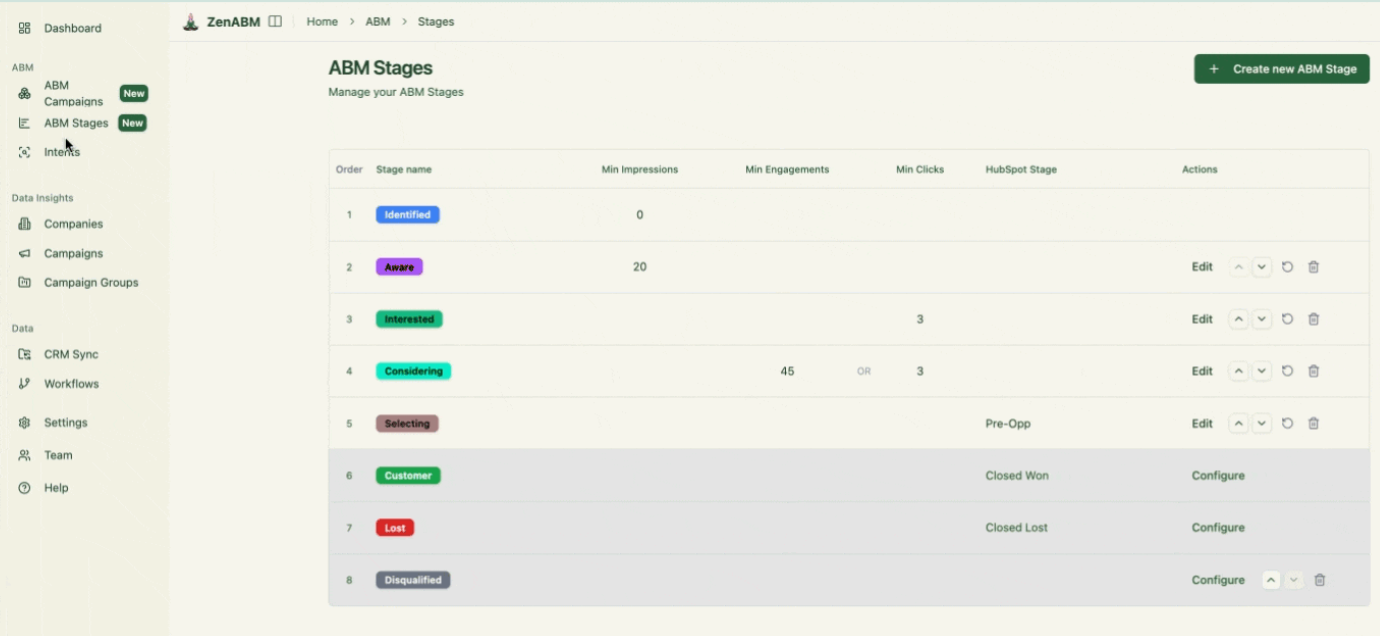
An account that just entered your “Aware” stage (50 or more impressions but no clicks yet) needs something fundamentally different from an account in “Interested” (3 or more clicks plus a pricing page visit).
The former needs credibility building, while the latter needs conversion: a specific, low-friction next step tied to what they have already shown interest in.
Serving an awareness-stage page to an interested-stage account wastes their readiness, and serving a conversion page to an awareness-stage account scares them off.
This dimension becomes much easier to operationalize if you already use ZenABM, because its customizable ABM stages and company-level engagement data help you distinguish between accounts that are merely aware and accounts that have already shown meaningful buying intent.
B2B buyers do not buy alone.
They bring their purchase recommendation to a committee that includes their manager, finance, procurement, and legal.
An ABM landing page that helps the champion build their internal business case is far more valuable than one that just convinces the champion, because the champion is not the bottleneck; the committee is.
Tas calls this “building the landing page like a business case,” and the principle is that your page should arm the champion with the materials they need to sell internally on your behalf.

Applying the “Where” framework in practice means building different landing pages for different buyer stages, not just different buyer personas.
Focus on the problem, not your product.
These visitors know they have a pain, but they are not ready to evaluate solutions yet, so show them you understand their problem better than they do.
Use their language, include data that quantifies the cost of the problem, and end with an invitation to learn more (a relevant resource, a webinar, a short assessment) rather than a demo request.
Demo requests at the awareness stage convert at under 1% and drive poor-fit meetings that waste both your team’s time and the prospect’s.
Now you can introduce your solution, but in the context of their specific problem rather than as a standalone product pitch.
Comparison content works well here: how you solve the problem versus how alternatives (including the status quo) solve it. G2 ratings, case studies from companies in their industry, and specific outcome data (not feature lists) are the most effective elements at this stage because the buyer is trying to build a mental model of which solution fits their situation best.
The buyer is ready to commit but needs internal approval, so your landing page should give them everything they need to make the case to their boss: an ROI calculator, an implementation timeline, security documentation, and references from similar companies.
Use one clear CTA (book a call, start a trial, get a custom quote) with no other distractions on the page, because at this stage, the buyer has already decided they want to move forward, and any additional options just slow them down.
If you are running stage-based journeys like this, ZenABM adds useful context by showing which companies are progressing from ad engagement to real pipeline.

Tas walked through the most common ABM landing page mistakes she sees in her consulting work:
Your homepage is built for all visitors, but your ABM target accounts are not all visitors.
When an Interested-stage account clicks your LinkedIn ad about a specific use case and lands on your homepage, they have to do the work of finding the relevant information themselves, and most do not bother.
Every LinkedIn ad should go to a dedicated landing page that matches the ad’s message and the account’s stage.
An ABM landing page with five different CTAs (“Book a Demo,” “Read the Case Study,” “Download the Whitepaper,” “Watch the Video,” “Start a Free Trial”) converts worse than a page with one CTA because the visitor paralysis is real.
One page, and one next step, matched to the buyer’s current stage.
A 12-field lead gen form on an awareness stage landing page will kill your conversion rate.
Tas shared a case study: a client had 2.5% CTR on their LinkedIn ads and $2.50 CPC, which is excellent performance, but nobody was filling out the form because it asked for sensitive company information before the visitor had built enough trust.
They ungated the main asset and offered the form as an optional next step, and conversions increased significantly with no change to the ads.

Putting “[Company Name]’s Personalized Page” in the headline while showing generic product copy below is worse than not personalizing at all, because it sets an expectation of relevance and immediately breaks it.
If you personalize, personalize the message rather than just the header, because the header is a promise, and the body copy is where you either keep it or lose it.
Standard landing page analytics (sessions, conversions, bounce rate) tell you about aggregate performance, but ABM requires account-level analytics: which specific target accounts are visiting which pages, how many times, and whether those page visits are correlating with deal progression.
The measurement stack Tas recommends:
Factors.ai, RB2B, or a similar tool identifies which companies are visiting your landing pages even when visitors do not fill out a form.
This is the layer that turns anonymous web traffic into account-level signal you can actually act on.
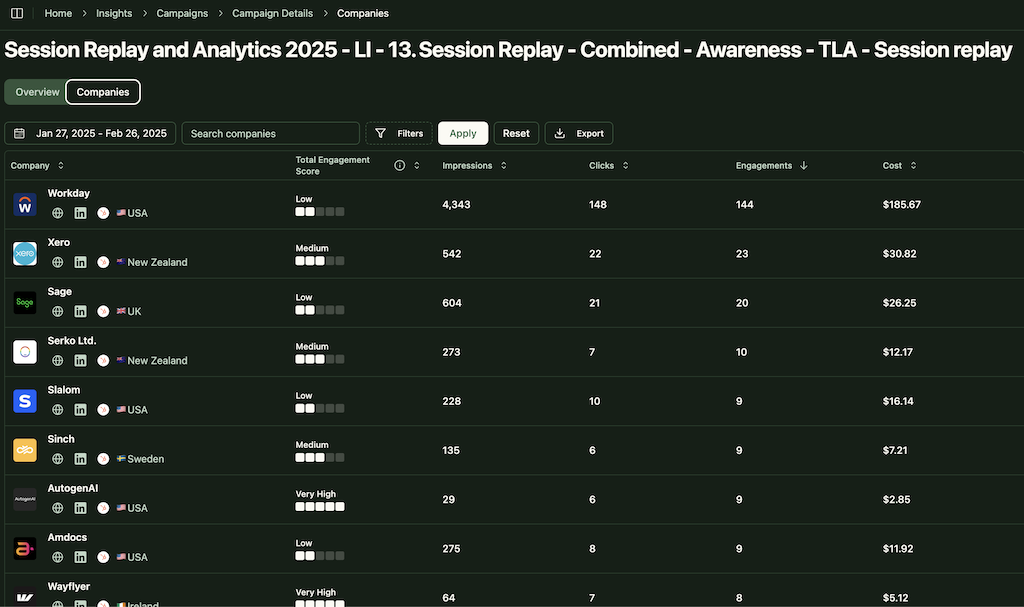
ZenABM tracks which LinkedIn ad campaigns drove each company to your landing page, connecting ad engagement to on-site behavior so you can see the full journey from impression to page visit rather than treating them as separate data sets.
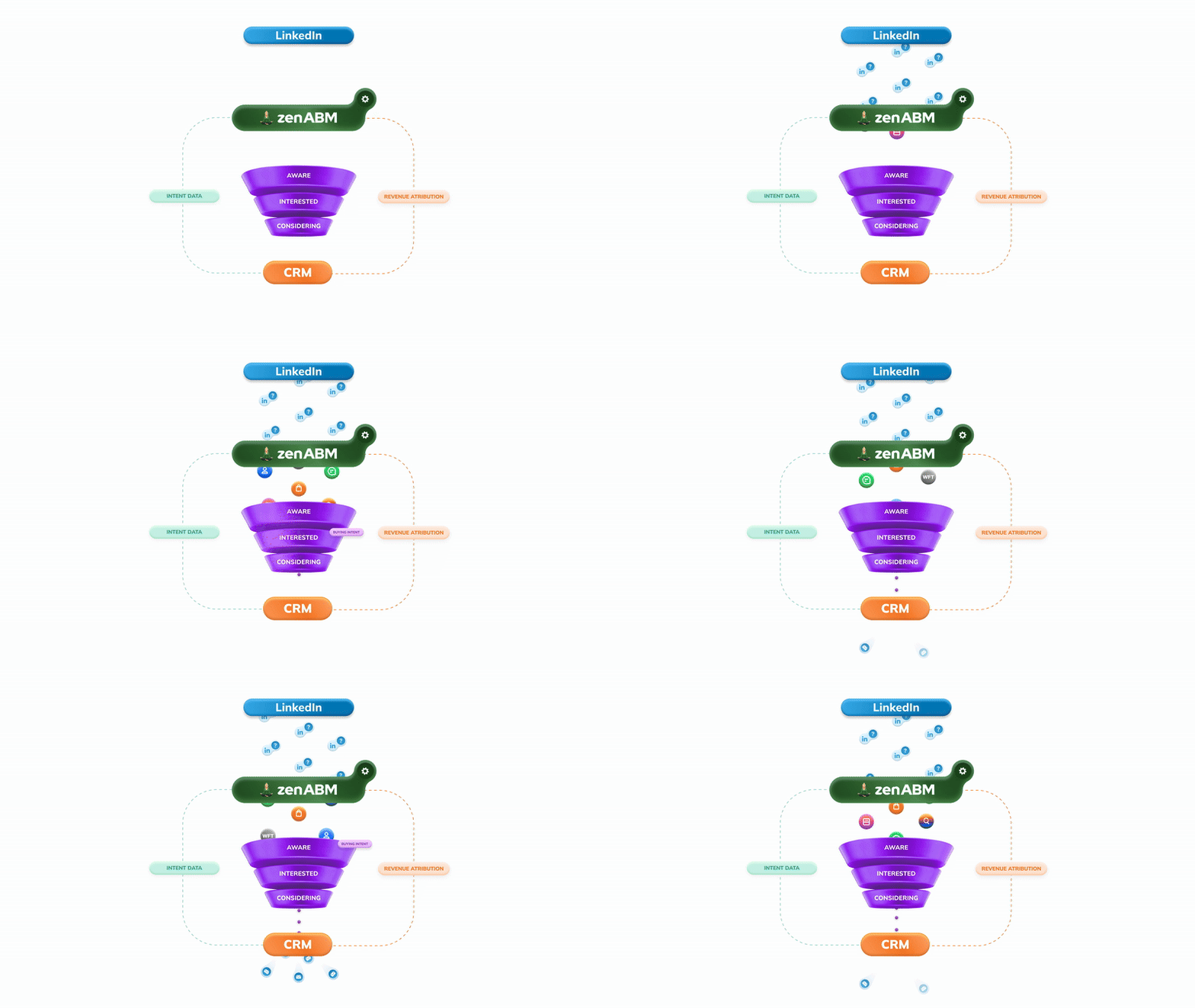
More specifically, ZenABM gives you company-level LinkedIn ad engagement, ABM stage tracking, and CRM sync.
That combination makes it easier to understand not just that a company visited your site, but which campaign influenced the visit, how engaged the account already was, and whether the visit should count as a stage progression signal.
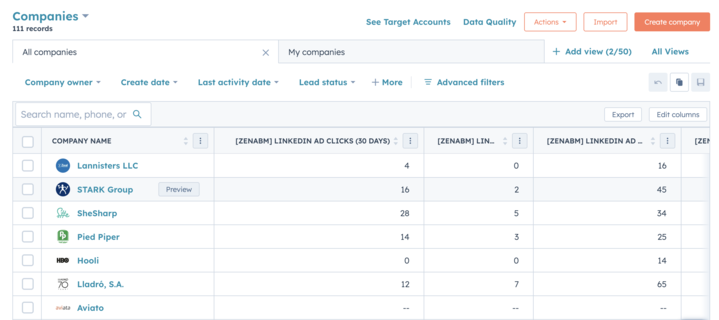
Push landing page visit data as company properties in HubSpot.
When a target account visits your pricing page three times in a week, that is a stage progression trigger rather than just a web analytics data point, and it should surface to the sales team as a reason to reach out.
The goal is that every high-intent page visit from a target account should appear in your CRM within 24 hours, visible to the sales team as actionable context.
See how to track company engagement from LinkedIn ads for the full setup.

The strongest ABM landing pages are not the ones that merely greet the visitor by company name.
They are the ones that reflect what the buyer is trying to solve right now, what context brought them there, and what they need next to move the deal forward internally.
That is the real difference between personalization that looks clever and personalization that actually converts.
Just as importantly, ABM landing pages need to be measured at the account level, not just through generic web analytics.
That is where ZenABM becomes especially useful. Its company-level LinkedIn ad engagement, ABM stage tracking, and CRM sync help you see which landing pages are actually moving target accounts through the funnel.
If you want a clearer view of whether your ABM pages are influencing real account progression, ZenABM is a strong layer to add.
Try ZenABM for free (37-day free trial) or book a demo now to know more!
Some common questions about ABM landing pages that convert and their answers:
A good ABM landing page matches the message of the ad that brought the visitor there, is appropriate for their buying stage rather than generic, has one clear CTA, and does not ask for more information than the trust level at that stage supports.
The most effective ABM landing pages feel like they were written specifically for where the visitor is in their journey rather than for the average visitor.
You need different landing pages for different buying stages, which is the most impactful personalization dimension. Industry-specific pages are useful if your product works meaningfully differently by industry.
Company-specific pages (with the company name, logo, and tailored content) should be reserved for Tier 1 accounts where the deal size justifies the investment in creating them.
One. Multiple CTAs reduce conversion rates by creating decision paralysis.
Choose the single most appropriate next step for the account’s buying stage: educational content for awareness, comparison content for consideration, and a demo or trial for decision. Everything else is noise that dilutes the action you actually want the visitor to take.
At the account level, not in aggregate. Use a website de-anonymization tool (Factors.ai, RB2B) to identify which companies are visiting your pages, then connect that data to your CRM so high-intent visits trigger sales follow-up.
Track which target accounts progressed from ad engagement to landing page visit to demo request, and measure how many days each stage transition takes so you can identify where accounts are stalling in the funnel.
If you want that measurement tied back to LinkedIn ads specifically, ZenABM is useful because it connects company-level ad engagement to page visits, surfaces those signals inside your CRM, and helps you see which campaigns and landing pages are actually influencing account progression.
