

©2026 ZenABM - All Rights Reserved.
Emilia Korczynska is Head of Marketing and co-founder at ZenABM. Before that she was VP of Marketing at Userpilot for nearly 7 years, where she ran a large ABM program primarily on LinkedIn ads.

ABM strategy and segmentation start with one decision: whether you run 1:many, 1:few or 1:1 campaigns, because that decides how finely you can slice your accounts. Slice too thin and your LinkedIn audiences fall below the minimum and your ROAS shrinks; slice too little and one message goes to everyone. Here is which segments work for each motion, and how to set them up with company engagement data from your own LinkedIn ads.
The numbers worth keeping in mind while you segment:
Metric | Number | Source |
|---|---|---|
Minimum campaign audience on LinkedIn | 300 member accounts | |
Company list: minimum rows and matched members | 300 each | |
Recommended company list size | 1,000+ companies | |
LinkedIn company match rate | About 90% at best; 70% audience penetration is a great result | Our own ABM programme |
Accounts in market at any time | About 5% | Our own ABM programme |
/abm-strategy-planning skill, which works back from your revenue goal.Here is the whole post in one picture:

Account based marketing segmentation means dividing your target accounts into groups, so each group gets the messaging, budget and effort that match its value and its stage. You can group by ICP fit, tier, industry, company size, persona or how much an account already knows you.
It starts from two things: your ICP (the blueprint of your best-fit account) and your TAM (the universe where those accounts live). Segmentation then breaks that universe into parts where you can actually win. In ABM the precision is the point, because every dollar and every touch goes to accounts that could move the needle, and each account gets the effort it deserves, no more and no less. If you are still setting up the wider programme, start with my LinkedIn ABM strategy blueprint.

There are three ABM motions. According to TechTarget, one to one (strategic ABM) addresses individual accounts with highly customized methods. One to few targets a handful of accounts, typically fewer than a dozen, with similar needs and only light customization. One to many (programmatic ABM) uses marketing automation to scale to more accounts, typically segmented into categories.
Most teams do not run all three at once. In the Momentum ITSMA and ABM Leadership Alliance 2022 benchmark, 53% of programmes used one type only, 29% used two and 18% used all three. Pick the one you can actually run well, because it sets everything else in this post.

The motion you run decides which segments are worth building. 1:many splits by company size and persona, 1:few splits by industry, and 1:1 splits by seniority or persona and by COLD vs WARM. Funnel stage is the one segment that applies to all three. For a worked example of each motion, see these ABM strategy examples for 1:1, 1:few and 1:many.
Motion | Accounts | Segment by | Why |
|---|---|---|---|
1:many | Hundreds to thousands | Company size, then persona or seniority | Size sets members per account and impressions needed; personas have different needs |
1:few | A small cluster of similar accounts | Industry | One industry shares pains, language and proof points |
1:1 | A handful of strategic accounts | Seniority or persona, plus COLD vs WARM | Different roles need different messages, and awareness differs per account |

My view is that you should pick the motion first, then segment only as finely as your audience allows. The most common and most expensive mistake is slicing a list thinner than your budget and your audience can carry.
Every segmentation strategy starts with a clearly defined ICP and an understanding of your TAM, because you cannot segment well if you don't know who you are after and where to find them.
Look at your best customers and find what they have in common:

If most of your successful accounts are mid-market fintech companies in North America with a certain tech stack, that is a strong ICP element.
Pro tip: write more disqualification criteria (industries or account types that don't fit) than qualification criteria, so your targeting stays focused.
Once you know who you want, work out how many such accounts exist. Whether you use a top-down or a bottom-up approach, you will end up segmenting it. For how to pick the accounts themselves, see how to choose target accounts for ABM.

GTM strategist Maja Voje explains why: "Segmentation helps you break down the vast TAM into manageable and actionable parts where you can win."

In B2B, firmographics (industry, size, revenue) are the most useful of the traditional segmentation types, so start there.
Then build your first list from the accounts closest to a deal. At our ZenABM LIVE meetup in London, I said you should start from the opportunities in your CRM and add companies that have engaged with your content before. Going after completely cold accounts first is a common mistake.
All your target accounts match your ICP, but they are not equally valuable, so tiering by value decides how much effort each one gets. An account score built from LinkedIn ad data is a practical way to decide which tier each account lands in.
Tier | Motion | What it looks like |
|---|---|---|
Tier 1 | 1:1 | Dream clients with high ACV potential or strategic value. White-glove personalisation and executive outreach. You might have 20 of them, each worth many typical deals. |
Tier 2 | 1:few | Strong ICP fits grouped by similarity. As an example, 50 accounts split into 5 clusters of 10 by sub-industry or common need, with semi-custom content per cluster. |
Tier 3 | 1:many | Larger batches of good-but-not-top accounts. Broad, automated campaigns that test for engagement and feed Tier 2. |

An ABM tier system sorts your target account list by expected value and gives each tier a different level of effort. Tier 1 gets 1:1 treatment, Tier 2 gets 1:few clusters, and Tier 3 gets programmatic 1:many campaigns. Accounts that raise their hand in Tier 3 graduate upward for more attention.
SalesLoft ran a tiered ABM segmentation model and saw a 115% lift in converting marketing leads into booked sales meetings. They isolated a subset of high-fit accounts and gave them richer data and more personalised touches. The takeaway is that extra effort on a well-tiered list beats treating every lead the same. Source: ABM in Action.
Whatever your motion, split accounts by how much they already know you. WARM accounts (closed-lost, churned, past engagers, CRM opportunities) need different messaging than COLD ones, and this is the one segmentation I would use in every motion.
I wouldn't assume every new logo on your list is unaware of you. Some already know you, some are problem-aware, some are solution-aware, and some are already comparing tools and need only a small nudge. Once they are split, here is how to move accounts from Aware to Considering.

If you don't know yet, run a pilot campaign that shows all content types (top, middle and bottom of the funnel) to every account. Then use ad engagement to split accounts into low intent and high intent.
In ZenABM you define ABM stages as rules over LinkedIn engagement and CRM conditions. ZenABM evaluates every account against those rules and moves it through the funnel automatically, so the stage is computed rather than updated by hand.
[Image: GIF #7230 | ZenABM stage editor with custom ABM stages from Identified to Lost]
You can see each account's engagement per campaign in Company engagements:


ZenABM also keeps an account engagement score, based on current and all-time activity with your ads. That score is essentially your warm/cold score.

To act on it, ZenABM can send an ABM stage such as WARM to LinkedIn as an audience through HubSpot. The audience then updates itself, so companies move between your COLD and WARM campaigns without CSV re-uploads.
Some teams measure intent with third-party intent data or IP-matching tools, but I prefer first-party signals. Syft's benchmark found that accuracy rates for company identification remain low across services, with Clearbit ahead and People Data Labs still behind. That is why ZenABM relies on first-party interactions with your LinkedIn ads to capture company intent.

In a 1:many programme, company size is the segment that matters most. It sets how many members you target per account, and therefore how many impressions it takes to move an account from COLD to WARM.
Impressions needed per account = members targeted per account × target impressions per member
With 3 members per account and 10 impressions each, that is 3 × 10 = 30 impressions per account. A small account with 3 matching people and a large one with 30 need very different amounts of delivery, so they shouldn't share a campaign.
Audience size matters just as much. In my LinkedIn post on audience maths, the point is that niche job titles in SMBs (where the title is maybe 5 to 10% of the company) leave you a very small audience. LinkedIn matches about 90% of companies at best, and 70% audience penetration is a great result. If you can only target 3 people per company, you need at least 2,500 companies to run a cold campaign.
Size also helps you manage impression caps. The logic is the same with a different goal: you prevent over-saturation of small accounts, where a few people see the same ad again and again.
I made this mistake myself 😅. In our $5k diaries campaign, we reached only 1,249 of 20,413 target accounts (6%). Impression capping could not apply until the audience had built, so a few accounts were over-saturated instead of the list being covered evenly.
LinkedIn's own frequency caps are set per member account (3 to 30 impressions per 7 days, brand awareness objective only), not per company. To see what each company actually received, open Company engagements in ZenABM, which shows impressions and engagements for every company you target, so saturated and barely-reached accounts are visible.
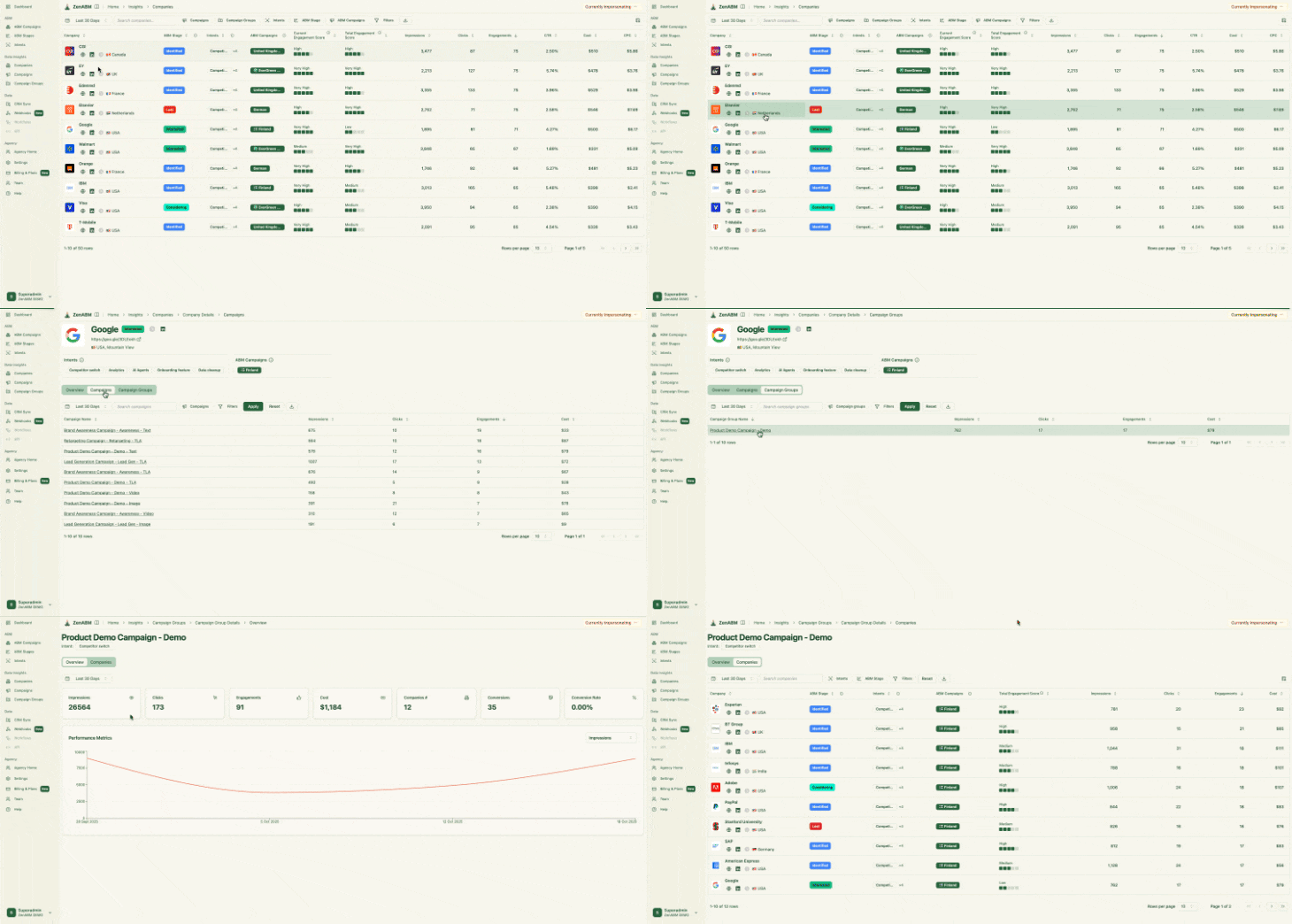
[Image: GIF #7265 | ZenABM Companies Insights table with impressions, clicks, engagements and cost per target company]
To turn this into a budget, our ABM Budget Calculator works back from your revenue goal to target accounts, impressions and spend, and the /abm-strategy-planning skill does the same thing from your website and CRM. In our webinar on planning your ABM strategy with AI on 30 September 2026, I showed the two formulas: target accounts required = demos ÷ deal-open rate, and the impression-based budget = (members per account × impressions per member) ÷ 1,000 × CPM. ZenABM typically targets 3 to 5 people per account.
Split by persona only when different roles genuinely need different messages or use cases, and for 1:many add seniority, because the economic buyer cares about different things than the end user.
Wouter Dieleman suggests using the SPICED framework (Situation, Pain, Impact, Critical Event, Decision) to build spot-on personas if you use HubSpot:

Identify the roles in your buying committee using HubSpot's role types: Decision Maker, Budget Holder, Champion, Influencer, End User, Executive Sponsor, Legal/Compliance and Blocker. Then write SPICED for your top three personas, for example a Champion who feels the Pain and a Decision Maker who sets the Criteria.
To check you reached the buying committee, ZenABM groups ad engagement by job title in Job title engagement, so you can see which roles your spend reached and which ones engaged.
Persona segmentation backfires when the slices get too thin. At Userpilot, we first segmented ad campaigns by buying stage and job-function persona, as I shared in my guest post on Growth Unhinged. LinkedIn needs at least 300 members per campaign audience, and our segments were too narrow to cross that line.
So we dropped the persona-first structure and rebuilt around an intent-first one. Here are the old and new structures side by side:

The thinner you slice, the more expensive campaigns get and the thinner your ROAS, as I put it in my post on what we learned burning $100,000+. Only segment when messaging or product genuinely differs. Segmenting by how expensive a geography is to target (CPM) does make sense.
Narrow personas also hit LinkedIn's data thresholds. In our campaign setup webinar, I recommend targeting a bit broader so that enough people per company engage for the data to be reported.
In a 1:few programme, industry is the natural segment, because accounts in one industry share pains, vocabulary and proof points that you can speak to directly.
Clarabridge, a B2B customer experience platform, began with just two verticals: retail banking and healthcare insurance. That let them tailor content deeply to each vertical, and they then split prospects by role inside each target account (for example IT leaders vs CMOs in healthcare). In a few months this influenced 96 deals worth about $24 million. Source: ABM in Action.

Treat this as 1:few with a persona layer on top. If you do the same, check that each industry-and-persona slice still clears the 300-member campaign minimum.
In a 1:1 programme, segment each account by seniority or persona where those roles need different messages, and run separate COLD and WARM campaigns so awareness decides the message. ZenABM's audiences move companies between COLD and WARM campaigns dynamically.
There is an audience-size trap here. A single strategic account rarely gives you 300 members to target on its own, so 1:1 ads usually run on a combined list of Tier 1 accounts, or as account-specific ads inside one shared audience, not a separate audience per account.
Keep the list clean too. I would exclude any company that isn't on your target list. In our webinar on AI for reporting and revenue attribution, I explained that LinkedIn can start targeting a company like Clay just because someone lists a skill such as "Clay expert" on their profile. In ZenABM, Exclusions apply across campaigns, including new ones, so you don't re-upload the list each time you launch.

Once the segments exist, give each one its own content and ads, so every account feels the message was written for it.
Pro tip: structure ad sets by theme, for example by product feature, and ZenABM tracks which companies engage with which theme. You can tag campaigns with their intent:

ZenABM then groups companies showing similar intent in one place, which is very useful for BDR outreach:


It also pushes the same intent to your CRM as a company property:

Here are four real examples, with what each team did and what the numbers were.
SalesLoft: tiered model. They isolated high-fit accounts and gave them richer data and more personalised touches, which led to a 115% lift in lead-to-meeting conversion. It worked because effort followed account value instead of being spread evenly.
Clarabridge: vertical plus role. They started with two verticals and then split by role inside each, which influenced 96 deals worth about $24 million. It worked because the content was deep per vertical and per role, on a list small enough to cover well.
Userpilot: persona-first to intent-first, plus company size. In our London talk, I described the Userpilot one-to-many programme: 47,000 accounts, over 500 ads and over $500k spent on LinkedIn. The persona-first structure fell below LinkedIn's threshold, so we rebuilt it as intent-first. We later split audiences by company size so each account got the right number of impressions, and simplified to three audiences: lookalikes of top customers, competitor users, and former MQLs, SQLs and customers, as I wrote in our ABM programme's first-year review.
ZenABM's $5k diaries campaign. The plan was to get 6,500 target accounts to 18+ meaningful impressions and generate 65 demos by 13 December, on $5k a month. What went wrong is that we reached only 1,249 of 20,413 target accounts (6%), because impression capping could not apply until the audience built. The lesson is to split by company size and watch impressions per company from day one.

Three mistakes cost teams the most: over-segmenting, not segmenting by company size, and not segmenting by persona where messaging differs.
Every extra slice makes campaigns more expensive and your ROAS thinner. Do the funnel maths first: about 5% of accounts are in market, you can reach 50 to 70% of them on LinkedIn, about 0.45% will visit your landing pages and under 1% will book a call. Thin slices rarely have the volume to pay back, so segment only when the message or product really differs.
If a small account with 3 matching members shares a campaign with one that has 30, the small one gets over-saturated while the big one is under-served. The fix is separate campaigns or audiences by size, with the impression target set per size.
If an economic buyer and an end user get the same ad, one of them gets a message that doesn't fit. The fix is a persona or seniority split, as long as each slice stays above 300 members.

Segmentation is not one and done, so track pipeline, win rate and deal value per segment, and move budget to the segments that win. To see which target accounts are actually engaging, read how to measure LinkedIn ad engagement for target accounts.
If Segment A drives more pipeline at a higher win rate than Segment B, double down on A's tactics or change B's messaging. Keep the list alive with your account engagement score: when a Tier 3 account surges in intent, graduate it to Tier 2 for more personal follow-up. These are the intent signals for ABM on LinkedIn worth watching for that.
ZenABM shows effectiveness per campaign. Each ABM campaign gets its own view of spend, ROAS and influenced pipeline, so you can compare motions instead of judging one blended average.


[Image: GIF #7244 | ZenABM dashboard with ABM influenced revenue and pipeline and campaign effectiveness metrics]
Slice by motion, by stage, and no thinner than your audience allows.
ZenABM is LinkedIn-first: it doesn't buy display ads or sell third-party intent data, and it handles these steps of segmentation for LinkedIn ABM:
[Image: GIF #656585 | Claude connected to the ZenABM MCP server creating LinkedIn image ads in a new ad set]
/abm-strategy-planning skill reads your website for ICP and personas and works back from your revenue goal to accounts, budget and ad count.[Image: GIF #7240 | ZenABM deal attribution view showing which LinkedIn campaigns touched each deal over time]
Plans start at $59/month; see pricing. You can try ZenABM or book a demo.
Experts agree that segmentation comes first. Maja Voje says it breaks the vast TAM into manageable parts where you can win. The warning from our own ABM programme is to keep persona segments wide enough, because narrow ones fell below LinkedIn's 300-member campaign minimum, and thinner slices cost more and shrink ROAS.
Account based marketing segmentation means dividing your target accounts into groups, so each gets messaging and effort that match its value and stage. You can group by ICP fit, tier, industry, company size, persona or funnel stage. The goal is to spend the most effort on the accounts that could be worth the most.
Three tiers is the common setup: 1:1 for Tier 1, 1:few for Tier 2 and 1:many for Tier 3. Tier 3 feeds Tier 2, because accounts showing intent in broad campaigns graduate upward. Start with three and adjust once you see how your accounts engage.
Tier by expected deal value and strategic fit first: the biggest, most strategic accounts go in Tier 1, strong ICP matches in Tier 2, and the rest in Tier 3. Then add engagement and intent signals, so accounts move up or down as their behaviour changes.
ICP is the blueprint of your best-fit account, and TAM is the universe where those accounts live. Define your ICP from patterns in your best customers, then map how many matching accounts exist in your TAM. The TAM segments that match your ICP become your first target account list.
Segment by company size first, because it sets members per account and the impressions needed to warm each account. Then split by persona or seniority only where messaging or use cases differ, and keep each audience above LinkedIn's 300-member minimum. Add a COLD vs WARM split on top.
About the author

