



Recotap is positioned as a LinkedIn-led ABM platform, while Terminus is a multichannel, enterprise ABM suite.
In this guide, I compare Recotap and Terminus on features, pricing and ABM fit so revenue teams can see which tool matches their motion, and where ZenABM can entirely replace or even complement them (some of its features are totally unique!).

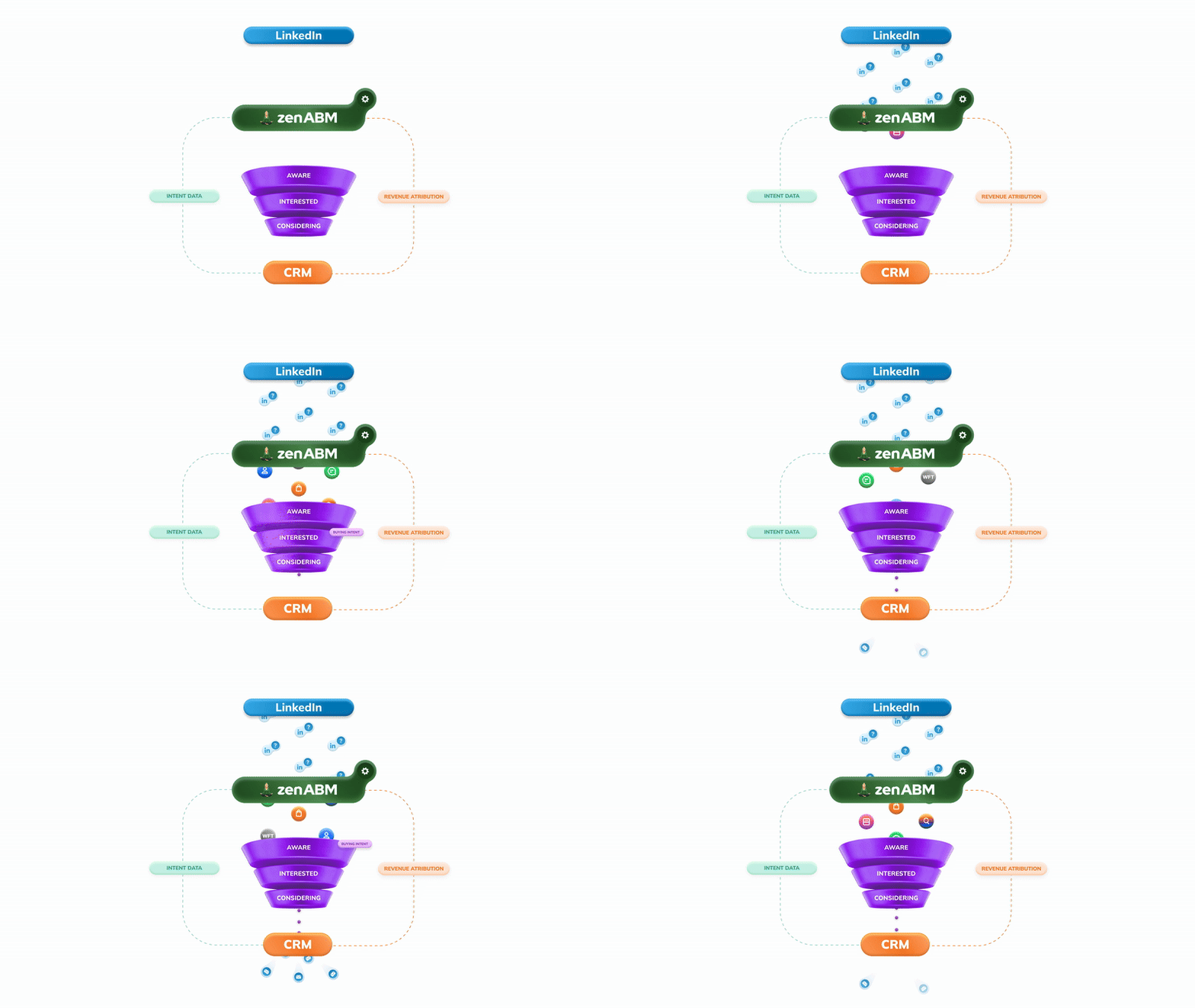
Recotap positions itself as a LinkedIn-first ABM platform for B2B teams that want to find, warm up and convert high-value accounts with more control.
Recotap acts as an all-in-one ABM layer across data, advertising, web experience and analytics.
Recotap pulls data from your CRM, marketing automation stack, website and third-party intent providers into a single account view.
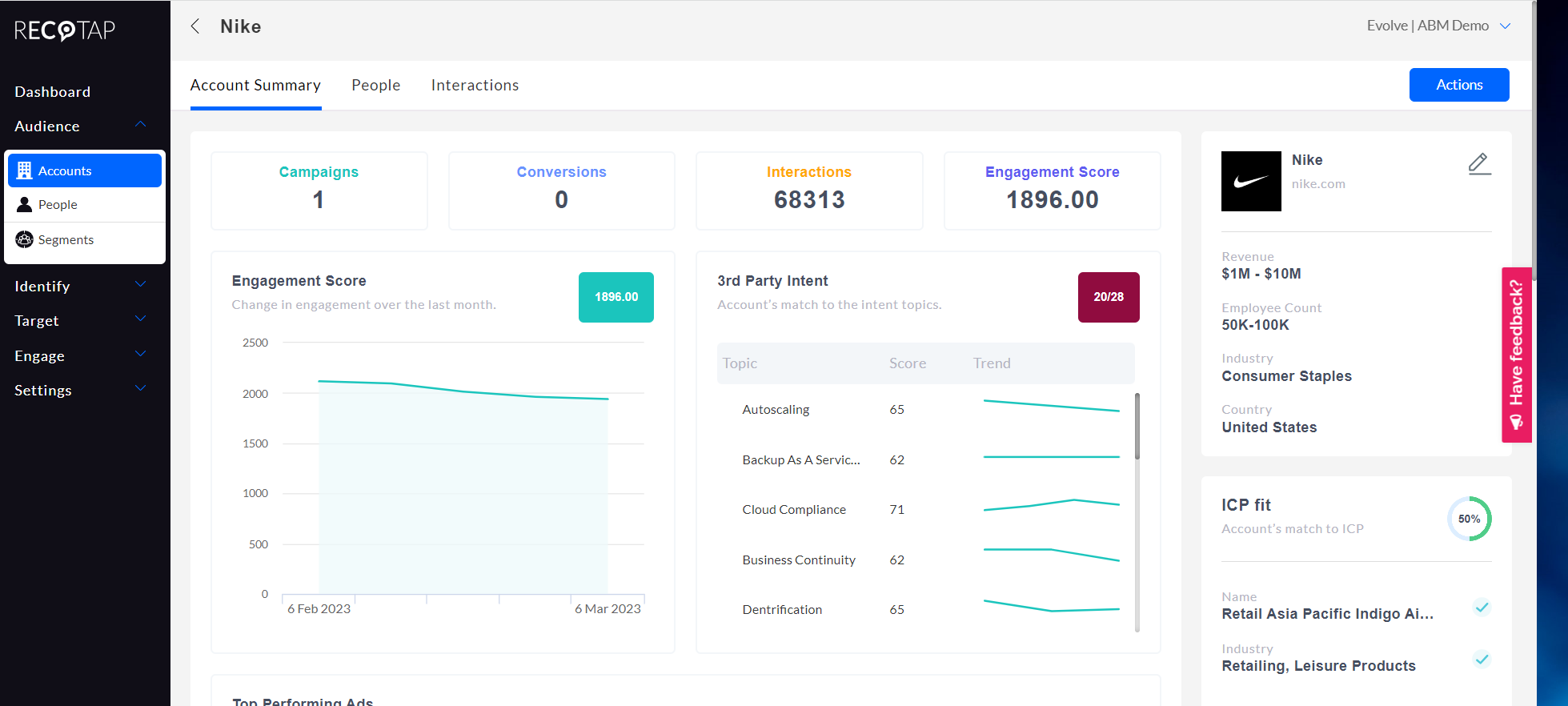
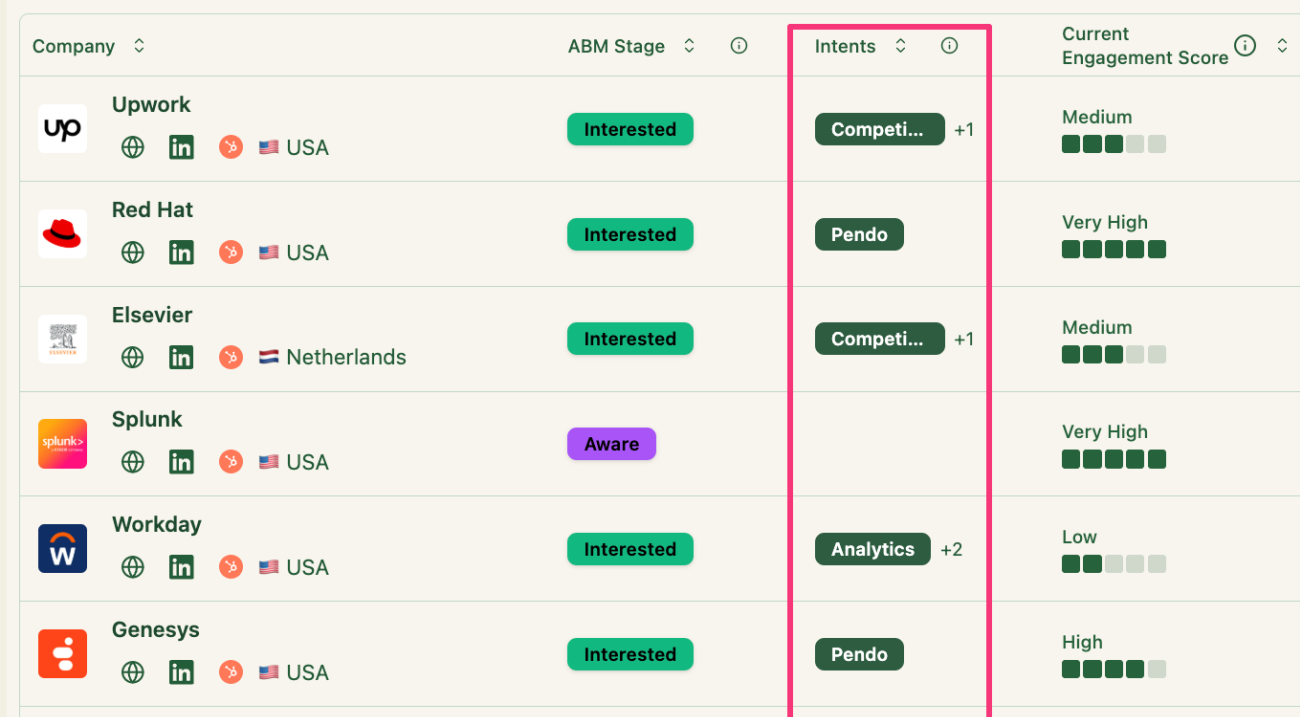
It combines signals like site visits, ad clicks, external intent from Bombora, G2 and TrustRadius, plus CRM activity, so you can segment and score accounts by fit and activity.

The goal is to see where each account sits in the buying journey and concentrate campaigns on those that match timing and fit.
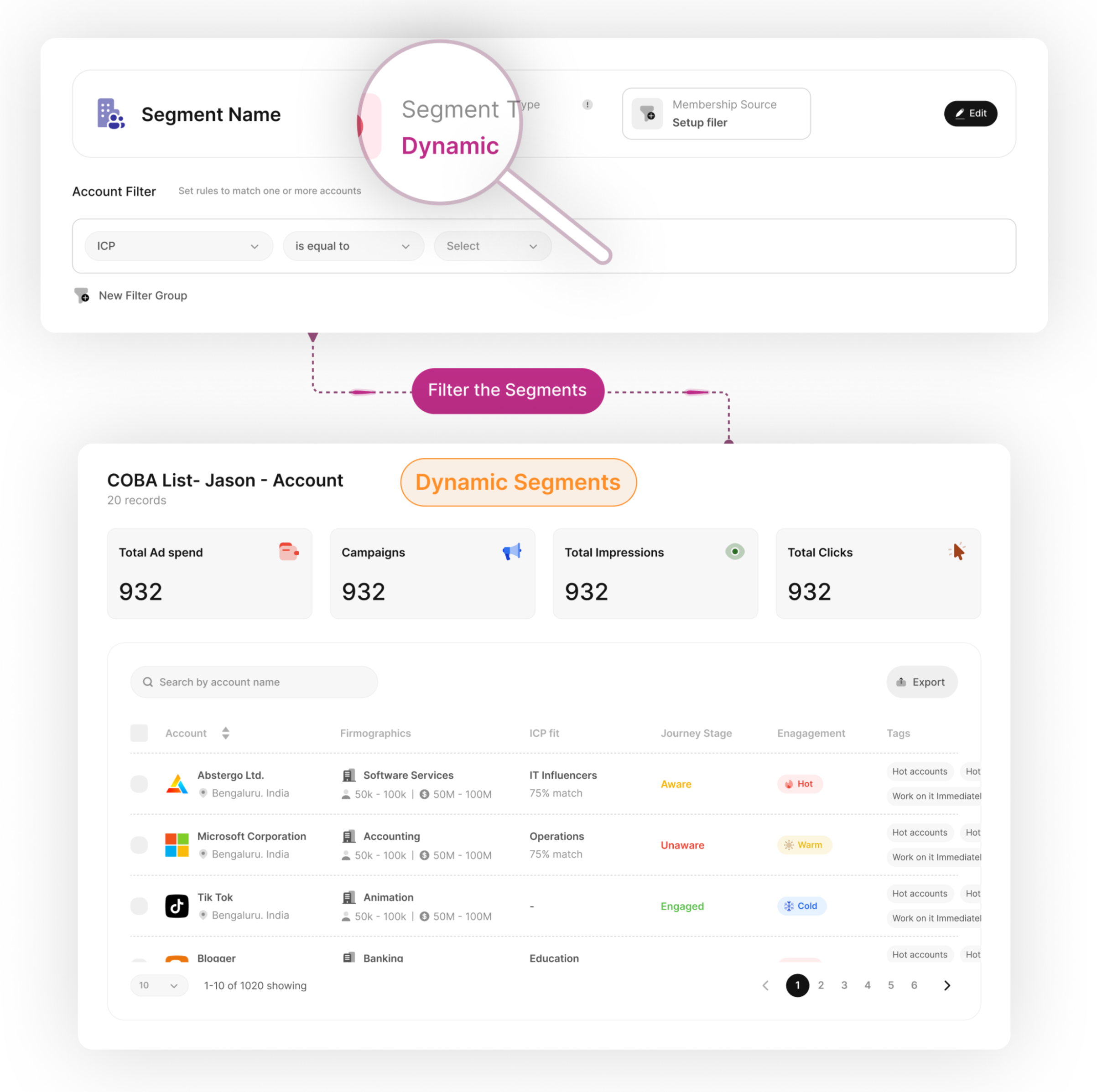
Recotap leans heavily on dynamic segments and AI-based scoring. You define segments using firmographics, engagement, ICP fit and intent level, and the system refreshes lists as data changes.
This reduces manual work on target account lists. Its AI can also tag journey stages so you see which accounts are still researching, which are engaged and which are close to handoff.
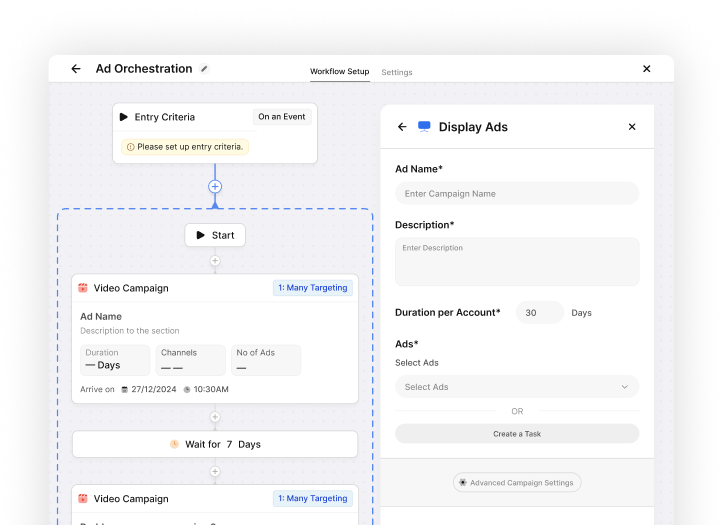
As an official LinkedIn Marketing Partner, Recotap is built for advanced LinkedIn Ads management.
It supports account-based LinkedIn campaigns and lets marketers roll out highly tailored LinkedIn ads for dozens or hundreds of accounts in one motion.
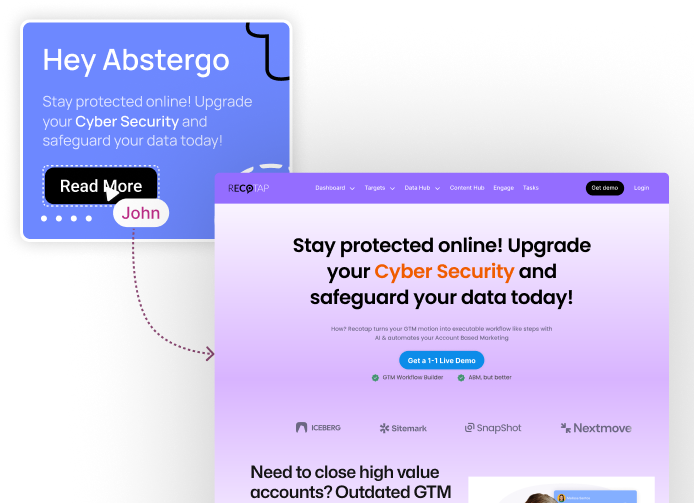
Recotap also brings personalization to your website. You can spin up 1 to 1 landing experiences for target accounts with minimal engineering, similar in spirit to the web personalization modules you see in tools like Terminus or Demandbase.
Recotap integrates with major CRM and marketing automation platforms so sales and marketing can work from one shared view.
Salesforce and HubSpot CRM are supported with bi-directional sync for accounts, contacts and deals, alongside Marketo and Pardot for marketing automation.
It also connects to sales tools like Outreach and Salesloft, plus Slack and Microsoft Teams, so BDRs can be alerted whenever a target account crosses a key threshold.
Recotap includes AI-powered analytics and revenue attribution dashboards.
Its Revenue Impact view links campaigns to pipeline and revenue, so you can see which initiatives drive deals and how account journeys evolve from first touch to closed won.
Recotap automates repetitive ABM chores so lean teams can still run complex plays.
It spots intent spikes, updates segments and triggers outreach when an account crosses a hot score. One G2 review highlights that the UX is designed to make ABM execution feel simpler without losing capability.
Recotap’s main angle is how it merges and interprets intent data to run smarter ABM campaigns.
Its ABM Signal Hub mixes first-party engagement data from CRM, website and marketing tools with third party intent from G2, TrustRadius and Bombora so you get a unified account story.
The intent scoring engine aggregates signals, ranks accounts by readiness and pushes hot companies into campaigns or sales queues. With real-time sync, Recotap can trigger LinkedIn ad sequences as soon as buying behavior shows up.
This gives you more precise targeting with less manual monitoring, though set-up can be more involved. Reviewers note that once tuned, the intent engine feels comparable to larger suites such as 6sense or Demandbase.
Recotap publishes pricing, which at least gives a clear starting point.
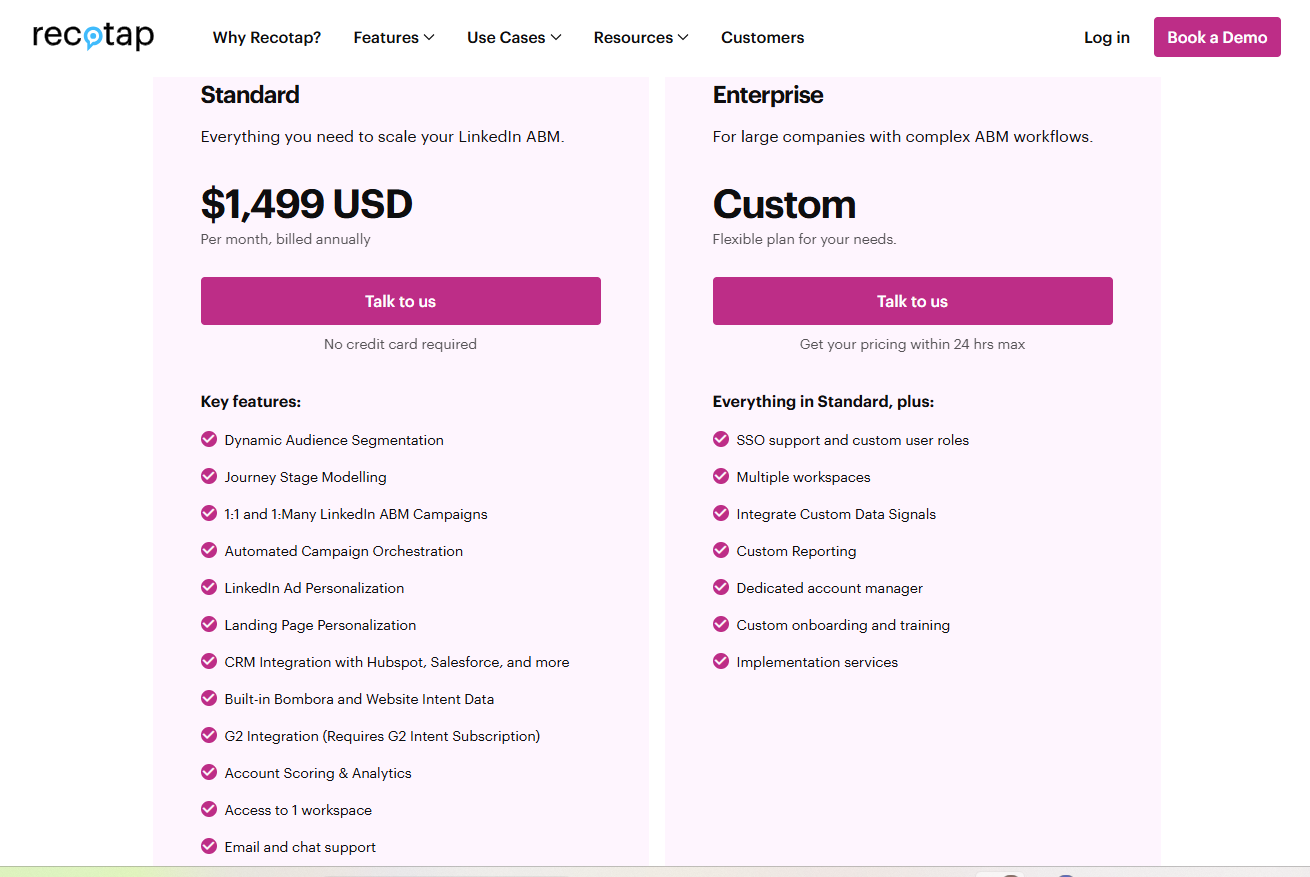
Given that Recotap’s entry tier already crosses $10K per year, ZenABM stands out as a leaner option, starting at ~$59/month for the Starter plan, with the top tier still under $6K per year.
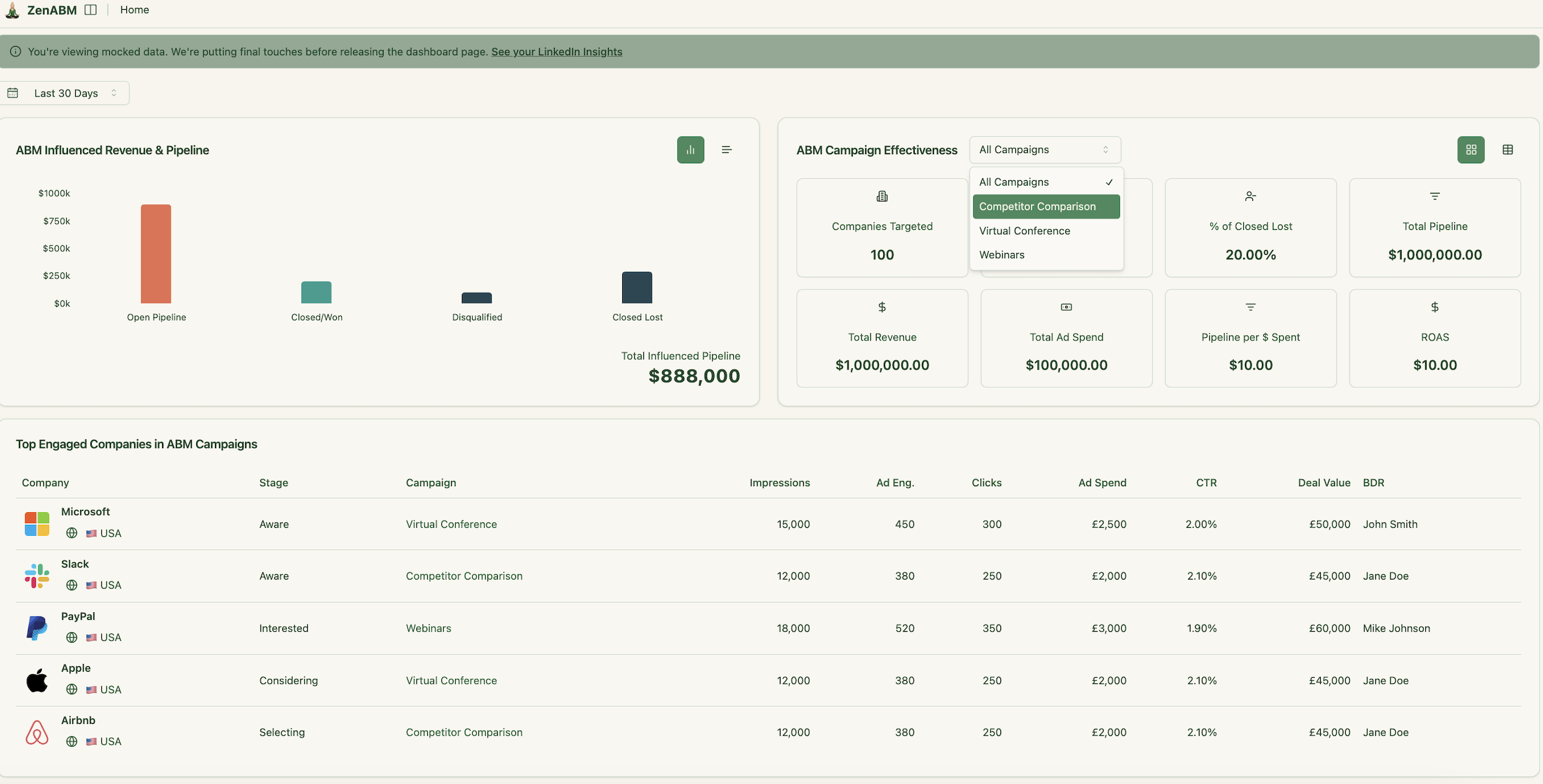
ZenABM still covers core LinkedIn ABM needs such as account-level ad engagement tracking, account scoring, ABM stage tracking, routing hot accounts to BDRs, bi-directional CRM sync, custom webhooks, qualitative company intent and plug and play ROI dashboards.
Recotap holds a 4.7 out of 5 rating on G2 from 47 reviews.
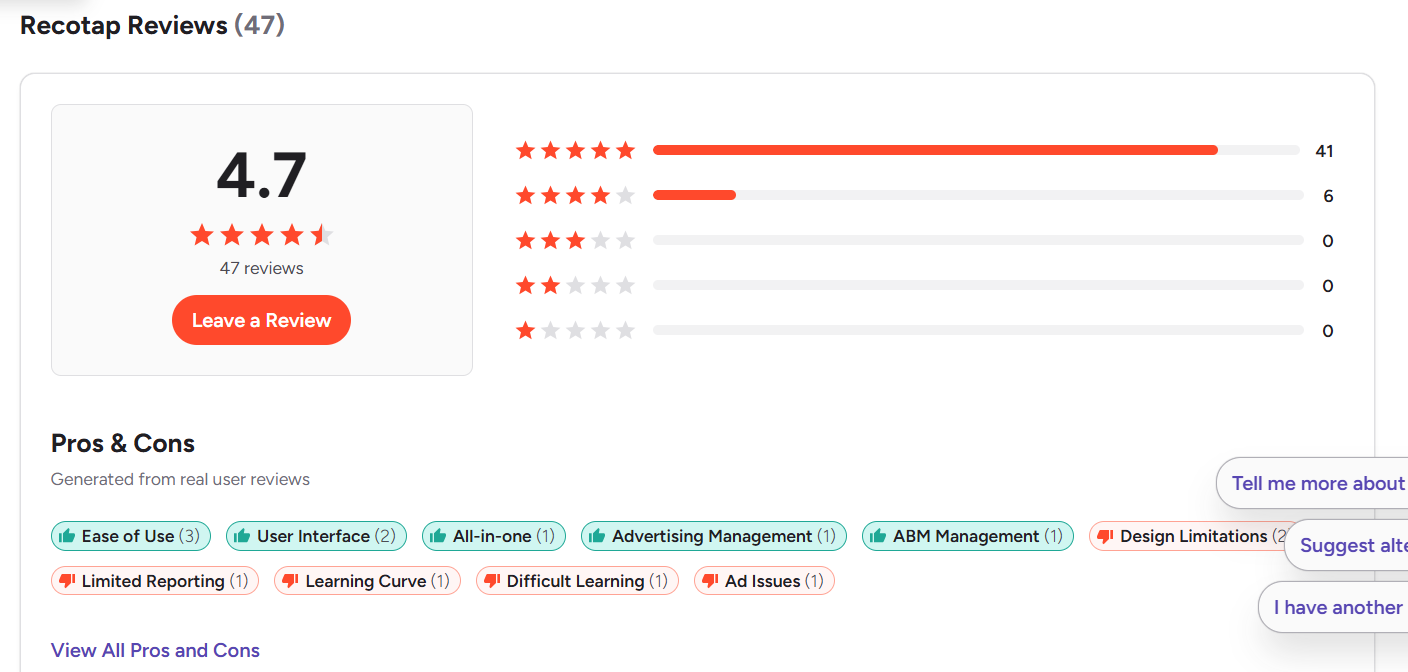
Most reviewers appear to be based in Asia, which suggests an APAC-heavy GTM motion.
Users often praise:
Common complaints:
TrustRadius and other review platforms still have limited coverage on Recotap.
Terminus is widely described as an end-to-end ABM platform for B2B teams that want a single Engagement Hub spanning ads, web activity and sales touchpoints.
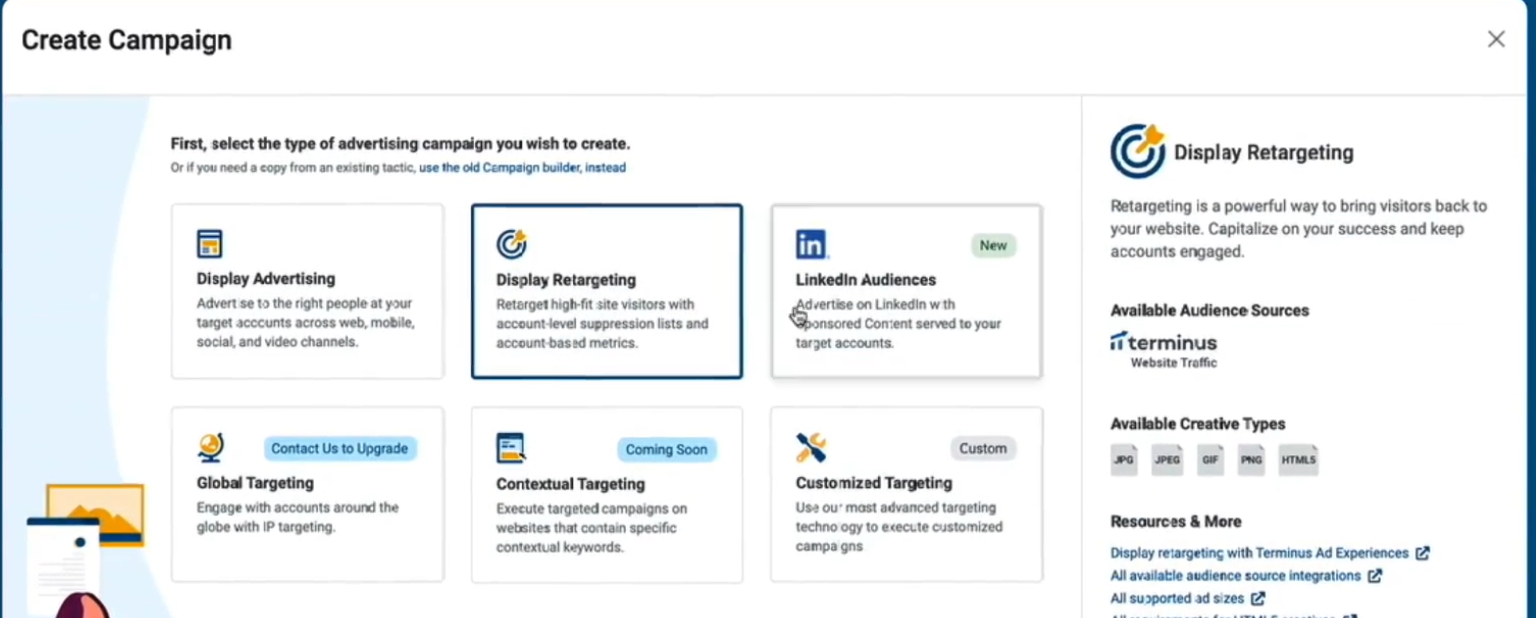
Terminus lets you plan and manage ads across multiple channels from one interface.
This includes traditional display ads through an account-based DSP, retargeting, LinkedIn Ads and formats like connected TV and audio.
With centralized media planning, Terminus helps you reach target accounts across web, social and other inventory while balancing impressions so a small group of accounts does not eat the full budget.
For teams that truly need multichannel orchestration in one place, Terminus can simplify ABM campaign management.
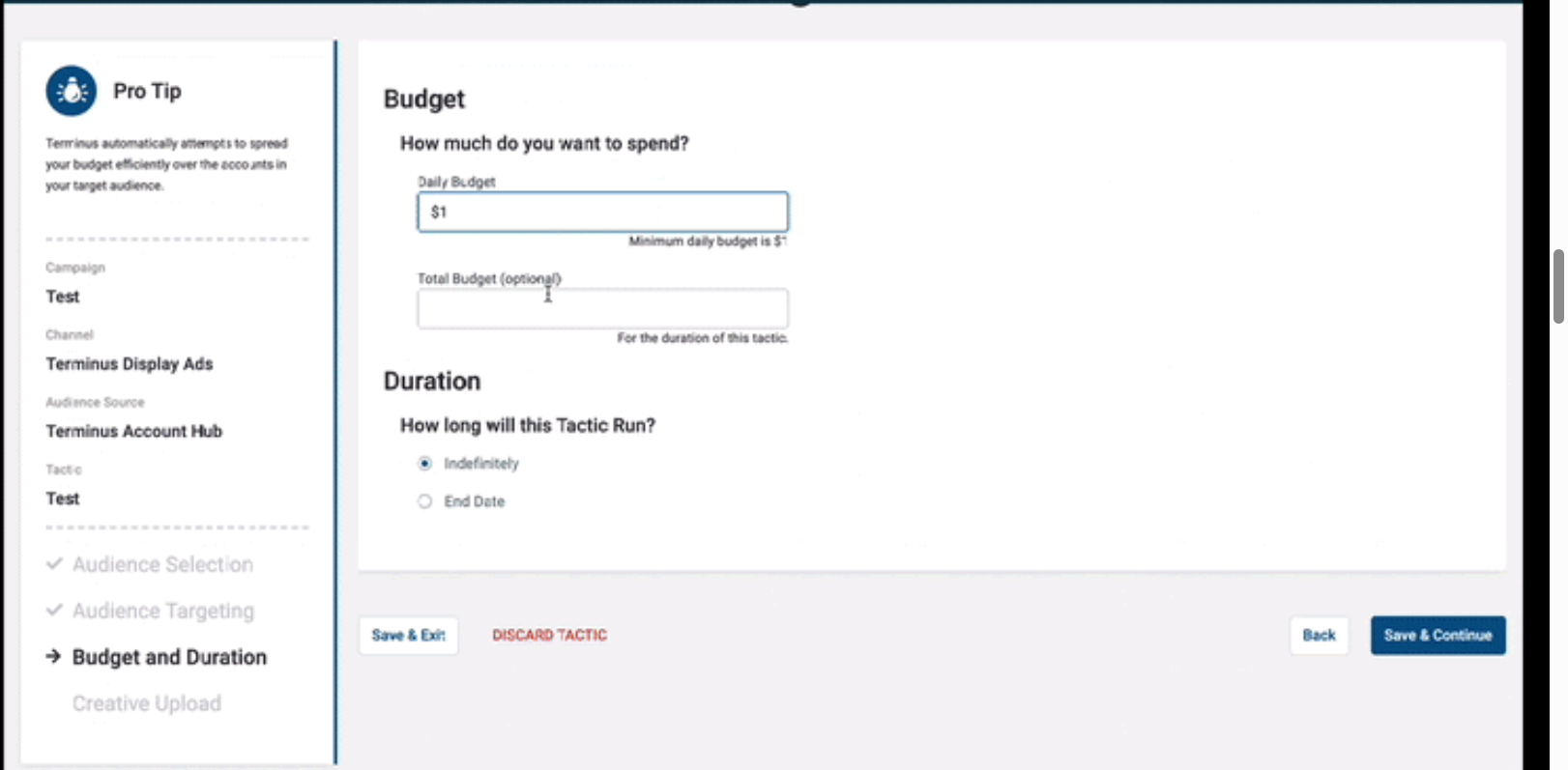
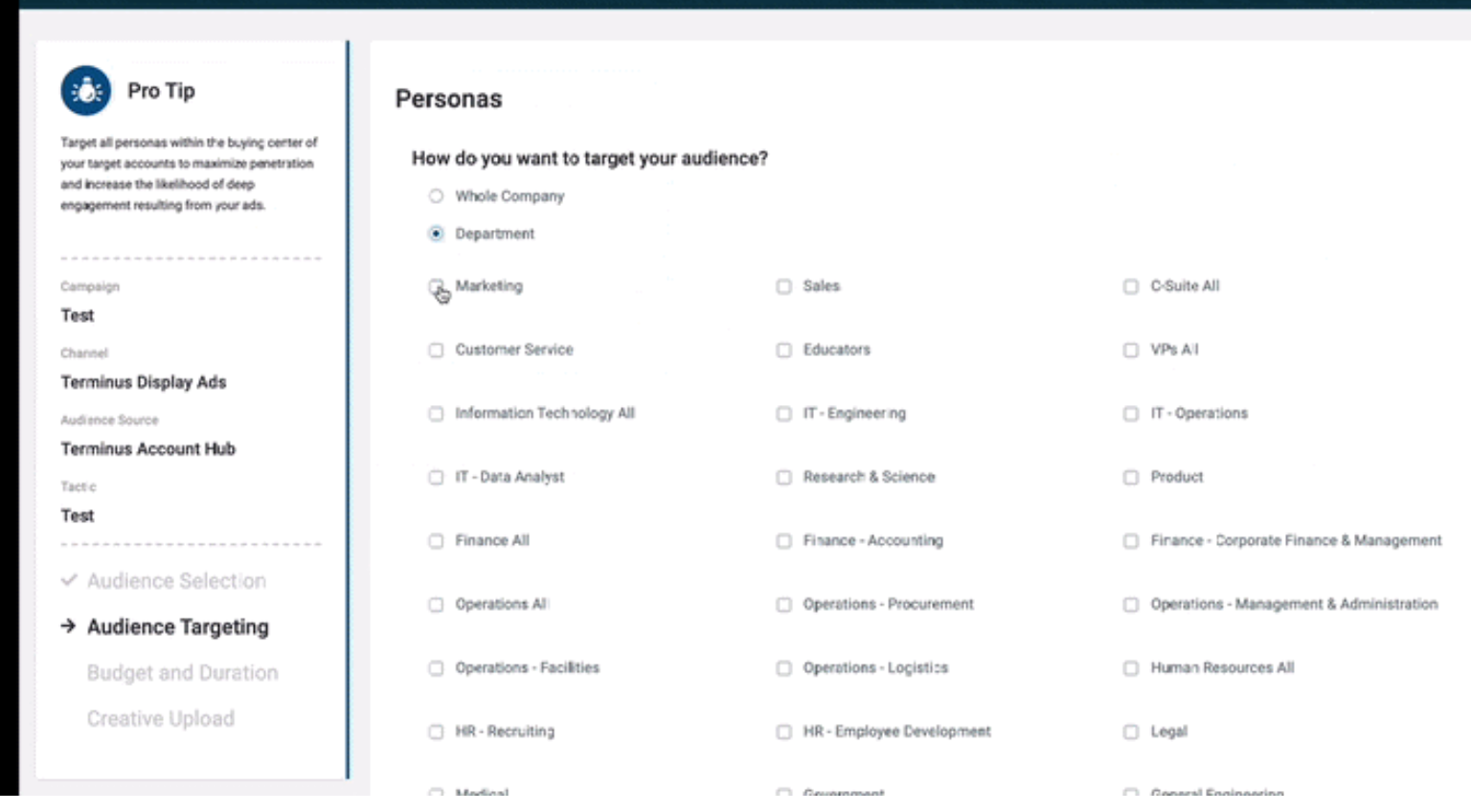
You can upload or sync target account lists from your CRM and refine audiences by persona attributes such as department, seniority or function.
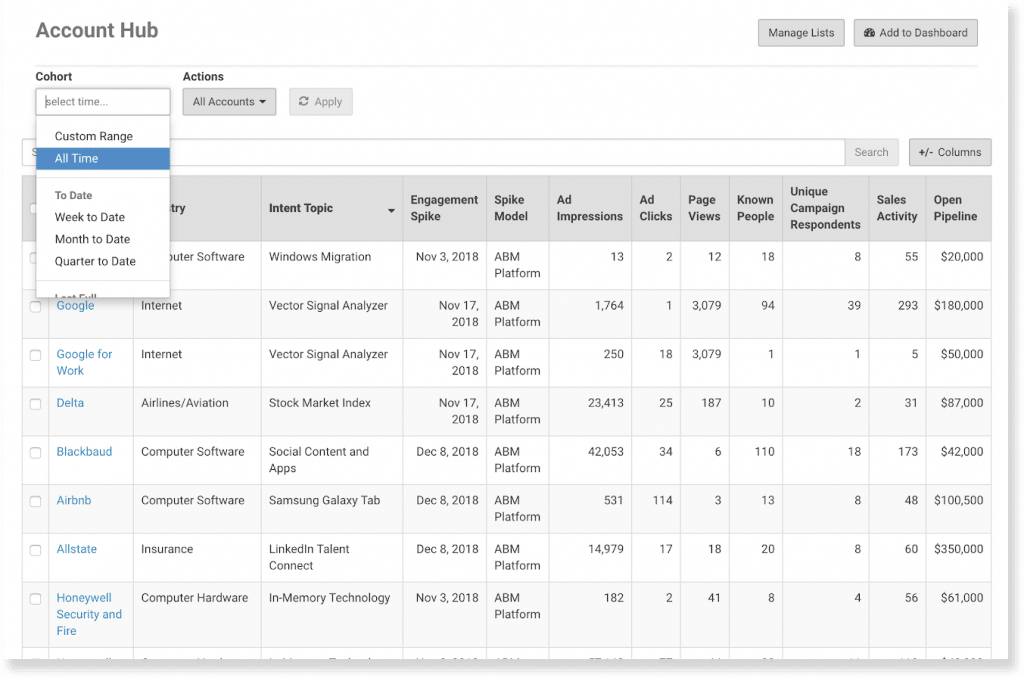
The platform tracks impressions, clicks, site visits and other engagement at the account level.
In ABM, just knowing that a target account repeatedly sees your ads is useful. Account Hub rolls up this engagement so you can gauge traction and support account-based attribution.
Terminus includes Visitor ID to de-anonymise website traffic.
It uses reverse IP lookup, cookies and CRM matching to infer which companies (and sometimes known contacts) are on your site.
If an anonymous visitor later fills out a form, Terminus connects that activity back to the account. It also maps CRM leads to sessions by email domain, so you know, for instance, when a director from Acme Corp spent time on the pricing page.
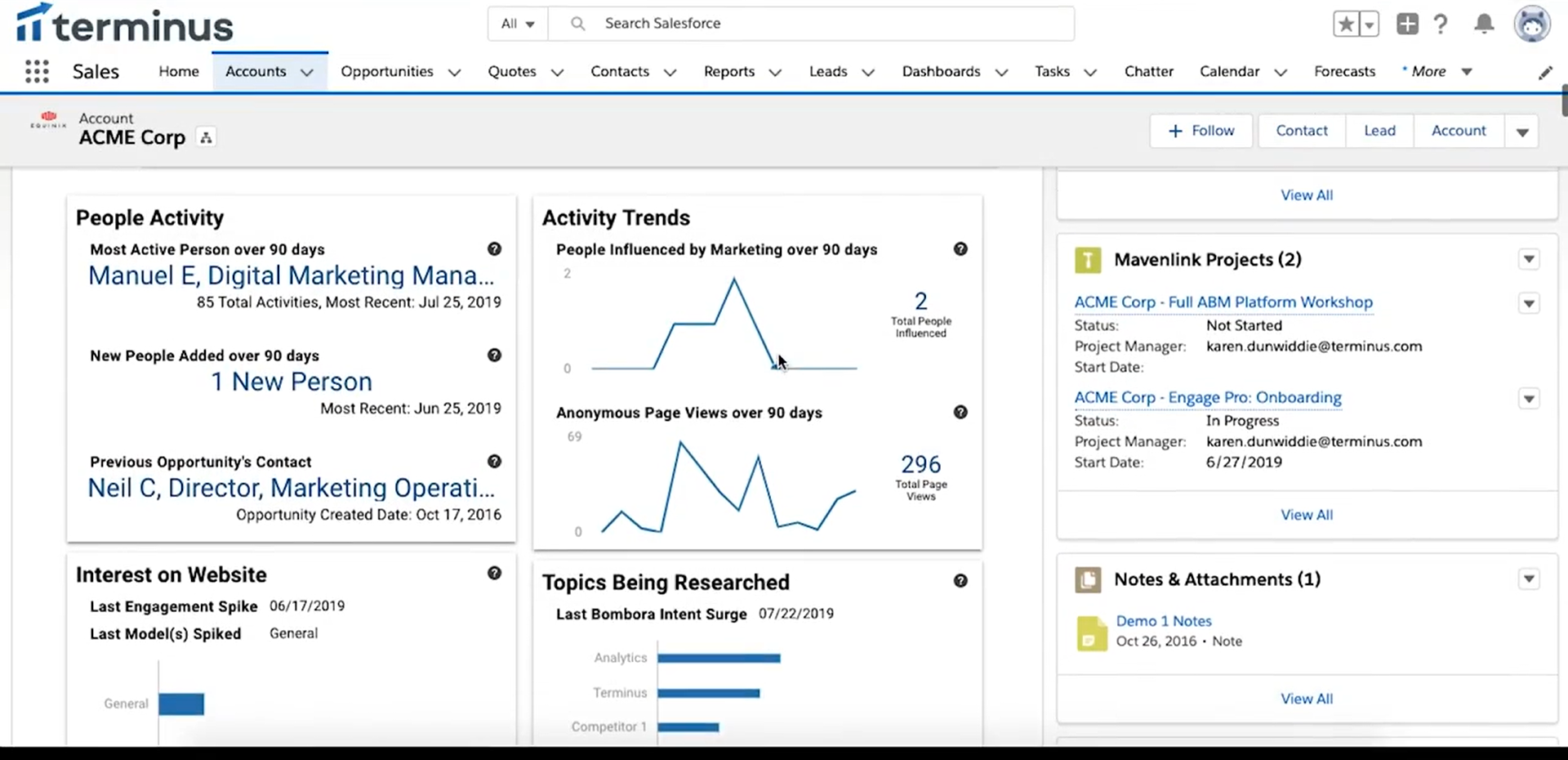
Terminus integrates intent data from providers such as Bombora to flag in-market accounts so you can concentrate spend where research behavior is strongest.
Pro Tip: Third-party intent spikes can be noisy; first-party signals tend to be more reliable.
ZenABM uses first-party qualitative intent by tracking which LinkedIn ads a company actually engages with, turning engagement patterns into concrete buying themes rather than abstract keyword surges.
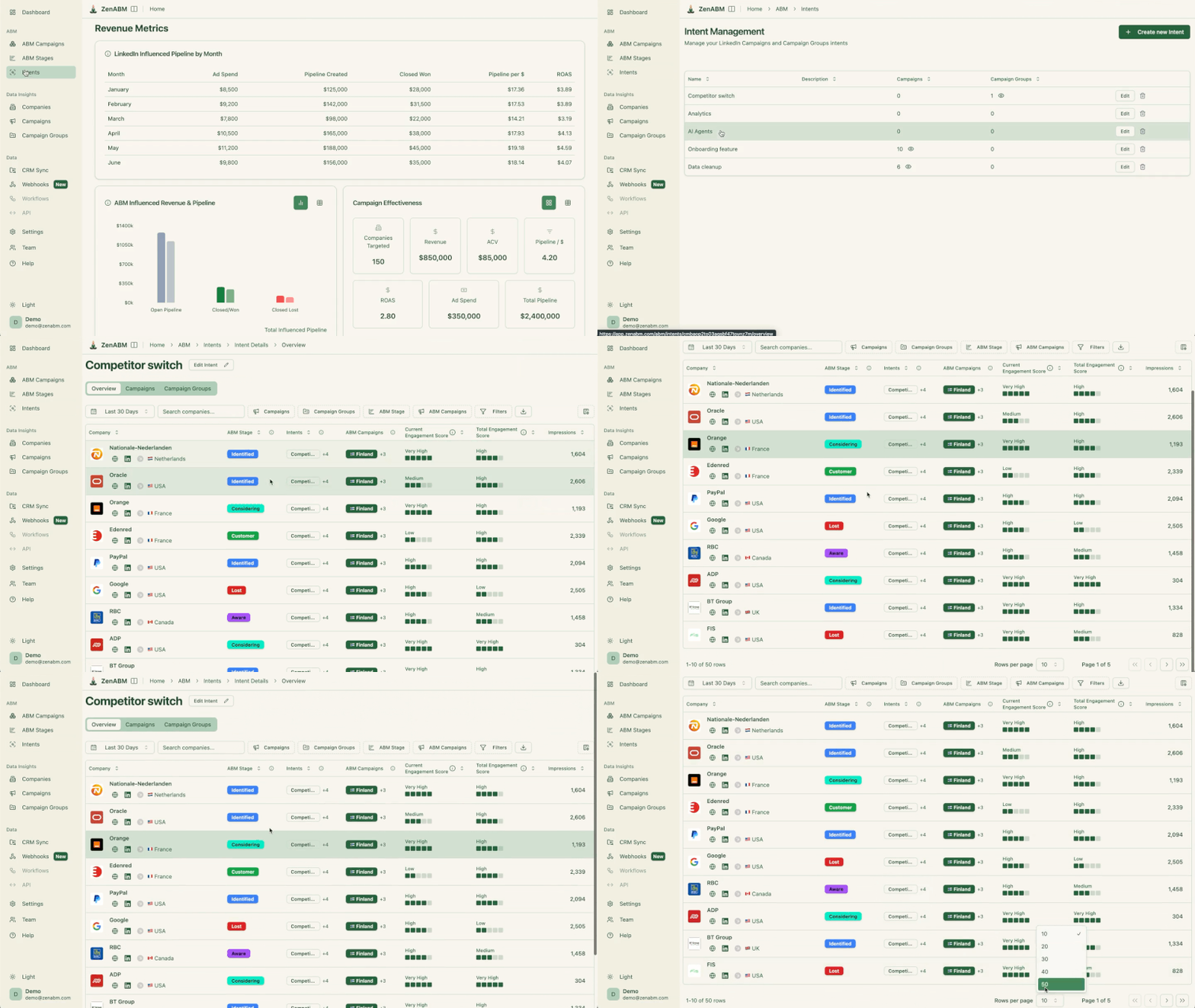
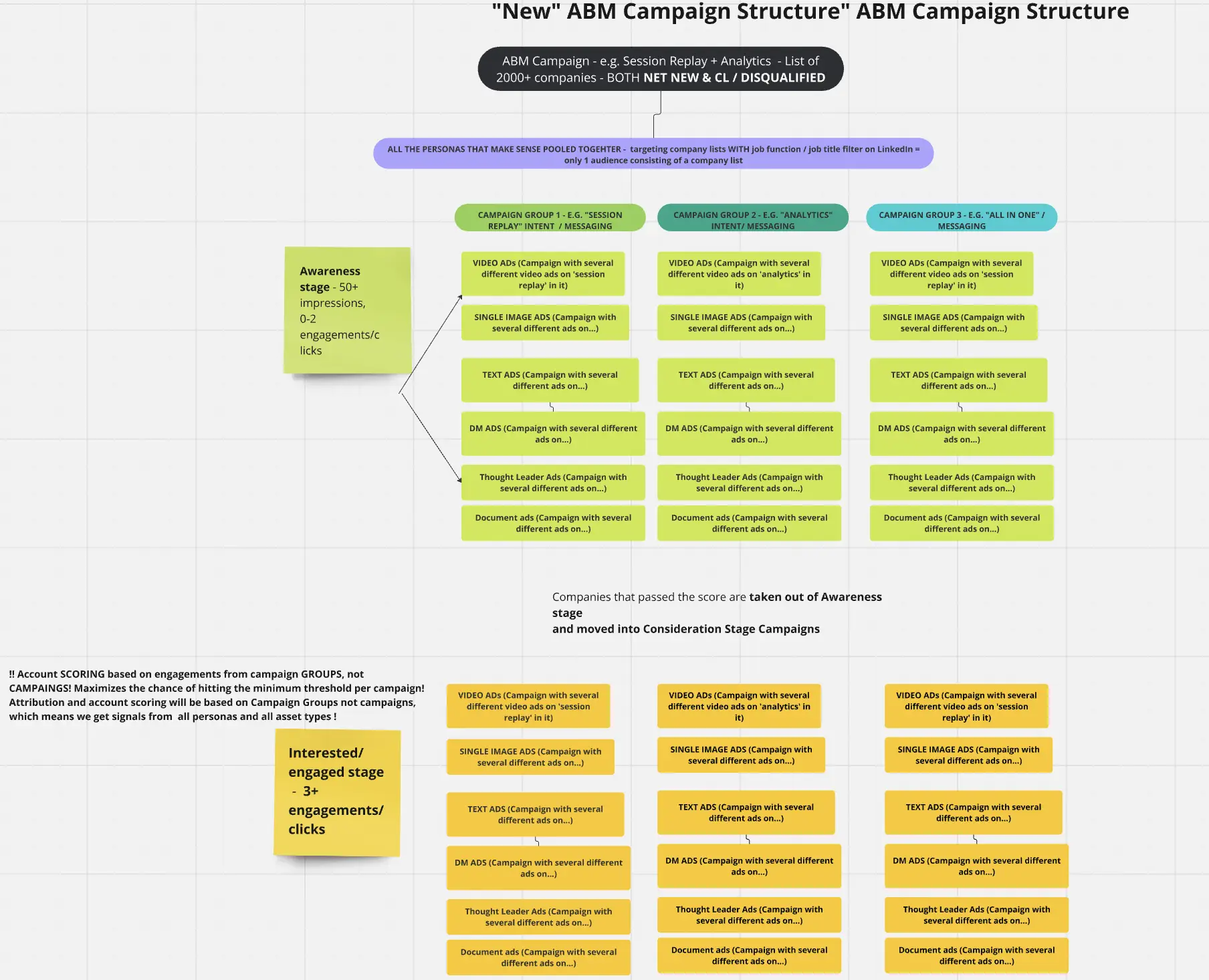
The Userpilot team (a ZenABM customer) built their ABM playbooks on this idea, tagging campaigns by pain point and increasing BOFU spend where accounts interacted most.
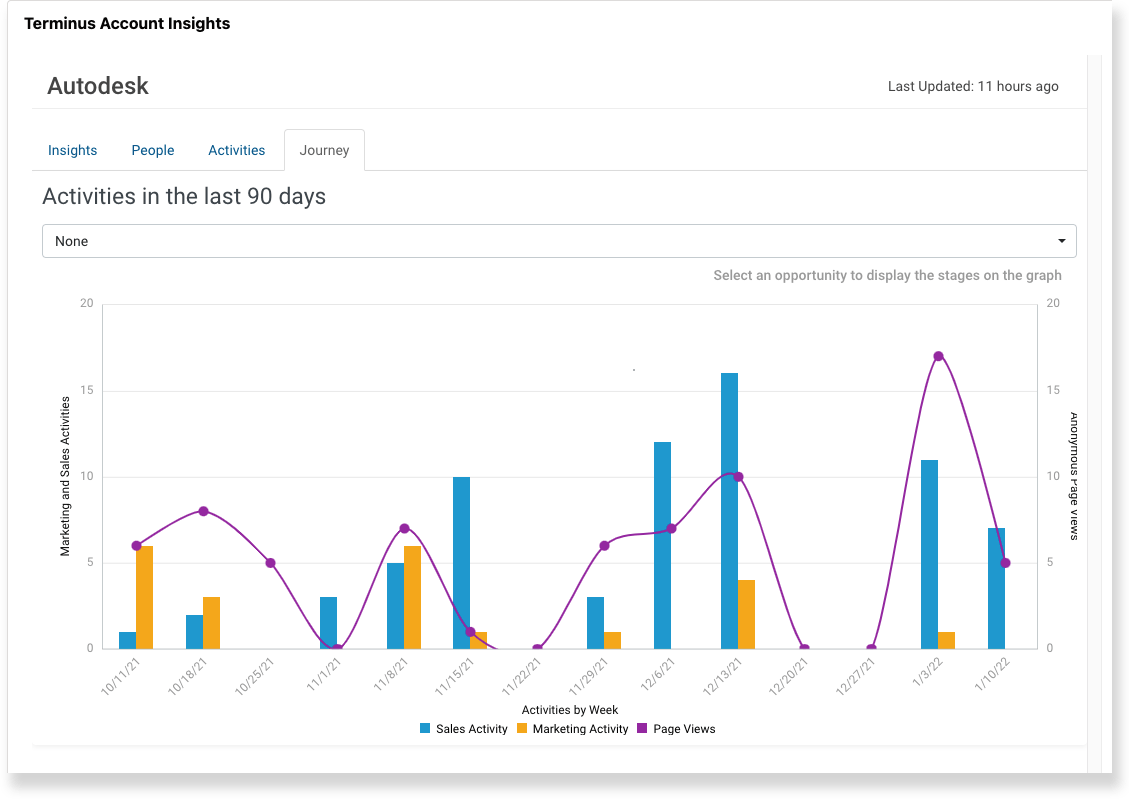
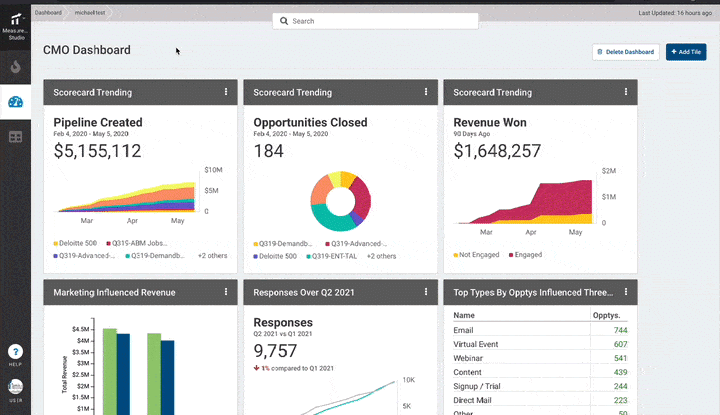
Measurement Studio in Terminus (powered by the BrightFunnel acquisition) handles multi touch attribution at the account level.
It lets marketers see how ads, email, website sessions, events and other touches influence pipeline and revenue using first touch, last touch or custom models.
All of this rolls into an account journey view so you can see how an opportunity moved from initial engagement to closed won.
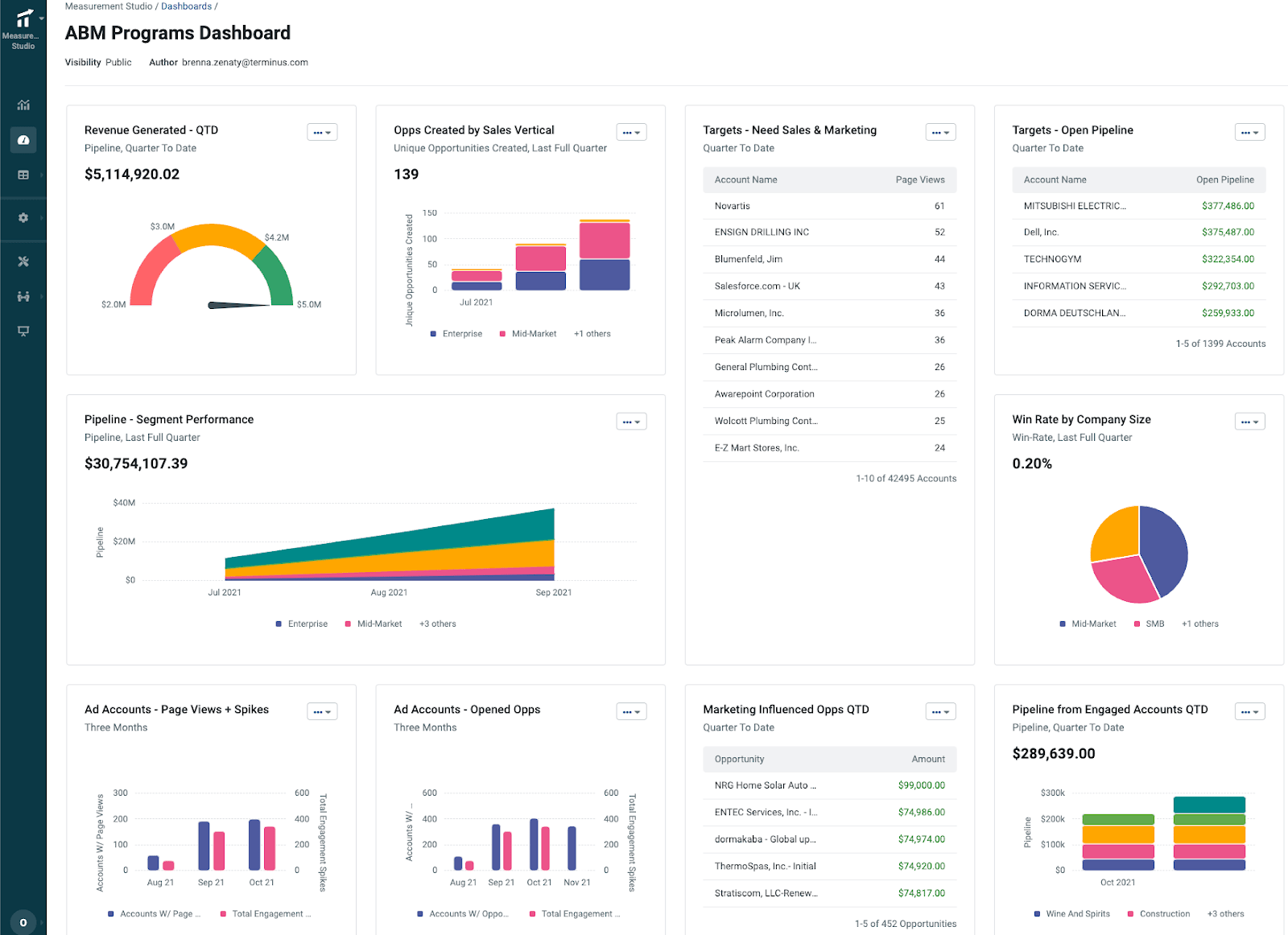
Terminus also provides ABM dashboards for revenue, opportunities, pipeline influence, top engaged accounts and topic-based discovery.
Terminus plugs into a wide set of B2B tools.
There are built-in connectors for major CRMs (Salesforce, HubSpot, Microsoft Dynamics), marketing automation platforms (Marketo, Pardot, HubSpot Marketing Hub, Eloqua), ad channels (LinkedIn Ads, Google Ads), sales tools (Outreach, Salesloft and others), analytics (Google Analytics, Adobe Analytics, PathFactory), data providers (Bombora, G2 intent, Clearbit, DemandScience) and more.
You can explore the full list in the Terminus docs.
Terminus runs on premium, custom-quoted pricing.
There is no public price card, so every deal goes through sales.
Most research suggests contracts land in the mid five figures per year and can climb into six figures for large enterprises.
Vendr cites a median Terminus price around $23,000 per year, with larger customers paying $100K to $250K or more.
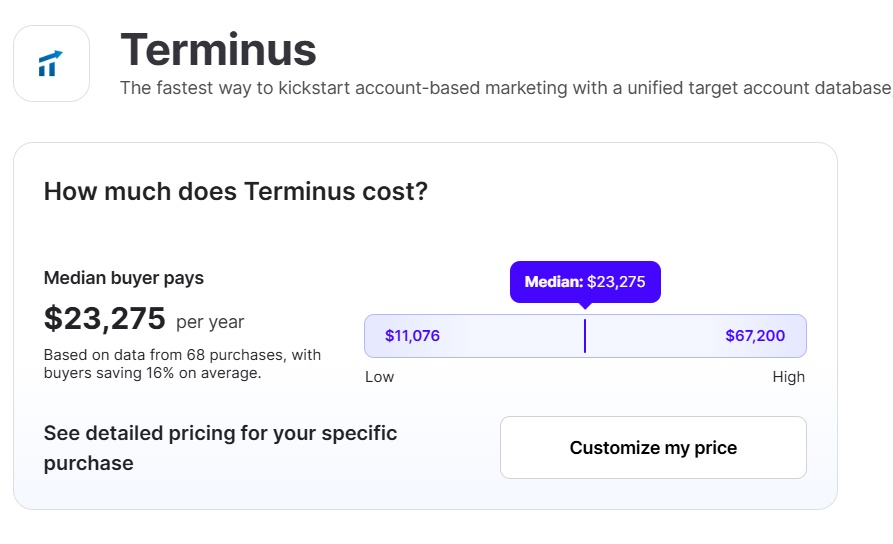
CMO.com mentions starting costs near $57,500 per year and contracts up to $266,000, while G2 reviews indicate a range between $18,000 and $87,000. In short, pricing is not built for very small teams with tight budgets.
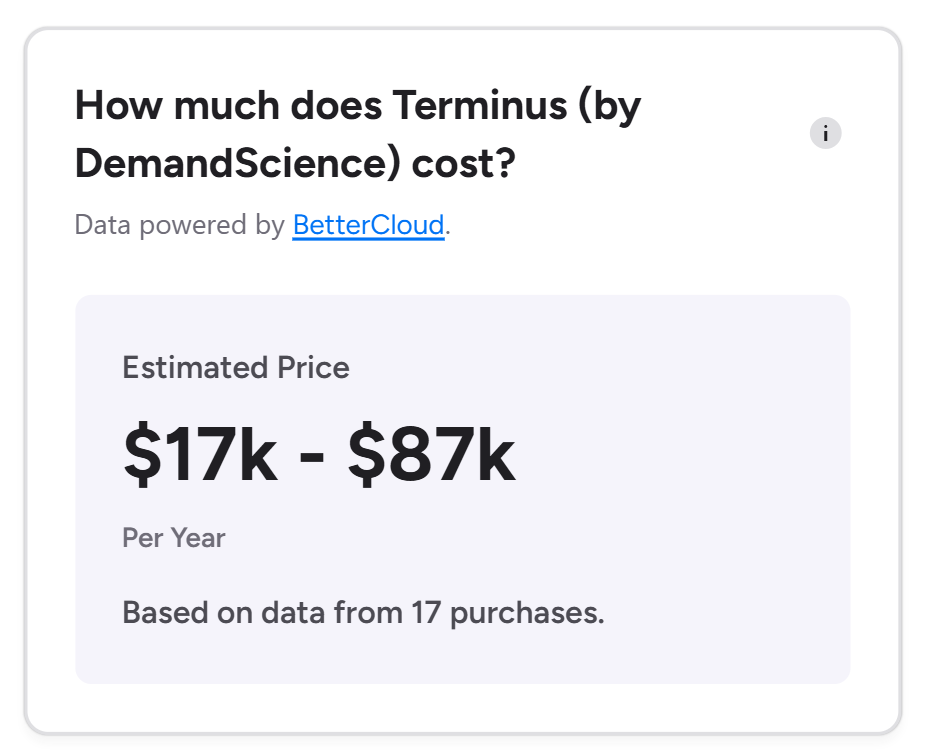
On sites like Trustradius, Infotech.com and Software Finder, users usually praise Terminus for a solid UX and broad ABM coverage.
The main negatives are cost, caps on accounts per campaign, some reporting gaps and occasional integration friction with HubSpot.
The key differences between Recotap and Terminus are summarized here.
| Criteria | Recotap | Terminus | Where ZenABM Fits |
|---|---|---|---|
| Primary focus | LinkedIn first ABM across ads, data, web and analytics | Multichannel enterprise ABM suite and Engagement Hub | LinkedIn only ABM analytics and intent, built for first-party accuracy |
| Channels | LinkedIn Ads, website personalization | Display, retargeting, LinkedIn, CTV, audio and more | LinkedIn Ads only, with deep company-level analysis |
| Intent data | ABM Signal Hub combining CRM, web, MAP and Bombora, G2, TrustRadius | Third-party intent providers, such as Bombora plus engagement | First-party intent from LinkedIn ad engagement and campaign themes |
| Personalization | 1 to 1 landing pages for target accounts | Web personalization modules and dynamic experiences at scale | No page builder, but uses ad engagement intent to inform messaging and outreach |
| CRM and MAP integrations | Salesforce, HubSpot, Marketo, Pardot, Outreach, Salesloft, Slack, Teams | Broad ecosystem across CRM, MAP, ad channels, sales tools and data providers | Bi-directional sync with HubSpot, Salesforce on higher tiers, plus webhooks |
| Analytics and attribution | Revenue Impact view for the pipeline and revenue per program | Multi-touch attribution and ABM dashboards across channels | Company-level LinkedIn ad engagement, ABM stages, ROAS and pipeline per dollar |
| Complexity | Lighter than full suites, it still needs ABM discipline | High, suitable for mature ABM orgs with ops support | Lean, designed for fast setup around LinkedIn and CRM only |
| Pricing style | Standard at about $1,499 per month, Enterprise custom | Custom enterprise quotes, typically higher annual spend | Transparent plans from $59 to under $6,000 per year |
| Best for | Mid-sized B2B teams with LinkedIn-centric ABM | Mid-market and enterprise teams running full-scale ABM | Teams that want LinkedIn first ABM accuracy without heavy suite complexity |
Pick Recotap if:
Pick Terminus if:
ZenABM is built for teams that rely on LinkedIn as the primary ABM channel and want first-party accuracy, automation, and revenue visibility without the price or complexity of multi-channel suites.
Let’s look at its core features:
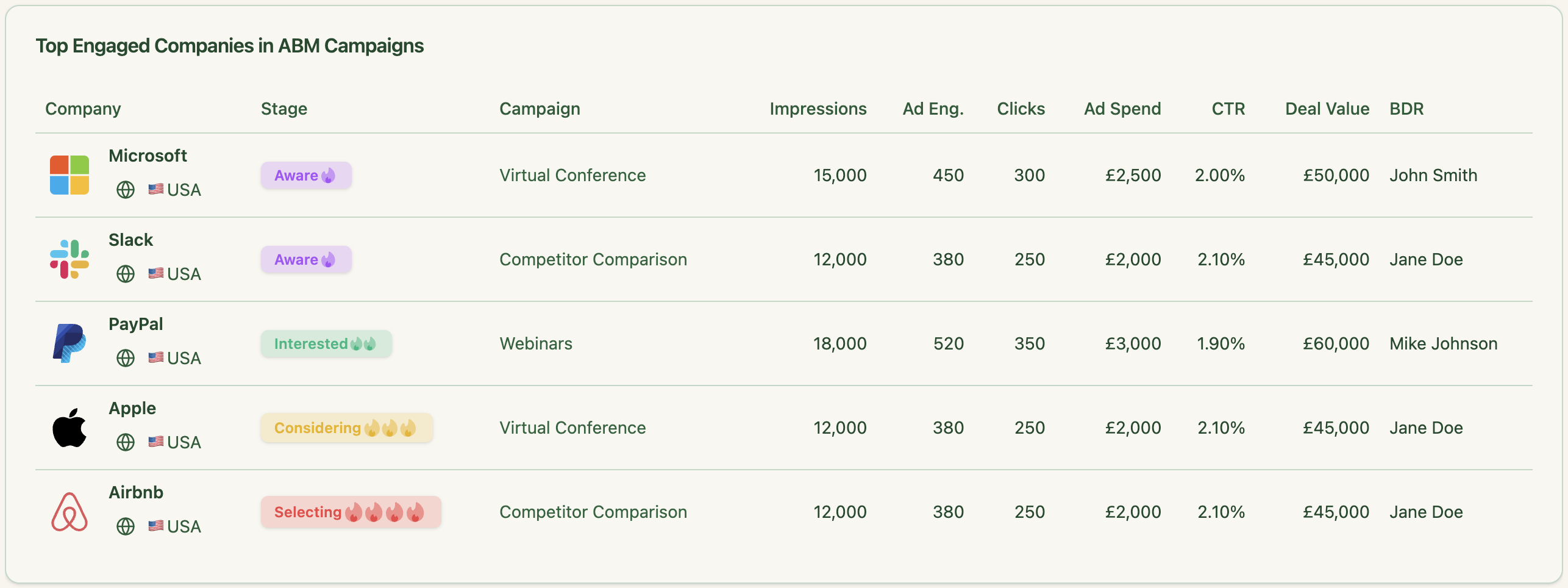
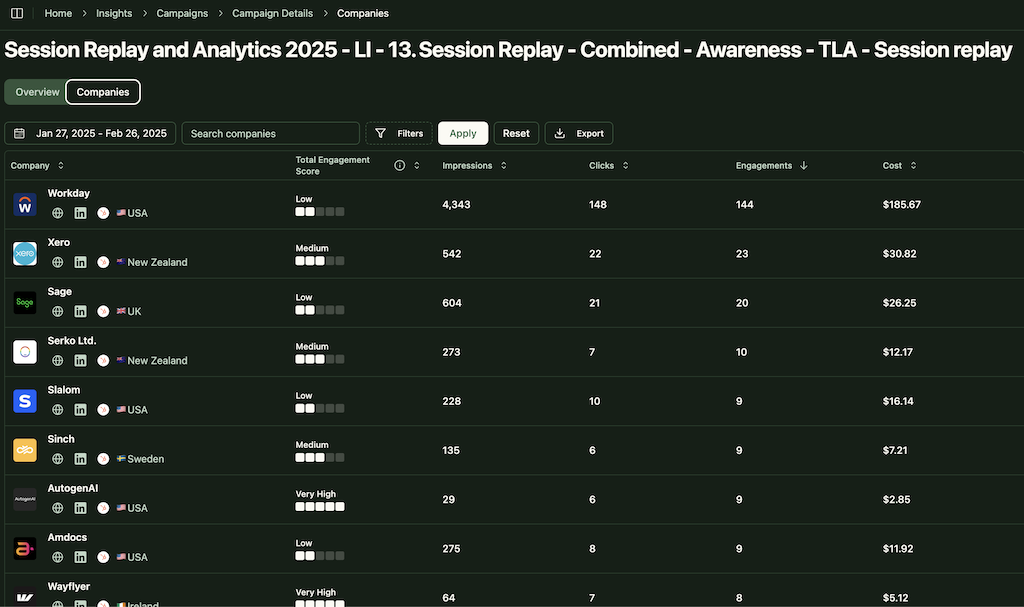
ZenABM connects to the official LinkedIn Ads API and captures account-level data for all campaigns so you can see which companies see, click, and engage with your ads.
Because this is first-party data from LinkedIn’s environment, it is more reliable than IP or cookie-based visitor ID.
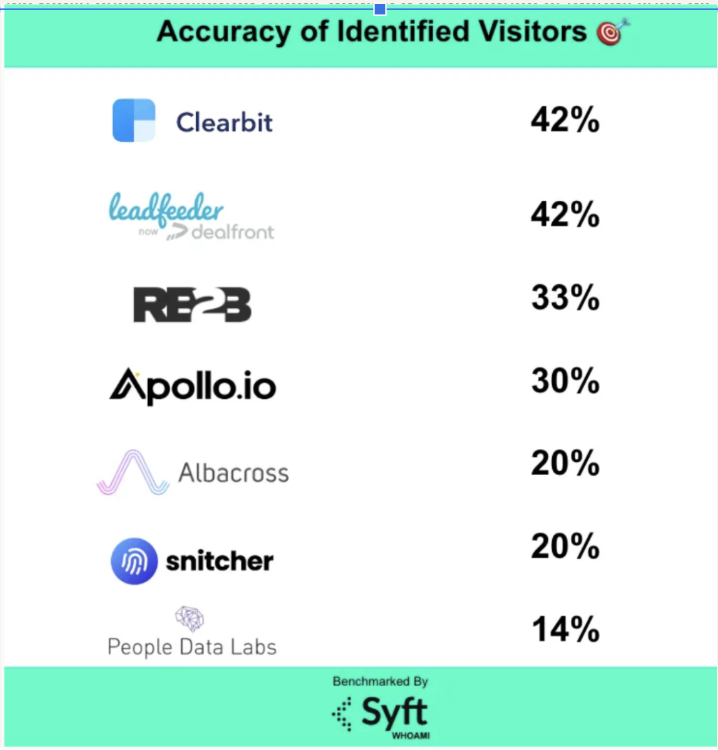
A Syft study puts IP-based identification at around 42 percent accuracy.
ZenABM treats LinkedIn ad engagement itself as first-party intent. When several people in one company keep engaging with your ads, that is a strong buying signal without rented intent feeds.
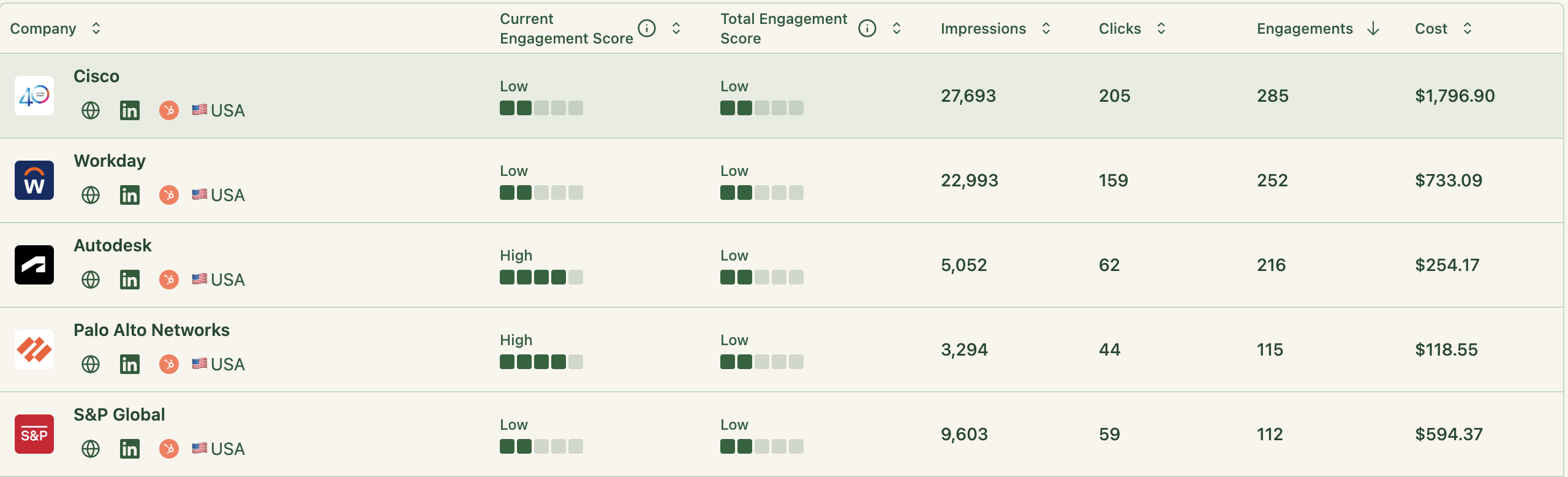
ZenABM updates engagement scores as accounts interact with your ads across campaigns, so you can see who is heating up over short or long windows and let marketing and sales prioritize accounts that show real intent.
ZenABM also shows the full touchpoint timeline for each company:
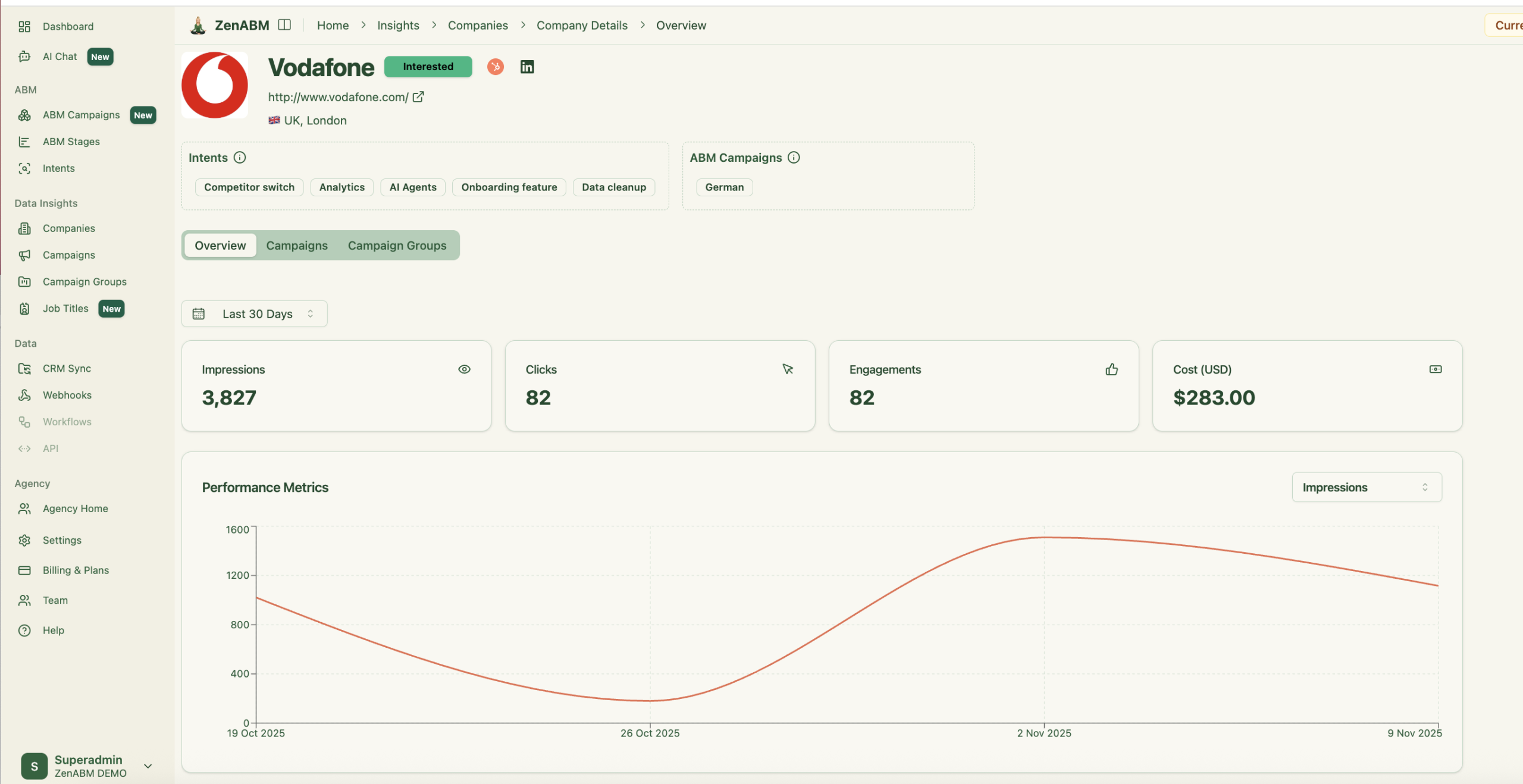
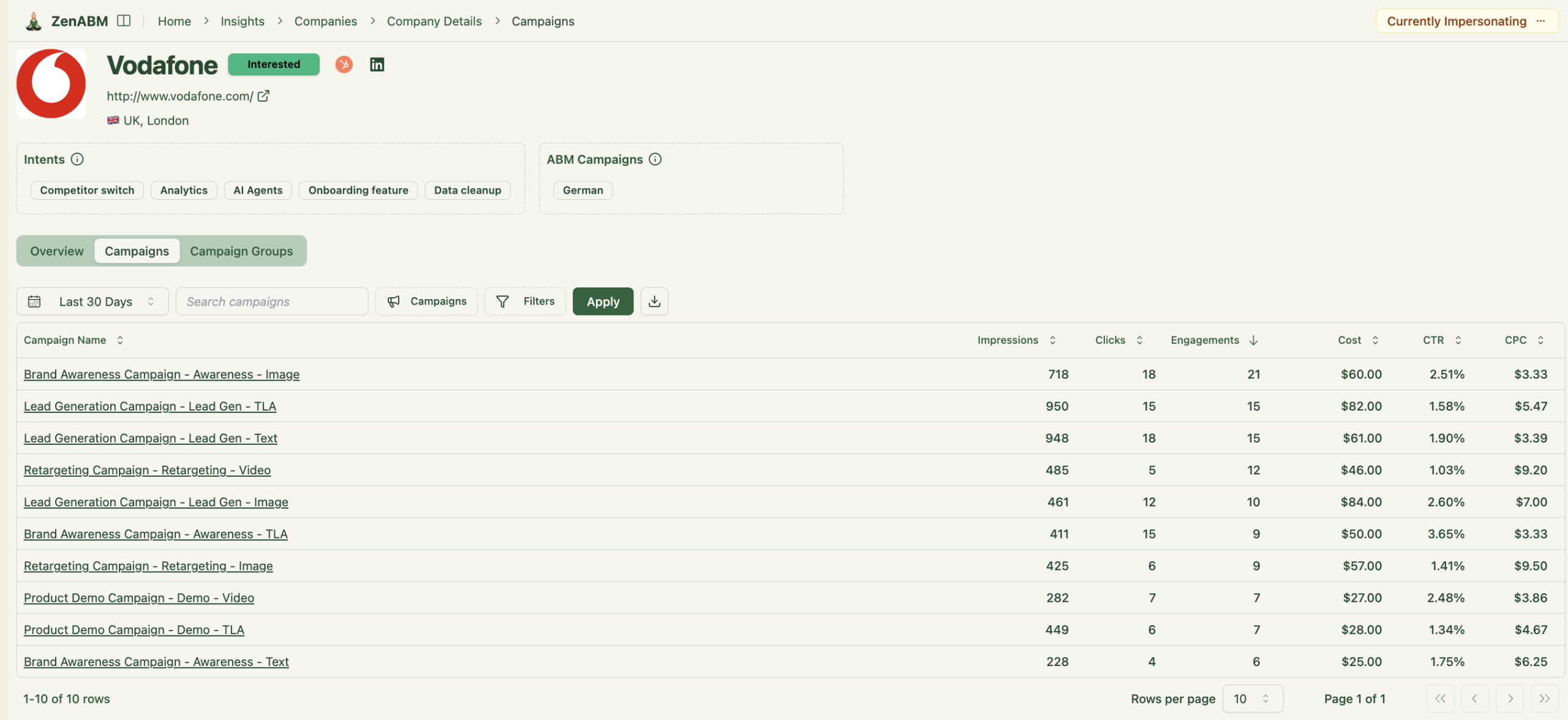
ZenABM lets you define stages such as Identified, Aware, Engaged, Interested, and Opportunity and automatically places accounts in the right stage using scores and CRM data.
You control thresholds, and ZenABM tracks movement over time.
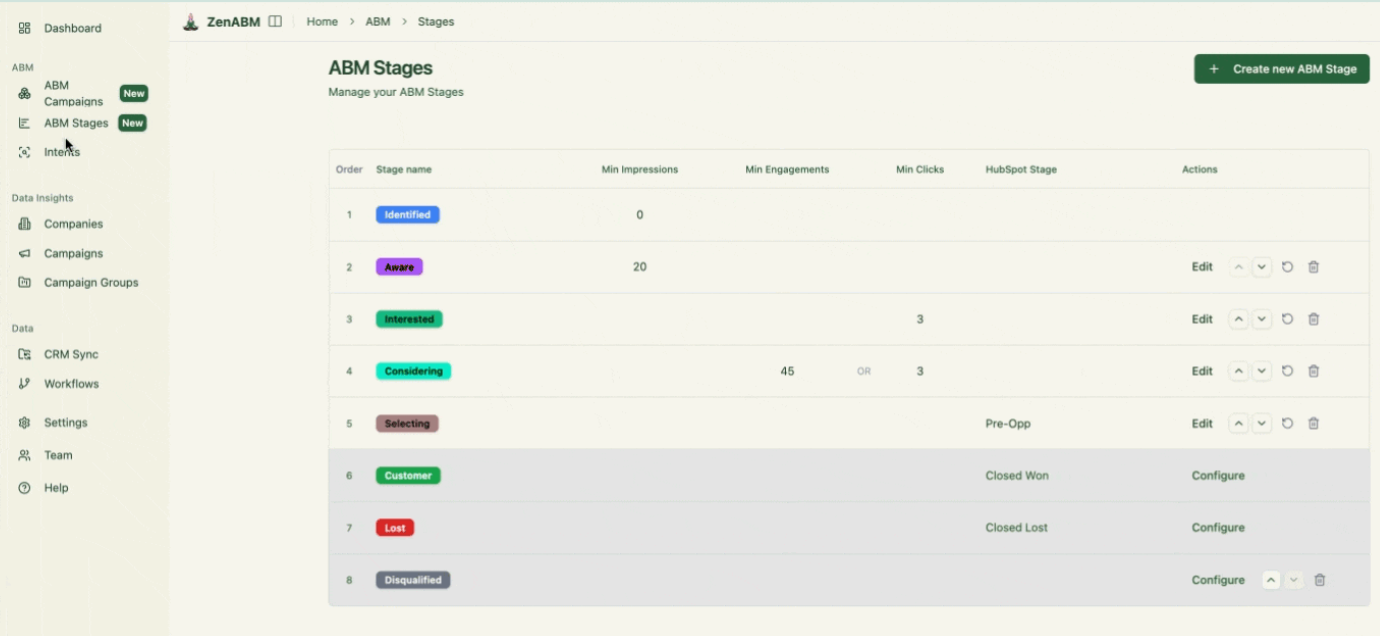
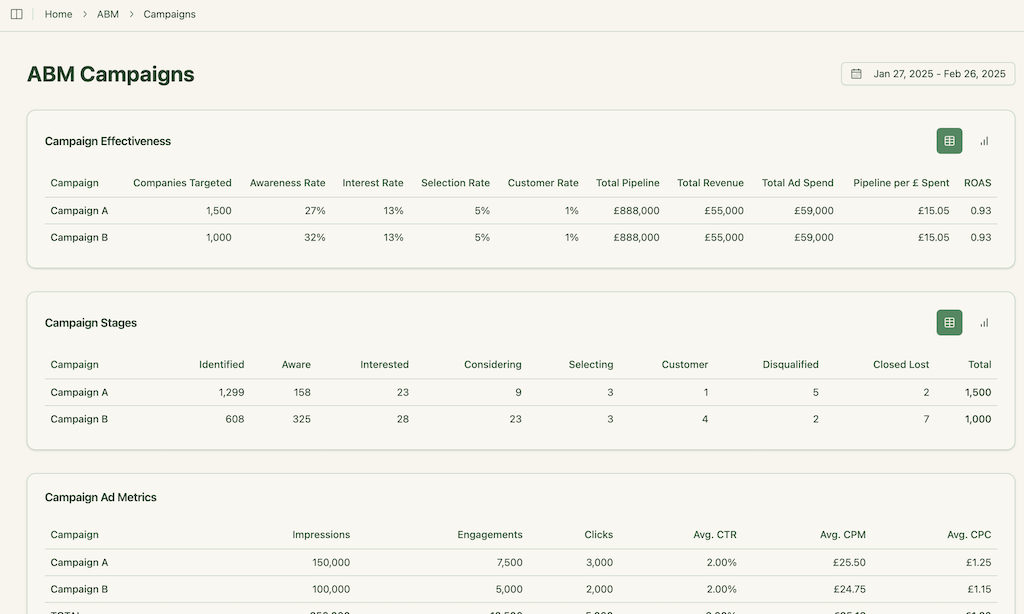
This gives you funnel visibility similar to larger suites, but powered by LinkedIn data.
ZenABM integrates bi-directionally with CRMs like HubSpot and adds Salesforce sync on higher tiers.
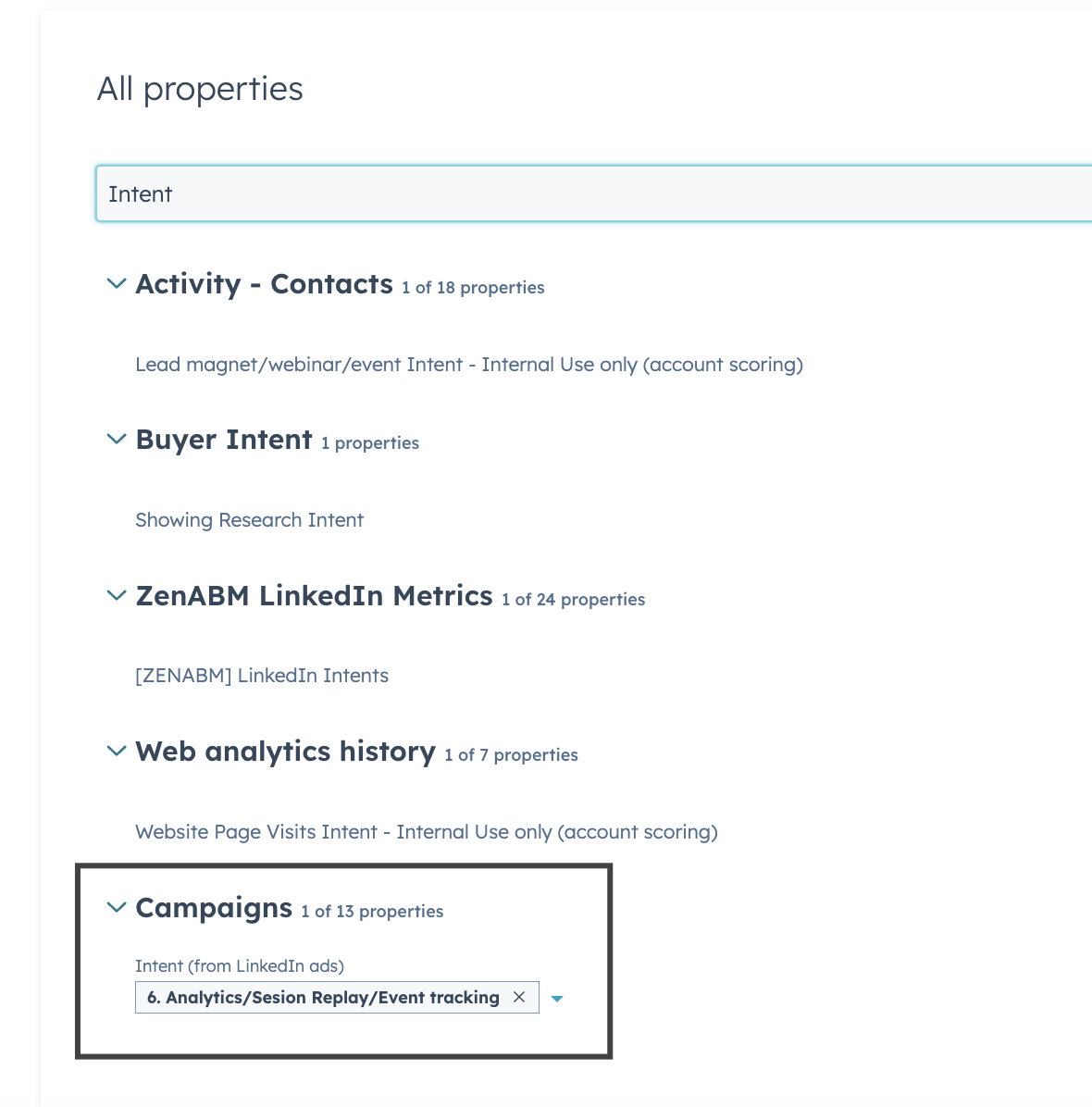
LinkedIn engagement data flows into the CRM as company-level properties:
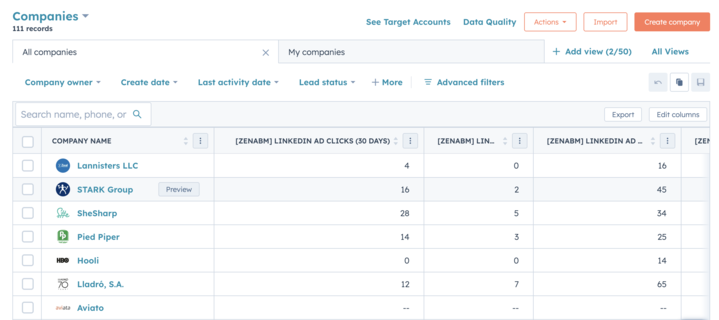
Once an account crosses your score threshold, ZenABM updates the stage to Interested and automatically assigns a BDR.
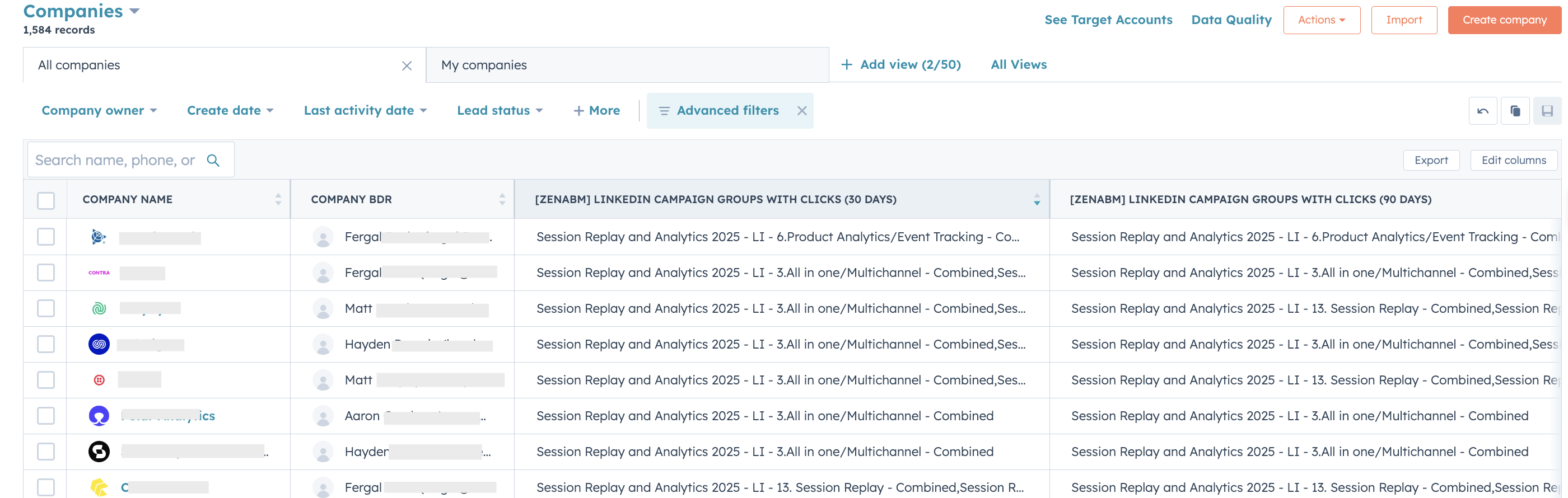
ZenABM lets you derive intent topics from LinkedIn campaigns by tagging campaigns by feature, use case, or offer.
ZenABM then shows which accounts engage with which themes.
This is clean, first-party intent from owned interactions.
You can push these topics into your CRM, so sales and marketing can tailor outreach to what each company has actually explored.
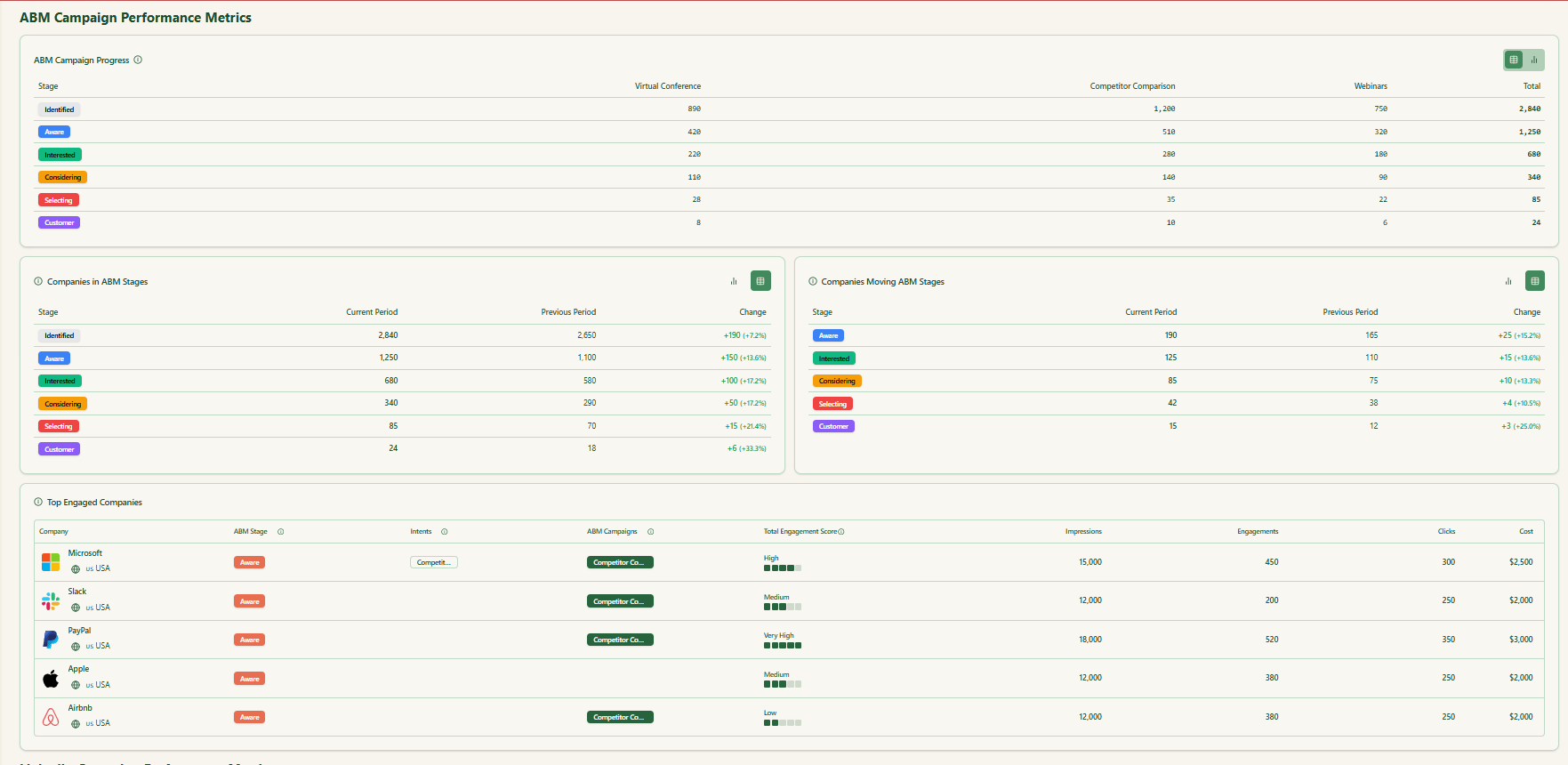
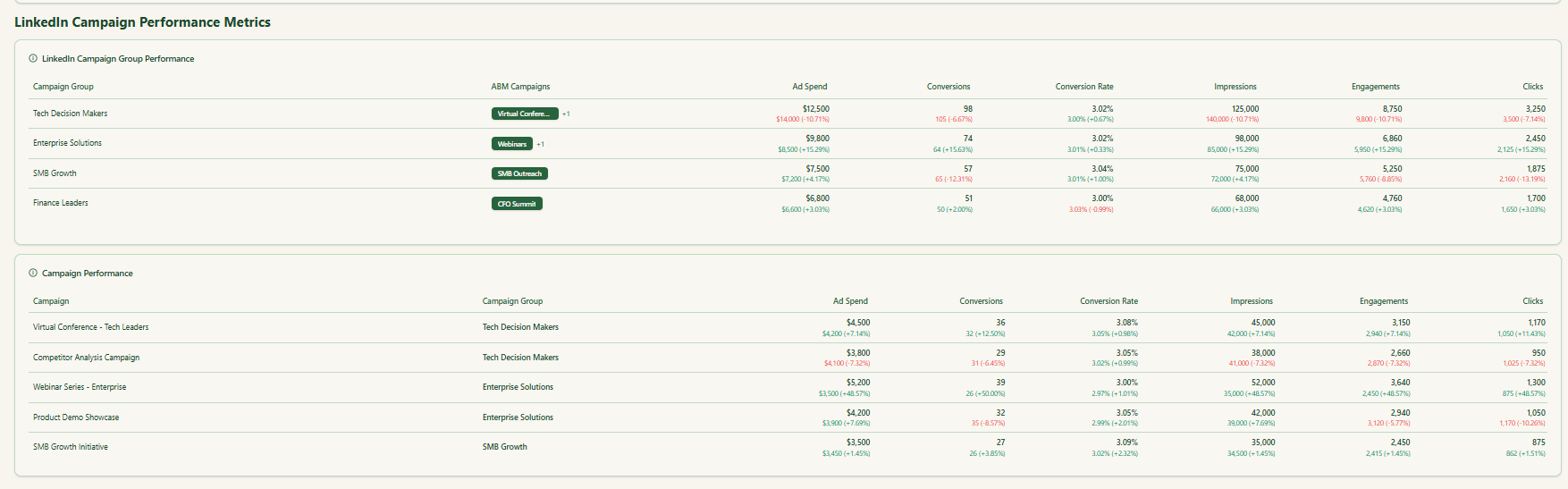
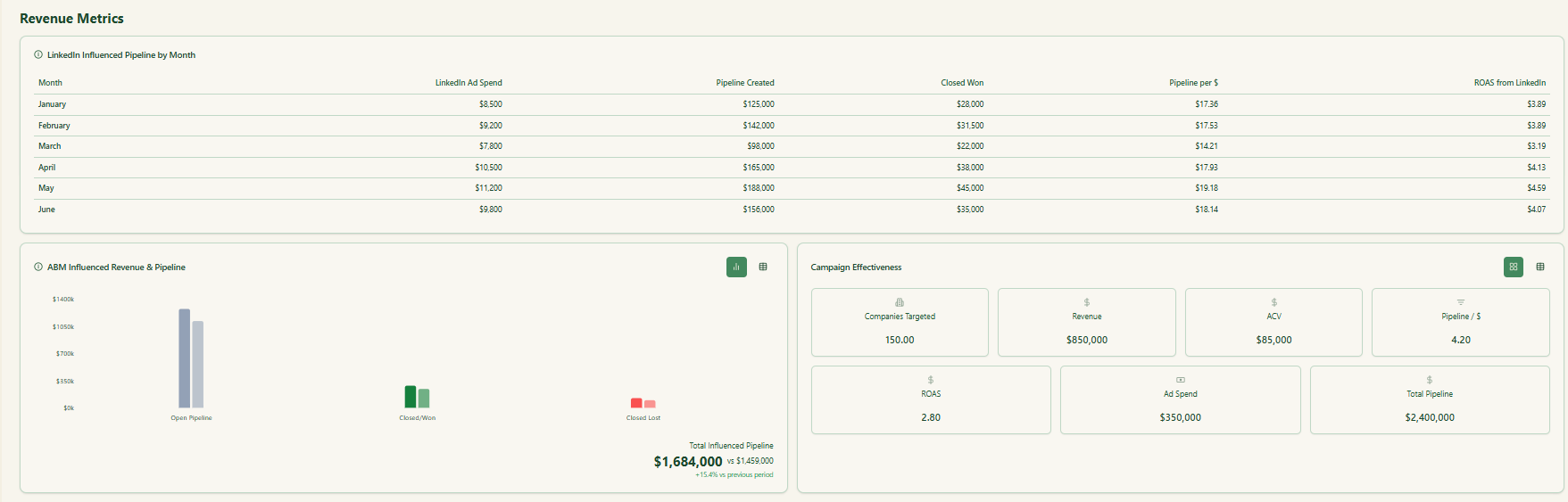
ZenABM ships with dashboards that connect LinkedIn ads to account engagement, stage movement, and revenue.
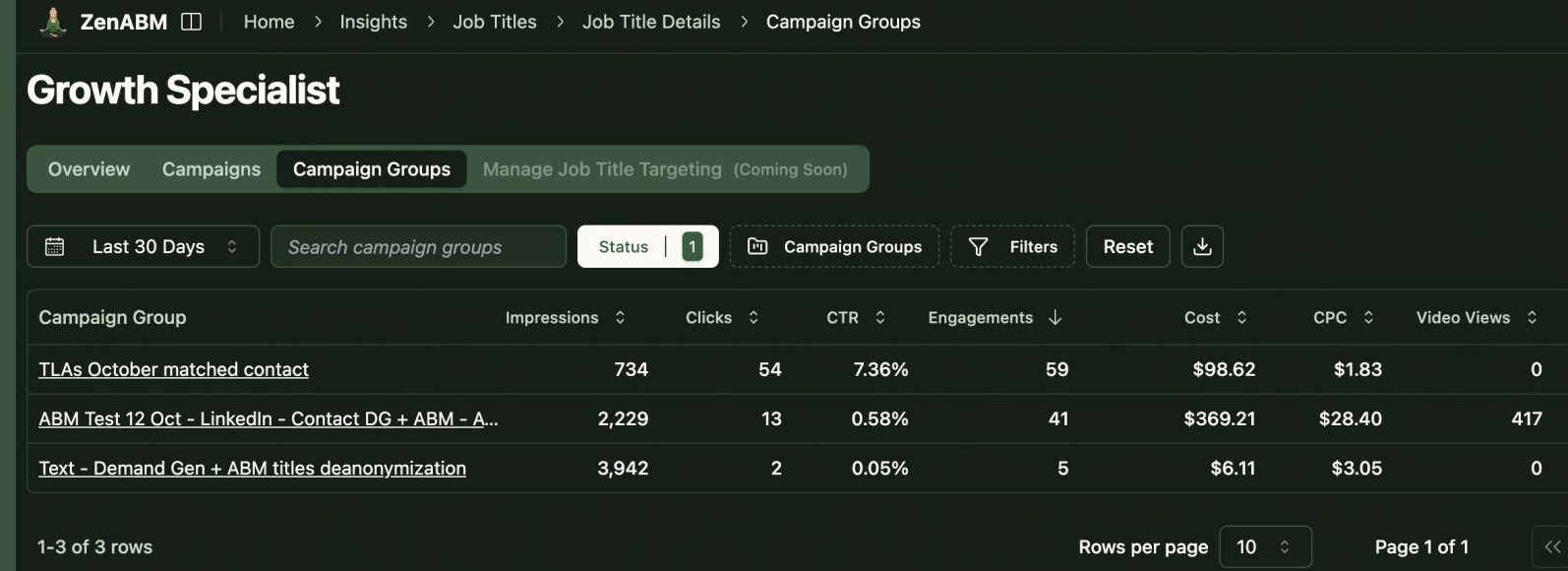
ZenABM shows which job titles engage with your creatives and gives dwell time and video funnel analytics.

ZenABM provides its AI chatbot called Zena that basically answers all you want from ZenABM in natural language.
You can ask Zena open-ended questions like you would a smart analyst and get company-level answers about:
Under the hood, Zena combines OpenAI with a library of carefully designed prompts and endpoints to join ad engagement, spend and CRM deals so it can explain which campaigns drove pipeline, which accounts turned into opportunities, which formats perform best and which companies are high intent but untouched by sales.
Instead of exporting spreadsheets and stitching pivot tables, you get plain language insights, ready to drop into strategy reviews, weekly sales standups or executive updates.
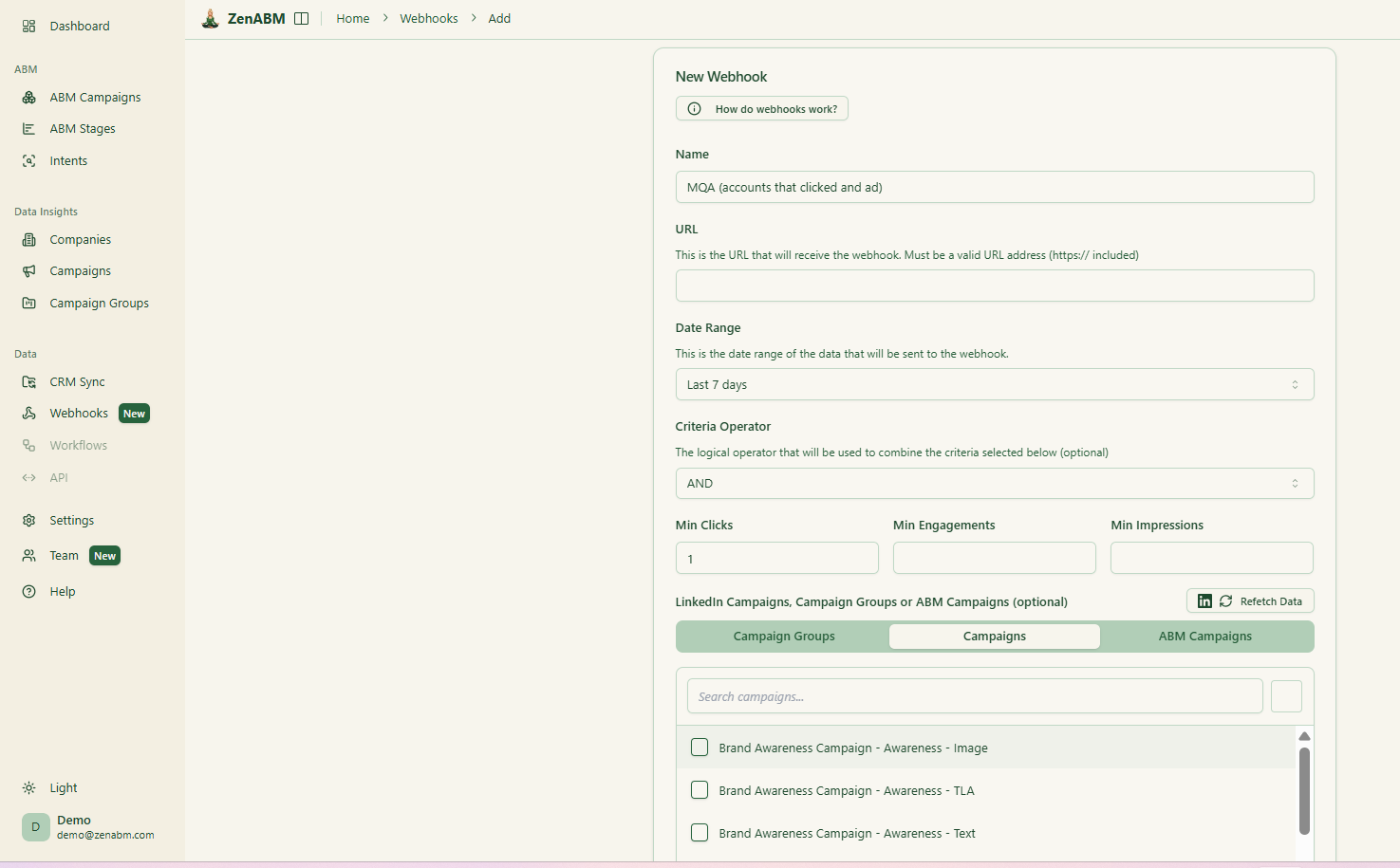
ZenABM’s custom webhooks let you push events into your stack, for example, Slack alerts, enrichment flows, or other ops automations.
Most tools treat each LinkedIn campaign separately. ZenABM lets you group several into one ABM campaign object so you can see performance across regions, personas, or creative clusters.
Instead of juggling fragmented reports in Campaign Manager, you see spend, pipeline, account movement, and ROAS for the entire initiative.
For agencies, ZenABM offers a multi-client workspace.
You can manage multiple ad accounts and clients in one environment, each with its own ABM strategy, dashboards, and reporting, instead of constantly switching accounts in Campaign Manager.

Plans start at $59 per month for Starter, $159 for Growth, $399 for Pro (with AI), and $479 for Agency.
The agency plan still stays under $6,000 per year.
All tiers include core LinkedIn ABM features. Higher tiers mostly increase limits and add Salesforce sync.
Plans are available monthly or annually, and every plan includes a 37-day free trial.
Recotap works best for teams that want LinkedIn-centric ABM with intent data and website personalization, without committing to a huge multichannel stack. It keeps the focus on target account lists, LinkedIn ads, dynamic segments and basic website tailoring.
Terminus is aimed at companies that want a full Engagement Hub that can coordinate ads across many channels, pull in website visitor identification, combine intent data and roll everything into multi-touch attribution. It rewards organizations that have the budget, headcount and patience to operationalize a larger platform.
If your real priority is first-party accurate LinkedIn data, clear ABM stages, CRM sync and revenue dashboards without another six-figure contract, ZenABM is the leaner option. It treats LinkedIn as the core ABM channel, converts engagement into company-level intent and pushes that insight straight into your CRM so marketing and sales can act on it together.
