 AI for ABM & LinkedIn Ads Week28 Sep – 2 Oct · Reserve your seatAI for ABM & LinkedIn Ads Week · 28 Sep – 2 Oct · Reserve your seat
 AI for ABM & LinkedIn Ads Week28 Sep – 2 Oct · Reserve your seatAI for ABM & LinkedIn Ads Week · 28 Sep – 2 Oct · Reserve your seat
LinkedIn conversion tracking tells you what happens after someone sees or clicks your ad. Did they visit your pricing page? Download your report? Book a demo? Without conversion tracking, you are flying blind – spending budget on LinkedIn ads with no way to measure whether those ads are actually driving business results.
In this guide, I will explain everything you need to know about LinkedIn conversion tracking – how it works, how to set it up (including CAPi – LinkedIn Conversions API (CAPI) – a server-side integration that enables your CRM data (or app usage data/database) directly to LinkedIn, without browser restrictions like cookies). CAPI improves tracking accuracy for both online and offline conversions, allowing for better campaign optimization, increased ROI, and lower cost-per-action (CPA).
Below, we’ll discuss how to use it specifically for account-based marketing where the tracking challenges are different from standard demand gen (lead-based tracking doesn’t work for account level!)

LinkedIn conversion tracking is a measurement feature in Campaign Manager that tracks specific actions people take on your website after interacting with your LinkedIn ads. It uses the LinkedIn Insight Tag (if you haven’t already – please add it to your website now, otherwise you won’t be able to apply anything you read below – or even run retargeting campaigns!)- a lightweight JavaScript snippet installed on your website – to detect when a LinkedIn ad viewer or clicker completes a defined conversion action.
Here are the key components of LinkedIn conversion tracking:
Based on data from ABM campaigns tracked through ZenABM and the LinkedIn ABM Performance Benchmarks Report 2026:
The 0.58% deal open rate is the critical number here. It means that for every ~170 accounts influenced by your LinkedIn ads, roughly one opens a deal. This is the conversion metric that matters for ABM – not form fills or content downloads, but actual pipeline creation.

The Insight Tag is a small piece of JavaScript code that you install on every page of your website. When a LinkedIn member visits your site, the Insight Tag fires and sends data back to LinkedIn about the page visit. LinkedIn then matches this activity against its ad data to determine if the visitor previously saw or clicked one of your ads.
LinkedIn supports several types of conversion tracking:
LinkedIn offers two types of attribution:
For ABM campaigns, both attribution types matter. Many B2B buying journeys involve someone seeing your ad multiple times before taking action – often without clicking. View-through conversions capture this influence that click-through alone would miss.
You can also track de-anonymized view-through and click-through conversions on company level in ZenABM’s company buying journey’s:


For ABM campaigns, I recommend setting up these conversion actions at minimum:
In Campaign Manager, assign your conversion actions to the campaigns that should track them. You can assign the same conversion action to multiple campaigns – which is important for ABM since multiple campaigns may influence the same account.
For ABM, I recommend extending the default attribution windows:
These extended windows capture the reality of B2B buying — a decision-maker might see your ad in January, visit your site in February, and book a demo in March. A 30-day click window would miss that entirely.

LinkedIn’s native conversion tracking is useful but has significant limitations for ABM specifically:
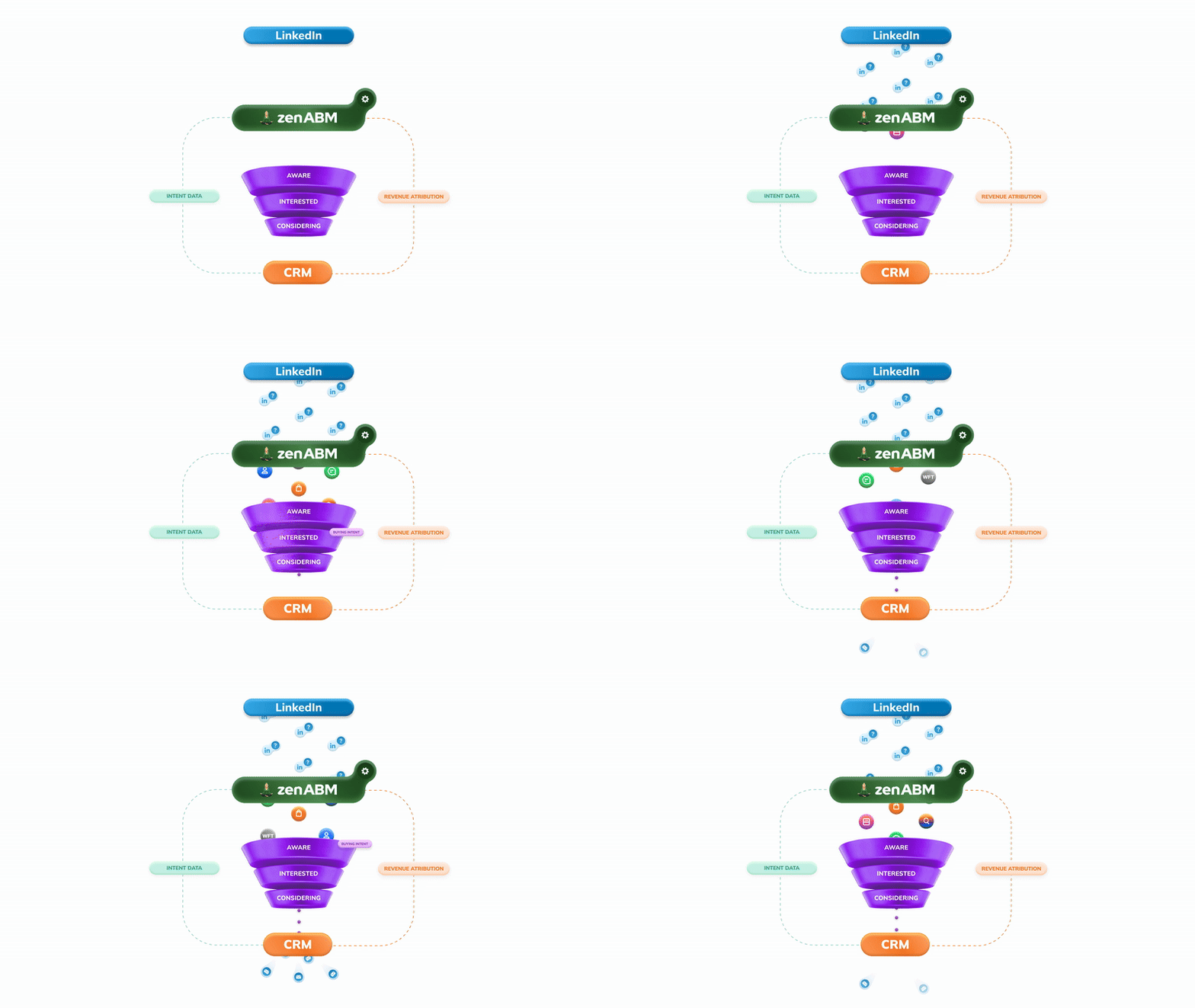
ABM is about accounts, not individual leads. LinkedIn conversion tracking tells you that “someone who saw your ad visited your pricing page,” but it does not tell you which company they are from or whether they are from a target account. You need additional tools like ZenABM to connect conversions to specific accounts inside your CRM:

LinkedIn can tell you that 50 people visited your demo page after seeing your ads, but it cannot tell you which of those became qualified opportunities or generated revenue. Connecting ad activity to pipeline requires CRM integration and proper UTM tracking alongside conversion tracking.
To connect to pipeline, you need to set up CAPI – LinkedIn Conversions API (CAPI).

It’s a server-side tracking solution that sends conversion events directly from your backend (or CRM) to LinkedIn, rather than relying only on the browser-based Insight Tag. It tracks actions such as form submissions, demo bookings, purchases, sign-ups, and other key events, even when cookies are blocked or users switch devices.
Because the data is sent server-to-server, it improves match rates, attribution accuracy, and signal quality for optimization – especially useful for B2B and ABM programs where conversions may happen behind login walls or across longer sales cycles. To set it up, you generate a CAPI access token inside LinkedIn Campaign Manager, define the conversion events you want to track, and then send those events from your server (or via a partner integration like HubSpot, Segment, Zapier, or a custom API implementation).
Ideally, you run CAPI alongside the Insight Tag in a hybrid setup to maximize data reliability and ensure deduplication using event IDs.
Open LinkedIn Campaign Manager and select the ad account you’ll use for tracking.
In the left-hand menu, click Data.
Click Signals Manager.
In Signals Manager, select Direct API.

Click Generate access token.
You’ll be prompted to sign in / confirm permissions.
LinkedIn will display the token — click the token to copy it and store it securely (treat it like a password).
Conversion tracking (Insight Tag / pixel-based)
Tracks user actions in the browser via the LinkedIn Insight Tag (and related browser-based signals).
Great for web events like page views, button clicks, form submits — but can be degraded by cookie blockers, ITP, ad blockers, and cross-device gaps.
Conversions API (CAPI / server-side)
Tracks conversions by sending events from your server/CRM/warehouse directly to LinkedIn (server-to-server).
Better for reliability + attribution, and it can track offline / CRM events (e.g., lead qualified, opportunity created) that don’t happen purely in the browser.
Best practice: run both (hybrid). Use event deduplication (same event sent via browser + server) using an event ID, so LinkedIn doesn’t double-count.
LinkedIn offers a “Website Conversions” campaign objective that optimizes delivery for people likely to convert. But as Max Herzeg warns:
“Do not use website conversions. It’s a more expensive version of website visits.” – Max Herzeg, former LinkedIn employee and Founder of Comrade
The conversion optimization algorithm needs substantial data to learn effectively. Most ABM campaigns have audiences too small for the algorithm to optimize properly, which means you pay more per click without getting better conversion rates.
When your ABM campaign targets 500 accounts, many people at those accounts will see your ads simply because they are on LinkedIn. If those same people later visit your website for any reason (organic search, direct visit, referral), LinkedIn may credit the conversion to the ad view. This inflates your conversion numbers.
To get a complete picture of ABM performance, combine LinkedIn’s native conversion tracking with these additional approaches:
As Tim Davidson recommends:
“Add UTMs to the call to action link… look at view conversions… video view percentage.” -=- Tim Davidson, Founder at B2B Rizz
UTM parameters feed attribution data into your analytics tools (GA4, Mixpanel, etc.) and CRM, allowing you to track the full journey from ad click to pipeline.

Use company engagement tracking tools (like this one :)) to see which target accounts are engaging with your ads and visiting your website. This bridges the gap between individual-level conversion tracking and account-level ABM measurement.

Connect your conversion data to your CRM to track which LinkedIn-influenced accounts progress through your sales pipeline. This is where ABM revenue attribution happens – connecting ad spend to closed-won revenue at the account level. This is exactly what tools like ZenABM facilitate without you needing to build any integrations.
Not all LinkedIn ad formats work the same way with conversion tracking:
For ABM campaigns using in-feed formats, video ads in particular, focus on engagement metrics (video view percentage, interaction rate) as proxy conversion signals rather than relying solely on website conversion tracking.
Page visits and content downloads are fine as secondary metrics, but your primary conversion actions should be demo requests, sign-ups, and pricing page visits — actions that indicate genuine buying intent.
B2B sales cycles are long. Extend click-through attribution to 90 days and view-through to 30 days to capture the full influence of your ABM campaigns.
LinkedIn’s conversion tracking works at the individual level. Pair it with account-level tracking through ZenABM or similar tools to measure ABM performance at the account level where it actually matters.
View-through conversions are useful directional data but should not be your primary success metric. In ABM campaigns with small, targeted audiences, view-through attribution will naturally inflate because your target accounts are frequently on LinkedIn and seeing your ads.
The LinkedIn Insight Tag is a lightweight JavaScript code snippet you install on your website. It tracks when LinkedIn members visit your site and enables conversion tracking, retargeting, and website demographics reporting in LinkedIn Campaign Manager.
After installing the Insight Tag, it typically becomes active within 24 hours. Conversion data may take an additional 24-48 hours to appear in Campaign Manager reporting. LinkedIn recommends waiting at least 48 hours before troubleshooting.
Click-through conversions happen when someone clicks your ad and then completes a conversion action. View-through conversions happen when someone sees your ad (without clicking) and later completes a conversion action. Both are important for ABM, but click-through conversions are generally more reliable indicators of ad influence.
No. As former LinkedIn employee Max Herzeg advises, the Website Conversions objective is a more expensive version of Website Visits. For ABM campaigns with small audiences, the optimization algorithm does not have enough data to learn effectively, which means you pay more without better results.
LinkedIn’s native conversion tracking works at the individual level, not the account level. To track account-level conversions for ABM, you need to combine LinkedIn tracking with UTM parameters, CRM integration, and an ABM platform like ZenABM that connects ad engagement to specific target accounts.
