Fibbler recently published a “ZenABM Alternatives” article that makes several claims about our product. We believe in transparency and healthy competition, so rather than ignoring these claims or getting defensive, we wanted to address each one directly. What was most telling about Fibbler’s article is that none of the claims were supported by evidence or actual usage of the tool – as you can tell from the complete lack of any screenshots or product demonstrations. We’ll do things a bit differently here and show you actual product screenshots alongside every point. So grab a coffee. Let’s go through this together.
Deanonymize LinkedIn ad engagements, get intent, accounts scoring (starting @$59/month!)
The 9 Claims from Fibbler’s Article (and What’s Actually True)
“Legacy API capped at 15,000 companies” – FALSE – The cited LinkedIn API docs don’t say this and the author made a wrong assumption about ZenABM’s technical stack & approach. Our Customers track performance from several tens of thousands of companies.
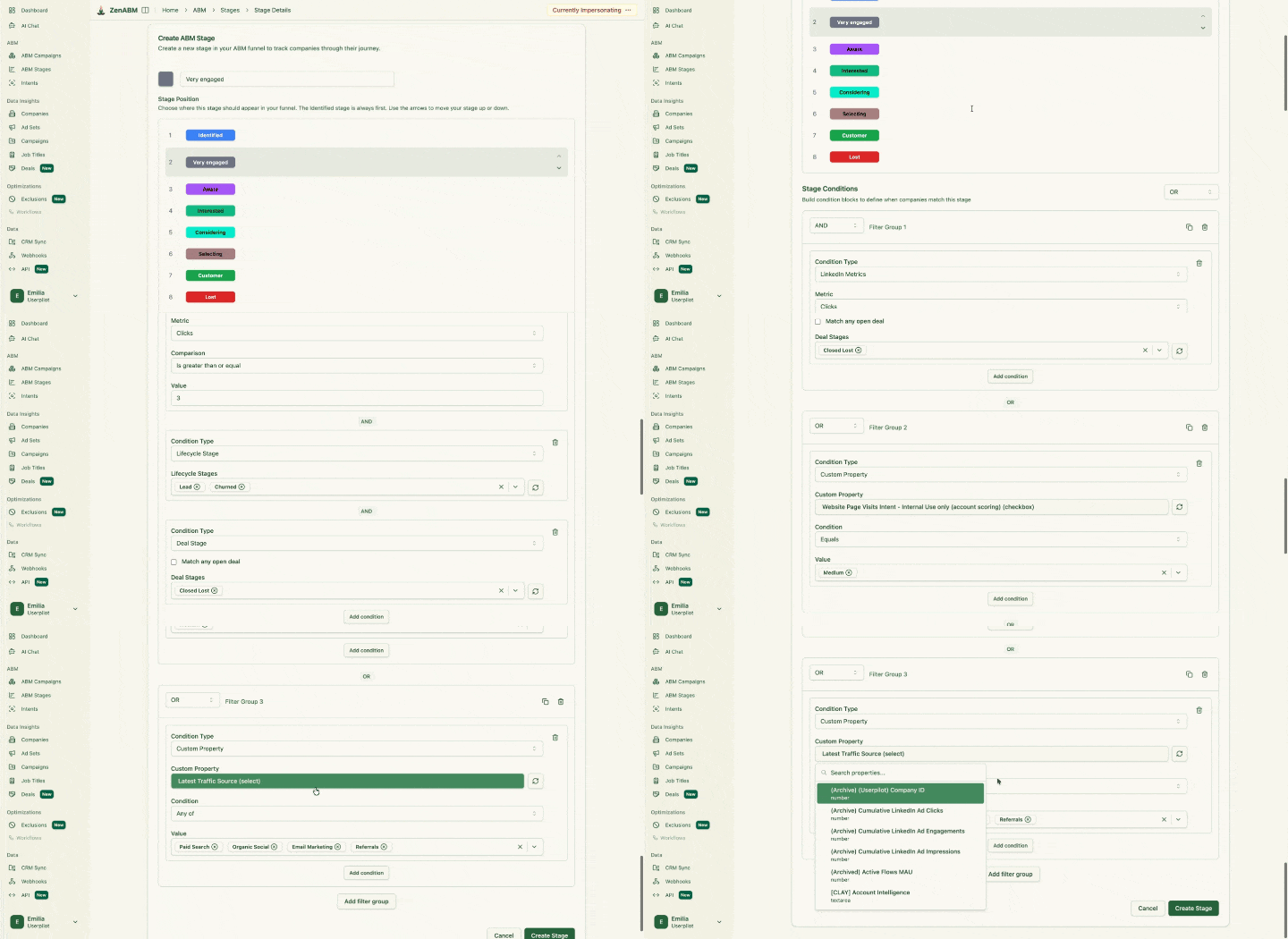
“Misleading funnel stages / ABM Theater” – FALSE – ABM stages are 100% customizable: any engagement thresholds, any time periods, combined with any CRM properties. Defaults are just starting points.
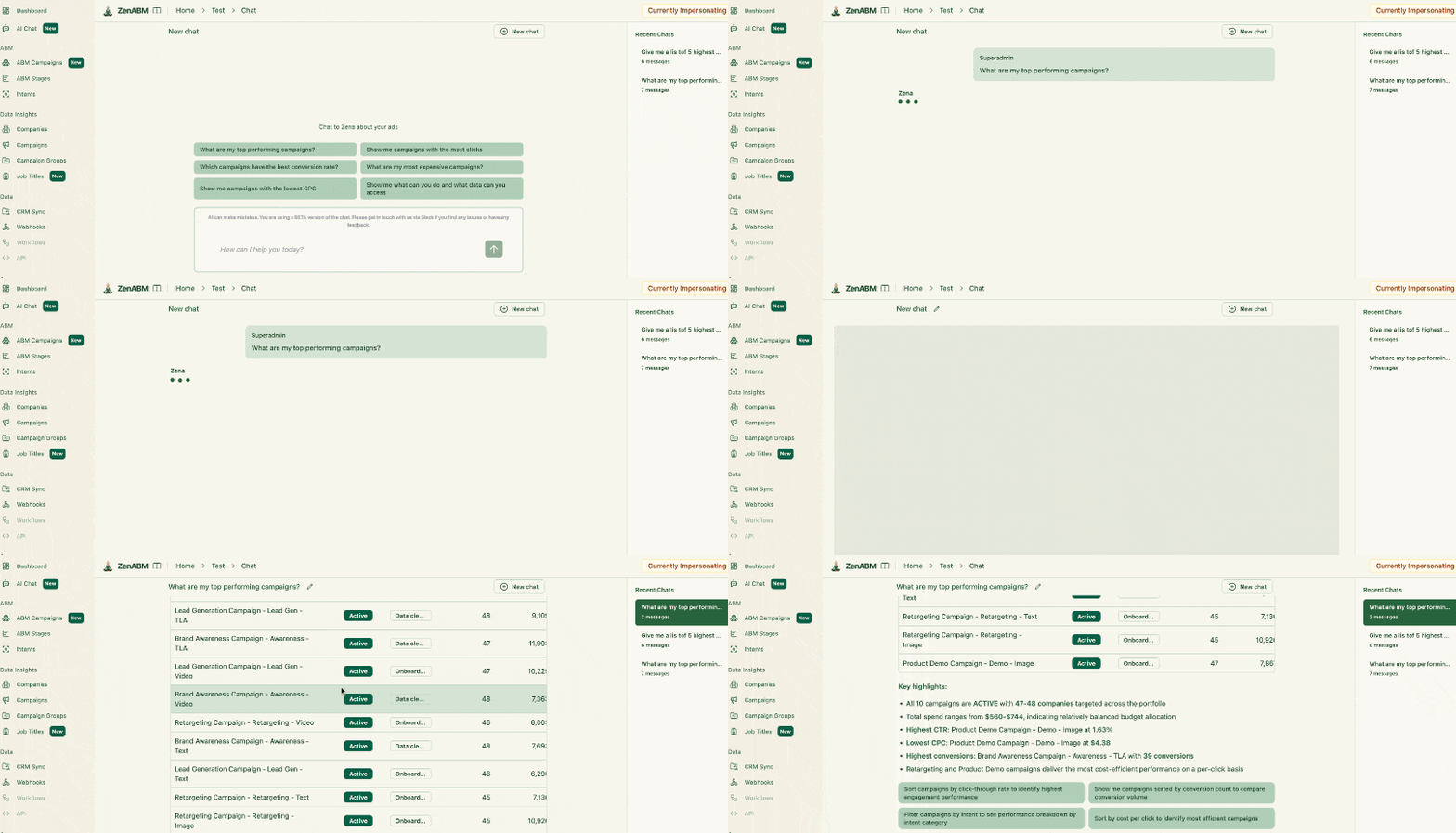
“AI generates confident answers from incomplete data” – FALSE – Zena AI pulls from multiple LinkedIn APIs + CRM data + expert knowledge base. Also: hard to critique AI when you have zero AI features yourself.
“Pricing deception on $59/month plan” – FALSE – Fibbler’s own $89/month plan limits you to 3 syncs, 3 signals, 3 caps, no Salesforce. ZenABM’s $59 plan includes multi-channel at no extra cost. Fibbler + Google Ads = $148+/month.
“Single-channel limitation” – OUTDATED – As of April 2026, ZenABM tracks LinkedIn Ads, Google Ads, Reddit Ads, organic traffic, and AI chatbot referrals. All included in paid plans. Fibbler charges $59/month extra for Google Ads alone.
“Missing lift analysis” – INTENTIONAL – Fibbler’s “lift” compares ABM deal ACV to average deal ACV. This is misleading because ABM targets are deliberately chosen larger accounts, so of course you will open larger deals with them. Correlation, not causation. ZenABM provides ACV per campaign for honest comparison instead.
“Unproven track record / ~10 customers” – FALSE – 70+ customers including enterprise companies. Fibbler shows 4 logos on their homepage by same logic. ZenABM is built by an engineer + practising VP Marketing running a 7-figure ABM programme daily. 50% of customers use implementation services.
“Missing operational features” – PARTIALLY TRUE – Impression capping is blocked by LinkedIn API access, not a broken promise. Campaign management in development will be end-to-end, not just simple scheduling.
“Automated intent stages ignore 95:5 rule” – FALSE – Same as #2 repackaged. Stages are fully customizable, user-defined, multi-signal. They show engagement behavior, not buying predictions.
1. “Legacy API Data Cap” – “ZenABM relies on a legacy API capped at 15,000 companies”
This one is our favourite, because the source that Fibbler cites in their own article does not actually say what they claim it says. The LinkedIn API documentation they reference does not state anywhere that the companies ZenABM can fetch are capped at 15,000. We went back and read it. Twice. Still couldn’t find it. But you don’t need to take our word for it. ZenABM users can simply open their analytics dashboards and see for themselves how many companies ZenABM is tracking. Many of our customers track well over 15,000 companies. Here’s an actual screenshot from a customer running campaigns to 20,000+ accounts:If there were a cap at 15,000, we imagine someone would have noticed by now. We’re not sure where this number came from. Perhaps it was a rough estimate, perhaps it was wishful thinking, or perhaps someone misread the documentation. Either way, it’s not accurate, and we’d encourage anyone who’s curious to sign up for the free trial and count the companies themselves. Here’s what ZenABM’s company-level engagement data actually looks like – searchable, filterable, and very much not capped at 15,000:
“ABM Theater” is a great phrase. Genuinely. We might borrow it for our next webinar title. But the claim behind it – that ZenABM’s funnel stages are rigid, engagement-only buckets that ignore revenue – is factually wrong. ZenABM’s ABM stages are 100% customizable. Every single one of them. You can:
Define your own stage names (add them, remove them, rename them)
Set thresholds based on any combination of LinkedIn ad engagements – clicks, engagements, impressions – over any time period you choose (last 7 days, 30 days, 90 days, or any custom window)
Combine LinkedIn engagement data with any company-level properties from your CRM: form submissions, website visits, webinar sign-ups, deal stages, lifecycle stages, custom properties – whatever you have
Include interactions from other acquisition channels too – Google Ads engagements, website visits, past deals, and more
Change all of this in a few clicks, whenever you want
The defaults exist to help new users get started quickly. They are starting points, not permanent fixtures. Calling a fully customizable, multi-signal account scoring system “ABM Theater” is a bit like calling a spreadsheet “misleading” because the template has sample data in it. Here’s what ABM stage customization actually looks like in ZenABM – you can see stages are built from a combination of LinkedIn ads touchpoints AND CRM properties:And here’s how those stages look in practice – with company intent signals derived from actual campaign engagements:
ZenABM account stage customization
Does that look like “theater” to you? These are real signals, from real campaigns, flowing into real CRM workflows. The alternative – what I had to do when using Fibbler – was building massive, fragile Hubspot workflows just to approximate what ZenABM gives you out of the box:That’s what “ABM Theater” actually looks like – spending hours building CRM workflows to replicate what a purpose-built ABM tool does in a few clicks.
3. “AI Unreliability on Partial Data” – “Zena AI generates confident answers from incomplete datasets”
This is an interesting criticism coming from a tool that has no AI features at all. It’s a bit like someone who has never cooked criticizing your recipe – technically they’re entitled to an opinion, but it’s hard to take the feedback seriously. Here’s what Zena AI actually does:
It pulls data from several different LinkedIn APIs and the user’s CRM
It uses the latest and most advanced LLM models, selected based on what’s most appropriate for each specific task
It has been trained on LinkedIn posts from top LinkedIn ad experts (Tim Davidson, Maximilian Herzeg, Kamil Rextin and others) and webinar transcripts from ABM Bootcamp sessions conducted by leading practitioners
Zena doesn’t operate on “fractional market information.” It operates on the same comprehensive dataset that powers all of ZenABM’s dashboards – raw LinkedIn engagement data, processed insights (intent signals, account scoring, funnel stages), and CRM data – enriched with domain expertise from people who actually run LinkedIn ABM programmes for a living.Beyond the chatbot, ZenABM also offers a REST API and an MCP server – which means you can connect your LinkedIn ads data to any LLM (like Claude Code) and build bespoke ABM analytics dashboards, reporting, or even agents that act on your data:You can actually try Zena out and get LinkedIn ads advice completely for free, without even setting up a ZenABM account (it just won’t have access to your campaign data – so better sign up for a trial):Is AI perfect? No. Is it more useful than manually exporting CSVs and uploading them to ChatGPT (which is what most marketers do today)? We’ll let our users answer that one.
4. “Pricing Deception” – “The $59/month starter plan is severely limited, forcing upgrades”
“Pricing deception” is a strong accusation. Let’s look at what both tools actually offer at their entry-level tiers. ZenABM Starter at $59/month: Designed for small companies beginning their ABM journey who don’t need multiple ABM campaigns simultaneously or a complex campaign structure. Currently used by several happy customers with smaller budgets and straightforward needs. It does what it says on the tin. Fibbler Growth at $89/month: Limited to just 3 campaign syncs, 3 signals, and 3 impression caps or campaign schedules. Does not include Salesforce integration. So Fibbler’s entry plan costs $30 more per month, also has significant feature limitations, and also lacks Salesforce on the lowest tier. If tiered pricing with feature gates constitutes “deception,” then Fibbler, Slack, HubSpot, and essentially every SaaS company on earth is doing the same thing – because hey, this is why we have pricing plans! To be able to charge more when the users are getting more product features or more usage / value. Who would have thought? 😅 And if you need multi-channel coverage? With Fibbler, Google Ads is a separate $59/month add-on, bringing the effective cost to $148+/month. ZenABM’s $59/month plan already includes Google Ads, Reddit Ads, organic traffic, and AI chatbot referral signals at no extra cost. We’ll let you draw your own conclusions about which pricing model is more “deceptive.”
5. “Single-Channel Limitation” – “ZenABM only tracks paid LinkedIn Ads”
This claim might have been partially true sometime in 2025. It is not true in April 2026. As of today, ZenABM captures engagement signals from:
LinkedIn Ads (our core product)
Google Ads
Reddit Ads
Organic traffic
AI chatbot referrals
All of these are included in ZenABM’s paid plans at no extra cost. We’re also implementing website visitor deanonymization (including Google Ads traffic) through the same provider Fibbler uses – Leadfeeder. Here’s what a multi-channel company engagement journey looks like in ZenABM – with touchpoints from LinkedIn Ads, Google Ads, Reddit, organic traffic, and AI referrals, all broken down by campaign on a timeline:
ZenABM company engagement journey + multi-channel attribution
Meanwhile, Fibbler charges a separate $59/month add-on for Google Ads company identification, capped at 1,000 companies per month. Fibbler does not offer Reddit Ads tracking, organic traffic tracking, or AI chatbot referral tracking. Here’s what Fibbler’s company journey looks like in comparison – by sources only, and available for companies with open deals only:We’d kindly suggest Fibbler updates their article to reflect 2026 reality rather than 2025 history as well – but we also get it’s hard to keep up with our engineering team, and since ZenABM is product-first – we may not have communicated this well enough just yet 😉
Let’s talk about what Fibbler’s “lift analysis” actually measures, because it sounds much more scientific than it is.Fibbler’s lift metric compares the ACV (average contract value) of LinkedIn Ads-influenced deals to the average ACV of deals that were not influenced by LinkedIn Ads. The implication: “Look, deals touched by LinkedIn Ads are bigger. LinkedIn Ads created that lift.” The problem? This metric produces a false sense of success. Here’s why: most marketers running ABM campaigns on LinkedIndeliberately choose which accounts to target. These tend to be larger companies with higher willingness and ability to pay. The deals that come from outbound strategies like ABM naturally tend to be larger than the average inbound deal. Comparing self-selected enterprise accounts to your overall deal average and calling the difference “lift” is not measuring the impact of your ads. It’s measuring the quality of your target account list. True lift analysis requires controlled experimentation – holdout groups, matched cohorts, statistical controls. A simple ACV comparison between two self-selected groups is not that. It’s correlation dressed up as causation, and it can lead to genuinely poor budget decisions. ZenABM provides the average ACV for every ABM campaign. Our users can compare ACV across campaigns, time periods, and against their CRM baselines. We intentionally chose not to build a vanity metric that tells marketers what they want to hear rather than what’s actually happening. Here’s what ZenABM’s revenue attribution dashboards look like – with deduplicated pipeline per ABM campaign, pipeline per $ spent, and deals broken down by campaign:
ZenABM deals per ABM campaign dashboard view
And here’s Fibbler’s analytics dashboard for comparison – total influenced pipeline and revenue, without ABM campaign segmentation or deduplication:We’d rather give you accurate, deduplicated attribution data and let you make your own informed decisions.
7. “Unproven Track Record” – “ZenABM has ~10 customer logos and zero G2 reviews”
Claiming ZenABM has only 10 customers because our website shows 10 logos is like claiming Fibbler has only four customers because their homepage shows four logos. By that logic, Apple has about six customers (the people in their homepage photos).The facts:
ZenABM currently serves 70+ happy customers
Our customers include in-house marketing teams, LinkedIn ads agencies with multiple clients on enterprise plans, SMBs, and large publicly listed enterprise companies
Yes, ZenABM has been on the market for a shorter time than Fibbler. We’re not pretending otherwise. But ZenABM is built by an engineer and a practising VP of Marketing at a large SaaS company, who runs a very successful 7-figure LinkedIn ABM programme every single day. ZenABM wasn’t born in a vacuum or from a market opportunity analysis – it was born from the real, daily frustrations of actually doing the work, and not having the right tools (ekhm). Every feature exists because we needed it ourselves first. And when I say we needed it – I mean I was building fragile Hubspot workflows to approximate ABM stages from Fibbler’s raw data, and finally said “there has to be a better way than this.” And about G2 reviews – yeah that’s fair, we’ll get there. We’ve been focused on building a genuinely useful product and supporting our customers’ success rather than optimizing for review collection. We’d rather have 70 customers who love the product and whose results speak for themselves, than 70 G2 reviews we paid for.Speaking of customer support: unlike Fibbler, ZenABM offers extensive implementation services, including LinkedIn ad strategy, ABM strategy programmes, and GTM engineering support. Roughly 50% of our customers opt for the service package, which is a major reason many achieve such strong ROI results from their ABM campaigns – in terms of pipeline per dollar spent and overall ROAS. None of Fibbler’s case studies mention the impact of Fibbler’s support on their customers’ outcomes. As a two-person company proudly serving 500+ users with a fully self-serve, PLG approach, you might want to ask yourself: if you run into a strategic question about your ABM programme, who’s going to help you? Here’s what ZenABM’s full ABM analytics dashboard looks like – the kind of insights our implementation team helps customers set up and act on:
This one is partially fair. We said impression capping was coming, and it hasn’t shipped yet. Here’s the honest reason: ZenABM is currently waiting for LinkedIn’s API access to implement impression capping properly. This is a LinkedIn platform dependency, not a product decision or a broken promise. We could hack something together, but we’d rather do it right. As for campaign management: it’s in active development, and it will cover a much broader scope than Fibbler’s campaign scheduler. ZenABM’s workflows will allow you to manage your LinkedIn ad campaigns end-to-end from within ZenABM – not just control the times when your ads appear. We think that’s worth waiting for. In the meantime, impression capping can also be done natively with LinkedIn Campaign Manager’s frequency cap audiences. It’s not as elegant as a one-click solution, but it works. And while we’re on the topic of what each tool offers beyond the overlap – here’s what ZenABM gives you that Fibbler simply does not: ABM campaign objects, customizable funnel stages, intent signals, account scoring, deduplicated revenue attribution, AI chatbot, MCP server, REST API, multi-channel engagement signals, and implementation services. We think the features that exist today more than make up for the ones still in development.
9. “Conflicting with Market Reality” – “Automated intent stages ignore the 95:5 rule”
This is essentially the same claim as #2, repackaged with a marketing buzzword. And the answer is the same: ZenABM’s ABM stages are not automated in the way Fibbler describes. They are fully customizable, user-defined, and based on whatever combination of signals the user chooses to configure. The “95:5 rule” (the idea that only ~5% of your target market is in-market at any given time) is a perfectly valid concept. But it has nothing to do with how ZenABM’s stages work. ZenABM doesn’t claim to tell you who is “truly buying.” It shows you who is engaging with your campaigns and to what degree, based on rules you define. That’s the entire purpose of first-party intent data – to surface behavioral signals so you can make better decisions about where to focus your energy. If you configure your stages well (which our implementation team helps you do), the accounts moving through your funnel will reflect genuine buying signals, not engagement vanity metrics. And if you configure them poorly, you’ll know quickly because the pipeline numbers won’t follow. That’s the beauty of a system you can actually control and iterate on. Here’s a reminder of what those “automated” (read: fully customizable) stages look like in practice:And how they translate into actionable CRM data – intent, stage, and engagement score pushed directly as company properties:
The Best Way to Decide? Try Both.
Ultimately, the best way to figure out which tool is right for you is to try them both. Read the comparison articles (including our detailed Fibbler vs ZenABM breakdown), but don’t just take anyone’s word for it – sign up, connect your LinkedIn account, and see which product actually solves your specific problem. Try ZenABM free for 37 days and get 90 days of your data backfilled instantly. No credit card required. No “pricing deception.” Just a product built by people who actually run ABM programmes every day.
Deanonymize LinkedIn ad engagements, get intent, accounts scoring (starting @$59/month!)