



Dreamdata is a B2B activation and attribution platform built to unify buyer journeys across channels and connect revenue back to the touchpoints that influenced it.
This deep dive is specifically about Dreamdata features: what the product actually does, which capabilities matter for ABM and revenue teams, where it tends to deliver real value, where it can become heavy, and how the pricing usually works once you move beyond the basics.
I’ll also cover where ZenABM (a first-party, LinkedIn-focused ABM platform) can be a stronger fit for LinkedIn-first teams, or a practical complementary layer alongside Dreamdata (or any enterprise attribution suite) because of ZenABM’s unique LinkedIn account-level capabilities.

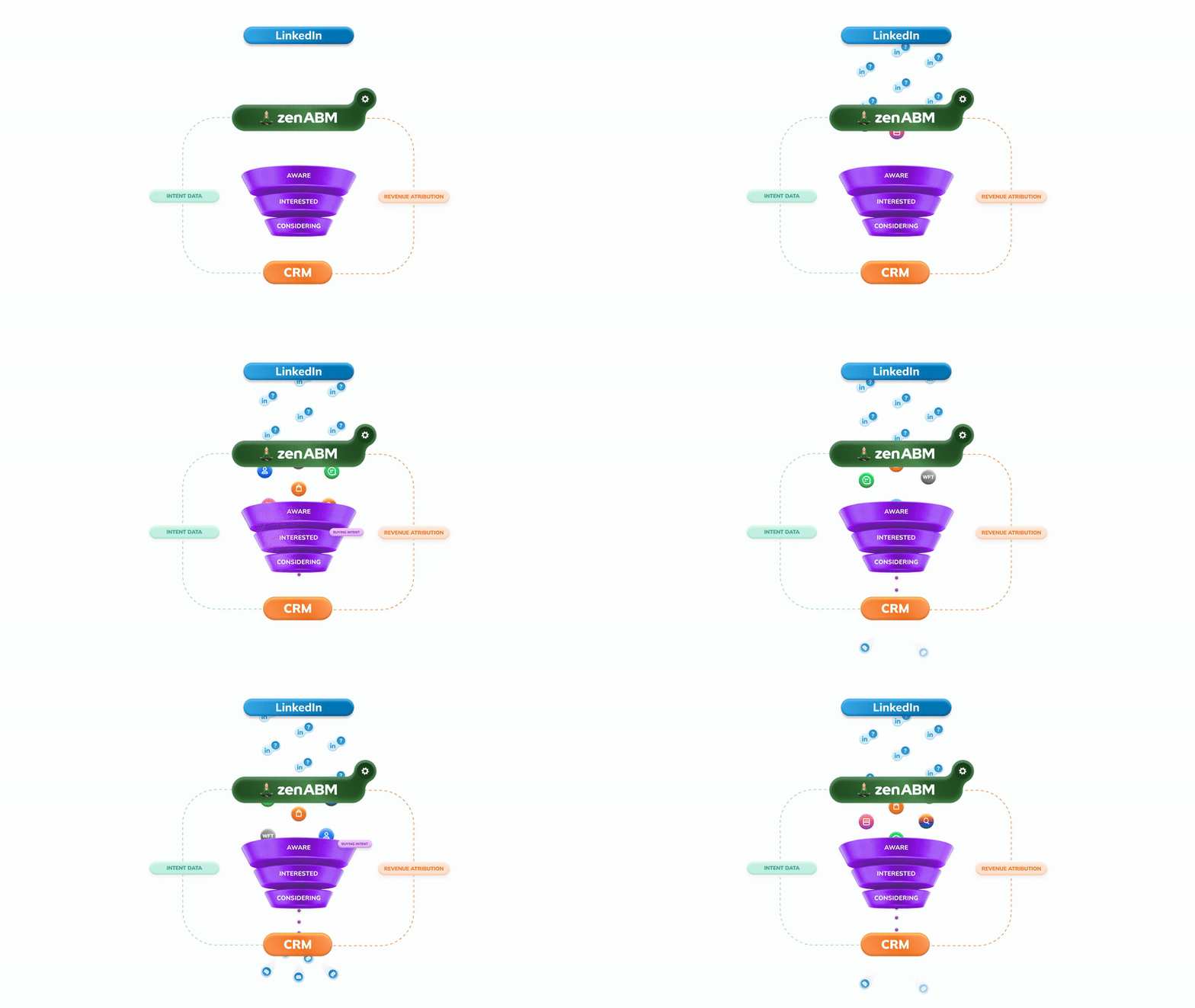
If you want the essentials first:

Dreamdata’s product promise is simple: connect spend, touchpoints, accounts, and revenue in one place, then let teams measure and act on that data.
Here are the Dreamdata features that usually matter most for ABM and revenue teams:

Dreamdata supports multiple attribution models so you can distribute credit across the touchpoints that influenced pipeline and revenue.
Dreamdata documents six default attribution models (first-touch, last-touch, linear, U-shaped, W-shaped, and data-driven). Depending on plan and setup, teams can also move beyond defaults with custom model logic and exclusions to better reflect how their motion actually works.
This feature is useful when you want something more realistic than last-click attribution, especially in B2B journeys where several touches influence pipeline across weeks or months.
The practical constraint is data quality. If tracking is inconsistent or CRM lifecycle stages are unreliable, attribution models will still produce output, but the output will be misleading.
Dreamdata also consolidates touchpoints (CRM activity, website sessions, ad engagement, content downloads, event interactions, and sales activity) into one journey timeline so you can see how multiple interactions build toward a deal.


Attribution is only one layer. Dreamdata also rolls connected data into revenue analytics dashboards that show pipeline, revenue, and performance breakdowns by channel, campaign, and content.
ABM-relevant views often include:
In practice, the reporting depth is strong, but teams typically need time to standardize definitions and decide which reports drive action.

By the way, ZenABM also provides detailed plug-and-play account-based LinkedIn ad revenue attribution dashboards for a starting price of just $59/month.


Dreamdata is often used for ABM reporting because it can group activity into account-level journeys, not just lead-level events.
Instead of focusing on one person’s clicks, you can review how a buying group from an account engaged over time, and which touches typically precede pipeline creation or a closed-won outcome.
This is valuable for account-based reporting and internal alignment, especially when marketing and sales disagree about influence or source.

Dreamdata also includes company identification and engagement scoring functionality (commonly associated with its “Reveal” experience) so teams can filter for ICP accounts, engagement levels, and high-intent-like behaviors such as repeat visits or key page activity.

Dreamdata goes beyond reporting into activation by letting you build audiences from connected data and sync those audiences to ad platforms.
Example: You could create a segment of all accounts that visited your pricing page twice in the last week and push that list to LinkedIn for focused retargeting.
Dreamdata’s Audience Hub is built for this workflow so teams can create and maintain audiences without stitching lists manually in spreadsheets.

It also supports conversion syncing back to ad platforms, so downstream CRM events (like SQL creation or closed-won) can be sent back into ad networks to improve optimization toward business outcomes, not just clicks.
One of the most operational Dreamdata features is signals and alerts.
Dreamdata can surface “highly engaged” accounts and notify teams via channels like Slack (and similar destinations depending on setup). The intent is straightforward: if a target account spikes in activity, teams get a usable trigger instead of finding out a week later in a dashboard.
The limitation is cadence and governance. Signals work best when teams align on definitions (what counts as “high engagement”), frequency (so alerts do not become noise), and ownership (who acts when an alert fires).

Dreamdata integrates across the usual B2B stack: CRMs, marketing automation, ad platforms, web analytics, sales tools, and data platforms.
Common connectors teams care about:
Dreamdata’s pricing is structured around usage, commonly framed as monthly tracked users (MTUs), and it starts with a free tier.
Here is the practical reality:
If you are looking for a leaner yet effective tool (especially for LinkedIn-first ABM), I present ZenABM, starting at just $59/month.
ZenABM offers account-level LinkedIn ad engagement tracking, ad engagement-to-pipeline analytics with plug-and-play dashboards, account scoring, ABM stage tracking, CRM sync, first-party qualitative intent, automated assignment of BDRs to hot accounts, custom webhooks, and ad engagement tracking at the job-title level.


Attribution tools are rarely “set it and forget it” products, so reviews often reflect the gap between expectations and implementation reality.
Across common feedback themes, the same patterns show up:
One alternative to Dreamdata is ZenABM.
It is designed specifically for LinkedIn ABM, so it can be a lean alternative for teams that mainly advertise on LinkedIn.
Even for teams running multi-channel ABM, ZenABM can work as a complementary layer alongside Dreamdata (or another attribution suite) because of ZenABM’s first-party LinkedIn account-level capabilities.
Let’s look at those features:
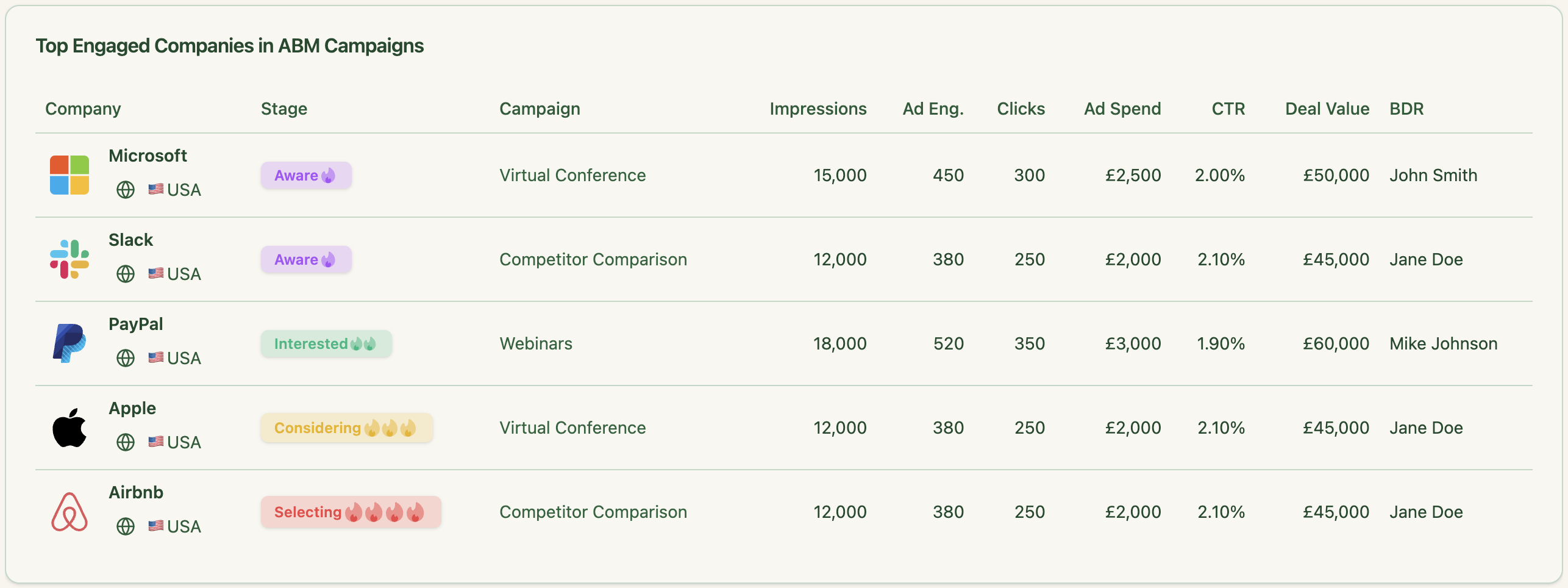
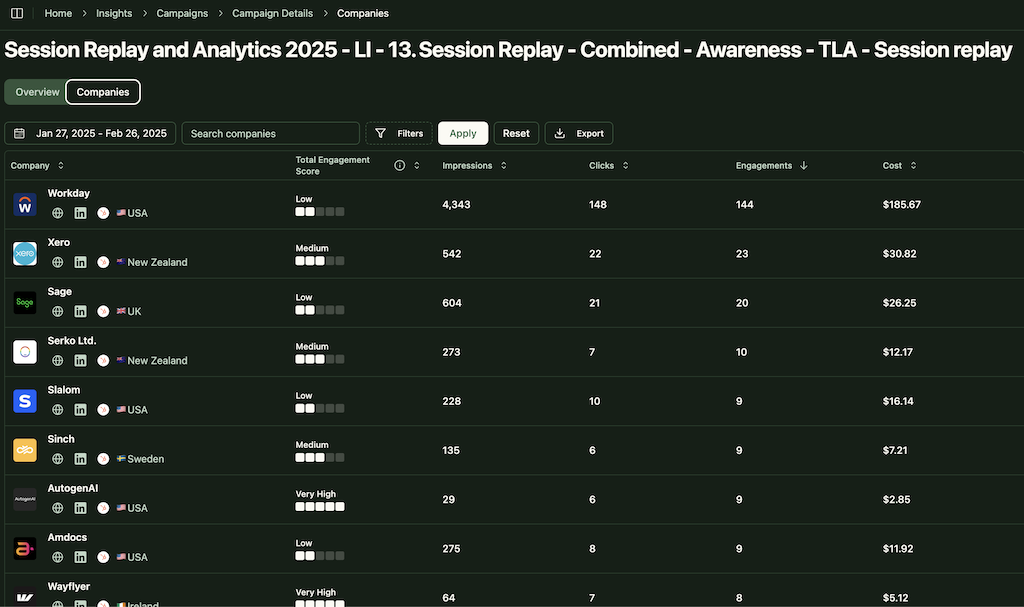
ZenABM connects to the official LinkedIn Ads API and captures account-level data for all campaigns so you can see which companies see, click, and engage with your ads.
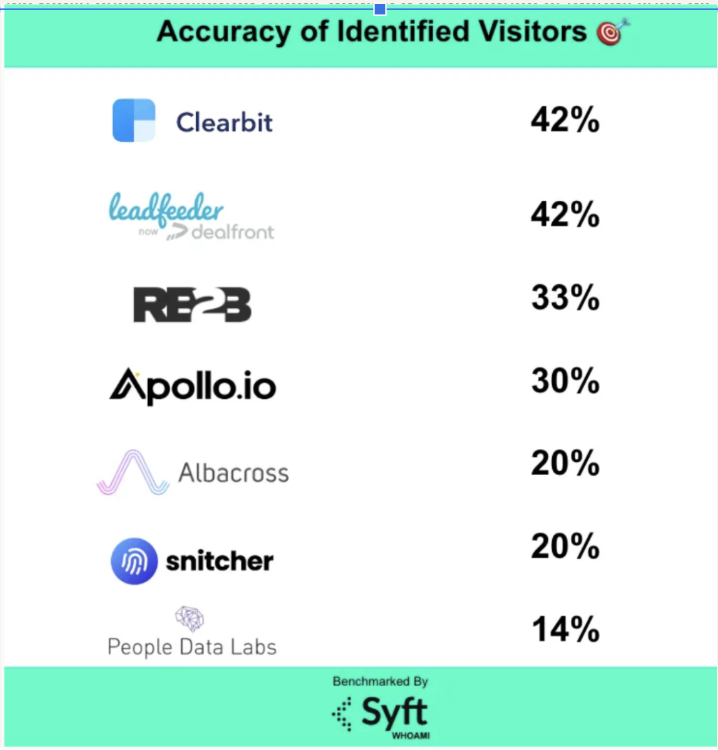
Because this is first-party data from LinkedIn’s environment, it avoids the uncertainty that comes with probabilistic site deanonymization approaches.
A benchmarking study by Syft shows that de-anonymization coverage and precision can be mixed across providers, often below 50 percent depending on the dataset and vendor.
ZenABM treats LinkedIn ad engagement itself as first-party intent. When several people in one company keep engaging with your ads, that is a strong buying signal without rented intent feeds.
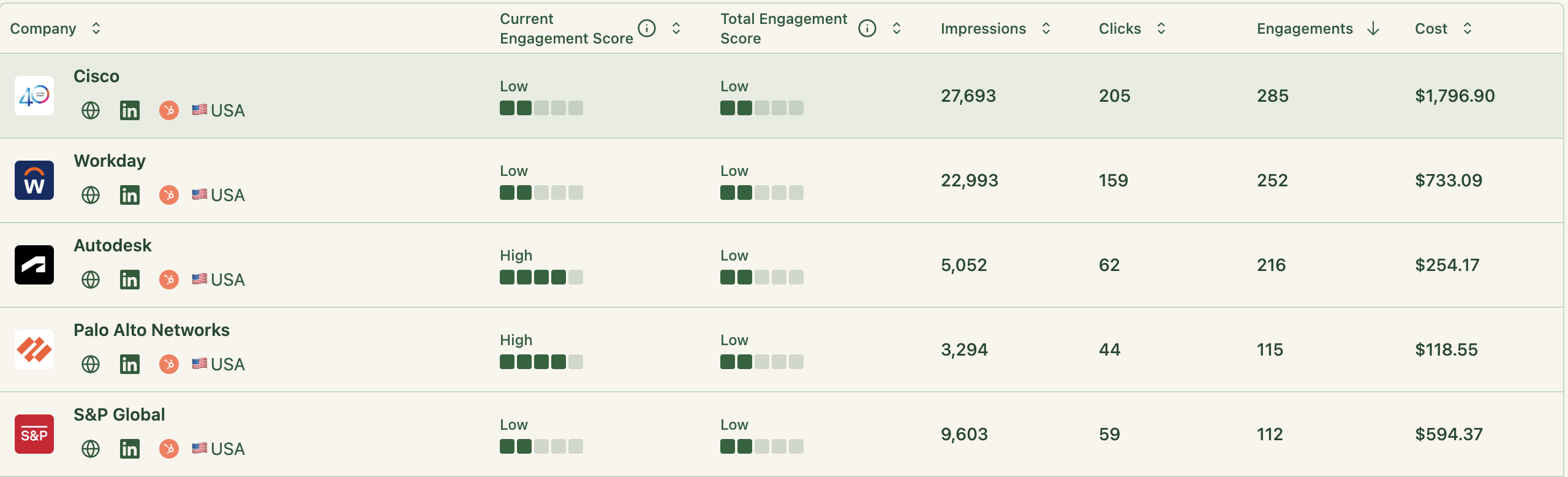
ZenABM updates engagement scores as accounts interact with your ads across campaigns, so you can see who is heating up over short or long windows and let marketing and sales prioritize accounts that show meaningful intent.
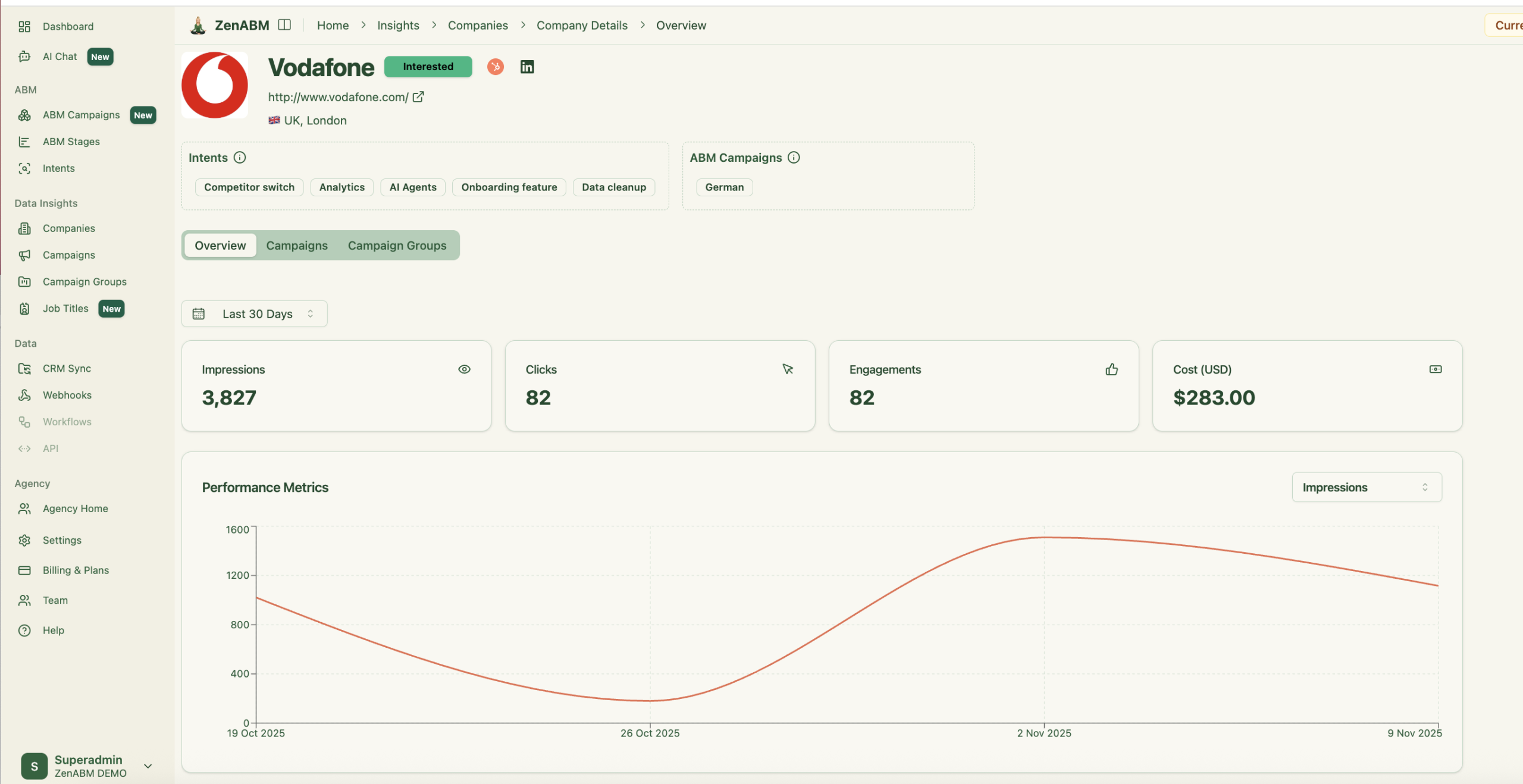
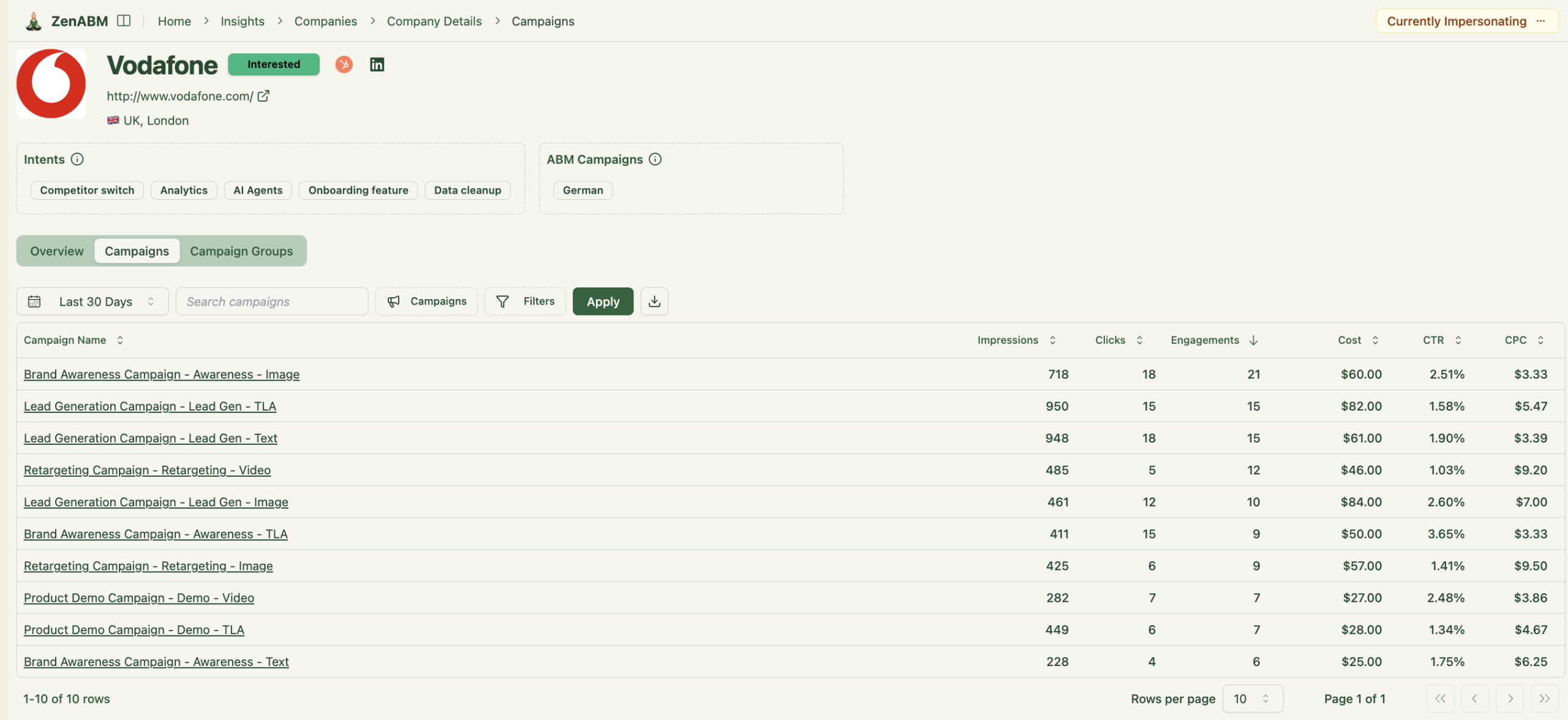
ZenABM also shows the full touchpoint timeline for each company:
ZenABM lets you define stages such as Identified, Aware, Engaged, Interested, and Opportunity and automatically places accounts in the right stage using scores and CRM data.
You control thresholds, and ZenABM tracks movement over time.
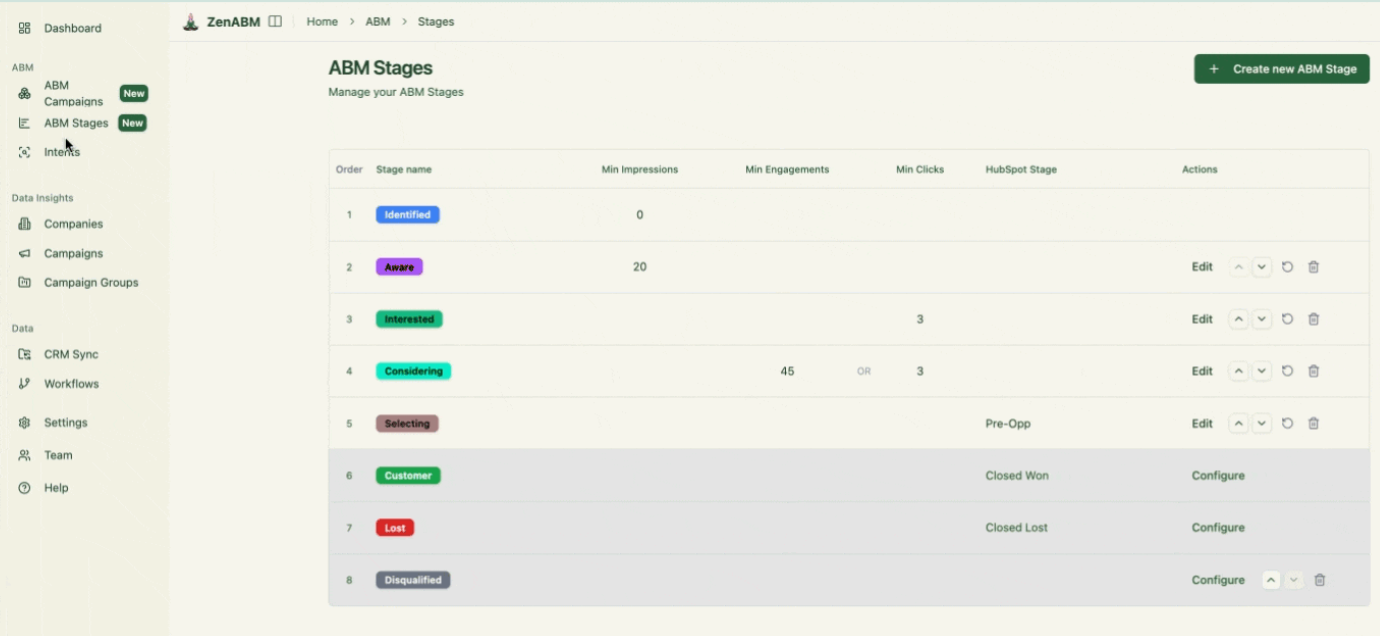
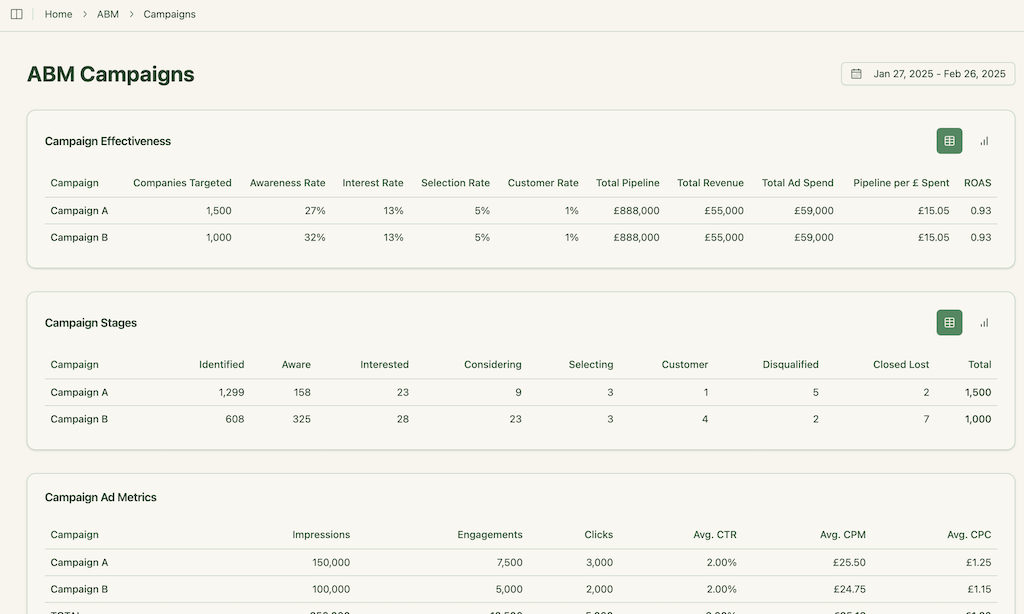
This gives you funnel visibility similar to larger suites, but powered by LinkedIn data.
ZenABM integrates bi-directionally with CRMs like HubSpot and adds Salesforce sync on higher tiers.
LinkedIn engagement data flows into the CRM as company-level properties:
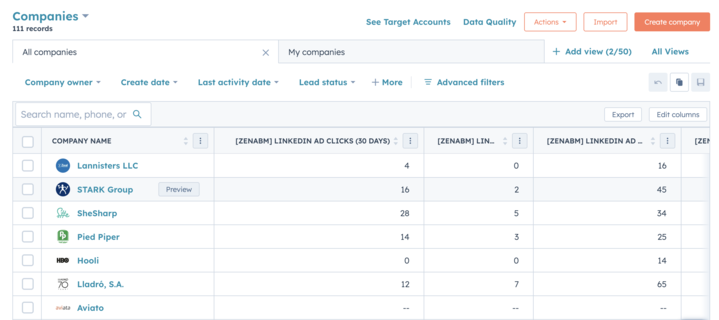
Once an account crosses your score threshold, ZenABM updates the stage to Interested and automatically assigns a BDR.
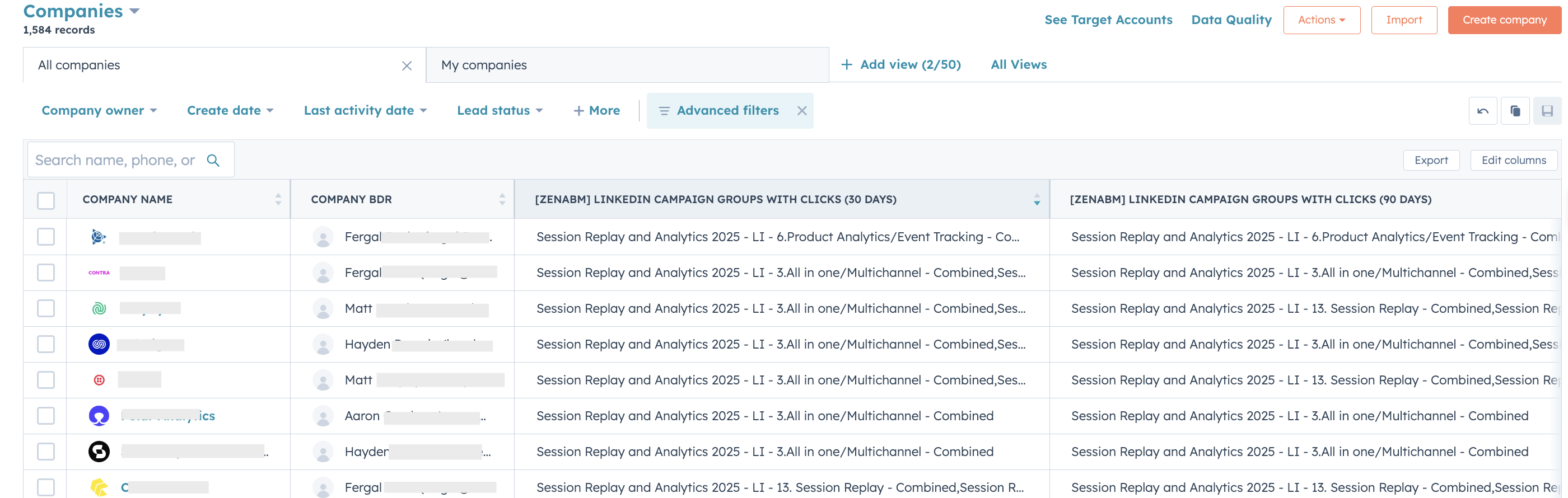
ZenABM lets you derive intent topics from LinkedIn campaigns by tagging campaigns by feature, use case, or offer.
ZenABM then shows which accounts engage with which themes.
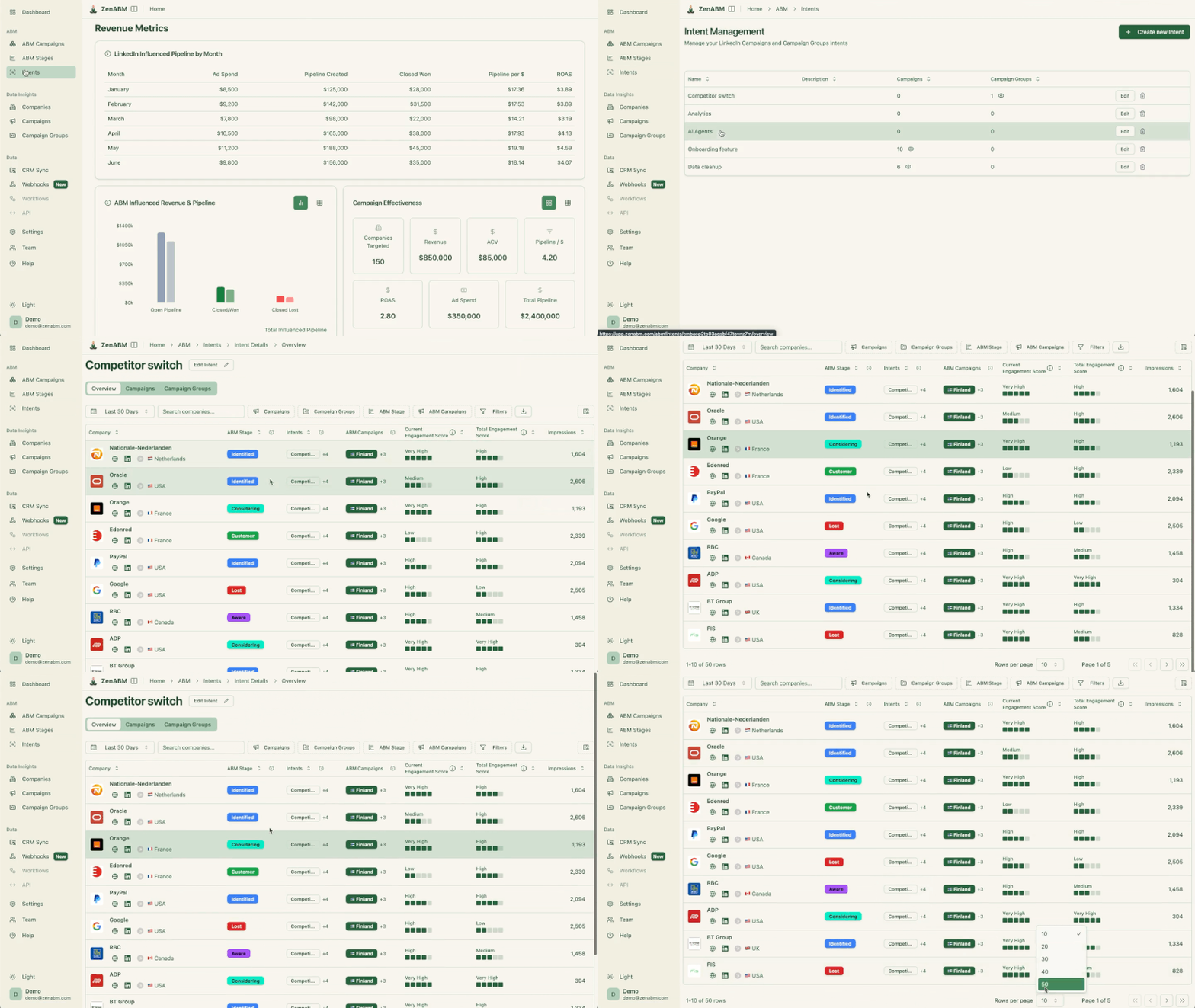
This is first-party intent from owned interactions.
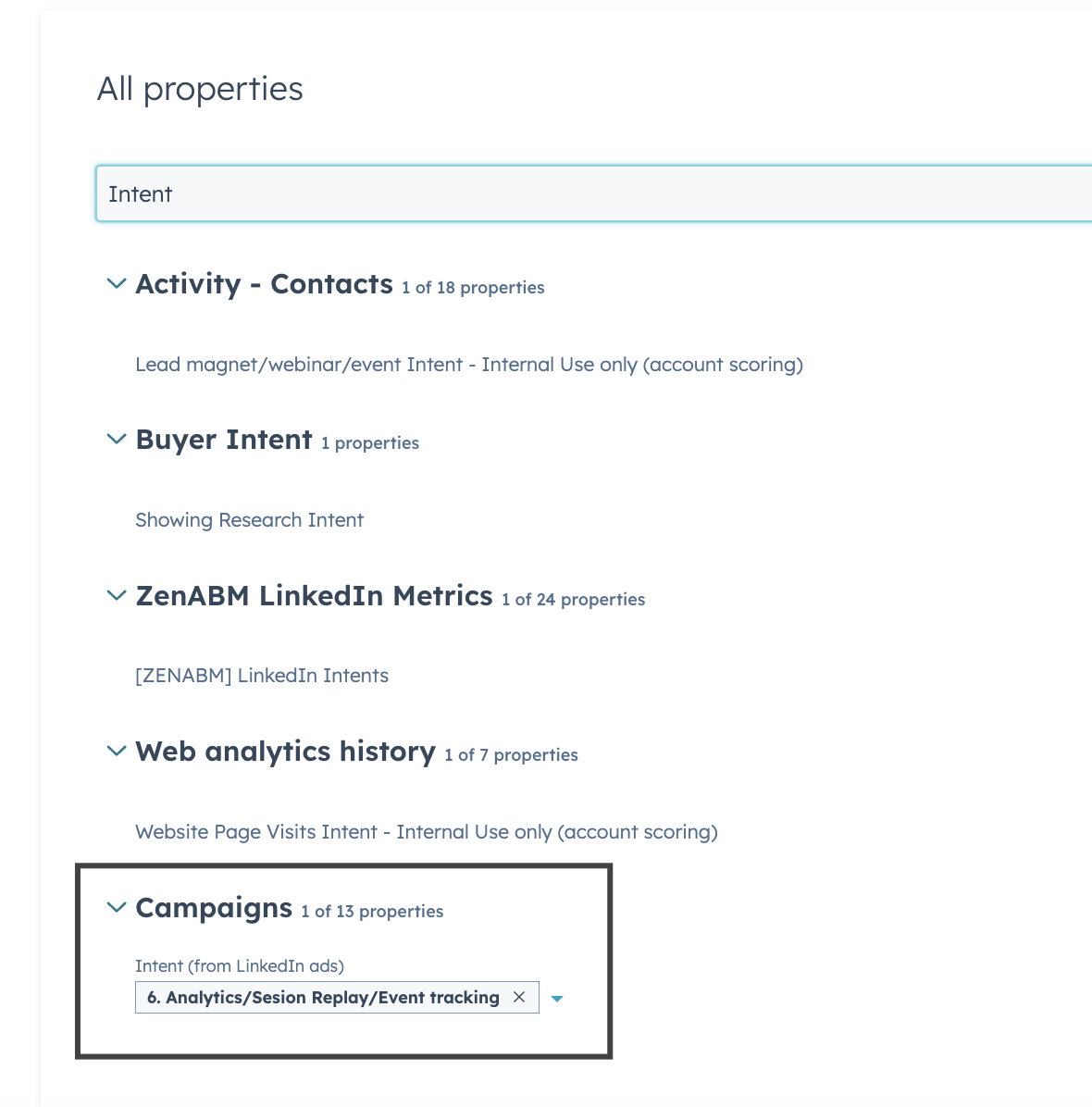
You can push these topics into your CRM, so sales and marketing can tailor outreach to what each company has actually explored.
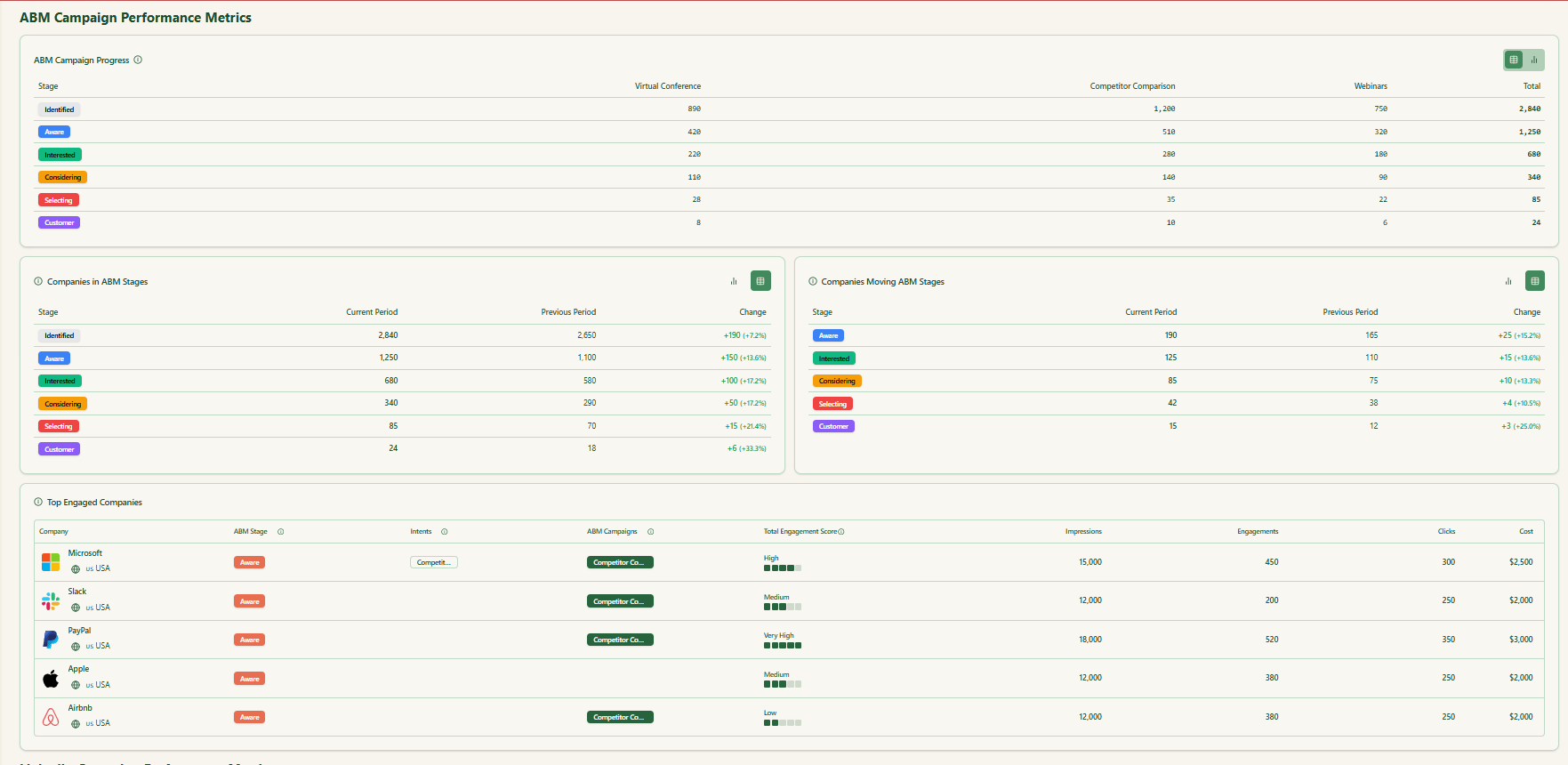
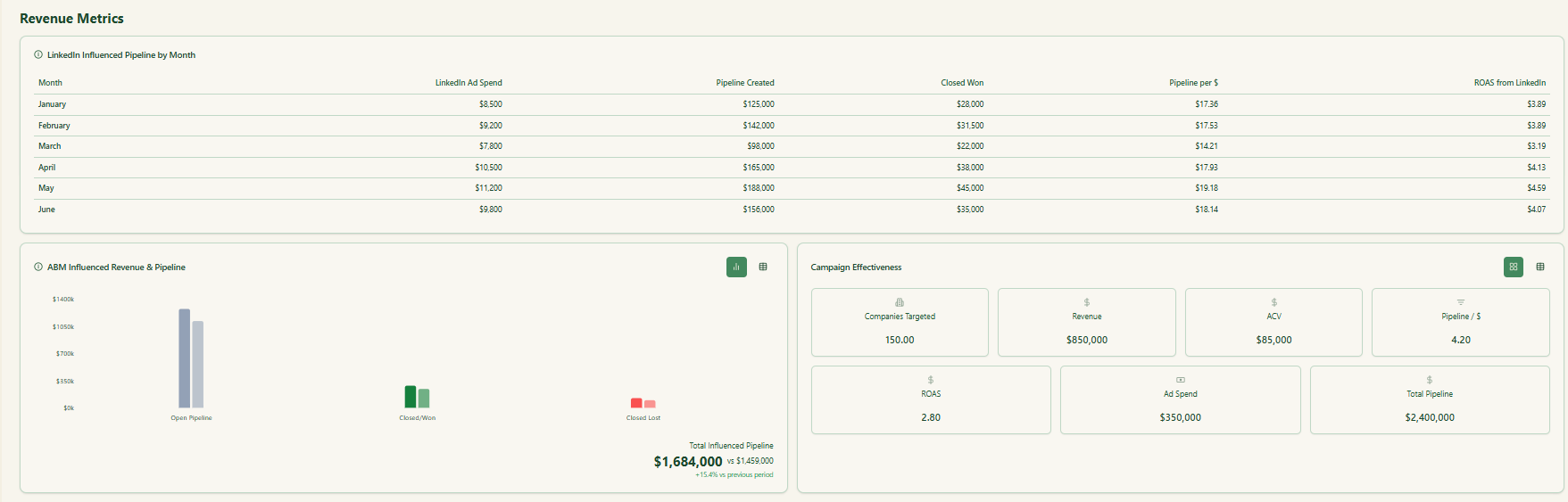
ZenABM ships with dashboards that connect LinkedIn ads to account engagement, stage movement, and revenue.
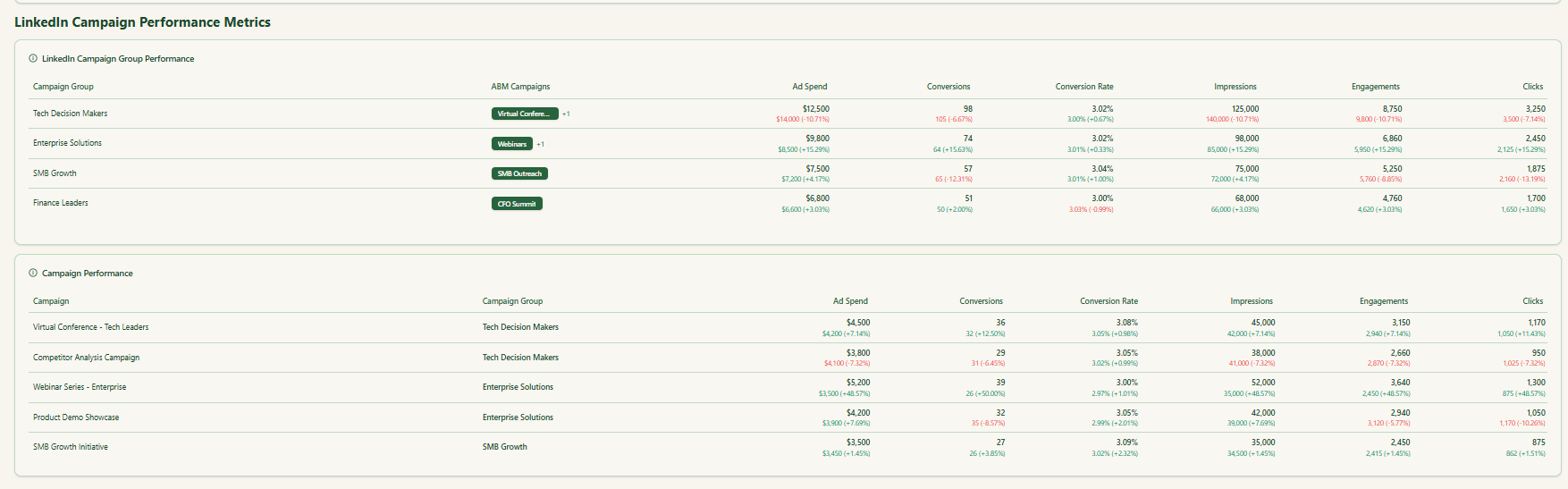
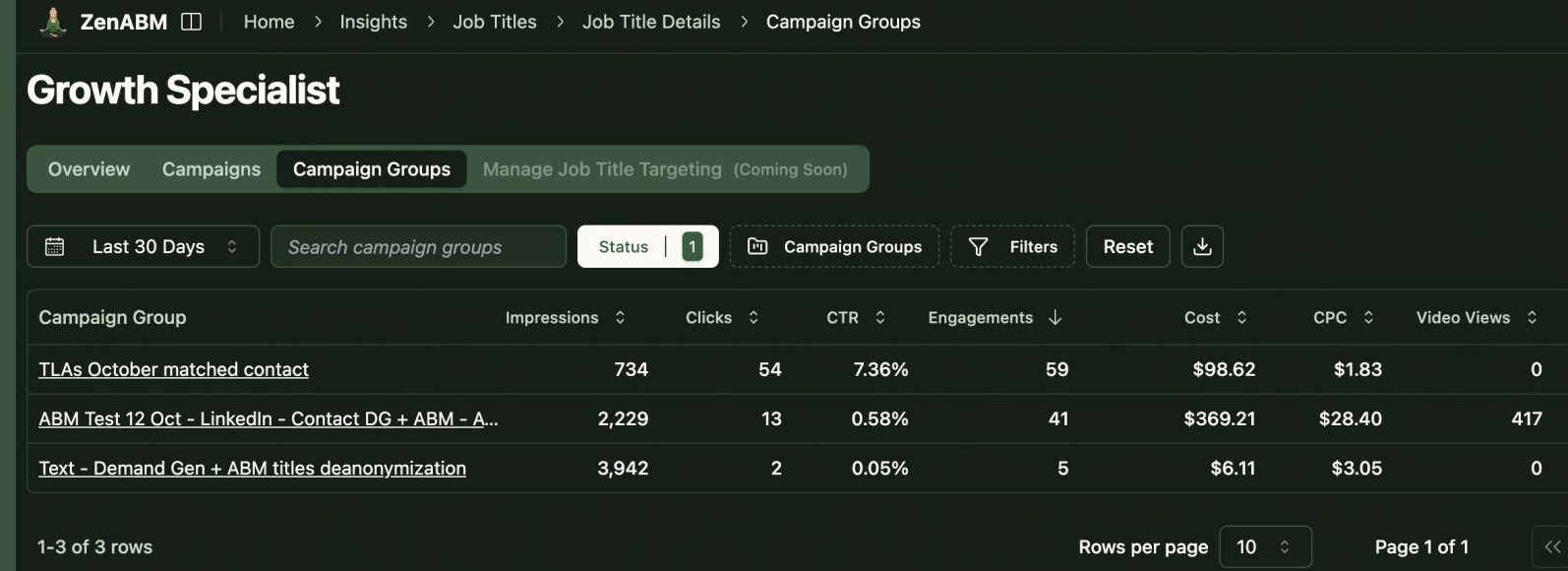
ZenABM shows which job titles engage with your creatives and gives dwell time and video funnel analytics.
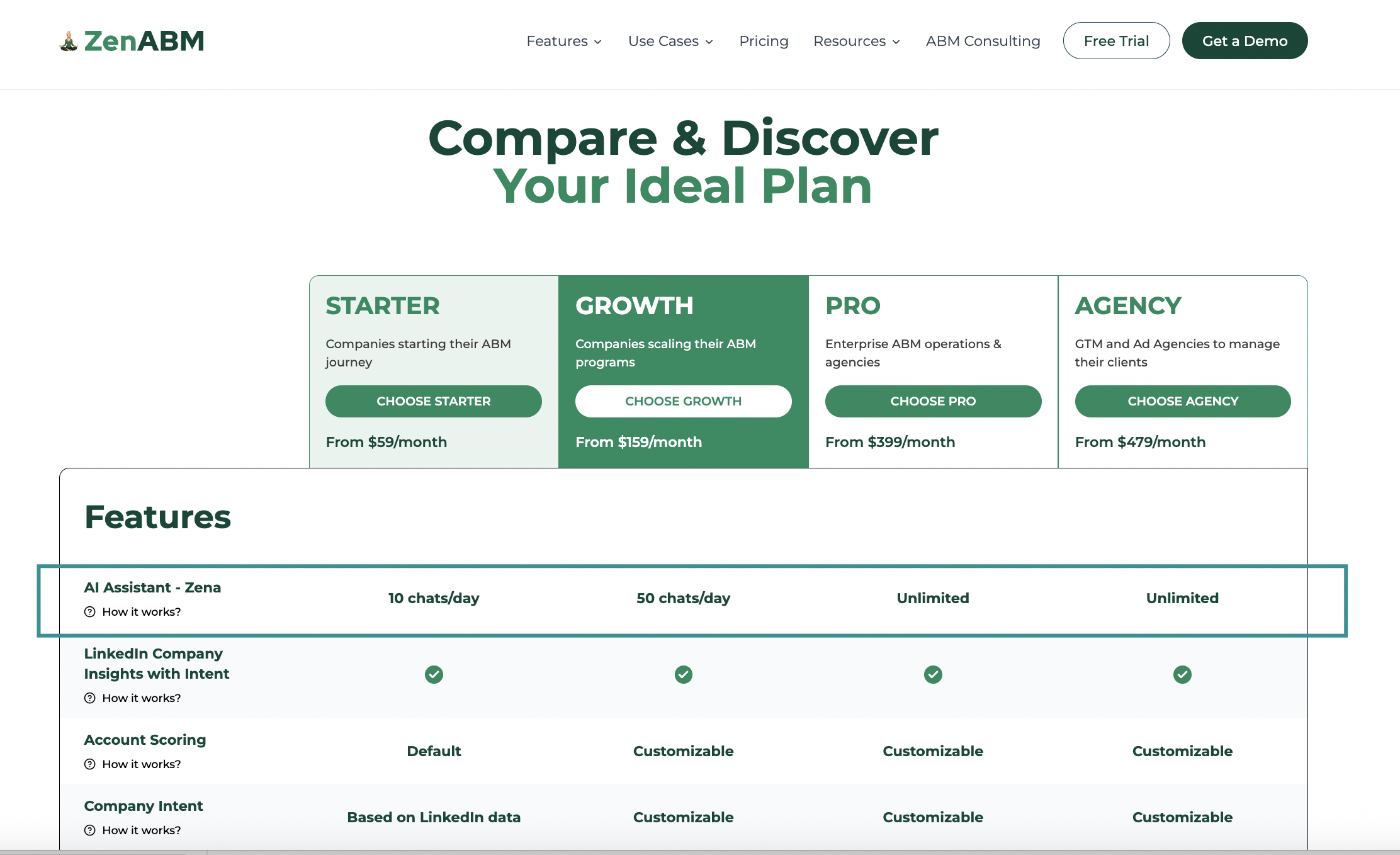
ZenABM provides its AI chatbot called Zena that answers analytics questions in natural language.
You can ask Zena open-ended questions like you would a smart analyst and get company-level answers about:
Under the hood, Zena combines OpenAI with a library of prompts and endpoints to join ad engagement, spend, and CRM deals so it can explain which campaigns drove pipeline, which accounts turned into opportunities, and where performance concentrates.
Instead of exporting spreadsheets and stitching pivot tables, you get plain language outputs that can be used in reviews, standups, or exec updates.
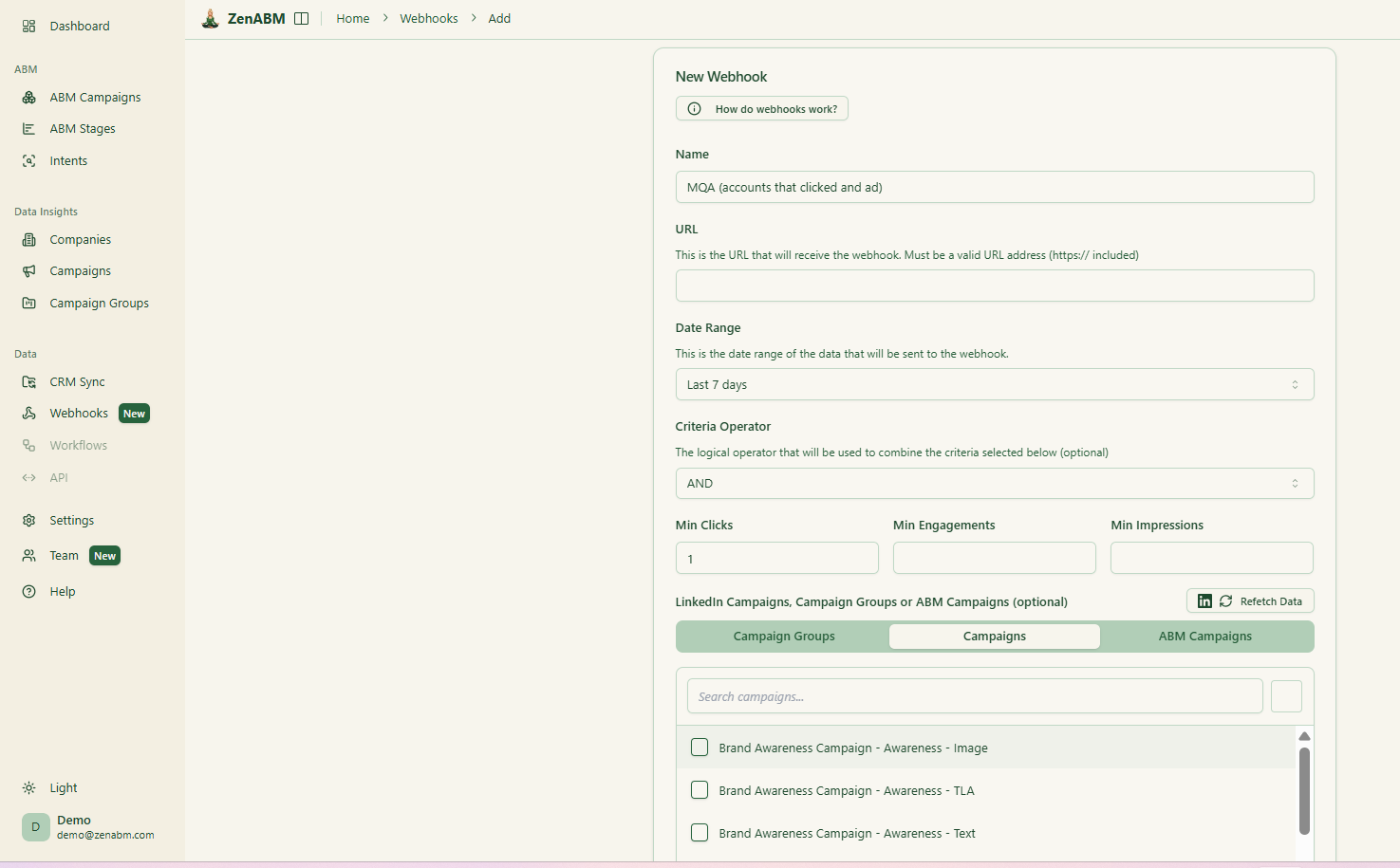
ZenABM’s custom webhooks let you push events into your stack, for example, Slack alerts, enrichment flows, or other ops automations.

Most tools treat each LinkedIn campaign separately. ZenABM lets you group several into one ABM campaign object so you can see performance across regions, personas, or creative clusters.
Instead of juggling fragmented reports in Campaign Manager, you see spend, pipeline, account movement, and ROAS for the entire initiative.
For agencies, ZenABM offers a multi-client workspace.
You can manage multiple ad accounts and clients in one environment, each with its own ABM strategy, dashboards, and reporting, instead of constantly switching accounts in Campaign Manager.
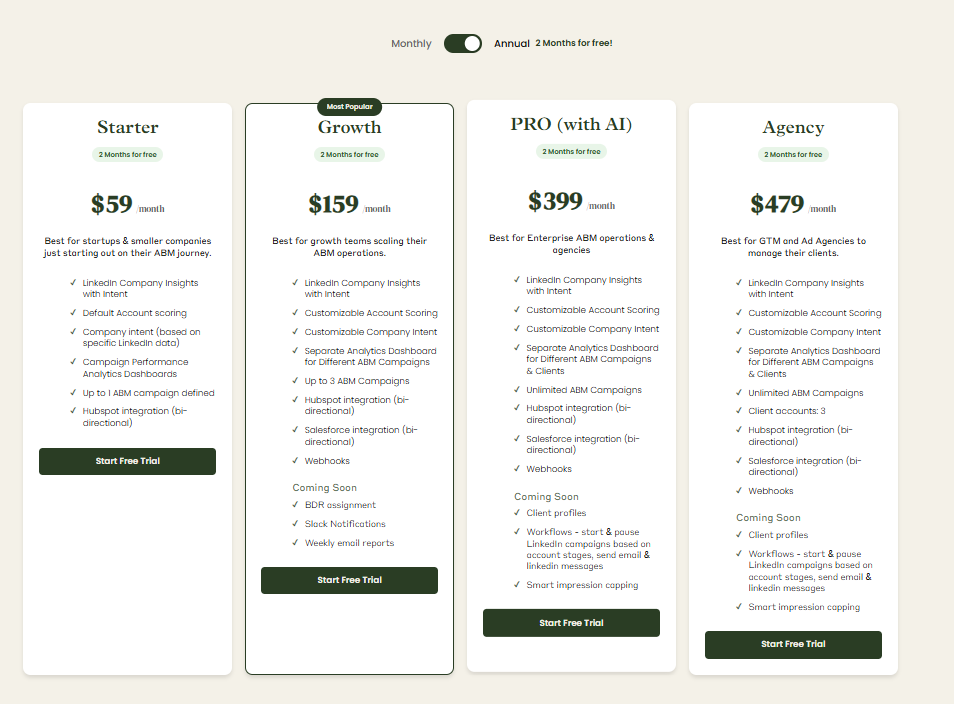
Plans start at $59/month for Starter, $159/month for Growth, $399/month for the Pro (AI) tier, and $479/month for the agency tier.
Even the highest tier costs under $6,000/year, far less than most enterprise attribution suites.
All plans cover essential LinkedIn ABM functions, with higher tiers mostly expanding limits or adding Salesforce integration.
Pricing is flexible (monthly or annual with two months free), and a 37-day free trial allows teams to try before buying.
Dreamdata is built for teams that want unified attribution plus activation workflows across a broad GTM stack, and who can commit to implementation and ongoing data quality.
If you truly need multi-touch attribution across multiple channels, long cycles, and complex buyer journeys, Dreamdata can deliver value, assuming tracking and lifecycle definitions are solid and the team operationalizes the platform.
If your ABM motion leans heavily on LinkedIn and your immediate need is to see which accounts are engaging, what themes they respond to, how they move stages, and what pipeline is being influenced right now, a LinkedIn-first layer is often the more practical starting point.
ZenABM gives you that focus with first-party account-level LinkedIn insights, faster setup, predictable pricing, and ABM workflows that connect engagement to action.
For many teams, it is the operational choice, and for others, it is a strong complement.
The 37-day free trial makes the evaluation straightforward.
