

©2026 ZenABM - All Rights Reserved.

When I first dug into ABM and realized most ABM platforms (ZenABM excluded) start around $10K per year, I asked a simple question: how to run ABM without expensive ABM tools so I can prove impact before I ask for budget.
I was not about to walk into a leadership meeting and say, “Please fund $30K for an ABM program to cover software and talent, and yes, this would be my first rodeo.”
If any of these constraints sound familiar, this playbook is for you:
If that is what is holding you back, I have laid out a lean LinkedIn-first ABM approach that you can execute right now with a tight spend and clear results.
And yes, I will explain why LinkedIn is the right starting channel when you are running lean.
Read on…
Account-Based Marketing usually assumes large budgets and teams to personalize at scale.
“Lean ABM” keeps the ABM discipline but trims the tooling and media waste. You concentrate spend only where it can move accounts.
LinkedIn is tailor-made for this approach because it offers precise, professional targeting and reliable reach inside named accounts.
You can segment by company, industry, title, and seniority so ads land with the right people inside each target account.
Take a look at what Sales Navigator makes available:

You can assemble your TAL there, then target that exact list in LinkedIn Campaign Manager and expand with look-alikes if needed.
This enables one-to-many ABM motions at scale on LinkedIn, where only ICP accounts see your ads.
Note: LinkedIn can be pricey on CPC and CPM, yet it pays when you stay disciplined. The trick is a tight TAL, smart segmentation, and coordinated sales touches to avoid wasting impressions on low-value audiences.
Before you launch, lock down these planning blocks so your spend aligns to outcomes.


With groundwork in place, let us get hands-on and build a lean ABM strategy for LinkedIn step by step.
A strong Target Account List is the backbone of ABM and becomes non-negotiable when you are running lean.
Every account on the list must fit your ICP and carry genuine potential value. A sloppy list wastes creative, budget, and sales time.
Here is a practical path to a right-sized TAL.
Work with sales and leadership to lock firmographics and traits that predict value.
Think employee count, industry, region, tech stack, revenue, and growth stage.
Do not chase dream logos only. Anchor criteria to where you have already won.
For example, the Userpilot marketing team analyzed past win-loss data to find patterns among customers that closed and those that did not.

They identified segments that fit best, such as SaaS companies of 50–2,000 employees in specific regions, then built the enriched account list with Clay and BuiltWith and focused execution there:

The lean path starts inside your CRM.
Mine:
Loop sales in early. Siloed lists miss context. Reps can sanity-check whether giant logos are realistic or if mid-market converts faster. Do not just grab the top 50 firms in your space. Cross-check with historical progression.
When budgets are tight, less is more.
Starting with 50–100 right-fit accounts is a smart first LinkedIn cohort.
Deep engagement with 50 aligned accounts beats shallow reach to 500 random ones.
Create disqualification rules so low-fit accounts never enter the list.
For net-new accounts that match your ICP, Sales Navigator is your best ally.
Free Resource: We spoke with GTM and Clay specialists about practical ABM recipes. See 7 proven methods here.
Do not outsource judgment to automation.
Spot-check each account. Remove subsidiaries that are not buyers and low-revenue companies if they cannot purchase.
Fix obvious mismatches. If you sell to SaaS only, drop manufacturing outliers.
Also, fix data hygiene before launch. Standardize company naming and deduplicate. Clean data in means clean targeting out.
Once the account list is right, identify who to reach inside those firms.
A lean ABM plan focuses on the few personas that drive decisions and uses LinkedIn to get in front of them.
For each account, map the economic buyer, the user champion, and influencers like IT or security where relevant.
If you already maintain buyer personas, align them to accounts now.
Example for a SaaS motion: Head of Product as buyer, Product Manager as champion, and UX Lead or Engineer as influencer.
Create a mini profile that lists pain points and current tooling. This feeds your ad angles and sales outreach.
Use LinkedIn to pull the right people.
In Sales Navigator or even basic LinkedIn, filter employees at each target account by titles that match your personas.
This takes time at scale, so do deep research on top-tier accounts and use broader filters for the rest.
For paid delivery, you can avoid manual emails by using Matched Audiences by company, then layering job function and seniority in Campaign Manager.

Company-based uploads typically match near 100 percent, and LinkedIn auto-keeps your audience fresh as people join or leave.
Uploading contact emails often matches poorly and decays quickly as people change jobs.
Bottom line: Upload a company list to LinkedIn, then filter by function and seniority. Let LinkedIn maintain the roster while you focus on messaging.
If you need emails for outreach or to reach the 300-member threshold, Apollo.io and ZoomInfo can help.
The Userpilot team used Apollo and Clay to pull persona contacts and stamped attributes like Persona and Seniority into CRM lists, then synced to LinkedIn via HubSpot Ad Audiences.

To increase reach inside each account, target several contacts per firm. For SMBs, aim for 2–5, for enterprises 5–10 or more.
Remember: You need at least 300 individuals in an audience to run ads. If the math comes up short, expand personas or combine lists that share creative logic. Keep cohorts coherent so messaging stays relevant.
Finally, verify that you are actually hitting the right people.
Use LinkedIn Demographics in Campaign Manager to confirm titles, industries, and seniorities.
If interns or unrelated roles appear, adjust filters or exclusions. That feedback loop keeps spend tight.
A lean ABM plan on LinkedIn uses a simple multi-stage arc. You serve relevant ads to a named list, watch who engages, and follow with sharper creative and human outreach.
Here is how to set that up with control and speed.


Even with a perfect lean ABM target list, set exclusions.
Exclude current customers unless upselling. Remove roles that add no value, such as HR or Accounting for many SaaS motions.
Also exclude job seekers, interns, and competitors. This keeps impressions focused on buyers and protects your budget.
Sales and marketing alignment is the engine of Lean ABM. Ads create air cover and signal. Sales converts interest into meetings and revenue.
Make that handoff predictable with a few simple rules.

The first click is the starting gun, not the finish line. Keep engaged accounts warm with content that advances the conversation.
Data is your edge when you run ABM without a big stack. Track what moves accounts and iterate quickly.
Smaller programs make it easier to spot patterns and fix issues in real time.
In lean ABM, measure movement through stages, not just clicks.
Define stages such as Identified, Engaged, Interested, Opportunity, and Won.
Use Kyle Poyar’s ABM stages framework as a starting point:

Track weekly progression between stages. If accounts stall, fix messaging, targeting, or sales follow-ups. Stage conversion rates expose bottlenecks.
Pipeline and revenue decide success. Calculate pipeline per dollar, including ads, tools, and time. Compare to outbound and other channels to show efficiency.
If you prefer not to build from scratch, ZenABM provides plug-and-play dashboards for ad-influenced pipeline and revenue:
Identify winning messages and formats, then increase their share of spend.
Use ZenABM to see account-level engagement for each ad creative and campaign group:

Attribution is messy in ABM. Track results at the account level, including impressions, clicks, and eventual deals. Even simple CRM cross-checks reveal the impact that lead-only reports miss.
Lean programs win by adapting fast. Swap out underperforming accounts, test new offers, and fix thin landing pages. Document what your ICP responds to and reuse those patterns.
Celebrate target-logo meetings and pipeline. Quality outcomes beat raw lead volume.
If you want to know how to run ABM without expensive ABM tools and still keep LinkedIn as your core ABM channel, follow a simple recipe that balances precision with velocity. Start by proving impact with a lightweight stack, then scale only what works.
If you are running Lean ABM on LinkedIn, do two things:
Why ZenABM for Lean ABM on LinkedIn:
To run ABM without a bloated stack, you need first-party clarity on which accounts are heating up and which ads spark that movement. ZenABM pulls company-level LinkedIn ad engagement data, including impressions, clicks, and engagements, plus ad spend for each LinkedIn campaign. You see which accounts are warming up by campaign and time window, without guesswork.
Lightweight ABM needs a simple way to separate noise from intent. Beyond raw engagement per company, ZenABM rolls historic and current activity into a company score that reflects awareness and buying interest. This gives you an at-a-glance signal to prioritize accounts without expensive intent add-ons.
Based on engagement and your CRM data, ZenABM assigns an ABM stage to each account. The engagement thresholds for these stages are fully customizable, which keeps your model aligned with your sales process rather than a vendor black box.

Speed matters when an account shows intent. Because ZenABM tracks the ABM stage of each account from engagement and CRM context, it can auto-assign hot accounts that hit your Interested threshold to BDRs in your CRM. That keeps your sales motion immediate and consistent, which is exactly what you need when running lean.

Your BDR outreach starts immediately without daily lookups or manual Slack alerts, which lowers tool overhead and saves hours each week.
Running ABM without expensive ABM tools means marketing can live in ZenABM and MAPs while sales stays in the CRM. ZenABM automatically pushes engagement as company properties, so reps see signals in their normal view and act fast.
For the return path, ZenABM matches engaged companies to deals in your CRM and pulls deal value for revenue context, which lets you report pipeline per dollar without stitching spreadsheets.
Proof beats promises when budgets are tight. ZenABM, powered by company matching and deal value, gives you ready-made ABM analytics and ROI dashboards so you can show impact early and often.

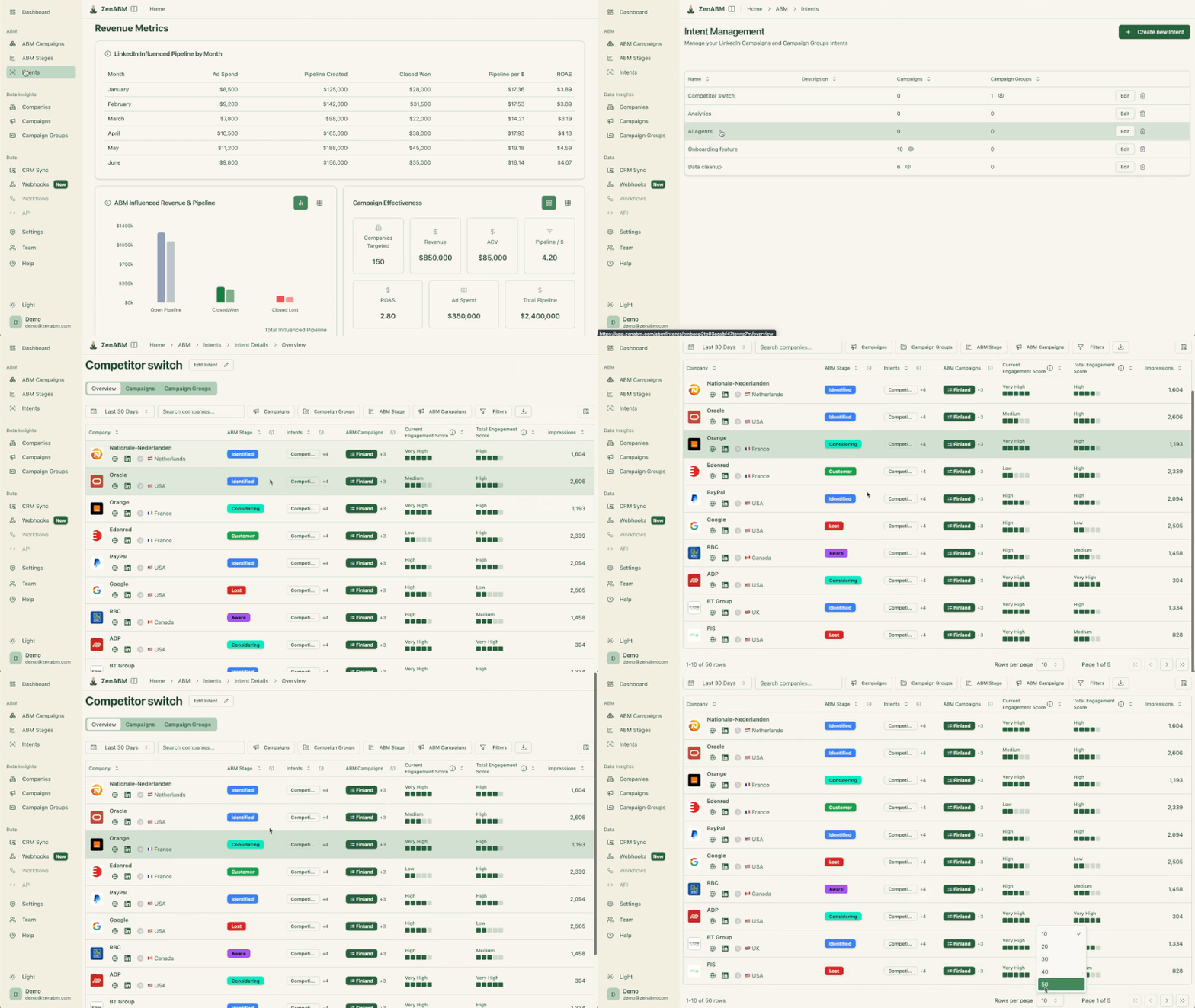
Third-party intent adds cost and delay, which conflicts with a lean plan. A practical alternative is to encode qualitative intent inside your LinkedIn campaigns and tag those campaigns in ZenABM. For a product management SaaS, create campaigns for intent themes like product analytics, onboarding, session recording, or all-in-one, then review the intent signals per company in ZenABM.
Something like this keeps your structure tidy and your insights actionable:

Then tag each campaign with intent in ZenABM so you see qualitative interest at the company level without buying extra tools:

ZenABM will also cluster companies with similar intent, so prioritization is faster and more confident:

Plus, ZenABM pushes intent to your CRM as a company property, so sales team has context on day one:

Your BDRs will know which accounts are hot and what to talk about on outreach, which is essential when you are proving.
Lean ABM thrives on fast feedback loops, which means you should see stage movement clearly and fix friction quickly before budget drifts.
ZenABM maps how many companies sit in each stage and how they move, so you can act with confidence. If many companies move from Aware to Interested but stall there, update sales follow-ups or improve the retargeting offer to push them to Meeting.
You do not need a six-figure stack to run ABM that works. A tight TAL, relevant creative, and fast handoffs can deliver results while you keep tooling light.
Start with LinkedIn, align with sales on simple MQA rules, and measure pipeline per dollar so leaders see impact early and clearly.
When an account crosses your threshold, act within 24 to 48 hours and reference the exact themes they engaged, then let data guide the next iteration.
ZenABM makes this practical by surfacing company-level impressions, clicks, and intent inside your CRM, by triggering BDR handoffs automatically, and by giving you revenue attribution dashboards without extra build work.
