Black Friday: up to 30% off ZenABM 💥Get up to 30% off ZenABM with our massive BlackFriday sale! 💥 - only 27-30 November!Get the deal12 Days of ABM Christmas · Report on your 2026 LinkedIn ABM & plan 2027 · Free webinars, 26 Nov – 9 DecSave your seat


Emilia Korczynska is Head of Marketing and co-founder at ZenABM. Before that she was VP of Marketing at Userpilot for nearly 7 years, where she ran a large ABM program primarily on LinkedIn ads.

Creative ABM ideas that work on LinkedIn start with the ad itself: who is in it, what the first page says and what the first three seconds show. This post covers six: Thought Leader Ads, document ads with a strange first page, talking-head videos, image ads with humour and real photos, a cold and warm message split, and small offline events for accounts that already engaged. These are the plays I would run first on a small budget, and you can see which companies reacted to each one in ABM campaign analytics dashboards.
Campaign Manager shows clicks and impressions for each ad, but not which companies sat behind them. ZenABM shows which companies engaged with each LinkedIn ad, so you know who deserves the next touch.
Here are the four ad plays and the cold, warm and offline path they feed:

This table matches each idea to what the account sees and where it fits best:
Idea | What the account sees | Best for |
|---|---|---|
Thought Leader Ads | A post from a real person, sponsored | Cold accounts, trust and reach |
Document ads | A document with a strange first page | Warm accounts, guides and reports |
Talking-head video | A person speaking to camera | Warm accounts, founder or customer voice |
Humour and real photo image ads | A funny or human single image | Cold awareness, stopping the scroll |
Cold vs warm sequencing | Different message by temperature | Every campaign |
Micro-events and exec dinners | A small in-person invite | Accounts that already engaged |
Here is how the three feed formats compare, using the median account in ZenABM's latest data pull (168 LinkedIn ad accounts, 27 April to 25 October 2026):
Format | CTR (all clicks) | Cost per landing page click |
|---|---|---|
Thought Leader Ad | 3.37% | $28.73 |
Single image ad | 0.53% | $15.26 |
Video ad | 0.69% | $27.39 |
CTR and CPC count every click on the ad, including likes and "see more". Cost per landing page click counts only the clicks that reach your page, so it is the fair way to compare formats. ZenABM calculates the landing page version out of the box, because Campaign Manager does not show it.
Thought Leader Ads are the first format I would try, because a real person's post gets read in a way a company page ad does not. The format turns a post from your CEO, a colleague, a customer or someone who mentions you into an ad. For the full playbook, see the ultimate guide to LinkedIn Thought Leader Ads.
Here is one from our Thought Leader Ads gallery, a post by Mathias Skov Onsby promoted by SparkForce, with its CTR, impressions and dwell time:

The gallery came out of the TLA Bootcamp, an event we ran in June 2026. We analysed 50+ Thought Leader Ads submitted by LinkedIn ad experts and showed them with their CTR, eCTR and dwell time. You can browse more in the best LinkedIn Thought Leader Ads examples gallery.
Best for: building trust through borrowed authority and brand awareness with cold accounts.
Across those 168 accounts, the median Thought Leader Ad had a 3.37% CTR against 0.53% for single image. LinkedIn makes a similar claim: Thought Leader Ads see 2x higher click-through rates than other single-image ads with the same objective, according to Social Media Today.
Do not stop at CTR. It counts every click, including likes and comments. On landing page CTR, Thought Leader Ads and single image ads are level at 0.37%, and the median landing page click costs $28.73 for Thought Leader Ads against $15.26 for single image. So use Thought Leader Ads for trust and reach, and judge traffic on the landing page numbers.
You can sponsor posts from four kinds of people:
You always need the author's permission. In Campaign Manager you can search posts from your own employees and from 1st or 2nd degree connections, and members can revoke permission later. Setting up the ad set needs super admin, content admin or Sponsored Content poster permissions on your company Page.
We once ran a customer advocacy programme where customers submitted a post in exchange for a reward, and we wound it up. Customers are not marketers, so we spent our time chasing fixes: posts in other languages, wrong links in the wrong place and posts written only to earn the reward. I went through what we learned in our TLA webinar on recruiting stakeholders, customers and influencers.
Thought Leader Ads run on Brand awareness, Engagement and Video view objectives. For COLD accounts I use Brand awareness, and for WARM retargeting I use Engagement. A Thought Leader Ad has no CTA button, except Event Thought Leader Ads. That surprises people, and it means the post itself has to do the work.
Add your landing page link to the organic post a few days after it goes live. The ad then sends clicks somewhere without you needing a CTA button.
To draft the post copy, try the TLA generator.
A document ad works when the first page makes someone stop and open it. Page one is the whole ad, because most people decide in a second whether to swipe.
Here is the rule I use. Lead with the payoff, a bold stat or a sharp question, never a logo or a title page. Generic cover titles like "Q3 Industry Report" get scrolled past. Something odd on page one, like a number that seems wrong or a question people disagree with, earns the swipe.
Here is what a few sponsored document ads look like in the feed, from Impactable:

Here are the specs you need:
Spec | Value |
|---|---|
File types | PDF, DOCX or PPTX |
Max size | |
Recommended length | |
Gating | With a Lead Gen Form, the full document stays locked until the form is filled |
Preview pages | You choose how many; a single-page document cannot be gated |
Intro text | Truncates around 150 characters on mobile |
This is how I would lay out a document ad, with page one doing most of the work:

Best for: warm accounts that already know you, with a guide, a report or a customer story.
Use Engagement for an ungated document that builds trust, and Lead generation when you gate it. An ungated document often earns more trust, and a gated one earns the lead. Pick based on what the account needs next.
Write the intro text as a second hook. The first sentence has to work on its own, because mobile cuts it off early.
A person speaking straight to camera can beat a polished video, as long as the person is worth listening to. LinkedIn's own analysis of 13,000+ B2B video ads found that unscripted moments with real employees or founders got +103% dwell time, and authentic emotion gave +78% engagement.
Here is a testimonial-style video ad from Wistia, with a real customer speaking to camera:

Best for: warm accounts, and founder or customer voice.
Video is not cheap traffic. The median video ad has a 0.69% CTR but only a 0.15% landing page CTR, and a landing page click costs $27.39. Use video for trust, not for clicks.
Use Video view for the ad, then build retargeting audiences from watch depth. LinkedIn lets you build video audiences at 25%, 50%, 75% and 97% watched. Deeper viewers are warmer, so give them the demo ask.
Test the audience temperature first. If the audience is cold, a single image ad gets the landing page click at lower cost, and video fits warm accounts better.
A single image ad stops the scroll when it shows something human or funny, and fails when it looks like a stock photo. In a LinkedIn and Magna study of 67 ads and 1,700 decision-makers, ads seen as creative had a 40% higher likelihood of purchase consideration. In the same study, 64% of decision-makers said B2B ads lack humour, 60% said they lack emotion and 59% said they lack relatable characters.
Best for: cold awareness and stopping the scroll with a small budget.
In ZenABM's own analysis, 0% of top single image ads (2%+ CTR) used stock photography. They used branded graphics, real team photos, product screenshots or diagrams. Single image is also the cheapest of the three feed formats for traffic: the median account paid $15.26 per landing page click, against $28.73 for Thought Leader Ads. For the full format guide, see LinkedIn single image ads.
Will Aitken claims 22M impressions from memes. He uses them not for instant conversions but to prime the algorithm, so his educational posts get reach later.
LinkedIn's analysis of B2B video ads also found that memes gave +111% engagement. Always credit the original creator when you share a meme, because skipping the credit can land you in legal trouble.
Here is what a one-to-one personalised landing page looks like:

Draft the image in the single image ad creator and swap in your own photo.
Match the ad to the account's temperature, because a demo ask on a cold account burns a small audience fast. This is the rule I use: COLD ads teach a funny concept with no demo ask, and WARM ads show customer proof and ask.
Temperature | Ad type | Message | Ask | Landing page |
|---|---|---|---|---|
COLD | Thought Leader Ads, humour image ads | One sharp or funny concept | None | Content download or webinar |
WARM | Single image and document ads | Customer proof, case study, comparison | Soft: calculator, comparison | Calculator or comparison page |
HOT | Retargeting, video of a customer | Direct response, testimonial | Book a demo | Demo or trial page |
At ZenABM I split COLD from WARM using ABM stages. COLD is Identified plus Aware, and WARM is Interested plus Considering. In our Q4 plan, the cold signals come from two campaigns. Air Cover is very cheap impressions that don't count unless someone clicks, and Meaningful Engagement is documents plus Thought Leader Ads. The WARM audience fills slowly, so plan for it: the goal in our plan is about 6,500 warm companies by mid-December.
Here is how the ABM stages are configured:

And here is the campaign structure that moves accounts from awareness ads into engaged-stage campaigns:

Here is what to say to cold, warm and hot accounts, and what to ask each one for:

One more fact to plan around: for the accounts that converted in July 2026, it took ZenABM an average of 22 weeks, 1,159 impressions per account and almost 8 campaigns. Keep the creative fresh.
You do not need a big budget to test this. Here is the test I would run first:
I learned the last two steps from our own programme: run fewer creative assets, review them bi-weekly and replace under-performers with ones similar to what moves the needle.
Here is the five-step test, with one metric and a review every two weeks:

Check that your budget supports the number of ads before you launch, because spreading it too thin means ads do not get delivered. The ABM Budget Calculator plans the spend, and the LinkedIn Ads Count Calculator shows how many ads each budget can carry.
See which companies engage with your LinkedIn ads
Campaign Manager shows clicks and impressions, but not the companies behind them. ZenABM shows you which companies engaged with each ad, so your next creative starts from a real signal.

Offline plays work as the next step for accounts that already engaged on LinkedIn, not as a cold-start tactic. Start from the list of accounts that engaged, then invite them.
I am not a fan of huge conferences. You spend your time queuing for the bathroom and hunting for an overpriced hotdog stand, and no one has time for a real conversation. Small beats big:
Here is Intridea's billboard, put up across the street from Ogilvy's New York office:

Log the event in your CRM within 24 hours and follow up personally within a week.
To pick the guest list, filter your Companies view by engagement score and ABM stage, then push the Interested-stage accounts to your CRM or to Clay by webhook. Community hubs are the low-cost version, so show up in the Slack groups and forums where your buyers hang out, add value and do not spam. We also run a ZenABM Slack community.
Here is a three-step framework for planning an ABM event strategy:

Once the creative is running, automation speeds up the research and outreach around it. An ABM workflow is the chain from finding target accounts to enriching and scoring them and starting outreach, without manual hand-offs. Clay is the hub in most of the examples I see.
These are the most common Clay uses for SaaS teams:
Use case | Clay's role |
|---|---|
Building account lists | Pulls from 150+ data providers to curate lists |
Identifying competitors' customers | Scrapes and enriches competitor customer lists |
Cleaning and validating data | Verifies emails and removes duplicates |
Enriching leads | Adds titles, funding and tech stack |
Scoring accounts | Builds scoring on role, funding and intent |
Personalised copy | Combines AI with CRM fields |
End-to-end orchestration | Runs enrich, score and outbound from one hub |
Here are two workflows worth copying. George Chasiotis, co-founder at Restartt, automates pre-call research. A Calendly booking creates a CRM deal, sends a Slack alert and pushes the contact to a Clay table for enrichment, so sales walks in with context.
Philip Lakin at Zapier exported his LinkedIn network to a Zapier Table and wired an AI agent to query it in plain English, which turns his network into a search engine for target accounts.
For the pipeline that feeds ZenABM signals into Clay, see the Clay for ABM guide. ZenABM pushes engaged accounts to Clay over webhooks, so nobody exports and uploads lists.
Here is the webhook configuration in ZenABM:

You can read intent straight from your own ads. Create ads by theme and group similar ones into campaigns, and each theme becomes an intent when a company engages.
Say you sell a product tool. You could run themes for "product analytics", "user onboarding" and "all-in-one". When a company clicks the onboarding ads, ZenABM tags it with that intent, so your BDR knows which angle to lead with instead of sending a generic pitch.
Here is how the intents look on the companies that engaged:
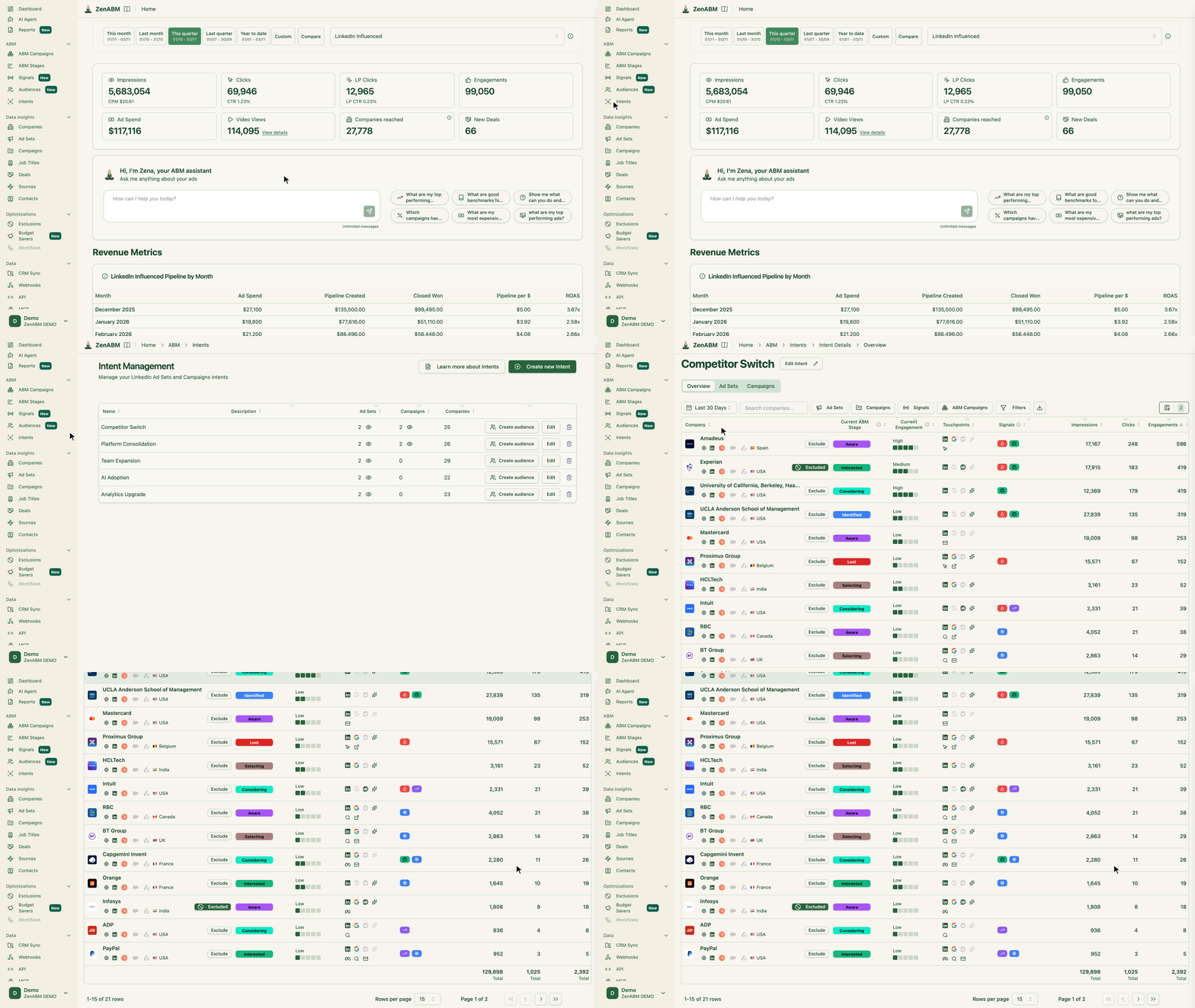
ZenABM syncs the intent to HubSpot, Salesforce or Attio as a company property and can push it to Clay by webhook. The same idea powers a few other plays: account-aware chatbots that greet a visiting company, social listening on target accounts' posts, and signal-triggered drops when a funded or newly hired account shows up. Those work best once you already know which accounts are warm.
I might be a bit biased as a co-founder, but I also know first-hand what it is like to struggle to find the right tool. When I was VP of Marketing at Userpilot, I struggled to run ABM on LinkedIn. My husband watched it up close and built ZenABM to fix it.
Here is which ZenABM capability does which step:
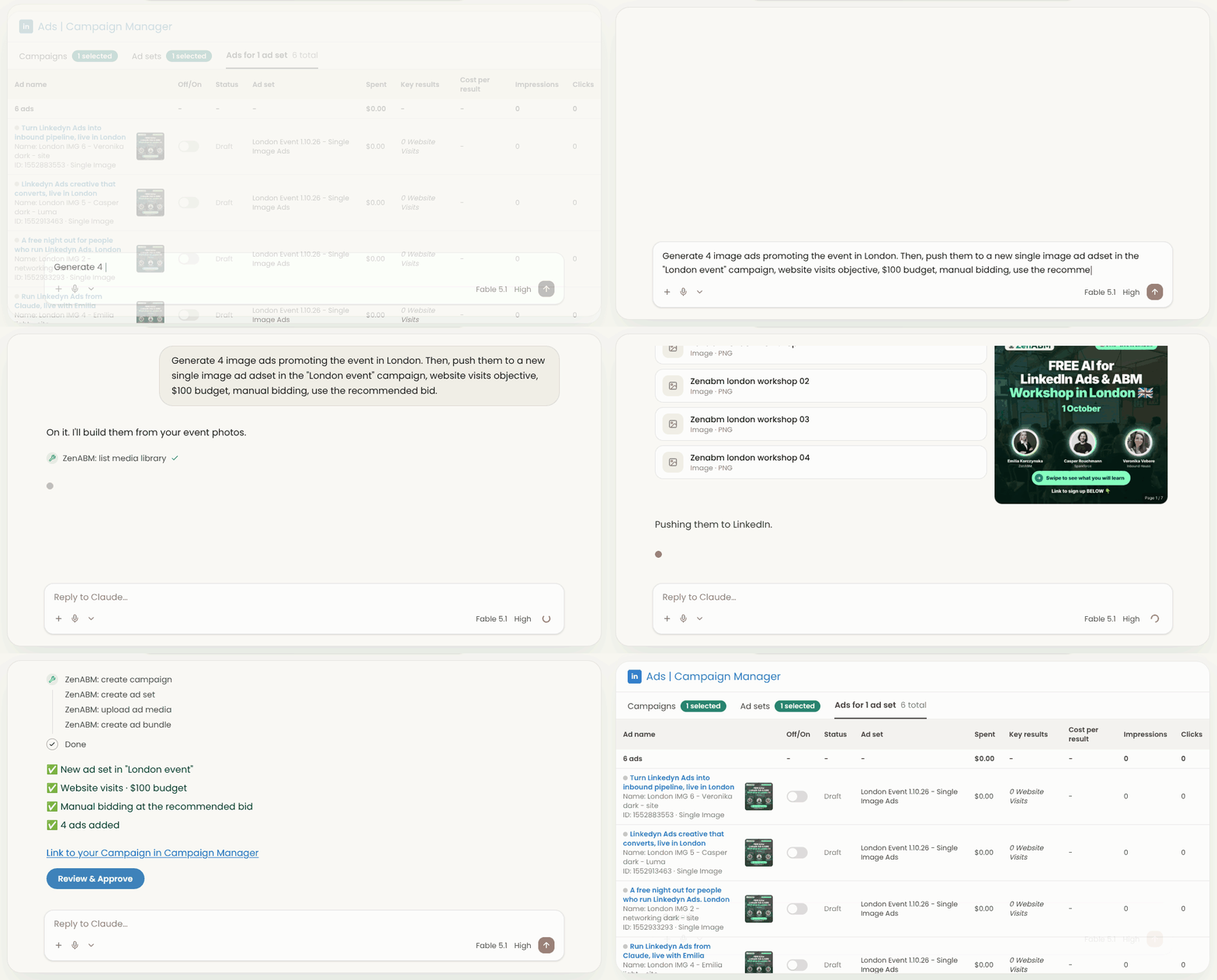
Here is the MCP creating LinkedIn ads end to end in Claude:
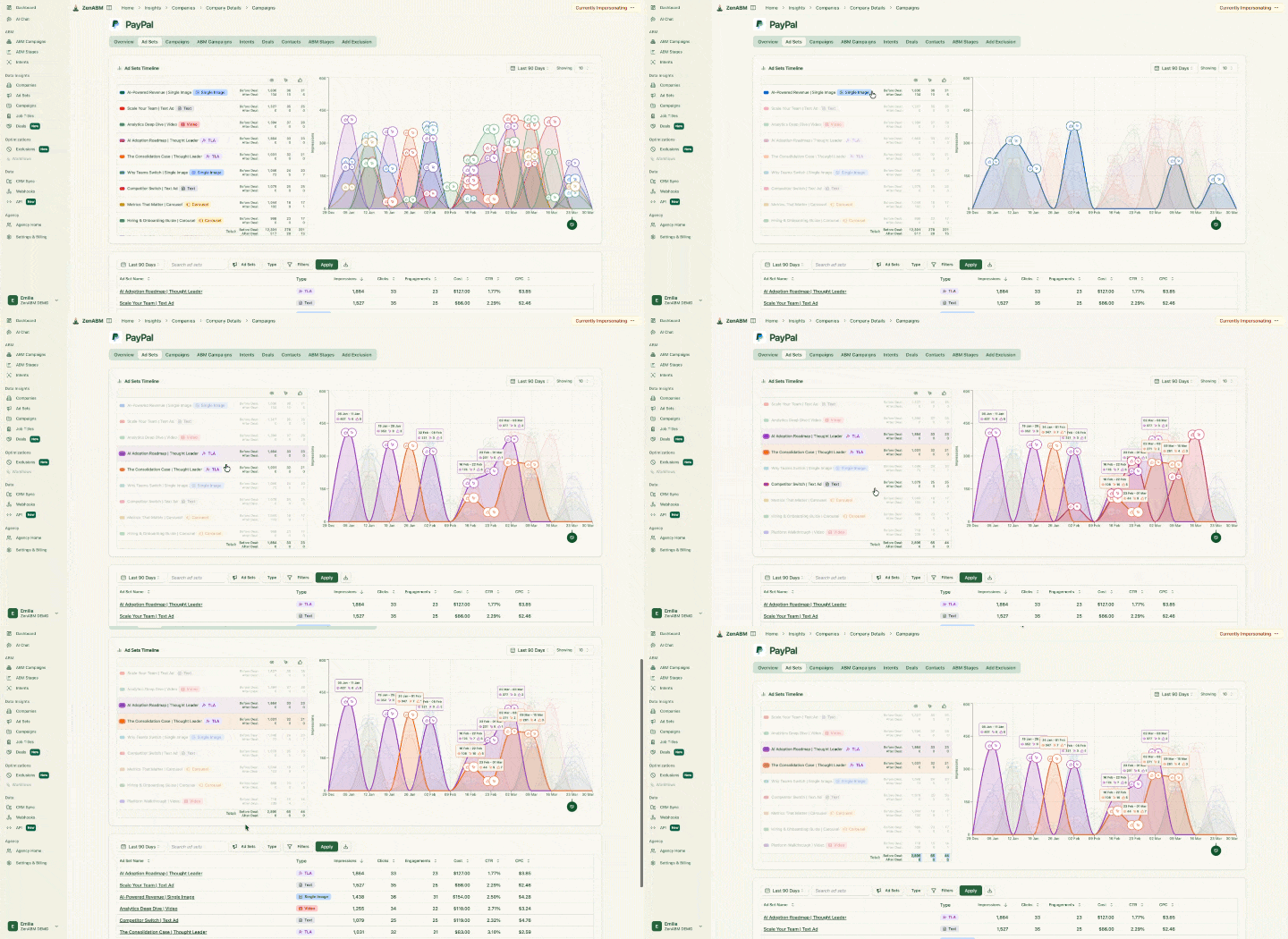
This is the company list with engagement levels, impressions, clicks, CTR and cost per account:

Here is the deal view with an account timeline of campaign touches per deal:
ZenABM has a 5.0/5 rating on G2 from 6 reviews, and one reviewer says they understand ABM beyond theory. A reviewer also notes ABM takes time to compound, so results are not always immediate. ZenABM is LinkedIn-first, so it does not buy display ads, personalise websites or sell third-party intent data, and you would pair it with a display suite if display is your main channel. Plans start at $59/month with a 37-day free trial, and the team ships new features fast.
Try ZenABM free for 37 days
ZenABM shows which companies engage with each ad and pushes that signal into your CRM, so every creative idea starts from a real signal.

The most creative moves on LinkedIn change what the ad looks like: Thought Leader Ads from real people, document ads with a strange first page, talking-head video, and humour image ads with real photos. Offline plays like micro-events come after. ZenABM shows which companies engaged with each ad, so you know who gets the next touch.
Start with one Thought Leader Ad, one cold concept ad and one warm proof ad, and review them every two weeks. In ZenABM's October 2026 data, the median Thought Leader Ad had a 3.37% CTR against 0.53% for single image. ZenABM adds company-level engagement so you can focus.
An ABM workflow is a repeatable chain that finds target accounts, enriches and scores them, and starts outreach with little manual work. One hub, often Clay, runs the steps together. ZenABM adds the engagement signals that tell the workflow which accounts to push to your CRM first.
An ABM motion is the repeatable set of steps your team runs to select, engage and convert target accounts, from research and ads to CRM follow-up. ZenABM tracks the LinkedIn side by showing each company's engagement and ABM stage, so you can see which accounts moved.
Start with a Thought Leader Ad from your CEO or a colleague, because it needs no design work and has a median CTR of 3.37%. Judge it on landing page CTR and cost per landing page click, not on raw CTR. Then add a cold concept ad and a warm proof ad.
About the author

