

©2026 ZenABM - All Rights Reserved.

Account-based marketing (ABM) isn’t just about acquiring new logos; it’s also about retaining existing ones.
So, I stalked ABM and customer retention experts, and researched other authoritative sources to bring you this ultimate ABM retention strategy guide.
I have also discussed how ZenABM can support your ABM strategy.
Read on…
Ask any revenue leader over 50 with battle scars in B2B: they’ll tell you today’s growth comes from expanding and retaining existing accounts and not just chasing new ones.
This is especially true for businesses operating on a recurring revenue model, where up to 70% of revenue can be generated after the initial sale.

Additionally, customer retention is approximately five to seven times less expensive than customer acquisition, according to Forbes.
You can visualize this approach like a double-sided bow tie (and not a funnel that ends at acquisition).

With all this said, the reality is that customer retention and expansion are still not taken seriously by marketers, and the burden is thrown on customer success teams alone (most small businesses don’t even have this department!).
My advice?
Drop the outdated “funnel” mindset and think in terms of a bow-tie or infinity loop where the customer journey never ends, and don’t shy away from using ABM for this approach.
Before you unleash advanced tactics, get your house in order 🙂
I’m talking about the alignment of your marketing, sales, and customer success teams.
ABM retention strategy demands tight orchestration across departments. No more passing the baton at closed-won and hoping customer success “handles” it. Everyone from the SDR to the CSM to the RevOps analyst should be rowing in the same direction with the same intel.
Establish a single view of each account in your CRM and tear down the walls.
Ensure marketing can see product usage and support tickets, sales can see campaign engagement, and customer success sees everything from day one. A shared account dashboard with status, health score, renewal date, open opportunities, and recent activities is a must.
Invest in RevOps and tools that unify these data streams (it pays off).
ZenABM, for instance, pulls all the LinkedIn ad engagement data at the company level and pushes it as a company property to your CRM automatically:


So, your sales and customer success teams don’t even need to log in to ZenABM. All’s available in the CRM.
Regular cross-functional check-ins are, I’d say, a must and include weekly pipeline and account review calls where marketing, sales, and CS leads huddle on the same numbers.
These meetings ensure everyone knows who’s targeting which accounts and why. If Marketing is still patting itself on the back for MQLs while Sales chases bookings and Success is scrambling at renewal time, you’re doing it wrong. Instead, define shared KPIs that actually matter for retention: churn rates, renewal rates, account growth, Net Promoter Score, net revenue retention, etc.
Bake alignment into your Ideal Customer Profile and account selection.
Don’t just hand Sales a target list and disappear.
Collaborate to refine which accounts have high expansion potential or fit your product’s sweet spot for adoption.
Pro Tip: The best ABM practitioners revisit their ICP for existing customers, not just prospects. For example, if you sell a multi-module SaaS platform, your ICP for expansion might be customers using Module A heavily who could benefit from Module B. Use product usage data and industry benchmarks to flag these opportunities. Identify growth opportunities continuously. E.g. a manufacturing client showing increased output might need more of your solution, or a SaaS client hitting user limits might be ripe for an upgrade.
Finally, empower a Revenue Operations (RevOps) framework to operationalize all this.
RevOps can automate the workflows that ensure no account falls through the cracks.
For instance, the RevOps team at LeanData runs an automated renewal play: 120, 90, and 60 days before an account’s renewal date, they check if a renewal opportunity is in the proper stage. If not, the account manager personally reaches out.
On the flip side, they have also set up churn risk alerts like health score drops, usage dips, or other risk factors flagged in CRM.
The takeaway: Systematize your retention workflow. Don’t wait until 30 days before renewal to scramble; bake proactive retention plays into your cadence (I’ll cover more plays shortly).
Enough preaching.
Let me show you the tactics now:
Yes, you read that right. The deal might be closed, but in ABM, a customer is never “closed.”
You market to them continually as if you’re still trying to win their business. In a way, you are, right?
Pro Tip: Dedicated customer newsletters featuring highly curated content for users of your product. This isn’t your generic marketing newsletter. It’s more akin to an elite insider brief. Share industry news, how-to articles, and (subtly) your product’s latest capabilities. Position it as an “exclusive” resource. People love feeling like they’re part of a special club of power users. And if you can spotlight one customer’s success story in each issue, even better. Peers learn from peers.
Quality, pricing, and similar factors only come later in the list.
Most churn is primarily due to neglect (as in bad customer service).
In fact, Forum Corporation’s research puts the number of churn cases caused by poor customer service at 70 out of every 100:

So, ABM champions are proactive, almost to the point of paranoia, about heading off customer issues before they fester.
And you must be too:
Pro Tip: Build your own churn prediction model. Your RevOps can do this. Start by unifying product, CRM, billing, and support data, engineering features (feature adoption, seat utilization, ticket volume, payment anomalies) and training a churn model that outputs a daily account-level risk score with top drivers. Segment by risk and tie each driver to a playbook: low adoption → enablement sprint, competitor interest → 1:1 ads + exec outreach (yes, here’s where ABM will come into the picture), ROI-time concerns → flexible ramp. Use AI to auto-draft personalized emails/success plans/in-app nudges and recommend next-best actions per account; let a simple bandit optimize offers and content. Close the loop by tracking adoption lift, renewal rate, and NDR, and retrain the model monthly.
No customer is ever “safe” if your relationship is limited to one or two contacts.
People change jobs, and priorities shift.
If your champion leaves and you haven’t cultivated other allies in the account, your position is on thin ice.
That’s why ABM retention strategy demands multi-threading to develop relationships with multiple stakeholders across the account, vertically and horizontally.
What does this mean in practice?
Bottom line: Don’t rely on one contact. Spread relationship capital so users through VPs have active ties to you. Renewals become smoother because multiple people vouch for your value. This is ABM retention strategy 101 – proactively embed many-to-many relationships so replacing you is hard when half a dozen stakeholders see you as essential.
A smooth, strategic onboarding is absolutely an ABM issue, and not just the headache of CS.
And the goal in onboarding is simple: get customers to value (the “aha” moment) fast.
In fact, companies with structured, well-executed onboarding see a 10% increase in customer retention in the first six months.
That’s huge. So work with your implementation and CS teams to tighten this up.
From an ABM perspective, consider creating onboarding campaigns that run alongside the CS-led training.
Remember, if users don’t adopt the product, they churn. Period. So treat product adoption metrics (feature usage, frequency, depth of use) as ABM retention strategy KPIs, not just CS metrics.
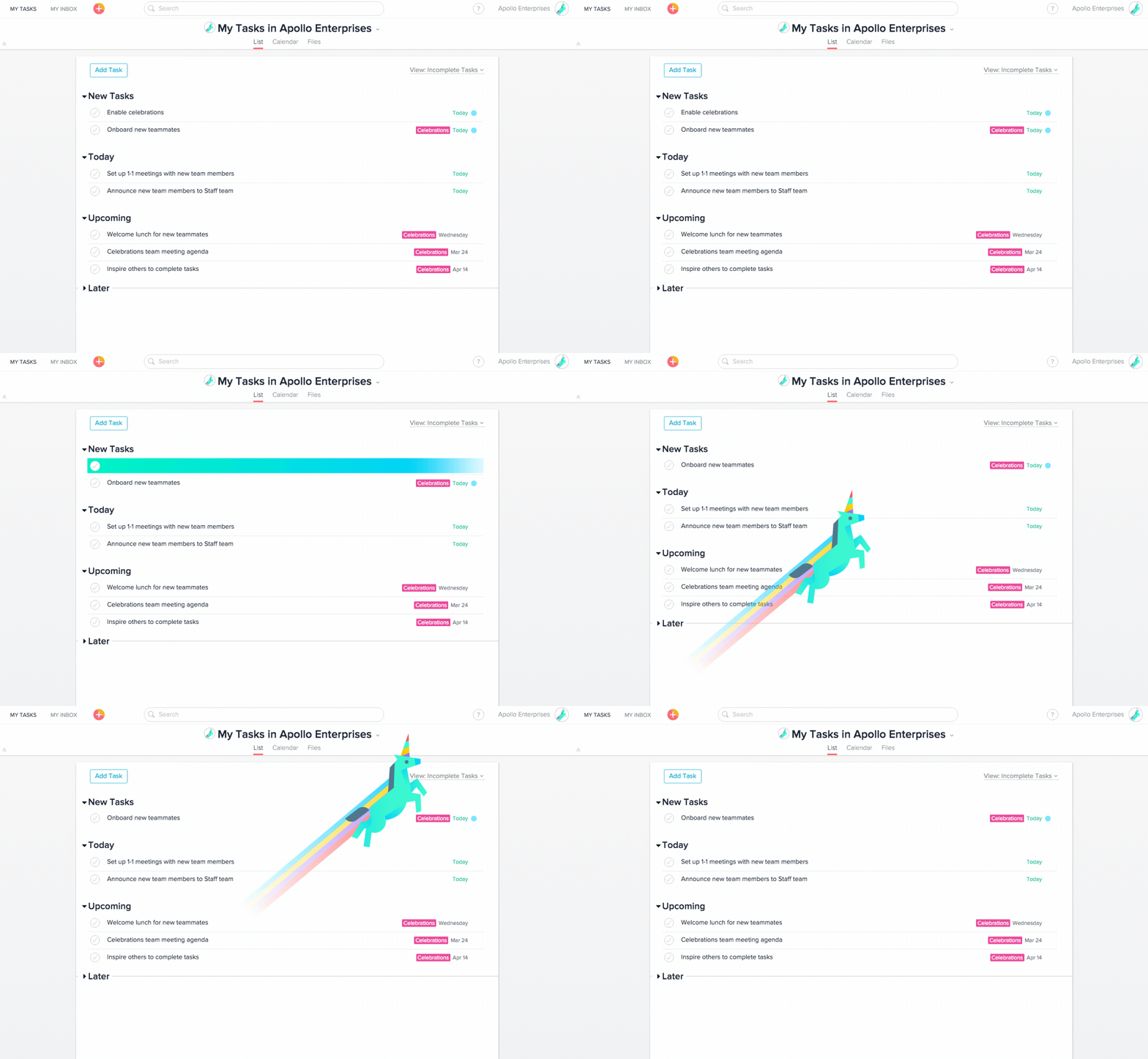
Pro Tip: Celebrate early wins in the adoption phase. When the customer achieves their first milestone, say, 30 days in, and they’ve completed implementation or hit a usage goal. Celebrate it. As cheesy as it sounds, send congratulations emails or use gamified elements. Asana does this pretty well:
Retention isn’t just about keeping the status quo. It’s also about growing the account.
A true ABM expert isn’t satisfied with 100% renewal; they’re aiming for 130%, meaning each account renews and expands.
Upsells and cross-sells are the turbochargers of your retention strategy, converting customer success into more revenue.
And guess what?
ABM retention strategy gives you the perfect toolkit to do this without being salesy.
First, identify expansion opportunities from your data and your customer’s context.
If you have multiple product lines or tiers, figure out which ones each customer doesn’t have yet but could genuinely benefit from.
Look at their industry peers or benchmarks and see if they are under-utilizing something others find valuable?
Use all this intel to pitch upsells that will actually solve the customer’s evolving needs, not feel like random add-ons.
Examples:
Also, be considerate of the timing. Align offers with logical moments like post-success, project kick-off, or new budgets. Please don’t wait for them to ask; by then, you’ve missed evaluation cycles. Instead, deliver data-driven, personalized recommendations like “You’re heavy users of Core, not XYZ (in higher tier); peers use it to achieve ABC; let’s discuss acceleration.”
The final stage of the ABM retention strategy is turning your clients into advocates.
How to do it?
Remember: Loyalty is not just prudent, but also emotional. All the rational benefits in the world (ROI, features, etc.) only get you so far; it’s the emotional connection that produces true loyalty. ABM’s personal touch, the constant value delivery, the feeling that “these guys have our back and really care about our success” – that’s what creates an emotional bond.
If you detect that an account can be upsold/cross-sold to, ZenABM can help you here.
You can first study what offer/feature will entice the customer, and then show them relevant ads on LinkedIn. With ZenABM, you’ll be able to see if the account is engaging with those ads:
If you are showing them multiple ads with different intents, you can track which intent has the most popularity with a particular account:

This will help you in knowing exactly which feature or upgrade you should talk about in your cross-selling or upselling pitch, respectively.
Plus, ZenABM matches engaged companies to the deals in your CRM, so you’ll get advanced dashboards showing if your ads really had an impact and how much:


Retention is your unfair advantage. Now operationalize it!
Use ZenABM to spot intent, prioritize accounts, and prove impact while your team runs personalized save/expansion plays.
Next steps: Book a 30-minute ZenABM demo, ship your first customer-only LinkedIn campaign this week, and stand up a renewal/risk dashboard in your CRM. Let’s turn renewals into NRR with a solid ABM retention strategy powered with ZenABM.
