

©2026 ZenABM - All Rights Reserved.

Carousel ads make up just 2.73% of total LinkedIn ad spend across the 211 companies in our 2026 LinkedIn ABM benchmarks report. Almost nobody is using them. And the people who skip carousels are usually doing so because the blended CTR (0.32%) looks lower than single image ads (0.42%).
That comparison misses the real story. Carousel ads have a unique card-level engagement pattern where later cards deliver dramatically higher CTRs – up to 2.89% on Card 7. The swipe mechanic acts as a self-qualification filter. People who keep swiping are increasingly likely to click.
In this post, I will share the complete carousel ads benchmark data from our 2026 report – overall metrics, card-by-card performance, and how carousels compare to every other LinkedIn ad format. These numbers come from 44 carousel ads analyzed across 211 companies and $5.5M in total LinkedIn ad spend. Here is the summary.

Here is what you should take away from the 2026 carousel ads benchmark data.
Metric | Median | Context |
|---|---|---|
CTR | 0.32% | Blended across all cards |
CPC | $13.30 | Comparable to single image ($13.23) |
CPM | $45.28 | Lower than single image ($47.43) |
Dwell Time | 4.56 seconds | 25% higher than single image (3.64s) |
Budget Share | 2.73% | Lowest of all major formats |
The blended 0.32% CTR tells you what happens on average across all cards and all impressions. But the card-level data below tells a very different – and more useful – story.
Let me put the carousel CTR and CPC numbers in perspective.
At $13.30 CPC, carousel ads cost essentially the same per click as single image ads ($13.23). The difference is negligible. Where things get interesting is what happens between the impression and that click.
With a single image ad, someone sees your creative and either clicks or scrolls past. That is one moment of engagement. With a carousel, someone might swipe through 3-4 cards before clicking. Even if they don’t click, they have spent significantly more time with your message.
The 4.56-second median dwell time reflects this. That is 25% more attention than single image ads (3.64s) and 17% more than video ads (3.91s). Only Thought Leader Ads generate higher dwell time – but those are a fundamentally different format.
For ABM campaigns where you need target accounts to absorb your message (not just see it), that extra dwell time matters. You are getting more content consumed per dollar spent.
The CPM of $45.28 is also worth noting. It is lower than single image ads ($47.43), which means you are paying less per thousand impressions while getting more engagement time per impression. That is a good trade.

This is the data that changes how you think about carousel ads. Most advertisers look at the blended 0.32% CTR and move on. But when you break it down by card position, a powerful pattern emerges.
Card Position | Impression Share | Weighted CTR | CTR Multiplier vs Card 1 |
|---|---|---|---|
Card 1 | 76.32% | 0.117% | 1.0x (baseline) |
Card 2 | 22.75% | 0.274% | 2.3x |
Card 3 | 0.43% | 0.597% | 5.1x |
Card 4 | 0.29% | 0.905% | 7.7x |
Card 5 | 0.13% | 1.121% | 9.6x |
Card 6 | 0.05% | 1.837% | 15.7x |
Card 7 | 0.02% | 2.890% | 24.7x |
Card 2 already gets 2.3x the CTR of Card 1. By Card 7, you are looking at a 2.890% CTR – the highest CTR of any card position in any ad format in our dataset.
Why does this happen? Every swipe is a self-qualification signal. Someone who swipes past Card 1 to Card 2 is saying “I am interested enough to keep going.” By the time someone reaches Card 5, 6, or 7, they are deeply engaged with your content. These are your most qualified viewers, and the CTR proves it.
76% of viewers only see Card 1 and scroll past. That is completely fine. Card 1 is not meant to convert – it is a pattern interrupt. Its job is to earn the swipe. The real engagement happens on Cards 2-3, and the conversion opportunity lives on your final card.
Card 1: Pattern interrupt only. Bold visual, curiosity-driven headline. Do not put your CTA here – people are not ready yet.
Cards 2-3: This is where the real engagement happens. Deliver your core value proposition or the most compelling data points. Card 2 gets 2.3x the CTR of Card 1, so treat it as your most important content card.
Final card: Clear CTA with a specific next step. The people who reach this card have self-selected through every previous card. They are ready to act – make it easy for them.
Here is how carousels stack up against every other major LinkedIn ad format in our 2026 benchmark data.
Metric | Carousel Ads | Single Image | Video Ads | Thought Leader Ads |
|---|---|---|---|---|
Median CTR | 0.32% | 0.42% | 0.24% | 2.68% |
Median CPC | $13.30 | $13.23 | $15.61 | $2.29 |
Median CPM | $45.28 | $47.43 | $36.50 | $49.37 |
Dwell Time | 4.56s | 3.64s | 3.91s | 6.63s |
Budget Share | 2.73% | 41.42% | 19.55% | ~7-10% |

A few things stand out from this comparison.
Carousel dwell time (4.56s) beats both single image and video. The swipe mechanic keeps people engaged longer than a static image and longer than auto-playing video. Only Thought Leader Ads (6.63s) generate more attention time – but TLAs are a completely different format that leverages personal profiles rather than company pages.
CPC is nearly identical to single image. You are not paying a premium for the additional engagement time. At $13.30 vs $13.23, the cost per click is essentially the same – but you are getting 25% more dwell time per impression.
CTR looks lower, but the comparison is misleading. The 0.32% blended CTR includes Card 1 impressions where 76% of people scroll past without swiping. For the audience that actually engages (swipers), the CTR on Cards 2+ ranges from 0.274% to 2.890%. These are highly qualified viewers.
Video is the underperformer, not carousel. Video ads have the lowest CTR (0.24%), highest CPC ($15.61), and lower dwell time (3.91s) than carousels. If you are choosing between video and carousel for educational content, the data favors carousel.
The benchmark data points to a clear optimization framework. Here is how to apply it.

Card 1 has a 0.117% CTR. Its job is not to generate clicks – it is to stop the scroll and earn the swipe. Use a bold visual, an unexpected data point, or a curiosity-driven headline that makes people want to see Card 2. Avoid putting your CTA or product pitch on Card 1.
Card 2 gets 2.3x the CTR of Card 1, and Card 3 gets 5.1x. This is where your most engaged viewers are making the decision to keep going or stop. Put your strongest content here – the most compelling stat, the clearest benefit, or the most relatable problem statement.
The formats that work best as carousels are the ones that benefit from sequential storytelling: step-by-step processes, data visualizations with progressive reveals, before-and-after scenarios, and educational frameworks. If your message works as a single image, use a single image. Carousels shine when the story builds across cards.
Card 7 has the highest CTR (2.890%) but only 0.02% impression share. Very few people reach it. The sweet spot is 5-7 cards – enough to tell a complete story and let engaged viewers self-qualify, without padding the carousel with filler content that dilutes the experience.

People who reach your final card have swiped through every previous card. They are your most qualified viewers. Give them a clear, specific call to action – not a vague “Learn More” but something tied to the story you just told. “Get the full framework” or “See how it works for your team” connects the CTA to the value you delivered in earlier cards.
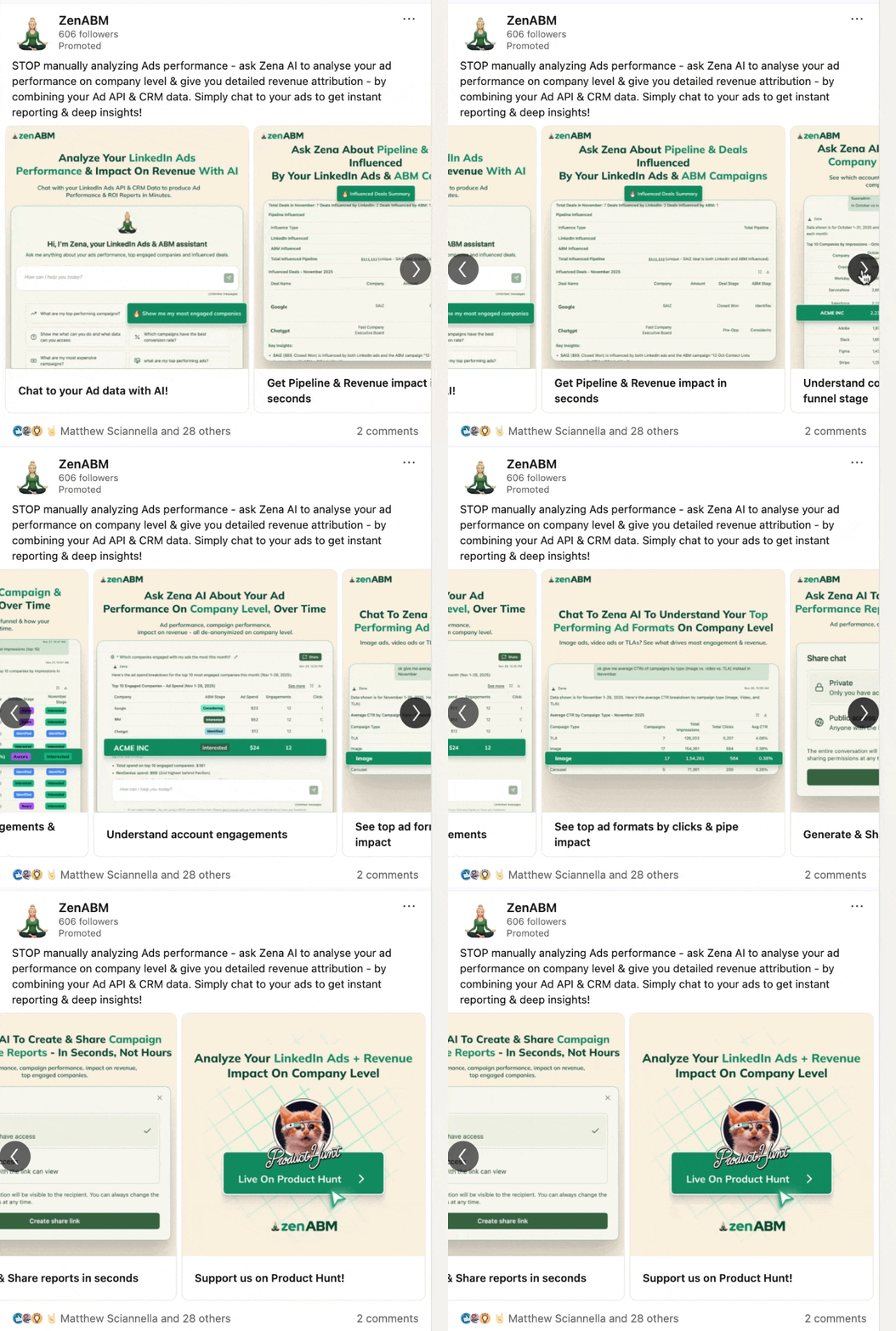
Standard LinkedIn analytics show you blended metrics. For ABM campaigns, you need to see which target companies are engaging with your carousel ads and which cards they are interacting with. Company-level engagement data tells you which accounts are in-market and moving down the funnel.
ZenABM allows you to easily track how your ads are performing for specific companies you’re targeting: at campaign, adset and individual ad level:

The median CTR for LinkedIn carousel ads is 0.32% based on our analysis of 211 companies. But this is the blended rate across all cards. Card 2 delivers a 0.274% CTR (2.3x Card 1), and later cards push above 1-2%. If your blended CTR is above 0.35%, you are performing above median. If your Card 2+ CTR is above 0.3%, your carousel is engaging the right people.
It depends on your goal. Single image ads have higher blended CTR (0.42% vs 0.32%) and are simpler to create. Carousel ads deliver 25% higher dwell time (4.56s vs 3.64s) and a unique self-qualification mechanic through the swipe pattern. For ABM campaigns, educational content, and story-based messaging, carousels outperform single image. For direct response with a simple offer, single image is usually the better choice.
The data supports 5-7 cards. You need enough cards to tell a complete story and let engaged viewers self-qualify through swiping, but not so many that you are padding with filler content. Card 7 has the highest CTR in our dataset (2.89%), but only 0.02% of impressions reach it. The real engagement happens on Cards 2-3, so make sure those cards deliver your strongest content regardless of total carousel length.
