 AI for ABM & LinkedIn Ads Week28 Sep – 2 Oct · Reserve your seatAI for ABM & LinkedIn Ads Week · 28 Sep – 2 Oct · Reserve your seat
 AI for ABM & LinkedIn Ads Week28 Sep – 2 Oct · Reserve your seatAI for ABM & LinkedIn Ads Week · 28 Sep – 2 Oct · Reserve your seat
LinkedIn carousel ad specs are stricter than other ad formats. Unlike single image ads that support three aspect ratios, carousel ads only accept one – and getting any spec wrong means your ad gets rejected or looks broken in the feed.
I have run carousel ads across ABM campaigns that generated over $5 million in pipeline. Carousels are what I call “a really underappreciated format” because they let you combine multiple messages into one ad. In this guide, I will cover every LinkedIn carousel ad spec – card dimensions, file formats, text limits, and the design details that separate good carousels from great ones.

Here are all LinkedIn carousel ad specs in one table:
| Spec | Requirement |
|---|---|
| Card image size | 1080 x 1080 px (1:1 square) – mandatory |
| File format | JPG or PNG only (no GIF) |
| Max file size per card | 10 MB |
| Number of cards | 2 to 10 |
| Card headline | Up to 45 characters per card |
| Introductory text | Up to 255 characters |
| Destination URL | One URL per card (can be different) |
| CTA button | Same options as single image ads |
Every carousel card must be exactly 1080 x 1080 pixels in a 1:1 square ratio. This is the only supported size – horizontal and vertical images are not available for carousel cards.
This is one of the strictest specs in LinkedIn advertising. If you upload an image that is not exactly 1:1, LinkedIn will either reject it or crop it, which can cut off text or visuals at the edges.
Carousel ads accept JPG and PNG only. GIF files are not supported – not even static GIFs. This is different from single image ads, which do accept GIF files.
Use PNG for cards with text, logos, or flat graphics. PNG preserves text sharpness and handles transparency. Use JPG for photographic images where text sharpness is less critical.
Each card can be up to 10 MB, which is double the 5 MB limit for single image ads. This higher limit accounts for the fact that carousel designs often contain more complex graphics. Still, I recommend staying under 2 MB per card for fast loading.

Carousel ads have more restrictive text specs than single image ads:
This is significantly shorter than the 600-character limit for single image ads. You have roughly one or two sentences to set up the carousel. Make every word count – explain what the viewer will learn by swiping through the cards.
Each card gets its own headline that appears below the image. 45 characters is tight – you need to be concise. Use the headline to provide context for the card image or to create a progression that encourages swiping.
Each card can link to a different URL. For ABM campaigns, I typically link all cards to the same landing page. But you can use different URLs for different cards – for example, linking each feature card to its specific product page.
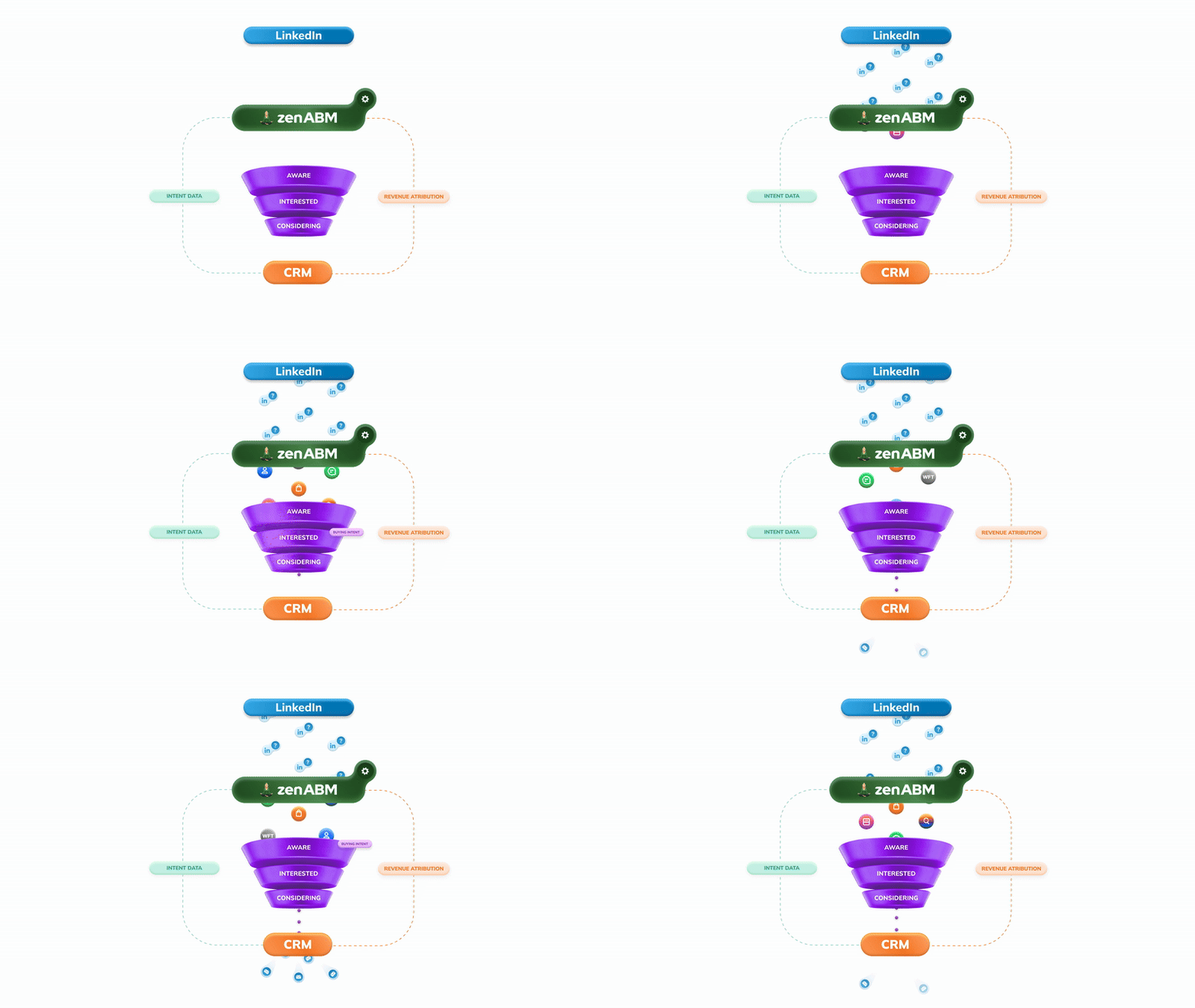
What is your target audience doesn’t click on your Carousel cards? You can still track their engagements and impressions and send the data into your CRM automatically with ZenABM.

LinkedIn allows 2 to 10 cards per carousel. The right number depends on your content and campaign goal:
| Card Count | Best For | Consideration |
|---|---|---|
| 3-4 cards | Quick comparisons, simple frameworks | Most users will see all cards |
| 5-6 cards | Product walkthroughs, case study stories | Sweet spot for engagement and completion |
| 7-10 cards | Detailed guides, multi-step processes | Drop-off increases after card 6 |
On mobile, users see about 1.5 cards at a time. This means your first card is the most important – it needs to create enough curiosity to drive swiping. Design it as a pattern interrupt that stands out from the feed.
Meeting the technical specs is the baseline. Here is how to design carousel cards that actually perform in ABM campaigns:

The first card decides whether someone swipes or scrolls past. Use a bold headline, a provocative question, or a surprising stat. Do not put your logo or company name as the first card – that is not a pattern interrupt.

Do not save all your value for the end. Deliver the core insight or comparison in cards 2-3. If someone swipes through three cards and finds them useful, they are likely to continue through the rest.
Your final card should be a clear call to action. Include a social proof element (customer count, specific result, testimonial) alongside the CTA. This card is where conversion happens.
“What has worked for us is tool comparisons, step-by-step tool walkthroughs – this can work great for the warm layer. For the cold layer, problem-solution framework.” Here are the specific patterns that work:
As Ishan from SpareGrowth shared in the ZenABM ABM Bootcamp: “If your product is so great, you don’t need an offer. Your product is the offer.” Tool walkthrough carousels that simply show what your product does can be incredibly effective when targeting already-aware accounts.

From ZenABM’s 2026 Benchmarks Report, carousel ads deliver:
Carousels are not the cheapest format per click, but they offer something single image ads cannot: the ability to tell a complete story in a single ad unit. For ABM, where you need to educate target accounts about your value proposition, this storytelling capability makes carousels worth the investment.
“A really underappreciated format, carousel ads. Great for combining all the messaging in your campaign into one ad, which makes it really cost-efficient to project your entire message to your audience at once.”
For the recommended ad mix in ABM campaigns: run 1 or 2 carousels alongside 5-7 single image ads, 5 TLAs, and 1-3 videos. This ensures variety while keeping each ad well-funded. Use company-level tracking in ZenABM to see which carousel cards drive the most engagement from your target accounts.
LinkedIn carousel ad cards must be exactly 1080 x 1080 pixels in a 1:1 square ratio. This is the only supported size – horizontal and vertical images are not available. Each card can be up to 10 MB in JPG or PNG format.
LinkedIn carousel ads support 2 to 10 cards. Based on performance data, 5-6 cards is the sweet spot for engagement and completion rates. Drop-off increases after card 6, so keep your key messages in the first 5 cards.
Yes, each card in a LinkedIn carousel ad can link to a different destination URL. For ABM campaigns, I typically link all cards to the same landing page for simplicity. But you can link each card to a different product page or resource if your carousel covers multiple topics.
LinkedIn carousel ads allow up to 255 characters for introductory text, which is significantly shorter than the 600-character limit for single image ads. Each card headline is limited to 45 characters. Keep your text concise and use it to explain what viewers will learn by swiping through.
No, LinkedIn carousel ads only accept JPG and PNG file formats. GIF files are not supported, not even static GIFs. This is different from single image ads, which do accept GIF files (non-animated only). Use PNG for text-heavy cards and JPG for photographic images.
