

©2026 ZenABM - All Rights Reserved.
![10 Best LinkedIn Ad Reporting Tools for ABM [2026]](/_next/image?url=https%3A%2F%2Fcdn.zenabm.com%2Fmedia%2F10-Best-LinkedIn-Ad-Reporting-Tools-for-ABM-1-1200x628.jpg&w=1920&q=75)
To run ABM with confidence, you need account-centric reporting that ties ad exposure (yes, down to impressions) and engagement to pipeline, movement across opportunity stages, and closed-won revenue.
If you want to defend budget and fine-tune delivery, you need a platform that is purpose-built for LinkedIn and ABM, not a generic analytics toy. This guide ranks the best LinkedIn ad reporting tools for ABM, with a clear bias toward view-through truth, tight CRM alignment, and board-ready reporting.
Let’s get to work.
Tool | Two-Way CRM Integration | First-Party LinkedIn API Data | Pricing | Summary | |
|---|---|---|---|---|---|
✅ | ✅ (native, bi-directional) | ✅ (via LinkedIn API) | $59–$119/mo | Built for LinkedIn ABM, with clean campaign-by-company metrics, instant HubSpot sync, clear deal matching, and very fast time to pipeline. | |
✅ | ❌ (pulls data, no native push) | ✅ (via LinkedIn API) | $399–Custom | Good impression controls plus AdPilot. Lacks native property write-back for CRM-level pipeline reporting out of the box. | |
✅ | ✅ (multi-CRM, bi-directional) | ✅ (via LinkedIn API) | Custom | Enterprise ABM suite with deep controls and revenue reporting. Powerful, and priced accordingly. | |
⚠️ (only for Matched Audiences) | ✅ (bi-directional) | ✅ (limited to matched audiences) | Custom | Strong Salesforce fit and account views, though impression analytics are constrained to Matched Audiences. | |
✅ | ❌ (only pull; native workflow building needed) | ✅ (via LinkedIn API) | Custom | Rich journeys and account paths. One-way CRM sync means extra effort to make pipeline dashboards sing. | |
❌ (cookie-dependent) | ❌ (custom setup needed) | ❌ | Custom | Omni-channel attribution engine. No official LinkedIn account analytics for impressions, which makes it weak for ABM pipeline needs. | |
❌ | ✅ | ❌ | Custom | Excellent prediction and segmentation, but it lacks impression-first, account-level LinkedIn reporting for pipeline proof. | |
❌ | ✅ (internal) | ❌ | $800–$3600/mo | Great for click and contact attribution inside HubSpot. Not designed for impression-led ABM pipeline tracking. | |
❌ (tracks engagement only) | ✅ | ❌ (different LinkedIn API for contacts, not impressions) | $999–Custom | Community signals with LinkedIn engagement. Helpful context, but not a substitute for impression-level pipeline reporting. | |
❌ | ❌ (manual account grouping) | ❌ | $19–$499+ | Excellent data hub and model playground. Not for LinkedIn ABM impression or pipeline-by-account analytics. |
Slick dashboards and long integration lists may look fancy. For pipeline math that holds up, three pillars matter. Miss one and your numbers start to wobble.
Most prospects never click. Sponsored Content CTR often sits around 0.44%. LinkedIn primes demand. Someone sees your ad on Monday, searches your brand on Thursday, and requests a demo on Friday. That is not pure organic. You need impression logs at the company level by campaign and by campaign group to credit assists and connect exposure to pipeline movement.
Contact-level impression data is not available via the official API. Reverse IP guessing misses often. Treat those reads as directional only.
Your reporting should write back to the system of record and also pull live deal data forward for matching.
Sync impressions, clicks, and engagement into HubSpot or Salesforce as company properties. Kill CSVs. Make it filterable by lists, saved views, and reports that sales actually uses.
Join CRM company records to LinkedIn campaign analytics. When Company X opens an opportunity and crosses your impression threshold, attribute influence to the right campaigns and refresh totals in near real time. That is pipeline reporting, not guesswork.
LinkedIn polices scraping and automation.

Deanonymization relies on cookies and IP ranges. That can be fine for click paths, not for impressions, and it misclassifies regularly.

DANs add bot noise and false positives. The punchline is simple:
For ABM pipeline reporting, use first-party, account-level LinkedIn engagement via the official API.
Now, the top contenders and how they stack up.
This article focuses on the tools you should use for ABM pipeline reporting. If you are wondering why not rely on LinkedIn’s native stack, here is the reason:
LinkedIn’s Revenue Attribution Report is lead centric, while ABM pipeline reporting is supposed to be account centric. You can stitch the native pieces together to see revenue influence from leads, but you will still miss critical account-level insights for the pipeline.
First, here is how to set up the native reporting:
Connect your CRM to RAR:

Provide the requested credentials, including Username, Password, Environment URL, and Security Token:

Data can take up to 72 hours to appear. Confirm the CRM opportunity field that RAR should treat as the revenue source of truth.
Set your minimum impression threshold for influence:

Choose a lookback window:

Then set the reporting time frame:

If you run multiple ad accounts, filter by the account or combine them as needed.
Install the Insight Tag across your site:

In Campaign Manager, configure conversions:


Set up CAPI as well:
/conversionEvents with the rule URN, timestamp, value, and hashed identifiers.Now, with this setup done, RAR can attribute most online conversions that preserve cookies and device continuity. To capture more, upload offline conversions from your CRM into Business Manager or stream them via CAPI with timestamps and hashed emails.
For true ABM pipeline reporting, you need company-level capture of impressions, clicks, and engagement per campaign group, plus a clean push into the CRM with account stages and intent. That is the gap the native stack does not fill on its own.
Now let us look at tools that fully or partially provide ABM pipeline reporting.
ZenABM is built for LinkedIn ABM pipeline reporting. You get view-through coverage, native CRM write-back, plug-and-play ABM dashboards, and intent-based scoring. The roadmap moves quickly.
These are not nice to have. They are table stakes, and ZenABM leads with them.

ZenABM records each account that:
Example. Company X collects 50 impressions with zero clicks, then opens a 75k opportunity two weeks later. ZenABM shows which campaigns warmed the account and shares credit across all exposures. All of this is via the official LinkedIn API.
Native, no code, and bi-directional sync, so pipeline reporting is not a science project.
ZenABM maps LinkedIn engagement to open opportunities and closed-won inside your CRM.

You also see per deal values tied to ad exposure.
So you can finally say:
ZenABM writes LinkedIn engagement into HubSpot as properties like “LinkedIn Ad Engagements – 7 days” and “LinkedIn Ad Clicks – 7 days.”

ZenABM calculates a rolling “Current Engagement Score” using impressions, clicks, and freshness.
Qualified accounts are auto-assigned to reps in HubSpot.

Campaign tags feed buyer-intent insights.

No Excel gymnastics or custom CRM builds. ZenABM ships dashboards that compute ROAS, lift, pipeline per dollar, and more.


In short, you get end-to-end view-through analytics and a single place to run ABM pipeline math.
Want to see it in action? Book a demo here.
ZenABM focuses on LinkedIn ABM, not visitor ID, broad intel, programmatic display, or list building.
Bottom line: A focused LinkedIn pipeline reporting and attribution tool that is lean, accurate, and affordable.

Three plans with minimal decision friction.
Starter at 59 dollars per month (annual) fits small teams. You get company engagement insights, default scoring from CRM plus ad data, campaign-level intent, one ABM campaign, and native two-way HubSpot.
Growth at 75 dollars per month adds configurable scoring, dashboards for up to three campaigns, and queued upgrades like auto routing, Slack alerts, and weekly rollups.
Pro at 119 dollars per month suits larger teams and agencies. It offers unlimited campaigns, client-ready dashboards, and upcoming AI helpers for impression control and campaign ops.
Every plan has a free trial. See the pricing page.

Supports LinkedIn, Google, and Facebook. Adds automation, intent capture, deanonymization, scoring, and multi-touch reporting.
For core data and pipeline mapping, mostly yes. CRM write-back is the main gap.
Pulls impressions, clicks, and spend via the LinkedIn API at campaign-group and campaign level, so you can tie exposure to pipeline movement.

HubSpot and Salesforce joins bring opportunity and revenue views.
Note: No native company-property write-back. You can create workflows to approximate it.


MAP, CRM, and Slack hooks for operations teams.
Benchmark LinkedIn alongside other paid and owned channels.
Bottom line: Strong impression controls and account-level analytics. Pipeline write-back to CRM requires some DIY.

Free offers basic visitor intel for up to 200 identified companies. Basic at 399 dollars adds LinkedIn intent and core CRM links. Growth at 999 dollars adds ABM analytics, G2, and workflows. Enterprise is custom.

Full-stack ABM with lists, delivery, analytics, and revenue reporting across channels. Demandbase is the brand, and Demandbase One is the platform.
Yes, across the board.
Certified LinkedIn partner with official API access. Account-level reporting is standard.
Bi-directional sync with HubSpot, Salesforce, Dynamics 365, Marketo, Pardot, and Eloqua. Measure pipeline and revenue, and write engagement into the CRM. A Capterra note. Sales teams often live in Salesforce, so plan change management.


Prioritise spend toward in-market accounts using intent data.
Price and complexity. You will need time to land value.
Bottom line: Excellent if you run multi-channel ABM with budget and want deep control.
Not public. Book a demo.

Ad-first engagement platform. Its LinkedIn Marketing Solutions integration updates delivery and analytics quickly.
Partly.
Strong for uploaded or CRM Matched Audiences, but it will not cover every account outside those lists.

Salesforce-centric funnel views and executive dashboards.


Triggers from Outreach, Salesloft, Uberflip, Bombora intent, and more.
Bottom line: Good LinkedIn analytics within curated lists. Not the cheapest if you are LinkedIn only.
Now part of DemandScience. Contact sales.

B2B analytics platform that blends LinkedIn Ads, site analytics, and CRM touchpoints into account and person-level paths.
Almost.


Note: One-way CRM sync. You will need workflows to push back into CRM properties.


Be cautious. Cookies and reverse IP affect identity fidelity. That is fine as supporting evidence.


One-way CRM sync, identity reliance on cookies and IP, and some UI depth gaps (see G2).
Bottom line: Strong cross-channel analytics with account-level LinkedIn impressions. Expect a learning curve and extra CRM work.
Sales led. See the pricing page.

Universal pixel plus offline ingestion for multi-touch attribution.
Partially. No LinkedIn API and cookie centric. Company views depend on your CRM joins and forms. Lead Gen Forms need webhooks.

Excellent for mixed media such as radio, events, and podcasts alongside digital. Clean journey maps and ROAS views.


Bottom line: Great omni-channel lens. Weak for impression-first LinkedIn ABM pipeline reporting.


Known for account ID, intent, and predictive scoring, with a tighter LinkedIn connection since 2023.
No. LinkedIn remains aggregate and impression by account is not exposed. Click or visit is needed for attribution, which under counts view-through influence on pipeline.


Bottom line: Great for display and targeting. Not built for impression-led LinkedIn ABM pipeline reporting.
Not public. Contact sales.

Native ads tool and attribution module. Pulls clicks and lead form data from LinkedIn into reports.
For click-based contact attribution, it is straightforward. Connect clicks to contacts to revenue. Flip models such as First, Last, Linear, U or W, and Time Decay.
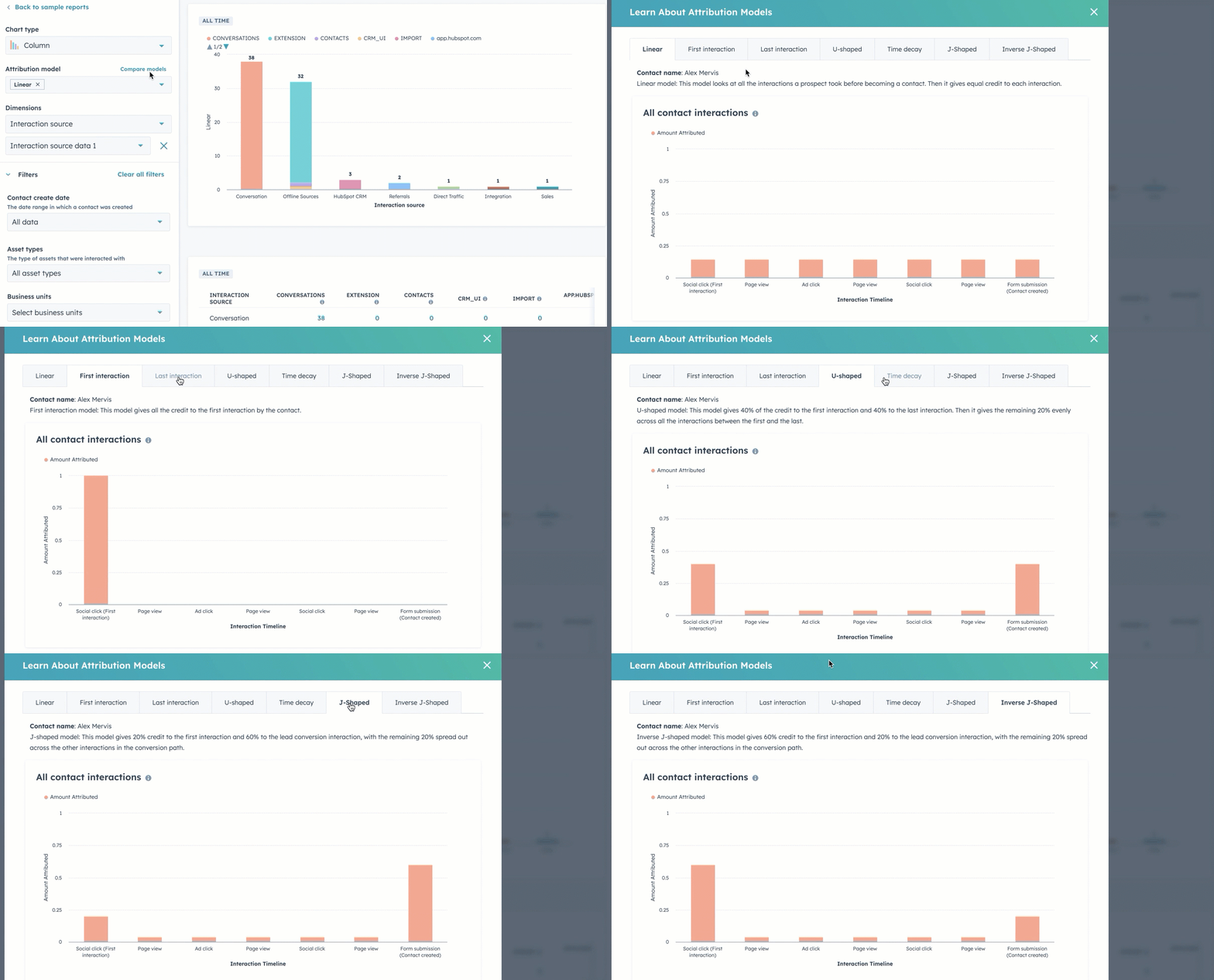
No custom weights and limited ad types via API. Practitioners note constraints, as many reviews indicate.

Bottom line: Excellent CRM and MAP. Not a LinkedIn ABM pipeline reporter.


Community intelligence that pulls LinkedIn engagement, Slack, social, and product signals to surface warm accounts.
No. There is no account-level impression tracking, so the ABM pipeline read is incomplete.

Correlate community spikes with LinkedIn pushes and let RoomieAI surface patterns.
Turn raw signups into company profiles that map back to accounts.

Bottom line: Terrific for community-led growth. Not a substitute for impression-level ABM pipeline reporting.

Starter from 999 dollars per month for 35k contacts and 2 seats. Team from 1999 dollars per month for 100k contacts and 3 seats. Enterprise is custom.

Data hub for attribution across more than 300 sources, with strong normalization and BI exports.
No. It needs clicks or lead forms for LinkedIn credit and leans on reverse IP for grouping. No impression by account analytics and manual grouping for ABM.

Bottom line: Excellent model layer. Not an ABM-first LinkedIn pipeline reporter.

Free includes 1 source and 30 day history. Basic 19 dollars, Standard 99, Plus 249, Professional 499, Enterprise custom.
Demandbase, HockeyStack, Terminus, and Factors.ai are strong when you are running larger programs with multi-channel scope and deep controls. LeadsRx does not use the LinkedIn API and leans on cookies. HubSpot Attribution remains click and contact centric. 6Sense focuses on targeting and visits more than impression-level reporting. CommonRoom surfaces community engagement, not impression logs. Windsor.ai is a stellar data layer, not an ABM-first choice.
If you want a cost conscious tool that still nails ABM pipeline reporting for LinkedIn, start with ZenABM. It tracks company-level impressions, maps them to CRM opportunities, writes properties into HubSpot, and shows which campaigns moved which deals, even when nobody clicked. Book a ZenABM demo to see how the best LinkedIn ad reporting tools for ABM should operate in practice.
